




Abstract
Stenotrophomonas maltophilia is a nosocomial, multidrug-resistant pathogen that causes significant economic losses in milk production and deterioration of dairy product quality. This study investigates the prevalence and the survival of S. maltophilia under different food preservation conditions. A total of 240 samples, including farm-sourced milk, dairy shop purchased milk, Kareish cheese, Domiati cheese, ice cream, yoghurt, cooking butter, and unpasteurized cream were collected from various locations in Beni-Suef Governorate, Egypt. Thirty samples of each product were analyzed by standard biochemical tests for the presence of Stenotrophomonas spp., which was isolated from 36% (87/240) of the examined samples. The highest prevalence was observed in ice cream (80%), followed by unpasteurized cream (67%), whereas the lowest incidence was in Domiati cheese (3.3%). S. maltophilia, identified by PCR, was found only in unpasteurized cream (13%), cooking butter (10%), ice cream (6.7%), and dairy shop milk (3.3%). We also studied the viability of S. maltophilia in laboratory manufactured cream, butter, and cheese under different preservation conditions. S. maltophilia was able to survive for 30, 30, 28, 30, and 8 d in the inoculated cream, butter 0% salt, butter 3% salt, cheese 0% salt, and cheese 6% salt, respectively. Thus, S. maltophilia was able to survive more than predicted in all products in this study. This suggests that strains of S. maltophilia may develop adaptive strategies that enable survival under different food preservation conditions, which contradicts previous knowledge about the sensitivity of this microbe to environmental stress conditions. Our overall aim was to draw attention to the prevalence and future potential for increased public health significance of Stenotrophomonas spp.
Introduction
Milk and milk products are an integral part of dietary guidelines and recommendations in many countries. They are commonly considered a source of essential nutrients such as proteins, vitamins B2, B12, A, D, phosphorus, calcium, and magnesium. Because of the reputation of dairy foods in enhancing human health and wellbeing (such as providing improved immune system function and reduced risk of bone mass loss) (Verruk et al., 2019), they are hence of great economic significance. For this reason, to support the development of a safe dairy industry, it is necessary to monitor and understand emerging potential pathogens.
Raw milk is the main material from which dairy products are manufactured and the initial number and type of microbiota found in raw milk are directly related to the quality of the finished product (Murphy et al., 2016). The health status of the dairy animals in milk production is a significant issue; the maintenance of herd hygiene, disease control programs, and preventive management, all aim to reduce the prevalence of infectious diseases in milk (Nauta, 2008). There are continuing complexities with identifying pathogen prevalence, particularly where advanced management systems are not uniformly used (Wen et al., 2019), and in ensuring the success of thermal treatments in sufficiently reducing pathogens (Mullan, 2019).
Many studies have been conducted in Egypt on the safety of raw milk, all showing that it is not satisfactory from a hygienic point of view (Zeinhom and Abdel-Latef, 2014; Ombarak and Elbagory, 2015). Refrigeration on farms and in processing plants has greatly increased the quality of the raw milk. However, continued storage of raw milk at refrigerated temperatures creates a good environment for the growth of psychrotrophic bacteria (Ozer and Yaman, 2014).
There are 13 recognized species in the genus Stenotrophomonas, and among these, only Stenotrophomonas maltophilia has emerged as a human pathogen (Denton and Kerr, 1998; Lockhart et al., 2007). S. maltophilia is an obligate aerobe and its growth does not occur at a temperature lower than 5°C or higher than 40°C, with an optimum temperature of 35°C (Denton and Kerr, 1998).
S. maltophilia is a nosocomial Gram-negative bacillus widely distributed in nature (Denton and Kerr, 1998) and may be isolated from materials used in clinical laboratories and medical practices, hemodialysis water and dialysate samples, cannulas, prosthetic devices, dental unit waterlines (Hoefel et al., 2005), foods (Qureshi et al., 2005), water, soil, plants, animals, and raw and microfiltrated milk (Rasolofo et al., 2010). Recently, it has emerged as an opportunistic pathogen owing to resistance to a wide range of antibiotics, formation of biofilm on biotic and abiotic surfaces (Di Bonaventura et al., 2007), secretion of extracellular enzymes, for example, DNase, lipase, protease, lecithinase and hyaluronidase enzymes (Ryan et al., 2009), and evasion of the host immune system (Waters et al., 2007). Moreover, its secretion of extracellular enzymes (protease, lipase, and lecithinase) causes deterioration in flavor and texture of milk as well as final dairy products (Eneroth et al., 1998; Cleto et al., 2012).
S. maltophilia is associated with a wide range of infections, such as septicemia and bacteremia (Denton and Kerr, 1998), urinary tract infections (Vartivarian et al., 1996), endocarditis (Mehta et al., 2000), meningitis (Platsouka et al., 2002), pneumonia, and chronic obstructive pulmonary disease (Brooke, 2012; Adegoke et al., 2017) and in patients suffering from debilitating conditions such as cancer (Looney et al., 2009). In cattle, S. maltophilia is seldom reported as causing mastitis, although this may be because standard screening tests for mastitis do not test for it (Nam et al., 2009).
Despite rising global incidence and resistance patterns among S. maltophilia, no broad, extensive studies have been conducted on the presence and contamination of milk and milk products with Stenotrophomonas in Egypt. Therefore, this study investigated the presence of Stenotrophomonas spp. in milk and dairy products produced in Beni-Suef Governorate of Egypt and assessed the survival of S. maltophilia in selected dairy products.
Materials and Methods
Samples collection
A total of 240 samples, including farm milk collected from pooled tanks (collected from six farms located in south and southwest of Egypt), dairy shop milk (from local markets), Kareish cheese (from 30 farmers' houses), Domiati cheese (from 30 dairy shops), yoghurt (from 30 dairy shops), ice cream (from 30 different street vendors), cooking butter (from 30 different farmers' houses), and unpasteurized cream (from 30 different separators). For the selection of the dairy products from different retail shops, the samples for each product were from the same brand but different retailers. Thirty samples of each product were collected randomly from different localities of Beni-Suef governorate in Egypt over a period of 6 months. All samples were taken to the laboratory in an insulated icebox (2–5°C) within 1 h from purchase for examination. For each sample, three replicates were used.
Isolation and identification of Stenotrophomonas spp.
A total of 1 mL of the homogenized milk samples or 1 g of the prepared milk product samples was aseptically inoculated into sterile cotton plugged test tube, containing 10 mL of nutrient broth (Oxoid, Ltd., Basingstoke, United Kingdom) and incubated at 37°C for 24–48 h (Bollet et al., 1995).
A loopful from the incubated broth was streaked onto plates of steno medium agar (Oxoid), which is a blood agar base, with imipenem, vancomycin, and amphotericin B. Streaked plates were incubated at 37°C for 24–48 h (Goncalves-Vidigal et al., 2011). The colonies were smooth, glistening, with entire margins and white to pale yellow (Denton and Kerr, 1998).
Two typical colonies were transferred to steno medium agar slant. Slants were incubated at 37°C for 24–48 h. The purified colonies were submitted for further biochemical identification, using catalase test (Land et al., 1991), oxidase test (Baron et al., 1994), sugar fermentation test (Speck, 1976), arginine dihydrolase test (MacFaddin, 2000), and oxidation fermentation test (Hugh and Leifson, 1953). Isolates collected from raw milk and milk products samples and identified as S. maltophilia were subjected to PCR for further identification.
DNA extraction of S. maltophilia
DNA was extracted following the manufacturer's recommendations using QIAamp DNA mini kit instructions (cat. no. 51304) (AppliChem GmbH, Darmstadt, Germany). The DNA concentration was measured using a spectrophotometer (DU530; Beckman Coulter, Brea, CA). An average of 10 μg of DNA was obtained.
Cycling conditions of the primers during PCR
Oligonucleotide primer of the gene 23S rRNA was obtained from Metabion (Planegg-Steinkirchen, Germany) with a sequence (forward 5 GCTGGATTGGTTCTAGGAAAACGC 3, and reverse, 5 ACGCAGTCACTCCTTGCG 3) as reported by Gallo et al. (2013). DNA (5 μL) was assayed in a 25 μL reaction mixture containing 12.5 μL Emerald Amp GT PCR master mix (code no. RR310A; Takara Bio, Kusatsu, Japan), 1 μL of each primer of 20 pmoL concentrations, and 5.5 μL of RNA-free water. The reaction was performed in a thermal cycler model 2720 (Applied Biosystems, Foster City, CA). The primary denaturation was at 94°C for 5 min, then secondary denaturation at 94°C for 30 s, followed by annealing at 58°C for 30 s, then extension at 72°C for 30 s (35 cycles), and final extension at 72°C for 7 min.
Gel electrophoresis was run of 20 μL of each reaction PCR product; negative control and positive control were loaded in a 1.5% agarose gel (AppliChem GmbH) at 1–5 V/cm of the tank length for 30 min and the gel was transferred to UV Cabinet (Thermo Fisher, Waltham, MA). The gel was photographed by a gel documentation system (Alpha Innotech, Biometra, San Francisco, CA) and the data were analyzed using computer software (Sambrook et al., 1989).
Culture conditions of S. maltophilia for examining its survival in cream, butter, and cheese
S. maltophilia isolate recovered from raw milk in this study was used to examine its survival in cream, butter, and cheese. S. maltophilia was inoculated in trypticase soya broth (Oxoid, Ltd.) and incubated at 35°C for 48 h. The resultant culture containing ∼109 colony-forming unit (CFU)/mL was used to inoculate the milk used for preparing cream, butter, and cheese to give an initial count of 1.6 × 10⁷ CFU/mL (7.2 log10 CFU/mL). The initial count (7.2 log) was targeted to that value because it was similarly used in another study by El-Sharoud (2009).
Manufacturing of cream
Twenty kilograms of buffalo milk was used, where the milk was heated to 85°C, cooled to 35–40°C, then S. maltophilia was added to give an initial concentration of 7.2 log10 CFU/mL. The milk was refrigerated for 24 h for cream formation (Ma and Barbano, 2000). The obtained cream was divided into two parts: the first was stored at 4°C for 30 d. The sample was examined daily for 1 week then every 2 d up to 30 d for enumeration and counting of S. maltophilia, for acidity according to AOAC International (2000) and for pH determination using Corning 240 pH meter (Corning, Suffolk, United Kingdom). The second part was used for butter making.
Manufacturing of butter
The second part of the cream obtained by gravity method was used in the manufacture of butter. The cream was cooled to a temperature of 5–7°C then mixed in a sterile blender for 10 min (Deosarkar et al., 2016). The obtained butter was divided into two parts: the first part without salt (0% salt), whereas the second had 3% salt added. Both parts were kept at −18°C for 30 d. The samples were examined for enumeration and counting of S. maltophilia daily for 1 week then every 2 d up to 30 d and for determination of acidity and pH as above, and salt % according to Aakanchha et al. (2020).
Manufacturing of white soft cheese
This followed the method of Hamad (2015) with a little modification. The skimmed milk remaining after cream separation (with a culture concentration of 6.2 log10 CFU/mL) was heat-treated at 30°C in a thermostatically controlled water bath. Calcium chloride solution 0.02% and the rennet at the rate of 1.5 g/100 kg milk (Chr. Hansen rennet) were added. At this point and before curdling the milk was equally divided into two portions for producing cheese with 0% salt and 6% salt. The curd was ladled in rectangular frames (20 × 20 cm) lined with sterilized cloth, and the resulting functional white soft cheeses were cut into cubes and packaged into plastic containers, which were filled with cooled whey of the same lot as the resulting cheeses and stored under refrigeration (4°C) for 30 d. Samples were taken at zero time, after curd formation and every 2 d until 30 d for enumeration and counting of S. maltophilia and for determination of acidity, pH, and salt as above.
Statistical analysis
Sample size was calculated based on Raosoft and all statistical calculations were made using the statistical software SPSS version 26.00 (IBM, Armonk, NY) at 0.05, 0.01, and 0.001 levels of probability. Quantitative data analysis with nonparametric distribution was carried out using the analysis of variance Mann–Whitney test to compare between two groups. The p-value was considered nonsignificant at the level of >0.05, significant at the level of <0.05, 0.01, and highly significant at the level of <0.001.
Results and Discussion
Stenotrophomonas spp. in raw milk and dairy products
Results (Table 1) indicated that Stenotrophomonas spp. were isolated from 36% (87/240) of the raw milk and dairy product samples. The highest prevalence was observed in ice cream samples (80%), followed by unpasteurized cream (67%), dairy shop milk (60%), Kareish cheese (27%), farm milk (23%), and cooking butter (23%). In contrast, Stenotrophomonas spp. were isolated in a low percentage of 3.3% and 6.7% from Domiati cheese and yoghurt samples, respectively.
Prevalence of Stenotrophomonas spp. in Raw Milk and Dairy Product Sampled from Different Localities in Beni-Suef Governorate, Egypt
ND, not detected.
The most prevalent species of Stenotrophomonas in farm milk samples was S. nitritireducens (13%) followed by S. africana (6.7%), whereas S. maltophilia was not detected in any sample (Table 1). The higher incidence of S. nitritireducens may be because of wet bedding and poor hygiene during milking operations, consistent with Finkmann et al. (2000) who reported that Stenotrophomonas spp. can be isolated from soil, sludge, water, and plant rhizosphere. In dairy shop milk samples, S. maltophilia, S. africana, S. acidaminiphila, and S. rhizophila were detected at 3.3%, 6.7%, 3.3%, and 10% respectively, but the highest incidence was S. nitritireducens (37%). Possible reasons for milk contamination by Stenotrophomonas spp. may be because of adulteration with water and/or contamination with soil (Ryan et al., 2009).
The highest incidence in Kareish cheese samples was 10% for both S. africana and S. rhizophila followed by S. acidaminiphila (6.7%). None of the Kareish cheese samples contained S. maltophilia or S. nitritireducens (Table 1). These results may be owing to poor handling and primitive ways of manufacturing and preparation of Kareish cheese. For Domiati cheese, only one sample (3.3%) was contaminated with Stenotrophomonas spp., that is, S. nitritireducens. This low incidence in Domiati cheese may be because of higher salt percentages that interfere with the growth of Stenotrophomonas (Martinez, 2011).
Ice cream samples showed an incidence rate of 23%, 28%, 17%, 6.7%, and 6.7% for S. rhizophila, S. africana, S. acidaminiphila, S. maltophilia, and S. nitritireducens, respectively (Table 1). The possible causes could be poor handling and unsanitary conditions during frozen storage or from the vending machine that used to serve ice cream, as well as the hygiene of persons involved in serving (Mathews et al., 2013), and/or from ice-making machines (Qureshi et al., 2005). On the contrary, only two samples of yoghurt were contaminated with S. rhizophila and S. acidaminiphila. Lower incidence in case of yoghurt samples may be attributed to the low pH of this product (Tang et al., 2012), as Stenotrophomonas requires pH 6–7 for optimum growth.
Cooking butter samples (Table 1) had highest incidence of S. maltophilia (10%), this could be because of contamination with human-derived aerosols to the butter during processing, which provides airborne transmission of S. maltophilia, or from individuals suffering from skin lesions, respiratory disorders who were handling the product, or from aerial contamination during packing (Vartivarian et al., 1996; Wainwright et al., 2009).
Cream is a milk product characterized by particularly high moisture and fat content. In Egypt, cream is a dairy product often made by farmers from raw milk under unsanitary conditions. The highest incidence was of S. acidaminiphila (26%), followed by S. maltophilia and S. rhizophila at 13% each, and then S. africana and S. nitritireducens at 10% each. One of the expected sources of cream contamination comes from the ability of many psychrotrophic bacteria, including S. maltophilia, to stick to the inner surface of the dairy utensils forming a biofilm that is difficult to remove by traditional cleaning methods (Di Bonaventura et al., 2007; Marchand et al., 2012). The presence of high concentration of S. maltophilia in foods or at food- contact surfaces such as on these utensils creates a potential risk of infection (Brouwer et al., 2017). It was clear from the findings (Fig. 1) that all the S. maltophilia identified by biochemical testing were confirmed using PCR assays with an incidence of 3.3%, 6.7%, 10%, and 13% in dairy shop milk, ice cream, cooking butter, and unpasteurized cream samples, respectively.
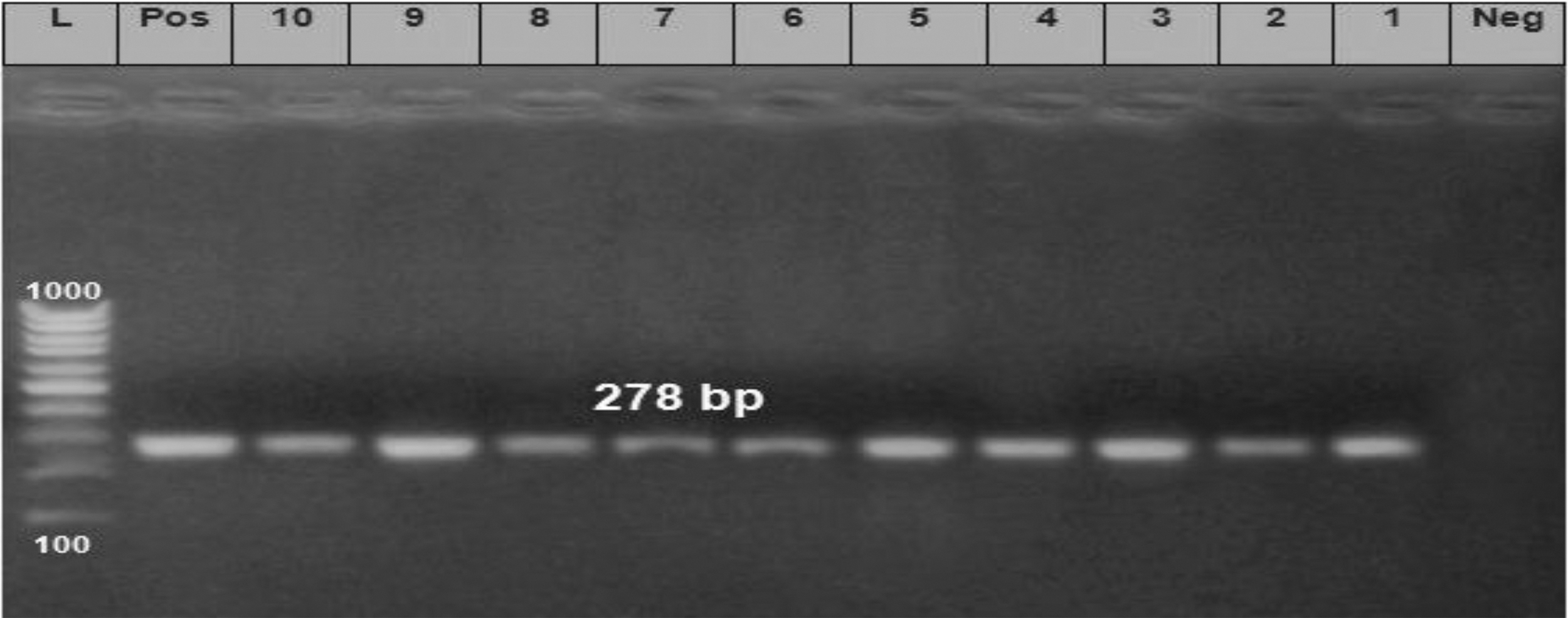
Agarose gel electrophoresis of PCR products amplified by multiplex PCR. Primer detecting gene Stenotrophomonas maltophilia 23S rRNA 278 pb. Lane L: Ladder, Pos: positive control; Neg: negative control; Lanes 1–2 S. maltophilia-positive isolates of ice cream; Lanes 3–6 S. maltophilia-positive isolates of cream; Lanes 7–9 S. maltophilia-positive isolates of cooking butter; Lane 10 S. maltophilia-positive isolate of dairy shops milk.
Survival of S. maltophilia in cream
The initial population of S. maltophilia at zero time was 7.2 log10 CFU/mL with a pH 6.55 and 0.14% acidity. There was a progressive rise in the count of S. maltophilia to a peak of 9.27 log10 CFU/mL at the 14th, gradually decreasing to 3.3 log10 CFU/mL at the end of the storage period. In addition, the pH decreased to 5.1 with acidity 0.35% at the end of the storage period (Table 2).
Survival of Stenotrophomonas maltophilia in Laboratory Manufactured Cream, Butter (0% and 3% Salt) and Cheese (0% and 6% Salt) Samples
S. maltophilia count expressed as log10 colony-forming unit/mL.
BLN, below the limit of enumeration.
Results (Table 3) showed a significant positive correlation (r = 0.76) between the count of S. maltophilia in liquid cream and pH (p = 0.000), but a significant negative correlation (r = −0.81) between count of S. maltophilia in cream and acidity % (p = 0.000), which reflects the fact already mentioned that S. maltophilia growth is impaired at low pH (Gallagher et al., 2019).
Correlation Between the Count of Stenotrophomonas maltophilia (log10 Colony-Forming Unit/mL) and the pH, Acidity and Salt % in the Laboratory Inoculated Dairy Products in Egypt
NF, not performed; p, significance percent, r, correlation.
Survival of S. maltophilia in butter
The initial population of S. maltophilia in both butter 0% and 3% salt at zero time was 7.2 log10 CFU/mL with pH 6.55 and 0.14% acidity. A gradual increase occurred in the counts of S. maltophilia in butter 0% salt to 8.23 log10 CFU/mL at 14th day of storage with pH 5.25 and 0.26% acidity, then decreasing toward the end of storage period to reach 4.94 log10 CFU/mL with pH 4.95 and 0.3% acidity (Table 2). There have been no previous reports on the survival of S. maltophilia in butter. On the contrary, there was a gradual decrease in the count of S. maltophilia in butter 3% salt from the 1st day of storage (6.9 log10 CFU/mL) until it disappeared completely at the end of the storage period (30th day) with pH 5.1 and 0.29% acidity with the salt at 2.9%. Taking these results together, the disappearance of S. maltophilia in butter 3% salt indicates that salt content interferes with its growth (Martinez, 2011).
The data (Table 3) revealed significant positive correlations (r = 0.61, p = 0.004 and r = 0.70, p = 0.001) between the count of S. maltophilia and pH in butter 0% and 3% salt, respectively. Moreover, there were significant negative correlations (r = −0.76, p = 0.000 and r = −0.90, p = 0.000) between the counts of S. maltophilia and acidity % in butter 0% and 3% salt, respectively. These findings confirm that growth of S. maltophilia is impaired at low pH (Gallagher et al., 2019).
For butter 3% salt, there was a strong negative correlation (r = 0.99, p = 0.000) between the count of S. maltophilia and salt (Table 3). These findings agreed with Martinez (2011), who found that the growth of S. maltophilia is impaired with salt >2%, and at 7% salt there was no observed growth, indicating that high salt concentration products will have reduced risk of infection with this harmful pathogen. Figure 2 confirms these findings and shows that there was a difference between butter 0% and 3% salt regarding the count of S. maltophilia. Therefore, it is highly recommended to add >2% salt during butter making.
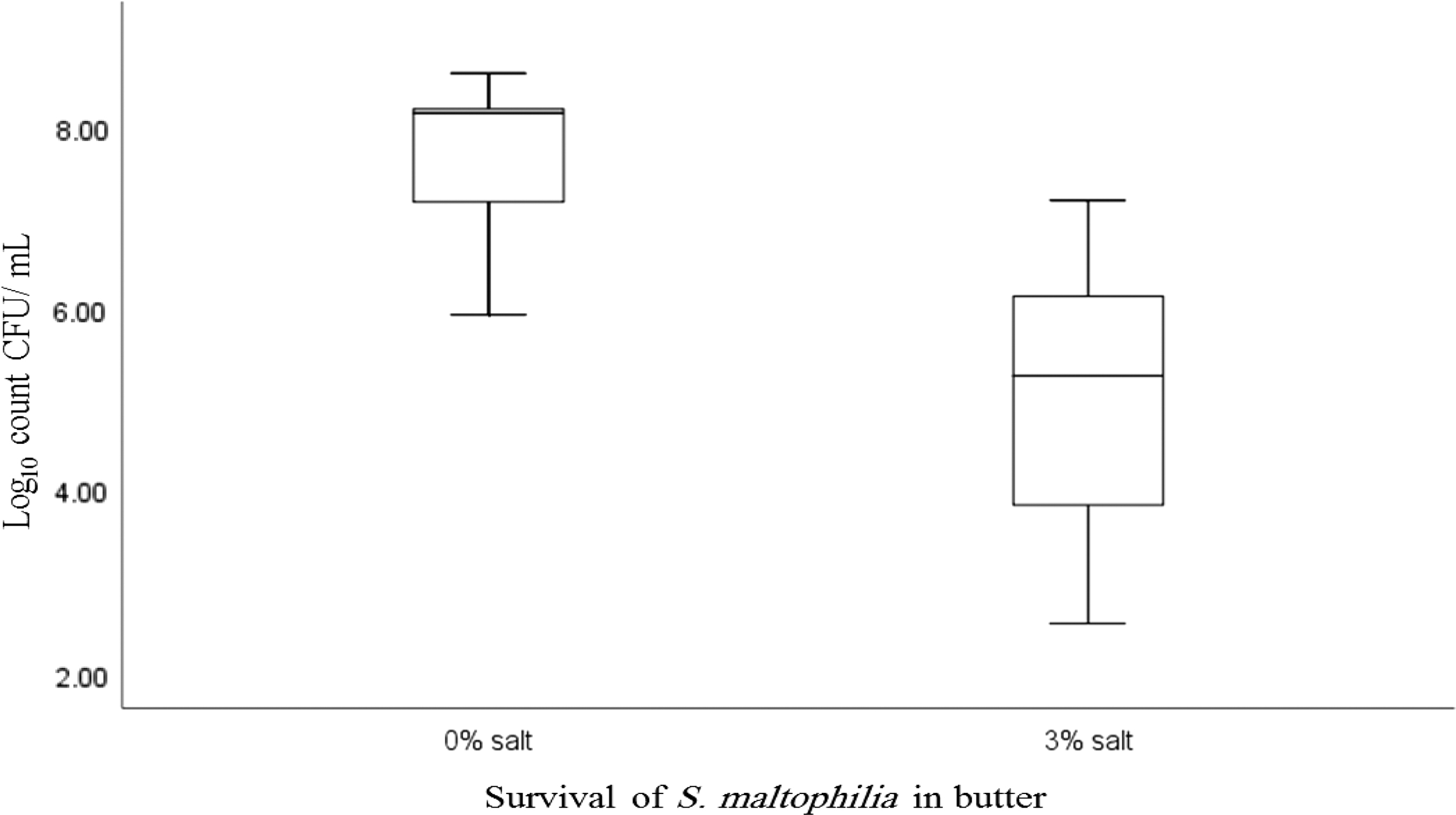
Boxplot show comparison between butter 0% salt and butter 3% salt regarding log10 count of Stenotrophomonas maltophilia using Mann–Whitney test for comparison between the two types of butter with p < 0.001 (highly significant). CFU, colony-forming unit.
Survival of S. maltophilia in cheese
The initial population of S. maltophilia during cheese making (0% and 6% salt) at zero time was 6.2 log10 CFU/mL with a pH 6.55 and 0.14% acidity. For cheese 0% salt, a slight increase occurred by day 2 of storage reaching 6.7 log10 CFU/mL with pH 5.9 and 0.19% acidity, after that there was a gradual decrease to 2 log10 CFU/mL at the end of the storage period (30th day), with pH 4.6 and 0.3% acidity (Table 2). For cheese 6% salt, one log reduction in the count of S. maltophilia occurred on the 1st day of storage, followed by a continuous reduction until complete disappearance on the 10th day of storage, at which the readings for the pH, acidity, and salt were 5.65, 0.22%, and 5.25%, respectively.
There were significant positive correlations (r = 0.58, p = 0.008 and r = 0.98, p = 0.000) between the count of S. maltophilia and pH in cheese 0% and 6% salt, respectively. Moreover, there was a significant negative correlation (r = −0.54, p = 0.015 and r = −0.95, p = 0.000) between the counts and acidity of S. maltophilia in cheese 0% and 6% salt, respectively. Taken together, all this evidence demonstrates that S. maltophilia is suppressed by lowering pH (Gallagher et al., 2019).
For cheese 6% salt, there was a strong negative correlation (r = 0.99, p = 0.000) between count of S. maltophilia and salt. Data presented in Figure 3 reveal a highly statistically significant difference between cheese 0% and 6% salt as regards the count of S. maltophilia (p < 0.001). These findings are similar to the above results of butter 3% salt; therefore, confirming the advisability of adding salt above 2% during cheese manufacturing to reduce the risk of S. maltophilia contamination (Martinez, 2011).

Boxplot show comparison between cheese 0% salt %, and cheese 6% salt regarding log10 count of Stenotrophomonas maltophilia using Mann-Whitney test for comparison between the two types of cheese with p < 0.001 (highly significant).
Ability of S. maltophilia to survive more than expected in laboratory-manufactured cream, butter, and cheese dairy products suggests the strain of S. maltophilia may develop adaptive strategies that enable it to survive under different food preservation conditions. It has been reported that S. maltophilia was able to acquire DNA from environmental bacteria. High population level of S. maltophilia in milk and dairy products in area of Beni-Suef Governorate, Egypt, implies a risk of horizontal gene transfer, which may generate new multiple drug-resistant strains (Brooke, 2012).
Conclusion
The high incidence of S. maltophilia in high-fat products may indicate the particular susceptibility of such products to this pathogen. Using raw milk in manufacturing of dairy products in addition to unclean water supplies used for rinsing dairy equipment are likely sources of product contamination, and are frequently the major causes of high bacterial counts. The presence of potentially pathogenic bacteria such as S. maltophilia should be further assessed in relation to the potential risk to public health. Therefore, it is desirable to improve the hygienic status of local dairy producers through education in general hygienic practices and in handling and storing products to protect them from infection and deterioration. At present, Egypt lacks well-developed cold chain infrastructure, guided by ISO22000 food safety management principles, for transportation of frozen or chilled dairy products. Hygienic production, preventative actions to reduce and eliminate pathogens, and good supply chain development, all depend on good knowledge of the prevalence and microbial modeling of each pathogen. In addition, information on health hazards associated with consumption of raw milk should be publicized, so that consumption of untreated raw milk and its products can be minimized. We plan to conduct a larger survey of cream, butter, and ice cream samples to better assess the overall quality and variability in the quality of these products as well as the mechanisms for the lipophilic properties of this pathogen.
Footnotes
Disclosure Statement
No competing financial interests exist.
Funding Information
No specific funding was received for this article.