




Abstract
Contamination of meat with antimicrobial-resistant bacteria represents a major public health threat worldwide. In this study, we determined the antimicrobial resistance profiles and resistance trends of Staphylococcus aureus isolated from major food animal carcasses (408 cattle, 1196 pig, and 1312 chicken carcass isolates) in Korea from 2010 to 2018. Approximately 75%, 92%, and 77% of cattle, pig, and chicken carcass isolates, respectively, were resistant to at least one antimicrobial agent. Resistance to penicillin (62.1%) was the highest, followed by resistance to tetracycline (42.1%) and erythromycin (28.2%). About 30% of pig and chicken isolates were resistant to ciprofloxacin. We observed linezolid resistance only in pig isolates (2.3%). However, all S. aureus isolates were sensitive to rifampin and vancomycin. We noted an increasing but fluctuating trend of kanamycin and penicillin resistance in cattle isolates. Similarly, the chloramphenicol, ciprofloxacin, tetracycline, and trimethoprim resistance rates were increased but fluctuated through time in pig isolates. Methicillin-resistant S. aureus (MRSA) accounted for 5%, 8%, and 9% of the cattle, pig, and chicken isolates, respectively. The MRSA strains exhibited significantly high resistance rates to most of the tested antimicrobials, including ciprofloxacin, erythromycin, and tetracycline compared with methicillin-susceptible S. aureus (MSSA) strains. Notably, a relatively high percentage of MRSA strains (5.2%) recovered from pig carcasses were resistant to linezolid compared with MSSA strains (2.1%). In addition, almost 37% of the isolates were multi-drug resistant. S. aureus isolates recovered from major food animal carcasses in Korea exhibited resistance to clinically important antimicrobials, posing a public health risk.
Introduction
S
The use of antimicrobials in animal husbandry exerts selective pressure on bacteria and contributes to the emergence of antimicrobial resistance. Therefore, farm animals could be an important ecological niche for multi-drug resistant (MDR) bacteria, including S. aureus. The bacteria can spread to humans through either the food supply chain or direct contact with animals (Pesavento et al., 2007). Several researchers in Asia (Chao et al., 2007; Moon et al., 2015), Africa (Osman et al., 2017; Adugna et al., 2018), North America (Weese et al., 2010; Jackson et al., 2013), and Europe (Normanno et al., 2007; Akbar and Anal, 2013) identified MDR S. aureus in food-producing animals and their products.
Meat is an important vector for the transfer of antimicrobial-resistant S. aureus to humans and forms an indirect link to public health (Bolton et al., 2002). Thus, continuous surveillance of antimicrobial resistance profiles of S. aureus is vital to design prevention and control strategies. In addition, knowledge of the trends of antimicrobial resistance of circulating S. aureus strains is needed to support the best possible use of the remaining antimicrobials. The antimicrobial susceptibility profiles of S. aureus isolated from food of animal origin, including meat in Korea, were previously reported (Lim et al., 2010, 2011; Rhee and Woo, 2010). These studies were conducted in some specific parts of the country for a short duration before 2011. Therefore, we aimed at investigating the antimicrobial resistance profiles and resistance trends of S. aureus isolated from cattle, pig, and chicken carcasses in Korea from 2010 to 2018.
Materials and Methods
Sample collection and isolation of S. aureus
A total of 2916 S. aureus isolates (408 isolates from cattle carcass, 1196 from pig carcass, and 1312 from chicken carcass) were obtained from 16 laboratories/centers participating in the Korean Veterinary Antimicrobial Resistance Monitoring System (Fig. 1). No ethical approval was deemed necessary for this study. The isolates were obtained from samples collected from 88 slaughterhouses from 2010 to 2018. The animals were delivered to the slaughterhouses from 1291 farms and carcasses were sampled at the slaughter chilling room, as previously described (Moon et al., 2015) (Supplementary Table S1). Homogenized samples were inoculated into Tryptic Soy Broth (Becton Dickinson) containing 6.5% sodium chloride and incubated at 37°C for 16 h. After incubation, one or two loops from each enrichment broth were streaked onto Mannitol Salt Agar (Difco, Detroit, MI). Isolates were then confirmed by matrix-assisted laser desorption/ionization time-of-flight mass spectrometry (Biomerieux, Marcy L'Etoile, France) or polymerase chain reaction (Mason et al., 2001).
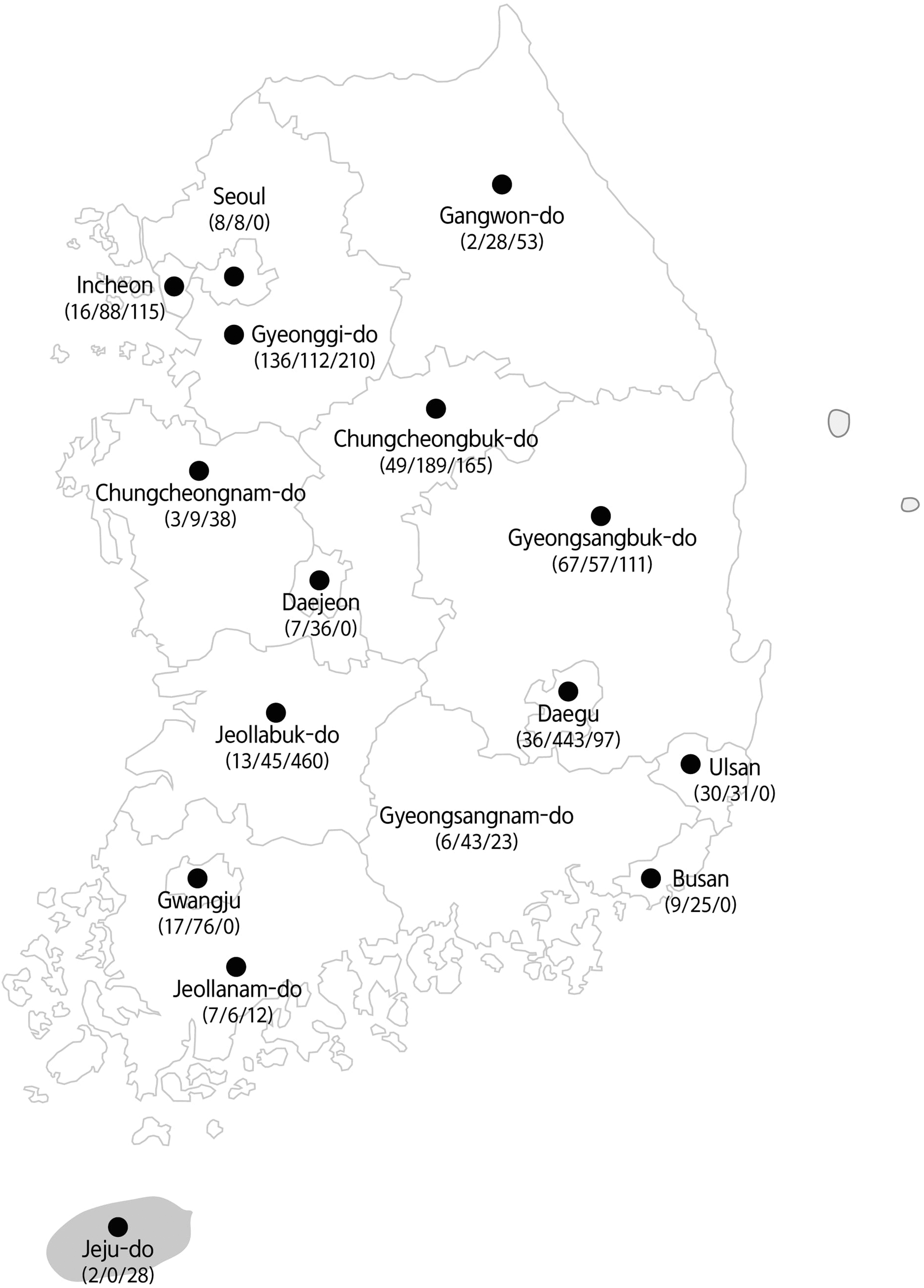
Number of Staphylococcus aureus isolates recovered from cattle, chickens, and pigs, respectively, from various provinces of Korea.
Antimicrobial susceptibility testing
We tested several antimicrobials, including those that are approved solely for human use. The susceptibility profiles of the isolates were determined by the broth microdilution method according to the Clinical and Laboratory Standards Institute (CLSI, 2018) guideline, using commercially available antibiotic-containing plates (Sensititre; Trek Diagnostics, Cleveland, OH). One plate per isolate was used. S. aureus ATCC 29213 was used as a reference strain. The MIC values of fusidic acid and mupirocin were interpreted following the European Committee on Antimicrobial Susceptibility Testing (EUCAST, 2018) guideline, whereas the CLSI (2018) guideline was considered for the remaining antibiotics. The MIC breakpoints are derived from human standards. Further, polymerase chain reaction assay was performed to detect the mecA gene among the cefoxitin-resistant strains as previously described (Mason et al., 2001).
Statistical analysis
Analysis was performed by using Rex software (Version 3.0.3; RexSoft, Inc., Seoul, Korea). Chi-square test was used to compare the observed resistance rate between methicillin-resistant S. aureus (MRSA) and methicillin-susceptible S. aureus (MSSA), and to assess the changes in antimicrobial resistance trends.
Results
Antimicrobial resistance rate
The antimicrobial resistance rate varied among isolates recovered from cattle, pigs, and chickens (Table 1). Besides, the percentage MIC distributions of the tested antimicrobials are summarized in Supplementary Tables S2–S4. In general, the resistance rate of pig isolates was higher than that of cattle and chicken isolates. The overall resistance to penicillin (62.1%) was the highest followed by resistance to tetracycline (42.1%), erythromycin (28.2%), and ciprofloxacin (27%). Cattle isolates presented relatively low resistance rates (<20%) to the tested antimicrobials except for penicillin (68.6%). We observed high penicillin and tetracycline resistance rates in pig (82.4% and 46.7%, respectively) and chicken (41.6% and 47.2%, respectively) isolates. About 8% of the total isolates, predominantly from pigs and chickens, were resistant to cefoxitin and the mecA gene was detected in all of these isolates. Besides, relatively few isolates (<0.5%) were resistant to mupirocin and sulfamethoxazole. Resistances to fusidic acid, chloramphenicol, and ciprofloxacin were relatively high in cattle, pig, and chicken isolates, respectively. Of note, we identified linezolid resistance in 2.3% of pig isolates.
Antimicrobial Resistance Profiles of Staphylococcus aureus Recovered from Cattle, Pig, and Chicken Carcasses Between 2010 and 2018 in Korea
p < 0.05 was considered a significant change in antibiotic resistance trends.
MDR, multi-drug resistant (resistant to at least three antimicrobial subclasses).
Antimicrobial resistance trends
The antimicrobial resistance trend varied among isolates recovered from cattle, pigs, and chickens. An increasing but fluctuating trend of kanamycin and penicillin resistance was found in cattle isolates (Table 1 and Supplementary Table S5). Although we did not find a significant change in the ciprofloxacin, clindamycin, gentamicin, mupirocin, quinupristin-dalfopristin, and trimethoprim resistance trends in cattle isolates, resistance rates peaked in 2016–2018 (Supplementary Table S5). We also observed an increasing but fluctuating trend of chloramphenicol, ciprofloxacin, tetracycline, and trimethoprim resistance in pig isolates (Table 1 and Supplementary Table S6). The clindamycin, erythromycin, and quinupristin-dalfopristin resistance rates in pig isolates were increased by at least 50% in 2016–2018 compared with the rates in 2010–2012 (Table 1). Nearly stable resistance rates to most of the tested antimicrobials were observed in chicken isolates (Table 1 and Supplementary Table S7). Overall, we observed an increasing but fluctuating trend (p < 0.05) of ciprofloxacin and sulfamethoxazole resistance in S. aureus recovered from cattle, chickens, and pigs during 2010–2018 (Supplementary Fig. S1).
Resistance profiles of MRSA and MSSA strains
Regardless of their origin, all MRSA strains exhibited higher resistance rates to most of the tested antimicrobials compared with MSSA strains (Table 2). Resistance to ciprofloxacin, clindamycin, erythromycin, kanamycin, quinupristin-dalfopristin, tetracycline, and trimethoprim was significantly higher (p < 0.001) in MRSA compared with MSSA strains. However, MSSA strains exhibited a higher level of resistance to fusidic acid compared with MRSA strains (p < 0.05). All MRSA strains were sensitive to rifampin, mupirocin, sulfamethoxazole, and vancomycin. We observed mupirocin resistance in MSSA strains recovered predominantly from cattle (54.5%, 6/11) and pigs (36.4%, 4/11). In addition, a relatively high percentage of MRSA strains (5.2%, 5/96) isolated from pigs were resistant to linezolid compared with MSSA strains (2.1%, 23/1100). The MDR rate was also significantly higher (p < 0.001) in MRSA than the MSSA strains recovered from cattle (81% vs. 12%), pig (90.6% vs. 45.9%), and chicken (99.1% vs. 24.7%) (Table 2).
Comparison of Antimicrobial Resistance Rates of Methicillin-Susceptible and Methicillin-Resistant Staphylococcus aureus Recovered from Cattle, Pig, and Chicken Carcasses Between 2010 and 2018 in Korea
p < 0.05 considered statistically significant.
MDR, multi-drug resistant (resistant to at least three antimicrobial subclasses); MRSA, methicillin-resistant S. aureus; MSSA, methicillin-susceptible S. aureus; ND, not determined.
MDR and antimicrobial resistance patterns
In the present study, 82.6% (2410/2916) of the isolates were resistant to one or more of the tested antimicrobials (Tables 3 and 4). Almost 37% of the isolates were MDR; the highest proportion was in pigs (49.4%), followed by chickens (31.3%) and cattle (15.4%) (Table 1). A total of 59, 193, and 68 MDR combination patterns were observed in the cattle, pig, and chicken isolates, respectively (Supplementary Tables S7–S9). Resistance to penicillin (36.3% and 19.1%) was the most frequent resistance pattern among cattle and pig isolates (Supplementary Tables S8 and S9); whereas resistance to tetracycline (10.5%) was the major resistance pattern in chicken isolates (Supplementary Table S10).
Frequent Resistance Patterns in Staphylococcus aureus Serotypes Cattle, Pig, and Chicken Carcasses Between 2010 and 2018 in Korea (n = 2916)
CHL, chloramphenicol; CIP, ciprofloxacin; CLI, clindamycin; ERY, erythromycin; FOX, cefoxitin; FUS, fusidic acid; GEN, gentamicin; KAN, kanamycin; PEN, penicillin; TET, tetracycline; TMP, trimethoprim; SYN, quinupristin-dalfopristin.
Distribution of Antimicrobial-Resistant Staphylococcus aureus Isolated from Cattle, Pig, and Chicken Carcasses Between 2010 and 2018 in Korea
MDR, multi-drug resistant (resistant to at least three antimicrobial subclasses).
Discussion
In the past few years, a considerable proportion of food poisoning outbreaks are associated with antimicrobial-resistant S. aureus strains mainly exhibiting resistance to penicillin and tetracycline (Hyeon et al., 2013; Li et al., 2015). Consistent with previous reports in Korea (Rhee and Woo, 2010) and other countries (Lin et al., 2009; Li et al., 2017), high percentages of cattle and chicken carcass isolates were resistant to penicillin and tetracycline. However, the tetracycline and penicillin resistance rates in cattle, pig, and chicken isolates in this study were higher than those described in previous reports from Japan (Hiroi et al., 2012), Italy (Pesavento et al., 2007) and the United States (Kelman et al., 2011). Resistance to penicillin and tetracycline is particularly noteworthy, because they are commonly used for the treatment and prophylaxis of various animal diseases in Korea.
Macrolides and lincosamides are commonly used to treat many infections caused by Gram-positive bacteria (Pyörälä et al., 2014). The erythromycin resistance rate of cattle carcass isolates in this study was similar to previous reports in Korea (Rhee and Woo, 2010) and other countries (Pesavento et al., 2007; Waters et al., 2011; Abdalrahman et al., 2015). We observed a low resistance rate (33.7%) among pig carcass isolates compared with Wang et al. (2012) in China (100%), and Abdalrahman et al. (2015) in the United States (55%). In chicken carcass isolates, the overall resistance rate (28.2%) was high compared with a previous report in Korea (12%) (Rhee and Woo, 2010) but it was lower than the findings of Sallam et al. (2015) (74%) in Egypt and Lin et al. (2009) (54%) in Taiwan. In addition, the overall clindamycin resistance rate in pig carcass isolates agreed with earlier reports in Korea (Rhee and Woo, 2010; Lim et al., 2011). However, it was high in chicken carcass isolates compared with those reports. In contrast, the clindamycin resistance rate in cattle carcass isolates (8.3%) was lower than those of Pesavento et al. (2007) (25%) in Italy and Rhee and Woo (2010) (23%) in Korea.
The relatively high erythromycin and clindamycin resistance rates, especially in pig carcass isolates, might be related to the frequent use of macrolides (tylosin) and lincosamides (lincomycin) in livestock. Indeed, the amount of these antimicrobials used by the Korean pig industry was increased by twofold in the past decade (Animal and Plant Quarantine Agency [APQA], 2019). Macrolides and lincosamides are considered older antimicrobial agents. However, they are among the preferable treatment options against Gram-positive bacterial infections because of the limited development of new antimicrobials. Thus, cautious utilization of these antimicrobials in animals is needed to prevent the emergence of resistance to structurally related and medically important ones.
The chloramphenicol resistance rate in pig carcass isolates was relatively high compared with previous studies in Korea (Rhee and Woo, 2010; Lim et al., 2011) and other countries (Lin et al., 2009; Pereira et al., 2009; Hiroi et al., 2012; Abdalrahman et al., 2015), whereas only a few isolates from cattle and chicken carcasses were resistant to chloramphenicol. Besides, we observed an increasing but fluctuating trend of chloramphenicol resistance among pig carcass isolates. Notably, we identified the cfr and fexA genes that mediate combined resistance to florfenicol and chloramphenicol in S. aureus isolated from pigs (Kang et al., 2020). The frequent use of other phenicols such as florfenicol against respiratory and enteric diseases of pigs in Korea could lead to the emergence of chloramphenicol-resistant strains (APQA, 2019).
Linezolid-resistant S. aureus strains have emerged in several countries, including Korea (Tsiodras et al., 2001; Morales et al., 2010; Yoo et al., 2020). Consistent with our previous study (Lim et al., 2011), only a few pig carcass isolates were resistant to linezolid. Notably, about 18% of the linezolid-resistant isolates belonged to MRSA. Linezolid is not approved for animal use in Korea. However, the application of other antimicrobials such as tiamulin and florfenicol might co-select for linezolid resistance (Wendlandt et al., 2015). Recently, we detected the occurrence of the multi-resistance cfr gene and mutations in ribosomal proteins rplC (G121A) and rplD (C353T) in linezolid-resistant S. aureus isolated from pig carcasses in Korea (Kang et al., 2020). The emergence of S. aureus strains, particularly MRSA, that are resistant to linezolid is concerning because it is among the last resort of antimicrobial agents against this pathogen in humans.
The emergence of MRSA in food animals has become a major public health concern. About 5–9% of the isolates were resistant to cefoxitin, with mecA gene detected in all of these isolates. Rhee and Woo (2010) identified MRSA in a very low percentage of isolates (<3%) from cattle, pig, and chicken carcass in Korea. Similarly, MRSA was detected in a small proportion of isolates recovered from beef (3%) and pork (6%) in the United States (Pu et al., 2009). In contrast, de Boer et al. (2009) identified a relatively high percentage of MRSA from beef (11%), pork (11%), and chicken carcasses (16%) in the Netherlands. The difference in MRSA prevalence rates among different studies might be related to differences in the detection methods used, antimicrobial use, and the prevalence of MRSA in live animals.
The MRSA strains resistant to multiple antimicrobials have been emerging, leaving a limited choice for their control (Pesavento et al., 2007). In this study, the rates of resistance to most of the tested antimicrobials were higher in MRSA than in MSSA and MDR was noted in 94% of MRSA strains. Consistent with this study, Lin et al. (2009) and Kelman et al. (2011) identified a strong correlation between oxacillin resistance and co-resistance to non-β-lactam antimicrobials such as ciprofloxacin, clindamycin, and erythromycin. The resistance of MRSA to multiple antimicrobials in this study is not surprising, because MRSA strains carry staphylococcal cassette chromosome mec elements and additional resistance determinants on plasmids (Zhang et al., 2005). Thus, considering the limited therapeutic options for MRSA in humans, it is important to continuously monitor the emergence of antimicrobial resistance in these pathogens.
Fusidic acid and mupirocin are the most commonly used topical antibiotics for the treatment of staphylococcus skin infection (Loeffler et al., 2008). This study identified high (p < 0.05) fusidic acid resistance among the MSSA strains (7.3%) compared with the MRSA (3%) strains. In addition, resistance to mupirocin was observed only in MSSA strains (0.4%). Similarly, Liu et al. (2017) identified fusidic acid and mupirocin resistance only in MSSA (4% and 21%, respectively) strains recovered from humans. In contrast, high fusidic acid and mupirocin resistance rates were reported among MRSA (46% and 18%, respectively) than MSSA (17% and 11%, respectively) strains (Stefanaki et al., 2017). Chen et al. (2010) revealed the difference in resistance mechanisms between MRSA (predominantly fusA mutation) and MSSA (acquisition of fusB and fusC genes) in MSSA strains. Although the resistance rates to these antimicrobials in MSSA strains were maintained relatively low, continuous surveillance on the resistance rate and detection of common resistance determinants are needed.
The key to the success of S. aureus as a pathogen is its ability to develop resistance to multiple antimicrobials. Consistent with Abdalrahman et al. (2015), ∼83% of the isolates were resistant to one or more of the tested antimicrobials. This is higher than our previous study in cattle, pig, and chicken carcass isolates (74%) (Lim et al., 2011) and the reports of Hiroi et al. (2012) (68%) in retail raw meats and food-producing animals in Japan. We found high MDR rate in pig (49.4%) and chicken (31.3%) isolates compared with cattle isolates (15.4%), a finding that is consistent with our previous report (Lim et al., 2011). Waters et al. (2011) reported that 64%, 35%, and 26% of the pig, cattle, and chicken carcass isolates were resistant to multiple antimicrobials, respectively. The resistance patterns identified in this study were also slightly different from our previous report (Lim et al., 2011), with resistance to some of the clinically important antimicrobials such as ciprofloxacin being frequently noted in most of the major MDR patterns. The variations in the MDR rate and antimicrobial resistance patterns with different studies might be related to the difference in locally approved antimicrobials, farm, and slaughterhouse management systems.
Previous studies have reported the occurrence of diverse genotypes of S. aureus, predominantly ST72, ST188, ST398, and ST541, with various staphylococcal protein A and staphylococcal cassette chromosome mec type types in food animals in Korea (Moon et al., 2015; Moon et al., 2019; Lee et al., 2020; Mechesso et al., 2021). The isolates carried genes encoding for aminoglycosides, tetracycline, macrolides, lincosamides, and phenicols resistance. Besides, virulence factor genes encoding staphylococcal enterotoxins and leukotoxins were noted in some of the isolates. These observations might suggest the role of food animals as a potential reservoir of antimicrobial-resistant and virulent strains of S. aureus (Moon et al., 2015; Lee et al., 2020).
Generally, the widespread use of antimicrobials in food animals is frequently associated with the emergence of antimicrobial-resistant strains. Although data on the history of antimicrobial usage in Korean livestock farms are lacking, the increased consumption of tetracyclines (2362 tons), penicillins (1941 tons), phenicols (755 tons), macrolides (630 tons), aminoglycosides (438 tons), and lincosamides (90 tons) in food animals between 2010 and 2018 might contribute to the high antimicrobial resistance rates (APQA, 2019). In this study, the lack of detailed information on the exact number of samples makes S. aureus prevalence determination problematic. Besides, the antimicrobial-resistant genes remained unclear. Moreover, we did not assess the virulence factors that are implicated in human infections and food poisoning.
Conclusions
We did an extensive and systematic investigation of the antimicrobial resistance profiles of S. aureus isolated from major food animal carcasses in Korea. The study showed that most of the isolates were resistant to at least one of the tested antimicrobials. The observation of MDR, including resistance to critically important antimicrobials in a considerable proportion of isolates, is concerning because of the potential risk to public health. Therefore, proper hygienic practices and thorough cooking of meat are needed to prevent the introduction of resistant bacteria into the food chain and the transmission of resistant bacteria to humans. Moreover, further studies on the molecular characteristics of carcass isolates are needed to determine the genetic linkage with human isolates and to design appropriate control strategies in the country.
Footnotes
Authors' contributions
S.K.L., S.J.K., and D.C.M. developed the concept of the study. S.J.K., S.S.Y., and D.C.M. designed the experiments. H.Y.K., A.F.M., H.J.S., S.J.K., J.H.C., and S.H.N. performed the experiments. S.J.K., H.Y.K., A.F.M., and J.H.C. collected and analyzed the data. S.J.K. and A.F.M. wrote the original draft. S.K.L., S.S.Y., and D.C.M. revised the article. All authors read and approved the final article.
Disclaimer
The sponsor did not play any role in study design; in the collection, analysis, and interpretation of data; in the writing of the article; or in the decision to submit the article for publication.
Disclosure Statement
No competing financial interests exist.
Funding Information
This work was supported by the Animal and Plant Quarantine Agency, Ministry of Agriculture, Food, and Rural Affairs, Republic of Korea [Grant No. N-1543081-2017-24-01].
Supplementary Material
Supplementary Table S1
Supplementary Table S2
Supplementary Table S3
Supplementary Table S4
Supplementary Table S5
Supplementary Table S6
Supplementary Table S7
Supplementary Table S8
Supplementary Table S9
Supplementary Table S10
Supplementary Figure S1
References
Supplementary Material
Please find the following supplemental material available below.
For Open Access articles published under a Creative Commons License, all supplemental material carries the same license as the article it is associated with.
For non-Open Access articles published, all supplemental material carries a non-exclusive license, and permission requests for re-use of supplemental material or any part of supplemental material shall be sent directly to the copyright owner as specified in the copyright notice associated with the article.
