




Abstract
Norovirus (NoV) is a main foodborne pathogen of acute gastroenteritis in the world. A preliminary quantitative risk assessment (QRA) was conducted to evaluate the health risk caused by this virus in shellfish in the Yellow Sea and Bohai Sea of China. The QRA framework was established from the process of shellfish at retail through cooking at home to consumer consumption. The prevalence and quantity of NoVs in shellfish, cooking methods, internal temperature and time of shellfish in different cooking conditions, shellfish consumption frequency, and consumption amount were analyzed in the exposure assessment. The results of exposure assessment were introduced into the beta-Poisson dose–response model, and Monte Carlo analysis was used to calculate the risk of gastroenteritis caused by shellfish consumption in the cities around the Yellow Sea and Bohai Sea of China. The results showed that the probability of illness caused by NoVs due to shellfish consumption per year (Pill,yr) was 1.86 × 10⁻⁵. It was estimated that the annual number of patients with gastroenteritis per 1,000,000 general population (Nexp,mil) was 0.10, 1.23, 16.90, and 0.38 for population aged 0–4, 5–18, 19–64, and >65 years, respectively. This assessment provides valuable information such as the probability of illness associated with the consumption of shellfish and it also provides a reference for further in-depth QRA of NoVs in shellfish or other foods.
Introduction
Norovirus (NoV) is an important cause of acute epidemic gastroenteritis in the world (Gyawalia et al., 2019). In China, NoV was the dominant pathogen of nonbacterial infectious diarrhea outbreaks (range 60–96%) (Zeng et al., 2012). In the United States and Europe, >50% of acute gastroenteritis outbreaks are caused by NoVs (range 36–59%) (Hall et al., 2011). NoVs are once known as Norwalk-like viruses and small round-structured viruses, which belong to the Caliciviridae family. NoVs are divided into seven genogroups (De Graaf et al., 2016), among which GI, GII, and GIV type NoVs can infect human, also known as human NoVs (Kroneman et al., 2013). GI and GII type NoVs are the main pathogens causing the outbreak of human acute gastroenteritis; GIV can also infect human, but it is rarely detected. GII.4 is the main type of NoV infection and the most popular virus strain (Koopmans, 2008).
The transmission routes of NoVs include human to human, food, and water transmission (Ahmed et al., 2014). Bivalve shellfish are main vectors for foodborne transmission because they can grow in human fecal contamination seawater and enrich NoVs from the environment (Hassard et al., 2017). Acute gastroenteritis outbreaks caused by eating raw or poorly processed NoV-infected shellfish—such as oysters, mussels, and clams—are constantly reported in many countries (Lodo et al., 2014; Mennec et al., 2017). It is difficult to culture human NoVs in vitro; these systems are not sufficient for the generation of highly purified virus stocks or the development of culture-based quantification assay (Duizer et al., 2004; Bhar and Jones, 2019). To improve the safety of shellfish, it is important to clarify the risk of NoV infection by eating shellfish. Quantitative risk assessment (QRA) can be used to estimate the possibility of exposure to foodborne hazards and the likelihood of adverse health effects of contaminated food consumption. There are only a few reports on QRA of NoVs, which mainly focus on water polluted by NoVs or vegetables or fruits irrigated with NoVs polluted water (Miranda and Schaffner, 2018; Gonzales-Gustavson et al., 2019; Amoueyan et al., 2020). The purpose of this study was to establish a QRA to evaluate the risk of gastroenteritis associated with NoVs from retail to consumption.
Materials and Methods
Risk model framework
QRA of NoVs in shellfish in the Yellow Sea and Bohai Sea of China was modeled from retail to consumers eating. The risk model framework is shown in Figure 1. In the exposure assessment, the prevalence and distribution of NoVs in shellfish were mainly considered in retail stage; the effects of different cooking methods, internal temperature, and processing time on NoVs infectivity were evaluated. Consumer age, consumption frequency, and consumption volume were also considered. After obtaining the exposure assessment parameters, combined with the dose–response model, the Monte Carlo method in Crystal Ball software (Oracle; Fusion Edition, 11.1.2.2.000) was used, and 10,000 iterations were used to obtain the probability of different populations consuming shellfish infected with NoVs.
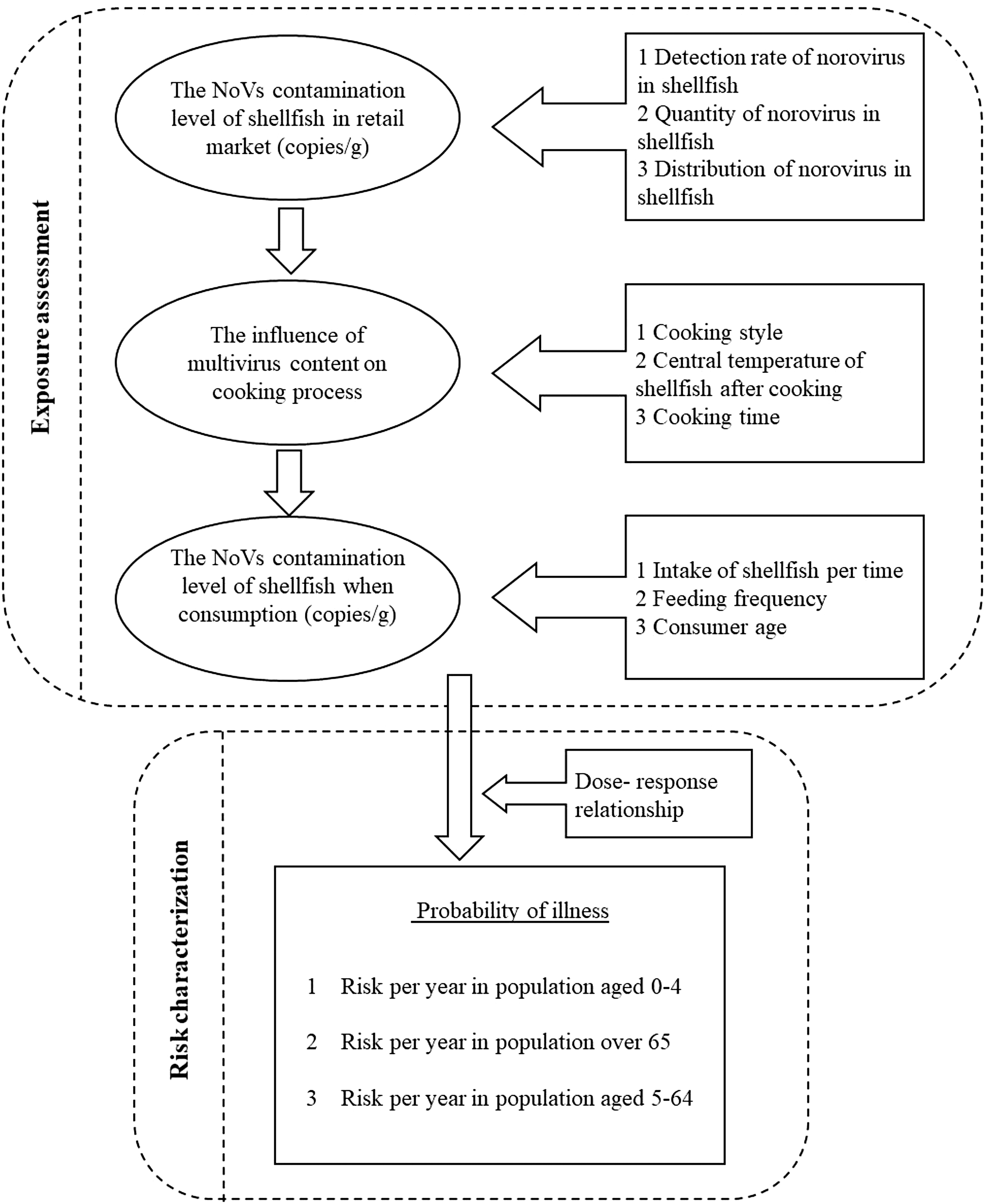
The model framework of the quantitative risk assessment of NoVs in shellfish. NoV, norovirus.
Hazard identification
NoVs mainly causes acute gastroenteritis, which can cause death in infants and the elderly with underlying diseases (Gyawalia et al., 2019). GI and GII type NoVs are the main pathogens causing the outbreak of human acute gastroenteritis, whereas GIV type NoVs are rare. NoVs have host specificity, so far no studies have found that animal-derived NoVs can infect humans (De Graaf et al., 2016). Therefore, only GI and GII NoVs in shellfish were considered in this QRA.
Exposure assessment
Prevalence and quantity of NoVs in shellfish at retail
Shellfish samples were purchased in the retail market from seven cities around the Yellow Sea and Bohai Sea (Supplementary Fig. S1). A total of 840 bivalve shellfish were collected, species including Crassostrea gigas, Mytilus edulis, Azumapecten farreri, Sinonovacula constricta, Scapharca subcrenata, and Ruditapes philippinarum. Randomly selected samples were stored on ice and transported to the laboratory as soon as possible.
NoV RNA was extracted through the High Pure Viral RNA Kit (Roche, Germany), following the instructions. Real-time (RT)-PCR was conducted using the one-step system (Takara, Dalian, China) in a 20-μL reaction mixture. The oligonucleotide primers of GI and GII NoVs were developed according to previously published (Kojima et al., 2002), shown in Supplementary Table S1. The reactions were carried out using a Lightcycler 2.0 (Roche) under the following conditions: reverse transcription at 42°C for 6 min, denaturation at 95°C for 15 min, followed by 45 cycles of amplification with denaturation at 95°C for 50 s, and annealing and extension at 52°C for 50 s. Each sample was amplified in duplicate.
Genotyping of NoVs
All RT-PCR positive samples were re-amplified with 289H/290J primers (shown in Supplementary Table S1) using the conventional RT-PCR method described by Jiang et al. (1999). If the conventional RT-PCR amplified the expected size of the product, the product was purified and cloned into pMD18-T vector (Takara). Sequencing was performed by BGI (Beijing, China). The genotype of NoVs were confirmed by NoVs Genotyping Tool version 2.0 (
Reduction of NoVs at different cooking conditions
To investigate the reduction rate of different cooking methods on NoVs in shellfish, we simulated three common shellfish cooking methods, including boiling, steaming, and frying. Single oyster weighing about 100 g were selected, and each group had 10 oysters. The whole shell oysters were used for boiling and steaming, and the oysters without shell were used for frying.
The internal temperature of oyster was measured after different cooking methods as follows. Boiling: oysters were placed in normal temperature water and heated to boiling for 5 min. Steaming: oysters were placed over boiling water in a steamer for 5 min. Frying: oysters were placed in 180°C oil and fried for 3 min.
The positive samples of GII.4 NoVs obtained from patients with diarrhea (diluted to 104 copies/mL) were treated in water bath for 5, 5, and 3 min, respectively, at the internal temperature of boiling, steaming, and frying. Propidiummonoazide (PMA) assay were used to evaluate the infectious of NoVs and then the reduction rates (Pred) of different cooking methods on NoVs were calculated according to previously published (Li et al., 2017).
Consumption
Probability of illness was determined based on the doses of GI and GII NoVs that were consumed per meal (Dmeal). The food frequency questionnaire (FFQ) was used to evaluate the dietary status of shellfish (shown in Supplementary Table S2). The distribution fitting of consumption of shellfish meat quantity per meal (Qcon) and consumption frequency (n), the number of shellfish consumption per year of different populations were obtained through FFQ. The consumption model [Eq. (1)] was described as follows:

where NVretail is number of NoVs during retail (copies/g), and Pred is reduction rate of NoVs during cooking (%).
Dose–response assessment
Human NoVs are difficult to be cultured in vitro, and there is no suitable animal model. Therefore, there were very few studies on the dose–response of NoVs. At present, there are only two volunteer results (Dolin et al., 1972; Teunis et al., 2008). By comparing the commonly used dose–response models, it was found that the beta-Poisson model can well reflect the two volunteer results. Therefore, beta-Poisson model is used in this QRA. The beta-Poisson dose–response model [Eq. (2)] was applied to estimate the probability of illness (Pill) per person per meal (Miranda and Schaffner, 2018).

where α and β are the probability-weighted selection of parameters to describe the distribution of probability of illness. In this model, α is 0.086 and β is 2.55 × 10⁻³.
Risk characterization
The results of exposure assessment were integrated into the dose–response to estimate the number of cases of adverse health effects resulting from the consumption of shellfish contaminated with NoVs. The probability of illness caused by NoVs due to shellfish consumption per year (Pill,yr) was estimated by the following equation:
where Pill is probability of illness per shellfish intake and n is consumption frequency per year.
The exposed numbers of case per 1,000,000 general population (Nexp,mil) of different age populations were calculated by the following equation:
where r is the ratio of different age populations around the Yellow Sea and Bohai Sea, which was adopted from National Bureau of Statistics of China.
Results
Exposure assessment
Prevalence and quantity of NoVs in shellfish at retail
Around the Yellow Sea and Bohai Sea, 840 bivalve samples were collected from seven cities for quantitative detection of NoVs. Among them, 112 bivalve samples were positive for NoVs, with an average detection rate of 13.33%, and the quantity range was between 1.9 copies/g shellfish meat to 7.94 × 10⁵ copies/g shellfish meat. Of the 112 positive samples, 2 samples that amplified from S. subcrenata and R. philippinarum classified as GI, with the remaining 110 samples classifying as GII. These results indicated that GII was the main genogroup of NoVs in shellfish. The quantity of NoVs in shellfish (NVretail) was modeled by crystal ball software and shown in Figure 2.

The distribution fitting curve of quantity of NoVs in shellfish The blue column represents the logarithm value of measured NoVs quantity, and the red curve represents the fitted distribution. NoVs quantity in shellfish accorded with lognormal distribution, the average value is 2.62, and the standard deviation is 0.84. NoV, norovirus.
Effects of different cooking methods on NoVs in shellfish
Shellfish is popular for its delicious taste; consumers usually do not cook shellfish for prolonged periods. The internal temperature and NoVs reduction rate of shellfish is shown in Figure 3, when shellfish were processed by boiling, steaming, and frying. The highest internal temperature of shellfish was 92°C after boiling for 5 min. The logarithm value of NoVs quantity after they were cooked is also shown in Figure 3. The reduction rate of cooking on NoVs was calculated and modeled a Program Evaluation and Review Technique (PERT) distribution as follows:
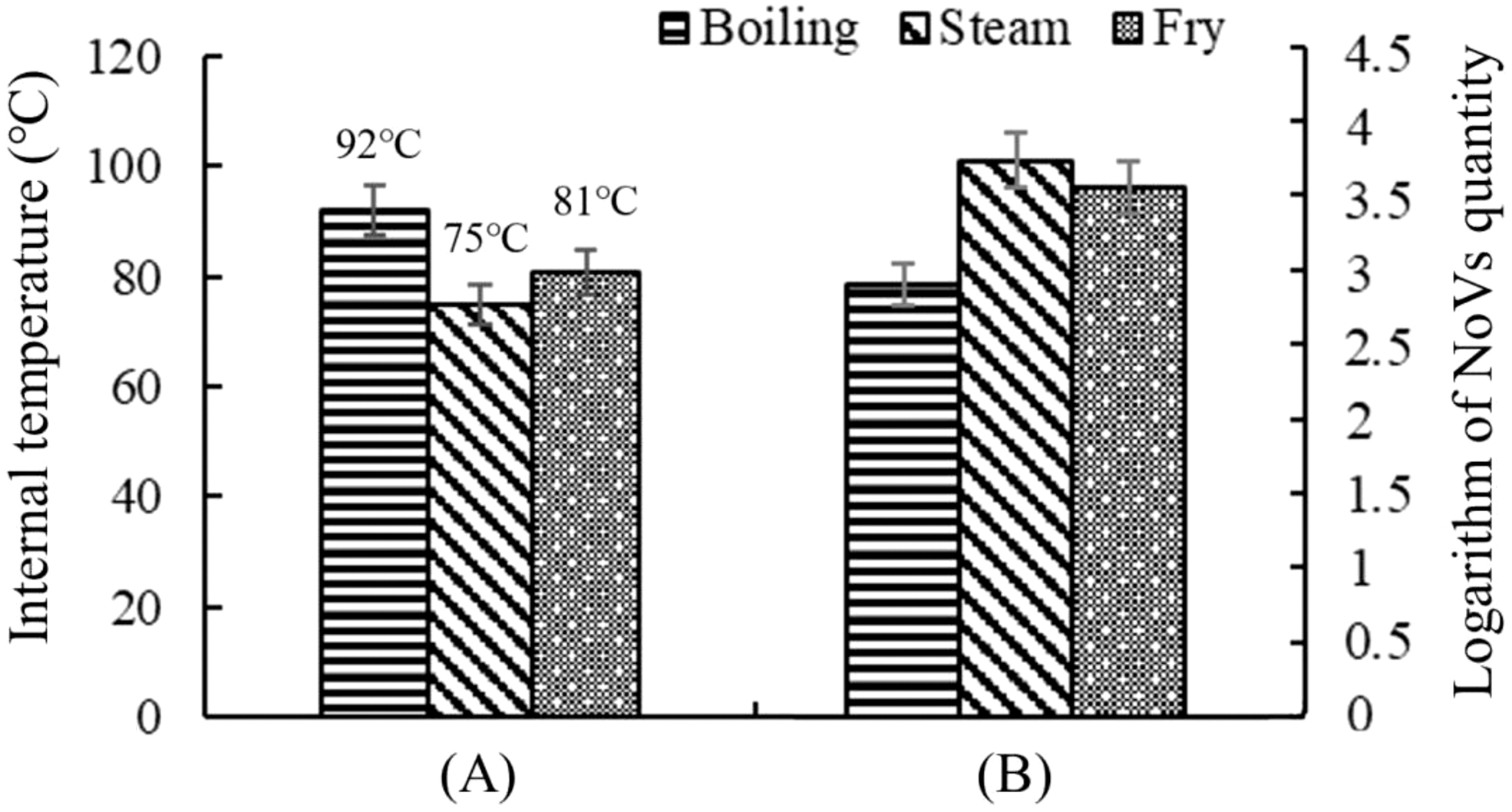
The internal temperature and NoVs reduce of shellfish at different cooking methods.
where 0.198 is the most likely value, 0.095 is minimum value, 0.367 is maximum value.
Investigation of shellfish diet
A total of 625 questionnaires were obtained from the dietary survey. The highest consumption frequency is 23.8, which is the number of shellfish consumption per year for population aged 19–64 years, followed by 13.8 for population >65 years, 12.8 for population aged 5–18 years, and 8.7 for population aged 0–4 years. The average meal intake of different age populations was 36.2 g. The highest average intake was 48.9 g for population aged 19–64 years, followed by 33.2 g for population aged 5–18 years, 20.2 g for population >65 years, and 6.6 g for population aged 0–4 years. The average intake of different age populations was significantly different (p < 0.05), and the average intake of 0–4 years old population was significantly lower than that of other age populations (p < 0.05). The dietary survey of shellfish in different populations is shown in Table 1. The average intake per time of different grouping (Ppre) was modeled as a normal distribution shown in Figure 4.
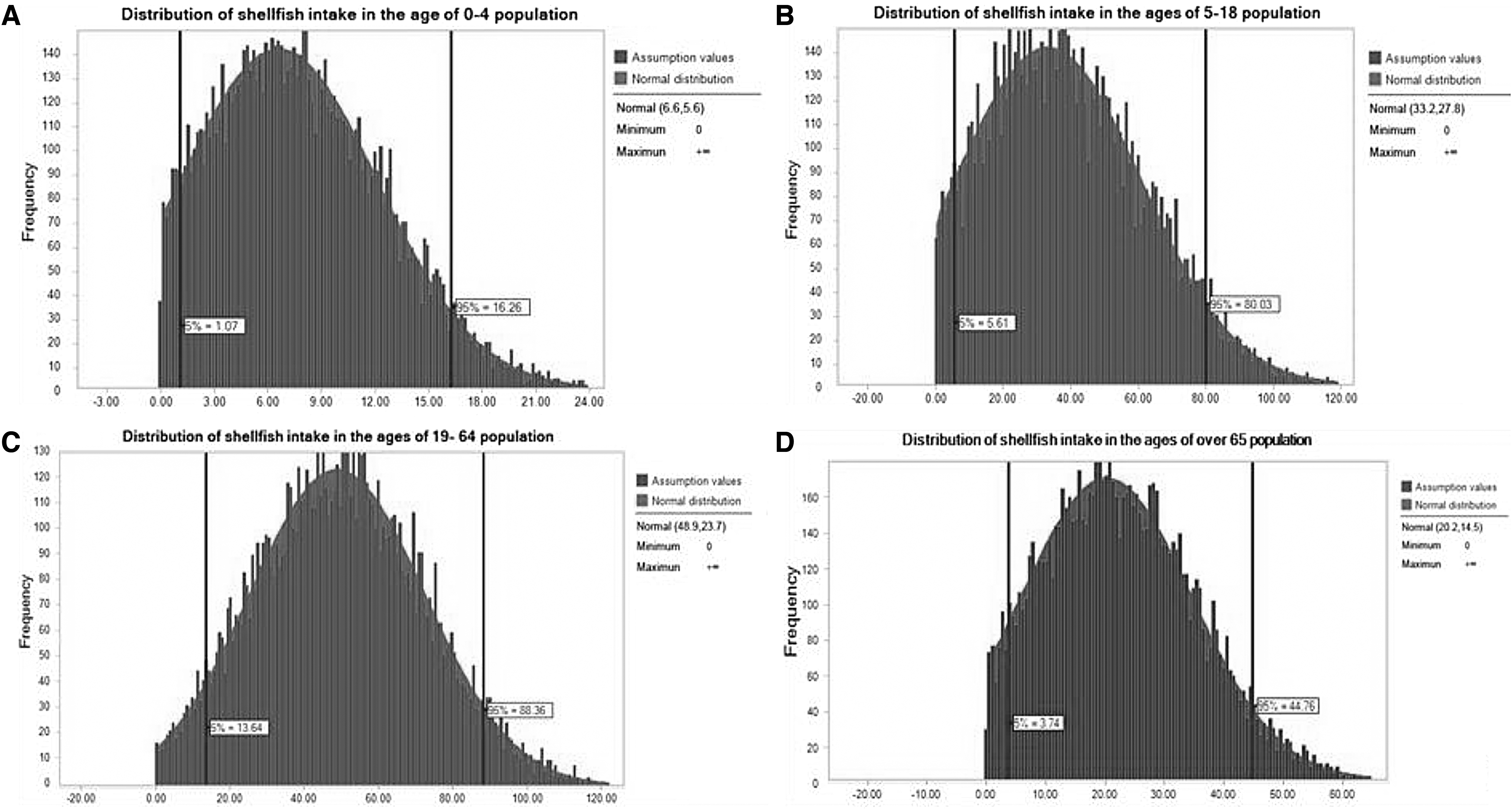
Distribution of normal frequency per shellfish intake of different age populations.
Shellfish Intake of Different Populations
Risk characterization
According to the age group, the probability of NoVs infection in different populations due to eating shellfish was simulated by the model. The outputs were summarized in Table 2. The risk was comparatively high in the population aged 19–64 years, with the Pill.yr was 2.52 × 10⁻⁵ and the Nexp,mil was 16.90. The Pill.yr of population >65 years old was 4.22 × 10⁻⁶, and Nexp,mil was 0.38. The Pill.yr of aged 0–4 years population was 1.77 × 10⁻⁶, and the Nexp,mil was 0.10. The Pill.yr of aged 5–18 years population was 6.69 × 10⁻⁶, and Nexp,mil was 1.23.
Risk Characterization for Different Ages of Consuming Shellfish
Discussion
Oysters and other shellfish seafood are the common foods causing outbreaks of human acute gastroenteritis. The NoVs in shellfish mainly come from aquaculture area and enter into shellfish through filtration. Recent studies have indicated that shellfish can selectively accumulate NoVs based on different histo blood group antigen (HBGA)-like carbohydrates in different tissues (Ma et al., 2018). In this study, six kinds of shellfish were all detected NoVs positive, showing that the NoV pollution in shellfish is relatively common. Methods for removing NoV from shellfish included heat processing, shellfish purification, and high hydrostatic pressure (HHP) processing. NoV is resistant to temperature, Sow et al. (2011) had shown that murine NoV were treated at 90°C for 90 s produced only 0.7 log10 reduction in virus infectivity, respectively. However, heating process under this temperature changed the organoleptic characteristics of shellfish, making them unacceptable to some consumers (Hsu et al., 2010). Lighter cooking, a popular way to cook shellfish, does not provide the required temperature/time combination for inactivation of NoVs. In this study, the commonly used thermal processing methods were simulated, and the results showed that the commonly used cooking methods could not effectively reduce NoVs. Shellfish purification can effectively reduce bacteria in shellfish, but the effect on NoVs is very limited (Younger et al., 2020). Studies have shown that nonthermal processing technology such as HHP can reduce NoVs in shellfish; however, the pressure is usually >400 MPa (Ye et al., 2015). Under this pressure, the protein and fat of shellfish are oxidized to varying degrees (Ye et al., 2015). The most effective way to control NoVs is to control the source, cut off the source of pollution and prevent NoVs from entering shellfish and other food.
Most people are susceptible to NoV. In this QRA, the highest probability of NoVs infection due to shellfish consumption is within the population aged 19–64 years, although the highest probability does not mean the most serious. Owing to underlying diseases and incomplete development of gastrointestinal function, severe or fatal cases usually occur in the elderly or young children. From 2001 to 2006, NoVs infection accounted for 20% of deaths from infectious intestinal diseases among population >65 years old in England and Wales (Harris et al., 2008). From 2008 to 2009, 82 cases of NoVs infection in northern Europe (median age 77 years) died within 1 month, accounting for 7% (Gustavsson et al., 2012). NoV infection in young children can easily cause severe complications such as necrotizing enterocolitis. Owing to the lack of models, this QRA only evaluated the incidence probability of NoV infection, and did not consider the course and severity of the disease.
QRA, especially the risk assessment of pathogenic microorganisms, is an extremely complex process; there are some uncertain factors in this QRA. The details are as follows: (1) Limitations of the exposure assessment framework. The exposure assessment of this QRA started from retail to consumption, and did not consider factors of cleaning, purification, and transportation of shellfish after harvesting. It is difficult to establish an appropriate model to simulate this process, for there is no unified standard operation process in China. (2) Limitations of dose–response model. The dose–response model used in this QRA also has some limitations, which is not based on Chinese volunteer experiments; the sensitivity of different populations to NoVs may be diverse. We will improve the dose–response model through experiments in future.
Conclusions
NoVs can be detected in multiple types of shellfish, with an overall detection rate of 13.3%. The results of risk assessment showed that the probability of gastroenteritis caused by NoVs due to shellfish consumption per year in the cities of the Yellow Sea and Bohai Sea was 1.86 × 10⁻⁵, and the total number of cases per 1,000,000 general population was 18.61. General home cooking methods have no significant effect on reducing NoVs in shellfish. The most effective way to control NoVs in shellfish is to eliminate the source pollution and prevent shellfish contaminated by NoVs from entering the market.
Footnotes
Disclosure Statement
No competing financial interests exist.
Funding Information
This study was supported by grants from the National Key R&D Program of China (2019YFD0901702).
Supplementary Material
Supplementary Figure S1
Supplementary Table S1
Supplementary Table S2
References
Supplementary Material
Please find the following supplemental material available below.
For Open Access articles published under a Creative Commons License, all supplemental material carries the same license as the article it is associated with.
For non-Open Access articles published, all supplemental material carries a non-exclusive license, and permission requests for re-use of supplemental material or any part of supplemental material shall be sent directly to the copyright owner as specified in the copyright notice associated with the article.
