




Abstract
Giardia duodenalis has a wide range of host species and is a common causative agent of diarrheal disease in humans and animals. This study conducted a systematic review and meta-analysis to evaluate the pooled prevalence of Giardia among dogs in China. We extracted 33 studies related to the prevalence of G. duodenalis in dogs, with samples taken from 2001 to 2021. The random-effect model was used to calculate pooled prevalence estimates with 95% confidence intervals, and the analyzed data were from 14 provinces in China. The estimated overall prevalence of G. duodenalis among dogs in China was 11.2%. The prevalence of Giardia was significantly higher in Northwestern China (35.7%) than in other regions. The prevalence in 2010 or later (11.8%) was significantly higher than in 2010 or before (6.9%). The estimated prevalence detected by microscopy (9.3%) was lower than molecular (12.3%) and serological (14.3%) ones. The prevalence was higher in dogs <1 year of age (12.2%) than that >1 year (5.4%). Among the genotype groups, the positive rate of assemblage A (5.2%) was significantly higher than that of other assemblages. Depending on the dog’ type, the prevalence of G. duodenalis in stray dogs (3.5%) was lower than that in pet dogs (6.7%) and intensively breeding dogs (11.8%). In addition, no correlation was found between Giardia positive rate and the dogs' gender (p > 0.05). We also analyzed the effects of different geographic factor subgroups (longitude, latitude, precipitation, temperature, humidity, and altitude) on the prevalence of G. duodenalis in dogs in China. The results showed that giardiasis was widespread in dogs in China. It is suggested that corresponding control scheme and effective management measures should be formulated and applied to reduce the transmission of G. duodenalis according to the difference in geographical conditions in different areas.
Introduction
G
The Global Enteric Multicenter Study (GEMS) found that Giardia caused acute diarrhea and even death in children <5 years (Certad et al., 2017). Giardia spreads to new hosts through the fecal-oral route, including a direct contact with human or animal feces containing cysts, and food or water contaminated by cysts (Feng and Xiao, 2011; Einarsson et al., 2016), which has a major impact on public health and socioeconomic aspects (Ryan et al., 2013, 2019). It was listed in the World Health Organization's “Neglected Disease Initiative” in 2004 (Savioli et al., 2006).
Studies have shown that Giardia duodenalis is a parasite of humans and mammals (sometimes referred to as Giardia intestinalis or Giardia lamblia) (Thompson et al., 2005). At present, G. duodenalis is classified into eight assemblages (A–H) with different host specificities (Cacciò et al., 2005). The assemblages A and B infect the largest host species and are considered to be the main assemblages that infect humans (Ballweber et al., 2010; Ryan et al., 2013; Thompson et al., 2019).
As a result of the continuous rising in living standards, the number of pets increases annually. As a consequence, the number of studies on pets' intestinal protozoa has also increased (Liu et al., 2017; Chen, 2020). Dogs, a kind of companion animals, can pose a threat to human health through ingesting water or food contaminated by G. duodenalis (Lou, 2010).
The study for protozoan parasites in Argentina in the past four decades showed that G. duodenalis was mainly detected in dogs, with a positive rate of 8.9 ± 7.0% (Rivero et al., 2020). Two previous studies showed that dogs, among companion animals, had a higher rate of G. duodenalis infection (Ballweber et al., 2010; Bouzid et al., 2015). The prevalence of G. duodenalis varies in different studies, which may be related to the animal's age, living environment, management methods, and detection techniques (Ballweber et al., 2010; Bouzid et al., 2015; Asher et al., 2016).
According to the “White Paper on China's Pet Industry in 2020” (2020 China pet medical industry white paper), the number of companion dogs has reached 52.22 million, which means that the risk of zoonotic diseases is also increasing yearly. To the best of our knowledge, there are currently reports of Giardia infection in humans and other animals in China (Li et al., 2017). However, this article mainly reviews the epidemiology, genotyping, and subtypes of Giardia. The effect of other risk factors on Giardia prevalence was not studied. Therefore, the first meta-analysis is carried out to estimate the prevalence of G. duodenalis in dogs in China. Regions, sample years, geographical characteristics, genders, sampling seasons, and detection methods were also evaluated as potential infectious risk factors for G. duodenalis in dogs.
Materials and Methods
Search strategy
The meta-analysis was performed based on the systematic review and meta-analysis of (PRISMA) guidelines (Supplementary Table S1; Moher et al., 2015). The systematic search was performed by using six electronic databases: VIP Chinese Journal Databases, China National Knowledge Infrastructure (CNKI), Wan Fang Database, PubMed, ScienceDirect, and Springer Link. We first retrieved the MeSH terms “Giardia” and “Dogs” in PubMed. The second step was to query the corresponding MeSH term “Giardia” using the free words “Giardias,” “Lamblia,” and “Lamblias.” We used the Boolean operators “AND” to connect MeSH terms and “OR” to connect the free words.
The final search formula in PubMed was (((((“Giardia”[Mesh]) OR Giardias) OR Lamblia) OR Lamblias)) AND (((“Dogs”[Mesh]) OR Dog) OR Canis familiaris)) AND (China). The final search formula in ScienceDirect was “Giardia, Dogs, Epidemiology, China.” The article type is “Review Articles, Research Articles and Conference Abstracts.” The final search formula in Springer Link was “(Giardia, And Dogs, And Epidemiology, And China),” which does not include preview-only content.
In the three Chinese databases, the keywords “Dogs” and “Giardia” in Chinese were used. EndNote (version X9) was used to catalogue the retrieved articles in English and Chinese. We focused on the data regarding Giardia prevalence in dogs, where the samples were collected from Mar 9, 2001 to Mar 9, 2021.
Selection criteria
First, we excluded the duplicate studies and reviews based on titles and abstracts. Then, the following criteria were used to select the eligible studies: (1) The targeted objects must be dogs; (2) the results must focus on the prevalence of Giardia in naturally infected dogs; (3) the research data must include the number of inspected dogs and information for the number of Giardia-positive dogs; (4) each sample was collected from one dog and cannot be mixed; (5) the study was published from 2001 to the present; and (6) a cross-sectional study was essential.
Two independent reviewers (Zi-Yu Zhao and Ming-Han Li) carefully examined all titles and abstracts identified in the search. Subsequently, the two reviewers assessed the full text of articles that were deemed potentially relevant. Any disagreement was resolved by discussion and the involvement of another two authors (Jing Jiang and Chuang Lyu). The database was built in Microsoft Excel (version 16.32).
Quality assessment
The quality of the selected publications was estimated based on the criteria derived from the Grading of Recommendations Assessment (Guyatt et al., 2008). The adopted criteria included precise research goal, research time, test method, and the analysis contained three or more risk factors. Each criterion was scored as 1 point. The total score was 4 points if meeting all criteria. The articles with a total of 4 points were considered as high quality, scores of 3 or 2 were considered as medium quality, and scores of 1 or 0 were marked as low quality.
Statistical analysis
The prevalence meta-analysis was performed using R v3.5.2 (“R core team, R: A language and environment for statistical computing,” R core team 2018), where the “meta” package was used to estimate models (Wang, 2018). Before performing the meta-analysis, five methods were employed to convert the observed proportions, including original rate “PRAW,” logarithmic conversion (PLN), logit transformation “PLOGIT,” arcsine transformation (PAS), and double-arcsine transformation (PFT) (Li et al., 2020a; Wang et al., 2020a). The heterogeneity of the results was analyzed by using an χ2 -based Q-test and the I 2 statistic (Ran et al., 2018, 2019). The size of the heterogeneity of the included studies was used as a basis to select the effect model.
Owing to the predictable obvious heterogeneity, the random effect model was used to combine the overall effect size with subgroup analysis (Gong et al., 2020a). The forest plot was used to display information, such as heterogeneity and weights. The funnel plot was used to show the degree of publication bias in the selected studies. Furthermore, the publication bias was considered significant when the p-value of Egger's test was <0.05 (Gong et al., 2020a). Conversely, the bias was considered to be not significant when p ≥ 0.05 (Gong et al., 2020b). We also conducted a sensitivity analysis to assess whether the merged results were robust (Barendregt et al., 2013; Taghipour et al., 2020).
Potential sources of heterogeneity were further investigated by subgroup analysis and meta-regression analysis (Wei et al., 2021). The investigated factors included geographic area (comparing Northwestern China with other regions), sampling years (comparing studies performed before 2010 with those performed in 2010 or later), detection methods (comparing microscopy, molecular, and serology), gender (comparing male and female), and lifestyles (comparing stray dogs, intensive breeding dogs, and pet dogs).
The latitude and longitude span of China's territory is large, and the differences in geographical environment and climate change are more prominent (Ni et al., 2020). Therefore, we also assessed the impact of geographic risk factors in this study through subgroup analysis and meta-regression analysis, including longitude (110–115° compared with other longitude ranges), and latitude (<25° compared with other latitude ranges), annual average precipitation (600–1300 mm compared with other precipitation groups), annual average temperature (<10℃ compared with other temperature ranges), annual average humidity (61–67% compared with other humidity value groups), and altitude (500–1500 m compared with other altitude value groups).
The statistical geographic factor data were obtained from the National Meteorological Information Center of China Meteorological Administration, including (longitude range, latitude range, annual average rainfall, altitude, annual average temperature, and annual average humidity) (Wang et al., 2020a).
Results
Search results and qualification studies
According to the inclusion and exclusion standards, a total of 724 published studies were collected by searching in six databases and related research reference lists. Finally, 33 studies met the criteria, and were included in the meta-analysis (Fig. 1). Of these, 18 were high-quality publications (4 points), 12 were medium-quality publications (2 or 3 points), and 3 were low-quality publications (0 or 1 point; Table 1).
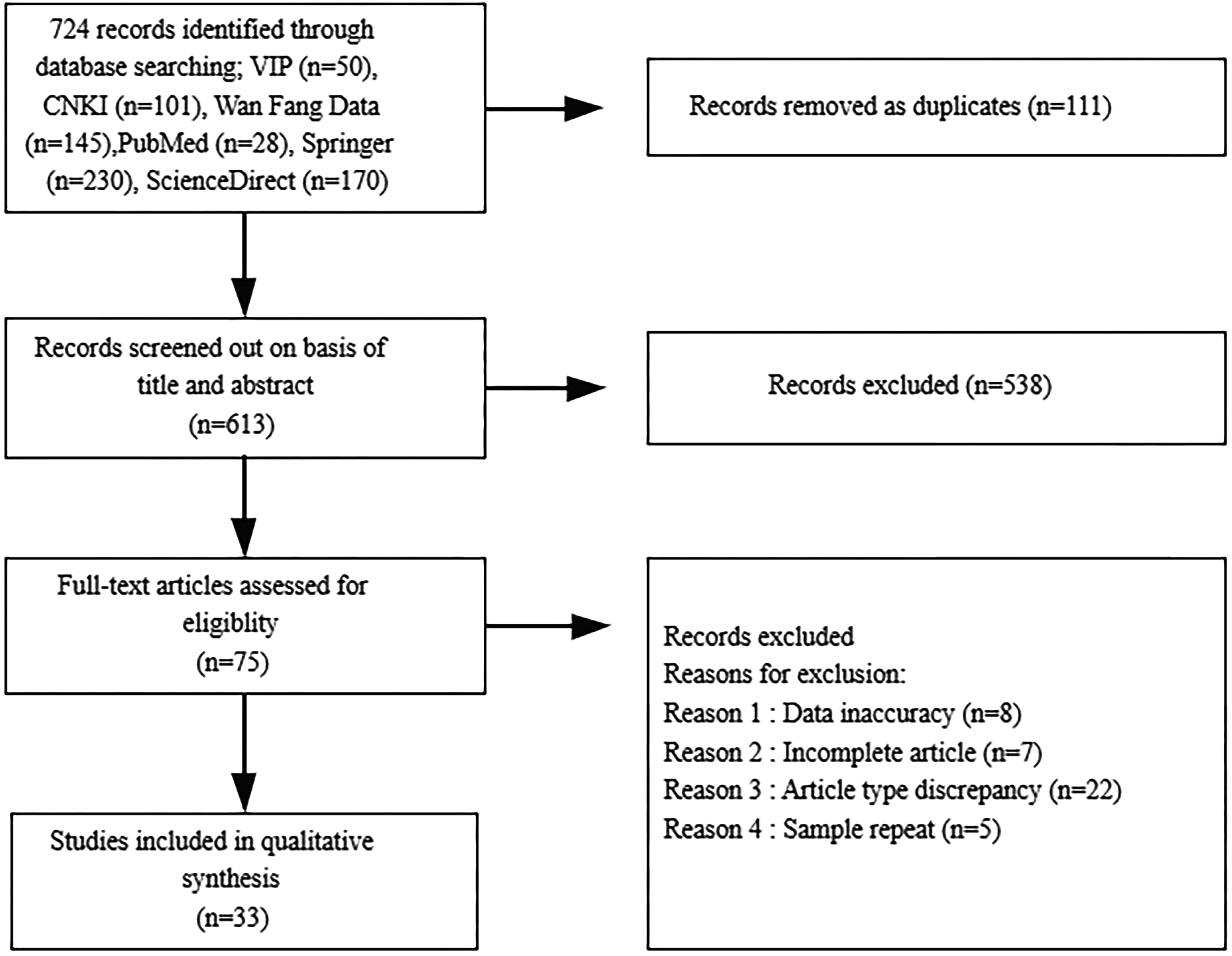
Flow diagram of the selection of eligible studies. CNKI, China National Knowledge Infrastructure; VIP, VIP Chinese Journal Databases; Wan Fang Data, Wan Fang Databases.
Studies Included and Quality Scores in the Analysis
UN, unclear; Y, Yes; N, No.
Publication bias
In the selected studies, the heterogeneity index was measured and demonstrated by a forest plot (Fig. 2). The extent of publication bias in the selected studies was measured and demonstrated by a funnel plot (Fig. 3). Both funnel plot and trim and fill test indicated a publication bias or small-sample size bias in this meta-analysis. We conducted an Egger's test to further quantify the heterogeneity. The result showed that the study had a publication bias (p < 0.05; Fig. 4, Table 2). The sensitivity analysis showed that the result was not significantly affected by an omission of any study, thus indicating the meta-analysis was reliable (Fig. 5).
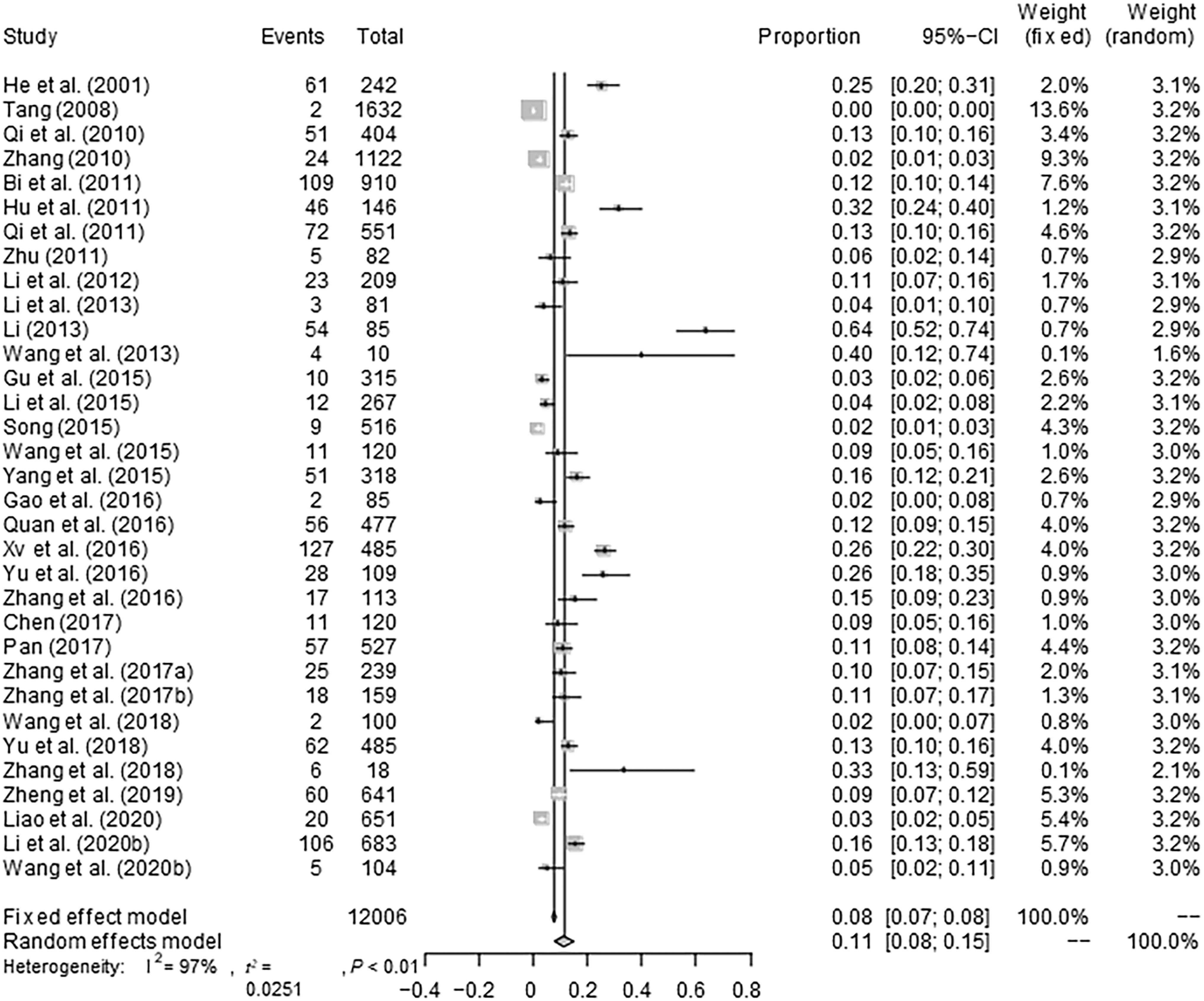
Forest plot of Giardia duodenalis prevalence in dogs in China. The length of the horizontal line represents the 95% confidence interval, and the diamond represents the summarized effect.
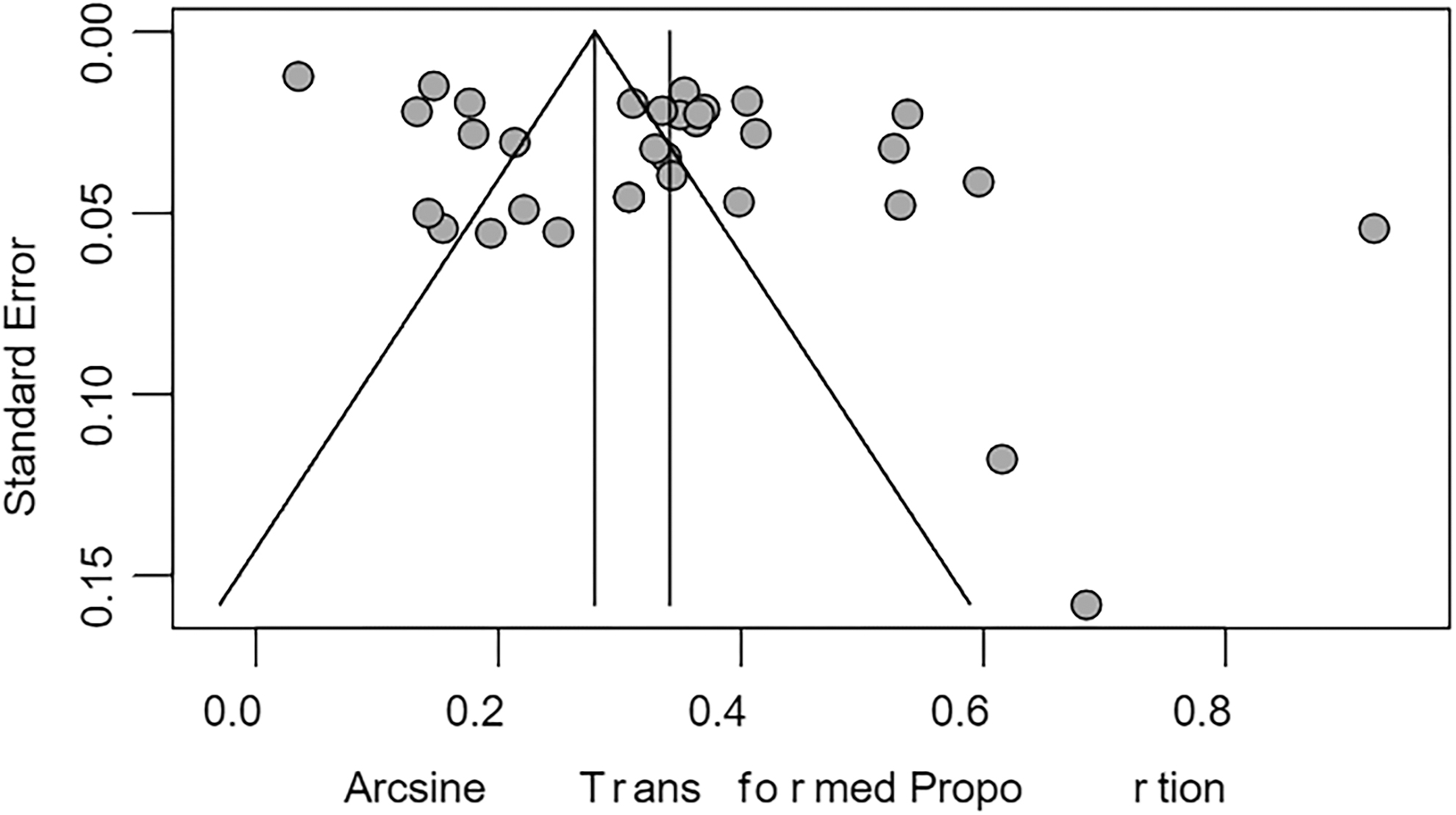
Funnel plot with pseudo 95% CI limits for the examination of publication bias. CI, confidence interval.
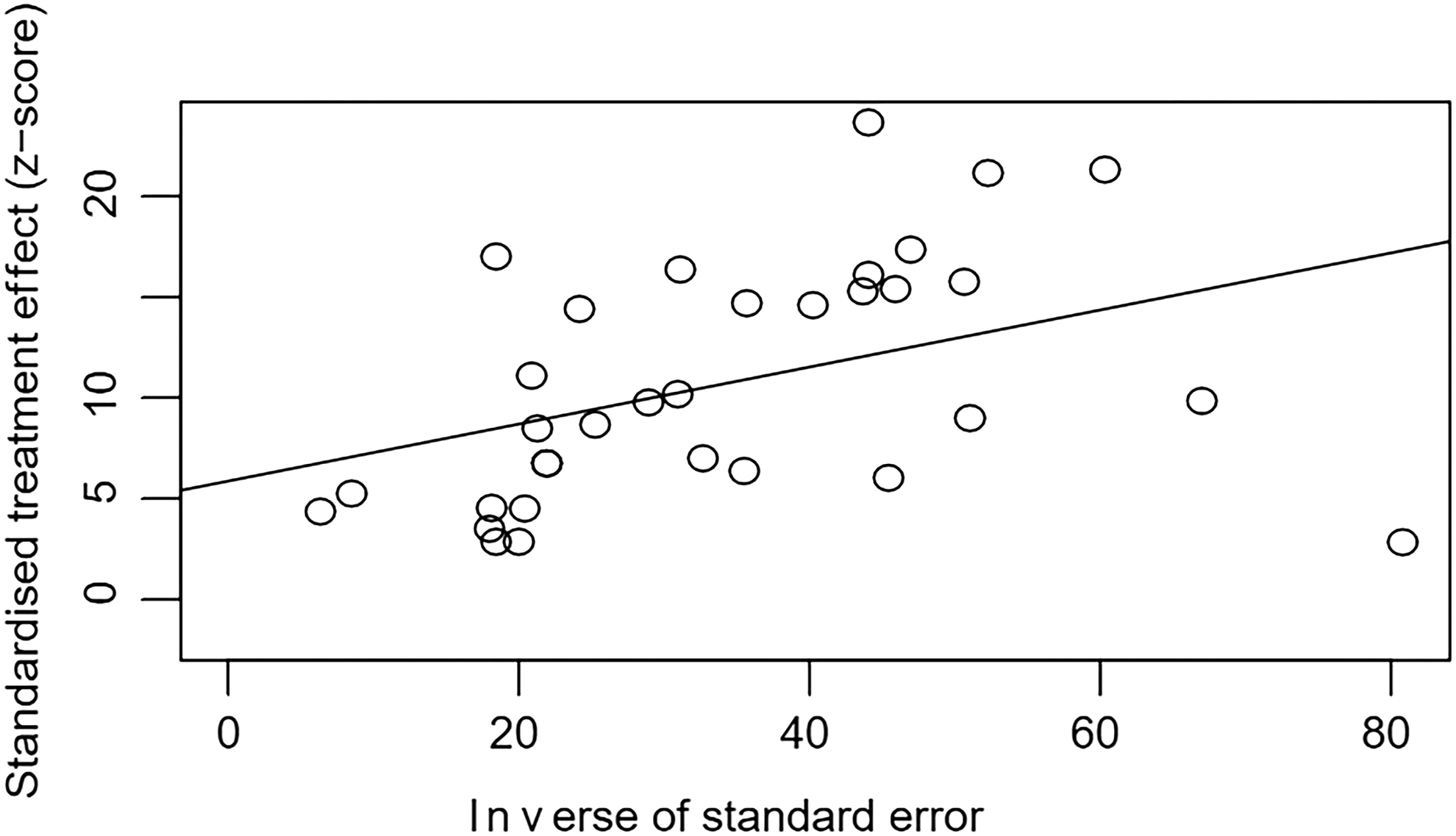
Egger's test for the publication bias.
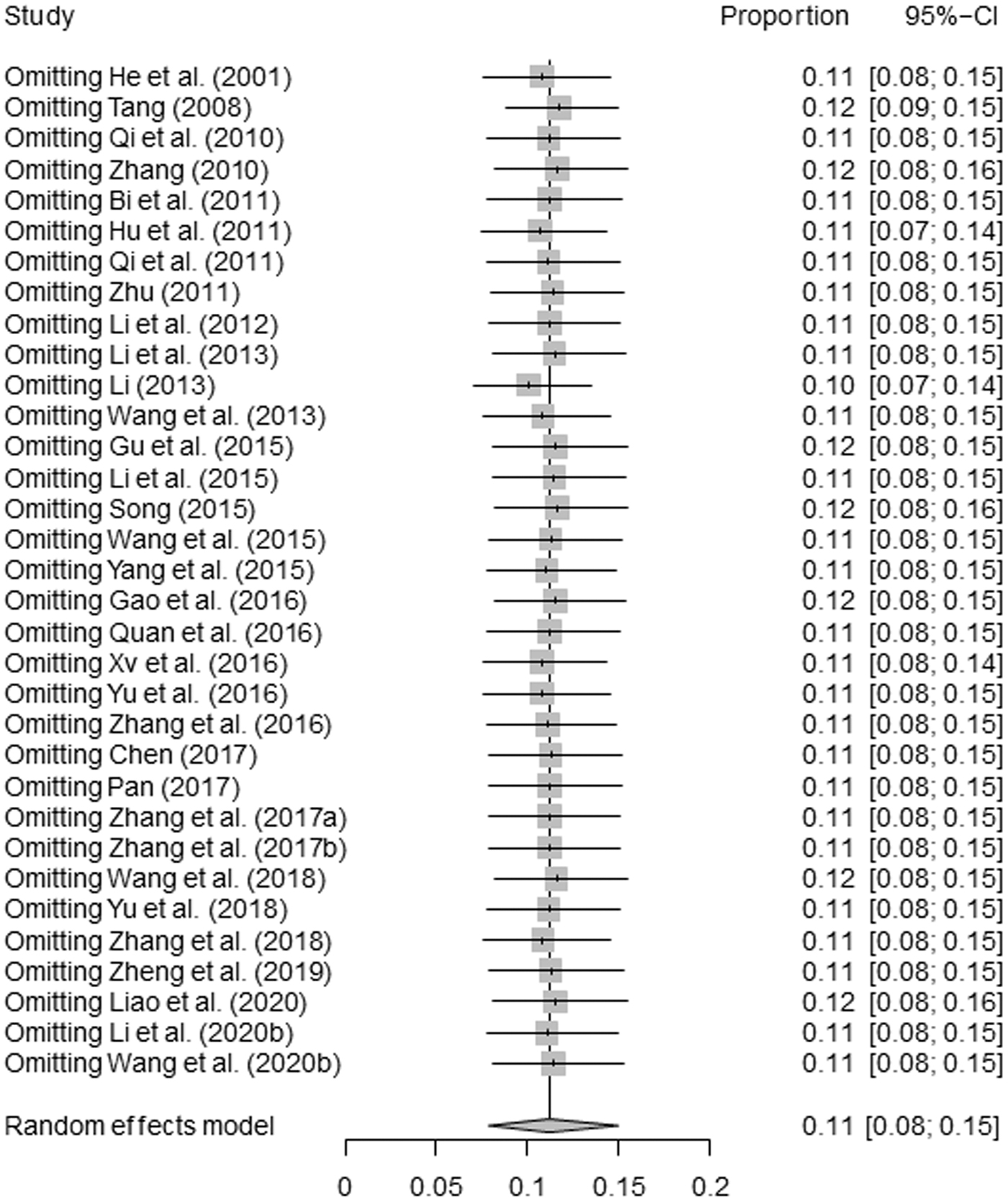
Sensitivity analysis. CI, confidence interval.
Egger's for Publication Bias
Results of the meta-analysis
In the 33 selected studies, “PAS” was chosen for the rate conversion data analysis (Table 3). The heterogeneity of the included studies was strong (χ2 = 1167.41, I2 = 97.3%, p < 0.01). Therefore, a random effect model was used for total effect size, consolidation, and subgroup analysis. Through the analysis, we established the overall combined prevalence of G. duodenalis in dogs of 11.2% (95% confidence interval [CI] 7.9–15.0; Fig. 2, Table 4).
Normal Distribution Text and Different Conversion of Normal Prevalence
PAS, arcsine transformation; PFT, double-arcsine transformation; PLN, the logarithmic conversion; PLOGIT, the logit transformation; PRAW, the original rate.
Association of Different Variables in the Prevalence of Giardia Duodenalis in Dog
Central China: Hunan, Henan; East China: Shanghai, Jiangxi; North China: Hebei, Beijing, Shanxi; Northeast China: Heilongjiang, Jilin, Liaoning; Northwest China: Qinghai; South China: Guangdong; Southwest China: Sichuan;
High: 4 or 5 points; Middle: 3 or 2 points; Low: 1 or 0 points.
CI, confidence interval.
Subgroup analysis
A univariate meta-regression analysis indicated that the region might be a major factor causing significant heterogeneity among the included studies (p < 0.05; Table 4). The result of region subgroups showed that the lowest prevalence of G. duodenalis was 6.9% in dogs in Southern China (95% CI 3.9–10.8, 248/3735; Table 4), and the highest of 35.7% in dogs from Northwestern China (95% CI 19.3–54.0, 10/28; Table 4). Meanwhile, we further analyzed the provincial factors (Fig. 6). Depending on the province of dogs' origin, the lowest prevalence of G. duodenalis was 0.1% in Hunan (95% CI 0.0–0.4), and the highest 35.7% in Qinghai (95% CI 19.3–54.0; Table 5 and Fig. 6).

Map of prevalence of Giardia duodenalis in dogs in China. Use Adobe Illustrator CC (22.0.0) to convert images into vector images. The map source is China Map Network.
Estimated Pooled Prevalence of Giardia Duodenalis by Provincial Regions in China
CI, confidence interval.
The results showed that the positive rate of G. duodenalis infection in dogs before 2010 (6.9%, 95% CI 0.7–18.7) was lower than that in 2010 or later (11.8%, 95% CI 8.8–15.0; Table 4). The established prevalence rate using microscopy (9.3%, 95% CI 4.7–15.4; Table 4) was lower than those molecular (12.3%, 95% CI 7.9–17.5; Table 4) and serological (14.3%, 95% CI 11.8–17.1; Table 4). In terms of age, dogs aged <1 year (12.2%, 95% CI 6.9–18.8; Table 4) had a higher infection rate than those aged >1 year (5.4%, 95% CI 2.2–10.0; Table 4).
Regarding the genotype subgroups, G. duodenalis assemblage A had a significantly higher prevalence (5.2%, 95% CI 4.1–6.5; Table 4) than that of other assemblages. Simultaneously, we found a reduced prevalence of G. duodenalis in stray dogs (3.5%, 95% CI 0.1–11.5; Table 4) as compared with other dog categories. An analysis of unusual quality grades showed that the low-quality study had the highest positive rate (20.9%, 95% CI 7.4–38.9; Table 4). In addition, we did not find any correlation between the G. duodenalis positive rate and the gender of dogs.
We also analyzed a detailed geographic and climatic subgroup of factors, with longitude and altitude as possible risk factors (p < 0.05; Table 6). Among them, the highest prevalence of G. duodenalis was in longitude <110° (18.8%, 95% CI 11.8–27.0) and altitude >1500 (21.0%, 95% CI 13.1–30.2).
Sub–Group Analysis of the Prevalence of Giardia Duodenalis According to Geographic Location and Climate Variables
CI, confidence interval.
Discussion
In the 33 selected articles based on the identified criteria, 1149 out of 12,006 dogs were Giardia positive. From 2001 to 2021, the combined infection rate of G. duodenalis in dogs in mainland China was 11.2% (95% CI 7.9–15.0), which was <15.2% globally in 2016 (Bouzid et al., 2015). However, with the increase in the number of pet dogs and abandoned dogs on the Chinese mainland in recent years, the opportunity for human contact with dogs has also increased dramatically (Li, 2019). Therefore, the potential infection risk of G. duodenalis in humans needs to be noticed (He, 2019).
This study conducted a subgroup analysis based on the dog's age, gender, region, detection method, genotype, lifestyle, and year of the article. The results showed that the age of dogs was negatively correlated with the positive rate of G. duodenalis. This was in line with a previous study that showed a higher prevalence in young animals than adult animals (Santin, 2020). However, no research shows the specific reasons for the high prevalence of G. duodenalis in puppies. The possible factors are rapid growth and metabolism of young dogs, low resistance, and failure to deworm in time. The combined effects of these factors lead to a poor resistance of puppies and more likely to be infected with G. duodenalis.
Moreover, overcrowding of kennels, immature intestinal immune system, and the quality of water sources are possible factors for the high prevalence of G. duodenalis in puppies. It is suggested that the relationship between age and G. duodenalis infection should be the focus of epidemiological investigation on G. duodenalis. Determining the causes of infection in puppies will have a positive effect on the control of G. duodenalis. Thus, young dogs should be regarded as the focus on the prevention and control of parasitic diseases in dogs. Veterinary medicine clinicians should not ignore gastrointestinal parasitic infections when receiving juvenile animals during their clinical work. In addition, the lack of significant differences between male and female dogs indicates that exposure and infection levels are less affected by gender.
In this meta-analysis, the main risk factor that affects the level of infection is the geographic location (p < 0.05). The level of G. duodenalis infection in dogs can represent to a certain the contamination degree of the environment by cysts to some extent and a potential risk of human infection (Bouzid et al., 2015). The results showed that the mixed infection rate was the highest in the western part of mainland China, respectively, in the Northwest (35.7%, 95% CI 19.3–54.0), followed by the Southwest (20.5%, 95% CI 4.8–43.2). In contrast, Southern China (6.9%, 95% CI 3.9–10.8), Central China (7.0, 95% CI 0.4–21.0), and Eastern China (7.8, 95% CI 0.0–26.9) showed the lowest prevalence.
At the same time, the included data set that came from 14 provinces in mainland China was concentrated in Guangdong Province (n = 9) and Jilin Province (n = 5). The western region is relatively backward in terms of economy and living standards except for the Sichuan Basin and Guanzhong Plain. However, Southern, Central, and Eastern China are economically developed regions in China (Fang, 2020; Li, 2020). The developed areas have better sanitation facilities and safer water sources, resulting in lower G. duodenalis infection rates. Therefore, we suggest that economically underdeveloped areas need more extensive and accurate detection of G. duodenalis infection. Our results were in line with those in the previous studies (Einarsson et al., 2016).
G. duodenalis can be detected by PCR amplifying marker genes, staining, and microscopic examination of cysts, detecting antibodies, and other methods (Cui and Wang, 2005; Yang, 2019). Our research found that microscopy-based research generally established a reduced prevalence as compared with molecular and serological analyses.
In 14 provinces of mainland China, the level of G. duodenalis infection in stray dogs (3.5%, 95% CI 0.1–11.5) was lower than that in pet dogs (6.7%, 95% CI 2.9–12.0) or dogs in intensive breeding (11.8%, 95% CI 6.6–18.2), and the difference was not significant. It has been shown that the exposure level of G. duodenalis in dogs of different lifestyles was similar. Javanmard and colleagues found that in addition to wastewater irrigation and human factors, food contaminated by the free-range animals on farm was also a main way to spread giardiasis (Dixon, 2020; Javanmard et al., 2020).
Dogs are an indirect factor for the increased risk of human infection with G. duodenalis through directly contacting feces containing cysts outdoors, or accidentally eating food and drinking water contaminated by cysts (Feng and Xiao, 2011; Einarsson et al., 2016). In the genotype subgroup, a total of nine assemblage combinations were found, among which assemblage A had the highest infection rate, followed by C and D, and a few assemblages mixed. A previous study showed that assemblages A and B had the widest host range (Sprong et al., 2009).
Both assemblages A and B have the ability to infect humans and a variety of mammals, including livestock, dogs, cats, and wildlife (Leonhard et al., 2007; Xiao and Fayer, 2008; Sprong et al., 2009). Assemblages C, D, E, F, and G seem to be host specific for nonhuman species. However, assemblages C, D, E, and F have been isolated from humans, with low prevalence rates (Xiao and Fayer, 2008; Sprong et al., 2009). Humans are mainly susceptible to assemblages A and B (Baruch et al., 1996). Therefore, assemblages A and B should be the focus for the future epidemiological investigation of G. duodenalis.
In addition, we also analyzed the prevalence of G. duodenalis according to geographic locations and climate variables in China. The natural factors have an important influence on the growth and development of parasites in the environment (Koehler et al., 2016; Squire et al., 2017; Plutzer et al., 2018). We found that altitude and longitude had a significant impact on the prevalence of G. duodenalis in dogs (p < 0.05). Areas with an altitude >1500 m (21.0%, 95% CI 13.1–30.2) and longitude <110° (18.8%, 95% CI 11.8–27.0) had the highest prevalence of G. duodenalis (p < 0.05). Corresponding to these two geographical factors, the climate of the relevant areas is characterized by wet and cold.
In addition, Giardia mainly exists as cysts in the environment and has strong resistance to the external environment. It can survive for several months in cold and wet conditions (Ankarklev et al., 2010). This may account for the high prevalence of Giardia in the range. In the subgroup analysis of precipitation and humidity, the prevalence of G. duodenalis was positively correlated with these two factors. Areas with precipitation exceeding 1300 mm (17.0%, 95% CI 7.3–29.8) and humidity exceeding 67% (12.4%, 95% CI 5.2–22.1) had the highest prevalence. Meanwhile, we found that the prevalence of G. duodenalis was the highest in the temperature range of 10–15°C. Therefore, we recommend that areas with high temperature and humidity should pay more attention to the prevention of giardiasis.
In the included studies, there were 12 medium-quality articles and 3 low-quality articles (Table 1). The articles without points caused by sampling time were not mentioned, and few risk factors were analyzed. The researchers are advised to record and analyze the actual situation in detail when conducting epidemiological investigations. This may benefit for reducing the prevalence of G. duodenalis, and in turn, providing accurate data for researchers.
This study provides a comprehensive and detailed analysis of various risk factors that affect G. duodenalis positive rate in dogs in China. However, this study also has some limitations. First, omissions may exist even if a more comprehensive search method was employed. Second, the small sample size may affect the validity of the overall estimate. Third, the data (precipitation, temperature, and humidity) obtained from some studies were failed for no detailed sampling year record. Despite these limitations, we believe that the report can reflect the actual positive rate of G. duodenalis in dogs in China.
Conclusion
This study systematically revealed the potential prevalence of G. duodenalis in dogs, which varied from region to region. In recent years, the infection rate of G. duodenalis in dogs has increased significantly, which poses a serious threat to human health. These data have updated the epidemiological analysis of G. duodenalis in China. However, further research is still needed to better and continuously evaluate the infection status of G. duodenalis. Therefore, it is important to adopt relevant measures to reduce G. duodenalis infection and transmission.
Footnotes
Authorship Confirmation Statement
Q.Z., Y.Z. and J.J. are responsible for the idea and concept of the article. Z.-Y.Z., Y.-F.Q., X.-B.Y., and N.M. collected the data. Z.-Y.Z., and X.-Z.M. analyzed the results. Z.-Y.Z., M.-H.L. and C.L. wrote the article. M.-H.L. and C.L. revised the article. All authors contributed to the article editing and approved the final article.
Disclosure Statement
No competing financial interests exist.
Funding Information
No funding was received for this article.
Supplementary Material
Supplementary Table S1
References
Supplementary Material
Please find the following supplemental material available below.
For Open Access articles published under a Creative Commons License, all supplemental material carries the same license as the article it is associated with.
For non-Open Access articles published, all supplemental material carries a non-exclusive license, and permission requests for re-use of supplemental material or any part of supplemental material shall be sent directly to the copyright owner as specified in the copyright notice associated with the article.
