




Abstract
Bacteria develop resistance to antibiotics naturally, but the inappropriate and widespread use of antibiotics in humans and animals has made antimicrobial resistance one of the biggest threats to modern medicine. Raw milk cheese can represent an important source of antimicrobial resistance. Thus, the objective of this study was to evaluate the prevalence and sensitivity of Escherichia coli isolated from artisanal cheese made from raw milk produced in Minas Gerais, Brazil. E. coli counts were determined using the most probable number method. An antibiogram was performed using the disk diffusion method, following the protocol described by the Brazilian Committee on Antimicrobial Susceptibility Testing (BrCAST) for 14 antibiotics of nine classes. E. coli was detected in 35 (71.4%) of the samples, with populations between 0.56 to 4.87 log (NMP/g) of cheese. The presence of E. coli resistant to multiple antimicrobials was more frequent in cheeses, with an E. coli population below the levels established by regulatory limits. Only four samples (11.4%) had all E. coli isolates susceptible to the 14 antimicrobials evaluated. The results showed the heterogeneity of antimicrobial resistance in E. coli between the producing regions of Minas artisanal cheese. Multidrug resistance was detected in 29% of the E. coli isolates and in almost 40% (38.8%) of the cheese samples. The frequency of multidrug-resistant (MDR) isolates was different between the production regions (p < 0.05). The presence of MDR E. coli in cheese from region D was 14, 4, and 20 times more likely than in cheese from regions A, B, and C, respectively. A multiple antibiotic resistance index of 0.200 predicted the presence of MDR E. coli in raw milk artisanal cheese with 99% probability. In conclusion, artisanal cheese can act as sources of MDR E. coli to colonize the human gastrointestinal tract.
Introduction
Bacteria develop resistance to antibiotics naturally, but the inappropriate and widespread use of antibiotics in humans and animals has made antimicrobial resistance one of the biggest threats to modern medicine. The broad and growing global trade in food animals and their derived products highlights the growing importance of global sharing of data on foodborne pathogens and diseases and the surveillance of antimicrobial resistance (World Health Organization, 2013; O'Neill, 2016).
The consumption of antimicrobials is estimated to increase by 67% in the production of food of animal origin by 2030, and Brazil is one of the largest consumers of antimicrobials (Van Boeckel et al., 2015). The potential for transmission of pathogenic bacteria resistant to antimicrobials from nonhuman sources to humans, for example, transmission via food intake, is a topic of debate today (Lazarus et al., 2015; Mulder et al., 2019). There is an extensive network of antibiotic resistance gene sharing among microbial communities of human, animal, and environmental origin (Pehrsson et al., 2016). The evidence for a link between nonhuman sources and transmission to humans is more significant for certain bacteria such as Escherichia coli (Poirel et al., 2018; World Health Organization, 2019).
Raw milk and derived products such as raw milk cheese can represent an important source of antimicrobial resistance (Vieira et al., 2011; Caudell et al., 2018; Godziszewska et al., 2018; Kuehn, 2018; Liu et al., 2020; Alexa (Oniciuc) et al., 2020; Kasem et al., 2021), including antimicrobials of critical importance to human medicine (World Health Organization, 2019). Artisanal cheese from Minas Gerais is a symbol of the cultural and gastronomic identity of the state of Minas Gerais, and manufactured by farmers on a small scale, utilizing traditional practices and produced using fresh raw milk, endogenous yeast, salt, and rennet (IPHAN, 2014; Martins et al., 2015; Andretta et al., 2019; Kamimura et al., 2019; Pinheiro et al., 2021).
The production technology of Minas artisanal cheese is similar between the producing regions, and the differences are determined principally by the raw materials, especially the endogenous yeast, the climatic and geographic conditions of each region, and dairy herd management. The cheese processing steps comprise the following: milking and raw milk filtration, the addition of rennet and endogenous start culture (called “pingo”), coagulation, curd cutting, stirring, draining, molding, pressing, dry salting carried out with coarse salt on the surfaces of the cheese, and ripening. The milk used in production cannot be pasteurized (IPHAN, 2014; Kamimura et al., 2019).
Owing to the particularities of production and the high consumption in the population's daily lives, artisanal cheese can expose the consumer to bacteria resistant to antimicrobials or genes of antimicrobial resistance via food intake more frequently than other products of animal origin, such as heat-treated foods.
Recently, the Brazilian legislation that establishes microbiological standards for food was revised and included E. coli as a sanitary parameter for foods to replace bacteria in the group of thermotolerant coliforms, highlighting the importance of this bacterium for monitoring food safety (Brasil, 2019a). E. coli is also considered a representative indicator of antimicrobial resistance of Gram-negative bacteria (Gregova and Kmet, 2020). Thus, the objective of this study was to evaluate the prevalence and sensitivity to antimicrobials of E. coli isolated from artisanal cheese made from raw milk produced in the state of Minas Gerais, Brazil.
Materials and Methods
Sample collection
Cheese samples (n = 49) produced in regions traditionally recognized as producers of raw milk artisanal cheese (Araxá, Canastra, Cerrado, and Serro) in Minas Gerais, Brazil, were purchased from supermarkets in towns in the state's interior and in a traditional market (Belo Horizonte's central market) in Belo Horizonte city, the state capital of Minas Gerais, Brazil, according to availability on the day of collection.
Belo Horizonte's central market was chosen because it is the best-known market in Minas Gerais and is also a gastronomic tourism local (Tripadvisor, 2021), being a traditional point of sale of artisanal cheese produced in all regions recognized as producers of this type of cheese in the state of Minas Gerais. The towns in the state's interior were chosen for convenience, considering that Minas Gerais is the Brazilian state with the largest number of municipalities, totaling 853 in total.
Producer control was carried out by consulting the sample packaging, since the identification of the producer is mandatory on the product/sample labeling and, in cases where the product was not packaged, particularly in some samples collected at the Belo Horizonte's central market, the producer's control was carried out by the information provided by the seller. The samples were immediately stored in isothermal boxes with reusable ice with temperature lower than 8°C and transported to the laboratory. In the laboratory, the samples were kept in a refrigerator (8°C) and analyzed within 48 h after collection. This analysis did not meet the definition of human subjects research (as defined in the Brazilian regulation) and was not subject to review by an institutional review board.
Enumeration and identification of E. coli
The population of E. coli was determined by the most probable number (MPN) method, using a series of three tubes per dilution (Kornacki et al., 2015) Briefly, 25 g of cheese was homogenized for 60 s in 225 mL of sterile diluent solution (NaCl 0.9%, wt/vol). Aliquots of each dilution were distributed in a series of tubes containing lauryl tryptose sulfate (LST) broth and incubated at 35°C for 24 h. Then, aliquots of the LST broth tubes with gas formation were inoculated into Escherichia coli broth (EC broth) tubes with gas formation were streaked on Petri plates with Levine eosin methylene blue agar and incubated at 35°C for 24 h. After incubation, the typical E. coli colonies of each Petri plate were purified and identified using biochemical tests of indole, methyl red, Voges/Proskauer, and citrate. E. coli ATCC® 25922™ was used as a control.
Antimicrobial resistance of E. coli
Antibiograms were performed in duplicate, using the disk diffusion method, following the protocol described by the Brazilian Committee on Antimicrobial Susceptibility Testing (BrCAST) (BrCAST, 2018, 2020), for 14 antibiotics (DME, São Paulo, Brazil) of nine classes: ceftazidime (30 μg), cefoxitin (30 μg), gentamycin (10 μg), tigecycline (15 μg), chloramphenicol (30 μg), ceftriaxone (30 μg), cefotaxime (30 μg), aztreonam (30 μg), azithromycin (15 μg), tetracycline (30 μg), meropenem (10 μg), cefepime (30 μg), sulfamethoxazole/trimethoprim (1.25/23.75 μg), and amoxicillin/clavulanic acid (20 and 10 μg).
E. coli isolates were cultured in the brain/heart infusion broth (Himedia, India), with incubation at 35°C for 18 to 24 h. An aliquot of the culture was transferred to tubes containing 9 mL of sterile saline solution (0.9% NaCl, w/v) to a concentration of 0.5 on the McFarland scale. The inoculum was placed on plates containing Mueller–Hinton agar. After incubating the plates at 35°C for 24 h, the inhibition zone diameters were measured and classified using the breakpoints of the BrCAST table (BrCAST, 2020), and in cases where there was no reference in BrCAST, the reference of the Clinical and Laboratory Standards Institute was used (CLSI, 2020).
In this study, only 7 of the 177 isolates evaluated were classified with intermediate resistance, two isolates in relation to ceftazidime, and five to gentamicin. Due to this low percentage, it was decided to classify these seven isolates as susceptible. E. coli ATCC 25922 was used as a control.
Statistical analysis and antimicrobial resistance index
The results were analyzed by univariate and multivariate statistical methods using Microsoft Office 365 (Microsoft Corporation, WA, USA) and SAS University Edition (SAS Institute, Inc., Cary, NC, USA). The differences between the producing regions were evaluated by analysis of variance and nonparametric tests of multiple comparisons of Steel/Dwass, at a level of significance of 5%. The association between categorical variables was assessed using the chi-square test. For statistical estimation, samples with E. coli populations below the detection limit (<3 MPN/g) were considered to have a population of 1 MPN/g.
The multiple antibiotic resistance (MAR) index was determined as described in Krumperman (1983), where the MAR index to a single isolate is defined as
Linear regression was used to establish the relationship between the E. coli population and MAR index. Cheese quality (acceptable/unacceptable E. coli regulatory limit), MDR E. coli presence, and MAR index between regions were assessed by nominal logistic regression.
Cheese samples were classified as acceptable quality, when the MPN of E. coli was less than or equal to 100/g of cheese, and as unacceptable quality, when above 100 MPN/g, according to the criteria defined by the Brazilian legislation (Brasil, 2019a).
Results
E. coli was detected in 35 (71.4%; 95% confidence interval [CI]: 57.6–82.1) samples, with populations between 0.56 and 4.87 log (MPN/g) of cheese, with 18 (36.7%; 95% CI: 24.7–50.7) of the samples unacceptable for consumption.
The proportion of samples with unacceptable quality was lower for cheese from region D when compared with other regions, and the probability of cheese from regions B and C containing E. coli in an unacceptable amount is six and seven times higher, respectively, than the probability of cheese from region D (Table 1). The E. coli population in Minas artisanal cheese is inversely related to the MAR. Consequently, identification of E. coli resistant to multiple antimicrobials was more frequent in cheese with an E. coli population below the limit established by the regulatory limit (<2 log MPN/g) (Fig. 1). Four cheese samples (11.4%; 95% CI: 3.2–26.7) had all E. coli isolates susceptible to the 14 antimicrobials evaluated. These four samples were from region C (n = 3) and region D (n = 1).

Distribution of Escherichia coli population in artisanal cheese samples produced in the regions of Minas Gerais, Brazil. Sample numbers by region: A (n = 6); B (n = 9); C (n = 10); and D (n = 24).
Distribution and Antimicrobial Resistance of Escherichia coli in Samples of Minas Artisanal Cheese from Four Producing Regions in Minas Gerais State, Brazil
Fisher's exact test for contingency table by region.
Regions with the same letters are equal by the nonparametric Steel/Dwass test (p > 0.05) to the MAR index.
MAR, multiple antibiotic resistance; MDR, multidrug resistance; CI, confidence interval.
The MAR index for the sample from region D was greater than that of region C and was equal to those of the A and B regions. Region D was also the one with the lowest percentage of samples with unacceptable quality and the lowest average E. coli counts (Table 1). Krumperman (1983) chose an arbitrary MAR index of 0.200 to differentiate between low- and high-risk contamination. In this study, this arbitrary value of MAR index predicts the presence of MDR E. coli in raw milk artisanal cheese with 99% probability (Fig. 1), and an MAR index of 0.163 predicts MDR E. coli with 95% probability.
The occurrence of resistance in E. coli isolated from artisanal cheese varied between regions (Fig. 3). Region B showed a higher frequency of susceptible isolates, but multidrug-resistant (MDR) isolates were also observed. In contrast, in region A, no MDR isolates were identified, but a smaller number of susceptible isolates were observed than that of region B. Region D had the highest number of isolates resistant to multiple antimicrobials, being the only region in which isolates resistant to six, seven, and up to eight antimicrobials were detected and was the region with the lowest percentage of susceptible isolates.
The antimicrobial resistance profile for the nine classes of antimicrobials found among the 177 E. coli isolates is shown in Table 2. All E. coli isolates were susceptible to meropenem (carbapenem), but resistance at very low or low levels was observed in relation to aztreonam and to cephalosporins of the third (ceftazidime, ceftriaxone, and cefotaxime) and fourth generations (cefepime) (Fig. 2). In contrast, a high level of resistance to tetracycline was observed (50.3%; 95% CI: 43.0–57.6), and moderate levels were observed for gentamicin (22.0%; 95% CI: 16.6–28.7), sulfamethoxazole/trimethoprim (19.8%; 95% CI: 14.6–26.2), chloramphenicol (18.6%; 95% CI: 13.6–25.0), and amoxicillin/clavulanic acid (22.0%; 95% CI: 16.6–28.7).
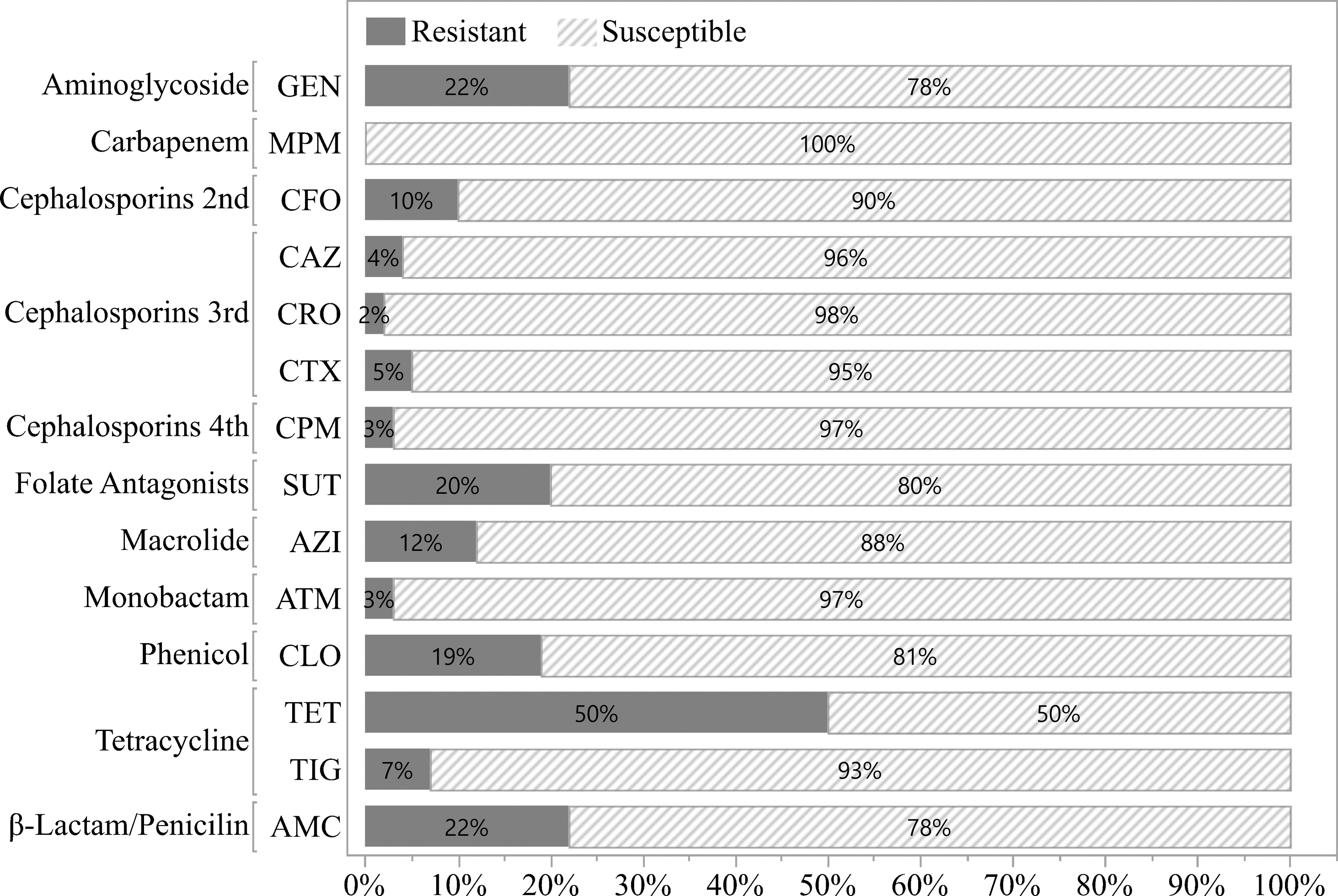
Frequency distribution of Escherichia coli isolates susceptible and resistant to antimicrobials of nine different classes in raw milk cheese produced in Minas Gerais, Brazil. Antimicrobials: amoxicillin/clavulanic acid (AMC), aztreonam (ATM), azithromycin (AZI), ceftazidime (CAZ), cefoxitin (CFO), chloramphenicol (CLO), cefepime (CPM), ceftriaxone (CRO), cefotaxime (CTX), gentamicin (GEN), meropenem (MPM), sulfamethoxazole/trimethoprim (SUT), tetracycline (TET), and tigecycline (TIG). 2nd, 3rd, and 4th are the second, third, and fourth generations, respectively.
Resistance Profile of 177 Escherichia coli Isolated Samples of Minas Artisanal Cheese, Minas Gerais, Brazil, to Nine Classes of Antimicrobials
CEF, cephalosporins; PEN, penicilin; MON, monobactam; AMI, aminoglycoside; MAC, macrolide; PHE, phenicol; FOL folate pathway antagonists; TET, tetracycline; SUS, susceptible to antimicrobial.
Cefepime, ceftriaxone, and cefotaxime resistance was observed only in region D. Resistance to second-generation (cefoxitin) cephalosporin and tigecycline was detected in isolates from three regions (B, C, and D). E. coli resistant to tetracycline and gentamicin was detected in all regions.
The occurrence of resistance to azithromycin in E. coli was 12% and was detected in E. coli isolates from cheese from the four regions. Azithromycin is an antimicrobial of the macrolide class that, unlike most macrolide agents, is used to treat diarrheal infections related to different Enterobacteriaceae (Gomes et al., 2019).
Multidrug resistance was detected in 29% (95% CI: 22.5–36.1) of the E. coli isolates and in almost 40% (38.8%; 95% CI: 26.4–52.7) of the cheese samples. The frequency of MDR isolates was different between the production regions (p < 0.05), and there was considerable variation between the regions (Fig. 3). The presence of MDR E. coli in cheese from region D was 14, 4, and 20 times more likely than in cheese from regions A, B, and C, respectively (Table 1). The distribution of MDR in artisanal cheese was heterogeneous among the producing regions, with a higher prevalence in region D and lower in C. On the contrary, regions B and C showed a higher percentage of susceptible E. coli isolates, and resistance to one or two antimicrobials was more frequent in isolates from regions A and C (Fig. 3).

Frequency distribution of Escherichia coli isolates that are susceptible, resistant to one to two, and resistant to more than three (MDR) antimicrobial classes in artisanal cheese produced in Minas Gerais, Brazil. MDR, multidrug-resistant.
Discussion
Human exposure to antibiotic-resistant bacteria and the resistance genes can occur via contact or consumption of contaminated food, especially by ready-to-eat food intake (Founou et al., 2016). This study analyzed the antimicrobial resistance of E. coli from artisanal cheese from raw milk collected at retail, a ready-to-eat food traditionally consumed in Minas Gerais. The results show that exposure to MDR E. coli is greater in artisanal cheese that had low E. coli populations. E. coli was frequently present in artisanal cheese samples, with a third of the samples having a population above the regulatory limit.
These results can be explained by the misuse or excessive use of antimicrobials in production animals, given that livestock exposure to low levels and prolonged exposure are possible contributors to the development of resistance (Vieira et al., 2011; Van Boeckel et al., 2015), favoring the survival of a small portion of the population resistant to antimicrobials. The use of endogenous starter culture called “pingo,” obtained according to a back-slopping procedure (De Filippis et al., 2016; Milani et al., 2020), can facilitate persistent of MDR isolates in cheese production ambient. The insects also can act with vectors in the introduction, spread, or maintenance of antimicrobial resistance in the environment of Minas artisanal cheese production.
Alves et al. (2018) isolated E. coli from flies collected in two dairy farms and detected multidrug resistance in 31% of the isolates, demonstrating that this vector can contribute to the spread of antimicrobial resistance. However, the results showed the heterogeneity of antimicrobial resistance in E. coli between the producing regions of Minas artisanal cheese, that is, the occurrence of antimicrobial resistance in E. coli is producer dependent, and does not characterize a specific producer region, as MDR was detected in all regions and susceptible isolates were detected in three of the four regions, including the region that presented an isolate resistant to eight antimicrobials.
The antimicrobials cefotaxime and ceftazidime (third-generation cephalosporins), meropenem (carbapenems), and azithromycin (macrolides) have been categorized as critically important by the World Health Organization (World Health Organization, 2019). Initial data from the Brazilian antimicrobial surveillance program (BR-GLASS) indicate that E. coli is the most common (32%) between Gram-negative species from hospitalized patients. Predominantly, associated urinary tract infections, representing 47% of inpatient urinary tract infections. E. coli isolated from these patients was resistant to ceftriaxone (15.9%), ceftazidime (4.2%), gentamicin (13.5%), and meropenem (3.2%) (Pillonetto et al., 2021).
Our results show an equal percentage of resistance for ceftazidime, a higher percentage for gentamicin, and a lower percentage for ceftriaxone and meropenem. The high rate of susceptibility to meropenem may reflect the nonuse of carbapenem antimicrobials in the raw milk cheese production chain in the Minas Gerais State. According to the Brazilian legislation, cefoperazone is the only third-generation cephalosporin that can be detected in foods of animal origin, in dairy cattle (Brasil, 2019b).
The microbiological resistance to cefoxitin suggests the presence of an AmpC enzyme in 10% of E. coli isolates. Resistance to tigecycline in 7% of the isolates can indicate some degree of exposure of cheese-producing animal species to resistant bacteria occurring in humans, via direct contact or through environmental routes of exposure, given that this antimicrobial is not normally used in animal production (European Food Safety Authority, 2012).
The high percentage of E. coli isolates resistant to tetracycline (50%; 95% CI: 43–57) can be explained by the widespread use of this antimicrobial in animal production. Unlike tetracycline, tigecycline represents a new group of tetracycline antibiotics called glycylcyclines that are active against pathogens such as extended-spectrum β-lactamase producers and is considered a last-resort drug against MDR Enterobacteriaceae (Linkevicius et al., 2013; Pournaras et al., 2016).
The occurrence of tigecycline resistance in isolates from the three regions alerts the dissemination of tigecycline-resistant isolates, given that colonized patients by tigecycline-resistant Klebsiella pneumoniae carbapenemase (KPC)-producing bacteria have not received tigecycline treatment, suggesting that dissemination is due to transfer from patient to patient or via food intake (Papadimitriou-Olivgeris et al., 2014; Pournaras et al., 2016). Tigecycline resistance cases have been reported in E. coli, including plasmid-mediated E. coli (He et al., 2019; Sun et al., 2019), and may be associated with other antimicrobials such as fluoroquinolones (Hornsey et al., 2010). Thus, the decrease in the use of antimicrobials in animals, especially tetracyclines and fluoroquinolones, would decrease the transmission of tigecycline resistance to humans via raw milk cheese intake.
Azithromycin resistance is of interest because of the potential risk of spreading to humans along the food chain, especially due to the plasmid transferability of macrolide resistance (Jost et al., 2016). The emergence of azithromycin resistance is of concern because it is of critical importance to human health.
Conclusion
This study revealed the significant occurrence of MDR E. coli in the raw milk artisanal cheese samples, evaluated, and demonstrated that this occurrence is heterogeneous among cheese from four traditional producing regions. Considering the prevalence and the E. coli counts identified in the samples evaluated, our results indicate that raw milk artisanal cheese can serve as potential sources of antimicrobial resistance in bacterial dissemination that may perpetuate in the human gastrointestinal tract by cheese consumption. In addition, continuous monitoring of antimicrobial resistance of foodborne pathogens in raw milk traditional cheese should be regularly done.
Footnotes
Acknowledgment
The authors acknowledge Fundação de Amparo à Pesquisa de Minas Gerais (FAPEMIG, Brazil).
Disclosure Statement
No competing financial interests exist.
Funding Information
This study was financially supported by Paulo de Souza Costa Sobrinho and Universidade Federal dos Vales do Jequitinhonha e Mucuri (scholarship to R.A.d.S.).