




Abstract
Enterococci have recently emerged as nosocomial pathogens worldwide. Their ubiquitous nature determines their frequent finding in foods as contaminants. In this study, we aimed to determine the counts, species diversity, antimicrobial resistance profile, and to screen for a set of virulence genes among enterococci. Enterococcus were identified from 75.7% (125/165) of chilled chicken carcasses, belonging to seven companies, sampled from retail markets in Abu Dhabi Emirate, United Arab Emirates (U.A.E.). Overall, the samples, with a mean Enterococcus count of 2.58 log10 colony-forming unit (CFU)/g with a standard deviation of ±1.17 log10 CFU/g. Among the characterized Enterococcus isolates (n = 90), Enterococcus faecalis was the predominant species (51.1%), followed by Enterococcus faecium (37.8%). Using Vitek2 automated antimicrobial sensitivity panel, we found none of the E. faecalis nor E. faecium to be resistant to ampicillin, teicoplanin, vancomycin, or tigecycline. A third of the E. faecalis (28.3%) and E. faecium (35.3%) were resistant to high-level gentamicin. Over half of E. faecalis (54.3%) were resistant to ciprofloxacin, and the same was in about a third of E. faecium isolates (29.4%). Linezolid resistance was identified in 10 E. faecalis and 7 E. faecium isolates belonging to samples from three companies. All of the linezolid-resistant isolates harbored oxazolidinone resistance optrA gene. Virulence-associated genes (asa1 and gelE) were significantly (p < 0.05) more detected among E. faecalis compared to E. faecium isolates recovered in this study. Over half of the E. faecalis (25/46) and E. faecium (20/34) isolates were identified as multidrug-resistant. This study provides further insight into virulence genes and their association with the dissemination of multidrug-resistant E. faecalis and E. faecium in supermarket chicken meat in the U.A.E. This is probably the first description of the optrA gene in enterococci from supermarket chicken meat in the U.A.E. and from Arab countries. This study adds to the regional and global understanding of antimicrobial resistance spread in foods of animal origin.
Introduction
The emergence of bacteria resistant to antimicrobials has become an alarming public health problem worldwide (Kim et al., 2021). The spread of antimicrobial resistance is further promoted among food animals; it can eventually be transferred to humans by introducing resistant bacteria, for instance, through direct contact with farm environments or on meat products that become contaminated during processing (Aidara-Kane, 2012). In particular, the increasing demand for chicken meat has led to a dramatic modernization of intensive poultry farming, including the regular use of antimicrobials in feed to promote growth and their therapeutic use. This selective pressure has dramatically increased the rate of resistance to various drugs in chicken microbiota, including commensals and pathogens alike.
Furthermore, horizontal gene transfer can enable the rapid exchange of resistance determinants between different bacterial lineages across hosts and environments (Arias et al., 2010; Aidara-Kane, 2012). Antimicrobial resistance contributes to increased morbidity and mortality in infection caused by exposure to foodborne bacteria; studies have linked antibiotic use in intensive animal production with antimicrobial-resistant bacteria isolated from humans (Kim et al., 2021).
The most frequently detected Enterococcus species in clinical and food samples of most significant importance to human health are Enterococcus faecalis and Enterococcus faecium. Although the enterococci are pathogenic only under specific conditions, they are now among the most common causes of human nosocomial infections, with E. faecalis considered the more pathogenic species because it is more likely to carry human virulence factors (Arias et al., 2010). Several virulence factors responsible for infections in humans have been described for Enterococcus spp. These virulence factors include aggregation and adhesions substances, cytolysin, gelatinase, extracellular surface proteins, and pheromones (Maasjost et al., 2019).
Despite the availability of anti-Gram-positive agents (e.g., vancomycin, linezolid, and tigecycline), enterococci have rapidly adapted, and resistance has emerged to all these newer agents (Hammerum, 2012). Because foods are potential vehicles for transmitting antimicrobial-resistant enterococci, monitoring contamination levels and antimicrobial resistance patterns of enterococci in food are of added value to public health and food safety (Aslam et al., 2012; Noh et al., 2020).
The analysis of global trends in the consumption of meat of all types indicates that the United Arab Emirates (U.A.E.) is among the leading countries in the consumption of poultry meat (∼60 kg/capita per year) (United States Department of Agriculture [USDA], 2021). Most poultry farms are located in the Emirate of Abu Dhabi, as it accounts for >70% of U.A.E. agricultural production (USDA, 2021). However, despite the growing demand and the high per capita consumption, there is a scarcity of reports on the microbiological safety and hygienic status of chicken meat produced and retailed in the U.A.E. (Habib et al., 2021).
Moreover, minimal research has been done on the spread of antimicrobial resistance and antibiotic use patterns in the chicken industry and other animal production sectors in the U.A.E. (Habib et al., 2021). Such a knowledge gap prompted the current study to (1) evaluate Enterococcus population and species diversity as an indicator of fecal contamination, (2) screen for selected virulence genes and profile Enterococcus resistance to some of the clinically relevant antibiotics, and (3) identify rates of multidrug resistance in isolates recovered from different producers supplying the U.A.E. fresh (chilled) chicken carcasses. This study adds to the regional and global understanding of antimicrobial resistance spread in foods of animal origin.
Materials and Methods
Study design and sampling
The number of samples was estimated based on an assumed prevalence of 50%, with the desired confidence level of 99% and a 10% margin of error. Matching these criteria with the capacity and feasibility of sampling and laboratory testing and taking into consideration sampling from different producers over different months, a total of 165 samples were collected from July to December 2021. Chicken carcass samples were collected from different supermarkets (n = 14) in Abu Dhabi Emirate. Samples comprise seven different poultry processing companies (each brand/company represents a different producer), of which six are U.A.E.-based companies, and one (company F) is supplied from neighboring Saudi Arabia. All seven brands are from conventional production systems (none was organic), and the brands are widely presented throughout the U.A.E. retail supermarkets. One sample per production batch (unique sample barcode) was included to assure sampling variability.
All samples were collected from chilled prepackaged self-service packs presented on supermarket shelves for direct consumer sale. Samples were transported in insulated containers with ice bricks (6–8°C) on the same day as retail purchase to the Veterinary Public Health Research Laboratory at the U.A.E. University for testing. All examinations were enabled within 6 h of collection.
Isolation and enumeration of Enterococcus
Enumeration of enterococci was conducted according to previously published methods using a surface spread technique (Ellis-Iversen et al., 2020). For whole chicken carcasses, the sample was taken from the neck skin if the chicken neck was present and from breast skin if the neck was not present. A test portion of 10 g was transferred to nine volumes (90 mL) of 0.1% peptone water (1 g bacteriological peptone [Oxoid, Basingstocke, England] in 1 L of sterile deionized water) and homogenized in a stomacher blender for 1 min. From this initial homogenate (10−1), one further serial dilution (10−2) was made in 0.1% peptone water. From each of the two dilutions (10−1 and 10−2), 0.1 mL was streaked onto Slanetz and Bartley agar (Oxoid) and incubated at 41.5°C for 48 h (Ellis-Iversen et al., 2020).
According to standard methods, up to five presumptive Enterococci colonies were identified to the genus level by Gram staining, catalase test, and growth in NaCl 6.5% broth, as well as growth and esculin hydrolysis on bile-esculin agar (Oxoid) (ISO, 2013; Ellis-Iversen et al., 2020). From each agar plate, up to two confirmed colonies resembling Enterococcus-positive culture were selected for species verification (and later, one isolate from each confirmed positive sample was analyzed for antimicrobial susceptibility). Isolates were stored at −80°C in brain heart infusion (Oxoid) containing 50% (v/v) glycerol for further use. The Vitek 2 compact system (bioMérieux, Marcy l'Etoile, France) Gram-positive identification test cards were used to identify the species of presumptive Enterococcus-positive colonies.
Antibiotic susceptibility testing
In this study, Enterococcus spp. susceptibility to 10 antibiotics (9 antibiotic classes) was determined using a Vitek AST-P592 card (bioMérieux) that tested for ciprofloxacin (CIP), tetracycline (TET), erythromycin (ERY), ampicillin (AMP), high-level gentamicin (HLG), high-level streptomycin (HLS), vancomycin (VAN), teicoplanin (TEI), tigecycline (TIG), and linezolid (LIN) resistance. According to the manufacturer's instructions, isolates were considered susceptible, intermediate, or resistant, utilizing the Clinical and Laboratory Standards Institute guidelines (M100-S27) (CLSI, 2019). Multidrug resistance was defined as resistance to at least three different classes of the antibiotics panel used (Magiorakos et al., 2012). Enterococcus fecalis A.T.C.C. strain 29212 was used as a reference strain for each batch of the Vitek2 testing runs.
PCR-based screening of virulence and resistance genes
All of the isolates confirmed as E. faecalis and E. faecium were screened for the presence of five virulence genes (asa1 [aggregation substance], gelE [gelatinase], cylA [cytolysin], esp [enteroco0ccal surface protein], and hyl [hyaluronidase]). Bacterial DNA extraction and multiplex PCR analysis were performed according to protocols described by Vankerckhoven et al. (2004). Among linezolid-resistant Enterococcus (LRE) isolates, the presence of optrA, cfr, and poxtA genes was screened using a previously described protocol of a multiplex PCR, described by Egan et al. (2020). The primer sequences used for multiplex PCRs of virulence and resistance genes are described in Supplementary Table S1.
Data analysis
For a descriptive summary of enumeration results, Enterococcus counts (colony-forming unit [CFU]/g) were converted to a logarithmic scale (base 10) to approximate the results to normal distribution. Different types of retail samples were clustered within each poultry processing company, and this was accounted for in the analysis by using the procedures xtpoisson (random-effects Poisson regression model) in the S.T.A.T.A. statistical software, version 16.0 (S.T.A.T.A. Corporation, TX). Enumeration data exhibited a skewed distribution, and Poisson regression was not always the best-fit model. Therefore, a negative binomial model was used to account for extra-Poisson variation. Comparing categories frequencies was analyzed by Fisher's exact test or unpaired t-test. Differences with p-values <0.05 were considered significant.
Results
Overall Enterococcus counts
Using direct surface plating, Enterococcus were recovered from 75.7% (125/165) of the fresh whole-chicken carcass samples, with a mean Enterococcus population of 2.58 log10 CFU/g (Table 1). Variation was evident between samples from the seven poultry processing companies regarding the overall direct plating recovery of Enterococcus (Table 1). Samples from companies A and E presented significantly higher (p < 0.05) average of Enterococcus counts (Table 1). The frequency distribution range of the counts reveal that the proportion of samples contaminated with Enterococcus at a level of ≥3 log10 CFU/g was 100% and 44.2% of the samples belonging to companies A and G, respectively (Fig. 1). Samples from companies F and D presented significantly (p < 0.05) lower mean of counts, as well as significantly (p < 0.05) lower overall recovery rate (<1 log10 CFU/g) of Enterococcus compared to samples from the other producers (Table 1 and Fig. 1).

Frequency distribution of Enterococcus counts in chilled chicken carcasses (n = 165) sampled from brands of seven different companies
Enterococcus Counts in Chicken Carcasses From Seven Different Companies (A–G) Presented at Retail Markets in the United Arab Emirates
One sample per production batch (unique sample barcode) was included.
Samples greater than or equal to the limit of quantification (1 log10 CFU/g).
CFU, colony-forming unit.
Diversity of Enterococcus species
Among Enterococcus isolates (n = 90; one isolate per sample) recovered (n = 35 did not recover) from frozen stock, we identified E. faecalis (51.1%) as the predominant species, followed by E. faecium (37.8%) (Fig. 2). The frequency of E. faecalis presence in samples of company G was significantly higher (p < 0.05, Fig. 2) than its rates in samples from the other brands. Among samples of the seven companies included in this study, other Enterococcus species were presented infrequently, such as E. durans (4.4%), E. gallinarum (3.3%), E. hirae (2.2%), and E. avium (1.1%) (Fig. 2).
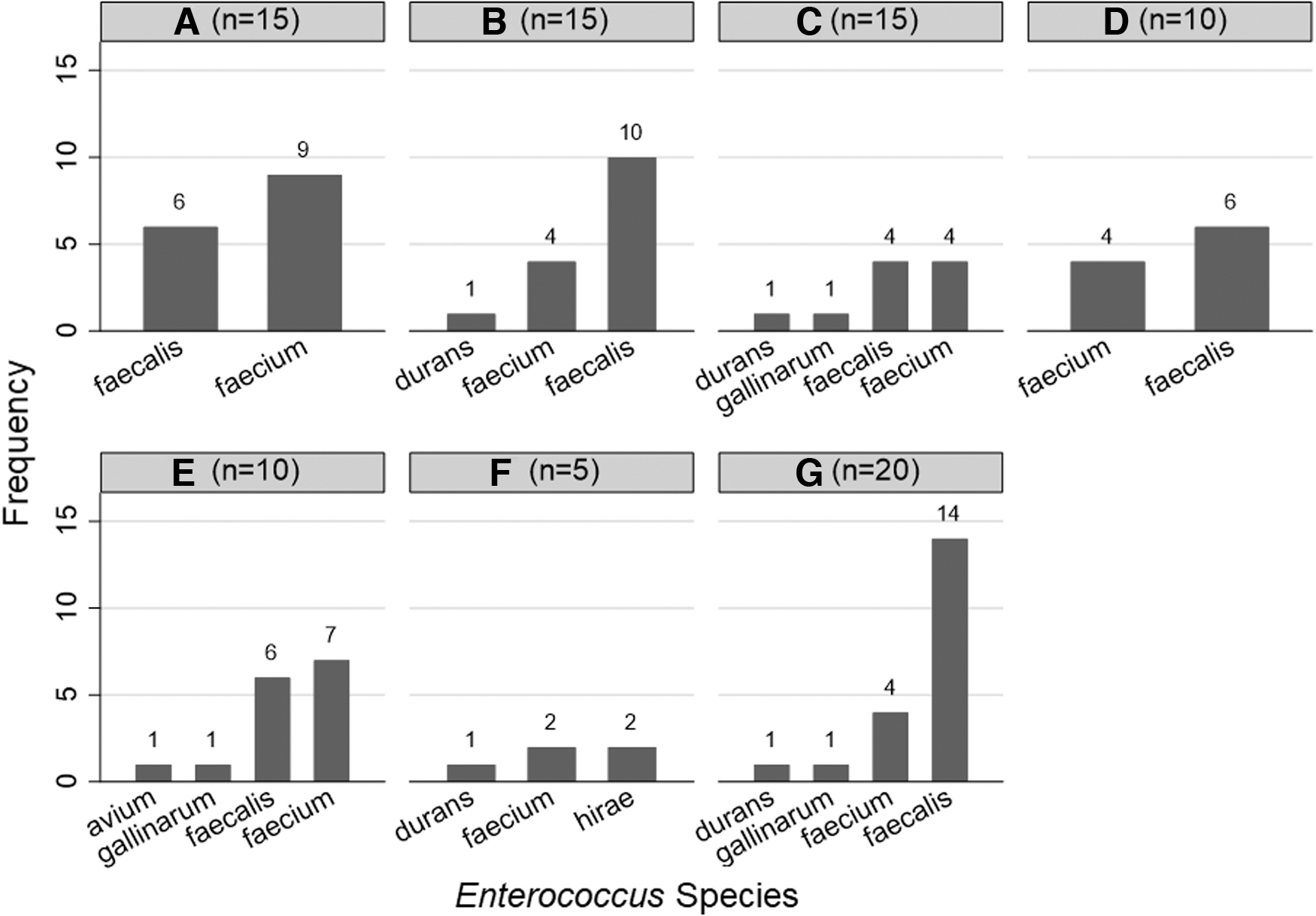
Identification of 90 Enterococcus isolates from chicken carcasses sampled from brands of 7 different companies
Antibiotic susceptibility of Enterococcus isolates
Neither E. faecalis nor E. faecium isolated from supermarket chicken in the U.A.E. was clinically resistant to ampicillin, vancomycin, teicoplanin, or tigecycline (Table 2). Three E. gallinarum isolates recovered in this study were not susceptible to vancomycin. The highest frequency of resistance among E. faecalis and E. faecium isolates was against tetracycline, followed by erythromycin (Table 2). As presented in Table 2, about a third of the E. faecalis (28.3%) and E. faecium (35.3%) were resistant to HLG (≥1024 μg/mL). Most of the isolates showing resistance to high-level gentamicin were attributed to samples from company G [46.2% (12/26)], followed by company B [26.9% (7/26)]. Results in Table 2 indicate that over half of E. faecalis (54.3%) were resistant to ciprofloxacin, and the same was in about a third of E. faecium isolates (29.4%). About a third [30% (12/40)] of the ciprofloxacin-resistant enterococci were isolated from samples of company G.
Distribution of Antibiotics Susceptible, Intermediate, and Resistant Enterococcus Faecalis and Enterococcus Faecium Isolated from Chicken Carcasses Sampled from Retail Markets in the United Arab Emirates
Linezolid resistance (minimum inhibitory concentration [MIC] ≥8.0 mg/L) was detected in 17 isolates, of which 10 were identified as E. faecalis and 7 as E. faecium. LRE isolates were recovered from samples belonging to companies A (58.8%), G (35.3%), and D (5.9%). The optrA gene was detected in all 17 LRE, while the cfr gene was not detected. Both optrA and poxtA genes were detected in 1 E. faecium isolate (Supplementary Fig. S1).
Results in Table 3 indicate that just over half of the E. faecalis and E. faecium isolates characterized in this study were identified as multidrug-resistant (MDR). Of note was that about a quarter (26%) of the E. faecalis exhibited coresistance to four antibiotic classes. Ciprofloxacin resistance was evident, along with tetracycline and erythromycin resistance, among the common MDR phenotypes of E. faecalis; on the contrary, ciprofloxacin resistance was not evident among the common MDR phenotypes of E. faecium (Table 3).
Antibiotic Resistance Patterns of Enterococcus Faecalis and Enterococcus Faecium Isolated from Chicken Carcasses Sampled from Brands of Seven Different Companies Presented at Retail Markets in the United Arab Emirates
CIP, ciprofloxacin; ERY, erythromycin; HLG, high-level gentamicin; HLS, high-level streptomycin; LIN, linezolid; MDR, multidrug-resistant; TET, tetracycline.
Virulence genes screening
The distribution of virulence genes in the characterized E. faecalis (n = 46) and E. faecium (n = 36) isolates from the seven brands is depicted in Figure 3. Only asa1 and gelE genes were detected, either individually or in combination. Virulence-associated genes (asa1 and gelE) were significantly (p < 0.05) more prevalent among E. faecalis compared to E. faecium (Fig. 3). Among linezolid-resistant enterococci, the asa1 gene was the most frequently detected virulent determinant, as detected in 11 out of 17 isolates, followed by gelE gene in 4 isolates. Both asa1 and gelE genes were concurrently detected in three linezolid-resistant E. faecalis.

Distribution of the virulence genes detected by PCR in Enterococcus faecalis and Enterococcus faecium isolated from chicken carcasses sampled from retail markets in the United Arab Emirates.
Discussion
This study presents the first published analysis of Enterococcus bacteria isolated from supermarket chicken meat in the U.A.E. Similar to our results, E. faecalis was the most common Enterococcus species reported in chicken meat based on studies from South Korea Canada, and China (Liu et al., 2013; Kim et al., 2021). The mean load of Enterococcus in chicken carcasses observed in this study (2.58 log10) was comparable to other studies testing conventional chilled chicken carcasses in South Korea (2.90 log10), as well as chicken meat in Slovakia (2.40 log10) and Spain (2.06 log10) (Ducková, 2007; Miranda et al., 2007; Kim et al., 2018). In comparison, a higher mean load of Enterococcus was reported in the neck skin of chicken carcasses in Egypt (4.80 log10) (Abdallah and Eldaly, 2019).
Furthermore, the detection rates and count distributions of Enterococcus spp. varied according to the companies of origin (Table 1). These results possibly reflect some evident variability in the hygienic processing and quality management practices exhibited across the suppliers of fresh chicken meat in the U.A.E. Several studies have reported that bacterial contamination in chicken carcasses varies depending on processing practices and the conditions in which the chickens were reared (Lisa et al., 2017). These results call for closer monitoring of the sanitary quality of fresh chicken meat in the U.A.E. market, because the presence of Enterococcus indicates possible intestinal contamination or prepackaging cross-contamination with the soiled processing environment (Cordero et al., 2019).
Our results revealed no clinical resistance to critically important antimicrobials such as ampicillin, vancomycin, teicoplanin, or tigecycline in E. faecalis and E. faecium recovered from chicken meat at the U.A.E. supermarkets. These results convey a positive insight regarding the usage of some critical antimicrobials in the poultry sector in the U.A.E. Similar to our finding, a study in the United States found no vancomycin nor tigecycline in isolates of Enterococcus cultured from raw chicken meat purchased at supermarkets (Manson et al., 2019). Good antimicrobial stewardship in the animal industry and strict antimicrobial registration procedures and control measures by the U.A.E. local and federal controlling authorities are crucial for maintaining susceptibility to critical antimicrobials in animals and humans.
Our study revealed that most enterococci isolated from supermarket chicken meat were resistant to tetracycline and erythromycin (Table 2). Although tetracycline and erythromycin are generally not used to treat enterococcal infections in humans, this finding still could be concerning given that resistance genes can be transferred to other gut bacteria, hence find their way to humans through the food chain (Hammerum, 2012; O'Dea et al., 2019). On the contrary, the present study reported a high frequency of HLG resistance in enterococci from samples originating from selected chicken meat companies. Consumer exposure to HLG-resistant enterococci could be arising from improper handling of contaminated raw chicken meat.
Previous research proved the spread of enterococci with HLG-resistance from animals to humans through the food chain (Sparo et al., 2018). It has been shown that enterococci isolated from food of animal origin and humans carried the same aminoglycosides-resistant genes (Hammerum et al., 2012). Due to its highly adaptive capabilities, enterococci in food can colonize the digestive tract, increasing the danger of gene transfer to the intestinal microflora (Giraffa, 2002). Hence, our finding that about a third of E. faecalis and E. faecium in fresh chicken carcasses tested in this study are HLG-resistant, which could be of concern to human health.
Our study revealed that over half of E. faecalis and about a third of E. faecium isolates were resistant to ciprofloxacin. From a clinical perspective, ciprofloxacin is considered to have only modest activity against enterococci and is not used as a drug of the first choice, for instance, in the treatment of enterococcal urinary tract infection (Arias et al., 2010). Nevertheless, such finding on the abundant presence of ciprofloxacin-resistant enterococcal isolates in supermarket chicken meat should be of concern to public health, given that genes encoding ciprofloxacin resistance in enterococci may be transferred to bacteria in the animal gut and to zoonotic bacteria where they could pose a human health hazard (Kim et al., 2021).
Seventeen Enterococcus isolates showed clinical resistance to linezolid (MIC ≥8.0 mg/L), which is considered one of the last lines of defense against vancomycin-resistant enterococci and methicillin-resistant Staphylococcus aureus (Freitas et al., 2020). Although linezolid is not approved to be used in food-producing animals, the resistance to this antimicrobial agent in animals has been reported in the United States, Europe, Asia, and Australia (Freitas et al., 2020; Yoon et al., 2020). In this study, linezolid-resistant E. faecalis and E. faecium isolates were detected in isolates originating from three of the seven companies, which is a matter of concern. To be sure that the phenotypic resistance to linezolid is not a platform (Vitek 2) associated, we performed screening using PCR for selected genes known to be associated with linezolid-resistant Enterococcus spp.
All of the linezolid-resistant E. faecalis and E. faecium isolates in this study harbored an oxazolidinone resistance gene, optrA. The optrA gene is transferable and has been found on plasmids that harbor resistance to other critical antimicrobial classes such as macrolide–lincosamide–streptogramin B, aminoglycoside, and phenicols (Sassi et al., 2019). To the best of our knowledge, this is the first description of the optrA gene in E. faecalis and E. faecium isolated from supermarket chicken meat in the Middle East. We also detected the phenicol–oxazolidinone resistance gene poxtA and optrA gene in one linezolid-resistant E. faecium isolate. Acquired linezolid resistance has been strongly linked to animals where the use of phenicol and macrolides (linked to optrA) or tetracycline (linked to poxtA) might coselect resistance to different antibiotic families (Elghaieb et al., 2019; Na et al., 2020).
Whether linezolid resistance in E. faecalis and E. faecium isolated from supermarket chicken meat in U.A.E. is being coselected by using phenicol or other antimicrobials in the poultry sector remains to be clarified. The presence of linezolid-resistant isolates at retail and in farms should be monitored further across the chicken meat supply in the U.A.E.
Our PCR-based screening revealed two virulence-associated genes (asa1 and gelE) among isolates recovered from retail chicken. Gelatinase (gelE) is an extracellular metalloprotease, able to hydrolyze gelatin, collagen, and hemoglobin, which has also been reported to contribute to bacterial adherence and biofilm formation (Vankerckhoven et al., 2004). Aggregation substance (e.g., asa1) has also been reported to increase adherence and invasion of eukaryotic cells, as well as promote biofilm formation (Pillay et al., 2018).
Our results indicate a higher frequency of virulence genes among E. faecalis isolates, which agrees with other studies showing a high prevalence of virulence factors in E. faecalis compared to E. faecium of food origin (Aslam et al., 2012; Maasjost et al., 2019; O'Dea et al., 2019). The information about virulence and resistance genes found in animal-derived enterococci is helpful to characterize such potential hazards better, The harboring of virulence and resistance genes by E. faecalis may pose a human health risk if these bacteria are ingested through undercooked meat (Eaton and Gasson, 2001).
In the present study, the frequency of MDR among E. faecalis and E. faecium was comparable to those that were concluded by other studies screening isolates from food of animal origin (Kim et al., 2018). Enterococci often acquire antibiotic resistance by exchanging resistance-encoding genes carried on conjugative transposons, pheromone-responsive plasmids, and other broad-host-range plasmids (Noh et al., 2020). Jahan et al. (2015) demonstrated that the gene determining resistance to tetracycline and streptomycin was transferred from food-derived E. faecium and E. faecalis strains to clinical strains. Hence, exposure to raw and processed food contaminated with multidrug-resistant microorganisms could potentially impact human health.
Conclusions
Vancomycin, ampicillin, teicoplanin, and tigecycline resistance were not detected in E. faecalis and E. faecium isolates from chicken meat in this study. However, a sizable amount of the characterized isolates was resistant to essential drugs used to treat complicated enterococcal infections, such as HLG and linezolid. It was noteworthy that we found an abundant rate of MDR Enterococcus isolates, especially E. faecalis, which calls for periodic monitoring of chicken and poultry environment to assess the transmission and persistence of resistant Enterococcus spp. This is probably the first description of the optrA gene in enterococci from supermarket chicken meat in the U.A.E. and Arab countries. Given the gap in knowledge on antimicrobial resistance situation in the food chain across the Middle East, these results add to our understanding of the local, regional, and global epidemiology of antimicrobial resistance in Enterococcus spp.
Footnotes
Authors' Contributions
Conceptualization, I.H., M.K., and D.L.; Formal analysis, G.B.L.; Investigation, M.Y.I.M. and A.G.; Project administration, I.H.; Supervision, I.H., M.K., and D.L.; Writing-original draft, I.H.; Writing-review and editing, I.H., G.B.L., M.Y.I.M., A.G., M.K., and D.L.
Ethics Statement
This study did not involve any animal experiments.
Disclosure Statement
No competing financial interests exist.
Funding Information
This research was funded by the United Arab Emirates University (U.A.E.U.)-Asian University Alliance (A.U.A.) grant number 12R009. The grant was facilitated through the UAEU-Zayed Center for Health Sciences.
Supplementary Material
Supplementary Figure S1
Supplementary Table S1
References
Supplementary Material
Please find the following supplemental material available below.
For Open Access articles published under a Creative Commons License, all supplemental material carries the same license as the article it is associated with.
For non-Open Access articles published, all supplemental material carries a non-exclusive license, and permission requests for re-use of supplemental material or any part of supplemental material shall be sent directly to the copyright owner as specified in the copyright notice associated with the article.
