




Abstract
This study aimed to investigate the drug resistance, molecular characteristics, and genetic relationship of extended-spectrum β-lactamase (ESBL)-producing Escherichia coli isolated from food and human stool samples in northern Xinjiang. From 2015 to 2016, a total of 431 samples (meats and vegetables) were collected from retail markets and supermarkets located in the regions of Urumqi, Shihezi, and Kuitun in Xinjiang, China, and 20 human stool samples from the Shihezi Hospital. The PCR method was used to detect E. coli, and the presence of ESBL-producing E. coli was confirmed using the K-B disk diffusion confirmatory method. The susceptibility to ESBL-producing E. coli was tested by the microdilution broth method, and the minimum inhibitory concentration was determined. PCR was used to detect the resistance and virulence genes of ESBL-producing E. coli, and phylogenetics, plasmid replicon typing, screening of three integrons, and multilocus sequence typing (MLST) were performed. The results showed that 127 E. coli strains (15 human stool and 112 food samples) were isolated. Out of the 127 E. coli strains, 38 strains (6 human stool and 32 food 34 samples) of ESBL-producing E. coli were identified through screening. These 38 strains showed resistance to cefotaxime (94.74%) and cefepime (94.74%), and were sensitive to meropenem (0.00%). The most detected resistance genes were blaTEM (47.37%), and the most detected virulence genes were fimH (97.73%), ompA (97.73%), hlyE (97.73%), and crl (97.37%). The isolates belonged to phylogroups B1 (42.11%), C (23.68%), and A (21.05%). Among the plasmid replicon subtypes, IncFIB was the main type (42.11%). The integrons detected were of the first type (47.37%) and the third type (26.32%). The 38 E. coli strains had 19 different sequence-type (ST) strains. These 38 strains of ESBL-producing E. coli were analyzed using MLST and STs are varied.
Introduction
E
The genotypes of ESBLs prevalent in different regions are not the same due to the differences in physicochemical and drug resistance properties (Bush et al., 1995). The genotypes of ESBLs are mainly divided into blaTEM , blaSHV , and blaCTX-M (Shaikh et al., 2015), with blaCTX-M -type β-lactamase E. coli being the most common in China (Shu et al., 2016; Yang et al., 2019).
Although the number of clinical studies on ESBLs has significantly increased in recent years, here remains a paucity of comparisons between food-derived and human-derived ESBLs, which are usually related to plasmids, also confirming that plasmids are the main factors affecting the multiple resistance of E. coli. Besides, integrons play a vital role in the spread of antibiotic resistance in Gram-negative bacteria, especially E. coli, which is capable of gene transfer and cassette capture (Guerin et al., 2011; Nardelli et al., 2012; van Essen-Zandbergen et al., 2007; Woodford et al., 2009). Plasmids, integrons, and other mobile genetic elements are readily accessible to E. coli, leading to the acquisition of resistance in E. coli (Bennett, 2008; Carattoli, 2009).
The molecular characteristics of ESBL-producing E. coli have been observed and confirmed worldwide for the spread and evolution of drug resistance. However, the data pertaining to the molecular characterization, clustering, and multilocus sequence typing (MLST) analysis of human stool-and food-derived samples for screening ESBL-producing E. coli were scarce. Therefore, this study aimed to determine the prevalence of E. coli and the characteristics of the ESBL-producing E. coli strains in food and human disease samples collected from the northern region of Xinjiang, China, to provide scientific guidance for the rational use of antibiotics in clinical practice in this region.
Materials and Methods
Sample collection, isolation, and identification of E. coli, and screening of ESBL-producing isolates
From 2015 to 2016, a total of 431 food samples (156 samples of meat, 241 samples of vegetables, and 34 samples of raw milk) were collected from different supermarkets and markets located in the northern region of Xinjiang, China, and 20 human stool samples from the Shihezi Hospital. E. coli was isolated and cultured in lauryl sulfate tryptose (LST) broth and EC broth (Qingdao Hope Bio-Technology Co. Ltd.), following which it was purified in an eosin-methylene blue (EMB) agar (Qingdao Hope Bio-Technology Co. Ltd.). Finally, the strain was biochemically identified according to the GB4789.38-2016 standard (China Food and Drug Administration, 2016). Finally, the E. coli β-
According to the recommendations of the Clinical and Laboratory Standards Institute (2020), drug susceptibility disks CTX and cefotaxime–clavulanic acid were used for screening ESBL-producing E. coli. This was verified via a phenotypic confirmatory test using the double paper codiffusion method. The difference in the diameter of the bacteriostatic ring between the two drug-sensitive paper sheets ≥5 mm was used to determine an ESBL-producing positive strain (China Food and Drug Administration, 2016). E. coli ATCC25922 was used as the quality control strain to determine the characteristics of ESBL-producing E. coli in food and humans.
Antibiotic-sensitivity experiment
The susceptibility test using E. coli ATCC25922 was conducted using the agar dilution method. A total of 19 antibiotics were administered, representing 7 antimicrobial classes, including cefuroxime, cefotaxime, cefixime, ceftriaxone, cefepime, gentamicin, kanamycin, imipenem, meropenem, chloramphenicol, nalidixic acid, ofloxacin, ciprofloxacin, tetracycline, ampicillin, methicillin, amoxicillin, piperacillin, and polymyxin B. Minimum inhibitory concentration (MIC) and antimicrobial susceptibility were determined according to the CLSI guidelines (Clinical and Laboratory Standards Institute, 2020). The MICs of each strain were determined by the microdilution broth method. The minimum drug concentration for the bacteria-free growth plate was defined as the MIC according to the cutoff point value standards recommended by CLSI: resistant (R), susceptible (S), and intermediate (I) (Clinical and Laboratory Standards Institute, 2020).
Detection of drug-resistant genes and virulence genes
The seven drug-resistant genes (CTX-M-2, CTX-M-9, CTX-M-8/25, blaTEM , blaSHV , blaOXA , and mcr-1) of the obtained isolates were detected using PCR (Dallenne et al., 2010; Kojima et al., 2005; Rebelo et al., 2018) (Supplementary Table S1). Similarly, 15 virulence genes (sfa/foc, afa/dra, kpsMT II, papA, iutA, fimH, hlyE, papC, ompA, crl, stx1, stx2, eae, ipaH, and aggR) of the isolates were detected using conventional PCR (Dias et al., 2010; Iveth Miranda-Estrada et al., 2017; Johnson et al., 2003; Khafipour et al., 2011; Pereira et al., 2011; Silva et al., 2009; Wu et al., 2014) (Supplementary Table S2).
Identification of phylogenetic groups and typing of plasmid replicons
Using four genes (chuA, yjaA, arpA, and TspE4.C2) and two complementary genes (ArpAgpE and trpAgpC) (Supplementary Table S3), E. coli was divided into eight recognized phyla, of which seven belonged to E. coli in the strict sense (A, B1, B2, C, D, E, and F) and one corresponded to E. coli branch I (Clermont et al., 2013) (Supplementary Table S4). The presence or absence of the four genes (+ represented positivity) in Supplementary Table S4 allowed the determination of the phylogenic group to which each strain belonged. Moreover, the plasmid replicon typing was performed via PCR analysis involving 18 plasmids (HI1, HI2, I1, X, L/M, N, FIA, FIB, W, Y, P, FIC, A/C, T, FIIS, FrepB, K/B, and B/O) to classify the plasmid-incompatible components in ESBL-producing E. coli isolates (Carattoli et al., 2005) (Supplementary Table S5).
Furthermore, PCR was considered for screening class 1 integron (Int1), class 2 integron (Int2), and class 3 integron (Int3) (Shafiq et al., 2021) (Supplementary Table S6).
Multilocus sequence typing
Seven housekeeping genes (adk, fumC, gyrB, icdA, mdh, purA, and recA) for the MLST test of E. coli were typed according to the details available on the MLST website as the target gene (Wirth et al., 2006). The primers for the seven housekeeping genes are listed in Supplementary Table S7. After PCR and gel electrophoresis, the PCR products were sent to Qingdao Sequencing Company of Ruiboxing Co., Ltd. for phase bidirectional sequencing and splicing. The sequences were submitted to the MLST website to obtain the allele sequence numbers for each housekeeper, and the allele sequence numbers of the seven housekeeping genes formed the allele spectrum of the strain. The allele spectrum was then submitted to the Pasteur database to obtain the sequence-type (ST) model of the strain.
The tandem sequences of the seven housekeeping genes were imported into BioNumerics V8.0 software to construct a phylogenetic tree and a minimum spanning tree based on sequence homology.
Results
Isolation, identification, and screening of ESBL-producing strains of E. coli
In this study, 112 strains of foodborne E. coli were isolated from 431 food samples collected from various parts of northern Xinjiang in China, and 15 strains of human E. coli strains were isolated from 20 human stool samples obtained from the Shihezi Hospital. Of 112 strains, 38 E. coli strains producing ESBLs were identified using the phenotypic confirmation test via the double-disk diffusion method (Table 1). Table 1 shows that the screening rate of ESBLs in Urumqi was the highest (41.18%) compared with the three sampling sites. The ESBL screening rate of meat samples was higher than that of human samples and vegetable samples.
Screening of Escherichia coli Producing Extended-Spectrum β-Lactamases from Supermarkets in Urumqi, Shihezi, and Kuitun, Xinjiang
Data of the second type represent the Escherichia coli strains isolated from 127 samples. Shihezi:Shihezi No. 2 Hospital; Long shopping supermarket; Kuitun: Star Supermarket; Urumqi: Good hometown supermarket; Long Tesco supermarket
ESBL, extended-spectrum β-lactamase.
Antibiotic resistance
The resistance rate of 38 ESBL E. coli strains to cefuroxime, cefotaxime, cefixime, ceftriaxone, and cefepime was 78.95% (30/38), 94.74% (36/38), 86.84% (33/38), 86.84% (33/38), and 94.74% (36/38), respectively. However, they were sensitive to meropenem (Table 2). Table 2 shows that the resistance rates of human samples to various antibiotics were higher than those of vegetable and livestock meat samples.
Antibiotic Resistance of Escherichia coli Producing Extended-Spectrum β-Lactamase
MIC sensitivity standard according to the Clinical and Laboratory Standards Institute (2020). MIC50 and MIC90:MIC50 and MIC90 were the MICs required to inhibit the growth of 50% and 90% of the test cells in a single batch. The range of antibiotics tested according to the Clinical and Laboratory Standards Institute (2020).
ESBL, extended-spectrum β-lactamase; MIC, minimum inhibitory concentration.
Detection of drug-resistant and virulence genes
Of the 38 ESBL-producing E. coli strains, 17 (44.74%) harbored blaTEM , 8 (21.05%) harbored blaCTX-M , and 4 (10.53%) harbored blaOXA . Although 7 (18.42%) of the 38 E. coli strains were resistant to ofloxacin, only 2 (5.26%) harbored mcr-1, and none of the remaining resistance genes was detected in these 38 E. coli strains. We found that the most common combination of genes was blaTEM + bla CTX (15.79%, 6/38), followed by blaOXA +blaTEM (5.26%, 2/38) (Fig. 1). Figure 1 shows that blaTEM was the dominant resistance gene; it was mainly present in meat samples, less in human stool samples, and not detected in vegetable samples. All four resistance genes (mcr-1, blaOXA , blaTEM , blaCTX-M-9 ) were detected in sample 07 (meat sample).
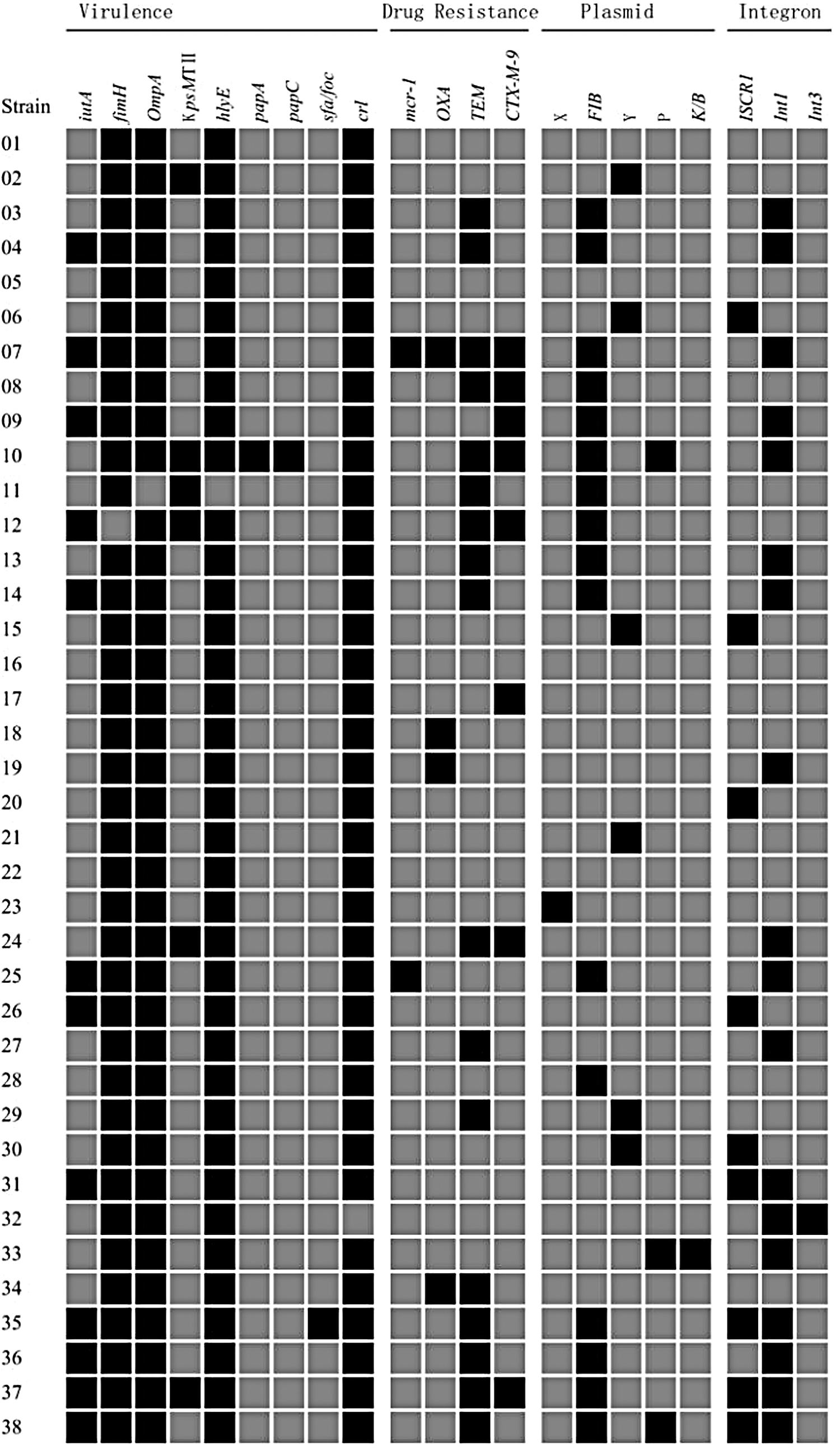
Heat map of antibiotic resistance genes, virulence gene, plasmid replicon genes, and integron genes (black squares indicate detection of study gene in these isolates, and gray squares represent absence of genes).
Similarly, out of these 38 strains, 20 (52.63%) harbored fimH, ompA, hlyE, and crl; 9 (23.70%) harbored intA, fimH, crl, hlyE, and ompA (Table 3).
Combination Pattern of Virulence Genes of Extended-Spectrum β-Lactamase Escherichia coli Isolated from Food and Human
Molecular characteristics of ESBL-producing E. coli
The phylogenetic analysis was performed on the ESBL-producing E. coli isolates. The isolates were divided into three populations (A, B1, and C), with B1 as the dominant bacterium group. The isolates belonged to phylogroups B1 (n = 16), C (n = 9), A (n = 8), and unknown (n = 5). Only one ESBL human isolate belonging to phylogenetic Group B1 was found commonly in meat and vegetable samples (Fig. 2). Plasmid replicon typing was also performed on these isolates, and the results obtained were as follows: 16 of 38 strains were of IncFIB type (42.11%), 6 strains were of IncF type (15.79%), 3 strains were of IncP type (7.89%), 1 strain was of IncK/B type, and 1 strain was of IncX type (2.63%).

Cluster analysis of genetic relationship among 23 strains of 19 ST food-derived and human-derived Escherichia coli (only 23 of 38 E. coli isolates were successfully sequenced at the time of MLST. Therefore, 23 isolates were studied in MLST; 19 represents that only 19 STs were detected). MLST, multilocus sequence typing; ST, sequence-type.
Figure 1 shows that FIB was the dominant plasmid replicon gene, IncFIB was mainly present in human stool samples (sample nos. 8–13), and the rest were present in pork samples. The results of integron screening showed that 18 of 38 strains belonged to class 1 integrons (47.37%) (IntI1), 10 strains belonged to class 3 integrons (26.32%) (9 strains belonged to ISCR1 and 1 strain belonged to IntI3), and no class 2 integron was found (Fig. 1).
MLST results
The MLST was used to amplify and sequence seven housekeeping genes, and determine whether the strains were related by comparing the differences between sequences. Moreover, MLST helped examine germ line development relations among bacteria from an evolutionary perspective, with the advantage of easy-to-standardize data, and the results of different laboratories could be compared with each other through a database. Only 23 of 38 E. coli isolates were successfully sequenced at the time of MLST, and therefore, 23 isolates were studied in MLST. The ST strains obtained from E. coli were as follows: ST345, ST745, ST2035, ST155, ST58, ST5487, ST6921, ST109, ST13, ST448, ST602, ST197, ST206, ST398, ST48, ST10, ST5422, ST93, and ST38.
The types in samples were relatively dispersed. ST48, ST58, ST155, and ST345 were the dominant ST strains, but they accounted for only 8.70% (2/23) of the isolates and were not related to the source and type of samples. No new ST strains were identified in this study.
BioNumerics V8.0 software was used for the cluster analysis of 23 E. coli isolates from different sources (Fig. 2). The genetic similarity of the strains was poor. Of four clusters, three had a genetic similarity of <40% and the remaining one had a genetic similarity of 50% (Fig. 2). However, some of the clustered strains had certain genetic relationships, such as ST155, ST58, and ST5487, and the genetic similarity among the strains of ST48, ST10, and ST5442 clusters was more than 80%.
The gene characteristics of the same ST strain were not necessarily the same. For example, among the two ST345 strains, one strain contained the blaTEM resistance gene and the other did not contain the gene. However, the genetic profiles of different ST strains might be consistent. For example, ST398 and ST48 (sample no. 39) had identical virulence genes, resistance genes, replicons, and integrons. The phylogenetics corresponding to the same ST strain were consistent. For example, two ST155 strains belonged to Group B1; however, the sources were different: one from the human sample and the other from the pork sample (Fig. 2). However, the phylogenetics corresponding to different ST strains were also consistent; for example, ST345 and ST155 belonged to Group B1 (Fig. 2).
Discussion
β-lactamase antibiotics are the most widely used antibacterial drugs in clinics. However, ESBL-producing E. coli is resistant to most β-lactamase antibiotics, negatively impacting clinical treatment. The existence of ESBL-producing E. coli in food and its possible transmission to humans through the food chain are noteworthy public health issues (Jalde and Choi, 2020). Yang et al. (2020) screened ESBL-producing E. coli from animal-derived food samples from the Sichuan Province of China from 2010 to 2016. The results showed that ESBLs were detected in 123 out of the 444 E. coli strains, with a total detection rate of 27.7%, and the detection rate of the blaTEM genotype was the highest (88.6%).
The results of this study were similar to those of the study conducted by Yang et al., with the detection rate of ESBLs being 31.15% (38/123). Among the four types of β-lactamase enzymes, bla CTX-M did not become the main genotype of ESBLs until the early 21st century, and blaTEM and bla SHV were mainly observed (Bradford, 2001). However, many studies documented that blaTEM was the most popular genotype in meat samples. In a study conducted in Singapore, blaTEM was detected in 45.3% (Guo et al., 2021) of livestock and poultry meat. Abdallah et al. (2015) also detected blaTEM in livestock and poultry meat with a detection rate of 58%. The results of the present study were also consistent with those of Abdallah et al., blaTEM was the most frequently detected resistance gene.
The detection of drug resistance genes in E. coli can help understand the types, numbers, and rules of drug resistance genes in epidemic strains. The drug resistance genes selected in this study were all β-lactam resistance genes (except mcr-1). In this study, blaOXA , blaTEM , and blaCTX genes were detected, but the blaSHV gene was not detected. The β-lactam resistance gene blaTEM was the most prevalent (17/38; 44.74%).
Moreover, the phylogenetic classification of E. coli isolates is important for understanding E. coli populations and elucidating the relationship between strains and diseases (Halaji et al., 2022). According to the phylogenetic analysis, Clermont et al. (2011) divided E. coli isolates into eight phylogenetic groups: B2, B1, A, D, F, E, C, and Clade Ι. The commensal E. coli was mainly distributed in Group A, and the ones with more virulence factors were often located in Groups B2 and D (Picard et al., 1999). Our results for the phylogenetic grouping of E. coli are consistent with those of Ramadan et al. (2020), they were all dominated by Group B1. Figure 2 shows that the phylogenic grouping is dominated by the B1 Group with lower toxins, and this may be due to the fact that most of the E. coli isolated from the selected samples in this trial were nonpathogenic.
Table 3 shows that a strain can carry up to six virulence genes, and at least three virulence genes. The detection rates of antiserum survival factor-related gene omp A, hemolysin-related gene hlyE, and colistin-related fimH were as high as 97.37% (37/38). Moreover, these virulence genes are present in both human and two other sources, which is consistent with the findings of Manges et al. (2015) that virulence genes are present in both human and food-animal hosts. The results of this study indicated that Group B1 was the optimal phylogenetic group, as described earlier, Each strain in Group B1 contained at least four or more virulence genes,which was consistent with previous findings.
As an effective method for bacterial genotyping, MLST can reflect the evolutionary relationship within the strain population and is suitable for large-scale epidemiological examinations (Larsen et al., 2012). Hence, the MLST bidirectional sequencing was performed on E. coli. The results showed that no new ST strains appeared, indicating that seven housekeeping genes were relatively stable. It is worth noting that the dominant ST-ST155 is present in both human and livestock meat sources, which is similar to the results of Manges et al. (2015).
The availability of mobile genetic elements, especially plasmids, via horizontal transmission is the main pathway for the emergence and transmission of AMR (von Wintersdorff et al., 2016). Transportable plasmids usually carry multiple resistance genes and facilitate the transmission and evolution of AMR. In view of this, the study tested for the presence of selected 18 plasmid replicons in E. coli. The results showed that E. coli isolates from different sources (e.g., meats, vegetables, and humans) shared the same Inc plasmid.
As a genetic element, integrons play an essential role in the antibiotic resistance of clinical E. coli strains, and they are also associated with various drug-resistant phenotypes (Stokes and Hall, 1989; Vinue et al., 2008). As integrons are known to be important in the development of antibiotic resistance, we examined the presence of three types of integrons in E. coli. Our findings revealed that only the first and third types of integrons were detected. In this test, multiple genetic elements could be detected simultaneously in 38 strains of drug-resistant E. coli.
This result is similar to the results of Sun et al., and further study is needed to determine which antibiotic resistance of E. coli is aggravated by integrons. Also the more resistant strains of E. coli were detected, and the mobile genetic elements were more detected. The multidrug-resistant strains carrying the same mobile elements also showed different degrees of multidrug resistance.
Although the sample size of this study was small, the sample sources were rich and representative, and two mcr-1 containing strains and polymyxin B-resistant strains were detected. I think there are two innovative points in this experiment. First: the drug resistance, genetic detection, clustering, and MLST of strains from different sources were carried out, especially the comparison of the characteristics of human samples and samples from other sources. Second: the abuse of antibiotics, polymyxin is the last line of defense, and we have detected seven strains resistant to polymyxin, the comparison of each characteristic of these strains with other strains is also one of the highlights of our study.
Conclusions
In this study, the prevalence, drug resistance, molecular characteristics, phylogenetic typing, and MLST analysis of ESBL-producing E. coli isolated from food and human stool samples in some parts of northern Xinjiang were monitored. Also, multidrug resistance and virulence genes were observed. The results showed that the drug resistance of E. coli in human stool samples and meat sources was high.
Footnotes
Acknowledgment
The author thanks Shihezi University for providing laboratory and experimental equipment.
Authors' Contributions
H.J., D.Z., Y.W., S.H., Y.N., X.Z., J.D., and B.L., conceived and designed the experiments in this study. Y.W. experiments farce boxingke sequencing company sequencing. Y.W. wrote the article.
Disclosure Statement
No competing financial interests exist.
Funding Information
This work was supported by grants from the National Natural Science Foundation of China (No. 32260621), the Corps Talent Project-Hua Ji, the Hebei Natural Science Foundation (No. C2021411001), and the Hebei University Science and Technology Research Project (No. ZD2021001).
Supplementary Material
Supplementary Table S1
Supplementary Table S2
Supplementary Table S3
Supplementary Table S4
Supplementary Table S5
Supplementary Table S6
Supplementary Table S7
References
Supplementary Material
Please find the following supplemental material available below.
For Open Access articles published under a Creative Commons License, all supplemental material carries the same license as the article it is associated with.
For non-Open Access articles published, all supplemental material carries a non-exclusive license, and permission requests for re-use of supplemental material or any part of supplemental material shall be sent directly to the copyright owner as specified in the copyright notice associated with the article.
