




Abstract
Avian pathogenic Escherichia coli (APEC) is an important bacterial pathogen that causes severe respiratory and systemic infections in poultry. Our previous research investigated the prevalence and antimicrobial resistance phenotypes of APEC isolated from poultry flocks in Jiangxi Province, China. The present study aims to further identify the serotypes and the carbapenem-resistant gene bla NDM in APEC strains. Serotype investigations revealed that the most dominant serotype was O24 (53.2%), followed by O78 (11.9%), O2 (3.2%), O18 (2.4%), O45 (0.8%), and O88 (0.8%). Serotypes O1, O30, and O65 were not detected, and 35 strains (27.8%) were un-typed. The identified genes bla NDM-5 and bla NDM-1 shared a close phylogenetic distance with Klebsiella sp. and Acinetobacter sp. isolated from river and human feces, respectively. Two APEC strains carrying bla NDM-5 and bla NDM-1 were subjected to whole-genome sequencing and analysis. The results showed that bla NDM-5 was associated with the mobile genetic element IS5 and bla NDM-1 was associated with the mobile genetic element ISAba125. Current study findings can be helpful for effective vaccine development and provide a deep understanding of APEC infections and antimicrobial resistance in poultry flocks.
Introduction
Avian pathogenic Escherichia coli (APEC), one of the most important bacterial pathogens, is responsible for significant economic losses in the poultry industry due to its high morbidity and mortality and reduced productivity (Christensen et al., 2021). APEC is a frequent cause of various extraintestinal infections in poultry, such as pericarditis, airsacculitis, perihepatitis, and peritonitis (Hu et al., 2022). APEC also has potential risks to be a zoonotic pathogen that infects humans through the environment or the consumption of animal-origin foods (Li et al., 2020). Protective and therapeutic strategies for APEC infection usually involve antibacterial drugs, vaccine prevention, probiotics, phage therapy, and various new therapies, such as innate immune stimulants, growth and quorum sensing inhibitors, and antimicrobial peptides (Kathayat et al., 2021). However, the emergence of severe antimicrobial resistance and the escalating prevalence of multidrug-resistant strains increases the complexity of treatment and controlling APEC infections (Wang et al., 2018).
Jiangxi is one of the largest provinces within the poultry industry in China. Poultry breeding in Jiangxi faces challenges due to its large-scale farming practices, including high incidence of bacterial diseases and difficulties in their prevention and treatment (Li et al., 2021). Research on the detailed characteristics of APEC strains in this region is limited. Our previous investigation on the prevalence and antimicrobial resistance profile of 126 APEC strains isolated from poultry flocks in Jiangxi Province revealed high levels of multidrug resistance in the strains and identified two bla NDM-positive APEC strains (Tan et al., 2023).
In this study, serotyping of APEC strains were performed using PCR assays, and dominant serotypes were investigated. The bla NDM genes were amplified, sequenced, and analyzed. The two identified bla NDM-positive APEC strains were subjected to whole-genome sequencing. Antimicrobial resistance genes (ARGs) and related mobile genetic elements (MGEs) involved in the strains were subsequently analyzed. Our findings provide a deep understanding of APEC in poultry flocks and help promote the development of novel prevention strategies for preventing and controlling APEC infections.
Materials and Methods
Genome extraction
APEC strains were recovered and expanded at 37°C in lysogeny broth (Hopebio, Qingdao, China). Bacterial DNA was extracted using a MiniBEST Bacteria Genomic DNA Extraction Kit (TaKaRa, Dalian, China) in accordance with the manufacturer’s instructions and dissolved in 10 mmol/L Tris–HCl buffer (pH 7.5) in the final step. DNA samples were stored at −20°C for subsequent assays.
Molecular serotyping
Ten primer pairs (Table 1) were used to identify specific serotypes (O1, O2, O18, O24, O30, O45, O65, O78, and O88) from bacterial genomes through simplex-PCR assays (DebRoy et al., 2011; Iguchi et al., 2015). Each 20 μL reaction system was composed of 10 μL of Premix Taq (TaKaRa), 1 μL of forward primer, 1 μL of reverse primer, 1 μL of bacterial genome, and 7 μL of double-distilled H2O (ddH2O). The PCR conditions were as follows: initial incubation at 95°C for 5 min, followed by 30 cycles of denaturation at 95°C for 30 s, annealing at specific temperatures (Table 1) for 30 s, extension at 72°C for 1 min, and a final extension at 72°C for 5 min. The PCR amplification products were separated on a 1% agarose gel that includes GelRed (Biotium, California, USA). ddH2O served as the negative control during all PCR assays.
Primers Used in This Study
APEC, avian pathogenic Escherichia coli.
Detection of blaNDM
bla NDM genes were amplified from the bacterial genomes using the primer pair NDM-F/NDM-R (Table 1). Each 50 μL reaction system was prepared in a volume of 50 μL consisting of 5 μL of 10× PCR buffer (TaKaRa), 4 μL of dNTP mixture (TaKaRa), 1 μL of Taq polymerase (TaKaRa), 1 μL of forward primer, 1 μL of reverse primer, 2 μL of bacterial genome, and 36 μL of ddH2O. The PCR conditions were as follows: initial incubation at 95°C for 5 min, followed by 30 cycles of denaturation at 95°C for 30 s, annealing at 58°C for 30 s, extension at 72°C for 1 min, and a final extension at 72°C for 5 min. The amplified PCR products were then sent to Sangon Biotech (Shanghai) Co., Ltd. (China) for nucleotide sequencing.
Construction of phylogenetic tree
Through the BLAST analysis of the sequencing results of the two bla NDM genes, eight or ten trains carrying these bla NDM genes with high sequence homology were selected to construct phylogeny tree. The distance trees were then exported using the BLAST online tool. Beautification and editing of the distance trees were performed with MEGA Version 11 software (version 11.0.13) (www.megasoftware.net).
Whole-genome sequencing and analysis
Sequencing libraries of the extracted genomic DNA samples were constructed after quality confirmation. Whole-genome sequencing was performed using the Illumina NovaSeq platform at Sangon Biotech (Shanghai) Co., Ltd. The raw data were assembled using SPAdesv3.12.0. The serotypes, ARGs, and MGEs of the two bla NDM-positive APEC strains were identified by uploading FASTA sequences and performing online analysis on The Center for Genomic Epidemiology (https://cge.cbs.dtu.dk/services/).
Results
Identification of O-serotypes
PCR assays showed that 35 strains were un-typed, accounting for 27.8% of all the APEC isolates. The remaining 91 strains can be classified into six serotypes, namely, O2, O18, O24, O45, O78, and O88 (Fig. 1). Serotypes O1, O30, and O65 were not detected. Details of serotype, host, sample, and collection time of each strain are listed in Supplementary Table S1.

PCR amplification for the serotype identification of APEC strains. M represents the DNA marker (100–3000 bp). − represents the negative control. APEC, avian pathogenic Escherichia coli.
As shown in Figure 2, the predominant serotype was O24 (53.2%, 67/126), whether in ducks (51.4%, 54/105), chickens (63.2%, 12/19), or geese (50.0%, 1/2). The proportions of other serotypes were as follows: O78 (11.9%, 15/126), O2 (3.2%, 4/126), O18 (2.4%3/126), O45 (0.8%, 1/126), and O88 (0.8%, 1/126). Among the duck-sourced APEC strains, O78 was the second most common serotype accounting for 12.4% (13/105), followed by O2 (3.8%, 4/105). Among the chicken-sourced APEC strains, O18 was the second most common serotype accounting for 15.8% (3/19), followed by O78 (10.5%, 2/19).

Detection frequency of specific O-serotypes in chickens, ducks, and geese. NT represents un-typed strains.
Analysis of the blaNDM genes
Given the high multidrug resistance rate of the APEC strains, the broad-spectrum resistance gene bla NDM was examined (Tan et al., 2023). PCR assays confirmed that the two strains, APEC-93 and APEC-103, were bla NDM-positive strains. These positive PCR products were subsequently sequenced and identified as bla NDM-5 and bla NDM-1. Further analysis showed that the bla NDM-5 gene (GenBank accession number: OR351943) carried by APEC-93 had the highest similarity to Klebsiella sp.SKJ2, which was isolated from a river in India (Fig. 3). In addition, the bla NDM-1 gene (GenBank accession number: OR351944) in APEC-103 exhibited a close relationship with Acinetobacter sp. NF403, which was isolated from human feces in southern China (Fig. 4).
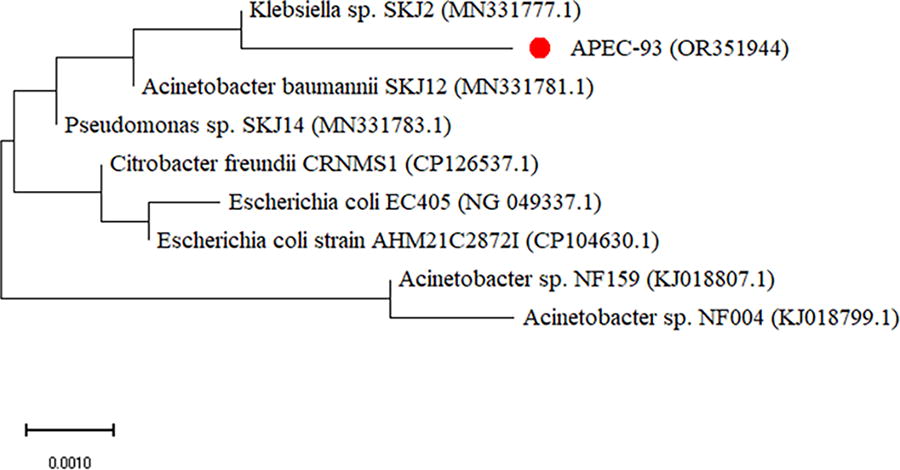
Phylogenetic tree based on the bla NDM-5 gene carried by one APEC strain. GenBank accession numbers follow the names of bacterial strains. APEC, avian pathogenic Escherichia coli.
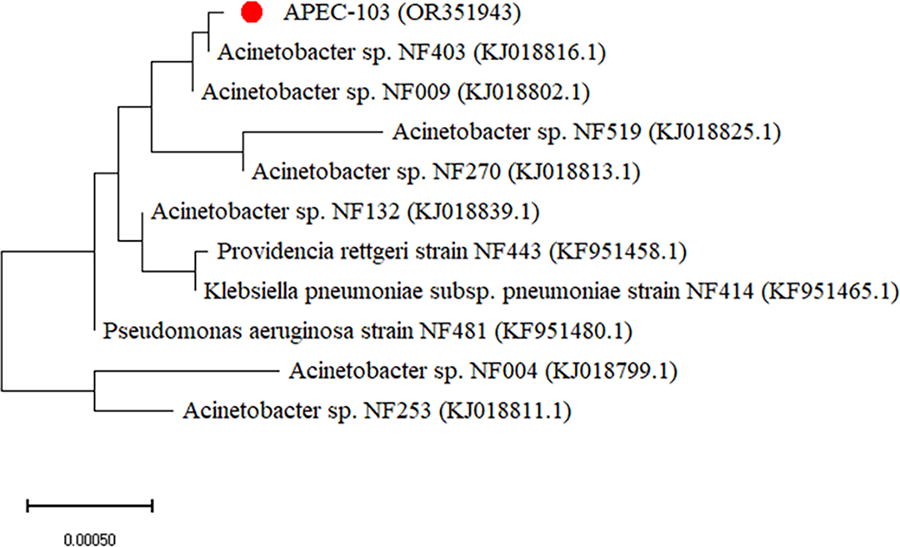
Phylogenetic tree based on the bla NDM-1 gene carried by one APEC strain. GenBank accession numbers follow the names of bacterial strains. APEC, avian pathogenic Escherichia coli.
Analysis of genome sequencing results
APEC-93 and APEC-103 were subjected to whole-genome sequencing to further investigate the genetic characteristics associated with ARGs. The sequences were uploaded to NCBI (BioProject ID: PRJNA1077093). Genome analysis results indicated that the serotypes of APEC-93 and APEC-103 are O63:H4 and O24:H21, respectively (Table 2), which were in agreement with the serotyping results of PCR (Supplementary Table S1).
Genetic Characteristics Associated with the Antimicrobial Resistance Genes of Two bla NDM-Positive Strains
APEC, avian pathogenic Escherichia coli.
Previous antimicrobial susceptibility assays showed that APEC-93 and APEC-103 were resistant to nearly all tested antimicrobial drugs such as penicillins, cephalosporins, tetracycline, chloramphenicol, macrolide, quinolones, and aminoglycosides except for polymyxin (Tan et al., 2023). Correspondingly, multiple ARGs were discovered in the two APEC strains (Table 2), such as carbapenemase-resistant gene bla NDM; β-lactamase-resistant genes bla OXA, bla TEM, and bla CTX-M); and aminoglycoside-resistant genes aph(3′)-Ia, aac(3)-IV, and aph(4)-Ia. Moreover, MGEs were observed upstream of the bla NDM genes and on the chromosomes. The MGE associated with bla NDM-5 was IS5 and the MGE associated with bla NDM-1 was ISAba125. Other MGEs and related ARGs were also identified and listed in Table 2.
Discussion
APEC is an opportunistic pathogen often associated with stressful factors, such as crowding, poor ventilation, and poor sanitation. Infection with APEC can occur through direct contact with contaminated feces, water, or feed or via aerosol transmission and be extremely detrimental to poultry health and production (Kathayat et al., 2021). Strategies to mitigate APEC in poultry flocks are one of the finest solutions for sustainable poultry production (Joseph et al., 2023). Amid the increasing antibiotic resistance, alternative treatment strategies such as vaccines, probiotics, and bacteriophages are necessary at the current stage (Joseph et al., 2023). Considering that a timely regional epidemiological investigation is necessary, we investigated the dominant serotypes of previously isolated APEC strains. The results can be beneficial to the development of targeted vaccines.
Among the numerous serotypes of APEC, O1, O2, and O78 have been considered the predominant serogroups by many foreign and domestic studies (Hu et al., 2022). For example, the predominant serotype in eastern China is O78 (43.2%), followed by O18 (13.6%) and O2 (13.6%) (Xu et al., 2019). O145, a pivotal serogroup in non-O157 Shiga toxin-producing E. coli, has emerged as a newly predominant serogroup of APEC in China (Wang et al., 2022). Our results showed that the isolated strains in Jiangxi Province were distributed in O2, O18, O24, O45, O78, and O88; among which, O24 (51.4%) was the predominant serotype, followed by O78 (11.9%). Serotype O24 of APEC was first reported and isolated from diseased ducks in Southwest China in 2010 (Wang et al., 2010). These findings indicated that the current epidemic situation of APEC is becoming complex, and effective APEC vaccines that can provide protection against diverse and variable serotypes are urgently needed. A high-throughput screening approach to search for universal protective antigens against the three traditional serogroups and the newly emerged O145 has been recently proposed (Wang et al., 2023), providing an idea for the inexpensive, rapid, and efficient screening of bacterial vaccine candidates.
Carbapenem-resistant Enterobacteriaceae have been increasingly reported worldwide (Wu et al., 2019). The genes bla NDM-5 and bla NDM-1 identified in this study shared a close phylogenetic identity with Klebsiella sp. and Acinetobacter sp. isolated from river and human feces, respectively. These results suggested the potential risk of pathogenic E. coli that acquires ARGs from pathogenic organisms and environmental microbiota. Subsequent genomic analysis results revealed different types of MGEs associated with these bla NDM genes. MGEs-mediated horizontal transfer plays an important role in the dissemination of bla NDM (Biez et al., 2023). For example, IS5 is frequently found upstream or downstream of bla NDM-5 in K. pneumoniae (Huang et al., 2021; Zhao et al., 2021), Morganella morganii (Guo et al., 2019), and E. coli (Xu et al., 2023).
Except for the bla NDM genes, several other types of AGEs are present in the two bla NDM-positive strains. Further whole-genome sequencing and analysis of all the APEC isolates will be helpful to reveal the diverse genetic backgrounds and molecular identification of APEC, such as virulence and resistance genotypes, multilocus sequence types, plasmid replicon types, and single nucleotide polymorphism-based core genome phylogeny.
Conclusions
This study provided insights into the dominant serotypes of APEC strains isolated from diseased poultry in Jiangxi Province, China. The presence and genetic relationship of carbapenem-resistant genes bla NDM-5 and bla NDM-1 were analyzed. The genetic characteristics associated with the ARGs and MGEs of the two bla NDM-positive strains were determined by whole-genome sequencing and analysis. Our results indicated that attention and efforts must be devoted to studying the increasing antimicrobial resistance of APEC in poultry flocks. A continuous clinical surveillance of APEC and regional prevention strategies would be an effective control measure that benefits the inhibition of APEC infections and its antimicrobial resistance.
Footnotes
Authors’ Contributions
T.J. and T.M.F. contributed to conception and design of the study. T.J., Z.F.F., L.H.Q., H.J.N., and K.Z.F. performed the experiments. W.Q.P. performed the statistical analysis. T.J. and Z.Y.B. contributed to the development of the figures. T.J. wrote the draft of the article. T.M.F. performed language and logic modifications. All authors contributed to article revision, read, and approved the submitted version.
Disclosure Statement
No competing financial interests exist.
Funding Information
This work was supported by the
Supplementary Material
Supplementary Table S1
References
Supplementary Material
Please find the following supplemental material available below.
For Open Access articles published under a Creative Commons License, all supplemental material carries the same license as the article it is associated with.
For non-Open Access articles published, all supplemental material carries a non-exclusive license, and permission requests for re-use of supplemental material or any part of supplemental material shall be sent directly to the copyright owner as specified in the copyright notice associated with the article.
