




Abstract
During the 2019 Chinese National Microbiological Food Safety Surveillance program, Listeria monocytogenes was detected in ice cream samples produced by Manufacturer A. By comparing the sequences of isolates derived from the ice cream with those of isolates derived from humans, we identified one human-derived isolate that was genetically indistinguishable from one ice cream-derived isolates. The patient was hospitalized with listeriosis in Beijing, China in March 2019. Food history obtained from the patient indicated that he had consumed ice cream produced by Manufacturer A during the 30-day period before the onset of illness. No cases of listeriosis were detected after the ice cream produced by Manufacturer A was removed from the shelves. Overall, this report presents the first case of L. monocytogenes infection associated with ice cream in China.
Listeriosis, a foodborne disease caused by Listeria monocytogenes has a low attack rate, high fatality rate, and variable incubation period (1–90 days). In China, the fatality rate due to listeriosis was 26.1% in 2013–2017 (Li et al., 2019). Listeriosis has been linked to the contamination of food products, such as ready-to-eat foods, dairy products, and fresh produce (McLauchlin et al., 2020; Montero et al., 2015; Thomas et al., 2020). Consumption of L. monocytogenes-contaminated food predominantly causes sporadic or small clusters of infections but occasionally develops into large outbreaks. Even in areas with contaminated-food exposure, the number of infections remains relatively small owing to factors, such as low attack rate and underdiagnosis. Ice cream has been established as a source of contamination for certain Listeria infections and outbreaks in the United States. However, evidence based on local context is necessary in China due to the huge difference between Chinese and Western dietary habit.
As part of the 2019 Chinese National Microbiological Food Safety Surveillance program, L. monocytogenes was isolated from two ice cream samples produced by Manufacturer A. Subsequently, expanded monitoring of 156 ice cream samples obtained from 70 manufacturers was performed. L. monocytogenes was detected in 20 samples, including 17 from Manufacturer A, two from Manufacturer B, and one from Manufacturer C. Different single colonies were selected from two Manufacturer A samples (sample numbers 8 and 9), and 20 isolates were obtained. All L. monocytogenes isolates were subjected to pulsed-field gel electrophoresis (PFGE) and whole-genome sequencing (WGS). Sequence types (STs) obtained from multilocus sequence typing (MLST) were derived from WGS. A core-genome multilocus sequence typing (cgMLST) spanning tree was created in BioNumerics v. 7.6 using categorical differences and the unweighted pair group method with arithmetic means. ResFinder 3.0 (Center for Genomic Epidemiology) and the virulence factor database (VFDB) were used to identify virulence and resistance genes.
The L. monocytogenes quantitative test of all 20 samples revealed <50 colony-forming units (CFUs/g ice cream). We further searched our L. monocytogenes database and found that two isolates had been obtained previously from two samples from Manufacturer A in 2016. Finally, we analyzed 35 isolates from 17 samples from Manufacturer A in 2019, two isolates from two samples from Manufacturer A in 2016, two isolates from two samples from Manufacturer B in 2019, and 1 isolate from 1 sample from Manufacturer C in 2019. All isolates from ice cream produced by Manufacturer A belonged to serogroup IIa, ST8 and had the same PFGE pattern (GX6A16.BJ0003). Two isolates from ice cream produced by Manufacturer B belonged to either serogroup IIa and ST7 or serogroup IIb and ST59. One isolate from ice cream produced by Manufacturer C belonged to serogroup IIa and ST8 and showed the same PFGE pattern (GX6A16.BJ0003) as that found in isolates from ice cream produced by Manufacturer A (Table 1).
Genes in LIPI-3 (llsAGHXBYDP) and LIPI-4 (LM9005581_70009–LM9005581_70014) were absent in all 40 isolates. No resistance genes, except fosX, were detected in the genomes of isolates. We compared sequences of all ice cream isolates with those of L. monocytogenes from patients in our database between 2013 and 2019. WGS of one isolate (number h102) revealed it as a member of serogroup IIa (ST8, GX6A16.BJ0003), and it showed a difference of only one allele when compared with an isolate from ice cream collected from Manufacturer A in 2019 (Fig. 1).
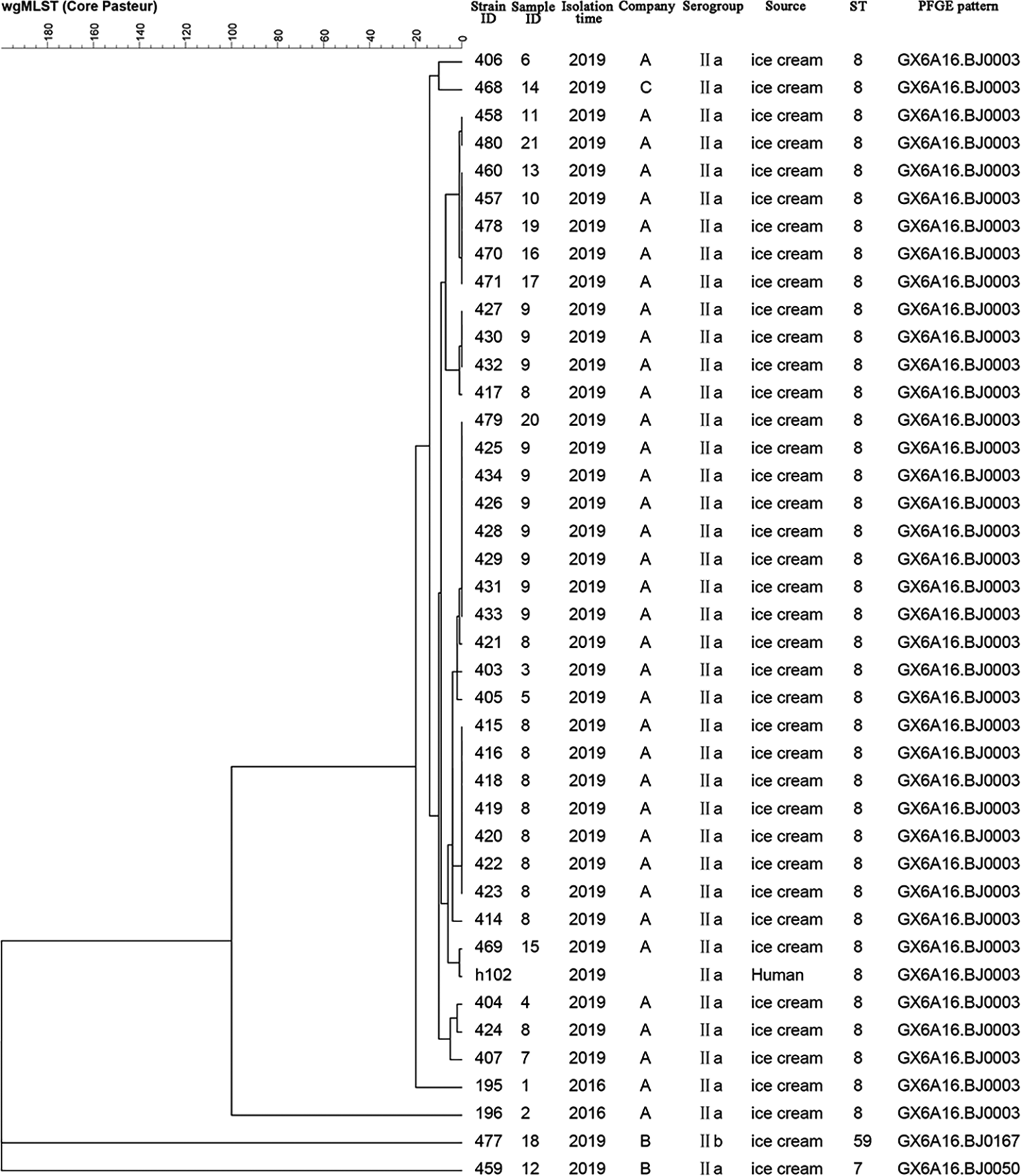
A phylogenomic tree for 40 Listeria monocytogenes isolates based on core-genome multilocus sequence typing (cgMLST) data (n = 1748). The corresponding data, including the name of the strain (strain identification [ID]), the name of the sample (sample ID), isolation time, manufacturer, serogroups, source, MLST type (ST), and pulsed-field gel electrophoresis type (PT) are shown to the right of the dendrogram.
Isolate number h102 was isolated from a 2-year-old boy, who had symptoms of high fever, diarrhea, vomiting, and convulsions and visited hospital 1 for treatment on March 7, 2019. After being prescribed anti-inflammatory and antipyretic drugs, he received infusion treatment at hospital 2, but the symptoms did not improve. On 14 March, he was hospitalized for further treatment; however, the symptoms still did not improve. On 18 March, the patient was transferred to hospital 1 and diagnosed with suppurative meningitis. L. monocytogenes (isolate number h102) was isolated from cerebrospinal fluid cultures on March 21, 2019. After appropriate therapy, the patient’s symptoms were alleviated, and he was discharged on May 14.
The patient’s food history indicated that he had consumed ice cream produced by Manufacturer A approximately 30 days before the onset of illness. A field epidemiological investigation was completed in the patient’s home area. In total, 9 samples of remaining foods and 11 samples of kitchen environment were collected and tested. However, no positive result was obtained. As the ice cream manufacturer is located in Shandong Province, beyond our jurisdiction, we could not able to investigate the cause of the contamination in the production environment.
We drafted a report on the food safety risk of L. monocytogenes detected in the ice cream produced by Manufacturer A and submitted it to the superior health department and market supervision department. Superior health authorities instructed all medical institutions to further strengthen the surveillance of listeriosis and improve the sensitivity of monitoring. The superior market supervision department ordered all retailers to remove ice cream produced by Manufacturer A from the shelves. All ice cream produced by Manufacturer A was voluntarily recalled. No such cases were detected after the ice cream produced by manufacturer A was removed from the shelves.
Characterization of 40 Listeria monocytogenes Isolates from Ice Cream
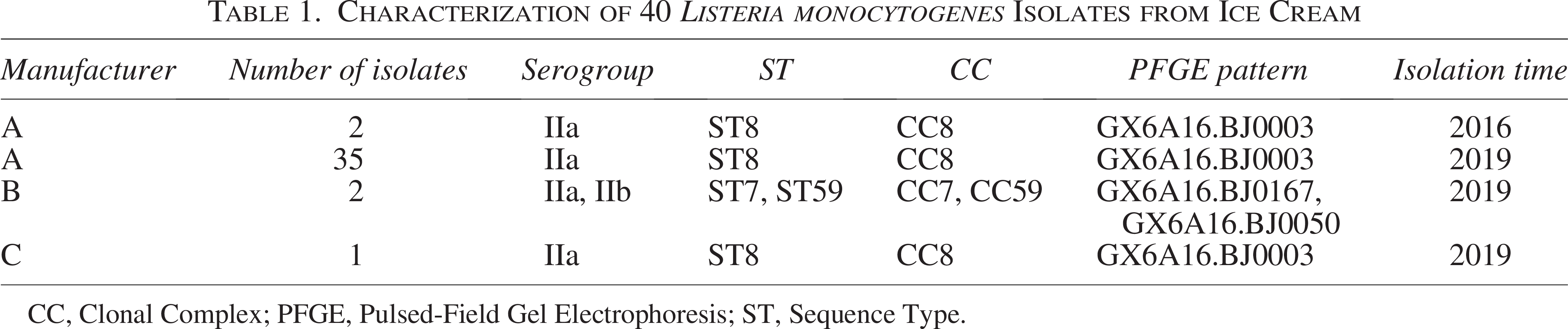
CC, Clonal Complex; PFGE, Pulsed-Field Gel Electrophoresis; ST, Sequence Type.
The general consensus is that a dose—response relationship exists for human foodborne listeriosis, where the possibility of developing invasive disease is directly proportional to the number of L. monocytogenes bacteria consumed [EFSA Panel on Biological Hazards (BIOHAZ), 2018]. However, in previous listeriosis outbreaks, unexpectedly high numbers of cases were reported after consumption of relatively low levels of butter (Maijala et al., 2001) or ice cream (Chen et al., 2016). In this study, the L. monocytogenes quantitative test results showed values lower than 50 CFU/g, and virulence genes, such as those related to adherence, invasion, and stress, were present in all isolates recovered from ice cream produced by Manufacturer A. Therefore, it is important to consider whether L. monocytogenes infection is related to both the number of bacteria and presence of virulence genes carried by different isolates. Before 2019, no specific quantitative rule was established for determining the presence of L. monocytogenes in ice cream in China. Our findings highlighted the need for formulation and improvement of limit standards for L. monocytogenes in ice cream or similar products. Subsequently, the National Health Commission of China formulated a zero-tolerance policy for L. monocytogenes in frozen drinks, including ice cream (NHC, 2021).
Here, ST8 L. monocytogenes was detected in ice cream produced on different dates by Manufacturer A. Persistent contamination might have occurred in the Manufacturer A production area. Previous data suggest that CC8 strains possess a strong capacity for biofilm formation, which might support persistence within food-production environments, and persistent strains may be less virulent than sporadic strains, on average (Ferreira et al., 2014; Verghese et al., 2011). However, some findings have suggested that CC8 isolates have higher virulence because they are also responsible for human listeriosis cases (Lachtara et al., 2022; Montero et al., 2015).
Overall, here we report the case of a 2-year-old boy who developed listeriosis after consuming ice cream contaminated with L. monocytogenes; this is the first established association between a case of L. monocytogenes infection and ice cream in China. Owing to the geographical reasons, we could not investigate the ice cream factory and isolate L. monocytogenes; however, the factory stopped producing ice cream following this event, and the risk of reinfection was ruled out.
Ethics
The ethics committee of the China National Center for Food Safety Risk Assessment approved the study (No. 2017015).
Authors’ Contributions
X.Z. and X.M. conceived and designed the study. Y.N. and X.M. performed the sample collection. X.Z. and Y.L. performed the experiments. X.Z., P.Z., and Y.N. analyzed the data. X.Z. and X.M. wrote the article. All authors read and approved the final version of the article.
Footnotes
Funding Information
This work was supported by the Capital High-level Public Health Technical Talent Development Project (grant number 2022–01-027), Capital Funds for Health Improvement and Research (grant numbers CFH2020-2–3012, CFH2011-1013–02) and Young Talent Project of Beijing Excellent Talents Funding (grant number 2015000021469G186).
Disclosure Statement
The authors declare no competing interests.