




Abstract
This study aimed to understand the epidemiological characteristics of Salmonella in Tibetan pigs. We isolated, identified, and examined via antimicrobial susceptibility testing on Salmonella from Tibetan pigs breeder farms and slaughterhouses in Tibet, China. A genetic evolutionary tree was constructed on the basis of whole genome sequencing (WGS). A total of 81 Salmonella isolates were isolated from 987 samples. The main serovars were Salmonella Typhimurium and Salmonella London in Tibetan pigs. The isolated Salmonella Typhimurium isolates subjected to antimicrobial susceptibility testing showed varying degrees of resistance to β-lactams, aminoglycosides, fluoroquinolones, sulfonamides, tetracyclines, and amphenicols. WGS analysis was performed on 20 Salmonella Typhimurium isolates in Tibet (n = 10), Jiangsu (n = 10), and 205 genome sequences downloaded from the Enterobase database to reveal their epidemiological and genetic characteristics. They were divided into two clusters based on core genome single-nucleotide polymorphisms: Cluster A with 112 isolates from Tibet and other regions in China and Cluster B with 113 isolates from Jiangsu and other regions. The isolates in Cluster A were further divided into two subclusters: A-1 with 40 isolates including Tibet and A-2 with 72 isolates from other regions. Virulence factors analysis revealed that all isolates from Tibet carried adeG, but this observation was not as common in Salmonella isolates from Jiangsu and other regions of China. Antibiotic resistance genes (ARGs) analysis showed that all isolates from Tibet carried blaTEM-55 and rmtB, which were absent in Salmonella isolates from Jiangsu and other regions of China. Genetic characteristic analysis and biofilm determination indicated that the biofilm formation capabilities of the isolates from Tibet were stronger than those of the isolates from Jiangsu and other regions of China. Our research revealed the epidemic patterns and genomic characteristics of Salmonella in Tibetan pigs and provided theoretical guidance for the prevention and control of local salmonellosis.
Introduction
Salmonella is considered one of the most common foodborne pathogens that can cause gastrointestinal diseases (Hendriksen et al., 2011). Human health continues to be threatened by salmonellosis caused by Salmonella. Pigs are among the main Salmonella carriers, and infected pigs may experience symptoms such as fever, diarrhea, collapse, and death (Bonardi, 2017). The occurrence of human salmonellosis is considered closely associated with the consumption of contaminated pork (Bonardi et al., 2016). According to monitoring data from the China Center for Disease Control and Prevention (https://www.chinacdc.cn/), Salmonella is responsible for ∼70–80% of foodborne bacterial outbreaks in China (Wang et al., 2007). According to the European Food Safety Authority (EFSA) and the European Centre for Disease Prevention and Control (ECDC) report, human salmonellosis is second only to campylobacteriosis, with an average of 23.4 Salmonella cases per 100,000 people (EFSA and ECDC, 2018). In parts of China, pigs are primarily infected with two serovars of Salmonella, namely, Salmonella Typhimurium and Salmonella Derby (Cai et al., 2016; Li et al., 2013; Tian et al., 2021). Tibet is in the southwestern part of the Qinghai-Tibet Plateau, with its geographical coordinates ranging approximately from 26°50ʹ to 36°53ʹ N and 78°25ʹ to 99°06ʹ E. Renowned for its unique geographical environment and climate conditions, this region serves as a habitat for various endemic species such as yaks and Tibetan pigs. In this study, Tibetan pigs in Linzhi and Changdu of Tibet were used as the research object. Tibetan pigs are one of the animal breeds raised by farmers and herdsmen in the Qinghai-Tibet Plateau for a long time. They are primarily distributed in Linzhi and Changdu, with Linzhi at an average altitude of ∼2900 m and Changdu at an average altitude of ∼3200 m. However, studies have yet to report the prevalence of Salmonella in Tibetan pigs in Tibet.
Traditional molecular typing techniques are very time-consuming and cannot meet the requirements of large-scale processing, so next-generation sequencing (NGS) has emerged as a more potential and more discriminative genotyping tool. NGS is a high-throughput sequencing technology that is widely used in whole genome sequencing (WGS). WGS can distinguish the differences between two genomes and accurately determine the relationship between different isolates (Seribelli et al., 2020).
In order to understand the prevalence and characteristics of Salmonella in Tibetan pigs, we investigated the prevalence of Salmonella and used WGS to investigate antibiotic resistance genes, virulence factors, and plasmids; the phylogenetic relationship was also analyzed based on WGS.
Materials and Methods
Sample collection
A total of 987 samples were collected between November 2018 and December 2019 in Tibet, China. Salmonella isolates were isolated from fecal samples and intestinal samples of Tibetan pigs from Changdu and Linzhi. Each sample was labeled, transported on ice packs to the laboratory, and microbiologically analyzed within 24 h of sample collection.
Salmonella isolation and serovar
Salmonella was isolated using the methodology used in our laboratory (Tian et al., 2021). Each sample (∼10 g) was added to 100 mL of buffered peptone water (BPW; BD Difco, Sparks, MD, USA) and incubated at 42°C for 16–20 h. Then, 3 drops of BPW (∼0.1 mL) were inoculated in separate spots on the surface of a modified semisolid Rappaport Vassiliadis agar (MRSV; BD Difco) and incubated at 42°C for 24–48 h. The subculture from this semisolid agar was done using the leading edge of the white haze from the motile Salmonella around the inoculum spot. Then, a loopful of the positive growth taken from the edge of the MRSV agar colony was further inoculated onto a xylose lysine tergitol 4 agar plate (XLT4; BD Difco) and incubated at 37°C for 24–48 h.
Salmonella serovar was identified using the classical slide agglutination test with somatic (O) and flagellar (H) antigens (Tianrun Bio-Pharmaceutical, Ningbo, China) based on the Kauffmann–White scheme (Fei et al., 2017; Wang et al., 2022). We also collaborated with Salmonella In Silico Typing Resource (SISTR) (Yoshida et al., 2016) based on WGS data to predict serovars of all isolates. The serovars of all isolates were ultimately identified through these two results, ensuring the accuracy of the experimental results.
Antimicrobial susceptibility testing
The Kirby–Bauer method recommended by the guidelines of Clinical and Laboratory Standards Institute (CLSI, 2020) was used for conducting antimicrobial susceptibility testing. Sixteen classes of antibiotic discs (Oxoid, Basingstoke, UK) were uniformly placed on the surface of the medium by using an antibiotic disc distributor (Table 3). The antimicrobial agents tested were ampicillin (AMP; 10 μg), amoxicillin (20 μg), kefzol (30 μg), meropenem (10 μg), aztreonam (30 μg), kanamycin (20 μg), streptomycin (STR; 10 μg), cidomycin (10 μg), amikacin (AMK; 30 μg), ciprofloxacin (5 μg), nalidixic acid (30 μg), sulfamethoxazole (SXT; 30 μg), doxycycline (30 μg), tetracycline (30 μg), florfenicol (30 μg), and chloramphenicol (30 μg). Escherichia coli ATCC25922 was used as a control. A vernier caliper was used to measure the diameter of each inhibition zone on the Mueller–Hinton agar plate, and the final experimental results were determined based on the CLSI 2020 manual (CLSI, 2020).
WGS and data analysis
The genomic DNA of 20 Salmonella Typhimurium isolates was extracted using the TIANamp Bacterial DNA kit (Tiangen, Beijing, China) following the manufacturer’s protocol and subjected to genome sequencing using the Hiseq 2500 platform (Novogene, Beijing, China). Trim Galore (V0.6.7) was used for trimming and filtering the 150 bp paired-end raw reads, whereas SPAdes 3.15.4 was used for de novo assembly (Bankevich et al., 2012). The analysis of antibiotic resistance genes, virulence factors, and plasmids based on WGS data was performed using abricate (https://github.com/tseemann/abricate). Ten isolates from Tibet, 10 isolates from Jiangsu, and 205 Salmonella Typhimurium isolates downloaded from Enterobase database (https://enterobase.warwick.ac.uk/) were used to construct phylogenetic tree based on core genome single-nucleotide polymorphisms’ (cgSNPs) analysis. The genomic information of 205 Salmonella Typhimurium isolates downloaded from the Enterobase database were included in the supplementary materials (Supplementary Table S1). WGS data of all 10 Salmonella Typhimurium isolates from Tibet and 10 Salmonella Typhimurium isolates from Jiangsu were submitted to the Genebank databases with the accession number PRJNA1064879. The phylogenetic tree of all Salmonella Typhimurium isolates was constructed using Parsnp and visualized by iTOL.
Measurement of bacterial biofilm
According to the Pratt method (Pratt and Kolter, 1998), a single colony was inoculated in 3 mL of tryptic soy broth (TSB) and incubated overnight at 37°C with shaking at 200 rpm. First, 10 μL of the overnight culture was added to 90 μL of TSB for dilution. Then, 10 μL of the diluted culture was added to 90 μL of TSB for further dilution. Finally, 100 μL of this diluted culture was transferred to each well of a 96-well polystyrene U-shaped cell culture plate. The plate was incubated at four different temperatures (18°C, 28°C, 37°C, and 42°C) without shaking for 24 h. Afterward, the culture medium was discarded, and the wells were washed with deionized water thrice and gently dried. Then, 100 µL of 0.4% crystal violet solution was added to each well, and the plate was stained for 20 min. The wells were washed with deionized water thrice and gently dried. Next, 100 µL of absolute ethanol was added to each well and gently mixed; then, absorbance at 570 nm (OD 570) was measured. This experiment was repeated three times, and the average was calculated to determine biofilm growth.
Statistical analysis
Data were presented as mean ± standard error of triplicate samples per experimental condition from three independent experiments in GraphPad Prism 5 (GraphPad Software, Inc., CA, United States). One-way analysis of variance followed by two independent samples t-test was conducted to detect significant differences between experimental groups. Statistical significance was determined at p < 0.001 (***).
Results
Prevalence and serovar of Salmonella isolates
Among the 987 samples, 205 were collected from pig feces in breeding farms in Linzhi and 570 were collected from pig intestinal samples in slaughterhouses. In addition, 212 samples were collected from feces in breeding farms in Changdu. As shown in Figure 1, a total of 81 Salmonella isolates were isolated, with an overall prevalence of 8.2% (Table 1), and the dominant serovar was mainly Salmonella London (58.0%, 47/81), followed by Salmonella Typhimurium (37.0%, 30/81) (Table 2). The serovar of Salmonella Typhimurium was used as the follow-up study object.

Distribution of 81 Salmonella isolates in Tibet, China. The regions where 81 Salmonella isolates from Tibetan pigs were collected in this study were marked in red. Other province-level regions were marked in light gray. “C” represents Changdu for the source of isolates; “L” represents Linzhi for the source of isolates.
Samples Of Salmonella Collected from Tibetan Pigs
Serovar Distribution of 81 Salmonella Isolates
Antimicrobial susceptibility testing
A total of 30 Salmonella Typhimurium isolates were used for antimicrobial susceptibility testing. Most isolates were resistant to ampicillin (100.0%), sulfamethoxazole (100.0%), doxycycline (100.0%), chloramphenicol (100.0%), and tetracycline (90.0%). The isolates were also resistant to kanamycin (86.7%), streptomycin (76.7%), amoxicillin (73.3%), kefzol (70.0%), and cidomycin (70.0%; Table 3). Notably, the results showed that the rates of resistance to amikacin (6.7%), aztreonam (16.7%), and nitrofurantion (10.0%) were very low (Table 3). No isolates were resistant to meropenem (Table 3).
Salmonella was considered to be multidrug resistant (MDR) when it demonstrated resistance to three or more classes of antibiotics. The MDR of the isolates is presented in Table 4.
Results of Antimicrobial Susceptibility Testing
AMC, amoxicillin; AK, amikacin; AMP, ampicillin; ATM, aztreonam; CHL, chloramphenicol; CIP, ciprofloxacin; CN, cidomycin; DO, doxycycline; FFC, florfenicol; KAN, kanamycin; KZ, kefzol; MEM, meropenem; NA, nalidixic acid; STR, streptomycin; SXT, sulfamethoxazole; TET, tetracycline.
Multidrug Resistance Of Salmonella Isolates
Triple-class resistance.
Quadruple-class resistance.
Five-class resistance.
Six-class resistance.
Seven-class resistance.
Gene characterization of Salmonella Typhimurium in Tibet
On the basis of WGS, all 10 Salmonella Typhimurium from Tibet carried β-Lactam resistance gene (blaTEM-55 ), aminoglycoside resistance genes [aac (6′)-Iaa, arcD, aadA2, and rmtB], sulfonamide resistance genes (sul1 and drfA12), fluoroquinolone resistance genes (emrA, emrB, emrR, and mdtK), and tetracycline resistance genes [tet (A)] (Fig. 2). All 10 Salmonella Typhimurium from Tibet contained 13 virulence factors (adeG, arvA, mig-14, ompA, sifA, sifB, gogB, phoP, phoQ, sodCI, spvB, spvC, and spvR). Except for arvA, mig-14, ompA, sifA, and sifB, which were shared by all isolates, gogB, phoP, phoQ, sodCI, spvB, spvC, and spvR were present in all 10 Salmonella Typhimurium from Tibet but not in all Salmonella Typhimurium from other regions in China (Fig. 2). All 10 Salmonella Typhimurium from Tibet carried the plasmid of IncB and IncR, but they did not exist in other regions of China (Fig. 2). Interestingly, the results of resistance genes testing showed that blaTEM-55 and rmtB existed in Salmonella Typhimurium from Tibetan pigs, but they did not exist in other regions of China. The results of virulence factors testing showed that adeG was present in all 10 Salmonella Typhimurium from Tibet, but they did not exist in other regions of China (Fig. 2). AdeG is possibly implicated in the synthesis and transport of autoinducer molecules during biofilm formation (He et al., 2015). In fact, previous research had found that adeG was related to biofilm formation in Acinetobacter baumannii. Our research analysis showed that our Salmonella Typhimurium isolates also carried this virulence factor, with 100% sequence homology and coverage, indicating that they had the same function.

Gene characterization of the 122 Salmonella Typhimurium isolates based on cgSNPs analysis. The analysis included 122 isolates from different regions, with 10 Jiangsu isolates marked in blue and 10 Tibetan isolates marked in red. The 102 remaining isolates were downloaded from the Enterobase database and were not marked. Antibiotic resistance genes, virulence factors, and plasmids were listed according to the WGS data. cgSNPs, core genome single-nucleotide polymorphisms; WGS, whole genome sequencing.
Biofilm measurement of Salmonella Typhimurium isolates in Tibet and Jiangsu, China
Salmonella Typhimurium in Tibet had virulence factors related to biofilm formation in comparison with Salmonella Typhimurium in Jiangsu. To validate the potential correlation between biofilm formation-related genes and biological characteristics, we conducted biofilm assays on Salmonella Typhimurium in Tibet and Jiangsu. The results of biofilm determination showed that at four different temperatures of 18°C, 28°C, 37°C, and 42°C, the OD 570 value of the biofilm of Salmonella Typhimurium in Tibetan pigs was significantly higher than that of Salmonella Typhimurium in Jiangsu (p < 0.001) (Fig. 3).

Comparison of Salmonella Typhimurium biofilm formation in different regions. The 96-well polystyrene U-shaped cell culture plate containing diluted bacterial solution was incubated at four different temperatures (18°C, 28°C, 37°C, and 42°C) without shaking for 24 h. Then, the growth of the biofilm was measured at 570 nm absorbance. Blue and red dots represent the absorbance values of Tibet and Jiangsu isolates, respectively. ***p < 0.001 for one-way ANOVA followed by two independent samples t-test. All data were presented as mean ± SEM of triplicate samples per experimental condition from three independent experiments. ANOVA, analysis of variance; SEM, standard error of mean.
WGS-based analysis of the phylogenetic relationship of Salmonella Typhimurium isolates in Tibetan pigs
On the basis of WGS, all 10 Salmonella Typhimurium isolates in Tibet and 10 Salmonella Typhimurium isolates in Jiangsu belonging to sequence type 19 (ST19) were randomly selected. In order to explore the phylogenetic relationship between Salmonella Typhimurium in Tibet and other regions in China, 205 ST19 Salmonella Typhimurium genomes were downloaded from the Enterobase database. Of these genomes, 41.3% were found in human isolates, 55.6% were from animal isolates, and 3.1% were detected in food isolates. The phylogenetic tree showed that 225 Salmonella Typhimurium isolates were used to determine the phylogenetic relationship (Fig. 4). The isolates were divided into two clusters, and cluster A was further divided into two subclusters (A-1 and A-2; Fig. 5). Interestingly, cluster A included 112 Salmonella Typhimurium isolates, including the Tibetan pigs isolates, with 50 human isolates and 62 animal isolates. Cluster B consisted of 113 Salmonella Typhimurium isolates, including the Jiangsu isolates, with 43 human isolates, 63 animal isolates, and 7 food isolates. All 10 Tibetan pigs isolates belonged to cluster A, which was further divided into A-1 (35.7%) and A-2 (64.3%) subclusters. In cluster A, Salmonella Typhimurium isolates were mainly from animal and human sources: 44.6% human isolates and 55.4% animal isolates.

Phylogenetic relationship of the 225 Salmonella Typhimurium isolates based on cgSNPs analysis. The analysis included 225 isolates from different regions, with cluster A containing 112 isolates that included 10 Tibetan isolates and cluster B containing 113 isolates that included 10 Jiangsu isolates. cgSNPs, core genome single-nucleotide polymorphisms.
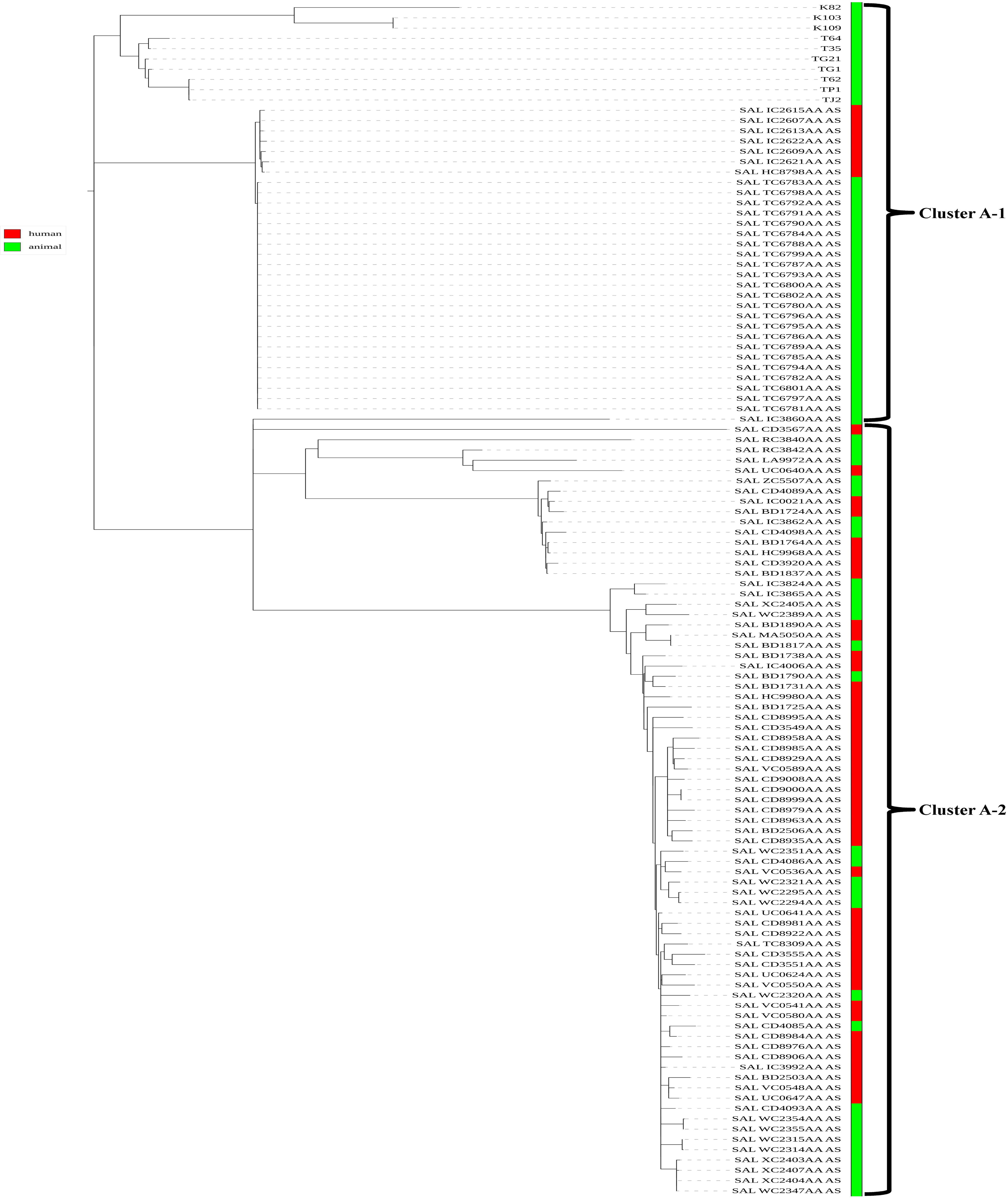
Phylogenetic tree of Salmonella Typhimurium isolates in cluster A based on cgSNPs analysis. This analysis was a further division of cluster A from Figure 4. Cluster A-1 contained 10 Tibetan isolates and 30 isolates from other regions, and cluster A-2 included 72 isolates from other regions. cgSNPs, core genome single-nucleotide polymorphisms.
Discussion
Salmonella is considered an important foodborne pathogen, and the occurrence of this disease substantially affects the development of animal husbandry and human health (Majowicz et al., 2010). After being infected with Salmonella, pigs show some clinical symptoms, become asymptomatic carriers to be expelled, or hide in some body tissues (Côté et al., 2004). In parts of China and Germany, the most common Salmonella serovars are Salmonella Typhimurium and Salmonella Derby (Cai et al., 2016; Tian et al., 2021; Visscher et al., 2011). Interestingly, our results showed that Salmonella London and Salmonella Typhimurium were the most common Salmonella serovars in the Tibetan pigs.
Similar to infections caused by E. coli and other foodborne pathogens, the treatment of salmonellosis mainly relied on antibiotics, and long-term antibiotic use had led to the serious resistance of Salmonella to antibiotics (Zhang et al., 2022; Wang et al., 2020). The antimicrobial susceptibility testing results showed that the resistance rate of the Salmonella Typhimurium from Tibetan pigs isolates to ampicillin (100.0%), streptomycin (76.7%), sulfamethoxazole (100.0%), chloramphenicol (100.0%), and amikacin (6.7%), which was significantly higher than the resistance rate to ampicillin (93.6%), streptomycin (17.0%), sulfamethoxazole (80.9%), chloramphenicol (80.9%), and amikacin (0%) reported by Tian Yuqi (Tian et al., 2021). There was no doubt that further studies should determine whether antimicrobial resistance is related to local anthropogenic emissions, animal feeding patterns, and antimicrobial use methods.
There were reports showed that blaTEM-1B was the most common β-lactam resistance gene identified in Salmonella Typhimurium (Prasertsee et al., 2019). The aminoglycoside-resistant genes [aac(6′)-Iaa, addA1, and aadA2] were also frequently identified in Salmonella Typhimurium isolates (Zhang et al., 2022). Similarly, sulfonamide–trimethoprim resistance genes (sul1, sul3, and drfA12) frequently reported in Salmonella Typhimurium genomes (Wang et al., 2020). The chloramphenicol resistance gene floR was also previously detected in one Salmonella Typhimurium isolate (Prasertsee et al., 2019; Zhang et al., 2022). A high incidence of tetracycline resistance gene tet(A) was previously reported in Salmonella Typhimurium isolates from China (Zhang et al., 2022). Interestingly, we found that all Salmonella Typhimurium genomes from Tibet carried β-lactam resistance gene (blaTEM-55 ), aminoglycoside resistance genes [aac(6′)-Iaa, acrD, aadA2, and rmtB], sulfonamide resistance genes (sul1 and drfA12), fluoroquinolone resistance genes (emrA, emrB, emrR, and mdtK), and tetracycline resistance gene [tet (A)]. This result was consistent with the antimicrobial resistance phenotype of Tibetan pigs isolates to β-lactams, aminoglycosides, sulfonamides, fluoroquinolones, and tetracyclines. In addition, our most important finding was that blaTEM-55 and rmtB were isolated from Salmonella Typhimurium in Tibet but not from other regions in China. The results suggested that the antimicrobial resistance associated with these two genes may be higher in Salmonella Typhimurium from Tibetan pigs.
It was worth mentioning that the biofilm formation gene adeG was present in all 10 isolates of Salmonella Typhimurium isolated from Tibetan pigs but not detected in Salmonella Typhimurium isolates from Jiangsu. The results of biofilm determination showed that the biofilm formation ability of Salmonella Typhimurium in Tibetan pigs was significantly higher than that of Salmonella Typhimurium in Jiangsu. These results suggested that the biofilm formation ability of Salmonella Typhimurium in Tibet was enhanced perhaps because of the carrying of the virulence factor.
ST19 is the major sequence type of Salmonella Typhimurium classified on the basis of multilocus sequence typing (MLST) (Antunes et al., 2010). Here, cgSNPs-based phylogenetic analysis was first used to divide the ST19 Salmonella Typhimurium isolates into two clusters. Cluster A included isolates of Salmonella Typhimurium originating in Tibet and other regions in China, as well as poultry, pigs, and humans. Conversely, cluster B consisted mainly of isolates in Jiangsu and other regions in China. In addition, 44.6% of cluster A isolates were derived from human products, and 55.4% of cluster A isolates were derived from animal products, including poultry, pigs, food, and humans. These results indicated that pigs and pig products are key reservoirs of Salmonella Typhimurium; this discovery was consistent with previous reports (Astorga et al., 2007; García-Feliz et al., 2007; Li et al., 2017; Xu et al., 2020). Therefore, cluster A isolates could potentially spread to humans through the consumption of animal food contaminated with Salmonella Typhimurium. It was worth noting that Tibetan pigs pork in Tibet was not only sold locally but also sold all over China. With the improvement of international trade, people from other countries had the opportunity to contact Tibetan pigs pork when they traded with China or travel to China. Tibetan pigs pork infected with Salmonella would pose a potential threat to people’s health.
Conclusions
In summary, our findings indicated that Salmonella was prevalent in Tibetan pigs, and the main serovars were Salmonella Typhimurium and Salmonella London. Salmonella Typhimurium isolated from Tibetan pigs widely carried genes related to biofilm formation compared with Salmonella in other regions in China. From a genetic and evolutionary perspective, Salmonella in Tibetan pigs was closely related with certain isolates in humans. This finding revealed the close connection of Salmonella infections in humans with those in pigs and their associated food products.
Footnotes
Authors’ Contributions
G.W., X.K., and Z.P. designed the research. G.W. and S.W. performed the experiments and analyzed the data. G.W. and X.K. participated in writing the article. G.W., X.K., C.M., D.G., L.S., X.J., and Z.P. were involved in the analysis and interpretation and assisted with this work. All the authors were involved in article revisions and in the final approval of the version to be published.
Disclosure Statement
No competing financial interests exist.
Funding Information
This research was supported by National Key Research and Development Program of China (2022YFC2604203), National Natural Science Foundation of China (32161143011), key research and development program (Modern Agriculture) project of Jiangsu Province (BE2021331), and the Priority Academic Program Development of Jiangsu Higher Education Institution and Jiangsu Key Laboratory of Zoonosis (R1801).
Supplementary Material
Supplementary Table S1
References
Supplementary Material
Please find the following supplemental material available below.
For Open Access articles published under a Creative Commons License, all supplemental material carries the same license as the article it is associated with.
For non-Open Access articles published, all supplemental material carries a non-exclusive license, and permission requests for re-use of supplemental material or any part of supplemental material shall be sent directly to the copyright owner as specified in the copyright notice associated with the article.
