




Abstract
Salmonella is one of the most common causative agents of infectious diarrhea in humans, but in China, there are very limited data on the presence of Salmonella in aquatic products. This study describes the isolation of Salmonella from aquatic products in Weifang, China, from April 2022 to April 2023. Seven out of 160 (4.38%) retail aquatic product samples were positive for Salmonella. Two distinct serotypes were identified: Salmonella enterica subsp. enterica serovar Senftenberg (n = 4) and S. enterica subsp. diarizonae serovar IIIb 59:z10:z57 (n = 3). The results of molecular typing of isolates with the same serotype were consistent. Only one of the isolates was resistant to ampicillin, while the other isolates were not resistant to the tested antibiotics, suggesting that Salmonella in aquatic products in this region are relatively susceptible to antibiotics. There were 17 resistance genes in the 7 strains, 13 of which were shared. golS, MdtK, mdsA, and mdtG were unique to S. Senftenberg. A total of 155 virulence genes were annotated in the S. Senftenberg isolates, and 136 virulence genes were annotated in the S. IIIb 59:z10:z57 isolates. The S. Senftenberg isolates harbored more adhesion-related genes than the S. IIIb 59:z10:z57 isolates. Multilocus sequence typing analysis revealed that ST34 has been the most prevalent type of Salmonella in China since 2020, followed by ST11. The predominant type of Salmonella in aquaculture is ST14. This study provided additional genetic information about Salmonella in aquatic sources, providing a basis for subsequent research related to risk assessment, antibiotic resistance mechanisms, and so forth.
Introduction
Salmonella is a major cause of foodborne disease outbreaks. Approximately 94 million cases of gastroenteritis caused by Salmonella infection occur every year worldwide, resulting in 155,000 deaths (Yang et al., 2019). In China, ∼9.87 million cases of gastroenteritis are caused by nontyphoidal Salmonella every year (Weng et al., 2022). A meta-analysis revealed that the rate at which Salmonella was detected in aquatic products in China from 2007 to 2021 was 13.7%; this rate was second only to the rate at which Salmonella was detected in raw meat (Miao et al., 2022). The safety of aquatic products has attracted attention, but epidemiological information and risk data concerning Salmonella isolated from aquatic products are very limited.
More than 2600 different serotypes of Salmonella have been identified; Salmonella enterica subsp. enterica (subsp. I) serotypes account for ∼99% of Salmonella infections (Lan et al., 2009), and S. enterica subsp. diarizonae has also been reported to infect humans (Gerlach et al., 2017). With the development and progression of molecular biology and bioinformatics, whole-genome sequencing (WGS) technology has emerged; this technology can be used to obtain substantial information about bacterial species, serotypes, virulence, antimicrobial resistance, and so on. Therefore, we combined WGS with traditional serotyping and molecular typing to analyze Salmonella isolates.
The incidence of Salmonella strains that are resistant to clinical antimicrobials have consistently increased worldwide in recent years (Michael and Schwarz, 2016). Therefore, this study investigated the prevalence and antimicrobial susceptibility of Salmonella in aquatic products that are sold through major retail channels in Weifang, Shandong Province, China. The results of this study are very important for understanding the genomic characteristics of Salmonella in this region and improving the monitoring of foodborne Salmonella.
Materials and Methods
Salmonella isolation and serotyping
From April 2022 to April 2023, a total of 160 aquatic product samples were randomly collected from wholesale retail markets and supermarkets in Weifang, Shandong Province, China, and placed in sterile sampling bags/tubes. All the samples were stored at 4°C and transported to the laboratory for processing within 24 h.
Detection of Salmonella spp. was performed following the method described in the National Food Safety Standards of China (GB 4789.4-2016). Briefly, a 25-g sample was cut into small pieces under aseptic conditions, placed in 225 mL of buffered peptone water, and homogenized and mixed for 2 min. Then, preculture and selective culture were performed. Salmonella strains were initially screened via biochemical assays, namely, indole and sugar fermentation assays, urease and H2S production assays, and lysine and ornithine decarboxylase production assays. Salmonella chromogenic medium was used to facilitate screening. Well-isolated colonies were confirmed at the species level via matrix-assisted laser desorption ionization–time-of-flight mass spectrometry. Salmonella isolates were serotyped by slide serum agglutination using commercial serum O, H (Statens Serum Institut [SSI], Copenhagen, Denmark) according to the White–Kauffmann–Le Minor scheme (Guibourdenche et al., 2010).
Antibiotic susceptibility testing
Salmonella isolates were subjected to antimicrobial susceptibility testing (AST) with 16 antimicrobial agents. The minimum inhibitory concentration (MIC) was determined and interpreted according to Clinical and Laboratory Standards Institute (CLSI) guidelines (CLSI, 2023). No streptomycin (STR) breakpoint was identified in the CLSI guidelines according to previous studies, so a traditional North American Rock Mechanics Symposium (NARMS) clinical breakpoint of 64 μg/mL was used (McDermott et al., 2016). According to the manufacturer’s instructions, an AST panel for aerobic Gram-negative bacilli was used for analysis with the help of a microbial drug sensitivity analysis system, aided by visual inspection. Escherichia coli ATTC 25922 was used for quality control, and the MICs were within the acceptable range.
Pulsed-field gel electrophoresis analysis
Pulsed-field gel electrophoresis (PFGE) was performed according to the protocol of the Centers for Disease Control and Prevention (Ribot et al., 2006). In brief, the concentration of a bacterial suspension was adjusted to 4.0–4.5 McFarland turbidity. The bacteria were embedded in agar blocks, and the DNA was digested with 50 U XbaI (Takara, Dalian, China) at 37°C for 3 h. The digested DNA was separated by electrophoresis in 0.5 × Tris–borate–ethylenediaminetetraacetic acid buffer at 14°C for 18 h via a CHEF Mapper electrophoresis system (Bio-Rad, Hercules, CA, USA). In addition, the S. Braenderup strain H9812 was used as a quality control strain. The gels were stained with ethidium bromide, and the DNA patterns were visualized on a UV transilluminator (Bio-Rad). The PFGE patterns were analyzed with BioNumerics, Version 5.1 (Applied Maths, BVBA, Belgium).
WGS analysis
Purified Salmonella samples were sent to Sangon Biotech (Shanghai) Co., Ltd. for WGS. DNA extraction was performed via the magnetic bead method, and the Illumina DNA Prep Kit was used for library preparation. Subsequent WGS was performed via the Illumina HiSeq platform. The raw data were filtered via FastQC for quality control (Biswas et al., 2019). Reads were de novo assembled via SPAdes 3.5.0. Salmonella serotyping was performed via the bioinformatics platform SISTR v1.0.2 (Hensel et al., 2016). Antimicrobial resistance genes were annotated via the Comprehensive Antibiotic Resistance Database (CARD) database (Florensa et al., 2022). The virulence genes of the isolates were identified and annotated via the Virulence Factor Database (VFDB) (Xu et al., 2023). Moreover, the assembled genomes were analyzed to identify the main pathogenic markers on the Salmonella pathogenicity islands (SPIs) via SPIFinder 2.0 (Roer et al., 2016).
Multilocus sequence typing analysis
Seven housekeeping genes (aroC, dnaN, hemD, hisD, purE, sucA, and thrA) in PubMLST were used for multilocus sequence typing (MLST). To understand the relationship between sequence type (ST) and different sources, as well as the ST composition of Salmonella in China in recent years, the population structures of Salmonella strains in China that were subjected to MLST from 2020 to the present as well as seven Salmonella strains isolated from aquatic animals in this study were examined (n = 1022; Supplementary Table S1). EnteroBase was used to search and download metadata for Salmonella strains in China from 2020 to 2024. A total of 1015 Salmonella strains were used; “China” was selected as the keyword, the search time was limited to 2022–2024, and unpublished MLST data as of April 23, 2024, were ignored. Minimal spanning tree visualization and annotation were performed with ST data via GrapeTree (Zhou et al., 2018).
Results
Prevalence and serotypes of Salmonella
Among the 160 samples that were analyzed, 4.38% (n = 7) were positive for Salmonella. The sampling sites were divided into four categories; the rates of Salmonella detection in the four groups were not identical (p < 0.05), indicating that Salmonella contamination may differ among different sampling sites. A pairwise comparison of the difference in the detection rates among the four groups revealed that the difference in the positive detection rate among the four groups was not statistically significant; this result may have occurred to the small number of positive samples. Other variables (such as the type of seafood product, sampling season, and geographic area) were also not statistically significantly different among the groups (p > 0.05) (Table 1). WGS results were consistent with conventional serotyping results. Seven positive Salmonella isolates were shown to be of two different serotypes: S. Senftenberg (n = 4) and S. IIIb 59:z10:z57 (n = 3). Our laboratories numbered them B8, C7, C8, C10, C21, C26, and D4 (Table 2).
Prevalence of Salmonella in Different Samples
Molecular Epidemiology Information and General Genome Characteristics of Seven Isolates
MLST, multilocus sequence typing.
PFGE analysis
Each Salmonella strain had 13 or more bands (Fig. 1A), the seven strains presented two PFGE profiles, and the similarity was between 32.41% and 100% (Fig. 1B). The isolates of the same serotype clustered, and the similarity between strains in the cluster was 100%, indicating high gene homology. Profile I was found in two geographic areas, and the samples were all from grocery stores. Salmonella may spread among different hosts in different areas through water, soil, and other media, and contamination may occur in the process of market transportation. Profile II was observed only in the same area; in this area, the sampling market type was different, and contamination was more likely to occur in the water environment.
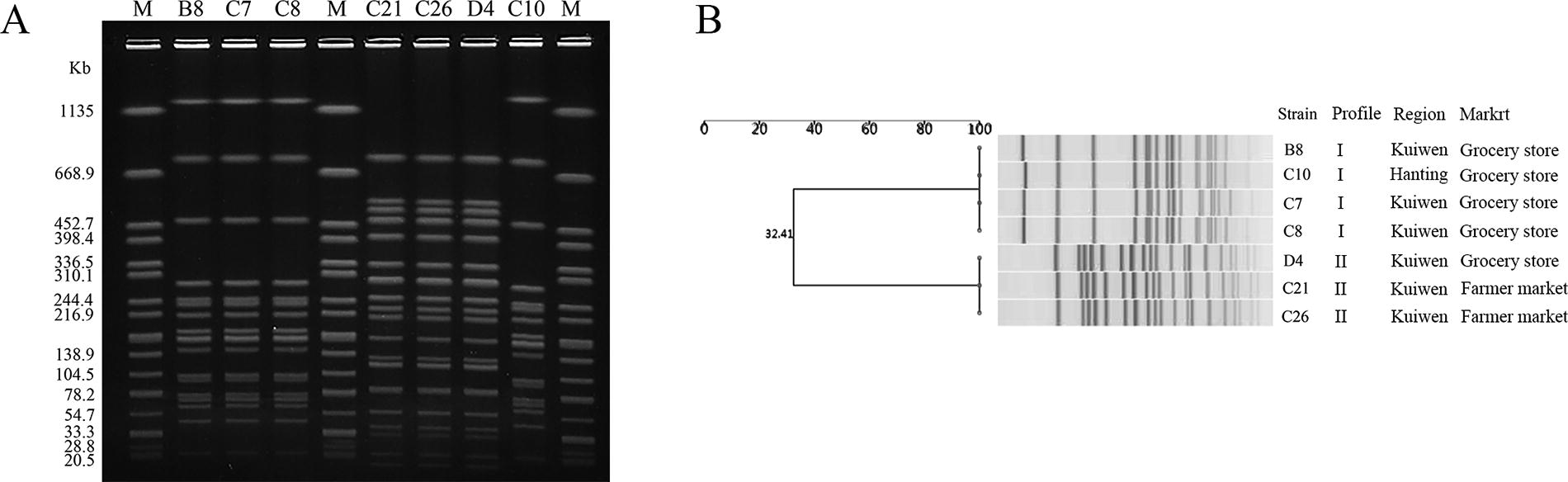
PFGE profiles of Salmonella strains.
Genome information
Seven isolates were sequenced and sequence-assembled, and the average size of the genome was 4.98 Mb (ranging from 4.86 to 5.18 Mb). The average GC content was 51.63%, with an N50 mean value of 347,898 (ranging from 182,483 to 451,603), and the average sequencing depth coverage was 264.3X. The prediction results of the gene elements revealed that an average of 4753 genes was predicted per isolate, and the average total length was 4.33 Mb. The numbers of genes encoding tRNAs and rRNAs in all the isolates ranged from 81 to 86 and 6 to 7, respectively, and all the isolates had one ncRNA and no pseudogenes (Table 3).
Antimicrobial Resistance and Susceptibility Pattern of the Isolated Salmonella Strains
AMK, amikacin; AMP, ampicillin; AMS, ampicillin/sulbactam; AZI, azithromycin; CAZ, ceftazidime; CHL, phenicol; CIP, ciprofloxacin; CT, colistin; CTX, cefotaxime; CZA, ceftazidime/avibactam; ETP, ertapenem; I, intermediate; MEM, meropenem; R, resistant; S, susceptible; STR, streptomycin; SXT, trimethoprim/sulfamethoxazole; TET, tetracycline; TIG, tigecycline.
Clusters of orthologous groups (COG) annotation of genes encoding proteins with biological functions in the seven genomes revealed that >70% of protein-coding genes were annotated, as shown in Figure 2, and the annotations of gene functions were divided into 22 categories. The most abundant COG functional group among the serovars was the gene function prediction only (R), and the highest (385) and lowest (362) number of genes in this category were observed in S. Senftenberg and S. IIIb 59:z10:z57, respectively. The next most abundant COG among the serovars differed. There were more genes related to amino acid transport and metabolism (E) than genes with unknown functions (S) in S. IIIb 59:z10:z57 and more S genes than E genes in S. Senftenberg. There were more genes whose function is unknown, which may be due to the lack of studies. In addition, both genotypes had several genes related to metabolism and energy, suggesting that their basic functions are similar.
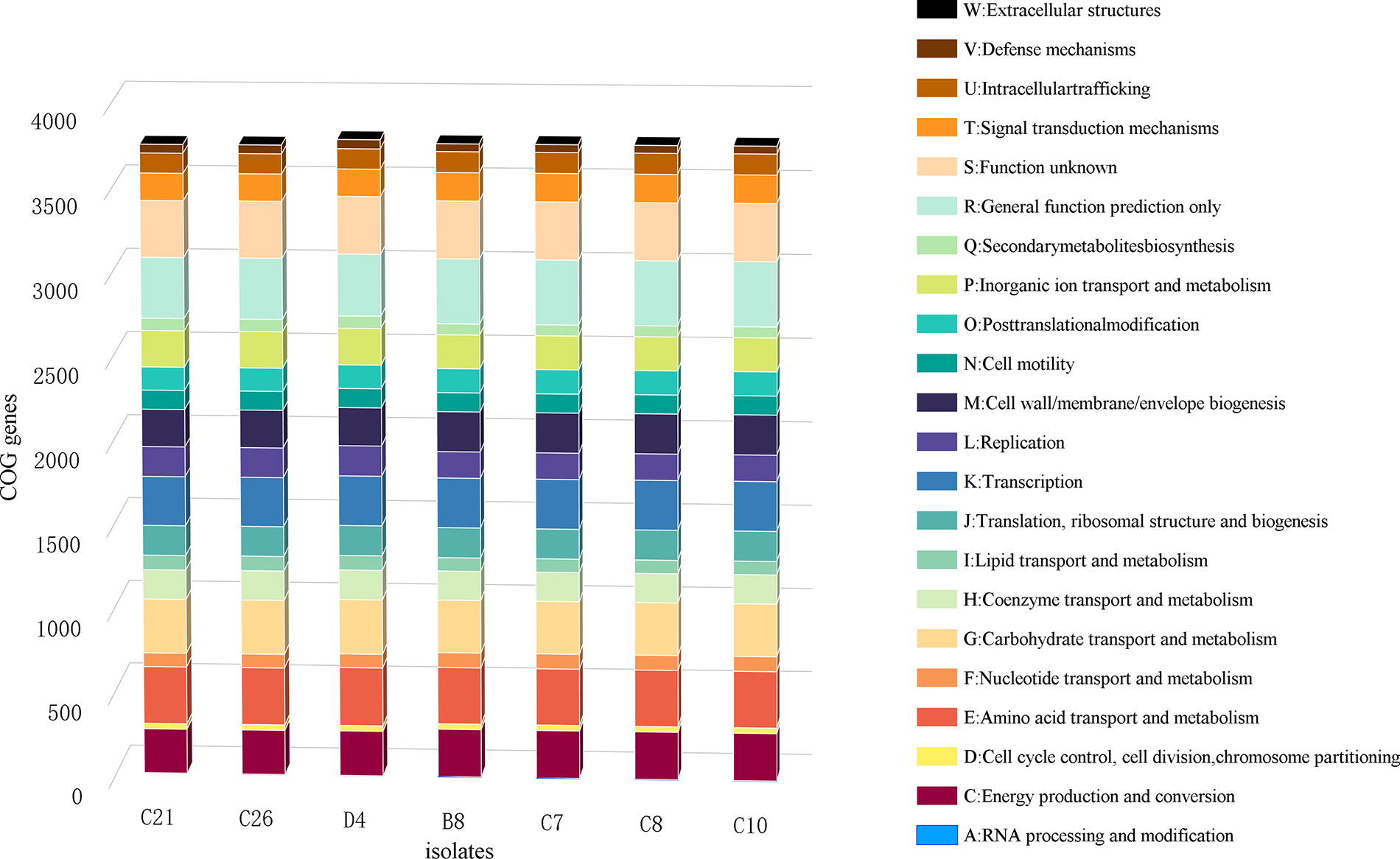
COG function annotation distribution plot. Different colors define different COG categories of genes. The horizontal axis represents strain number. The vertical axis is the number of genes annotated to this classification. COG, clusters of orthologous groups.
Seven-gene MLST population structure
Two STs were identified among the seven Salmonella isolates: ST14 (4/7, 57.14%) and ST875 (3/7, 42.86%) (Table 2). There was a corresponding relationship between ST and serotype. The 1022 Salmonella isolates were divided into 86 STs, with ST34 being the most common (n = 176), followed by ST11 (n = 174), ST19 (n = 141), ST155 (n = 106), and ST198 (n = 59). Among the 86 STs, 54 STs had a single source, and 32 STs had two or more sources. The STs isolated only from aquatic animals are ST14, ST875, ST17, ST950, ST7612, and ST10344. However, ST17 and ST516 were identified in both aquatic animals and other sources. The predominant phenotype in aquatic products was ST14, which is consistent with the type we isolated in aquatic products (Fig. 3).
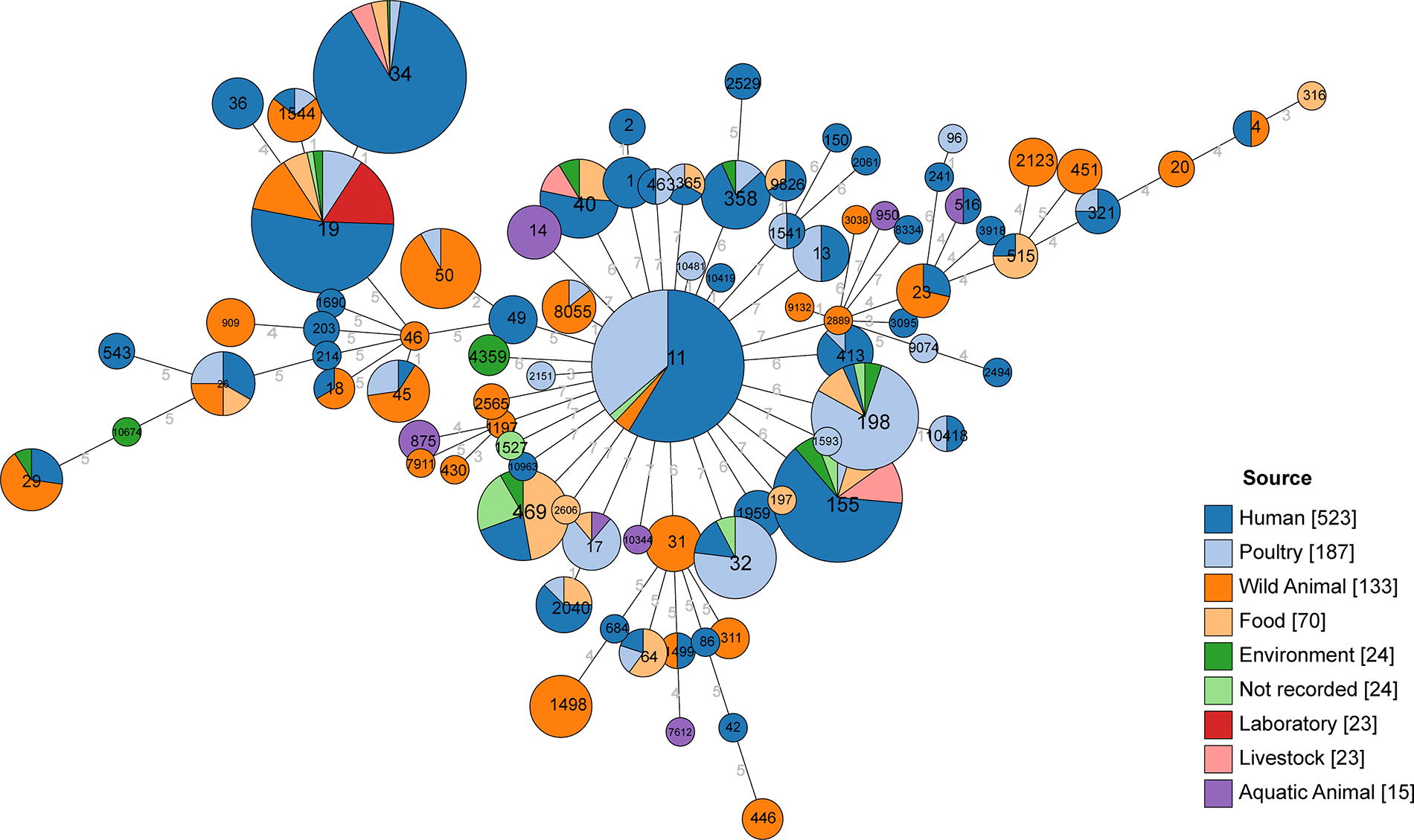
Population structure of Salmonella MLST in China, 2020–2024. Each node corresponds to a single ST. The size of the node is proportional to the number of strains. Different colors represent different sources. The area size of the color in the node is proportional to the number of strains from this source. The gray numbers on the branches between two nodes represent the number of housekeeping genes with two different STs. MLST, multilocus sequence typing; ST, sequence type.
AST and resistance genes
The results revealed that the antibiotic resistance profiles of three isolates of S. IIIb 59:z10:z57 were entirely consistent. All seven isolates showed intermediate resistance to colistin (CT), and six isolates were susceptible to the other 15 antibiotics that were tested. However, the situation was different for the S. Senftenberg strain isolated from an anchovy, which was resistant to ampicillin (AMP) and showed intermediate resistance to STR (Table 3).
The CARD database annotation results revealed a total of 17 resistance-related genes from seven Salmonella strains, with the number of resistance genes carried by each strain varying between 13 and 17. These genes included 15 resistance genes encoding drug efflux pumps; one gene conferring resistance to aminoglycosides, aac(6′)-Iy; and one peptide resistance gene, bacA. The same serotypes had the same composition of resistance genes. All seven strains harbored the peptide resistance gene bacA and the aminoglycoside resistance gene aac(6′)-Iy. The types and numbers of Salmonella resistance genes are shown in Supplementary Table S2.
Pathogenicity islands and virulence gene analysis results
The seven Salmonella isolates shared six pathogenicity islands, SPI-1, SPI-2, SPI-3, SPI-5, SPI-9, and C63PI. SPI-4 and SPI-8 islands were detected in S. Senftenberg. SPI-4 is involved in regulating the adaptation and survival of Salmonella in the host macrophage environment (Gerlach et al., 2007). Additionally, SPI-13 was detected in S. IIIb 59:z10:z57. The protein encoded by SPI-13 may be involved in the nutritional virulence of Salmonella pathogens (Elder et al., 2018).
A total of 191 virulence genes were annotated via the VFDB database. A total of 155 virulence genes were annotated in the S. Senftenberg isolates, and 136 virulence genes were annotated in the S. IIIb 59:z10:z57 isolates. The invA gene was annotated in all seven isolates; the protein encoded by this gene can stimulate the body to produce corresponding antibodies (Yan et al., 2017). Studies have shown that sseL located on SPI-2 islands is closely related to the pathogenicity of Salmonella (Cerny and Holden, 2019). Three S. IIIb 59:z10:z57 serotype isolates were not shown to harbor this gene, whereas S. Senftenberg isolates were shown to harbor this gene (Supplementary Table S3). The distributions of virulence genes of different serotypes were very different. For example, there were 71 genes associated with fimbrial adherence determinants in the S. Senftenberg serotype and only 31 in the S. IIIb 59:z10:z57 isolates.
Discussion
Among the 160 aquatic samples analyzed, 7 samples were positive for Salmonella, with a total detection rate of 4.38%. The rate of Salmonella detection in fresh retail aquatic products in the second phase of the national survey in the Chinese retail market was 5.3% (Yang et al., 2022), which was close to that reported in our study. The prevalence of Salmonella was 36% in 335 seafood samples from Thailand from 2018 to 2019 (Atwill and Jeamsripong, 2021), which is higher than the detection rate observed in our study. This disparity is likely the result of the different geographic locations of the sampling sites. This difference may also occur due to differences in the environmental sanitation conditions in the studied areas. Therefore, ensuring the health and safety of aquaculture, transportation, and sales of aquatic products is necessary.
Salmonella Enteritidis is the predominant Salmonella serotype in China, followed by S. Typhimurium (Yan et al., 2021). The main Salmonella serotype that was detected in Taiwan’s aquatic environment is S. Newport, while S. IIIb 50:k:z ranks among the top five serotypes (Ho et al., 2018). However, the serotypes of Salmonella that were isolated from aquatic products in our study were S. Senftenberg and S. IIIb 59:z10:z57. Therefore, the serotype composition of Salmonella in aquatic environments is diverse, and more research is still needed. PFGE has been widely used to analyze the genetic relationships between different subspecies of strains and to trace the source of infection. In this study, seven strains of Salmonella that were isolated from aquatic products exhibited two band patterns. The similarity of the PFGE band patterns of samples that were collected at different times was 100%, suggesting that the Salmonella population was highly homologous and that Salmonella was present for a long time. Owing to the limited types and quantity of the samples collected, expanding the scope of monitoring to establish a perfect PFGE molecular typing database of Salmonella in Weifang is necessary.
Previous studies have shown that a serotype may contain one or more STs, and an ST may also contain one or more serotypes (Wang et al., 2022). The STs of the seven isolates were highly correlated with the serotypes, with four S. Senftenberg isolates corresponding to ST14 and three S. IIIb 59:z10:z57 isolates corresponding to ST875. In this study, MLST population structure analysis was performed on 1022 Salmonella strains that were isolated from different sources in China from 2020 to April 2024. The most common ST was ST34, followed by ST11. More than half of the STs were collected from a single source, but some STs were collected from multiple sources. The main ST found in aquatic products is ST14, which is consistent with our experimental results.
A study of retail fresh aquatic products in China revealed that 38.9% of the isolates showed multidrug resistance, and the rates of resistance to STR, AMP, and tetracycline were the highest (Yang et al., 2022). However, in our study, only one isolate was resistant to AMP, and it showed intermediate resistance to STR. The remaining strains showed intermediate resistance to CT and were sensitive to all the other 15 antibiotics. The results of WGS and drug susceptibility tests revealed that all seven isolates carried several identical resistance genes, which indicated that horizontal transmission of resistance genes may have occurred in these isolates. The 6 isolates were not resistant to any of the 16 antibiotics tested, and most of the resistance genes carried by these isolates were related only to drug efflux pumps. No resistance genes to sulfonamide, quinolone, tetracycline, or β-lactam antibiotics, which are commonly used in aquaculture, were found, indicating that the drug resistance phenotype was consistent with the drug resistance genotype. However, the C8 strain was resistant to AMP, but no β-lactam resistance genes were detected. This phenomenon of a resistant phenotype without corresponding resistance genes suggested that resistance may be mediated by other resistance mechanisms or environmental influences. Virulence gene analysis revealed that the S. Senftenberg isolates carried significantly more adherence-related genes than S. IIIb 59:z10:z57 isolates did, which may help pathogens form biofilms, improve their adhesion and colonization ability, and thus increase their pathogenicity (Stover et al., 2016). However, the differences in virulence genes and virulence mechanisms between different serotypes still need to be further studied.
Conclusion
In conclusion, this is a sample survey of Salmonella contamination of retail aquatic products in the Weifang area. A total of 7 strains of Salmonella were isolated from 160 aquatic product samples. Four isolates were serotype S. Senftenberg, three isolates were serotype S. IIIb 59:z10: z57, and the isolates of the same serotype shared the same molecular type. One strain of S. Senftenberg was resistant to AMP, and the remaining isolates were not resistant to the antibiotics that were tested. These findings suggest that the use of antibiotics in aquatic products in Weifang may be reasonable. All the isolates carried multiple resistance genes and virulence genes, which need to be further studied and verified. MLST analysis was performed on 1022 Salmonella strains from various sources in China. The predominant phenotype in aquatic products was ST14, which is consistent with our findings.
Footnotes
Acknowledgments
The authors would like to thank the Weifang Municipal Center for Disease Control and Prevention and Weifang Key Laboratory for Food Nutrition and Safety for providing us with the experimental platform and technical guidance.
Authors’ Contributions
J.H., C.H., and Fengxiang Zhang designed the research. J.H., X.X., C.S., and P.Q. performed the experiments and analyzed the data. M.Y., Fengjuan Zhang, and Fengxiang Zhang were involved in the analysis and interpretation associated with this work. J.H. and Fengxiang Zhang participated in writing the article.
Disclosure Statement
No competing financial interests exist.
Data availability
The sequenced and assembled data were deposited in the GenBank database (National Center for Biotechnology Information) under BioProject accession no. PRJNA1123910. The accession IDs of all seven sequenced strains were JBEULB000000000, JBFNGI000000000, JBFNGJ000000000, JBFNGK000000000, JBFNGL000000000, JBFNGM000000000, and JBFNGN000000000.
Funding Information
This work was supported by 2022 National Food Safety Risk Assessment Center Research Joint Project (LH2022GG05) and Shandong Provincial Natural Science Foundation Project (ZR2023MH265).
Supplementary Material
Supplementary Table S1
Supplementary Table S2
Supplementary Table S3
References
Supplementary Material
Please find the following supplemental material available below.
For Open Access articles published under a Creative Commons License, all supplemental material carries the same license as the article it is associated with.
For non-Open Access articles published, all supplemental material carries a non-exclusive license, and permission requests for re-use of supplemental material or any part of supplemental material shall be sent directly to the copyright owner as specified in the copyright notice associated with the article.
