




Abstract
The ongoing increase in antimicrobial resistance (AMR) in Escherichia coli, particularly the emergence of extended-spectrum β-lactamase (ESBL)-producing and colistin-resistant strains in livestock, is a significant public health concern. The effectiveness of pig abattoir management, specifically through Hazard Analysis and Critical Control Points (HACCP) protocols, in reducing antimicrobial-resistant contamination continues to be scrutinized. This study investigated the prevalence, characteristics, and critical contamination points of ESBL-producing E. coli (ESBL-Ec) and colistin-resistant ESBL-Ec across the slaughtering processes in two pig abattoirs in Thailand—one operating under HACCP standards and the other certified solely under Good Manufacturing Practices. A higher prevalence of ESBL-Ec was found in the non-HACCP facility (67.98%) compared with the HACCP facility (52.04%), especially in pig carcasses. Skin and carcass washing in HACCP facilities effectively decreased bacterial contamination. Conversely, non-HACCP facilities should implement measures such as cleaning skin with disinfectants at the lairage, regularly monitoring and adjusting the final washing protocol, and strict sterilization of chopping plates to effectively control contamination points. Most ESBL-Ec isolates were multidrug-resistant and carried blaCTX-M group 1 or group 9 genes. Additionally, 12.6% of these isolates were resistant to colistin, with the mcr-1 gene predominantly identified. ST10 was the dominant clone of mcr-carrying ESBL-Ec across various slaughtering stages and sample types. These findings highlight the importance of implementing HACCP protocols to reduce contamination, enhance food safety, and mitigate public health risks. Ongoing AMR monitoring to find critical points along the slaughtering process is essential to reduce sources of AMR transmission to consumers.
Introduction
The global rise in antimicrobial resistance (AMR), particularly in foodborne pathogens such as Escherichia coli, poses a significant threat to public health and livestock. The emergence of extended-spectrum β-lactamase-producing E. coli (ESBL-Ec) and colistin-resistant E. coli (CREC) strains has compromised last-resort antibiotics such as cephalosporins, carbapenems, and colistin, as noted by the World Health Organization (WHO, 2024). ESBL-Ec and CREC have been isolated worldwide from community-onset extraintestinal infections in patients, as well as from animal products such as pork and chicken. The co-occurrence of colistin resistance in ESBL-Ec presents an even greater therapeutic challenge. The use of antimicrobials for prophylactic and therapeutic purposes in livestock fosters the development of multidrug-resistant organisms, which can be transmitted to humans through production systems (Hide et al., 2024; Shafiq et al., 2022; Sudatip et al., 2023; Wu et al., 2018). The blaCTX-M gene, which encodes the ESBL enzyme, has the most variants and is classified into five main groups (Zhang et al., 2021) and mcr gene conferring colistin resistance by altering bacterial lipopolysaccharide. Additionally, the blaCTX-M and mcr genes have demonstrated extensive global dissemination, likely facilitated by their integration into highly mobile genetic elements such as plasmids and transposons. These genetic platforms play a crucial role in the rapid and efficient spread of these genes across diverse bacterial populations (Bai et al., 2018; Cantón et al., 2012).
Abattoirs are critical points for monitoring contamination across the pig production chain, where inadequate hygiene can pose significant food safety concerns and risks of zoonotic transmission (Vial, 2018). The Hazard Analysis and Critical Control Points (HACCP) system identifies hazards, manages critical control points (CCPs), and ensures food safety through monitoring, corrective actions, verification, and record-keeping. It has earned wide recognition for its effectiveness across food industries (Uzoigwe and Kongolo, 2024). Several studies have shown that HACCP significantly reduces contamination in pig carcasses compared with non-HACCP systems, particularly for Salmonella and E. coli (Saenkankam et al., 2025; Wilhelm et al., 2011; Wu et al., 2019). However, comparative research on resistant bacteria in Thai abattoirs is limited. This study aimed to evaluate the prevalence, resistance profiles, and molecular characteristics of colistin-resistant and ESBL-Ec in two abattoirs, one HACCP-certified and one non-HACCP-certified. Samples from all slaughtering stages were analyzed to identify critical contamination points of ESBL-Ec to safeguard public health.
Materials and Methods
Sample collection
This study was conducted in two porcine abattoirs in Eastern Thailand: Abattoir 1 (HACCP group, S1) followed HACCP protocols and Good Manufacturing Practices (GMP), while Abattoir 2 (non-HACCP group, S2) was GMP-certified by the Department of Livestock Development only. The abattoirs in this study are large-scale private meat processing facilities sourcing pigs from company-owned farms, allowing the tracking of antibiotic usage and management practices (Supplementary Table S1). Sampling was carried out biannually from July 2020 to August 2021, yielding 342 samples from S1 (three visits) and 228 from S2 (two visits). The abattoirs and samples in this study were previously used by the authors to investigate Salmonella contamination at these sites (Saenkankam et al., 2025). During each visit, rectal content and carcass swabs were collected from the first 12 pigs processed at various slaughtering stages, following EC Regulation 2073/2005 (EFSA, 2005). Environmental samples were taken both before and during slaughtering operations. Other abattoirs with similar slaughtering patterns, farming practices, and regional antibiotic policies can use the data from this study to mitigate contamination (Supplementary Table S2).
Bacterial enumeration
Samples were serially diluted and plated on 3M™ Petrifilm™ Rapid E. coli/Coliform Count Plates (3M Health Care, USA). After incubation at 35°C for 48 h, bacterial counts were determined using an automated Petrifilm™ Plate Reader.
Isolation of ESBL-Ec
Samples were enriched and plated on Eosin Methylene Blue agar with cefotaxime (2 μg/mL) (Tansawai et al., 2019). Metallic sheen colonies were subcultured and identified via Matrix-Assisted Laser Desorption Ionization combined with time-of-flight analysis (MALDI Biotyper, Bruker, USA), with ESBL production confirmed using combination disc tests with cefotaxime and ceftazidime, following CLSI guidelines (CLSI, 2015).
Antimicrobial susceptibility testing
Minimum inhibitory concentrations were determined for representative isolates from each positive sample using EUVSEC Sensititre™ plates (Thermo Scientific™, Massachusetts, USA). In brief, the bacterial suspension was standardized to 0.5 McFarland, mixed with Mueller-Hinton II broth, transferred into the plate, and incubated at 37°C for 18 h. Results were interpreted using CLSI (CLSI, 2021) and FDA breakpoints (USFDA, 2015), with E. coli ATCC 25922 as the control.
Detection of resistance genes
DNA was extracted from ESBL-Ec to detect blaCTX-M (groups 1, 2, 8, 9, 25–26) and mcr-1 to mcr-8 genes using multiplex and simplex PCR. PCR primers and conditions were based on previous studies with slight adjustments. In brief, each PCR reaction utilized the FIREPol® master mix (Solis Biodyne OÜ, Estonia) and 20 pmol of primer. E. coli ATCC25922 served as the negative control, while E. coli CU13 carrying mcr-1 and mcr-3 served as the positive control (Supplementary Table S3) (Lugsomya et al., 2018; Rebelo et al., 2018).
Molecular typing
Multilocus sequence typing (MLST) was performed on mcr-carrying ESBL-Ec isolates, targeting seven housekeeping genes (Adiri et al., 2003). PCR products were sequenced and analyzed using the MLST database for sequence types (STs) as shown in Supplementary Table S4.
Statistical analysis
Data analysis was conducted using SPSS version 22.0 (SPSS Inc., Chicago, IL, USA) with a 95% confidence level. Bacterial concentrations were reported in log colony-forming unit (CFU)/100cm2. Welch and Brown-Forsythe tests with Dunnett’s T3 were used for coliform comparisons, while analysis of variance assessed E. coli counts (Cai et al., 2019). Logistic regression analyzed the prevalence of positive samples across sample types, sampling times, and slaughtering steps, while Fisher’s exact test compared ESBL-Ec prevalence and AMR between the two abattoirs (Wu et al., 2009).
Results
Bacterial counts and prevalence of ESBL-Ec
Bacterial concentrations varied significantly across slaughtering steps within individual abattoirs (p < 0.01; Fig. 1). In HACCP carcasses (S1), coliform and E. coli counts peaked post-stunning (2.03 ± 0.07 and 1.84 ± 0.41 log10 CFU/100 cm2, respectively) before declining (Fig. 1A). Conversely, the prevalence of ESBL-Ec decreased from post-stunning to post-chilling but sharply increased after cutting, reaching 86.11% (Fig. 1B). In non-HACCP carcasses (S2), coliform counts were highest post-scalding (2.84 ± 0.94 log10 CFU/100 cm2), while E. coli counts peaked post-stunning (2.22 ± 0.40 log10 CFU/100 cm2) and remained stable until cutting. The prevalence of ESBL-Ec peaked post-stunning, stabilized through scalding and chilling, and then declined after cutting to 58.33%.
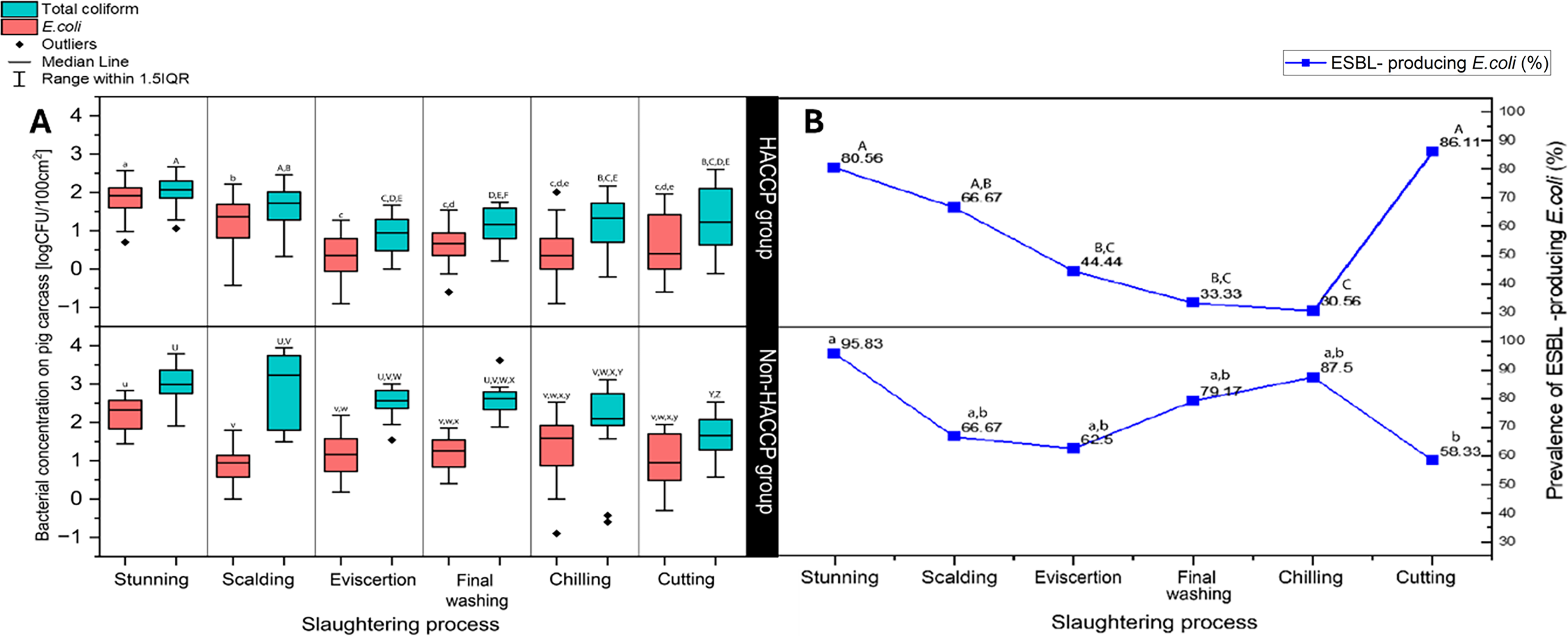
Bacterial contamination levels were assessed on carcasses during each slaughtering step in two abattoirs.
Comparison of ESBL-Ec prevalence across sample types
Non-HACCP samples (S2) had a significantly higher prevalence of ESBL-Ec compared with HACCP samples (S1, p < 0.01). Notably, S2 carcasses exhibited a significantly higher prevalence than S1 carcasses (p < 0.01), as detailed in Table 1. No significant differences in prevalence were observed across sampling times (Supplementary Table S5). Among sample types, environmental samples had the lowest prevalence of ESBL-Ec. Most cutting boards and knives in both abattoirs had bacterial levels exceeding the standard limits (total coliforms <100 CFU/cm2 and no detectable E. coli; DMSC, 2017), with ESBL-Ec contamination detected both before and during activities. Additionally, conveyors and worker gloves in S2 were heavily contaminated with ESBL-Ec. In contrast, water samples from both abattoirs tested negative (Supplementary Table S6).
Prevalence of ESBL-Producing Escherichia coli (ESBL-Ec) and Colistin-Resistant ESBL-Ec in Rectal, Carcass, and Environmental Samples from Two Abattoirs
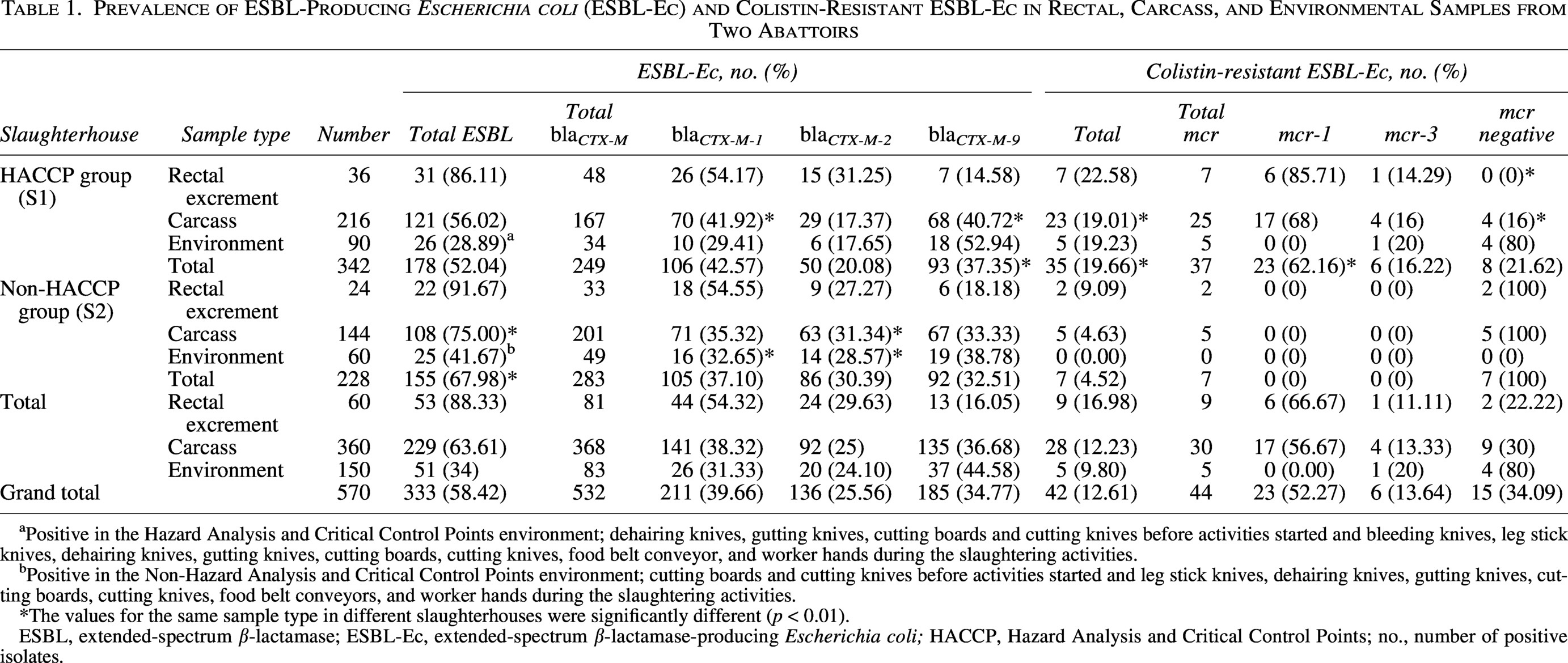
Positive in the Hazard Analysis and Critical Control Points environment; dehairing knives, gutting knives, cutting boards and cutting knives before activities started and bleeding knives, leg stick knives, dehairing knives, gutting knives, cutting boards, cutting knives, food belt conveyor, and worker hands during the slaughtering activities.
Positive in the Non-Hazard Analysis and Critical Control Points environment; cutting boards and cutting knives before activities started and leg stick knives, dehairing knives, gutting knives, cutting boards, cutting knives, food belt conveyors, and worker hands during the slaughtering activities.
The values for the same sample type in different slaughterhouses were significantly different (p < 0.01).
ESBL, extended-spectrum β-lactamase; ESBL-Ec, extended-spectrum β-lactamase-producing Escherichia coli; HACCP, Hazard Analysis and Critical Control Points; no., number of positive isolates.
AMR profiles and resistance genes detection of ESBL-Ec
AMR profiling of 333 ESBL-Ec isolates revealed that 97.3% were multidrug-resistant, with high resistance to veterinary drugs such as ampicillin and tetracycline. These isolates showed low resistance to critically important antimicrobials (HPCIAs), as identified by World Health Organization (WHO, 2024), included colistin, meropenem, and tigecycline as detailed in Table 2. ESBL-Ec isolates from S1 abattoir showed significantly higher resistance to chloramphenicol, ciprofloxacin, colistin, gentamicin, nalidixic acid, and trimethoprim compared with those from S2 (p < 0.05). The AMP, CTX, CAZ, GEN, TET, CHL, T, and SUL resistance pattern (P6) was the most common antibiogram profile across both abattoirs. The P6 pattern was identified in 12 isolates from rectal content, carcasses, cutting boards, and worker hands in the S1 abattoir. Similarly, this pattern was found in 23 isolates across all slaughtering stages in the S2 abattoir, including carcasses, cutting tools, and worker hands (Supplementary Table S7).
Prevalence of Antimicrobial Resistance in ESBL-Producing Escherichia coli (ESBL-Ec) Isolates from Rectal, Carcass, and Environmental Samples from Two Abattoirs
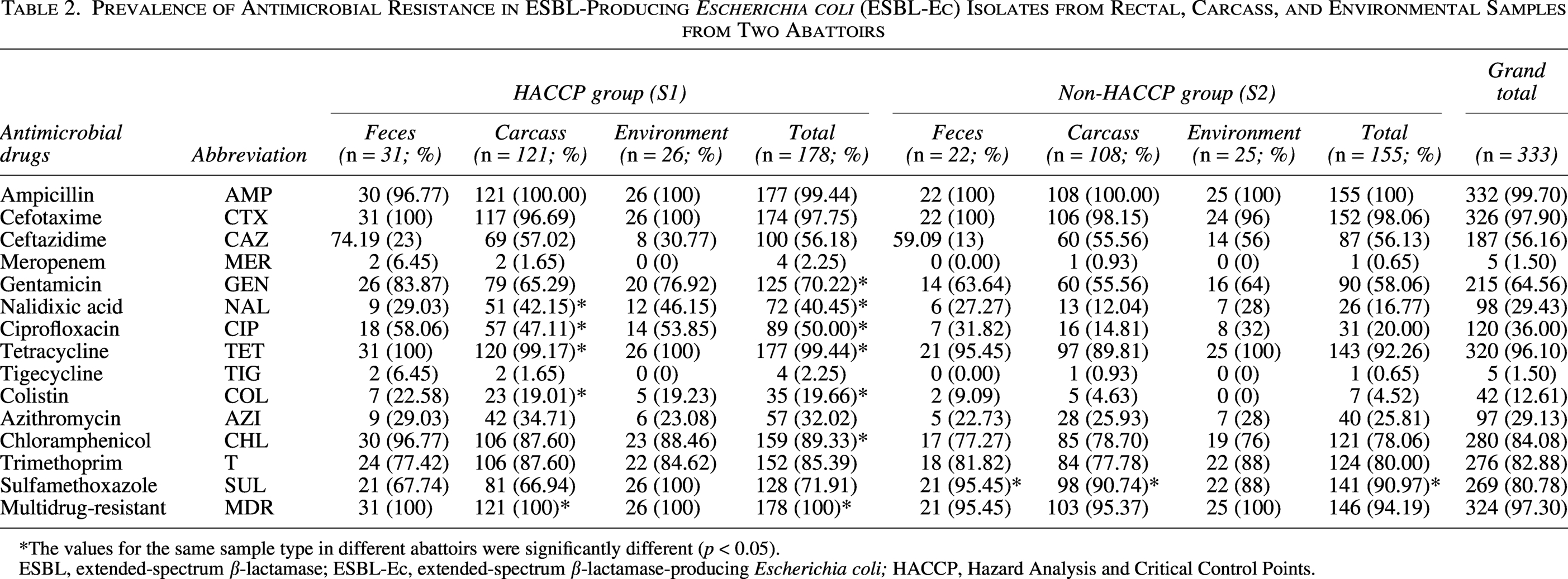
The values for the same sample type in different abattoirs were significantly different (p < 0.05).
ESBL, extended-spectrum β-lactamase; ESBL-Ec, extended-spectrum β-lactamase-producing Escherichia coli; HACCP, Hazard Analysis and Critical Control Points.
The blaCTX-M-1 group was predominantly found in isolates from rectal content and carcasses, while the blaCTX-M-9 group was most detected in isolates from environmental samples. Additionally, some isolates harbored multiple blaCTX-M groups. Colistin-resistant isolates from the S1 abattoir predominantly carried mcr-1, followed by mcr-3, whereas no mcr genes were detected in isolates from the S2 abattoir (Supplementary Table S8).
Molecular typing
MLST identified ST10 (37.04%) as the most frequent ST, followed by ST278 (29.63%). ST10 was found in rectal contents and across multiple carcass processing stages, including post-stunning, scalding, evisceration, and on the cutting plate. Genetic analyses revealed relatedness among isolates. For example, rectal content isolates (TF2.1, TF5.1) and a post-scalding carcass isolate (TSC1.1) shared identical antibiograms (AMP, CTX, CAZ, GEN, TET, COL, CHL, T, SUL) and ST10 profiles. Similarly, a post-stunning carcass isolate (TST3.1) and a cutting board isolate (TBE6.1) exhibited matching antibiograms and genetic profiles within ST10 (Fig. 2, Supplementary Table S8).
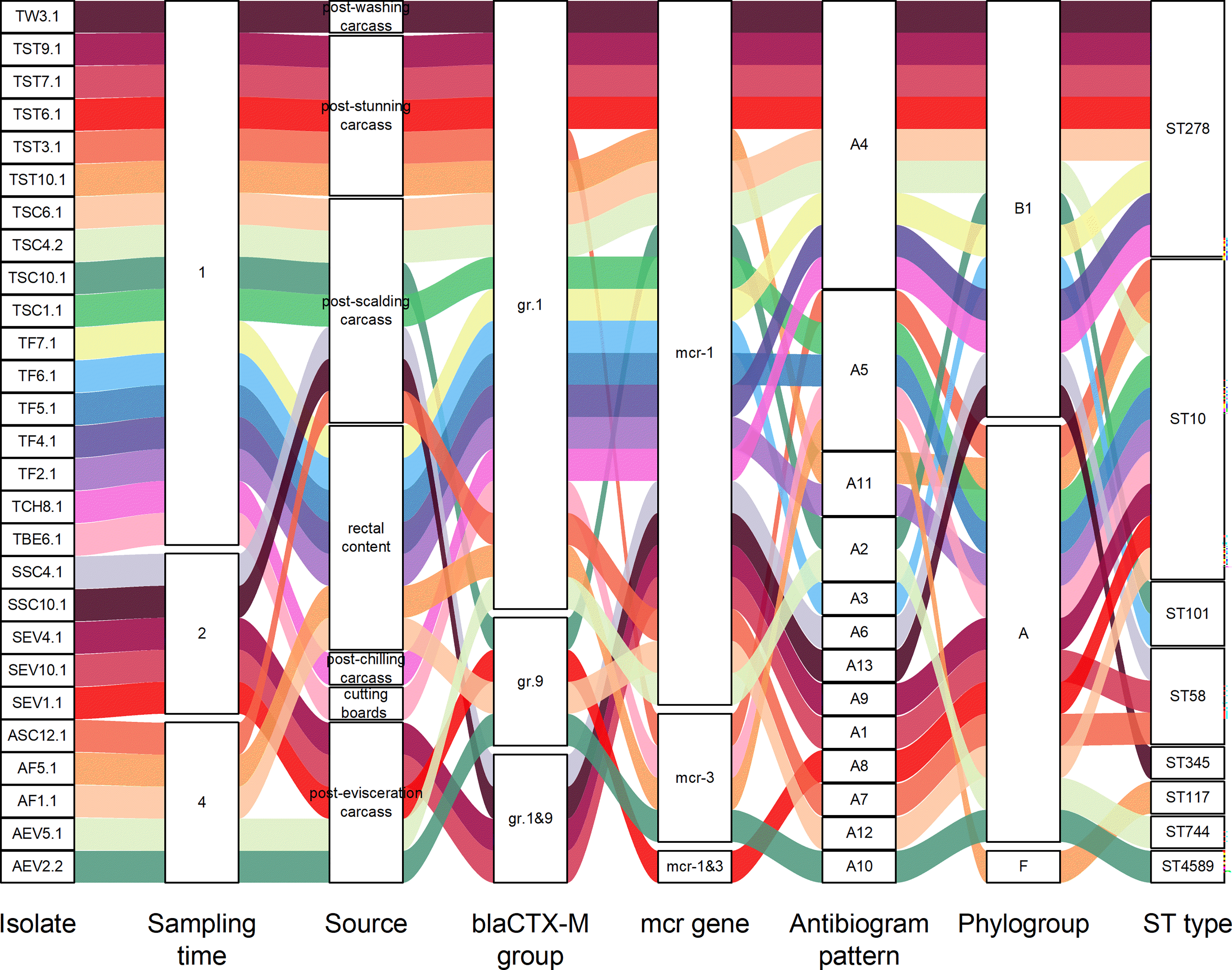
Alluvial diagram illustrates the distribution of mcr-positive ESBL-producing Escherichia coli isolates in the HACCP group (S1). The diagram displays the relationships between isolates, sampling times, sources, blaCTX-M groups, mcr genes, antibiogram patterns, phylogroups, and sequence types (STs). ESBL, extended-spectrum β-lactamase; HACCP, Hazard Analysis and Critical Control Points; ST, sequence type.
Discussion
The emergence of ESBL-Ec in pigs poses a public health risk due to zoonotic transmission and antibiotic resistance transfer. This study found ESBL-Ec in 58.4% of samples, including 88.33% of rectal contents and 63.61% of carcasses. The prevalence of ESBL-Ec in feces observed in this study was higher than that reported in Switzerland (15.2%), Thailand (29.4%), and the European Food Safety Authority (EFSA) surveillance across Europe (76.1%) (EFSA, 2024; Lay et al., 2021; Van Damme et al., 2017). Conversely, the prevalence in carcasses was lower than the EFSA surveillance (81.5%) but higher than those reported in Korea (8.9%) and Thailand (33%) (Biasino et al., 2018; Boonyasiri et al., 2014; Kim et al., 2021). Variability among reports may result from differences in antimicrobial use and production practices (Lugsomya et al., 2018; Ribeiro et al., 2024). The high prevalence in carcasses in this study may be attributed to sampling the same carcass at multiple slaughtering steps, whereas other studies sampled at single steps. Additionally, 34% of environmental samples exceeded safety contamination standards before and during slaughtering, reflecting insufficient sanitation protocols in both abattoirs (Abayneh et al., 2019; Tschudin-Sutter et al., 2014). Notably, 26.7% of cutting boards showed excessive bacterial counts and a high ESBL-Ec rate before activity commenced, potentially due to biofilm formation by E. coli and knife-induced scratches, which create difficult-to-clean surfaces that facilitate bacterial persistence on surfaces (Jarmila et al., 2010; Sandhya et al., 2021). Furthermore, the non-HACCP abattoir exhibited higher contamination rates on food conveyors and workers’ gloves during operations compared with the HACCP abattoir, which may contribute to bacterial transfer to pork. This study reveals a significantly higher ESBL-Ec rate and bacterial count in non-HACCP carcasses compared with HACCP carcasses, with critical contamination points identified at various stages of the slaughtering process in each abattoir. The higher bacterial contamination observed immediately after stunning both abattoirs underscores the risk of contamination during the pre-stunning and post-stunning processes, consistent with findings from previous studies (Gaire et al., 2024; Wheatley et al., 2014). Research has demonstrated that maintaining clean lairage areas and applying chlorocresol-based disinfectants during showering can significantly reduce fecal contamination and bacterial loads on pigs’ skin before slaughter (Costa et al., 2015; Walia et al., 2017). The ESBL-Ec rate increased, and the bacterial count remained high in S2 carcasses after final washing and chilling, whereas both decreased in S1 carcasses. This indicates that the manual high-pressure washer used in S2 was inadequate for reducing contamination, whereas the washing procedures in S1, serving as a CCP in the HACCP system, effectively minimized contamination. Similarly, previous studies have demonstrated that washing with running or high-pressure water produces variable outcomes depending on factors such as water temperature and pressure (Orsoni et al., 2020; Projahn et al., 2018; Zdolec et al., 2022). Therefore, S2 should implement training on proper washing procedures to mitigate contamination caused by inadequate infrastructure.
The cutting stage emerged as a critical contamination point, with increased levels of Salmonella and E. coli observed in S1 abattoirs that may be due to cross-contamination from equipment and the handling of carcasses, as the S1 cutting process involves mixing all carcass parts before separation. In contrast, S2 immediately separates and packages different cuts after butchering. This aligns with studies reporting higher bacterial counts in post-cutting meat (Velebit et al., 2021; Voloski et al., 2016). Therefore, modifying the cutting protocol may help reduce contamination. The samples in this study were previously tested for Salmonella (Saenkankam et al., 2025), with Salmonella detected in 13.7% of S1 samples and 41.2% of S2 samples. A comparison of ESBL-Ec and Salmonella contamination across slaughtering steps revealed that the HACCP-regulated abattoir (S1) significantly reduced bacterial concentrations from post-stunning to post-chilling. In contrast, the S2 abattoir maintained higher contamination levels up to the post-cutting stage, suggesting that carcasses and meat act as reservoirs for antimicrobial-resistant bacteria and pathogens, contaminating food contact surfaces and adjacent carcasses. Additionally, handling gloves and the surrounding environment serve as secondary reservoirs, further exacerbating cross-contamination. The HACCP system effectively reduces AMR and bacterial contamination by implementing CCPs and conducting regular monitoring, as recommended by the United States Department of Agriculture (USDA) and Food and Agriculture Organization of the United Nations (FAO) (FAO/WHO, 2015; USDA, 2014).
This study highlights the challenge of AMR in food production, revealing that over 97% of ESBL-Ec were multidrug-resistant, with high resistance to ampicillin, cefotaxime, and tetracycline, commonly used in veterinary settings. Higher drug resistance in S1 isolates may result from pig farm management practices, frequent antibiotic use, and environmental antibiotic residues, which foster the development of resistant strains and accelerate the spread of resistance through gene transfer (De Koster et al., 2021; Gebreyes et al., 2017; Hickman et al., 2021; Huber et al., 2021). The blaCTX-M gene confers resistance to β-lactam antibiotics and spreads efficiently via transferable plasmids, enabling the dissemination and adaptability of diverse bacterial strains and hosts (El-Ghareeb et al., 2020; Patil et al., 2019; Thepmanee et al., 2019; Yossapol et al., 2024). This study identified a high prevalence of blaCTX-M group 1 and group 9 genes, with group 1 being dominant in rectal content and carcass samples, while group 9 was more common in environmental isolates. These findings align with studies in Europe and Asia, where pigs are significant reservoirs of blaCTX-M group 1 genes like blaCTX-M-1, blaCTX-M-15, and blaCTX-M-55 (Sidjabat and Paterson, 2015; Wang et al., 2016). Although transmission to humans through direct contact or contaminated pig products is possible, clonal relationships between human and animal strains remain rare (Ewers et al., 2021; Jakobsen et al., 2015). This study identified colistin resistance in 12.6% of ESBL-Ec isolates. Among these, only isolates from S1 harbored the mcr-1 and mcr-3 genes, whereas isolates from S2 lacked mcr genes. This finding suggests that resistance in S2 isolates may be attributed to chromosomal mutations (Hide et al., 2024; Kim et al., 2019). The prevalence of colistin-resistant ESBL-Ec in this study was lower than that reported in previous studies on pigs worldwide, particularly in Thailand, as well as in global clinical samples (Dadashi et al., 2022; Mandujano-Hernandez et al., 2024). Several factors may contribute to colistin resistance in ESBL-Ec. First, although Thailand has banned the use of colistin in livestock feed, similar to regulations in the United States and Canada, its use for treatment is still permitted under veterinary prescription (DLD, 2019; Fang et al., 2019; Kempf et al., 2016). Second, both AMR genes may be located on the same plasmid, enabling bacteria to develop resistance to multiple antibiotics under selective pressure from other antimicrobial agents. Third, the recruitment of mcr genes within the cell acts as a survival mechanism to preserve cell wall integrity and may contribute to the increasing prevalence of mcr-carrying ESBL-Ec (Trongjit et al., 2022). According to the Global Action Plan, veterinarians should test pathogen susceptibility before prescribing antibiotics and implement training in hygiene standards to reduce AMR. Countries should develop national guidelines for antibiotic use and establish national policies for AMR risk analysis and monitoring within the One Health framework (WHO, 2015).
MLST analysis of mcr-carrying ESBL-Ec isolates revealed significant genetic diversity, with ST10 being the predominant ST (37.04%). ST10 isolates were detected in rectal contents, carcasses at various slaughtering steps, and cutting plates, demonstrating resilience to decontamination and a high transmission potential. Similar studies highlight ST10’s prevalence among resistant E. coli across various hosts, contributing to the global spread of AMR (Diaz-Jimenez et al., 2020; Lu et al., 2023; Shi et al., 2022). Genetic relatedness among isolates suggests clonal dissemination during slaughtering, indicating that current sanitation protocols may be insufficient. HACCP procedures were more effective in reducing ESBL-Ec contamination and limiting transmission from environmental surfaces to carcasses compared with non-HACCP methods. These findings underscore the need for improved hygiene protocols to prevent the spread of antimicrobial-resistant strains during pork processing.
Conclusions
This study highlights the high prevalence and AMR profiles of ESBL-Ec in two Thai pig abattoirs, with significantly higher contamination levels observed in the non-HACCP-certified facility, particularly in carcasses and environmental samples. The recommended measures for facilities to reduce contamination include cleaning animal skin with disinfectants at the lairage to effectively minimize bacterial entry into the slaughter line. Regular training and monitoring of the washing protocol are essential to reducing bacterial contamination, especially in small-scale abattoirs. Finally, strict adherence to chopping plate sterilization is essential to prevent bacterial contamination from equipment. Most resistant E. coli (97%) were multidrug-resistant, predominantly carrying blaCTX-M group 1 and group 9 genes. The detection of mcr-1 and mcr-3 in colistin-resistant ESBL-Ec strains poses serious public health risks. Molecular typing identified ST10 as the predominant clonal group responsible for cross-contamination, highlighting deficiencies in hygiene and sanitation measures. These findings emphasize the urgent need for strict HACCP implementation and enhanced antimicrobial stewardship to mitigate AMR transmission from animals to humans.
Authors’ Contributions
All authors contributed significantly to the study. Key roles included conceptualization (I.S., W.N., N.P.), methodology (I.S., W.N., N.S., P.A., N.P.), investigation (I.S., N.S., P.A., N.P.), validation (I.S., D.J.H., N.P.), writing—original draft (I.S., N.P.), review and editing (I.S., D.J.H., N.P.), visualization (I.S., N.P.), supervision (N.P.), project administration (N.P.), and funding acquisition (I.S., N.P.). All authors approved the final article.
Footnotes
Acknowledgment
The authors thank the abattoir staff for their support in providing slaughtering management data.
Funding Information
This research was supported by the Royal Golden Jubilee PhD Program, the 90th Anniversary of Chulalongkorn University Fund, and 2568-Fundamental Fund, Thailand Science Research and Innovation (FOOD_FF681253100014).
Disclosure Statement
No competing financial interests exist.
Supplemental Material
Supplemental Material
Supplemental Material
Supplemental Material
Supplemental Material
Supplemental Material
Supplemental Material
Supplemental Material
References
Supplementary Material
Please find the following supplemental material available below.
For Open Access articles published under a Creative Commons License, all supplemental material carries the same license as the article it is associated with.
For non-Open Access articles published, all supplemental material carries a non-exclusive license, and permission requests for re-use of supplemental material or any part of supplemental material shall be sent directly to the copyright owner as specified in the copyright notice associated with the article.
