




Abstract
Abstract
Objectives:
Physical activity and cognitive training are effective to enhance cognition in older patients with mild cognitive impairment (MCI). Xbox 360 Kinect cognitive games are a combination of physical activity and cognitive training. The objective of this study was to determine the short- and long-term effects of Xbox 360 Kinect cognitive games on slowness and complexity of electroencephalography (EEG) and cognitive functions in older subjects with MCI.
Materials and Methods:
A clinical trial was conducted on 44 MCI subjects. Both males and females were randomized into experimental group (participated in Xbox 360 Kinect cognitive games) and control group (range of motion exercises only and no Xbox 360 Kinect cognitive games). Subjects were assessed before and after one session of game intervention for short-term effects and after 6 weeks for long-term effects. The outcome measures were the mini-mental state examination (MMSE), Montreal cognitive assessment scale (MoCA), trail making test (TMT) A and B, and slowness and complexity of EEG.
Results:
After one session of game intervention, delta (0.704 ± 0.025; P = 0.013), theta (0.128 ± 0.009; P = 0.00127) waves, and complexity of EEG (0.642 ± 0.042; P = 0.008) significantly improved, in eyes closed state. Whereas after 6 weeks intervention of games, delta (0.673 ± 0.029; P = 0.013), theta (0.129 ± 0.013; P = 0.002), beta2 waves (0.044 ± 0.009; P = 0.046), complexity of EEG (0.051 ± 0.042; P = 0.016), MMSE (26.25 ± 0.347 vs. 23.722 ± 0.731; P = 0.003), MoCA (25.65 ± 0.310 vs. 22.00 ± 0.504; P = 0.0001), TMT-A (1.429 ± 0.234 vs. 2.225 ± 0.259; P = 0.028), and TMT-B (2.393 ± 0.201 vs. 3.780 ± 0.195; P = 0.0001) improved significantly. These changes were not observed in the control group.
Conclusion:
Xbox 360 Kinect games showed beneficial effects after short- and long-term intervention on MCI subjects. These games can serve as potential therapeutic candidates for MCI.
Introduction
M
Exergames are videogames that require subjects to be active through physical movements to play games and have to complete tasks in response to visual clues. 21 Different terminologies are used for them, such as, active gaming and motion-based videogaming. 22 Common games that are involved in this category are “Nintendo Wii” and “Microsoft Xbox 360 Kinect.” These games are used as a leisure activity in a large scale, but now there is growing evidence that this technology can be used for health benefits.23–25 Knowing the fact that these games engage brain circuitry, it would be interesting to see their effects on brain. Particularly effects of exergames on MCI subjects have not been thoroughly investigated. The Xbox 360 Kinect has the advantages of being easily available, user friendly for elderly people even in a home-based environment, and the risk of falling of elderly people is limited. Playing games while using the Xbox 360 Kinect system showed improvement of cognitive abilities in healthy older adults as compared with those who played games by using sedentary platform (as in Wii fit). 26 The Xbox 360 console consists of a graphing processing unit, central processing unit, memory, and input/output. It is a low-price device and can be easily handled in clinical as well as in home-based rehabilitation. 27 The Xbox 360 gaming console is connected with Kinect (it is a motion-sensitive input device). It helps the subject to play a game using body movement or by gestures without touching the screen or game controller. It can work in normal room lighting conditions. Proper detection of all movements from head to feet requires the recommended distance of 1.8 meter from the sensor. 28 The accuracy and precision of Kinect to detect movements of body, are higher than any other motion-tracking devices such as “Nintendo Wiimote.” 29
Several studies have explored different electroencephalography (EEG) parameters to diagnose MCI and Alzheimer's subjects. Three parameters are considered reliable and acceptable for the diagnosis of MCI/Alzheimer's subjects, and these are: (1) Increases in low-frequency power band (delta and theta) and decrease in high-frequency power bands (alpha and beta).30,31 In early stage of dementia (MCI), “slowing” of EEG has positive correlation and high sensitivity with progression of disease. 32 In MCI subjects, low powered delta waves are increased, because there is degeneration in corticocortical connectivity. 33 (2) Decrease in complexity of EEG. 31 Complexity or approximate entropy (ApEn) is a non-negative number, 34 widely accepted parameter for the diagnosis of MCI subjects.35,36 MCI subjects have less complexity of EEG due to neuronal death and decrease in neurotransmitter levels.37,38 (3) Decreased synchronization.39–41 These above mentioned parameters are mostly observed in eyes-closed state, during resting EEG.
The effect of Xbox 360 Kinect cognitive game training on brain EEG rhythms in MCI subjects has not been studied up to our knowledge. The EEG may provide us with a better understanding of the mode of action of Xbox 360 Kinect cognitive games on brain. Due to all these above mentioned limitations and gaps, this study was planned to determine the short- and long-term effects of Xbox 360 Kinect cognitive games on cognitive functions, slowness of EEG, and complexity or ApEn in MCI subjects. It was hypothesized that Xbox 360 Kinect cognitive games would have positive effects on MCI subjects.
Materials and Methods
Study design
The design of the study is a randomized controlled trial. It was conducted at the Pakistan Railways General Hospital, in Rawalpindi, Pakistan, from March 2016 to May 2017. All procedures were approved by the Internal Review Board (IRB) of Riphah College of Rehabilitation Sciences and Atta-ur-Rahman School of Applied Biosciences, National University of Sciences and Technology, Islamabad, Pakistan (approval number IRB-67).
Subject
Subjects who visit the hospital and were diagnosed as MCI patients were selected in this study. The subjects were excluded if they: (1) were on medications interfering with the cognition, (2) had any disease affecting the central nervous system (such as multiple sclerosis, Parkinson, stroke, thyroid disease, diabetes, and hypertension). Moreover, the subjects had to be able to read and write their name in Urdu (local national language) and English. The ethics procedure was explained in Urdu to the subjects, and they gave their written informed consent before participation. Out of 83 subjects, 44 were eligible to participate in the study and screened on the basis of inclusion and exclusion criteria (Fig. 1). These subjects were randomly divided into an experimental group (Xbox 360 Kinect cognitive games training, n = 22) and a control group (range of motion exercises, n = 22). During the study, four subjects from the control group and two from the experimental group were lost in the follow-up (Fig. 1).
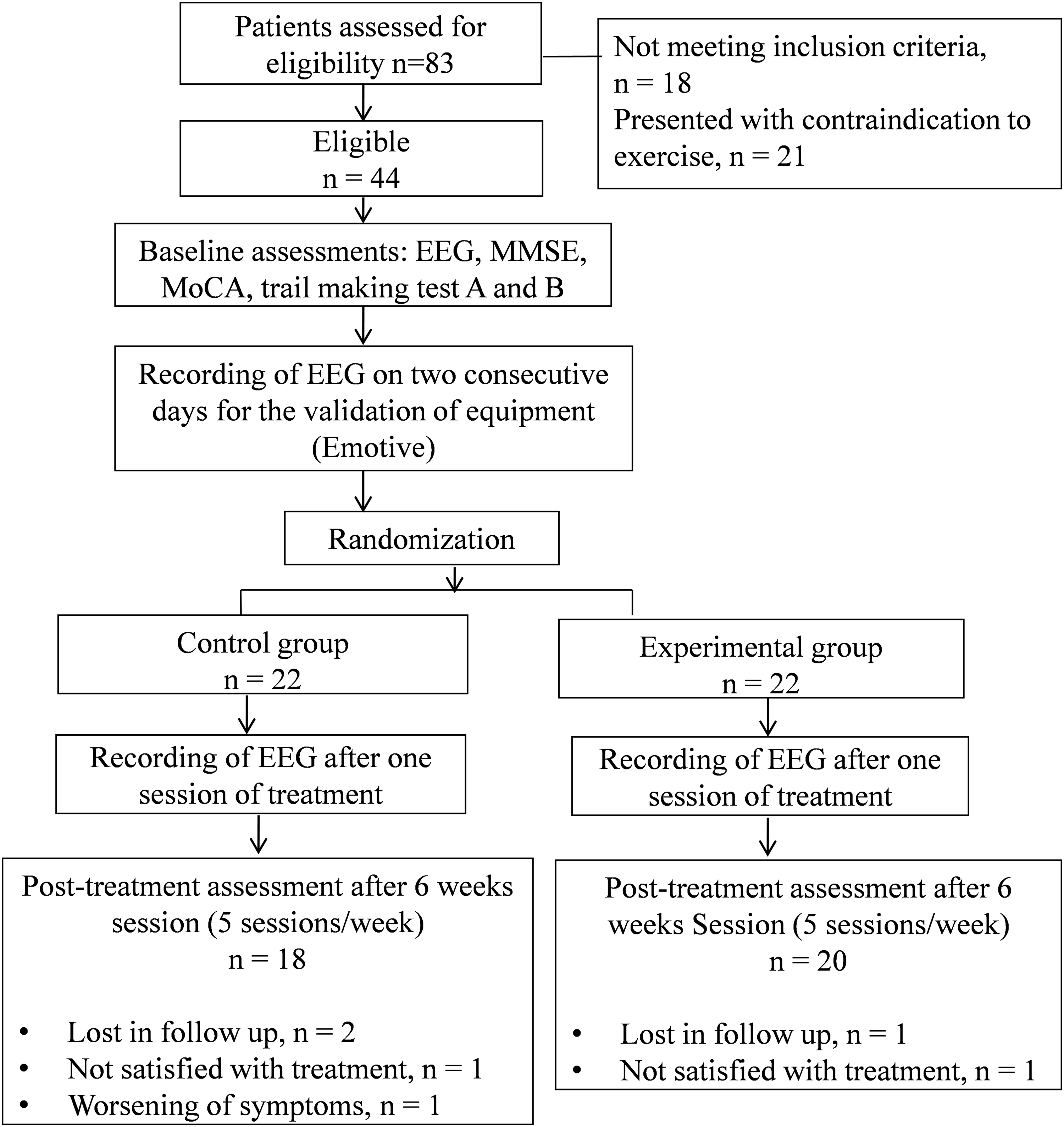
Flow chart of subjects' recruitment and follow-up assessment. EEG, electroencephalography; MMSE, mini-mental state examination; MoCA, Montreal cognitive assessment; n, number of subjects.
Experimental setup
The EEG was measured before the start of treatment, after one session, and after 6 weeks of training with or without Xbox 360 Kinect cognitive games. Neurocognitive tests were performed before the start of treatment and after 6 weeks of Xbox 360 Kinect cognitive games training (Fig. 1).
EEG and neurocognitive measurements
Electroencephalography
EEG was recorded using the Emotiv Epoc with 14 channels. The channels were: AF3, F7, F3, FC5, T7, P7, O1, O2, P8, T8, FC6, F4, F8, and AF4 according to the international 10–20 system. The channels were referenced at P3/P4 and sampled at 128 Hz. The impedance of the electrodes was below 10 kΩ in all recordings. The EEG was recorded for 2 minutes (in both cases, short term and long term), alternating between 30 seconds with closed eyes and 30 seconds with open eyes. The recordings were performed while the subject was seated, and before the recordings clear instructions were given that there should be no movements of the body. Verbal cues to the subject were given by the experimenter when the recordings of the eyes open/close were starting. During the recordings with open eyes, the subject was instructed to look at a focus point to reduce eye movements.42–45
Equipment validation
To validate the EEG recordings from the Emotiv, two similar 2-minute recordings were performed with a 1 day break in between to test if there was any difference in terms of slowness and complexity of the EEG. The EEG recording protocol was the same as mentioned above. It was also ensured that there should not be any type of intervention (exercise) between two recordings.
Mini-mental state examination and Montreal cognitive assessment
To test the cognitive abilities of the subjects, the mini-mental state examination (MMSE) and Montreal cognitive assessment (MoCA) tests were performed. The testing procedure was the same as described previously46–48 with slight modifications, in which instructions were given in Urdu language (Supplementary Figs. S1 and S2; supplementary material are available online at https://www.liebertpub.com/suppl/doi/10.1089/g4h.2018.0029). These tests were used as a screening of the MCI subjects (inclusion criteria) and at the end of treatment to compare cognitive performance. MMSE is used as a screening tool for MCI subjects and its specificity (65% to 90%) and sensitivity (40% to 60%) are quite reliable. This tool consists of 30 different questions and tasks to assess different aspects of cognition. 48 MoCA is also a sensitive (80% to 100%) and specific (56% to 76%) screening tool for MCI subjects. 46 This tool consists of 30 different tasks and questions to assess cognition level.
Trail making test A and B
These tests are used to determine the executive functions (processing speed and task switching), and the testing procedure was the same as described previously49,50 with slight modifications, that is, instructions were given in Urdu language. The trail making test (TMT) is another psychomotor test to evaluate the cognitive abilities of MCI subjects. Before the test, the examiner explained the task, and the subject practiced the test once or twice to become familiar with it. In TMT-A, the subject had to connect numeric digits without lifting the pen (Supplementary Fig. S3). In TMT-B, the same task was performed as in TMT-A, but in this test the subject had to connect letters and numbers with a line, alternatively (Supplementary Fig. S4). A stopwatch was used to record time in minutes to complete TMT-A and TMT-B.
Cognitive training with Xbox 360 Kinect games–experimental group
In the experimental group, a virtual reality-based Xbox 360 Kinect platform was used with commercially available games (“Body and Brain Exercises” by Dr. Kawashima). Every subject was treated individually in the rehabilitation department. The procedures were explained to the subjects, and a demonstration of games was given by the therapist before starting the intervention. Before the intervention, there was a 5-minute warm-up time, and after the session there was also a 5-minute cool-down time. The intervention time was 25 to 30 minutes, 5 days a week for 6 weeks. The subjects played the games in the hospital on an Xbox 360 with Kinect (China, 2014; 015543340108) under the supervision of a therapist. The screen (CX54 L515; Ecostar) size was 54 inches, and it was made sure that there should be at least 1.8 meters of distance between the Kinect and subjects. 28
For cognitive training, there are five domains, such as logic, physical, memory, reflexes, and math. We included two games in four of the categories but only one in the math category due to the difficulty level for subjects. In the logic category we selected “Time a Bomb” and “Match Makers,” in the physical category we selected “Traffic Control” and “Mouse Mayhem,” in the memory category we selected “Strike a Pose” and “Pizza Catch,” in the reflexes category we selected “Flag Frenzy” and “Follow the Arrow,” and in the math category we selected “Which is Bigger.”
In these games, by different visual cues, the subjects were asked for different tasks and they had to respond to it with different physical movements. All subjects started at the same difficulty level and with the same game. On each alternative session the subjects were rotated to another game in the same category to maintain the interest of the patient for a good follow-up.
Range of motion exercises–control group
The subjects in the control group performed normal joint range of motion and stretching exercises of upper and lower limbs, 5 days/week for 6 weeks. The session lasted 25 to 30 minutes with 5 minutes of warm-up and 5 minutes of cool-down time. It was ensured that subjects in this group did not take part in any computer or digital games like in the experimental period.
Data analysis
For analysis of slowness of EEG signals, the first step was to visually inspect signals from all channels, followed by removing any artifacts in EEG signals that were visible. Next, all channels were subjected to prefiltering using a 12th order bandpass, Butterworth Finite impulse response (FIR) filter 0.5–40 Hz. After visual inspection and filtration of all channels, signals were divided into three epochs of 5 seconds each, from each eye close and eye open signal that is, six epochs for eyes open and six epochs for eyes closed. Then the average power of different frequency bands was calculated (MATLAB® 2015) in the following frequency ranges: Delta: 0.5–4 Hz, theta: 4–8 Hz, alpha1: 8–11 Hz, alpha2: 11–14 Hz, beta1: 14–25 Hz, and beta2: 25–35 Hz. For power calculations, we used a periodogram to determine the average power (in each band range, like for the delta, average power was calculated in the range of 0.5–4 Hz after making fast Fourier transform, and average power is presented in the table). The power of each frequency band was normalized with the total signal power (over all frequency ranges). This resulted in relative power of each band of interest.
For analysis of complexity of EEG signals, ApEn of both groups was estimated to distinguish data sets by a measure of regularity. ApEn is a nonlinear statistically valid formula tool that will quantify their regularity of time series. As suggested by Pincus, 35 we have used Embedding dimension (m = 2) and tolerance (r = 0.2 × standard deviation of the original data). The results of the ApEn have been averaged based on all the epochs within the 2-minute period of EEG recordings.
Statistic analyses
SPSS Version 21 for windows was used for analyses. Slowness and complexity of EEG were analyzed by two-way factorial repeated measure analysis of variance (ANOVA). The factors are time [three levels: (1) before treatment, (2) after one session, and (3) after 6 weeks] and groups (experimental and control). Post hoc (Scheffe) was applied to determine changes within time and group factors. Neurocognitive assessment measures were analyzed by mixed factorial ANOVA, the factors were time (before treatment and after 6 weeks treatment) and group (experimental and control). Post hoc (Scheffe) was applied to determine changes within time and group factors. For equipment validation, a paired t-test was applied on two consecutive EEG readings on two different days, to compare the slowness and complexity of EEG. The significance level was P < 0.05. Data are expressed as mean ± standard error of mean (SEM).
Results
Neurocognitive tests
For MMSE there was a significant interaction effect of factor “group” and “time” (F1,36 = 19.49; P < 0.001). For MoCA, there was also significant interaction effect of factor group and time (F1,36 = 41.09; P < 0.001). Post hoc analysis showed that there was significant improvement after 6 weeks in MMSE (26.250 ± 0.347; P = 0.003; Fig. 2A) and MoCA (25.650 ± 0.310; P = 0.0001; Fig. 2B) of the experimental group as compared with MMSE (23.722 ± 0.731) and MoCA (22 ± 0.504) of the control group (Fig. 2A, B).
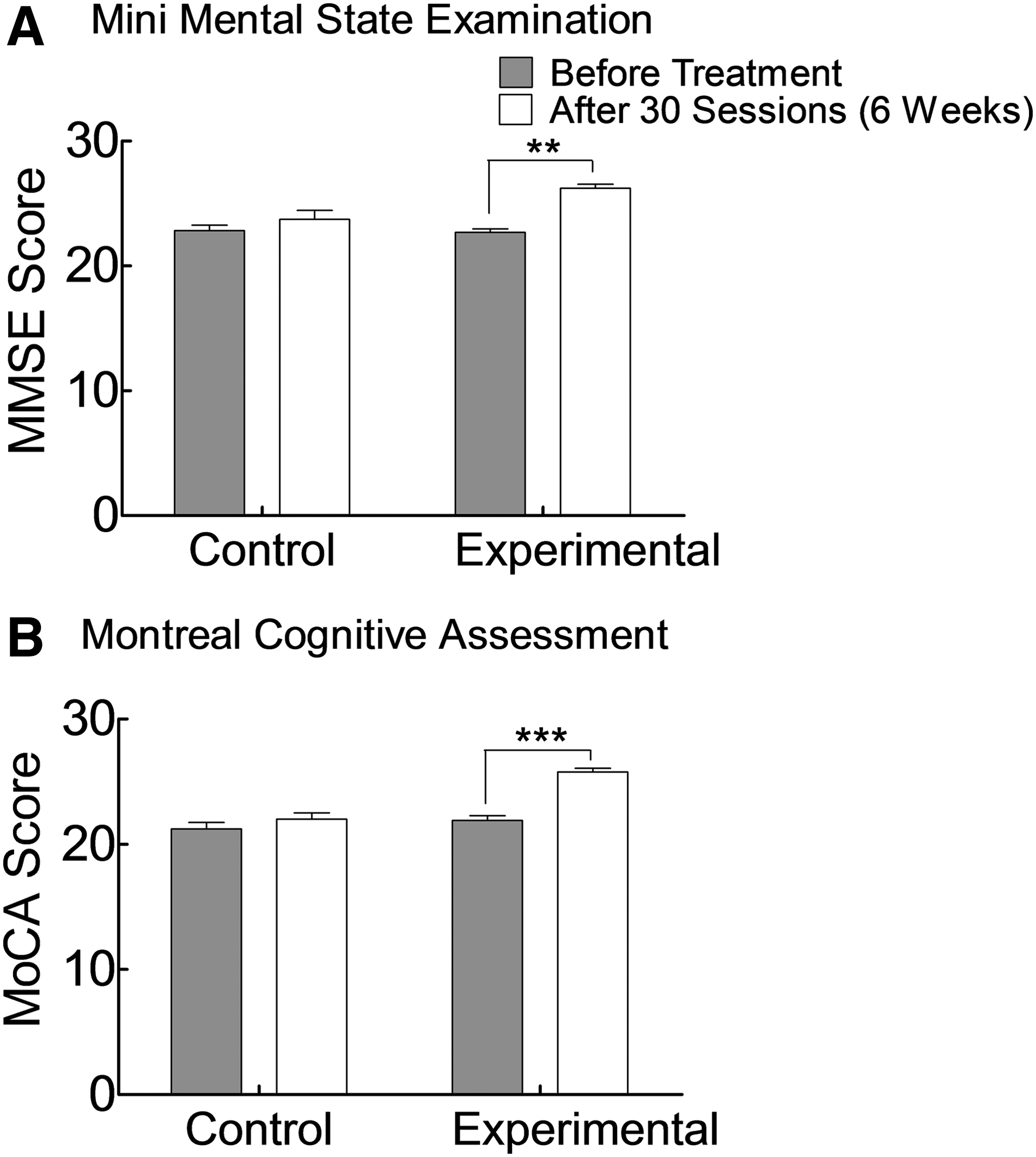
The graph showing
For TMT-A there was no significant interaction effect of factor group and time (F1,36 = 0.398; P = 0.532). For TMT-B there was significant interaction effect of factor group and time (F1,36 = 28.33; P < 0.001). Post hoc analysis showed that there was significant improvement after 6 weeks in TMT-A (1.429 ± 0.234; P = 0.028; Fig. 3A) and TMT-B (2.393 ± 0.201; P = 0.0001; Fig. 3B) of the experimental group as compared with the TMT-A (2.225 ± 0.259) and TMT-B (3.780 ± 0.195) of the control group (Fig. 3A, B).
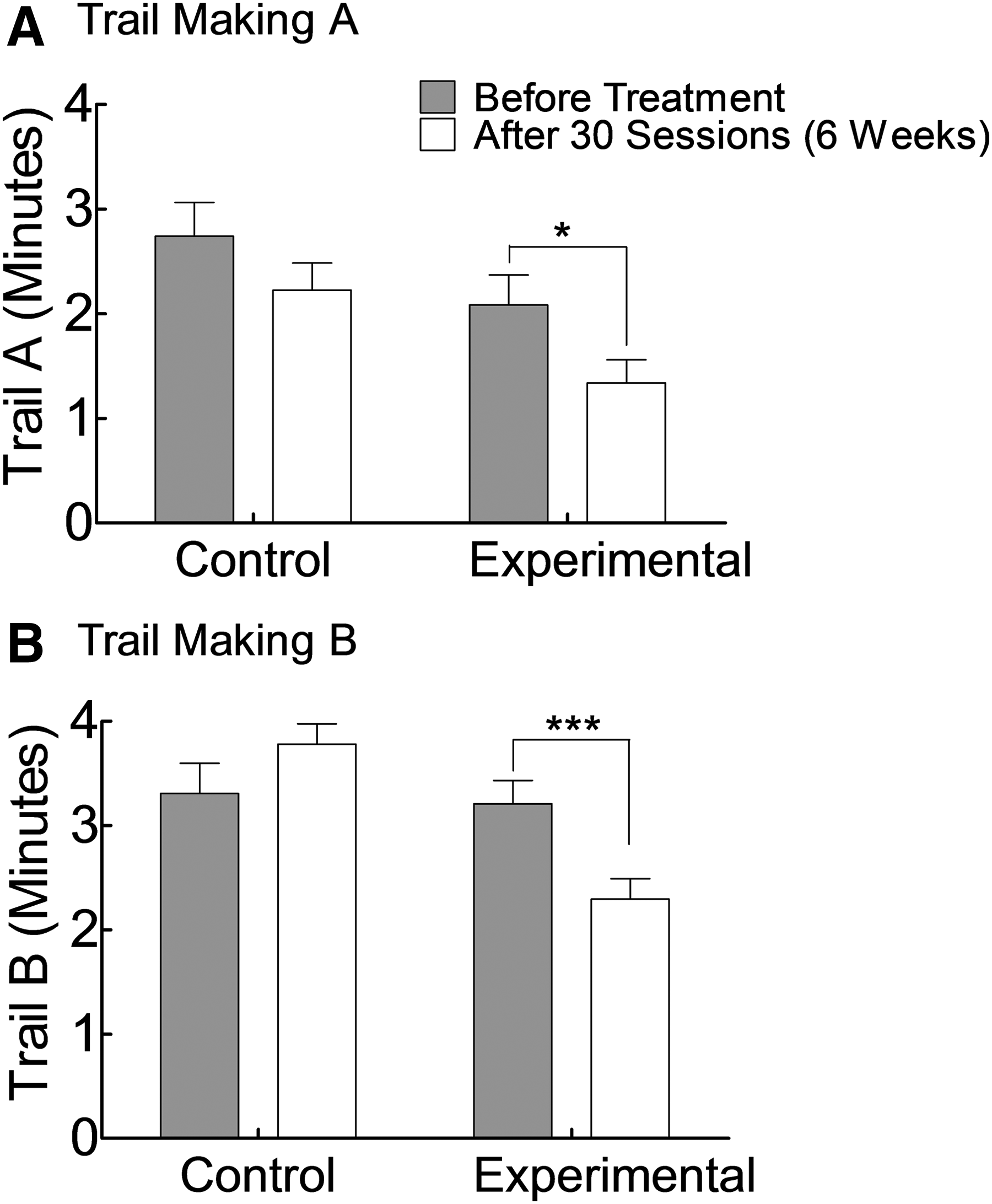
The graph showing TMT results.
Equipment validation
For equipment validation two readings of EEG at two different times were compared. Paired t-test showed that there was no significant difference in the eyes closed state for the delta (0.782 ± 0.029; P = 0.492) and theta (0.062 ± 0.007; P = 0.256) waves as compared with delta (0.798 ± 0.029) and theta (0.058 ± 0.007) waves of the second reading. In eyes open state there was no significant difference in delta (0.798 ± 0.029; P = 0.913) and theta (0.052 ± 0.006; P = 0.054) as compared with delta (0.800 ± 0.035) and theta (0.044 ± 0.006) waves of the second reading.
The complexity, ApEn, of EEG revealed that there was no significant change (0.515 ± 0.020; P = 0.374) in the eyes closed state as compared with the complexity (0.535 ± 0.027) of the second reading. In the case of eyes open state there was no significant change in complexity (0.487 ± 0.022; P = 0.210) as compared with complexity (0.452 ± 0.016) of the second reading.
Effects of Xbox 360 Kinect cognitive games on slowness of EEG
For the delta waves in the eyes closed state, there was a significant interaction effect of factor group and time (F2,120 = 3.314; P = 0.040). For the delta and theta waves in the eyes open state, there was significant interaction effect of factor group and time (F2,120 = 3.909; P = 0.023) and (F2,120 = 3.631; P = 0.029), respectively. There was no significant interaction for alpha and beta waves (Table 1).
Data presented as mean ± standard error of mean.
Significance is shown after comparison with pretreatment values.
The P-value was obtained by two-way ANOVA.
P < 0.05.
P < 0.01.
ANOVA, analysis of variance; SEM, standard error of mean.
Short-term effects of Xbox 360 Kinect cognitive games on slowness of EEG
After a single session of Xbox 360 Kinect cognitive games training, post hoc analysis revealed that in the eyes closed state a significant effect was observed on delta (0.704 ± 0.025; P = 0.013) and theta (0.128 ± 0.009; P = 0.0001) waves, whereas alpha1, alpha2, beta1, and beta2 remained unaltered after one session of Xbox 360 Kinect cognitive games treatment (Table 1).
In the eyes open state, there was significant difference after one session in delta (0.724 ± 0.025; P = 0.044) and theta (0.103 ± 0.009; P = 0.003); whereas alpha1, alpha2, beta1, and beta2 remained unaltered after one session of Xbox 360 Kinect cognitive games treatment (Table 2).
Data presented as mean ± standard error of mean.
Significance is shown after comparison with pretreatment values.
The P-value was obtained by two-way ANOVA.
P < 0.05.
P < 0.01.
Long-term effects of Xbox 360 Kinect cognitive games on slowness of EEG
After 6 weeks of Xbox 360 Kinect cognitive training, post hoc analysis revealed that in the eyes closed state, a significant effect was observed on delta (0.673 ± 0.029; P = 0.013), theta (0.129 ± 0.013; P = 0.002), and beta2 (0.044 ± 0.009; P = 0.046) waves; whereas alpha1, alpha2, and beta1 remained unaltered after 6 weeks of Xbox 360 Kinect cognitive games treatment (Table 1).
In the eyes open state, there was a significant difference after 6 weeks in the delta (0.708 ± 0.025; P = 0.006), theta (0.101 ± 0.009; P = 0.003), and beta2 (0.040 ± 0.007; P = 0.015) waves; whereas alpha1, alpha2, and beta1 remained unaltered after 6 weeks of Xbox 360 Kinect cognitive games treatment (Table 2).
Effects of Xbox 360 Kinect cognitive games on complexity of EEG
For the EEG complexity, ApEn of the EEG in the eyes closed state, there was no significant interaction effect of the factors time and group (F2,120 = 2.218; P = 0.113), but for the complexity of EEG in the eyes open state, there was a significant interaction effect of the factors time and group (F2,120 = 4.540; P = 0.013; Fig. 4A, B).

The graph showing complexity or ApEn of EEG.
Short-term effects of Xbox 360 Kinect cognitive games on complexity of EEG
The complexity of the EEG revealed that there was a significant improvement (0.642 ± 0.042; P = 0.008) after one session of Xbox 360 Kinect cognitive games treatment as compared with the control group (0.498 ± 0.028), in the eyes closed state (Fig. 4A). In the eyes open state, complexity was also significantly improved (0.589 ± 0.033; P = 0.002) after one session of Xbox 360 Kinect cognitive games treatment as compared with complexity (0.486 ± 0.029) of the control group (Fig. 4B).
Long-term effects of Xbox 360 Kinect cognitive games on complexity of EEG
The complexity of the EEG revealed that there was significant improvement (0.651 ± 0.042; P = 0.016) after 6 weeks of Xbox 360 Kinect cognitive games treatment as compared with the control group (0.510 ± 0.553), in the eyes closed sate (Fig. 4A). In the eyes open state, complexity was not significantly improved (0.580 ± 0.032; P = 0.063) after 6 weeks of Xbox 360 Kinect cognitive games treatment as compared with complexity (0.487 ± 0.026) of the control group (Fig. 4B).
Discussion
Exergames are emerging therapeutic candidates for different types of disorders, especially, neurological disorders.10,51–53 Xbox 360 Kinect cognitive games are the principal type of exergames, and their effects on MCI subjects are not explored. Especially effects of Xbox 360 Kinect cognitive games on slowness and complexity of EEG have not been studied. Based on this fact, we decided to study the effect of these games on slowness and complexity of EEG in MCI subjects.
In the present study, MMSE, MoCA, TMT-A, and B were used to assess cognitive and executive functions, such as motor speed, task alteration, and visual search.46,47,49,50 Xbox 360 Kinect cognitive games significantly improved MMSE and MoCA scores, and time to complete TMT-A and B. These results are consistent with those from healthy and older adult population, in which exergames significantly improved cognitive abilities.1,10,52 Previously one study examining the effects of exergames on cognitive levels of MCI subjects reported that there were medium-level effects in the favor of exergames group. 51 The possible reason for this improvement of cognition is that, these games require the subjects to integrate attentional resources (visual, divided, and switch), visual–motor abilities, processing speed, and visuospatial 54 and executive functions. 55
It was found that Xbox 360 Kinect cognitive games showed improvement in slowness of EEG in delta, theta, and beta waves after one session and 6 weeks of treatment. Slowing of EEG is a well-established parameter to differentiate the healthy elderly population and MCI subjects. Slowing of EEG in the MCI subjects has positive correlation and high sensitivity with progression of disease. 32 In MCI subjects, low-frequency delta wave power is increased because there is degeneration in the corticocortical connectivity. 33 Theta waves, which are also low-frequency waves, increase in MCI subjects and it is believed that this is due to the slowing of subcortical axonal conduction time. 56 In these subjects degeneration of the Perisylvian pathway and lateral capsular pathway, consisting of cholinergic neurons, causes the slowness of reactivity and loss of cortical connectivity. These pathways play critical roles in cortex-related activity (readiness), since the state of the cortex is mediated through these pathways. 57 Exercise or structured physical activity increases the concentration of neurotransmitters (e.g., acetylcholine) in the brain. 58 As Xbox 360 Kinect games' training also involve specific planned physical activity, this could be a cause of increase in the acetylcholine activity in these pathways and effect slowness of EEG.
In the current study, Xbox 360 Kinect cognitive games training increases ApEn, not only after one session of treatment but also after 6 weeks of training. Complexity or ApEn is a non-negative number, its high values represent more complexity or irregularity in EEG data. 34 ApEn is a widely accepted measure for the diagnosis of MCI subjects.35,36 It has already been established that subjects with Alzheimer's disease have less complex and more regular electrophysiological parameters in the cerebral cortex, 36 may be due to decreased dynamic complexity of different parts of the brain. However, the exact mechanism involved in this regularity of signals is not clear. 38 Loss of connectivity of neural networks due to neuronal death and general effect on neurotransmitters' activity, could be the reasons that cause more regularity and less complexity of EEG.37,38 Xbox 360 Kinect cognitive games improved EEG indicators and cognitive functions probably through multiple mechanisms, such as, cognition improvement,15–17 increasing cerebral blood flow, 59 neural plasticity, 60 activation of arousal system, 61 neurotransmitters modulation, 58 and probably formation of new spines, suggesting that multiple therapeutic mechanisms may be involved following treatment with cognitive games.
If there is loss of function due to any injury or degeneration of neuronal cells or network, therapeutic strategies based on repetitions and increasing intensities of usage of that neuronal/synaptic network can reactivate these neuronal pathways and circuits in the brain resulting in strengthening of neurons. 62 Exergaming follows this basic principles of task-based exercises, repetitions, and high intensities are also part of this type of treatment. Moreover, exergames provides sensory feedback through auditory, visual, and tactile stimulation 63 and maintains motivation of the individuals. 64 Based on these findings from our study, it is concluded that Xbox 360 Kinect cognitive games improve conditions of MCI subjects by improving electrophysiological parameters and cognitive functions. Therefore, these games can serve as potential therapeutic options for old age MCI patients, and this can prevent transformation from MCI to demetia in most of these subjects.
Conclusion
The Xbox 360 Kinect is a cheap equipment, easily available, and can be installed at any place. It is also easy to use. 65 Our study has shown that Xbox 360 Kinect cognitive games help MCI subjects to improve their cognitive abilities and vital electrophysiological parameters with no obvious side effects. Especially in third-world countries this type of equipment could be helpful to rehabilitate MCI subjects.
The sample size of this study was small, so further studies with large sample size are required. Our study has shown huge potential of games which utilize brain along with physical activity. There is no major side effect associated with this intervention. Further studies with Xbox 360 Kinect cognitive game treatment and resulting detailed changes in brain can be helpful in understanding the progression from MCI to dementia, and help in therapeutic interventions.
Footnotes
Acknowledgments
The authors are thankful to the Riphah College of Rehabilitation Sciences, Rawalpindi, Pakistan, Atta-ur-Rahman School of Applied Biosciences, National University of Sciences and Technology, and Railway General Hospital, Islamabad, Pakistan, for providing support, funding, and clinical facilities to complete this study. They are also thankful to the Biomedical Department of Riphah International University and research center of New Zealand College of Chiropractic, New Zealand, for providing research facilities.
Author Disclosure Statement
We confirm that there are no conflicts of interest associated with this study and there has been no significant financial support for this work that could influence its outcome.
References
Supplementary Material
Please find the following supplemental material available below.
For Open Access articles published under a Creative Commons License, all supplemental material carries the same license as the article it is associated with.
For non-Open Access articles published, all supplemental material carries a non-exclusive license, and permission requests for re-use of supplemental material or any part of supplemental material shall be sent directly to the copyright owner as specified in the copyright notice associated with the article.
