




Abstract
Objective:
Muscle weakness is an important risk factor for falls in older adults. Intensity and duration of muscle activity are important determinants of exercise effectiveness in combating muscle weakness. The aim of this article was to assess the intensity and duration of muscle activity in virtual reality (VR) balance games.
Materials and Methods:
Thirty young and 30 healthy older adults played seven different VR balance games. Muscle activity of the vastus lateralis, vastus medialis, soleus, and gluteus medius was obtained using surface electromyography (EMG). The processed EMG signals were divided into 200-ms blocks, after which each block was categorized by its average normalized EMG activity, that is, >80%, 60%–80%, 40%–60%, or <40% of maximum voluntary contraction (MVC). We calculated the total number of blocks in each category to score intensity, as well as the maximal number of consecutive 200-ms blocks (MCBs) >40% MVC, to identify prolonged muscle activity.
Results:
Muscle activity during game play was mostly <40% MVC and prolonged activation was lacking. Only the games that included more dynamic movements showed activation blocks of higher intensity and resulted in more MCBs.
Conclusion:
Our method allowed us to analyze the overall muscle activity and the distribution of activity over a trial. Although the activation levels during these VR games were low in general, we identified game elements that could potentially provide a strength training stimulus. Future research should aim to implement these elements, such that the intensity, prolonged activity, and rest are optimized to sufficiently challenge lower limb muscles in VR training.
Introduction
Age-related decreases in muscle strength contribute to the increased incidence of falls at higher age.1,2 Muscle strength of the lower limbs has been shown to be a predictor of functional balance, 3 postural stability, 4 and fall incidence in older adults.1,5,6 Fortunately, sufficiently challenging exercises combined with optimized nutrition provide muscle protein synthesis in older adults similar to young adults. 7 Indeed, older adults can improve muscle strength and power after resistance training.7,8
Virtual reality training (VRT), an alternative training method that combines playing games using commercial consoles (e.g., Wii console, Kinect) and exercising, is applied to improve balance in older adults.9,10 The term virtual reality (VR) covers a wide range of applications as described in the virtuality–reality continuum. 11 In this study, VR is defined as computer games using commercial consoles as Wii and the Kinect console and that are controlled with body movements. VRT might lead to increased motivation because of the gaming element,12,13 which could help against low adherence in home-based training programs.14,15 Furthermore, VRT creates a training environment in which either direct (e.g., coach on the screen gives feedback on the posture of the player) or indirect feedback (e.g., scoring points of the game) can be provided. Feedback can help to increase physical activity during the game. 16 However, systematic reviews yielded conflicting results on the fact whether VRT can improve (components of) balance in elderly.9,17,18 This might be explained by the wide variety in VRT tools and the different nature of the games. For VR to have an optimal effect on biomechanical constraints of balance, 4 it should challenge balance, by going to the individual limits of stability,4,19,20 and also include muscle strength training.21,22 However, all these goals have to be pursued keeping in mind the person's safety. Effects of training programs on muscle strength, as a determinant of balance, have received limited attention 23 and the muscular demands of different VRT programs have not been studied.
Training load is affected by overall muscle effort, which depends on the relative intensity of muscle activity and the amount of rest between periods with substantial muscle activity. 24 Recommendations regarding conventional strength training in older adults suggest using moderate to heavy intensities, that is, >60% of the maximum weight that can be moved for one repetition (1RM). 25 Strength training using higher velocity concentric exercises improves muscle power and is more effective than traditional strength training in improving functional performance, as reflected in sit to stand, jump height, and reaction time. 26 Furthermore, the rate of torque development appears to help discriminate fallers from nonfallers, 27 suggesting that muscle strength should also be trained at high velocities.
Weight-bearing exercises, possibly with added extra weights, are more suited for VRT than externally loaded exercises using weight machines. However, muscle activity during weight-bearing exercises might be low. To maximize muscle fiber recruitment, it is recommended to add steps or to increase the number of repetitions until muscle exhaustion.8,28 The introduction of rests within a training set has been shown to attenuate increases in growth-hormone release and strength gains after a training regimen. 29 Therefore, it is important to also consider the duration of the bouts of muscle activity within a training session. High-intensity exercises at high speed will induce muscle hypertrophy; however, a high number of repetitions at lower intensities will induce muscle fatigue and as such also induce muscle hypertrophy. 8 Low intensities are potentially more suitable for elderly than high intensities since these exercises are more accessible, safer, and pleasant to perform. 30
The aim of this study was, therefore, to assess intensity and duration of lower limb muscle activation elicited by different commercially available VRT applications in young and older adults. The results were interpreted in the context of reported recommendations for conventional strength training.8,25,31
Methods
Participants
Thirty young and 30 healthy older adults (aged >65 years) were recruited using flyers around the sports facilities of the KULeuven (Table 1). All participants had to be free of any pathology of the musculoskeletal and neurological or vestibular system, cardiovascular disease or diabetes that would prevent them from safely performing exercises. Participants signed written informed consent before participation, in accordance with the Declaration of Helsinki. The study was approved by the local ethics committee (Commissie Medische Ethiek K.U. Leuven). All participants completed the Mini Mental State Examination to ensure they were in a cognitive good state. Participants had to score at least 25 out of 30 to be eligible for the study. Mean score for the test was 29.3 and no participants were excluded (Table 1).
Subject Characteristics
Data presented as means (SD).
MMSE, Mini Mental State Examination.
Material
Seven games involving different movements were tested (Table 2 and Supplementary Appendix for full description of the games). Games were selected on their potential ability to challenge balance or muscle activity or were used in VR balance training studies previously.10,18,32 Games were selected to represent a varied but realistic sample of games that can be used as VRT at home or in retirement homes and small rehabilitation facilities. There are different forms of virtual environments that can be used for VRT. In this study, we focus on projection-based environments. 33 The games were controlled by the Xbox Kinect camera (Microsoft), which tracks the players' movements through depth sensing cameras, or by the Wii Balance Board (Nintendo®, Japan), which registers movements of the center of pressure (COP). Recommendations regarding conventional strength training in older adults suggest using >60% of the maximum weight that can be moved for 1RM. 25 However, this 1RM concept cannot be used for unloaded exercises. Therefore, the intensity in unloaded exercises is hard to quantify and we used surface electromyography (EMG) to measure muscle activation. EMG signals that are normalized to values achieved during maximum voluntary contractions (MVCs) have shown to be approximately linearly correlated with force.34,35 Neuromuscular activation was obtained using silver–silver chloride pregelled bipolar electrodes (Ambu Blue Sensor, DK) connected to an eight-channel wireless EMG system (Aurion, Zero-wire, IT), which was recorded in Nexus (Vicon, Oxford Metrics, United Kingdom) at 1000 Hz.
An Overview of the Included Games with the Total Game Duration, Abbreviations, and a Qualitative Description of the Postures Adopted and Movements Predominantly Performed During Each Game
Protocol
Before participants engaged in the VRT experiments, EMG electrodes were placed on four lower limb muscles that have been shown to be important in balance and preventing falls in older adults1,36,37; vastus lateralis (VL), vastus medialis (VM), soleus (Sol), and gluteus medius (GluM). For practical reasons, we chose to measure muscle activity unilaterally. Electrodes were consistently placed on the left leg, according to the Surface Electromyography for the Non-Invasive Assessment of Muscles (SENIAM) guidelines. 38 MVC was obtained according to the SENIAM guidelines. 38 Participants played seven different games in a randomized order, during which EMG signals were recorded. The shorter games (Adventure, Wiiski, Kinski, Wiiyogaw, and Wiiyogahm) were played three times, whereas the longer games (Boxing and Kinyoga) with repeating sequences were played once. After each game, the participants were asked to sit down and take a rest for ∼5 minutes.
Processing
All processing was performed in Matlab (MathWorks). EMG signals were high-pass filtered at 20 Hz, using a third order high-pass Butterworth filter before being rectified and smoothed using a moving average technique with a window of 100 ms. 39 The processed signals from the experimental trials were normalized to maximum values obtained during the MVCs.
Outcome measures
Traditional outcome measures quantifying intensity obtained from EMG data include the area under the curve, mean, median, or maximum values. 40 However, these methods lose potentially valuable temporal and amplitude information. Therefore, muscle activity was averaged for 200-ms blocks and each block was categorized in one of four activation zones, <40%, 40%–60%, 60%–80%, and >80% MVC (Fig. 1). The number of blocks in each zone was counted and total time spent in each zone was normalized to the duration of the game, to express the time in zone (TIZ). This normalization was done because a shorter game will more likely result in less blocks than longer games but could in practice be played several times to accommodate for this difference. Larger metabolic stress is expected from a high number of consecutive blocks of muscle activation and plays a crucial role in strength gains after exercise at lower intensities. 29 Therefore, we calculated the maximal number of consecutive 200-ms blocks (MCBs) separated by no more than 3 seconds of <40% MVC EMG activity.
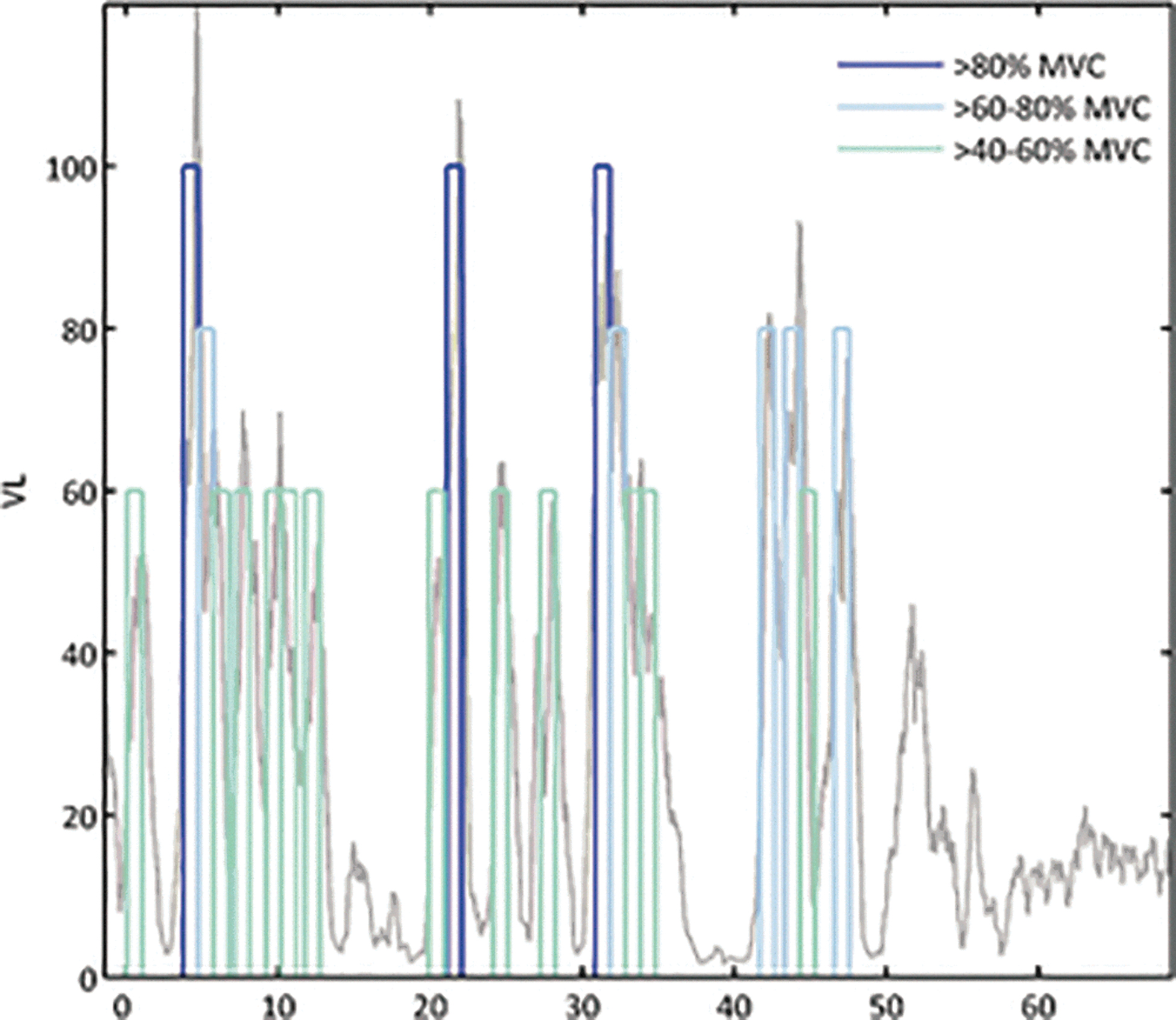
Example of blocks detection. The smoothed electromyography amplitude of the VL muscle during a section of the Adventure game is plotted in gray. The colored 200-ms blocks represent different activation zones, based on the average of the smoothed signal over these 200-ms blocks. MVC, maximum voluntary contraction; VL, vastus lateralis. Color images are available online.
Statistics
The games that provoke very low muscle activation were omitted from further statistical analysis. Threshold was defined as <5% of total game duration activations >40% of MVC and in addition a low number of MCBs. Generalized estimating equations were used to perform null hypothesis testing for the factors game and age group on the variables TIZ and MCBs for all muscles, with trial number as a covariate. The correlation structure was set to autoregressive. Post hoc pairwise comparisons were done using least significant difference. No previous effect sizes were available to estimate power and sample size. Since our focus was to test the proof of concept and feasibility of the novel exergames, only a limited sample size of 16 subjects were recruited. All statistical analyses are performed with IBM SPSS Statistics Version 21.0.
Results
Wiiyogaw, Wiiyogahm, and Wiiski, all using a COP-based controller, provoked only minor muscle activation parameters and were omitted from further statistical analysis.
In general, all games elicited during <20% of total game duration a muscle activation >40% of the MVC. The longest periods of consecutive high muscle activity were very short (<5%) in almost all games. The number of MCBs that muscles were active at or >40% of the MVC was also low.
Time in zone
To assess duration of lower limb muscle activation, TIZ for every activity zone was calculated. TIZ was compared between age groups and games (Fig. 2, Table 3), and in case of an interaction effect, further analyses were performed (Fig. 3).

TIZ descriptive statistics. In rows, games, muscles, and age groups (y = young, e = elderly) are indicated. Along the x-axis, the TIZ as a percentage of the total game duration is plotted. The TIZ for the four different categories is stacked to provide an overview of the total time that each muscle is active during each game. GluM, gluteus medius; Sol, soleus; TIZ, time in zone; VM, vastus medialis. Color images are available online.
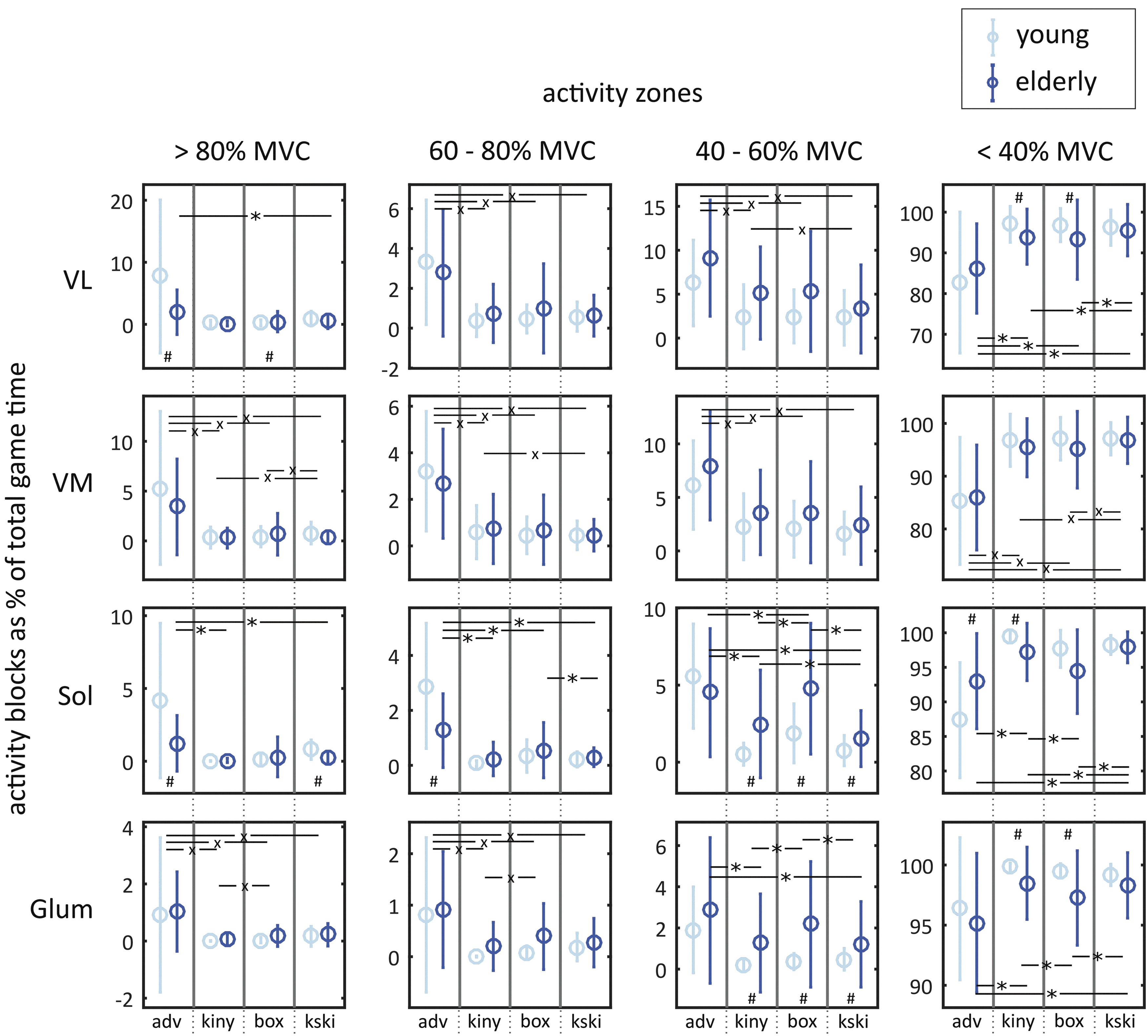
TIZ post hoc comparisons. Panels show mean values and standard deviations of TIZ, horizontally grouped by muscle and vertically grouped by activity zone. Significant differences (P < 0.05) between games are marked “x” spanning groups, and in case game x group interactions were found and between game comparisons were made within the elderly group “*”. Significant group differences within games are indicated “#”. adv, Adventure; box, Boxing; kiny, Kinyoga; kski, Kinect ski. Color images are available online.
Summary of the Generalized Estimating Equations Model Effects
Significant effects (P < 0.05) are marked in bold.
GluM, gluteus medius; SOL, soleus; VL, vastus lateralis; VM, vastus medialis.
Between-game differences:
For older adults, a very low time (<5%) with activations >40% was seen for the GluM in all games. However, for the >40% categories, Adventure showed longer periods of activation than the other games.
For the VM and VL, longer TIZ was seen for the Adventure game than the other games for all activation zones except the lowest activation zone. For the latter, the Kinski game showed the longest time.
For the Sol, longer activation in the >60% activation zones was seen for both Adventure and Boxing game than the other games.
Group differences:
For the VL, during Adventure, young participants showed longer TIZ in the >80% category than older adults. In contrast, during the Boxing game, older adults spent more time in the >80% category. In the 40%–60% category, older adults had longer TIZ than young participants across all games. Furthermore, young participants had longer TIZ in the <40% category during both Boxing and Kinyoga.
The VM did not show a significant game × age effect. However, a significant main effect of age indicates that older adults show slightly more activity than young in the 40%–60% across all games.
For the Sol, a significant game × age effect was seen for all activation zones. Young participants showed longer TIZ in the >60% categories than older adults during Adventure. In the 40%–60% category, older adults had longer TIZ than young subjects during Kinski, Boxing, and Kinyoga. In the lowest category, older adults had longer TIZ than young during Adventure, whereas young participants spent more time in this category during Kinyoga.
For the GluM, in the 40%–60% category, older adults showed longer TIZ than young participants during Kinski, Boxing, and Kinyoga. In the lowest activity category, young subjects had longer TIZ during the Boxing and Kinyoga games.
Maximal consecutive blocks
Larger metabolic stress is expected from a high number of consecutive blocks of muscle activation and plays a crucial role in strength gains after exercise at lower intensities. 29 For this, we calculated the MCBs for each muscle in the Adventure, Kinyoga, and Boxing games (Table 4).
MCBs Generalized Estimating Equations Model Effects
Significant model effects (P < 0.05) are accentuated in bold.
Most of the games showed little sustained muscle activity indicated by a very low number of MCBs (>40% MVC) (Fig. 4). It should be noted that the median values of the games that elicited the longest active periods indicate that the muscle was active for a consecutive bout of only 8 seconds. For all muscles, a game × age interaction was found for the MCBs.
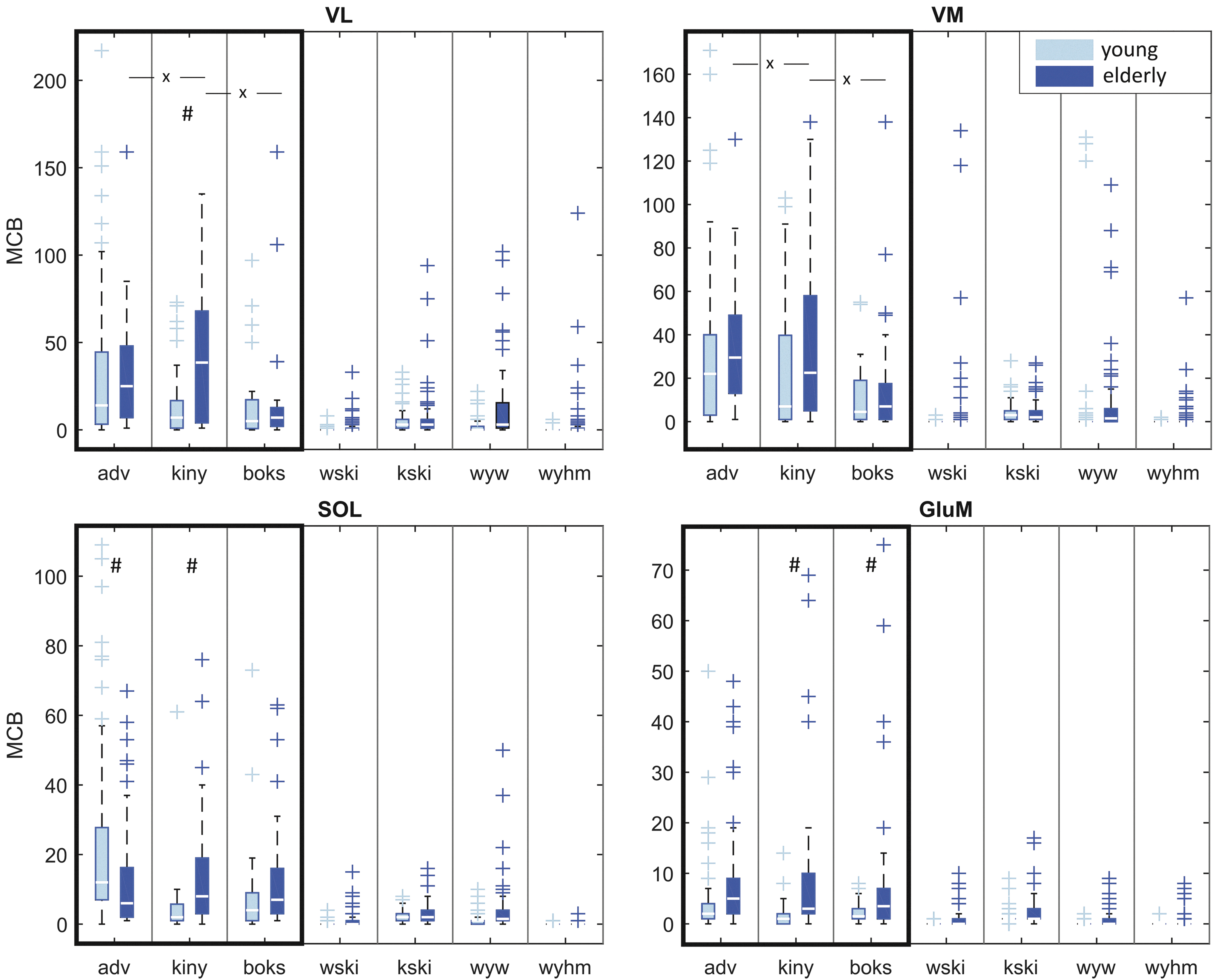
Maximal consecutive blocks. Median values are indicated with a horizontal line, the box ranges from the first to the third quartile. Whiskers indicate the range of the data. The games included in the statistical analysis are indicated by the bold border. Significant game effects (x) and outliers (+) are indicated as well as group differences within games (“#”). adv, Adventure; boks, Boxing; kiny, Kinyoga; kski, Kinski; wski, Wiiski; wyhm, Wiiyogahm; wyw, Wiiyogaw. Color images are available online.
Between-game differences:
VL and VM showed higher MCBs, reflecting more consecutive muscle activity during Kinyoga than during Adventure and Boxing in older adults. Sol and GluM did not show significant differences between games.
Group differences:
For the VL, Sol, and GluM, older adults showed more MCBs than young subjects during Kinyoga (and Boxing for the GluM). In the Sol, young participants showed more MCBs than older participants during Adventure. For the VM, there were no group differences.
Discussion
The aim of this study was to identify potential effective VR games for muscle strength training. Muscle strength training is seen as one of the balance components that need training in elderly. The percentage of total game time that a muscle was active in predefined activity categories was studied, as well as the MCBs that muscles remained active were studied. Both factors were seen as indicators of overall muscular effort during different VRT games.
In general, all included games elicited very low muscle activity. Most of the games elicited substantial muscle activity (>40% of MVC) only during a small fraction of the total game time. The longest periods of consecutive muscle activity at >40% MVC were very short. Especially GluM activation was most of the time in the <40% MVC category. Regarding the number of MCBs that muscles were active at or >40% of MVC was low, the effectiveness of when games in improving muscle strength is questionable.
Only few studies investigated muscle activation during exergames and used a different approach to assess this activation. The study by Soltani et al., where EMG of the upper limb was recorded during a swimming exergame, 41 reported muscle activations in the arms between 4.9 and 95.2% of the MVC. Furthermore, Fernandes Da Silva et al. reported low activation (relative to the MVC) of the quadriceps during Wii™ games, which is in line with the low activations we found for the Wii games. 42 None of these studies used such an extensive approach as this study (i.e., by using the novel activation measures; TIZ and maximal consecutive blocks) to determine muscle activation.
Game differences
For all muscles, the Adventure game elicited the highest percentage of game time at muscle activity >80%. This highly dynamic game, with frequent squatting and jumping movements, also had the highest percentages of activation in the 60%–80% category. The Kinski game, with frequent weight shifts but only occasional jumps, resulted in the lowest TIZ in the higher activity zones. Consequently, muscle activation was more prominent in the <40% MVC category during Kinski for VL, VM, and Sol. For the GluM, Kinyoga and Kinski did not differ in this category. The longer TIZ in the <40% category during the Kinski game reflects that the combined TIZ of the higher categories is longer during Adventure, Kinyoga, and Boxing. The Kinyoga and Boxing games incorporated dynamic exercises (e.g., squats, lunches, and one leg stance), but these were performed at lower speeds than in the Adventure game.
The games that scored lowest on muscle activation parameters (Wiiyogaw, Wiiyogahm, and Wiiski) were omitted from statistical analysis. It is interesting to note that the Kinski game seemed favorable over the Wiiski game when looking at the muscle activation despite the similar objective. This difference may be attributable to the different controller, kinematic controller (Kinski), and force plate (WiiSki). A kinematic controller, which tracks kinematics, may impose more dynamic and varied movements, such as jumps, squats, and taking steps. This agrees with findings of our previous study, in which games with different types of controllers lead to different center of mass displacements. 43
The MCB measure was introduced to study the effectiveness of the game in inducing a prolonged muscle training stimulus at >40% MVC to induce the desired metabolic stress. 29 The variations in duration, from around 1 minute for the adventure and the skiing games up to more than 7 minutes for Kinyoga, might obscure the effectiveness of the longer games, when only evaluating the TIZ measure. Indeed, we found that for the VL and VM muscles, the Kinyoga game, which incorporated structured sets of squats at a low pace, induced a higher number of MCBs than Adventure, which performed better for the TIZ measure. However, the number of MCBs and, therefore, the duration of sustained muscle activity are still low. In the future, research can be conducted with focus on the development of games with fast and/or specific movements (e.g., squatting and single leg stance), adding extra weights (weight belts) or adding steps to increase muscle activation.
Group differences
Differences in muscle activation level and duration between young and older subjects were found. For the VL, young subjects showed longer TIZ in the >80% category during the Adventure game, whereas older subjects showed longer TIZ in the Boxing game. For Sol, young subjects had longer TIZ during the Adventure in both the >80% and 60%–80% categories, and during Kinski in the >80% category. These differences might be attributable to the incentive that is used to elicit more movements. In both the Adventure and Kinski games, the player is encouraged to squat and jump to speed up the game. However, older adults are typically less inclined than young to speed up these games. Furthermore, the jumps might be outside of the comfort zone of the older players, resulting in lower TIZ for the >80% category. The Boxing and Kinyoga games on the other hand have coaches that perform the movements that the player has to mimic and the player is rewarded more points when performing the movements in time. This type of game dictates the speed at which the movements are performed, and might, therefore, be more challenging for older adults. The caveat in a game design with fixed difficulty would be an inappropriate difficulty level, which could result in negative feedback and decrease motivation and effectiveness.44,45
Limitations
The multitude of comparisons, with significant, but small, differences between age groups and games, could obscure the main finding, that is, all included games elicited very low muscle activity, especially the games omitted from the statistical analysis. However, since the exact criteria at which muscle activation during weight-bearing exercises can be effective are not well established, we choose to study multiple outcome measures. Nonetheless, the main finding is that in all studied VRT, the muscle activity appears low.
For traditional strength training, recommendations are to use at least 60% of 1RM, 25 but for functional weight-bearing exercise, these thresholds are less well established. Furthermore, there is no exact linear relationship between EMG and force. However, it is shown that higher EMG correlates with higher forces. In addition, if EMG is normalized to values achieved during MVC, they are approximately linearly correlated with force.34,35 Therefore, we categorized the EMG activity in different activity zones based on the level of muscle activity. Especially the faster movements induced activity in the highest (>80% MVC) zone, which is in line with findings of Soltani et al. They find higher muscle activations in games that were played at higher than at lower velocities. 41 When lower loads are used, it is recommended to increase the number of repetitions up to muscle exhaustion. 8 However, the small amount of prolonged muscle activity, as indicated by the low MCBs, shows that it is unlikely that the games studied challenge the player enough to reach muscle exhaustion. Yet there is no literature on the duration of muscle activity and the accompanying recovery time required to induce an optimal metabolic response. Three seconds without any muscle activation blocks was chosen as the cutoff point for initiating a new series. Small changes of this threshold, ranging from 1 to 10 seconds, did not lead to different conclusions for this study. Low muscle activity can also be due to low effort of the subject while playing the games. Game performance scores were not assessed; however, based on our observations, it seemed that participants tried their best when playing the games.
Data were collected and analyzed in this study with focus only on muscle activations, as one of the factors that need to be trained for balance. It is evident that other factors are also important to improve balance in elderly (e.g., center of mass movement, muscle force, sensory, and movement strategies) and that the balance component that needs most training can vary between patients.4,19 This differentiation is beyond the scope of this article.
Conclusions
Overall, the muscle activity when performing the VRT games studied seems low for effective muscle strength training. This means that muscular benefits for the tested games are unclear. However, the games could have other beneficial effects such as on cardiovascular health or well-being. Muscle activity was high only during jumping, indicating that certain elements of these games could be part of an effective muscle training, when suited for the participants.
In future studies, games with higher muscle activity (e.g., more dynamic movements and kicks) should be developed and tested, keeping the safety of participants, that is, elderly, in mind.46–49 To improve VR games for muscle strength training, muscle activity should be higher (e.g., >40% of the MVC) and better structured over time (e.g., longer bouts), to induce higher metabolic stress and make better use of the total game time. Especially increasing the length of the sets, while keeping the muscle activity at a low percentage of the MVC, seems a more viable way for VRT. Furthermore, the incentives to trigger more challenging exercises should be adequate for the target population, and preferably be adaptable to the physical fitness of the individual player.
In conclusion, VRT games have potential for muscle strength training in elderly; however, in future, games should be developed with the purpose to sufficiently activate and thereby train their muscles, since the existing games elicit too low muscle activity
Footnotes

References
Supplementary Material
Please find the following supplemental material available below.
For Open Access articles published under a Creative Commons License, all supplemental material carries the same license as the article it is associated with.
For non-Open Access articles published, all supplemental material carries a non-exclusive license, and permission requests for re-use of supplemental material or any part of supplemental material shall be sent directly to the copyright owner as specified in the copyright notice associated with the article.
