




Abstract

Games for health (G4H) have been demonstrated to have desired effects on some lifestyle-related health behaviors and health outcomes.1,2 Lifestyle behaviors are generally considered to be habitual behaviors that can influence health, for example, diet, physical activity (PA), sedentary behavior, smoking, and alcohol intake. Although active videogames have increased PA under certain circumstances,3,4 simply providing participants with active videogames did not increase PA. 5 Nutrition education videogames have generally resulted in some knowledge or behavior changes, but the changes have generally been small. 6 This editorial attempts to identify needed research to enhance the knowledge base for the design and efficacy of G4H by (1) identifying what it is about videogames that leads one to expect that G4H could have a high impact and (2) advocating an experimental approach to research on videogame components to maximize the effects of lifestyle-related G4H on health behaviors.
How might G4H influence health?
Given the current state of knowledge, it is reasonable to propose that a videogame influences lifestyle behaviors and health outcomes by the hypothesized pathways depicted in Figure 1. G4H are complex interventions (also called multifactorial or bundled) 7 that include many operative components to effect change in diverse mediating variables. G4H typically incorporate game elements (e.g., lenses, 8 playful experiences,9–11 mechanics, 9 and story 12 ) and behavior change techniques (e.g., knowledge enhancement, goal setting, self-monitoring, and behavioral modeling) in an effort to promote behavior change. 13 The game elements attract players to initially play the videogame. The player comes to the videogame with expectations, which may, or may not, be met and may or may not lead to behavior change initiation. Game play can be conceived as initial, continued, and maintained engagement (i.e., the frequency, intensity, and duration of game play), the sum of which has been called dose. 14 Paralleling these, behavior change is conceived to have initiation, continuation, and maintenance phases. There is a set of psychosocial variables (e.g., immersion, 15 presence, and fun 16 ) that mediate game play and that may be different for initial, continued, and maintained game play engagement. There is another set of psychosocial variables (e.g., self-efficacy, attitude, and descriptive norm 17 ) that likely mediate the influence of game play on the phases of behavior change, which also may vary for initiation, continuation, and maintenance phases.
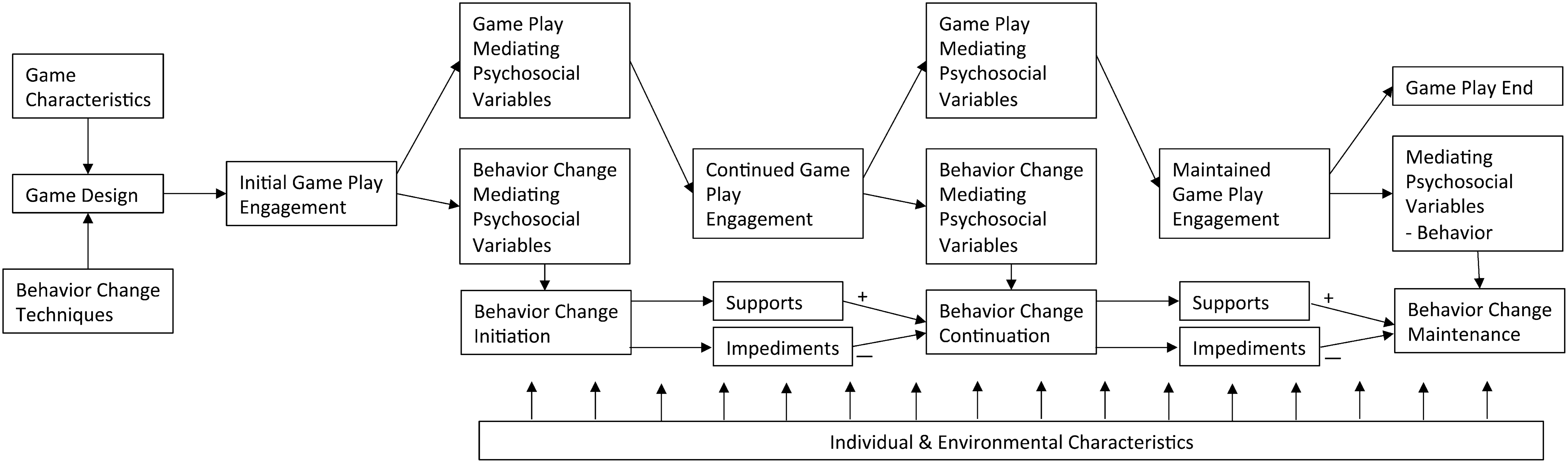
Model of how games may influence behavior change. When behavior change is attempted, the person encounters supports and impediments to performing that behavior; + indicates an aspect of the environment that increases the likelihood of subsequent change (continuation or maintenance); − indicates an aspect of the environment that decreases the likelihood of subsequent change (continuation or maintenance).
Changes in the mediating variables theoretically change the targeted behavior, which should induce corresponding changes in the health outcomes. For example, appealing characters modeling a targeted behavior (e.g., eating more vegetables and expressing positive emotions or reactions while doing so) may improve self-efficacy (i.e., the confidence I can successfully engage in this behavior), thus increasing the likelihood of behavior change in the player. A G4H that induces higher levels of engagement exposes the player to more behavior change techniques. Greater exposure to the behavior change technique should increase the desired influences on the mediating variables and the downstream effects on behavior and health. There, typically, are other influences on the psychosocial variables and behaviors outside of the videogame itself (e.g., socioeconomic status and cultural differences), which must be anticipated and addressed in the videogame design.
State of G4H research
The most common approach to G4H research is to conduct formative and/or feasibility research to inform videogame design, develop a videogame (or sometimes use an off-the-shelf videogame) to change a particular behavior or health outcome, and conduct an outcome evaluation. The videogame is often designed based on the intuitive understanding of the videogame developers, sometimes informed by formative qualitative research. Although valued by funding agencies and their review panels, this approach is not likely to elucidate the most effective elements for game play engagement, or behavior changes. Storyboarding, wire framing, and alpha and beta testing (i.e., formative research) can identify important issues (positive and negative) specific to a particular videogame. Although such methods are important to the design of an appealing videogame, they are not adequate to systematically develop a knowledge base for effective G4H design. For example, small numbers of target group participants are engaged in a storyboard review; the storyboarding typically presents one approach to answering key questions, rather than systematically varying different approaches; storyboard review relies on self-report of immediate responses, which may be unreliable.
Some investigators have conducted meta-analyses and meta-regression of published outcome evaluations to discern which videogame design elements 2 and behavior change techniques 18 have had the desired behavioral effects. Unfortunately, this approach is limited since it violates core assumptions of meta-analysis: unlike pharmaceutical products that, within laboratory standards, are identical across studies, no two videogames are alike: the videogame elements and behavior change techniques are combined in different ways, for example, audience, context, and outcome measures, leading to high random heterogeneity, and no clear answers to the research question. Meta-analysis, further, requires a large number of studies to delineate the true effect from the noise, and confounding across studies makes it difficult to have confidence in the results. 7 Sometimes the videogame elements and behavior change procedures are not carefully articulated or inappropriately operationalized in published articles, further confounding the difficulties in using meta-analyses.
Although there will always be creative elements in the development of a specific videogame, experimental research needs to assess the effects of individual videogame elements and behavior change techniques for each element shown in Figure 1. This research, in turn, can be used to empirically inform subsequent videogame design. Descriptive observational research is generally considered hypothesis generating, whereas experimental research is considered hypothesis testing. 19 In hypothesis testing, the phenomena of interest must be isolated and experimentally manipulated or varied. Experimental tests of videogame elements and behavior change techniques in a videogame can be conducted with brief interventions. For example, brief videogames have been successfully used to influence food selections at an ensuing snack buffet through nutrition/food advergames.20,21
Research to enhance the efficacy of G4H
Experimental research can efficiently test the impact of specific videogame elements (e.g., game mechanics,9,22 playful experiences,9–11 and lenses 8 ) or behavior change techniques 13 on videogame experiences, mediating psychosocial variables and objective indicators of behavioral outcomes. Not all mechanics, lenses, or playful experiences will be appropriate for all purposes, but which purposes are appropriate should become clear as the research progresses. See Table 1A for research questions that could be usefully addressed using nonexperimental (N) and experimental (E) methods. Identifying the videogame elements most likely to result in desirable behavior change would advance the design of G4H and help ensure they more effectively change behaviors. We know of only one G4H study that systematically varied a type of game 20 ; another that varied a behavior change procedure within a videogame 23 ; and only one that has systematically varied one videogame element (i.e., type of story). 24 Calls for research on influences on engagement, specifically enjoyment, have already appeared in the literature. 25
Research Questions with Regard to Each Component of the Model from Game Design to Influencing Health Outcomes (Fig. 1)
E, experimental design; N, nonexperimental design; SES, socioeconomic status.
Answers could be generated by systematically testing one aspect, for example, character, then a second, etc., and ending with a test of the seemingly one or two best combinations, based on previous results. It would be an inefficient use of limited resources to develop a complete videogame (e.g., multiple episodes each of half an hour) to test one intervention procedure, especially when so many need to be tested. Furthermore, tests using simpler more targeted videogames would enable students and lone investigators to contribute to this research, rather than requiring large expensive teams with diverse skills and substantial external funding.
Videogames, furthermore, offer uniquely specific (and perhaps more powerful) ways of testing the effects(s) of videogame elements or behavior change techniques. Descriptive norms provide one example of how this might be done. 26 Descriptive norms, a type of social norm, are beliefs about what others actually do. They are potentially important in G4H because descriptive norms have predicted diverse behaviors, suggesting they may be an important mediating variable in videogames designed to change behavior.27–29 Limited research has tested manipulations of descriptive norms. 27 A videogame-based approach to influencing descriptive norms has character, environment, behavior, and character verbalization elements, all of which could be manipulated. See Table 1B for a preliminary list of videogame-based research questions relevant to descriptive norms. Objectively assessed answers to these questions are sorely needed to inform the design of more effective G4H. This research is also needed for other mediating psychosocial variables often targeted in behavior change interventions, such as attitudes, self-efficacy, and perceived behavioral control. Over time, this type of mechanistic research would provide insight into the most effective mediating psychosocial variables for a particular behavior and group. This insight would substantially contribute to the knowledge base of how to design videogames to change a particular health behavior.
Expanding the G4H horizon
Another issue worthy of exploration is intrinsically motivated games versus gamification. The relative efficacy of purely intrinsic games versus gamification remains controversial, but little research has directly compared these methods of intervention delivery. Videogames are often hypothesized to change behavior due to increasing forms of autonomous motivation, including intrinsic motivation, 30 but not always. 31 Purely autotelic games (i.e., those that are purely intrinsic with no real-world purpose or impacts) that do not emphasize extrinsically motivated real-world outcomes may impact autonomous motivation differently than gamified apps that overlay game mechanics (e.g., leaderboards and badges) onto real-world goals (e.g., weight loss and medication adherence). For example, rhythm and dance games that use motion controls are autotelic—there is no point other than the game. In contrast, many motion controlled games have an explicit external focus on calorie counting and workout tracking, which is a less autonomous gamified orientation. One study compared the use of board game media with board game media+game mechanics and found that both produced greater intrinsic motivation than a control condition. 32 That is, even the act of simply framing an activity as a game can be a powerful motivator. Experimental tests of videogame framing are needed to identify the conditions under which this enhances outcome. Expanding beyond the G4H literature may be helpful. For example, reviews of literature from human–computer interaction or communication that have addressed related issues may be helpful.
As experimental research documents the effects of videogame elements, intervention program planning models could be expanded to incorporate game mechanics among the behavior change techniques (e.g., Behavior Change Wheel 13 ). Taxonomies based on experimental tests of videogame elements could provide a clear vocabulary, improving communication within the field and to reviewers of grants and articles who may be unfamiliar with videogame scholarship. Videogame mechanics (authority, avatar, badge, co-discovery, etc.) 9 and playful experiences (captivation, challenge, competition, etc.)10,11 from published taxonomies may be matched to selected behavioral theory constructs. For example, for descriptive norms, “simulation”10,11 and “agents” 33 incorporate role plays with simulated peers, which can demonstrate appropriate social norms (e.g., appealing characters can model eating fruit and vegetables for an after-school snack). Videogame elements may complement or supplant standard behavior change techniques (e.g., “simulation” and “agents” supplanting descriptive norms), depending on the situation, or be used to implement behavior change techniques in a playful manner.
Conclusion
Ideally, G4H researchers would redirect some of their time and effort to address these basic issues associated with videogame design and to identify the best ways to maximize the effects of videogame play at each point in the sequence shown in Figure 1. If not, we will continue to find that our G4H result in only modest changes and only for short periods of time. Funding agencies will come to find this unacceptable, and we, as G4H designers and researchers, also should not accept it. Securing funding to conduct the proposed mechanistic research will be challenging, but that is a topic for another editorial. 34 Ideally the findings from such research should be applicable across types of lifestyle behaviors and health outcomes, thereby making a contribution to the broad G4H design and evaluation community.
The field is poised to make a difference. People of all ages enjoy videogames and parents are open to having their children play G4H, making videogames a potentially important avenue for behavior change. Videogame researchers should seize this opportunity and identify the techniques most likely to produce desired effects on psychosocial mediators and health behavior. This article proposes one way in which this could be accomplished, but others may exist. Strong research designs are needed to push the field forward to create videogames with proven-effective game elements and behavior change procedures, to effectively encourage, promote, and support ample behavior change in ways that are enjoyable and effective. Accept the challenge today! G4HJ would be particularly receptive to publishing articles that pursue such a research agenda. We look forward to reading the results of your studies and to participating in the ensuing discussions on the design of effective G4H.
Footnotes
Author Disclosure Statement
No competing financial interests exist.