




Abstract
Objective:
We examine the extent that videogame avatars provide players with opportunities for identity exploration, aiming to test the findings of self-discrepancy theory research on the user/avatar relationship with novel cognitive anthropological methods. Specifically, we examine if avatar traits are idealized (more representative of players' ideal rather than actual self) or actualized (more representative of players' actual self) as a function of players' self-esteem.
Materials and Methods:
Utilizing cognitive anthropological methods, we examine the relationship between actual, avatar, and ideal selves. We first asked 21 respondents to list traits they associated with their various selves. We then asked 57 new respondents to perform four pile sorts of the salient items from these lists (1 unconstrained sort of like-traits, and 3 sorts of terms indicative of respondents' ideal/actual/avatar self). Analysis of this “free list” and “pile sort” data allowed us to clarify (in a manner sensitive to gamer culture) relationships between respondents' various conceptions of self, including how those relationships were modified by self-esteem. Illustrative quotes from the interviews further clarified these relationships.
Results:
Paired t-test analysis shows that informants as a whole describe their avatar compared with actual selves with fewer negative terms (idealization). Low-esteem players actualize what they deem as positive traits onto their avatars, while simultaneously idealizing avatars' negative traits by minimizing them. Compared with low-esteem gamers, high-esteem players associate significantly more positive attributes with all their various selves—actual, avatar, and ideal—while describing avatar compared with actual selves with fewer positive terms and comparable numbers of negative terms (the latter a process of actualization).
Conclusion:
Results point to the necessity of theoretical accounts that recognize that avatars may reflect a complex relationship with the user's actual and ideal self, without assuming that avatar play frees gamers from offline social, psychological, or bodily constraints.
In this study, we examine the extent that videogame avatars provide players with opportunities for identity exploration, with our aim to confirm research on the user/avatar relationship using novel cognitive anthropological methods. Research on user/avatar relationships typically bases the analysis on Higgins' (1987, 1989) self-discrepancy theory (SDT).1,2 The SDT approach identifies three separate aspects of the self; adopted for videogame research, these are defined as the actual self (characteristics of the offline user), the ideal self (the traits one would optimally possess), and the avatar self (characteristics of the user's online personae).
In a review of 43 studies, Sibilla and Mancini find that, in the majority of research, the avatar self is created as “better than the user, resembling the ideal self more closely than the actual self.” 3 This trend was found for both physical and psychological features of videogame players' various selves. Importantly, a now substantial body of research suggests that gamers suffering from low self-esteem—predicted by SDT as resulting from felt tensions emerging from the perceived disjunction between the actual and ideal self 4 —tend to create avatars even more closely resembling their ideal selves, possibly to compensate for perceived shortcomings and thereby bolster psychosocial well-being.3–12
Sibilla and Mancini's recent (2018) review of the literature shows that the most frequent types of user/avatar relationships can be characterized as processes of idealization and actualization. 3 In the first process, avatars allow players to enact in virtual game-worlds their best and most ideal selves—their “ideal elf,” in one well-known early formulation by Bessière et al. 5 Here, avatars as idealized second selves have the potential to help players compensate for their life failings, thereby bolstering their psychosocial well-being, as previously noted.3–12
Yet potentially, the process of idealization also contributes to problematic gameplay, as players become overly attached to their virtual avatar identities. 13 In the second actualization process, videogame players more typically replicate in avatars their offline “actual” selves. Like Proteus, the Greek sea-god, videogame players could theoretically infinitely transform their shape and personality in their chosen virtual world. Instead, players often reproduce the offline cultural norms and social hierarchies that constrain and limit self-expression—forming what Yee calls a “Proteus paradox,” a reproduction of offline, actual selves despite the myriad possibilities for self-transformation. 14 Yee's position too finds support in studies showing how avatars often strongly resemble their actual users.3,15–19
In the current study, we attempt to verify central aspects of SDT avatar research related to processes of idealization and actualization. Namely, we examine whether avatars are typically constructed as better versions of players' actual selves,3,4,13 with the degree of avatar idealization compared with actualization shaped by users' self-esteem.3,5 However, we aim to confirm these findings using a different methodology from the existing SDT avatar studies. Research on the user/avatar relationship tends to rely on global personality assessments (e.g., the Big Five Personality Inventory4,5,20) and avatar identification measures (e.g., the Avatar Identification Subscale4,21 and the Self Presence Questionnaire22,23).
By contrast, the present study utilizes a systematic cognitive anthropological approach that emphasizes grounding all assessments and measures in informants' own understandings and experiences.24–26 That is, rather than relying on pre-existing psychological scales, the current research uses structured interviews that have informants themselves identify and describe traits associated with their various actual/avatar/ideal selves, which are then operationalized into quantifiable scale measures.
More specifically, we ask our first sample of videogamer respondents to first list the traits they associate with their various selves (actual, avatar, and ideal), and subsequently have a second sample of gamers sort what they considered similar traits into piles, with the latter clarifying the underlying structure of their thinking. Analysis of data from these “free list” and “pile sort” tasks—as they are referred to in the field of psychological or cognitive anthropology, from which we draw24,25—allows us to compare how respondents conceptualize their various selves, although from a perspective sensitive to gamer-culture frameworks of meaning.26–28
Following existing avatar self-discrepancy research discussed above, we anticipated that our respondents' avatar selves would be better versions of their actual selves, even approximating their ideal self [for positive traits (T+): Ac(tual) < Av(atar) < I(deal); negative traits (T−): Ac > Av > I] (our first hypothesis, H1), as current research suggests that videogamers' avatars tend to be better versions of players' perceived actual selves. 3 However, again following current research,3,5 we anticipated that respondents' self-esteem would modify this relationship in two distinctive ways. First, we anticipated that between the two esteem groups, low-esteem gamers would tend toward idealization in the creation of their avatar selves, by rating avatars as better than their actual selves, and thus, compared with actual selves more closely resembling their ideal selves (T+: Ac < Av < I; T−: Ac > Av > I) (H2). Second, we thought that high-esteem players would tend to create actualized avatars, which more closely approximated their actual rather than ideal selves (T+/−: Ac ≈ Av) (H3).
Overall, we examine in the current study how some videogame players might compensate for perceived shortcomings by constructing idealized avatar second selves (idealization), while others might feel more constrained by real-world processes when constructing relatively realistic avatars (actualization), with these two processes driven by gamers' self-esteem.
In pursuing a cognitive anthropological approach, we aim to limit researcher bias by relying on informants' own words and concepts in the creation of scale measures. This technique allows us to build metrics with what anthropologists call “emic validity.”29–32 To obtain emic—or cultural insider—validity, anthropologists construct scales using only the concepts and language that are salient and meaningful to members of a cultural group—in this case, to typically young adult videogame players. Finally, in attempting to validate prior studies, here using a novel suite of anthropological methods, we pursue a goal identified as important for the advancement of psychological and social science.33,34
Materials and Methods
This study utilizes a multiphase, mixed-method, cognitive anthropological approach (Fig. 1). All informants in this study self-identify as “gamers,” all being multigame and multigenre videogame players. First, we conducted 21 semistructured interviews that asked respondents to “free list”24,25,35 the characteristics and traits of their actual, avatar (i.e., their primary avatar at the time), and ideal selves. Free listing, a formal methodology that mimics informal “brainstorming,” is used to elicit aspects of a specific cultural domain (a culturally patterned topic of thought and speech).24,25 Informants (17 male; 4 female; average age of 23 years old, standard deviation [SD]: 5.6) were sampled from university classes and from local gaming clubs (these demographics are similar to other gaming studies13,14).
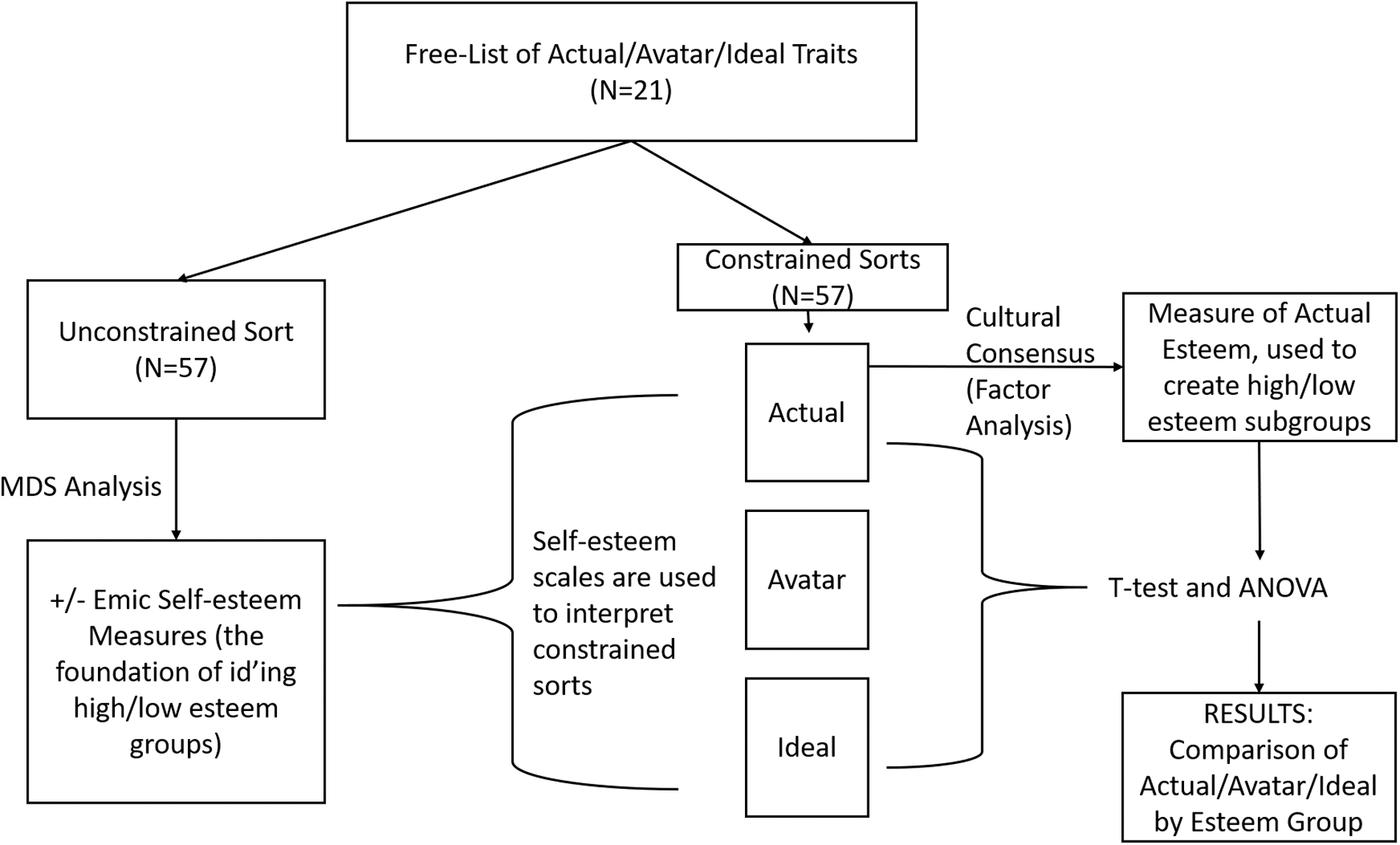
Diagram of methodology.
Data were analyzed in Visual Anthropac 36 to identify common and salient descriptive terms across informants. A total of 484 unique terms were generated. After combining words representing a common underlying idea (e.g., likes to read, well-read), synonyms (e.g., athletic, sporty), and finally categorizing by theme (e.g., fearful, panicked, and scaredy-cat were combined into the term, timid), sixty-nine terms were created for further use in this study (Table 1).
Free List Terms of Actual/Avatar/Ideal Self Characteristics
dps, damage per second.
We then elicited a separate sample of 57 gamers (39 males, 17 females, 1 nonbinary; average age 24 years, SD: 6.5) to perform “pile sorts” on the descriptive terms from the free lists. Pile sorts ask interlocutors to sort terms based on various similarity or difference criterion.24,25 The aggregate analysis of these piles allows for the identification of patterns across informants. We conducted four different pile sorts with each informant in the following order: An “unconstrained” pile sort, where individuals created groups based on their own criterion; and three “constrained” pile sorts, where respondents sorted the terms that were indicative of their actual (primary), avatar, and ideal selves.24,25,35 By using the same free listed items for each sort, we were able to compare similarities and differences between gamers' conceptualizations of their various selves.
We examined the pile sort data in ways that clarified our interviewees' patterns of self-concept thinking. First, in Visual Anthropac, 36 we used multidimensional scaling (MDS) to visually represent the pattern of proximities in the self-concept items in our unconstrained pile sort data. Informants were asked to “sort terms by similarity, making as many or as few piles as you wish,” during which informants were asked to describe the thought process of each sort and the meaning of each pile. Again, in this technique, self-concept terms were sorted by informants without any a priori instruction, for the purpose of eliciting a cultural cognitive map of the relationship of the items. 29
Successive respondents' pile sorts allowed us to create a similarity matrix between the terms, which were graphed in two dimensions to show similarities and differences as a function of spatial coordinates. 37 We then conducted a cluster analysis, an analysis of group identification, on that same unconstrained pile sort data, with the aim of further understanding how sorted self-concept items were meaningfully arranged.29,30,38,39
Via the MDS and cluster analysis of the unconstrained pile sort data, we identified two distinctive clusters of terms (out of five clusters total, more details below in Results) that described positive (23 items) and negative (24 items) traits, which became the basis of an emic—or cultural insider26,29–31—measurement approximating scholarly understandings of “self-esteem,” which we used to categorize our informants as either high or low self-esteem. These designations are derived from our informants own description of these groups—for example, references to “good traits” and “positive traits” and quotes such as “these remind me of a good moral person, like my grandfather” were used to identify the high-esteem terms, whereas “misery,” “bad guys,” “negative personality traits,” and “bad traits” (all direct quotes) were often used to describe the low-esteem terms.
Next, we analyzed the actual self pile sort data via cultural consensus analysis (CCA).31,32 CCA, a form of factor analysis, provides a measurement of interinformant similarity, and an estimation of group membership based on these patterns. Subgroupings on either the first or the second factor can be plotted to identify meaningful subcultural differences.40,41 In this case, we identified subgroupings of informants who listed more positive traits in association with their actual selves (whom we placed in our high self-esteem group) from those who listed more negative terms (grouped in a low self-esteem group).
Then, we compared the aggregate, as well as the high and low self-esteem groups', various self-concepts according to the number of positive and negative terms used in each of the constrained pile sorts. In these cases, we asked informants to “group together the terms that describe your actual/avatar/ideal self.” As such, informants created two piles, one that contained terms applicable to “self,” and another pile of discarded or unused terms. These pile sorts effectively function as a “true/false” questionnaire, with sorted items being labeled as “true” and excluded items as “false.” This produced six distinctive scales that measure the positive and negative attributes (via the MDS) of actual/avatar/ideal self (Cronbach's alpha for these six scales: Positive Actual = 0.88; Positive Avatar = 0.87; Positive Ideal = 0.89; Negative Actual = 0.79; Negative Avatar = 0.82; and Negative Ideal = 0.51.).
Finally, data were collected in the context of longer interviews, where respondents explained their thinking and expanded upon their answers. We provide illustrative quotes from two of these interviews, to further clarify our respondents' thinking in regard to their actual, avatar, and ideal selves.
These methods were approved by the Institutional Review Board at Colorado State University. Verbal informed consent was gathered from each informant, and no personal identifying information was collected.
Results
Cultural domain analysis: free lists and pile sorts
Sixty-nine terms elicited from these interviews were determined to capture the salient ways in which gamers spoke and thought about their offline and online personas (Table 1).
The unconstrained pile sort MDS and cluster analysis of Table 1's 69 items showed five categories (Fig. 2): starting from the left and going clockwise, the first cluster of terms (24 terms) described negative self traits (e.g., cruel, lazy, pessimistic, unattractive), the second gaming-classes (8 terms; e.g., warrior, dps (damage per second)), the third physical and demographic descriptors (9 terms; e.g., female, male, short, tall), the fourth positive self traits (23 terms; e.g., attractive, capable, caring, intelligent), and the fifth morally charged and sometimes ambiguous terms (5 terms; e.g., jokester, religious, sexual, chaste). For our analyses going forward in this article, we focus on the positive (subdomain 4) and negative (subdomain 1) suite of traits gamers used to describe their various selves.
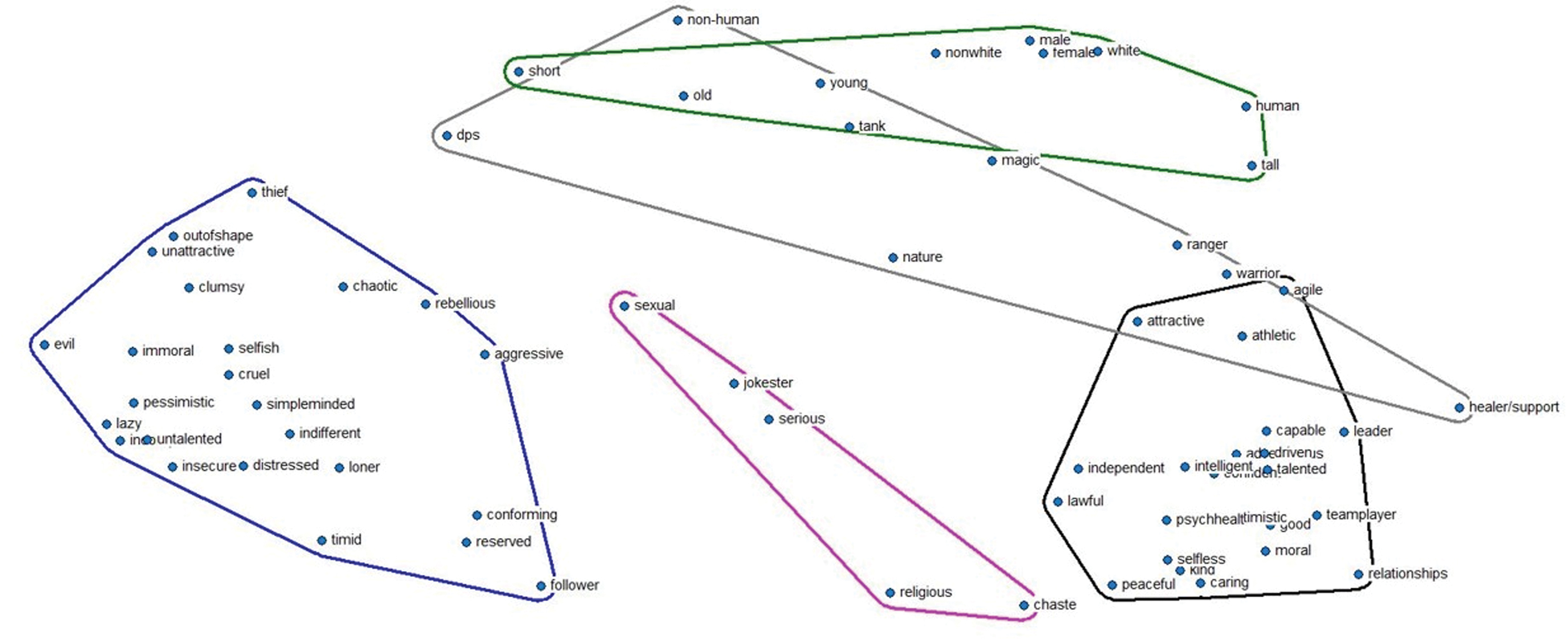
Multidimensional scaling and cluster analysis of characteristics that describe actual, avatar, and ideal self, stress = 0.189. Subdomain 1: aggressive, chaotic, clumsy, conforming, cruel, distressed, evil, follower, immoral, incompetent, indifferent, insecure, lazy, loner, out of shape, pessimistic, rebellious, reserved, selfish, simpleminded, thief, timid, unattractive, untalented (negative traits). Subdomain 2: dps, healer/support, magic, nature, nonhuman, ranger, tank, warrior. Subdomain 3: female, human, male, nonwhite, old, short, tall, white, young. Subdomain 4: adventurous, agile, athletic, attractive, brave, capable, caring, confident, driven, good, independent, intelligent, kind, lawful, leader, relationships, moral, optimistic, peaceful, psychologically healthy, selfless, talented, team player (positive traits). Subdomain 5: chaste, jokester, religious, serious, sexual. dps, damage per second. Color images are available online.
From the constrained pile sort of actual self, we performed CCA (i.e., factor analysis). While the results showed that there was overall similarity in the ways by which our informants described their actual selves, there was important subgroup variation. Figure 3 shows the clustering of individuals (n = 57), plotted by the first and second factors. Subsequent analysis revealed that the difference of positive to negative self terms (i.e., related to the 23- and 24-item clusters just described above) is strongly correlated with the first (0.92, P = 0.000) and second (−0.81, P = 0.000) factors, indicating that the top group uses significantly more negative terms, and the bottom group uses more positive terms to describe their actual selves. These subgroups (divided at coordinates 0.5,0) form our low- and high-esteem groups (analysis of variance [ANOVA]: F = 65.26, P = 0.000).

Cultural consensus analysis of actual self constrained pile sort data. Outlier was included in the negative-esteem group.
A paired t-test analysis on the aggregate sample shows that on average, informants as a whole use 1.7 more positive terms to describe actual compared with avatar self [t(56) = 2.73, P = 0.01] (see Fig. 4 for results discussed in this and the next two paragraphs). However, informants describe their ideal selves in substantially more positive ways than either actual or avatar self, on average using 4.6 [t(56) = −7.2, P = 0.00) to 6.3 (t(56) = −9.0, P = 0.00] more positive terms, respectively.
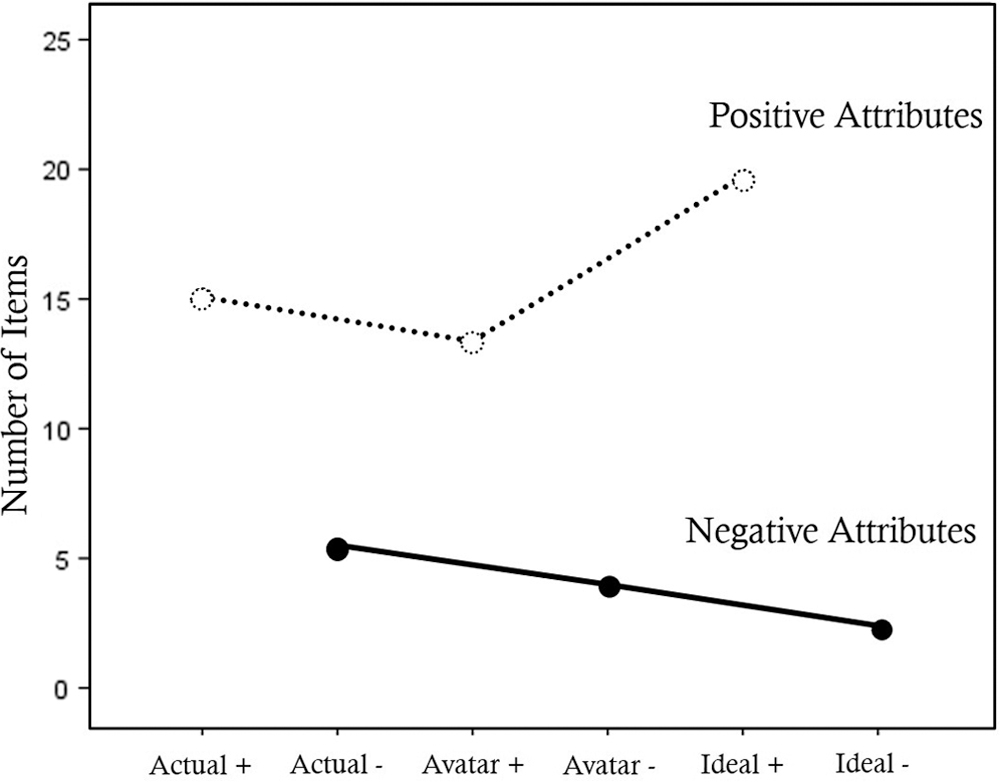
Aggregate analysis of actual/avatar/ideal self positive/negative attributes.
For undesirable traits, informants in the sample as a whole use on average 1.5 [t(56) = 3.61, P = 0.00] more negative terms to describe their actual selves compared with their avatars. Whereas the ideal self has the fewest negative terms compared with actual [3.1 terms fewer, t(56) = 6.47, P = 0.00] or avatar [1.6 terms fewer t(56) = 3.69, P = 0.00] descriptions.
Taken together, informants idealize avatars' negative traits (T−: Ac > Av > I) and actualize their avatars' positive traits (T+: Av ≤ Ac < I). In other words, players do not see their avatars as having more positive attributes than their actual selves, but they do see them as having fewer negative traits than actual-world selves (H1).
Further analysis via the self-esteem subgroups shows a more complicated picture, as illustrated in Figure 5. Individuals in the low-esteem group describe their ideal self with 6.6 more positive terms than their actual self [t(36) = −11.14, P = 0.00], while they describe their actual and avatar selves with a comparable number of positive terms. Importantly, low-esteem respondents apply on average two fewer negative terms to their avatars compared with their actual selves [t(36) = 4.12, P = 0.00]. Thus, low-esteem players actualize what they deem as positive traits onto their avatars (T+: Ac ≈ Av < I), while simultaneously idealizing negative traits (T−: Ac > Av > I) (H2).
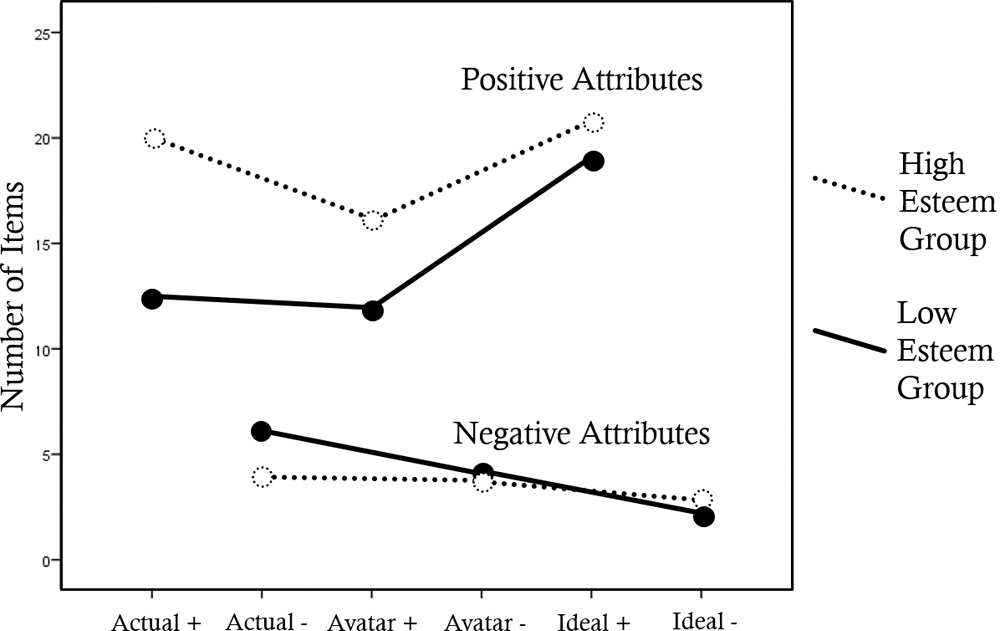
Positive/low self-esteem group differences of actual/avatar/ideal self positive/negative attributes.
Comparing the two esteem groups, individuals in the high- compared with the low-esteem group associate significantly more positive attributes with all their various selves—actual [7.8 more items, t(52.78) = −8.21, P = 0.00], avatar [4.2 more items, t(52.09) = −3.17, P = 0.00], and ideal [2 more items, t(44.56) = −1.78, P = 0.08].
Looking just within the high-esteem group, informants with high esteem use the same number of positive terms to describe their actual and ideal selves (T+: Ac ≈ I > Av). These players describe their avatars with fewer positive terms compared with their actual self [4 fewer terms on average, t(19) = 4.32, P = 0.00]. Yet, positive-esteem players' avatars are still described significantly more positively compared with avatars from the low-esteem group. Finally, members of the high-esteem group attribute the same number of negative terms to their actual and avatar selves (no statistically significant differences; T−: Ac ≈ Av > I) (H3).
Illustrative quotes from interviews
Jim is a 23-year-old student in communications, who has been gaming since he was 5 years old. He enjoys role-playing games (RPGs), in part, because he enjoys making different avatars. He tells us his favorite character is Commander Shepard from the Mass Effect series, a mixed Caucasian-Asian woman with green eyes. Jim's real interests are in the story and moral choices he makes as his avatar. He is adamant that there is little correlation between his actual/ideal self and his avatars.
The avatar doesn't really… it's not that big of an association. I don't really think there's an association between my motivations and different avatars.
No, not necessarily. You just disassociate yourself from the avatar you're playing. You are not the main player in the game, the character you're controlling is the main player.
No, not really. Not at all. I just see them as characters of a story. I don't really identify or see these characters as part of my personality.
However, when inquired more specifically about story and moral choices he makes in the game, Jim places himself within Homeric or Joseph Campbellian “archetypal” narratives he is striving to “write” with his avatars:
(If you make certain choices), the player has a chance to really be a paragon of heroism, so to speak. Being a paragon of heroism is more than just (typical) fantasy of the knight vs the dragon. It's a feel-good story, where there are trials and tribulations that are eventually triumphed. It's similar to most epic stories, like the Odyssey and the Iliad…That sort of archetype of the good overpowering the evil, or standing up for what they believe in and being compassionate.
I think I just enjoy the heroic story archetype more than anything else because I… [long pause] identify with that compassionate, good way of life. I do tend to look for the good in people over the bad. And it's kind of nice to (play) a character that is the pinnacle of that idea…It's much more of a personal thing where this is a story I've created.
Jim, like many of our informants, is unaware that he uses the game to focus and magnify aspects of his ideal self. He initially rejects any comparison between himself and his avatar. Yet, after probing by the researcher, it becomes clear that his own interests in epic stories lead him toward game niches that afford similar opportunities for narrative construction. And through his avatar self, Jim can become the paragon of heroism that he admires so much.
For other gamers, however, the connection between actual and avatar selves is explicit. Sandy is a 20-year-old anthropology student, who is known among her friends for her quick wit and humor. She is an avid gamer of many genres, including life-simulators such as The Sims, and RPGs such as Skyrim and Fallout. While the location of each game differs, the suburbs, a Tolkienesque landscape, and the irradiated ruins of post-apocalyptic Boston, each also affords great flexibility in constructing the looks and behavior of the avatars. As a result, all of Sandy's avatars, in these diverse games, are a single representation of herself—Sandaria.
As she explains:
I can describe (all) my avatars in five words: Tall, brunette, brown eyes, glasses usually, small nose because I do have a small nose…compared to the rest of me (laughs)! I guess when you play a video game you're escaping the real world, and if your avatar looks like you, you get to imagine that you're doing all of these things even though you know you cannot because those things do not exist. You can't kill a dragon, dragons aren't real. But dang it this thing that looks vaguely like me is going to!
They're stronger, they're faster, they have more skill with things that kill other things. And they are usually thinner than I am. (In the Sims,) I'll start her out looking like me then I'll make her exercise so she's attractive. Because I don't, so she should.
For Sandy, her avatar is an extension of herself. Her virtual selves mimic her own positive personality traits: she has many stories of her confident and trickster avatars. At the same time, her avatars minimize some of the qualities she, and her culture, views as negative, primarily her weight. The affordances of these games cut two ways for Sandy: they allow her to imagine herself on these fantastical adventures, while also providing a juxtaposition of her actual and ideal body image, thereby reinforcing offline cultural norms within her online fantasies.
Discussion
Considering all respondents together, avatar-selves were found to idealize (i.e., minimize) negative traits, but also minimize positive traits, thus only partially confirming our H1 idea that avatars overall would reflect idealization processes.
Furthermore, self-esteem—as assessed via our cultural insider measure—modified the way respondents spoke of their various selves. Low-esteem group members attributed fewer negative attributes to their avatars compared with their actual selves (idealization), although they did not attribute more positive attributes to avatars compared with actual selves (actualization), thus partially confirming the H2 idea that low-esteem gamers would possess idealized avatars.
Members of the high-esteem group attributed the same number of negative terms to their actual and avatar selves, partially confirming the H3 idea that high-esteem gamers would actualize themselves in their avatars. However, players in this esteem group also attributed fewer positive terms to their avatar compared with actual selves. In this case, the positive avatar attributes of high-esteem players may represent an “alter-ego” style profile, where avatars serve to explore less socially desirable boundaries and even “break free from constraints of the offline world,” 4 although this idea remains speculative and was not the focus of an explicit hypothesis.
The two interview extracts illustrated how avatars can play compensatory roles for our respondents, although that role was more consciously acknowledged by Sandy and Sandaria compared with Jim and Shepard (H1). Also, we see clear evidence in Sandy's interview of the way that actual-world constraints shape her avatar choices, with her avatars typically strongly resembling her actual self, although in a more ideal form.
Overall, our analysis supports the body of avatar SDT literature that the user/avatar relationship reflects, in part, a trend toward idealization or actualization, with those processes varying according to players' self-esteem. Furthermore, we find connections with more recent research, particularly Mancini and Sibilla's work on user/avatar discrepancy profiles.4,42 As revealed in that prior research, we also see evidence that the user/avatar relationship may not be easily characterized by a single profile. Modern gaming platforms, along with the human imagination, allow avatars to be imbued with complex physical and personality traits. Just as offline selves are multidimensional constructs, avatars too reflect gamers' enactment of ideal and actual selves, sometimes used to compensate for personal flaws,3–12 other times bound by offline personal and social constraints.3,15–19
Study strengths and limitations
Unlike prior research, our study utilized cultural insider understandings of both positive and negative self traits, potentially allowing for more culturally sensitive and nuanced assessments of processes related to psychosocial compensation in online worlds, which makes our study an important extension of prior studies using a novel methodological approach. This study also showed that avatars may be constructed to idealize some traits and actualize others. Future research might follow this and the work of Mancini and Sibilla (2017, 2018) to investigate multiprofile patterns of the user/avatar relationship, including their “alter ego” profile, which we briefly mentioned above.
In addition, this study only looked at two dimensions—positive and negative traits—associated with videogamers' perceived selves. Future research might profitably expand this to a consideration of other personality dimensions, including our morally ambiguous terms, which were not the focus of the current analysis. Importantly, future research would be aided by assessing how and why players attribute meaning to their avatars' various traits, and how such attributions are modified by players' psychosocial well-being, both of which would be further enhanced by incorporating qualitative research findings, as in the current study.
Footnotes
Author Disclosure Statement
No competing financial interests exist.
Funding Information
No funding was received for this study.