




Abstract
Objective:
The Köhler effect is a social-psychological group motivation gain phenomenon that has been successfully adapted to video-based exercise games (exergames) using human partners. This research then shifted to using software-generated partners (SGPs), providing greater flexibility and adaptability to manipulate the game environment to be most motivating for the user. However, recent SGP-based experiments have demonstrated a diminished motivation gain effect. Extending previous work with human–human partners, this experiment varied the perceived exercise ability of the SGP as a potential motivation gain effect moderator on the participant's exercise persistence.
Materials and Methods:
Male and female college students (n = 176; mean age, 21.5 years) completed two series of abdominal plank exercises using an exergame developed specifically for a previous Köhler study. Participants completed the exercises individually and, after a rest, were randomly assigned to complete the same exercises again alone or with one of three SGPs: low ability discrepancy partner (LP), moderate ability discrepancy partner (MP), and high ability discrepancy partner (HP).
Results:
A 2 (sex) × 4 (condition) analysis of covariance main effect for Condition was not significant after controlling for Block 1 times (P = 0.093). However, contrast estimates of plank persistence times between the MP condition and individual no-partner control were significant, P = 0.014, 95% confidence interval [4.34–37.68]. There were no other significant condition persistence differences.
Conclusions:
A moderate discrepancy between the participant and the superior nonhuman partner is more motivating in a conjunctive task paradigm than exercising alone or with an SGP that is low or high in ability discrepancy.
Introduction
The pervasive adoption of electronic and software applications provides an attractive option for individual and team exercise modalities to improve health. Applications that engage the user in exercise to play a game (exergame) or activate game-like features (e.g., competition, levels, scoring) are now widely available. These applications also offer exciting alternative methods to study social-psychological motivation variables. For example, exergame user performance information can be monitored over time, various types of performance feedback during exercise can be provided, and interaction with the game elements and other coexercisers can be manipulated.
One of the most interesting possibilities of exergames in terms of motivation is the ability to present a coexerciser or partner in a way that the user might find most useful to their performance goals. Partnered physical activity interventions may be superior in motivating adherence to physical activity,1,2 and many exergame players prefer these social elements. 3 However, there is limited evidence to suggest that social, cooperative, or partnered aspects of exergames actually increase time engaged in the activity or adherence. 4 This limitation may be due to the fact that few exergame intervention studies have actually utilized social-psychological group dynamics that foster interdependence to motivate performance gains.
This project sought to further understand the Köhler effect, a motivation gain effect, and one of the few group dynamics paradigms capable of realizing performance gains (vs. limiting performance losses). The Köhler effect is a robust motivation phenomenon that has been successfully adapted to exergames using human partners.5,6 The Köhler effect utilizes a unique interdependent dyad structure referred to as a conjunctive task condition 7 and is predicated on the weaker member understanding that when they can no longer continue, their stronger partner must also stop performing the task. The effect on performance is thought to be the result of one's feelings of indispensability to the team and from making an upward comparison to one's higher-ability partner when they understand that the outcome is determined by the weakest member's performance. 8 The conjunctive task structure has demonstrated significantly greater performance gains compared to structures upon which the dyad efforts are added, dyad independent performances were not linked, or individual repeated efforts. 8
In an attempt to bridge the gap between ad hoc laboratory studies and applying the Köhler effect to real-world settings, Feltz et al. utilized virtually-presented human partners embedded in an existing Playstation (Sony, Tokyo, Japan) exergame. 5 This strategy overcame potential problems with matching a suitable stronger exercise partner during the user's availability. The researchers adapted the exergame so that the human dyad partners exercised simultaneously in separate laboratories, visible to each other through a video connection. In the Köhler study protocols, participants performed a series of exercise tasks alone before a rest period during which they were informed that they would be repeating the exercises a second time with a partner and that his/her activity would be projected onto a screen for their partner to view and vice versa. Participants were then told that their partner was slightly more in shape and that they would be working together toward a team score dependent on the team member who quit the exercise task first. The participant was also informed that the partner's first exercise series performance was superior to their own (always manipulated by the researchers to be 40% better compared with the participant's first series performance). The use of this moderate performance discrepancy was based on the idea that an ability discrepancy perceived to be too similar or too large is not as motivating as one that is moderate. 9 The participant was not aware that the video was prerecorded and looped so that the stronger human partner would never stop the exercise before the participant. This deception was a necessary element to be able to capture the participant's plank time, while also serving as live performance feedback that reinforced the conjunctive task structure (the moderately superior partner was not stopping the activity).
In social-psychological contexts, there is compelling evidence that the discrepancy in partner ability perceived by the participant may have a meaningful impact on performance.9,10 With human partners performing nonexercise tasks, early Köhler effect studies demonstrated that the motivation gain was indeed moderated by the discrepancy between the partners' abilities.9,10 The researchers noted that a moderate discrepancy resulted in the largest performance gains and speculated that this perceived difference may represent a reasonable challenge, while discrepancies too small or large either pose no challenge or one that is not attainable. After adapting the Köhler effect paradigm to physical activity tasks, Feltz et al. then tested whether the moderate ability discrepancy protocol previously established was actually optimal for virtually-presented human partners in exercise settings (as described in the preceding paragraph). 11 Maintaining the same methods as previous Köhler studies, the researchers tested ability discrepancy using three teammate conditions (low/1%, moderate/40%, and high/100%) and compared them with a no-partner control condition. All partnered conditions performed significantly longer average plank times compared to the no-partner control. Specifically, the 40% moderate-discrepancy condition performed best, while the 1% low discrepancy condition and the 100% high discrepancy condition were less motivated. Thus, the study confirmed that earlier work suggesting a moderate discrepancy in exercise ability between the participant and their stronger human partner offers a reasonable achievement goal for the weaker partner and is most motivating. However, this ability discrepancy work is yet to be extended to software-generated partners (SGPs).
Recent Köhler exergame research has shifted toward using SGPs, providing greater flexibility and adaptability to manipulate the game environment so that they are most motivating for the user.12,13 However, with the move to exergames and SGPs, the experiments have demonstrated a diminished motivation gain effect.13,14 The diminished motivation gain is not completely uncommon in Köhler studies due to the two-block design. The partner manipulation comes during the second block, after each participant engages in the exercise and has already experienced some fatigue. As conjunctive conditions continued to demonstrate significantly better performances versus control conditions in prior studies, these differences have sometimes meant that the better group was the one with the smallest performance losses (not performance gains from Block 1 persistence). Of course, it is meaningful to repeat an exercise task and only experience a small decrease in performance considering the effects of boredom and fatigue on one's efforts. Other than inferring previous results with human–human dyads, little is known about how one's performance in an interdependent team setting will be influenced by the perceived relative ability of an SGP—a partner who is not real. Digital avatars and agents have become quite common in our social and professional life, and there is evidence that humans often interact with nonhuman agents much like they would with a human counterpart.15,16 However, a typical human participant-SGP relationship may not successfully translate to the unique Köhler effect paradigm interdependent exercise task structure. For example, the participant may be unwilling to accept that the nonhuman partner's ability is really limited and fatigable and, thus, potentially ignoring the Köhler effect mechanism motivating cues (team indispensability and upward social comparison).
Therefore, the purpose of this experiment was to vary the exercise ability of the SGP as a potential motivation effect moderator on the participant's exercise persistence. This replication study's research question explored whether exercising with a moderately more capable virtual teammate in a Köhler effect exergame would result in longer exercise persistence than exercising with a teammate who is either slightly or extremely more capable. The significance of this project rested in furthering our understanding of group dynamic processes with nonhuman partners, as well as extending its use to practical applications in an effort to improve health.
Materials and Methods
Participants and design
After obtaining Drexel University IRB approval, males and females, who were healthy enough for physical activity, were recruited and screened before and during the informed consent process and the completion of the Physical Activity Readiness Questionnaire. All participants were provided an informed consent process by the researcher before any experimental interaction, including time for questions, and subsequently signed written consent. Human subject protections were provided during this study following the ethical principles and guidelines for the protection of human subjects of research adopted by the University based on The Belmont Report. College-aged participants (N = 185; 104 females) were randomly assigned to one of the four conditions: individual no-partner control (IC; n = 46), 1% low ability discrepancy partner (LP; n = 42), 40% moderate ability discrepancy partner (MP; n = 45), or 100% high ability discrepancy partner (HP; n = 43). The mean participant age was 21.5 years (standard deviation [SD] = 3.74).
Power analyses performed using G*Power software 17 following f index recommendations suggested that a moderate effect (f = 0.25) should be detected with a sample size of 179, with a probability of 0.80. This effect size projection is consistent with previous Köhler studies that have shown moderate treatment effects.12,13
Procedure
After the informed consent process, all participants watched an instructional video that explained and demonstrated the upcoming series of five abdominal isometric exercises (a front plank, right and left side planks, and raised right and left foot planks), completed a brief survey, applied an exercise heart rate monitor strap, and then individually completed five baseline abdominal plank exercises (Block 1). Participants were instructed to hold each plank for as long as possible and that there would be 30-second breaks between exercises.
Participants in the IC condition were then informed of their average Block 1 time and that they would complete the same set of exercises again (Block 2) after a 10-minute rest. The experimental condition participants were informed that they would repeat the exercises with a same-sex SGP while simultaneously holding the planks for as long as possible. The participants were also told that the partner had been programmed to be somewhat better than they were at holding the plank exercises. The researcher then informed the participant that had the partner done the same exercises s/he just completed, the partner would have held each exercise longer than what the participant had just performed. The SGP's Block 1 persistence time that was provided to the participant was calculated off the participant's Block 1 persistence, used as the performance feedback manipulation to be always longer, with the exact difference depending on the discrepancy condition: 1%, 40%, and 100% better, respectively. In addition, the participants were told that, although the partner was programmed to be better, they were unable to hold these exercises forever and, at some point, would become tired and stop holding the exercise, just like a real person. Further instruction notified participants that they would be exercising together with the SGP toward a team score, defined as the number of seconds until the first of the two team members quits holding the plank (team outcome is dependent on the weaker member). Unknown to the participant and to maintain experimental control, the SGP was programmed to hold the exercises indefinitely, never quitting first (so the participant always defined the team's score).
During the 10-minute rest period, participants in partnered conditions were introduced to their SGP and provided the discrepancy manipulation information. The participants also completed a brief survey, but item was not part of our hypotheses and therefore not reported in this article. The SGP-participant introduction consisted of a brief conversation built on a dialogue tree progression during which the SGP would speak followed by two or three answer options for the participant. The conversation proceeded through four branches of dialogue based on the choices the participant made to resemble an actual conversation where both parties have some control over how the conversation plays out. The dialogue tree was adapted from a previous Köhler SGP exergame study. 13 Upon completing Block 2 (alone or partnered), participants completed surveys and were debriefed.
The SGP introduction and exercise activities were embedded in the CyBud-X2 videogame, integrated with a webcam to also project the participant's image onto a screen during the exercises (along with the SGP's image). This software was developed for a previous experiment and was based roughly on the Playstation 2 EyeToy: Kinetic exergame. 14 The three-dimensional male and female characters were created to resemble a human-looking partner, speaking briefly and moving with human-like motion during the introduction (mild swaying and upper extremity movement) and to perform the plank exercises. The SGPs did not actually visually display any characteristic that could be interpreted as fatigue during the exercises. The male and female SGPs were similar in terms of age, body shape, and clothing for all partnered conditions and were created to be visually appealing but generalized in appearance enough to not induce discomfort or be intimidating in terms of their physical performance ability.
Measures
Persistence
Persistence holding the plank exercises was used to infer motivation gains. Such exercises are common to workouts designed to improve core fitness and health and are simple effort-based tasks so that performance is more directly attributable to motivation compared to complex movement exercises. Performance was operationalized as the total number of seconds the participant held the plank, from the time they assumed full position to the moment they quit. The times were summed for each block of five plank exercises.
Perceived ability discrepancy
After completing all exercises, partnered condition participants were asked to respond to a single ability discrepancy question: “Concerning the exercises, how do you feel you compared to your partner?” Responses were chosen from a 1 (Much less capable than my partner) to 7 (Much more capable than my partner) scale.
Heart rate
After consent but before any procedures, participants in all conditions were fitted with a Polar H7 Bluetooth heart rate sensor attached to a chest strap (Polar Electro Oy, Kempele, Finland). Heart rate was monitored throughout the experimental session as an objective physiologic measure of exertion, during which the researcher time stamped key events (e.g., beginning and end of each plank and rest period).
Ratings of perceived exertion
Subjective ratings of perceived exertion (RPE) were measured immediately after each plank using the Borg 6–20 scale 18 with participant responding to a rating range from 6 to 20 (6 = “no exertion at all”; 20 = “maximal exertion”).
Results
Manipulation check
As all partnered condition methods were identical except for the verbal Köhler experimental manipulations, participants with an inaccurate understanding of the task structure would not be expected to respond to the motivational mechanisms being tested. Therefore, nine participants were excluded from all analyses (three from each partnered condition) based on the responses to a manipulation check that described how their total team score was determined during the exercises, resulting in a total sample size of 176.
Primary analysis
To examine the effect of the Köhler group dynamic on the motivation to persist with the plank exercises, an analysis of covariance with Block 1 persistence scores as a covariate was used to analyze Block 2 sum persistence scores. Because there was not a significant effect for sex, analyses included both male and female combined. The ANCOVA main effect for Condition was not significant after controlling for Block 1 times, F(3,171) = 2.33, P = 0.076. Planned multiple comparisons are advisable when there is a strong theoretical reason behind the planned comparisons, even after a nonsignificant omnibus test. 19 Therefore, we proceeded with the bootstrapped planned contrasts which revealed that the contrast estimate of plank persistence times between the MP condition and IC was significant, P = 0.012, 95% confidence interval (CI) [4.68–37.44]. Planned contrasts between the LP and HP and IC groups were not significant (P > 0.05). However, bootstrapped post hoc comparisons resulted in significant adjusted mean differences between MP and IC (M = −21.06, P = 0.008, 95% CI [−5.15 to −36.18]) and between HP and IC (M = −16.02, P = 0.049, 95% CI [−1.41 to −31.52]). There were no bootstrapped mean differences between the LP and IC (P = 0.126) or between any of the partnered conditions (Fig. 1).
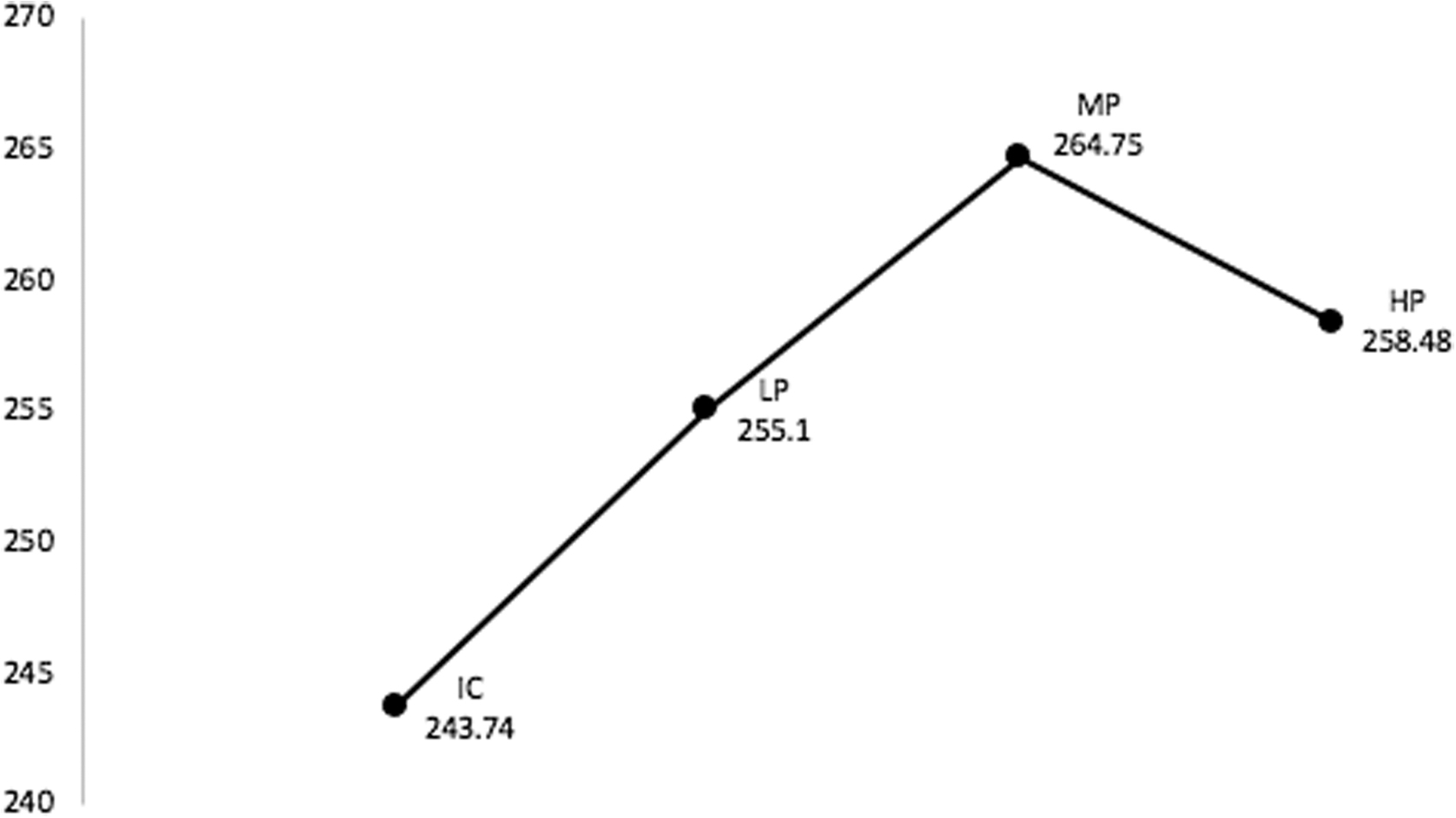
Estimated block 2 sum plank times by condition (means).
Ancillary analysis
There were no significant differences in average Block 2 end-plank (peak) objective heart rates between conditions when controlling for Block 1 end-plank heart rate. All condition average end-plank heart rates did exceed the lower threshold for moderate-intensity physical activity (60%–80% of age-predicted heart rate (HR) maximum, 119–159 bpm). RPE for Block 2 planks (controlling for Block 1 ratings) was significantly different for all partnered conditions compared to IC but there were no significant differences between the partnered conditions (see Table 1 for heart rates and exertion ratings). In terms of perceived ability discrepancy between participants and their partners, all conditions rated their capability less than their partner: HP = 2.88 (SD = 1.06), MP = 2.4 (SD = 1.11), and LP = 2.16 (SD = 1.08). These ratings generally aligned with the partner's Block 1 performance discrepancy that was provided to the participant during the 10-minute rest.
Block 2 Mean (Standard Deviation) Heart Rate and Ratings of Perceived Exertion by Condition
LP, low ability discrepancy partner; MP, moderate ability discrepancy partner; HP, high ability discrepancy partner.
Discussion
This study sought to duplicate previous work that explored the perceived discrepancy in ability between two human partners as a moderator of the Köhler motivation effect to see if a moderate difference would also be most motivating in human-SGP Köhler dyads. Similar to Feltz et al. and Messe et al., participants in the 40% moderate ability discrepancy condition performed better than the other conditions (although the partnered condition differences were not statistically significant) and suffered significantly less of a decrease in persistence during Block 2 performance than those in the no-partner control condition. The Köhler motivation effect has been a robust and consistent finding in conjunctive experimental paradigms with nonexercise tasks (Weber and Hertel, 2007, for a review) and also when applied to exercise tasks. 8 In light of imperatives to address the many health risks associated with the alarming amount of physical inactivity, 20 this line of Köhler research continues to explore active alternative methods to motivate physical activity. This study is practically important in understanding moderators that may strengthen the motivation effect with SGPs. It is logical to assume that exergame users may not perceive characteristics of the SGP as they would a human partner. While we've chosen male and female SGPs that should not be unpleasant or disconcerting to the participant,13,14 it is possible that participants perceive the SGP to have infinite ability or as being indefatigable when partnered to complete an exercise task. As with several previous Köhler studies, this experiment demonstrates that, with little verbal explanation regarding the SGP capability, participants do seem willing to believe that the SGP can have human-like limitations in ability. However, this study also reinforces the importance of a reasonable ability discrepancy that might enhance a participant's motivational upward comparison goals. Therefore, support for both of these human-SGP interaction phenomena informs further Köhler effect research and also may be helpful to nonconjunctive task settings that utilize competition, dependence, or interaction with a digital partner or agent. Finally, the general pattern of performance differences between conditions in our study was similar to findings from Feltz et al. 11 in that all partnered conditions performed better than control. Feltz reported that all of the Köhler condition plank times were significantly different than the no-partner control condition (although the moderate discrepancy was optimal) in their human partner design. Our study demonstrated a similar pattern in that all SGP-partnered conditions performed better than control, even though there were only significant differences between both the moderate and high-discrepancy conditions and the no-partner control condition. Researchers and game designers may interpret these findings as an opportunity to explore ideal motivational game environments across varied SGP-participant ability discrepancies. Specifically, game designers can harness the other benefits of using an SGP (e.g., controllability, improving design elements, and other theoretical motivation elements).
Although objective heart rate values were not significantly different between conditions, perceived effort ratings were significantly higher in the partnered conditions. This result is in contrast to previous Köhler studies which showed that, despite persisting longer, partnered participants did not perceive their effort to be significantly different than the no-partner control group.11–13 In this study, it may be that the SGP increases awareness of exertion as they move through the five plank trials during Block 2. In the context of working out with a nonhuman partner, the higher ratings of exertion could be viewed as a coping mechanism for being the weaker member of the team. It is plausible for someone to compensate for quitting first and letting the teammate down by inflating their level of exertion when with an SGP. Exertion perceptions may also be heightened by the fact that the SGP did not display any obvious signs of fatigue during the exercises, regardless of how long the planks were held while the participant may have been struggling. However, further research is required to examine these social and physical reactions to exercising with an SGP.
Future Köhler research should continue to examine potential moderators to boost the motivation gains possible in this unique paradigm. As people enjoy participating in exergames with a partner or small group, it is important to take advantage of dynamics inherent to those situations. While other Köhler moderators (gender, competition, feedback, age, weight, ostracism) have been studied, 8 few studies have attempted to understand the effect in SGP-human conjunctive partnerships. There is also a need for studies to replicate the Köhler paradigm with different exercise modes and intensities, as well as explore the implications of the Köhler conjunctive task structure and a moderate-ability discrepancy on performance over time.
Although this study examined the effect of ability discrepancy in conjunctive task conditions, similar perceptions of differences in ability may affect performance in other exergame or videogames with cooperative or competitive multiplayer designs. It is reasonable to assume that participants may assume or perceive interdependence with a partner even though no such explicit parameters exist. For example, by pairing two people up to exercise and asking each to share their performance goals, one or both persons may persist with the exercise or choose an exercise intensity simply based on a perception of interdependence (i.e., if they stop, it will prevent the other person from obtaining their goals). This sense of obligation or interdependence may not occur and, therefore, not be of benefit if the ability discrepancy is not reasonable. Future research should also explore this potentially overlooked moderator in terms of why players don't continue to play nonconjunctive multiplayer games or don't perform well.
Future research may seek to understand how these findings might enhance our understanding of human nature. As noted previously, the Köhler effect is thought to rely on one's perception of indispensability and tendency for upward social comparison. However, there isn't research that has examined common human traits that may help explain why these Köhler mechanisms motivate people in a conjunctive task setting with an SGP partner. Even with a nonhuman partner, there may be a basic human need to conform, need to belong, satisfy reciprocity, or engage in competition. As Reeves and Nass have maintained, 16 computers are social actors and interacting with computers may automatically initiate social norms. Social interaction with a nonhuman includes powerful perceptions that there is a social presence, triggering people to act accordingly. Reeves and Nass have suggested that people may have a social-norm default reaction to a computer character that compels them to treat it like a human if it acts like a human. 16 So, it may be interesting to study how the participant's willingness to respond to an ability discrepancy aids in understanding these phenomena.
Overall, this study provides evidence that people are motivated by an SGP with a moderate discrepancy in the Köhler conjunctive task structure. These same motivation gains were not witnessed in the low or high discrepancy groups. Therefore, game developers, fitness professionals, and others looking for motivational strategies applied to game technologies should consider the Köhler motivation gain paradigm with an interdependent partner who is moderately better than the participant.
Footnotes
Acknowledgments
The authors thank Edwin McCulley, Aleighsa Riess, Benjamin Carlo, Madeline Gillooley, Elena Chermak, and the other research assistants for their help with running experimental sessions.
Author Disclosure Statement
No competing financial interests exist.
Funding Information
The study was supported by funds from the Drexel University Department of Health Sciences.