




Abstract
Objective:
Processing speed (PS) is an important indicator of cognitive functioning and normal aging. However, the tools used to evaluate these are often rather simplistic and only assess one cognitive component. The aim of this study was to use cognitive mobile games (CMG) to evaluate the evolution of reaction times over the life span during different cognitive tasks.
Methodology:
We carried out a retrospective observational study in which we obtained anonymized results of 15,000 subjects. Scores of five CMG that train arithmetic, vocabulary, response control, visual attention and recognition, and working memory were analyzed.
Results:
Overall, we observed a highly statistically significant decrease (P < 0.001) in PS and a decrease of accuracy (P < 0.001) with increasing participant age, indicating that for each cognitive function tested, older participants performed cognitive tasks more slowly than younger participants. We also observed an interaction between the age of the participants and the number of errors. These results are consistent with physiological data with respect to aging and cognition.
Conclusion:
Owing to their wide availability and ease of use, CMG could be used as a simple tool to monitor cognitive function such as PS. Further studies are needed to study the influence of pathologies on those variables.
Introduction
The World Health Organization estimated that the population aged older than 60 years will double in size by 2050. 1 In the context of the aging of the population, the accurate and accessible assessment of cognitive function is thus of increasingly high importance for both public and individual health. Clinically, normal aging is associated with progressive decline in cognitive functions. 2 Usually, cognition is divided into several subfunctions such as attention, memory, language, and visuospatial abilities; these subfunctions are each impacted differently by the process of aging.3,4
Indeed, following childhood's fast cognitive growth, early adulthood (i.e., the ages of 20–39 years) is marked by relative stability and peak cognitive function, then many declines occur in the cognitive system. 5 The functions most affected by age are the processing speed (PS), executive functions, 6 inhibitory function, 7 and episodic memory, 8 while verbal abilities 9 and implicit memory seem to be preserved. 10 As the name indicates, PS relates to the rate at which information is detected, interpreted, comprehended, and reacted to. PS is often regarded a critical component of attention; certainly, the majority of tests of attention are speed-sensitive, if not speed-dependent, however, some specialized neuropsychological testing disentangles attentional accuracy and response speed. 11 PS deficiencies may impair cognitive processing in various cognitive areas (e.g., placing a limit on the amount of information that can be attended to or encoded at one time).
PS, on the contrary, may be separated from other cognitive domains and subdomains. 12 From a clinical point of view, PS is an important factor to evaluate since it is a good indicator of cognitive function and thus of declining cognitive performance in healthy aging 13 and in dementia. 14 Furthermore, it has been highlighted that PS has an effect on other cognitive skills; PS is responsible for a significant amount of the decreases in cognitive ability associated with aging. In addition, studies suggest that reductions in PS may influence daily functioning and driving behavior. 15 Clinically, cognition is evaluated using different scores and scales that can assess global cognition or more specifically different cognitive subfunctions. 16
So far, measures of reaction time are still performed using so-called simple reaction time tasks or more complex methods such as the flanker reaction time task. 13 The mean speed of responding is the most commonly used measure in the assessment of reaction time. 17 Currently, there is still a lack of information about the evolution of PS during various cognitive tasks across the life span using automated computerized solutions (e.g., digital biomarkers). 18
One study previously investigated the PS in different activities using tablets and apps. 19 The authors assessed the cognitive function of a large sample size of more than 15,000 participants using a computerized cognitive task battery composed of 13 tasks that were categorized into 3 cognitive constructs of memory, attention, and PS. The authors found that PS mediated the relationship between age and other cognitive performance scores. However, despite the large sample size, only a limited number of participants (n = 837) older than 60 years were included in this study. There is thus a lack of information about the evolution of PS at old and very old age. Since PS is a good indicator of healthy aging, it is therefore important to study how PS evolves with ages and to analyze if there is any difference between the different cognitive functions. Today, the development and use of cognitive mobile games (CMG) are becoming more and more popular in a clinical context and in research thanks to the worldwide success of cognitive videogames such as “How old is your Brain” by Dr. Kawashima, 20 and other popular apps. The games have been developed to train and challenge the brain to preserve or improve cognitive functions.21–23 Besides the brain training aspects provided, CMG also offer other interesting possibilities, such as allowing simultaneous cognitive evaluation while performing the exercises.24–26
Such assessments can be done using directly the scores provided by the CMG25,27 or by developing new applications to collect more psychological measurements such as the reaction time and PS. 28 Remote health assessments that collect real-world data outside of clinic settings need a thorough grasp of the appropriate data collection, quality assurance, analysis, and interpretation of methodologies. 29
Therefore, the main aim of this study was to establish the validity of the outcomes obtained from the CMG in the study of human cognition. The specific aim of this study was to determine if the PS in different CMG could be used as an indicator of cognitive aging. To do so, we examined the PS of age-related change of differences and hypothesized that, as for the cognitive functions, the change in PS in the different cognitive functions should not be equally affected by the aging process and that these changes may affect the strategies of the participants (e.g., focus on correct answers rather than speed).
Materials and Methods
We carried out a retrospective observational study in which we obtained anonymized results of 15,000 subjects ranging from 18 to 83 years (43 ± 10 years). This study was approved by the Cambridge Psychology Research Ethics Committee (Pre.2020.28), and all participants agreed that their data could be used for research purposes when installing the app. To have the same number of participants in every category of age (i.e., balance design), subjects were randomly selected (using simple random sampling) from a list of participants who had played five CMG provided by Peak brain training (www.peak.net, London, United Kingdom).
The five CMG were selected based on a previous study that computed correlations between scores obtained for these five particular CMG and scores in two clinically established cognitive assessments (the Mini-Mental State Examination and the Addenbrooke's Cognitive Evaluation) in elderly subjects with and without cognitive impairments. 25 To avoid risk of bias induced by the training or familiarization of the CMG, we only analyzed the first session of play. Screenshots, descriptions, main objectives, and how the PS is computed for the five CMG are presented in Table 1. For the different CMG, the main cognitive abilities trained were defined based on previous research. 30 The CMG were played on a smartphones or tablets. The CMG response time data are automatically recorded by the application.
Screenshots, Descriptions, and the Main Cognitive Abilities Evaluated for the Different Cognitive Mobile Games
CMG, cognitive mobile games. Color images are available online.
The main outcomes were the PS evaluated by the processing time (PT defined as the time required to perform each task in the CMG, see Table 1), and we separately analyzed PT for correct and incorrect answers. As secondary outcomes, we also computed the accuracy (the number of correct trials divided by the total number of trials) as well as the number of correct trials as an indicator of the efficacy of the training.
We analyzed the different outcomes of each CMG using mixed models 31 and tested the interactions between the age of the participants and the PT for correct and incorrect responses.
Statistical analyses were performed at an overall significance level of 0.05. Statistical analyses were conducted in RStudio (version 1.2.5042) with R version 3.6.3, using the LME4 package to run the mixed-effect models. 32
Results
Results of the mixed-model analysis for the five different CMG are presented in Table 2. The evolution of PT, the number of successes, and the accuracy over age are presented in Figure 1. First concerning the accuracy, we observed that, except for arithmetic (measured by Square Numbers, β = 0.003 [−0.004 to 0.011], P = 0.345), there is a statistically significant linear decrease of accuracy with age. The most important decline is for task shifting (measured by Must Sort, β = −0.102 [−0.112 to −0.091], P < 0.001) and the less important, yet highly significant, for working memory (measured by Rush Back, β = −0.039 [−0.046 to −0.032], P < 0.001).

Evolution of the processing time according to age for the different CMG. Green color indicates the PT for correct responses, red color for incorrect responses, and black dashed lines represent the accuracy. The small boxes (blue lines) represent the number of correct answers per CMG session. CMG, cognitive mobile games; PT, processing time. Color images are available online.
Results of the Regression (Mixed-Models)
CI, confidence interval.
For the PT, first concerning the correct response, there is a significant effect of age, regardless of the cognitive functions. The effect size (estimated by the beta) 33 is more important for vocabulary (measured by Word Pairs, β = 44 ms [42 to 46]) and less important for task shifting (measured by Must Sort, β = 6.2 ms [5.9 to 6.7]), see Figure 2 for complete results. Similar results were obtained for the PT during incorrect responses: the change in time to give incorrect responses is always more important that the change for correct ones.
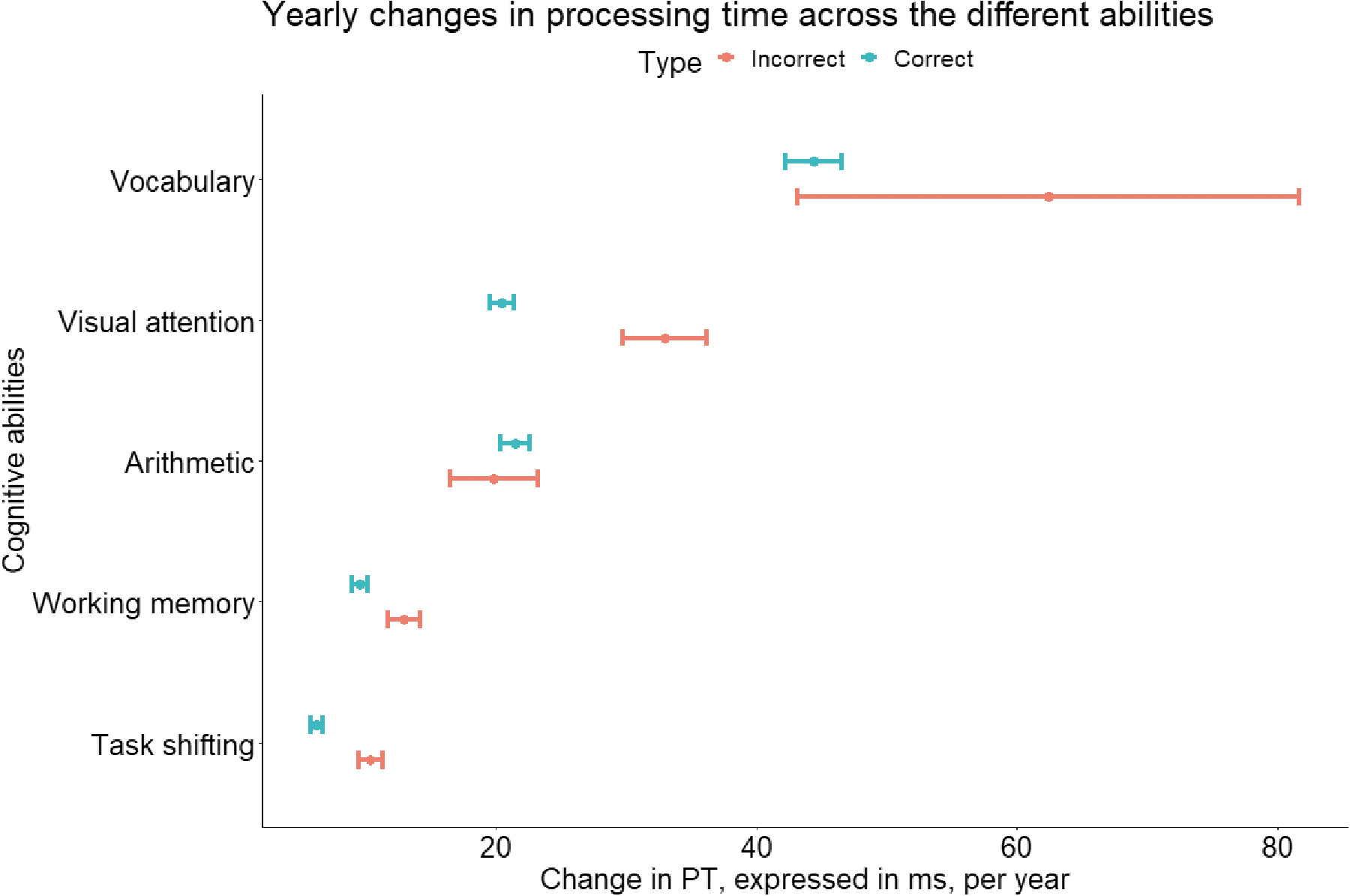
Yearly changes in PT across the different cognitive abilities for correct and incorrect responses. Color images are available online.
To visualize the evolution of PT across the life span between the different cognitive abilities, we first centered the PT by removing the average results of the younger participants (18–21 years) for the different CMG and then plot the evolution of PT through ages, as shown in Figure 3. To detect change in slope across aging, we applied a Continuous-piecewise-linear Pruned Optimal Partitioning for the different CMG. 34 We observed three different patterns. For task shifting and working memory, a small and linear evolution of PT. For the visual attention, the evolution is also linear but more marked (β = 6.2 for Must Sort, β = 9.5 for Rush Back, and β = 20 for Unique).

Evolution of PT for the different cognitive functions across the life span. To ease the comparison of the different functions and interpretations, data were centered for each different CMG by removing the average values of younger participants (18–21 years). Color images are available online.
Finally, for vocabulary and arithmetic abilities, the PT increased linearly until ∼50–55 years; after this first phase we observed an important change in the increase of PT. For the vocabulary, this change occurs at 52 years and for arithmetic at 56 years. Next, we compared the slope before and after this change. For vocabulary, the slope is 17 [14 to 21] before 52 years and 73 [64 to 82] after, the difference is significant (P < 0.001); for the arithmetic abilities, the slope is 8 [6 to 10] before 56 years and 36 [31 to 41] after, yielding to a significant difference (P < 0.001).
Finally, we assessed the interaction between correct and incorrect responses and found significant interactions for all assessed cognitive functions with ages indicating that the older the subjects are the more important the difference in PT between correct and incorrect response is.
Discussion
The main result of this study is that CMG can be used as an indicator of cognitive function to evaluate the PS of participants within different cognitive tasks. The observed increase in PT for the five CMG is coherent with physiological data and previous studies.6,13,28 Analyses showed that the smallest effect was observed for fluency (Word Pairs), consistent with the notion that vocabulary and fluency are the most preserved cognitive function with age.4,35,36 Indeed fluency task seems to be only reduced at old or very old age,37,38 in our study, we observed an important increase in the PT around 50 years, but both the accuracy and the number of responses decreased linearly.
On the contrary, task shifting (Must Sort) is the most affected with a large effect size, which is also in accordance with the literature since this task is the closest one to a simple reaction time test, and previous studies highlighted that this function is particularly strongly affected by aging.3,6 It has been previously shown that older adults experience more difficulties in task shifting compared with younger individuals due to highest cognitive cost (i.e., change in performance on no-switch trials in dual-task blocks compared with no-switch trials in single-task blocks). 39 The difficulties are more marked when the tasks also require inhibition skills, 40 which was not the case in this study.
Concerning the other functions, for visual attention (Unique), the linear increase in PT, more important for incorrect responses, is also consistent with neurophysiological knowledge on aging where a decrease of selective attention is observed 41 that may be due to the deterioration of the field of view and vision. 42 For working memory (Rush Back), the same trend was observed, which is also consistent with the literature, where it has been shown that older adults tended to show less improvement in scores after n-back training (similar task than the Rush Back) than younger adults. 43 Finally, for the arithmetic ability (Square Numbers), the time required to perform the computation stays stable until 50 years and then there is an important increase, the accuracy is also decreased.
A recent study shows that arithmetic ability skills are preserved in healthy elderly adults and that older adults could even outperform young adults because they more often retrieve arithmetic facts from long-term memory. 44 Our results did not support those findings as we observed a decrease of accuracy, number of response, and an increase of PT. This may be due to the educational background of the participants. The high variability and the different patterns of PT changes, evaluated through the CMG and presented in Figures 1 and 3, are in line with previous studies.
A recent study highlighted the fact that no single measure of cognitive performance and performance variability produces the same findings with respect to age-related change. 45 The authors observed that the age of peak performance varied significantly across metrics, with young adults performing best on measures of median PT, middle-aged adults performing best on certain measures of PT variability, and older adults performing best on accuracy.
Another important finding of this study is the interaction between the age of the participants and the difference between PT for correct and incorrect measurements. While a slight decrease in accuracy was also found with age, this interaction indicates that older participants tend to have a higher PT for incorrect responses compared with younger participants. Several mechanisms could explain these differences. The reduced response inhibition is reflected by a poorer performance in incongruent trials where prepotent responses can interfere with other correct responses. 46 Older adults also demonstrate difficulty forming and retrieving episodic memories. One proposed mechanism is that older adults are impaired at binding information into nonoverlapping representations, which is a key function of the hippocampus. 47
The results of this study must be interpreted with caution and three main limitations should be borne in mind. Due to the study design, the first—and probably the most important one—is the selection bias of the participants. Since all the participants were users of the apps, it implies that they are familiar with smartphone and mobile apps. Despite the fact that we analyzed only the first session of training to avoid training of familiarization effects, there may have been a transfer of the abilities trained in other apps into this one as a study highlighted that an owner and a regular owner of smartphones have a reduced risk of dementia compared with people who do not own one mobile device. 48 This effect may be more important in younger participants, who are more familiar with smartphones and the use of apps or games 49 ; therefore, the observed difference in PT may be overestimated.
The second limitation is that we do not have information about the participants, but it is well documented that several factors, not only age, influence cognitive function and abilities such as education, 50 lifestyle-related factors, 51 genetics, 52 or comorbidities (i.e., diabetes, 53 chronic respiratory diseases, 54 cardiovascular diseases, 55 or stroke 56 ). Since we do not have access to this information, we cannot speculate the influence of those parameters on the results. The third limitation is related to the use of different technologies (hardware and software). Here again we do not have information on the devices used. Since the PT is recorded in ms, the accuracy may vary depending on the types of devices used. However, given the large sample size, we can assume that the vast majority of the participants playing with these kinds of apps are cognitively healthy and that the effects of these factors, if any, must be mitigated by the large number of participants.
Despite the abovementioned limitation, the results of this study are in accordance with current neurophysiological knowledge. Remote digital studies have the potential to alter the user experience, in comparison with conventional clinical trials, and provide additional issues to the researcher that must be addressed to conduct a successful study. 57 The proposed method to assess PS has many advantages: largely available, affordable, and efficient administration, automated scoring, fun, and evaluation not requiring the presence of a health care professional even at old age (older than 80 years).
Another advantage is that, with the exception of Square Numbers and Word Pairs, the CMG are culturally and educationally unbiased, which is particularly important for cognitive evaluation, since it is widely known that education has a confounding effect on cognitive assessment. 58 The above aspects are particularly interesting in the context of low- and middle-income countries; owing to the global increase in life expectancy, these countries are faced with the high price of the disease of the elderly with limited human resources. 59 CMG could be used as a practical tool for the routine screening of PS, and therefore, as a method of longitudinal assessment and follow-up.
However, before being used at a large scale and as a routine, further studies must focus on the changes in PT in various pathologies affecting cognitive function such as dementia, mild cognitive impairment, stroke, multiple sclerosis, and Parkinson's disease. Important efforts must also be done to link the results with neurophysiological 60 and imaging data. 61 These efforts should help determine the best criteria for assessing and classifying participants or patients, as well as determining thresholds and values to be reached during regular monitoring.
Conclusion
This study highlights the potential use of CMG as an indicator of the different cognitive functions. Beside the positive effect of brain training using CMG, these types of apps could also be used to perform regular follow-up of cognitive functions or as new outcomes for interventional or physiological studies. Performing an application-based study also enables researchers to do cross-sectional studies at a cheap cost. Due to the device's portability, it is an ideal tool for cross-cultural studies. In addition, the device's mobility enables data collection in places or populations that may not be readily accessible or equipped with equipment capable of conducting lengthy testing. In addition, mobile apps might be beneficial for cognitive and psychological testing.
The evaluation tools may be used to evaluate and define persons who are at an increased risk of cognitive impairment or illness. Further research should focus on the use of CMG in older adults with and without risk of cognitive impairment and in neurological patients suffering from cognitive impairment.
Footnotes
Author's Contribution
The author confirms sole responsibility for the following: study conception, design, analysis, and interpretation of results, and article preparation.
Acknowledgment

Author Disclosure Statement
No competing financial interests exist.
Funding Information
No funding was received for this article.