




Abstract
Objective:
A technology-assisted teaching tool with interactive features may improve the outcomes of illegal drug-use prevention strategies. This study explores augmented reality (AR) and paper board games incorporating a brief antidrug educational program for students without drug-use problems to increase their antidrug knowledge, attitude, life skills, subjective norms, perceived behavioral control, and intention to avoid using drugs.
Materials and Methods:
A total of 600 students were recruited, and 578 completed the intervention program and pre-and post-tests. The participants were randomly assigned to one of the following three groups: AR board game, paper board games, and comparison groups. The brief educational program consisted of two sessions. Generalized estimation equations were used to assess group differences in outcome variables. The paired t-tests were used to assess improvements in outcome variables of the two experimental groups.
Results:
The study found that the students who received the brief educational program featuring the AR board game was significantly different from the comparison group in outcome variables, including antidrug knowledge (P = 0.001), life skills (P = 0.004), subjective norms (P < 0.001), perceived behavioral control (P < 0.001), and intention (P = 0.02). The group with the paper board games also revealed similar findings as to the AR board game group in outcome variables, except for antidrug knowledge. There were no group differences in antidrug attitude between experimental and comparison groups.
Conclusion:
The results of this study support the efficacy of the two types of board games incorporated with a brief educational program. Results suggest that schools can adopt AR or paper board games as learning tools to assist in drug-use prevention programs and reduce the likelihood of students using illegal drugs.
Introduction
According to the World Drug Report of the United Nations Office on Drugs and Crime, in 2017, ∼271 million people in the world had used drugs at least once, an increase of 5 million compared with 2016. 1 It also estimated that 13.8 million adolescents aged 15–16 years have used marijuana worldwide, equivalent to 5.6%. According to the findings of the National Institute of Drug Abuse (NIDA) survey, “Monitoring the Future” (MTF) in 2018, 17.6% of eighth grade students, 32.3% of 10th grade students, and 37.3% of 12th grade students reported lifetime illegal drug use. 2 In Taiwan, the prevalence of drug use is the highest among senior and vocational high school students. 3 Illegal drug use is a severe threat to the health of adolescents. Illegal drugs can damage their physical, psychological, and social well-being, endanger family relationships, and cause societal problems.4,5 Conventional didactic teaching has proved insufficient in preventing adolescents from initiating substance abuse. 6 There is indeed a critical need to establish an effective educational strategy to prevent drug abuse from spreading among adolescents.
Advantages of board games in learning
Games and playing are characteristics of human nature and can improve the learning motivation of students.7,8 The application of board games in teaching enables students to learn by playing, interacting with others, communicating and enhancing team cooperation, exploring the external environment, and learning with more interest. 9 With technological advances, augmented reality (AR) has become a popular platform for learning. AR combines the real and virtual worlds, allowing individuals to interactively and realistically experience 3D models with virtual text images in real time. AR can structure any environment by presenting a 3D stereoscopic effect, which allows the integration of the information in real life and the virtual world. 10 Wu et al. stated that AR environments can enhance the sense of existence, immediacy, and immersion of learners. 11 Hsiao and Rashvand stated that AR implementation in education can attract learners and motivate them to explore the learning topics. 12 New interactions between physical materials and AR learning environments can be generated, which can increase their enthusiasm for learning. 12
Previous studies reported that board games enabled students to participate, think, discuss, and interact with others while acquiring knowledge and skills in health topics.13,14 A review article concluded that board games are a promising tool for health promotion. 15 Results indicated that playing traditional board games (e.g., chess) helps alleviate cognitive impairment and depression. Playing newly developed board games benefits behavioral modifications, such as promoting healthy eating, smoking cessation, and safe sex. 15 Peer-interactive board games can effectively reinforce knowledge retention. 16 Another study demonstrated a significant increase in self-efficacy as a result of playing board games in the learning prevention of dengue hemorrhagic fever. 17 In addition to knowledge improvement, a study that involved the application of nutrition educational board games reported enhanced dietary behavior over 6 months and a sustained effect on the BMI. 13
Theory of planned behavior and life skills
The theory of planned behavior (TPB) provides theoretical constructs for motivational factors that predict the likelihood of performing a targeted behavior. A meta-analytic review concluded that TPB was empirically supported and provided a framework for investigating behavioral intention and behavior. 18 TPB assumed that the intention to conduct a behavior was affected by the attitude toward the behavior, subjective norms, and perceived behavioral control. 19 According to TPB, the attitudes toward a behavior refer to the positive or negative evaluation of the targeted behavior. The subjective norms refer to perceived social pressure to perform the behavior, and perceived behavioral control refers to the perceived ease or difficulty of performing the behavior. 19
In the context of drug-use prevention, several studies integrated TPB and life skills for the development of school-based programs on drug-use prevention.6,20 The study findings provide empirical evidence to support this combination. In addition to cognition and attitude, life skills training can enhance the ability of students to handle social influence. 21 Life skills enable students to translate knowledge and attitude into behavior, thereby improving attitude and the sense of behavior control. A previous study reported that the promotion of life skills was related to favorable prevention outcomes. The authors suggested that favorable prevention outcomes can be influenced by building knowledge about general life skills. 22
Aims
This study aimed to explore the effectiveness of two types of board games for the prevention of drug use among senior high school students.
Methods
Participants
A quasi-experimental design was used in this study. We received administrative support from a city in northern Taiwan with 33 senior high schools under its jurisdiction. An invitation letter was sent to all schools and four of them accepted the invitation. However, one school withdrew from the study because of a tight schedule. The remaining three schools were randomly assigned to the AR board game, paper board game, and comparison groups. We invited the administrative supervisors and teachers of the three schools to attend a meeting that introduced the purpose and methods of the study. Afterward, we invited students of classes to enroll in the study and received written consent from enrolled students and parents/guardians. All students and parents/guardians were informed of their right not to participate and were assured that their class grades were not contingent on participation. The selection criteria were (1) current 10th to 12th grade senior high school students, (2) willing to comply with verbal instructions, (3) not suffering from any severe chronic diseases (e.g., heart disease), and (4) ability to operate the board game. When each group had collected 200 written permissions, we stopped recruiting because the sample size was sufficient to detect the intervention's effects. 23 Those that were incomplete or with inappropriate logic flows were excluded, resulting in a final sample of 578 (Fig. 1).
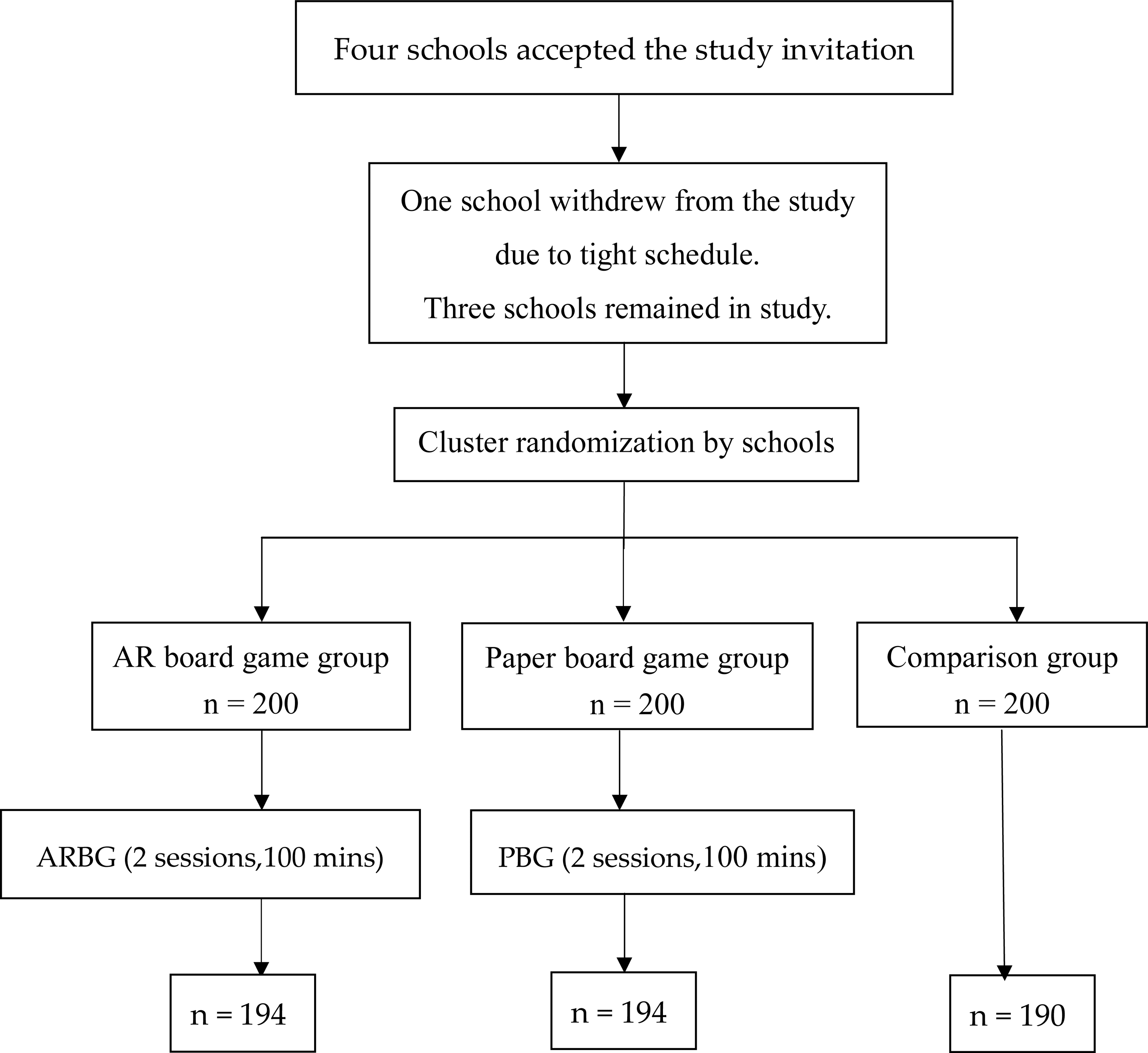
Flowchart of participant enrollment and intervention. ARBG, augmented reality board game; PBG, paper board game.
Board game
The board game was to provide an interactive and formative approach to assess learning framed to prevent students from using illegal drugs. Students learned antidrug use knowledge and TPB-related variables through the process of playing board games. The board game is designed for students to work in person and compete against each other by playing cards and achieving the goal of the game. The illegal drug-use situations used in the board game were developed by a professional team consisting of health education, nursing, and drug-use prevention experts based on the teaching materials of the Ministry of Education. 24
AR board game
The AR board game set comprises the following categories: (1) a map of the magic forest and road cards, (2) magician and elf character cards, (3) target cards, (4) question cards, and (5) function cards (seal, dispel, see-through, damage, and turn around). These cards are listed in Table 1. In the AR board game, “Magic forest: Be aware of disguised drugs and find the way out,” the players play either as elves or magicians. By answering question cards, players can draw a “road card” and build their own road by obtaining target cards that are the key to getting out of the magic forest. A target card is an illustration of disguised drugs with descriptions. The AR board game aims to encourage students to work together and to be aware of the disguised drugs. The only way to get out of the forest is to detect the dangers of the disguised drugs. Through enhancing their awareness, players are advised to avoid using disguised drugs. Players use function cards to perform various functions, such as sealing or turning around, increasing the fun of the game. When all question cards have been answered, the game is over, and the score is calculated. The player with the highest score wins.
Augmented Reality Board Game “Magic Forest New Export”
AR, augmented reality.
Paper board game
In the paper board game, students are expected to build an antidrug tower. The aim is to enhance the antidrug knowledge and skills of students by answering questions while playing. The playing rules and accessories are described as follows (refer Table 2): (1) Foundation cards: the tower can only be built on foundation cards. (2) Vertical cards: players obtain vertical cards to build the wall of the tower by answering questions. (3) Horizontal cards: there are two types of horizontal cards. One type of cards (question cards) provides either knowledge- or skill-related questions. Players receive a vertical card after answering the question. The other (dangerous card) presents risky situations. Players must remove one vertical card while they draw a dangerous card, making the tower unsteady upon losing the vertical card. (4) Function cards: there are four types of function cards. Players receive two vertical cards while they draw a protection card. Turn around cards reverse the playing order, rest cards indicate that players must pause once and wait for the next round, and forward cards indicate that players get a chance to play again. Finally, the player with the highest floor count wins.
Paper Board Game “Building a Tower”
The height of the tower built symbolizes the amount of antidrug-related knowledge and skills learned by the students. Students visualize dangerous cards damaging their tower-building effort, which could give them the impression that if they are not alert to risks, they might lose what is important to them.
Intervention procedure
The students in the experimental group participated in a board game course of ∼100 minutes. The research team explained the playing rules to the students. The games were played in groups, and each group had seven to eight students. Written material related to antidrug life skills was distributed before the game. After the game, each group discussed the risky situations they encountered during the game and what kind of responses were appropriate. Finally, the groups shared the results of the discussion. The research team expressed appreciation of the positive attitude of the students and their confidence to fight drugs. In addition, the research team encouraged students to be aware of risky situations and emphasized the use of life skills.
Measurements
The outcome variables included antidrug knowledge, life skills, and four TPB variables consisting of attitude, subjective norms, perceived behavior control (PBC), and the intention not to use illegal drugs. The variables were drawn from previous studies with permission and modified. 25 Demographic variables consisted of gender, age, years of education of parents/guardians, parenting style (authoritative vs. democratic), household status (living with both parents, living with a single parent and others), and lifetime use of tobacco, alcohol, betel nut, and illegal drugs.
Antidrug knowledge measured students' understanding related to antidrug. The scale consisted of 10 multiple-choice items. Participants scored one point for correct answers and zero for incorrect answers, with the total score ranging from 0 to 10.
Antidrug life skill assesses students' skills to avoid using illegal drugs in high-risk situations in daily life, to make correct decisions, critically to consider the consequences of drug use, and to refuse illegitimate offers of drugs. This was measured using 14 items. Each item was scored on a Likert-type scale of 1–7 with the higher scores indicating a higher level of life skills employed to avoid from using drugs. A sample item is “When a friend uses drugs, I would like to communicate with him to discuss the impact of drug use on one's life.” Cronbach's α coefficient on this aspect was 0.94.
Antidrug attitudes were measured using four pairs of evaluative bipolar adjectives (pairs of opposites) to assess participants' positive or negative evaluations and feelings regarding illegal drug use. Each item was scored on a reverse Likert-type scale of 1–7 with higher scores indicating a higher level of agreement on not using the drug. The sample item is “To me, drug use makes me feel unjoyful/joyful” Cronbach's α coefficient in this aspect was 0.96.
The antidrug subjective norm was measured by four items using a seven-point Likert-type scale. Higher scores indicate a higher level of the significant others' agreement on not using the drug. A sample item is, “My parents/guardians think I should not use drugs.” Cronbach's α coefficient on this aspect was 0.87.
Perceived antidrug behavioral control was measured using two items. Each item was scored from 1 to 7 with higher scores indicating a higher level of confidence in not using the drug. A sample item was, “I have confidence in myself of not using drugs.” Cronbach's α coefficient on this aspect was 0.98.
The intention not to use drugs was a proxy measure for drug-free behavior. The measurement of intention was modified from previous studies. 26 The intention not to use drugs was measured by three items using a seven-point Likert-type scale. Each item was scored from 1 to 7 with higher scores indicating a higher level of students' agreement on not using the drug. A sample item was “Currently, I would not plan to use drugs.” Here, Cronbach's α coefficient was 0.93.
Statistical analyses
SPSS (version 23.0; IBM Corp) was used for descriptive analysis of the demographic and outcome variables. The χ -tests were used to compare the differences of demographic variables between the experimental and comparison groups. The improvements of outcome variables of experimental groups were evaluated by using paired t-test. The generalized estimation equation (GEE) was used to investigate the effects of time, groups, and their interactions on the outcome variables.
Ethical considerations
The study protocol was approved by the institutional review board of the National Taiwan Normal University.
Results
Characteristics of study participants are given in Table 3. There were no statistically significant differences between groups in the years of education of parents/guardians, parenting style, household status, and lifetime substance use. However, the participants of the comparison group had a higher percentage of males (70%) and younger (92%) students compared with those of the AR (43%, 64%) and paper board games (53%, 88%). The mean age and standard deviation (SD) of the comparison group were 17.64 (SD = 3.04). The mean age and SD of the AR and paper board game groups were 20.88 (SD = 4.08) and 19.03 (SD = 3.34), respectively. Thus, the two confounding variables of gender and age were controlled in GEE analyses.
Characteristic of Social Demographics (n = 578)
Outcome comparison between the AR board game and comparison groups
The GEE analyses for the AR board game participants and the comparison group are given in Table 4. There was a significant group × time interaction for the five outcome variables. Compared with the outcomes of the comparison group, those of the AR board game group demonstrated improvements in antidrug knowledge (estimates = 0.0608, P = 0.001), life skills (estimates = 0.357, P = 0.004), subjective norms (estimates = 0.520, P < 0.001), perceived behavioral control (estimates = 0.568, P < 0.001), and behavioral intention (estimates = 0.362, P = 0.020) after controlling for gender and age, but not for attitude. Based on the paired t-test results, significant improvements from pre-test to post-test were antidrug knowledge (t = 5.56, P < 0.001), life skills (t = 2.61, P < 0.01), subjective norms (t = 2.28, P < 0.01), and perceived behavioral control (t = 3.10, P < 0.01) in the AR board game groups.
Outcome Comparisons Between the Augmented Reality Board Game and Comparison Groups: Results of Generalized Estimating Equations Analysis
Reference group (time): pretest.
Reference group (group): comparison group.
Reference group (time × group): comparison group × pretest.
SE, standard error.
Outcome comparison between the paper board game and comparison groups
The GEE analyses for the paper board game participants and the comparison group are given in Table 5. Compared with the outcomes of the comparison group, those of the paper board game group demonstrated improvements in life skills (estimates = 0.459, P < 0.001), subjective norms (estimates = 0.628, P < 0.001), perceived behavioral control (estimates = 0.474, P = 0.001), and behavioral intention (estimates = 0.387, P = 0.011) after controlling for gender and age, but not for antidrug knowledge and attitude. Based on the paired t-test results, significant improvements from pre-test to post-test were life skills (t = 3.97, P < 0.001) and subjective norms (t = 3.25, P < 0.001) in the paper board game groups.
Outcome Comparisons Between the Paper Board Game and Comparison Groups: Results of Generalized Estimating Equations Analysis
Reference group (time): pretest.
Reference group (group): comparison group.
Reference group (group × time): comparison group × pretest.
Discussion
Our findings provide evidence for combining TPB constructs and life skills to enhance the intention of students to not use drugs by playing board games. The group differences in the patterns of change over time were examined using GEE analysis. Results show that there were significant group by time interactions for both group comparisons of AR board game versus comparison and paper board game versus comparison. Our findings reveal that incorporating board games, either the AR or paper form, for drug-use prevention education may produce favorable outcomes. Possible explanations associated with the favorable outcomes in the board game groups are linked to the arrangements of learning activity. Through playing board games, students get to work in groups, compete with other groups, and visualize their efforts to completion. For example, players built a tower while playing a paper board game or found a way out of the forest while playing the AR board game. Similar to a previous study, board games indeed promote student engagement and interaction. 9 In addition, students discussed the risky situations they encountered during the game and the appropriate responses after the game. The groups shared their opinions. Drug use is a socially learned behavior, which may be counteracted through the social learning processes of modeling, imitation, and reinforcement. 27 The antidrug board games created a socially interactive environment for learning; therefore, life skills and perceived subjective norms were enhanced after playing board games. In addition to concept construction, life skills learning should include the recognition of the situations where the skills can be performed. The conception of the situational design for the board games was derived from the cases of students with drug-use problems. Participant students were of similar age to the drug-use cases. Through games, participants' awareness of risky situations increased. Through team discussion, participants had the opportunity to think about how to apply the life skills listed on the worksheet.
Of interest, knowledge did not significantly improve after playing board games, especially the paper board game in this study. Although game-based learning has been supported to contribute to learning, 15 there is still a lack of studies on whether the types of games and the topics of learning affect the different types of learning outcomes. The board game alone may not be sufficient to increase knowledge. A study on virtual reality games in smoking prevention highlighted the necessity of integrating other learning strategies with educational games to improve knowledge. 28
According to TPB, behavior is a manifestation of the intention that demonstrates an individual's tendency or plans to perform the target behavior. 19 The students' perceived behavior control and behavioral intention were enhanced after playing board games, compared with the comparison group. Several meta-analyses of the TPB revealed that behavior intention had the strongest relationship with behavior, whether risky behavior such as alcohol consumption and smoking or health behavior such as nutrition-related behaviors29–31 and physical activity. 32 If more TPB constructs were promoted, it was more likely to affect students' behavioral intention in the future. Playing board games produced an effect on perceived behavior control instead of attitude. The mechanism for enhancing perceived behavior control and attitude may be different and require more studies to explore the mechanism.
Previous empirical evidence of examining the relationship strength between intention and TPB constructs yielded inconsistent results. For a healthy lifestyle, the attitude has the strongest association with behavior intention, such as physical activity and dietary behavior.31,32 In contrast, other meta-analytical studies on health-risk behavior (smoking) suggested that the optimal predictor of intention was perceived behavior control. 30 The TPB framework was empirically supported as a parsimonious model for explaining behavior intention. However, the TPB constructs may influence behavior intention differently for different behavior attributes, such as intention to perform health behavior or intention to desist from risky behaviors. The application of TPB to prevent drug use needs to consider behavior attributes.
Our findings revealed that playing board games with a combination of TPB constructs and life skills would enhance students' intention of not using drugs. However, the study had some limitations to be considered. First, the effect assessment of the game-based learning was constructed immediately after game playing, which was a lack of tracking follow-up effects. It was suggested to include the follow-up evaluation in future research. Second, we recognized that school differences may have influences on learning effects. To evaluate the influences of students nested under schools, in a further study there was a need to recruit sufficient school samples and incorporate school characteristics into the analysis. 33 Third, the AR board game requires schools to provide electronic devices and an internet connection, as well as students to have a basic ability to operate electronic devices. Therefore, the generalizability of the research results is limited by the school equipment and the students' ability to operation.
Conclusion
The results of this study support the efficacy of the two types of board games incorporated with a brief educational program. Results suggest that schools can adopt AR or paper board games as learning tools to assist in drug-use prevention programs and reduce the likelihood of students using illegal drugs.
Footnotes
Authors' Contributions
Conceptualization and design: J.-L.G., C.-M.H., M.-C.W., and C.-H.S.; formal analysis and investigation: L.-C.C., M.-C.W., C.-H.S., and F.-H.L.; project administration and resources and validation: M.-C.W., C.-H.S., C.-M.H., F.-H.L., and J.-L.G.; visualization: J.-L.G., C.-M.H., and M.-C.W.; writing original draft: C.-M.H., L.-C.C., and J.-L.G.; writing, review, and editing: all authors. All authors read and agreed to the published version of the article.
Acknowledgments
The authors thank all students who participated in this study. This study was supported by the National Taiwan Normal University, Taiwan, ROC.
Author Disclosure Statement
No competing financial interests exist.
Funding Information
No funding was received for this article.