




Abstract
Background:
Preclinical studies suggested the exposure to environmental enrichment (EE) as an intervention able to prevent or reduce nicotine-taking and nicotine-seeking behaviors. Virtual reality (VR) may help to test the effects of EE in smokers in a reproducible and feasible manner.
Materials and Methods:
In the present study, 31 smokers (14 women) were divided into two groups: (1) exposure to a virtual EE (VR-EE) and (2) exposure to a virtual neutral environment (VR-NoEE). Cigarette craving was assessed as basal and evoked, at different timepoints during the session. Behavior activity during VR exposure, mood, and subjective measures were also collected.
Results:
EE exposure in VR significantly reduced craving scores from basal timepoint. This was not observed in the VR-NoEE group, which significantly increased craving compared with values at neutral scenario. When both groups were exposed to smoking-related VR scenario, the VR-EE group showed an increased craving compared with previous timepoint up to score values not different from those in the VR-NoEE group. A significant positive correlation between basal craving scores and interactive behavior with virtual smoking cues was observed in the VR-NoEE but not in the VR-EE group.
Conclusion:
These findings suggest that virtual EE might have an inhibitory effect in smokers on basal, but not on evoked cigarette craving. Noteworthily, the interactive activity correlation to craving scores in the VR-NoEE participants was not observed in the VR-EE group, adding further evidence that the enrichment simulation was nonetheless able to modify behavior in the smoking-related scenario.
Introduction
Among the different nonpharmacological approaches for addictive behaviors, preclinical research suggested the hours-to-weeks exposure to environmental enrichment (EE) as an intervention able to prevent or reduce drug (including nicotine) taking and seeking.1–5 EE defined as “a combination of complex inanimate and social stimulation” 6 is de facto a spatial environment that stimulates motor, sensory, and cognitive processes. EE has been shown to induce different effects associated to neuroplasticity, such as increase dendrites and synapsis morphogenesis, neurotrophin secretion, and improvement of cognitive performance in rodents.7,8
The configurational complexity of EE and different exposure factors (e.g., length of exposure time, number of exposure sessions, location, type of stimulations, etc.) limit translation into the clinical practice. In order to develop EE protocols with higher translational value and feasibility, preclinical research tested the effects of short-term EE exposures which, however, showed discrepant results. Brief EE (few hours) exposure in rodents attenuates cue-induced sucrose-seeking,2,3,9–11 but it potentiates conditioned context-induced sucrose-seeking (i.e., renewal) or context-induced reinstatement. 12
Therefore, the question is how an EE with controlled variables and parameters could be applied in a feasible and reproducible manner in humans. Sensorimotor and cognitive stimulations with computer games and/or tasks have shown to improve intervention programs for opioid dependence13,14 or positively affect brain correlates of addictive behaviors,15–17 but these computer-aided interventions do not mimic the configurational complexity of EE conditions. Thus, the difficulty to recreate the complexity of such a spatial configuration in the laboratory urges for methodological models with better control of variables and parameters. 18
Smoking cue reactivity is the reaction to environmental conditions that informs smoking behavior. 19 It is a phenomenon that could be triggered by a complex pattern of discrete conditioned stimuli (e.g., a package of cigarettes) and by distal, contextual, smoking-conditioned spaces (i.e., environment associated to smoking).20–25 Cue reactivity may be measured as increased craving, mood unbalance (psychological measures), changes of heart rate and skin conductivity (physiological measures), and specific gestures/actions and drug-seeking (behavioral measures). 26 A critical issue is how the experimental conditions in the lab may mimic the complexity of the real-world situation. 21
Virtual reality (VR), a technology that creates a state of immersion closer to the real situation and allows for controlled assessment of variables, is a widely used methodological approach in addictive behaviors. 27 VR has been used in smoking research,28–31 including studies that categorized VR contextual situations and showed the specific role of smoking context.18,32–34 However, none of these VR studies investigated the potential effects of EE, except for a recent study where the effect of virtual EE was studied on craving for palatable food images. 35
The aim of the present study was to assess, under a VR simulation, the potential effects of EE on craving for cigarette when smokers are exposed to smoking-related cues and context. Craving for cigarette was assessed at different timepoints during the experimental session when smokers were exposed to virtual EE (or non-EE control) condition and then to virtual smoking-related simulation. Therefore, we assessed both basal craving and, after the smoking-related VR simulation, evoked craving for cigarette. The secondary objective was to explore psychological measures of affective and mood states associated to virtual EE (or non-EE control) condition and then, to virtual smoking-related simulation.
Material and Methods
Participants
The experimental sample was composed of both sexes smokers (age 18–65 years), native Italian speakers, who smoked at least five cigarettes a day.
In total, 36 smokers (male = 17) accepted to participate in the study. The following exclusion criteria were applied: (1) history of epilepsy or first-degree family members with epilepsy; (2) history of severe cardiovascular or chronic disease; (3) pregnancy; (4) presence of cardiac pacemaker or other metallic devices in the body; (5) ongoing therapy with psychiatric drugs; (6) intake of psychoactive substances. After screening, four volunteers were excluded because of first-degree family members with seizures (N = 1), antidepressant use (N = 1), smoking less than five cigarettes per day (N = 1), and presence of pacemaker (N = 1). One additional participant was removed because of outline high values of exhaled carbon monoxide (CO) concentration (more than three standard deviations above the mean of the sample), not compliant with the requirement of abstinence from smoking during the hour before the experiment.
The remaining participants were divided into two experimental groups through a semirandomized distribution [virtual reality enriched environment (VR-EE): n = 15; virtual reality no enriched environment (VR-NoEE): n = 16]. For each participant, basic demographic information (age, gender, education, previous experience with VR), smoking-related data (smoking history and smoking status), degree of nicotine dependence (Fagerstrom test 36 ), and a personality measure [Barratt Impulsiveness Scale-11 (BIS-11) 37 ] were collected (Supplementary Table S1). Participants did not differ significantly in the demographic characteristics under consideration (see “Data Analysis” section).
Instruments and software
VR tools
We used the HTC-Vive VR device, consisting of a head-mounted display (HMD), two controllers for interacting with the virtual environment, and two external infrared sensors.
All VR scenarios (Fig. 1) were modeled with Blender 2.8 software and implemented in Unity 2017.4. Four scenarios were developed: (1) a tutorial environment to familiarize participants with VR technology, consisting of a room with a graspable object (a cube); (2) VR-EE; (3) VR-NoEE; and (4) a “stimulation” scenario with discrete (smoking cigarette, cigarette pack) and contextual (bus stop) cues. The VR-EE scenario consisted of an indoor gray walls space environment divided into four compartments, containing materials to perform two cognitive and two motor activities. The cognitive activities consisted of (1) a shape-matching activity, including mental rotation, and (2) a visuomotor activity of navigating a maze. The motor activities were (1) climbing a horizontal ladder and (2) climbing poles. There was copyright-free, wordless music in the headphones. The VR-NoEE scenario consisted of the same indoor gray wall space environment as VR-EE, but devoid of the interacting objects, thus allowing no interaction.
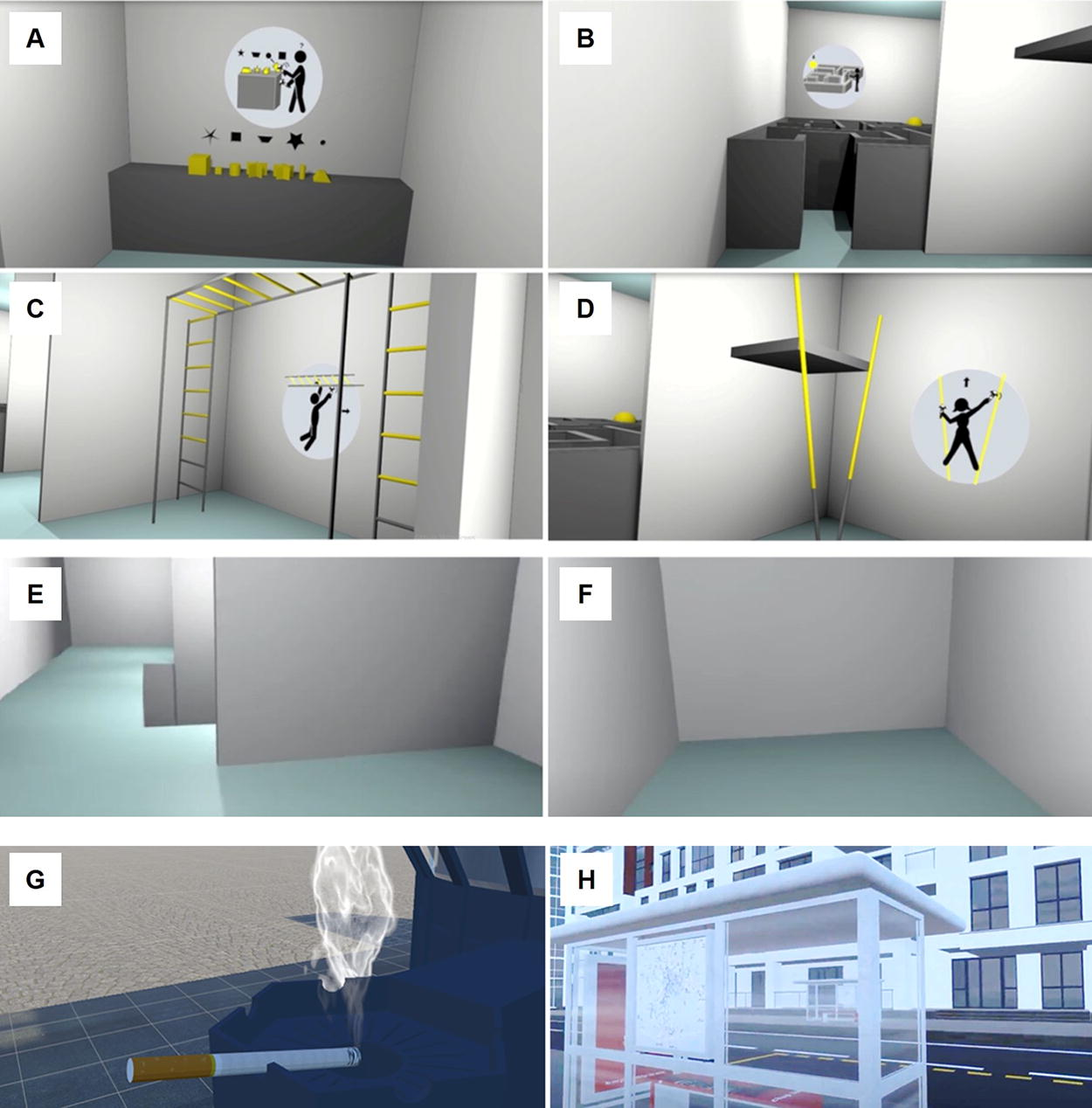
VR scenarios. VR-EE scenario
Behavioral Observation Research Interactive Software (BORIS)
BORIS (University of Torino) was used for visual quantification of participants’ behavior during the immersion in a VR environment, using the computer screen output that corresponded to what participants viewed through HMD. For both groups, we measured two parameters during the stimulation scenario immersion, namely, deambulation and interaction. Deambulation included teleporting by using hand controller into a participant-pointed white circle on the floor of the simulation. Interaction included manipulating and throwing objects (e.g., a pack of cigarettes) in the virtual environment. The measures were: (1) number of interaction or deambulation events (event), (2) average duration of single interaction or deambulation events (average duration), and (3) percentage of session time in interaction or deambulation (event % time).
Measures
Craving
Craving for cigarette, alcohol, and food were measured by 10-point scales (0 = not at all, 9 = extremely) constructed ad hoc based on the literature,34,38 with items such as “How much do you want to smoke right now?”.
Pleasantness and arousal
Pleasantness and arousal elicited by the virtual scenarios were measured using ad hoc 10-point scales (0 = not at all, 9 = extremely) based on the literature34,39 and characterized by items such as “Can you rate how much you liked this environment?”.
Mood
The difference in mood tone between the start and the end of the session was measured with the Profile of Mood States (POMS), 40 consisting of a list of 58 adjectives, with a five-point scale response (0 = not at all, 4 = extremely), measuring a total score and six factors: tension/anxiety (T; a state of intensified tension described by adjectives such as “Nervous” or “Restless”), depression/dejection (D; self-inadequacy hallmarked by adjectives like “Unhappy” and “Hopeless”), anger/hostility (A; a feeling of anguish described by adjectives such as “Annoyed” or “Resentful”), vigor/activity (V; a cheerful mood described by adjectives such as “Lively” or “Active”), fatigue/inertia (S; a state of low energy described by adjectives like “Exhausted” or “Weary”), and confusion/bewilderment (C; a state of cognitive inefficiency described by adjectives like “Forgetful” or “Bewildered”). Cronbach’s alpha of the six factors is high (0.82–0.9). In addition, the positive and negative mood associated with each virtual environment was measured after each scenario using ad hoc 10-point scales (0 = strongly disagree, 9 = strongly agree) built on the basis of the literature34,41 with items such as “I am happy, cheerful or satisfied.”
Sense of presence in VR environments
The perception of “being present” in the virtual environment was measured using the Presence Questionnaire (PQ 42 ), a 29-item questionnaire with a 7-point scale response (1 = not at all, 7 = completely), which provides a total score and four subscales: involvement (a state of focused attention on a coherent set of stimuli/activities, measured by items such as “How involved were you in the virtual environment experience?”); sensory fidelity (the degree to which a virtual environment permits users to examine/manipulate objects. It is measured by items such as “How closely were you able to examine objects?”); adaptation (a state characterized by the perception of being enveloped by an environment and interacting with it. It is described by items such as “How quickly did you adjust to the virtual environment experience?”); interface quality (a factor that measures how much control/display devices interfere with task execution. It is described by items such as “How much delay did you experience between your actions and expected outcomes?”). Except for the interface quality factor (Cronbach’s alpha = 0.57), which consists of only three items, the reliability coefficients of the other subscales are quite good (0.80–0.89). 42 In addition, the degree of immersion elicited by each virtual environment was measured after each scenario using an ad hoc 10-point scale built on the basis of the literature,34,39 consisting of the item “To what extent did you feel immersed in the environment you just perceived?”.
Side effects associated with VR environments
The presence of symptoms associated with cybersickness was assessed using the Simulator Sickness Questionnaire (SSQ 43 ). The SSQ consists of 16 items (a list of symptoms such as “Fatigue,” “Headache,” and “blurred vision”), 4-point response scale (from “None” to “Severe”), and provides a total score and 3 subscales (nausea, oculomotor disturbance, and disorientation). Cronbach’s alpha is 0.87. 44
Procedure
All participants, recruited through online and paper advertisements placed in the main recreational areas of the local Medical College, were warned not to smoke cigarettes in the hour prior to the study. Participants underwent an initial screening (Fig. 2) during which they signed informed consent and were assessed for eligibility based on inclusion/exclusion criteria, followed by measurement of the CO-expired concentration (ppm and %COHb) through the EC50 Smokerlyzer (Bedfont Instruments; Kent, UK) to verify smoking status. Then, the demographic questionnaire, smoking history and smoking status, Fagerstrom test, BIS-11, and POMS were administered. The experimental phase began with measurement of basal craving (basal timepoint), then participants were briefed on how to interact in virtual environments, and immediately after, they were immersed in the training scenario (“Tutorial”) for 2 minutes. After the second craving measurement (neutral timepoint), participants were pseudorandomly allocated to the VR-EE or VR-NoEE condition and exposed to the respective scenario for 4 minutes, followed by another craving measurement (condition timepoint). Then, both groups were exposed to the triggering phase in the stimulation scenario for 2 minutes, at the end of which the evoked craving was measured (stimulation timepoint). Immediately following all craving measurements, measures of positive and negative moods were also taken. After each virtual scenario, the pleasantness, arousal, and immersion elicited by the VR environments were measured.

Schematic representation of the phases of the procedure. BIS-11, Barratt Impulsiveness Scale-1; CO, carbon monoxide; POMS, Profile of Mood States; PQ, Presence Questionnaire; SSQ, Simulator Sickness Questionnaire.
In each virtual scenario, participants had no specific task to perform and were free to move and interact. At the end of the triggering phase, participants filled out the SSQ, PQ, and the POMS (total compilation time: about 20 minutes).
All procedures were approved by the local academic ethical committee (Comitato di Approvazione della Ricerca Sulla Persona - CARP, approval number 40.R1/2021) and followed the principles of the Declaration of Helsinki. Participants did not receive any type of benefit or compensation for participating in the study.
Data analysis
Sample size (36 participants) was estimated by G*Power 3.1 software 45 with an a priori analysis (α level: 0.05, power level, 1-β: 0.80, effect size f: 0.2). Regarding cigarette craving measures, after assessing the normality of the sample (Shapiro-Wilk test), two-way Analysis of Variance (ANOVAs) with Geisser-Greenhouse correction were performed to test the possible effectiveness of environmental enrichment in reducing craving, with “CONDITION” as the between factor (two levels: VR-EE and VR-NoEE) and “TIMEPOINT” as the within factor (three levels: basal, neutral, and condition). A second set of two-way ANOVAs was performed to test the effect of EE on craving evoked during the triggering phase (between factor: CONDITION, within factor: TIMEPOINT, both factors at two levels). In case of significance, posthoc comparisons were conducted (Fisher’s Least Significant Difference -LSD- test). The same analyses were conducted for alcohol craving, food craving, positive and negative moods, pleasantness, arousal, and immersion.
Two Wilcoxon signed-rank tests were conducted on the total scores of POMS pre- and postsession, independently by condition, to test for mood changes associated with VR immersion. If significant, the same analyses were performed on the subscales of POMS. After checking the normality of the data (Shapiro-Wilk test), PQ was analyzed with an unpaired t test with Welch correction. In case of significance, the same analyses were performed on the subscales of PQ. Mann–Whitney U test was used to compare SSQ scores and the BORIS measures for deambulation and interaction between VR-EE and VR-NoEE groups. Correlation between craving scores and the percentage of session time in deambulation and interaction (event % time) were tested with Spearman’s r.
The presence of any differences in the demographic characteristics of participants in the two groups was tested with Mann–Whitney U test (age, Fagerstrom score, CO ppm, % COHb), t test with Welch correction (BIS-11), Fisher’s exact test (cigarettes/day, use of VR), and chi-square test (gender, years of smoking) (Supplementary Demographic Characteristics in Supplementary Data S1).
The final sample included in the analyses was 31 participants (see “Participants” section for details on excluded participants). Since the initially calculated sample was 36 participants, a posthoc power analysis with G*Power was conducted (Supplementary Results in Supplementary Data S1).
Apart from sample size calculation and posthoc power analysis, all other analyses were performed with GraphPad Prism 9.1.0.
Results
Craving
Regarding cigarette craving (Fig. 3), main effect was significant for TIMEPOINT [F (1.800, 52.20) = 3.78, P = 0.033], but not for CONDITION (P = 0.4) factor. In the VR-EE group, condition craving was significantly lower than basal craving (P = 0.028) but not significantly different from neutral values (P = 0.6). In the VR-NoEE condition, there was a significant increase in craving from timepoint neutral to condition (P = 0.034). Neither craving for alcohol [F (2, 58) = 0.78, P = 0.4] nor craving for food [F (2, 58) = 0.04, P = 0.9] showed significant differences.
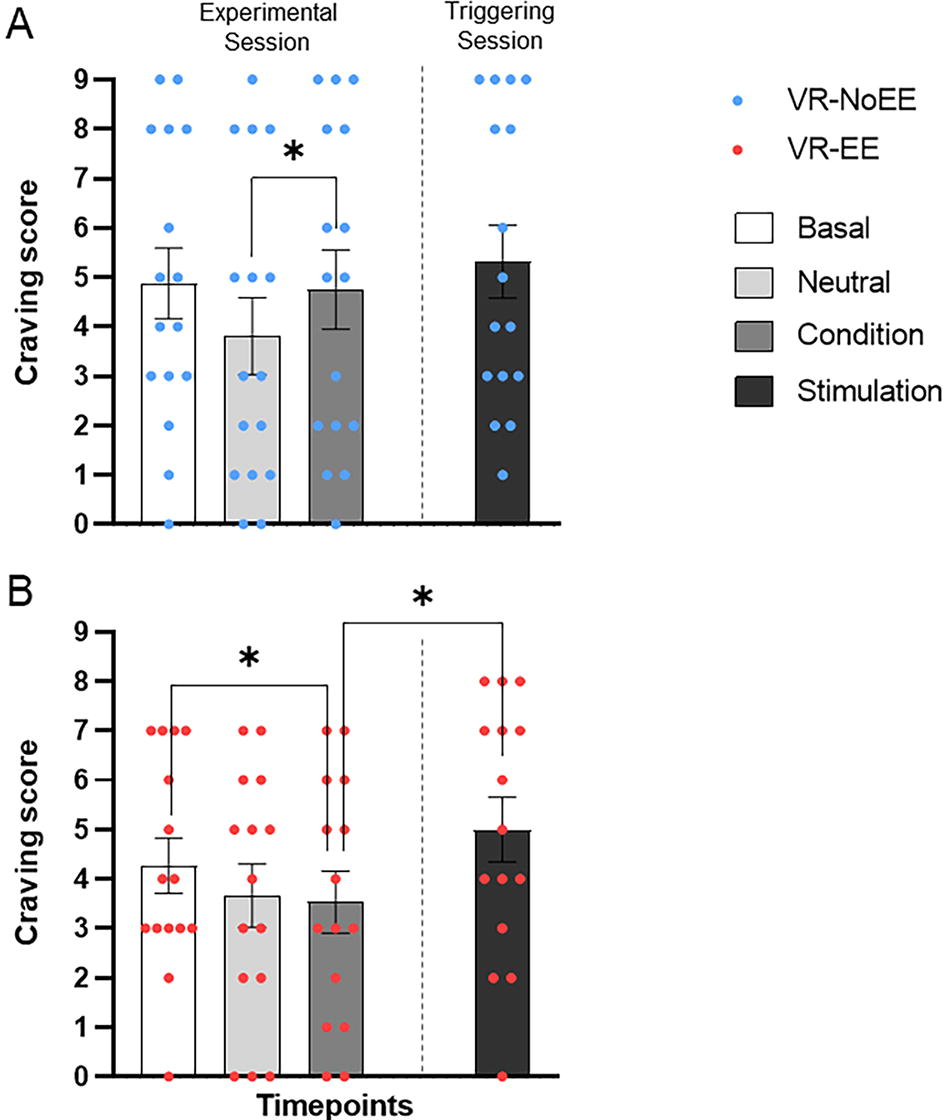
Effects of environmental enrichment on cigarette craving scores. Bars represent the average scores and the Standard Error of the Mean (S.E.M.) of craving measured at the beginning of the session (basal timepoint), after the tutorial scenario (neutral timepoint), after the scenario with (panel
The second set of ANOVAs showed a significant main effect of TIMEPOINT for cigarette craving [F (1, 29) = 20.24, P < 0.001]. In the VR-EE condition, posthoc tests revealed a significant increase at stimulation compared with condition (P < 0.001) (Fig. 4). Neither craving for alcohol [F (1, 29) = 1.27, P = 0.2] nor craving for food [F (1, 29) = 2.20, P = 0.14] showed significant differences.
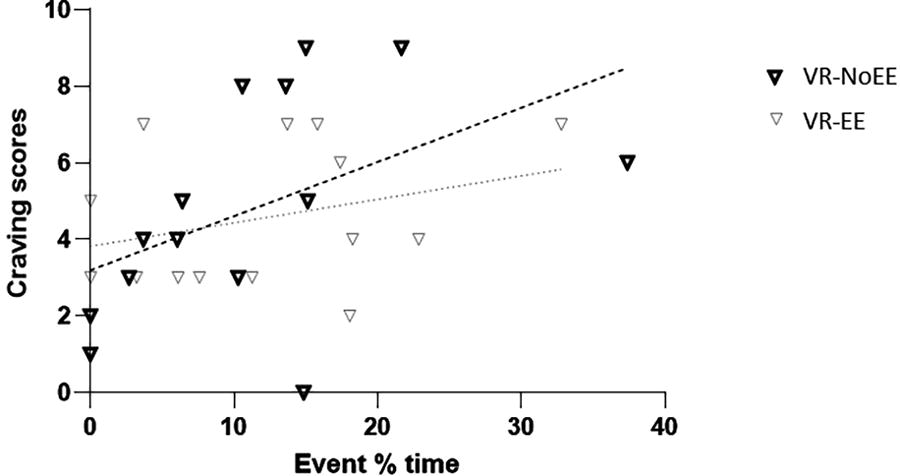
Correlational analysis between activity measures of interaction “percentage of session time in interaction” (event % time; x-axis) in the “Stimulation” scenario and basal craving score values (y-axis) in VR-NoEE and VR-EE conditions.
Activity in virtual environments
Except for the average duration (U = 62, P = 0.02), no differences emerged between the two groups in terms of deambulation measurements in the “Stimulation” scenario (event: U = 81.5, P = 0.1; average duration: U = 114, P = 0.8; event % time: U = 92, P = 0.2). Neither did the interaction measures differ between conditions (event: U = 117, P = 0.9; average duration: U = 102, P = 0.4; event % time: U = 115, P = 0.8).
The correlative pair-wise analysis (Spearman’s r) between the measures of deambulation “Event % time” in the “Stimulation” scenario and craving scores showed no significant correlation for both VR-EE and VR-NoEE groups. In contrast, the same analysis performed on interaction scores revealed a significant positive correlation between basal craving scores and “Event % time” in the VR-NoEE but not in the VR-EE group (r = 0.57, P = 0.021) (Fig. 4).
Pleasantness and arousal
Regarding pleasantness (Supplementary Fig. S1), CONDITION [F (1, 29) = 13.25, P = 0.001] main effect and CONDITION × TIMEPOINT interaction [F (1, 29) = 14.90, P < 0.001] were significant. Posthoc tests showed a significant increase in pleasantness from timepoint neutral to condition in the VR-EE group (P = 0.007) and an opposite effect in VR-NoEE (P = 0.015). When the two groups were directly compared, the VR-EE condition timepoint was significantly more pleasant than in VR-NoEE (P < 0.001).
The second set of ANOVAs showed significant main effects of TIMEPOINT [F (1, 29) = 10.38, P = 0.003] and CONDITION [F (1, 29) = 8.23, P = 0.008] and CONDITION × TIMEPOINT interaction [F (1, 29) = 33.29, P < 0.001]. Posthoc tests showed an increase in pleasantness from condition to stimulation timepoint (P < 0.001) for the VR-NoEE group (Supplementary Fig. S2).
Regarding arousal (Supplementary Fig. S3), the main effect of CONDITION [F (1, 29) = 11.25, P = 0.002] and the CONDITION × TIMEPOINT interaction [F (1, 29) = 17.04, P < 0.001] were significant. In the VR-EE group, posthoc tests showed an increase in activation from neutral to condition timepoint (P = 0.009). In contrast, VR-NoEE showed a decrease in arousal from neutral to condition timepoint (P = 0.005). When the two groups were directly compared, the condition timepoint in VR-EE was significantly more activating than VR-NoEE (P < 0.001).
A significant main effect of CONDITION [F (1, 29) = 5.57, P = 0.008] and a significant CONDITION × TIMEPOINT interaction [F (1, 29) = 55.35, P < 0.001] was shown by the second set of ANOVAs. Posthoc tests showed an increase in arousal from the condition to the stimulation timepoint (P < 0.001) in the VR-NoEE and an opposite pattern for VR-EE (P < 0.001) group (Supplementary Fig. S4).
Mood, sense of presence, and side effects
The overall POMS score decreased significantly between the start and the end of the entire session in the VR-EE [W = −79, P = 0.003], but not in the VR-NoEE condition [W = −44, P = 0.2] (Supplementary Fig. S5). In the VR-EE condition, the subscales of the POMS D [W = −47, P = 0.014], A [W = −51, P = 0.007], and S [W = −45, P = 0.003] decreased, while T [W = −38, P = 0.1], V [W = 33, P = 0.2], and C [W = −43, P = 0.18] showed no significant differences.
The results for positive and negative moods (Supplementary Figs. S6A and S6B), sense of presence (Supplementary Fig. S7), immersion level (Supplementary Figs. S8 and Figs. S9), and cybersickness are described in the supplementary materials (Supplementary Results).
Discussion
Enriched environment virtual exposure significantly reduced cigarette craving from basal values, with a significant main effect of factor timepoint. On the contrary, this time-dependent decrease was not observed in the VR-NoEE group, which showed a significant increase of craving after VR compared with values at neutral pre-VR exposure. When both groups were exposed to VR smoking-related stimulation scenario, the VR-EE group showed a significantly increased craving for cigarette compared with previous timepoint, up to score values not different from those in the VR-NoEE group. These findings suggest that (1) virtual immersion in an enriched environment decreased basal craving for cigarette, but (2) did not prevent craving evoked by a smoking-related stimulation. Therefore, it appears that a short exposure to a virtual enriched environment might have a beneficial effect in smokers on basal but not on evoked craving for cigarette.
A recent study with identical VR-EE and VR-NoEE scenarios showed that exposure to EE, but not to NoEE, reduced basal craving for palatable food. On the contrary, similarly to the present study, VR-EE was not able to reduce craving evoked by palatable food images. 35 In spite of the different methods through which craving was evoked (observation of standard 2-D images of palatable food on computer screen vs. immersion in a 3-D virtual smoking-related scenario) on two different study samples (respectively healthy volunteers and smokers), we observed similar findings: virtual exposure to an enriched environment was able to reduce basal oversession craving but not the evoked one. We designed the VR-EE simulation according to methods of EE, as described and extensively tested in laboratory animals,7,46 which include sensorimotor and cognitive stimulation. We tested the effects of virtual EE on craving, as well as on psychological and behavioral measures such as sense of presence, degree of interaction and exploration, and improvement of affective measures. 35 In the current study, we further demonstrate that the configuration of our virtual EE affects basal craving for appetitive reward (either palatable food or cigarette) that develops during the experimental session. For both studies, we are currently not able to explain if the craving affected by EE was owing to time-dependent increase of withdrawal from the last reward-taking, also considering that such an explanation would not apply for palatable food craving in healthy volunteers. Although we required participants to abstain from smoking at least 1 hour before the start of the session, we had a variability in time latency since the last cigarette (four and six overnight abstinent, respectively, in the VR-EE and VR-NoEE group). This is a limitation of our study that suggests further investigations with the same protocol of virtual EE in overnight abstinent smokers.
EE has been shown to reduced drug and food reward behaviors in animal models, including studies where the operational definition of craving was modeled as triggering of drug- or food-seeking behavior.4,5 EE exposure (several days or few hours) was shown to be effective to inhibit addictive behavior in laboratory rodents both after cessation of drug- or food-taking (e.g., to accelerate extinction of responding), and when relapse of responding was triggered by cues, priming, or stress.4,5 We applied a short EE exposure that evidently differs from the hours-to-days exposure periods in rodent studies, with the proper objective to test if the acute, ad hoc, EE exposure may help to reduce situational craving evoked by smoking cues and context. Although our primary scope was not met, we, however, confirm that a short virtual EE exposure may reduce basal craving. It would be interesting to investigate the conditions under which short VR-EE applied in an interventional modality may help to develop coping skills for situations of cues and context reactivity and prevention of relapse in smokers.
Noteworthily, the interactive actions correlation to craving scores after stimulation in the VR-NoEE participants was not observed in the VR-EE group adding further evidence that the enrichment simulation was nonetheless able to modify behavior in the smoking-related scenario. On this matter, we have previously reported the importance of participants’ behavior as a correlate of enriched environment exposure. 35 Future studies should include more accurate assessment of participant’s behavior in the immersive virtual space and/or in the real laboratory space when under virtual immersion (see ref. 47).
Our study suffers of a main limitation owing to the lack of a VR scenario contrasting the stimulated VR smoking cues and context, i.e., a VR immersion in a simulation known to have a low/null risk of triggering cigarette craving (for instance, a museum33,48). A low/null-stimulation scenario could be inserted between the condition and the stimulation scenarios or including two extra groups exposed to the low/null-stimulation scenario, respectively, after the VR-EE and VR-NoEE condition.
Taken together, the findings described in the present study support the need for further studies on the effects of enrichment environment exposure delivered for short ad hoc preventive and/or therapeutic intervention for coping to craving for cigarette. It will be important to assess the effects after overnight abstinence, under high-risk contextual condition, as well as to investigate the acute effect duration or rather the need of repetitive VR-EE exposures. The opportunity to use VR technology for testing these hypotheses in the lab appears feasible and reliable.
Footnotes
Acknowledgments
The authors thank Luoghi di Prevenzione, reference center of Lega Italiana per la Lotta contro i Tumori (LILT), for helpful discussions on smoking-related context and brief interventions and Hybrid Reality s.r.l. (Padua, Italy) for the creation of the virtual environments.
Ethics Approval
All procedures were approved by the local academic ethical committee for research in healthy volunteers (Comitato di Approvazione per la Ricerca sulla Persona, CARP, protocol n. 40.R1/2021), and followed the principles of the Declaration of Helsinki.
Authors’ Contributions
G.B.: Conceptualization, methodology, formal analysis, investigation, writing—original draft, writing—review and editing. S.P.: Investigation, writing—review and editing, visualization. A.V.: Investigation, writing—review and editing, visualization. C.C.: Conceptualization, methodology, writing—original draft, writing—review and editing, supervision, project administration.
Author Disclosure Statement
No competing financial interests exist.
Funding Information
The study was part of a project funded by the Italian Ministero dell’Università e della Ricerca PRIN 2020, number 2020EHAZNB. The enriched environment virtual software was developed under a past project funded by Fondazione Cariverona, Italy.

References
Supplementary Material
Please find the following supplemental material available below.
For Open Access articles published under a Creative Commons License, all supplemental material carries the same license as the article it is associated with.
For non-Open Access articles published, all supplemental material carries a non-exclusive license, and permission requests for re-use of supplemental material or any part of supplemental material shall be sent directly to the copyright owner as specified in the copyright notice associated with the article.
