




Abstract
Aim: The aim of this study was to estimate the prevalence of hemoglobinopathies in South Brazil. Methods: Samples of dried blood spots collected by heel prick in neonates were evaluated by isoeletric focusing and/or high-performance liquid chromatography techniques. All variants were characterized at the molecular level. Results: A total of 437,787 samples were evaluated. Among these, 6391 showed an abnormal hemoglobin pattern. These included 48 cases (0.01%) of sickle cell disorders (33 hemoglobin SS [Hb SS], 7 Hb SC, 7 Hb S/β thalassemia, 1 Hb SD), 1 neonate who was homozygous for β thalassemia, 6272 (1.4%) newborns who were heterozygous for Hb S, C, or D, and 71 (0.02%) neonates who were carriers for rare hemoglobin variants. Most of these rare variants were identified for the first time in Brazil. Conclusions: Comparing these results with those obtained in other Brazilian regions, we observe a highly heterogeneous distribution. This knowledge is useful in healthcare planning and allocation of resources, as well as identifying at-risk couples, which will assist with disease prevention.
Introduction
H
One of the most interesting characteristics of the Brazilian population is its heterogeneity, which is due to five centuries of interethnic mixing of people from three continents (Callegari-Jacques et al., 2003). The southern Brazilian population differs from this general standard, as they presented smaller levels of African and higher degrees of European contributions when compared with other Brazilian groups.
The aim of a neonatal screening program is to identify those individuals within a population who have a specific serious disorder, in which the outcome can be improved by an early intervention. The advantages of early diagnosis conferred to babies and children with sickle cell disorder (SCD) include the use of prophylactic penicillin (Gaston et al., 1986; Davies et al., 2000), administration of anti-pneumococcus vaccine (Davies et al., 2000; Lees et al., 2000), and education of parents to detect symptoms of acute splenic sequestration and give comprehensive care.
The Brazilian Ministry of Health recognized the importance of hemoglobinopathies for public health in 2001 when it was decided that hemoglobinopathies would be incorporated into the National Brazilian Neonatal Screening program. The present study reports the results of 4 years of hemoglobinopathies screening in the southern Brazilian population.
Materials and Methods
From January 2004 to December 2007, 437,787 samples of dried heel-prick blood spots from neonates were collected. Samples were tested on the day when received or on the next working day by isoeletric focusing (IEF; Perkin Elmer) or high-performance liquid chromatography (HPLC; Bio-Rad Variant Hemoglobin Testing System-Sickle Cell Short Program) (Campbell et al., 1999). All samples with an abnormal pattern on one system were further analyzed by the other system (IEF or HPLC).
Babies without hemoglobin A (Hb A), with a variant other than Hb S or Hb C, or with a larger proportion of hemoglobin variant than Hb A and babies who had underwent transfusion prior to blood sampling were recalled for repeat testing at 4-12 weeks of age. In some cases, parental samples were requested for a definitive hemoglobinopathy diagnosis and were analyzed by IEF and HPLC (Bio-Rad β-Thal Short Program).
Molecular techniques were used to distinguish homozygous Hb S disease from Hb S/beta thalassemia and to identify rare hemoglobin variants. Briefly, genomic DNA was obtained from peripheral blood samples through a salting-out procedure (Lahiri and Nurnberger, 1991). HB S genotypes were investigated by polymerase chain reaction using specific primers for β-globin gene exon I (5′-GGC AGA GCC ATC TAT TGC TTA-3′ and 5′-ACC TTA GGG TTG CCC ATA AC-3′). The amplified product was digested with DdeI, because the HB S mutation abolishes a recognition site for this enzyme at codon 6. The digestion fragments were analyzed on 2.5% agarose gels stained with ethidium bromide.
Amplification of the HBB, HBA2, and HBA1 genes were performed using gene-specific primers (Miranda et al., 1997; Moradkhani et al., 2009). DNA sequence analysis was performed with an automated sequencer (ABI 3100 [Applied Biosystems] or CEQ 8000 [Beckman Coulter]).
Allele frequencies were estimated by gene counting. Comparisons among gene frequencies were performed using the PEPI software program (Abramson, 2004).
The project was previously approved by the Research Committee from Federal University of Rio Grande do Sul and developed integrally according the ethical principles in the resolution 196/196 of National Health Council.
Results
Table 1 shows the prevalence of variant hemoglobins found in this study as well as those observed in other Brazilian regions (Fig. 1). Among the 437,787 samples tested, 48 cases (0.01%) of SCD were diagnosed: 33 were homozygous for Hb S, 7 were compound heterozygous for Hb S and Hb C, and 1 was compound heterozygous for Hb S and Hb D. Additionally, seven neonates were compound heterozygous for Hb S and beta thalassemia and one neonate was homozygous for beta thalassemia. These results were confirmed using follow-up samples or family studies. The incidence of SCD in this population was 1:9120. From these results, it was possible to estimate gene frequencies for the most common variants using the Hardy-Weinberg equation. Allele frequencies were as follows: Hb S: 0.006, Hb C: 0.001, and Hb D: 0.0002. Although there was no deviation from those expected for Hb S frequencies, there were significant differences in genotype distribution and allele frequencies between different regions from Rio Grande do Sul State (Fig. 1). These frequencies were 0.0026 in the northwest region and 0.0079 in the southeast region (p < 0.001).
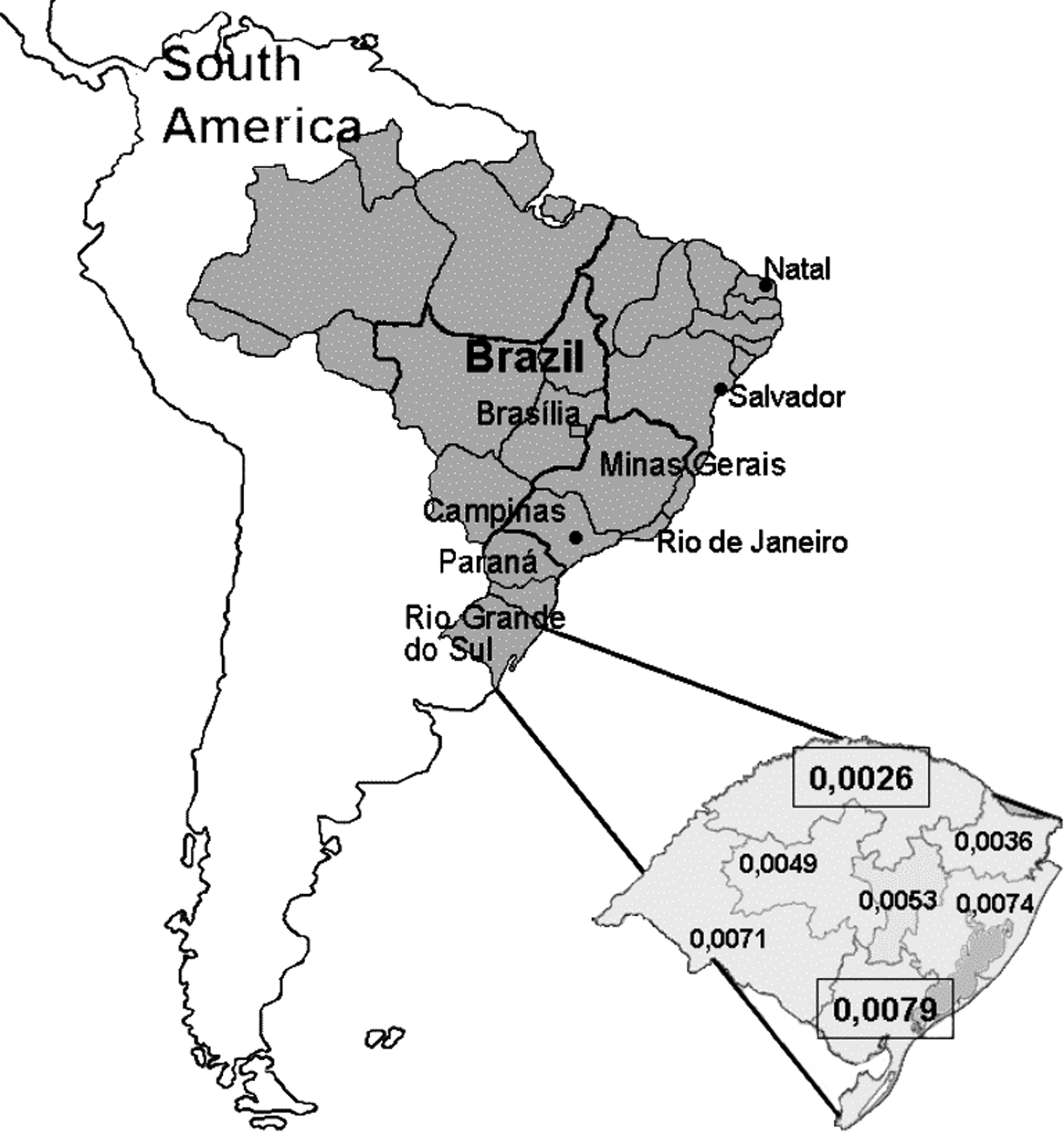
Map of Brazil indicating its five sociogeographic regions (separated by heavy lines), as well as the states' contours (lighter lines) and the locations of the cities from other studies. Also shown is a map of Rio Grande do Sul indicating Hb S gene frequencies in the northwest and southeast regions.
SCD, sickle cell disorder; Hb, hemoglobin.
These figures are not available in the original references.
In 71 samples, rare hemoglobin variants were detected (alpha and beta globin-chain variants). We were able to identify the variant by DNA sequencing in 47 of these cases: 26 were due to mutations in the alpha-globin genes and 21 were due to mutations in the beta-globin gene. From these, eight different hemoglobin variants were described for the first time in a Brazilian population. Twenty blood samples were not available for DNA studies and four cases could not be characterized. Familial studies were performed in 36 (77%) cases in which a rare variant was identified and parents were available for DNA studies. In all these cases the rare variant was also identified in one parent. Table 2 lists these variants, the number of samples in which they were detected, and their occurrence in the world.
Variants in italics are described for the first time in Brazilian population.
One case of compound heterozygous with Hb C was found.
One case of compound heterozygous with beta thalassemia trait was found.
Compound heterozygous with Hb S was found (Wagner et al., 2006).
Discussion
Brazilian studies have shown important regional differences related to prevalence of Hb S and Hb C, varying from 0.2% (south region) to 9.8% (northeast region) (Table 1; Fig. 1). This reflects the diversity of racial origins and the different degrees of interethnic mixing in Brazil. The African component is lowest in the south (11%), whereas the highest values are found in the northeast and southeast (18%-20%) (Callegari-Jacques et al., 2003). Comparisons among hemoglobin surveys conducted in the southeastern region (Minas Gerais, Rio de Janeiro, and São Paulo-Campinas; Table 1) showed higher frequencies of Hb S and Hb C in Rio de Janeiro and Minas Gerais than in Campinas, São Paulo. This last study presented lower Hb S and Hb C frequencies in relation to other locations from the same region (Brandalise et al., 2004) and similar to that observed in the southern population (present study). It has been estimated that between 1800 and the mid-20th century, about 4 million individuals entered the country, mainly from Portugal, Italy, Spain, and Germany. This second immigration wave settled predominantly in São Paulo State and in the Brazilian southern region (Salzano and Freire-Maia, 1970); therefore, the similarity between the results observed in Campinas, which is in São Paulo State (Brandalise et al., 2004), and in Rio Grande do Sul with lower HB S and Hb C frequencies are not an unexpected finding.
When Hb S allele frequencies were compared in Rio Grande do Sul (Fig. 1), a heterogeneous distribution was observed (p < 0.001). These results indicate lower frequencies in the northwest region (0.0026), an area in which the Italian contribution was most marked, and a higher incidence (0.0079) was found in the southeast, a region in which there was a high concentration of slave labor during the colonial period (Cesar, 1970).
Besides Hb S and Hb C, we also found 71 neonates heterozygous for rare variants (Table 2). It is important to note that occasionally the presumptive identification of hemoglobin variants using screening methods may be incorrect, because some variants are not discriminated from each other by current screening methods. Therefore, the presence of rare hemoglobin variants justifies the use of molecular biology techniques for correct identification and reflects the diverse ethnicities of the southern Brazilian population. Most of these rare hemoglobins were first described in Mediterranean and African populations, with whom the present-day Brazilians share recent common ancestors. They were probably introduced during the process of colonization but some, such as Hb Woodville and Hb E-Saskatoon, are found in a variety of different populations, including Vietnamese, Greek, Japanese, Scottish, Spaniards, and Turkish (Giardine et al., 2007), and probably have arisen by independent mutation events in diverse populations, although we did not have any evidence of de novo mutations in the investigated sample.
The benefits of rare variant identification during neonatal screening are evident because some of them are clinically relevant: Hb Stanleyville II and Hb G-Phil when associated to -α3.7 deletion results in a thalassemic phenotype; Hb J-Guantanamo presents a hemolytic mild anemia; and Hb Beckman presents a chronic anemia, with microcytosis and reticulocytosis (Giardine et al., 2007). On the other hand, hemoglobins such as Hb Shelby and Hb E-Saskatoon, which are silent mutations, present the same IEF or HPLC pattern as the common clinically relevant Hb S or Hb C. Identification of these and other clinically significant hemoglobin variants can avert unnecessary future investigations and treatments, especially when hypochromia and microcytosis are present.
Nonselective hemoglobinopathy screening has ensured the diagnosis of SCD in the neonatal period, reducing morbidity and mortality in these patients, and this reason has led to the introduction of screening programs in many parts of the world (Peres et al., 1995; Almeida et al., 2001; Bardakdjian-Michau et al., 2002; Boemer et al., 2006; Gulbis et al., 2006; Cela de Julian et al., 2007; King et al., 2007; Manu Pereira Mdel et al., 2007; Therrell and Adams, 2007; Downing and Pollitt, 2008; Michlitsch et al., 2009). At present, the Neonatal Screening Program of the public health system covers 77% of babies born in Rio Grande do Sul. Adding to those performed in private laboratories, the coverage reaches 95% of babies. In this study, 6073 neonates heterozygous for Hb S and Hb C were identified, representing 94.9% of all results with altered hemoglobin patterns. The main benefits of heterozygous detection are family counseling and the identification of previously unknown at-risk couples (Henthorn et al., 2004).
Our results represent an extensive evaluation of neonatal screening for hemoglobinopathies performed in Rio Grande do Sul. Comparing these results with those obtained in other Brazilian regions, we observe a highly heterogeneous distribution. This knowledge is useful in healthcare planning and the targeting and allocation of resources to areas of most need.
Footnotes
Disclosure Statement
No competing financial interests exist.