




Abstract
The upregulation of fecal cytokeratin 19 (CK19) correlates with age and metastatic status in human colorectal cancer (CRC). To further explore its clinical significance in older patients (>60 years), their fecal CK19 was measured by quantitative reverse transcription-polymerase chain reaction. Differences in CK19 transcripts were compared using the nonparametric Mann-Whitney U test. Clinical significance was assessed with the chi-squared test and a binary logistic regression model. The association between overall survival and expressions of fecal CK19 in combination with other serum markers, carcinoembryonic antigen and carbohydrate antigen 19-9 (CA19-9), was evaluated using the Kaplan-Meier method. In these older groups, CRC patients had significantly higher median fecal CK19 expression (p = 0.006) than controls. The highest risk of CRC (odds ratio, 5.8; 95% confidence interval, 2.3-14.7; p < 0.001) was detected when the cutoff value for fecal CK19 expression was set at the median value of the 28 healthy controls. The lowest overall survival (29.2% ± 21.4%) occurred in patients in whom serum CA19-9 levels were high and fecal CK19 was overexpressed. Our results suggest that fecal CK19 expression is associated with CRC, and together with serum carcinoembryonic antigen or CA19-9, it can predict overall survival in older patients.
Introduction
S
For many years the serum concentrations of carcinoembryonic antigen (CEA) and carbohydrate antigen 19-9 (CA19-9) have been used in the clinical management of patients with CRC (Nozoe et al., 2006). However, the sensitivity of such single (or few)-marker assays is not sufficient for clinical applications (Sheu et al., 2006; Wang et al., 2007). Many genetic changes are found in primary and metastatic tumors (Ramaswamy et al., 2003). In CRC, accumulation of these genetic changes has been reported to have effects on gene expression patterns (Vogelstein et al., 1988) and some of these could be a molecular signature for disseminated tumor cells (Gervasoni et al., 2008).
One of these molecular markers, cytokeratin 19 (CK19), is differentially expressed in epithelial cells in the peripheral blood of patients with breast cancer (Pinzani et al., 2006; Daskalaki et al., 2009) or in patients with advanced Dukes' stage CRC (Wong et al., 2001; Gervasoni et al., 2008). The differential expression of CK19 mRNA occurs in many human cancers (Daskalaki et al., 2009; Feng et al., 2009). Moreover, serum levels of CK19 fragments (CYFRA 21-1) have also been evaluated in many cancers (Mizuguchi et al., 2007; Wakatsuki et al., 2007) and CYFRA 21-1 is used as a marker in saliva for the detection of oral squamous cell carcinoma (Nagler et al., 2006) and in urine for the detection of bladder cancer (Morsi et al., 2006).
For the purpose of diagnosing CRC, many studies have suggested developing a molecular test using fecal material (Davies et al., 2005; Haug and Brenner, 2005). We have previously reported the correlation of age and metastatic status with the upregulation of fecal CK19 in patients with CRC (Yang et al., 2005; Chang et al., 2009). To further explore its clinical significance, fecal levels of CK19 mRNA from older subjects were analyzed and correlated with clinicopathological parameters (Gervasoni et al., 2008).
Materials and Methods
Subjects and fecal samples
Ninety-five patients with CRC between the ages of 60 and 92 years from the Cathay General Hospital and the Taipei Veterans General Hospital participated in this study. Informed consent was obtained from all participants and study guidelines were approved by the institutional review boards. Solid fecal samples were taken from patients before surgical or chemical therapy. The initial tumor stages and serological levels of CEA and CA19-9 were determined. Abdominal computed tomography was routinely performed for determining the presence of metastases; however, chest computed tomography was conducted only in patients with suspected lung lesions. The median time of follow-up was 37.3 months (SD, 28.1 months). In addition, 28 fecal samples from healthy controls (age range, 61-91 years), who received complete colonoscopy examinations and had no inflammatory bowel conditions, were also obtained (Chang et al., 2009). Fecal total RNA for each sample was extracted using an RNA Extraction Kit (Geneaid Biotech) as described previously (Yang et al., 2005; Huang et al., 2008). Finally, the eluted fecal total RNA was quantified using a NanoDrop ND-1000 spectrophotometer (Thermo Fisher Scientific) and prepared for conversion to fecal cDNA.
Detection of fecal CK19 expression levels
Fecal cDNA was generated as described previously (Chien et al., 2006). Briefly, 1 μg of fecal total RNA was reverse transcribed using oligo(dT) primers, following the manufacturer's instructions (One-Step RT-PCR kit; Bioman Scientific). Synthesized cDNA was used to perform quantitative PCR. Relative levels of fecal CK19 mRNA were quantified using probes from the Universal Probe Library and TaqMan master mix in a LightCycler thermal cycler system (Roche Diagnostics), as described previously (Chang et al., 2009). Briefly, the Universal Probe numbers were 71 for CK19 (AF202321) and 77 for 18s rRNA (X03205), which served as a housekeeping gene. Each run included cDNA from HT-29 cells, a CRC cell line (ATCC number HTB-38), diluted 512-fold as a standard to avoid errors because of run-to-run differences in RNA quantity.
Statistical analysis
Data were statistically analyzed using SPSS software. Group comparisons were performed using the chi-squared test or Fisher's exact test where appropriate. The nonparametric Mann-Whitney U test was applied to assess the presence of significant differences in fecal CK19 mRNA across the two groups (healthy controls and patients with CRC). To estimate the effect of fecal CK19 expression on older patients with CRC, odds ratios and 95% confidence intervals were computed with a binary logistic regression model. Survival probabilities were estimated using the Kaplan-Meier method and compared using the log-rank test. Differences were considered statistically significant at p < 0.05.
Results
Differential expression of fecal CK19 RNA in older subjects
Because of the age-related expression of fecal CK19, which was reported in our previous study (Chang et al., 2009), we measured the relative fecal CK19 RNA levels from older subjects (>60 years) in this study. The normalized median level of fecal CK19 mRNA for healthy controls (n = 28) was 0.0002 (range, 0.0000-0.0612), and for patients with CRC (n = 95) it was 0.0135 (range, 0.0000-0.1183). Further, from the results of statistical analysis with the Mann-Whitney U test, patients with CRC had higher expression of fecal CK19 compared with healthy controls (p = 0.038) (Fig. 1).

Scatter plot shows the distribution of relative levels of fecal cytokeratin 19 (CK19) expression. The differences in CK19 transcript between groups were compared using Mann-Whitney U test. Each expression level of CK19 mRNA was normalized by individual level of 18s rRNA. The horizontal lines represent the median values. A significant difference is directly indicated as p-value.
Older patients with lower levels of fecal CK19 mRNA had an increased risk of CRC
The 95 patients with CRC were separated into higher (CK19+) and lower (CK19−) groups according to different cutoff values for fecal levels of CK19 mRNA. The highest risk of CRC (odds ratio, 5.8; 95% confidence intervals, 2.3-14.7; p < 0.001) was detected when the cutoff value was set at the median value of the 28 healthy controls (0.0002) (Table 1). Using this cutoff value, up to 85.3% of older patients with CRC (81 of 95) but only 50% of healthy controls (14 of 28) were grouped into the higher group (p < 0.01, chi-squared test). The sensitivity and specificity values for the occurrence of CRC in older patients were 0.85 and 0.50, respectively. The clinicopathologic features of patients with CRC were also characterized (Table 2). Older patients with a T3/T4 depth of tumor invasion (91.0%, 61 of 67) had higher levels of fecal CK19 mRNA than patients with a T1/T2 depth of invasion (70.4%, 19 of 27) (p = 0.011, chi-squared test). In contrast, the level of fecal CK19 mRNA was independent of sex, presence of lymphatic invasion, distant metastasis, differentiation, tumor location, and tumor size.
The median values for the 28 older healthy controls and the 95 older patients with colorectal cancer are 0.0002 and 0.0135, respectively.
A total of 95 patients with colorectal cancer were enrolled, 94 patients were available for depth of invasion and lymphatic invasion, 91 patients for tumor location, 90 patients for tumor size, and 77 patients for differentiation.
High level of fecal cytokeratin 19 mRNA was defined as the level greater than the median value of the 28 healthy controls (0.0002).
The median tumor size was 4 cm.
Synergistic effect of fecal CK19 and serum markers on 6-year overall survival of older patients
From the analysis of serum levels of the tumor marker CEA (Fig. 2A), older patients with low concentrations of CEA (CEA−, ≤5 ng/mL; n = 53) had a statistically higher 6-year overall survival (72.0% ± 8.2%), whereas patients with elevated serum concentrations of CEA (CEA+, >5 ng/mL; n = 40; p = 0.010) had a lower 6-year overall survival (53.8% ± 10.4%). In contrast, comparison of the two patient groups with different serum levels of CA19-9 (CA19-9−, <37 U/mL vs. CA19-9+, <37 U/mL) revealed no significant difference in 6-year overall survival (p = 0.139) (Fig. 3A). However, using the above cutoff value of fecal CK19, the presence of both markers was found to affect the 6-year overall survival of these patients. A lower 6-year survival rate occurred when fecal CK19 was present along with serum CEA or CA19-9. The 6-year overall survival rate of patients with CEA+CK19+ (49.1% ± 11.2%; n = 32) or CEA−CK19+ (69.8% ± 10.1%; n = 41; p = 0.012) was lower than for patients with CEA+ or CEA− alone (Fig. 2B). This combined evaluation of fecal and serum markers on survival rate was also significant when fecal CK19 was coupled with serum CA19-9, even though no significant difference was observed when individual statistics were assessed for serum CA19-9 (Fig. 3B). Briefly, older patients with CA19-9−CK19+ (67.5% ± 8.8%; n = 42) had a better 6-year overall survival compared with patients with CA19-9+CK19+ (29.2% ± 21.4%; n = 22; p = 0.036).
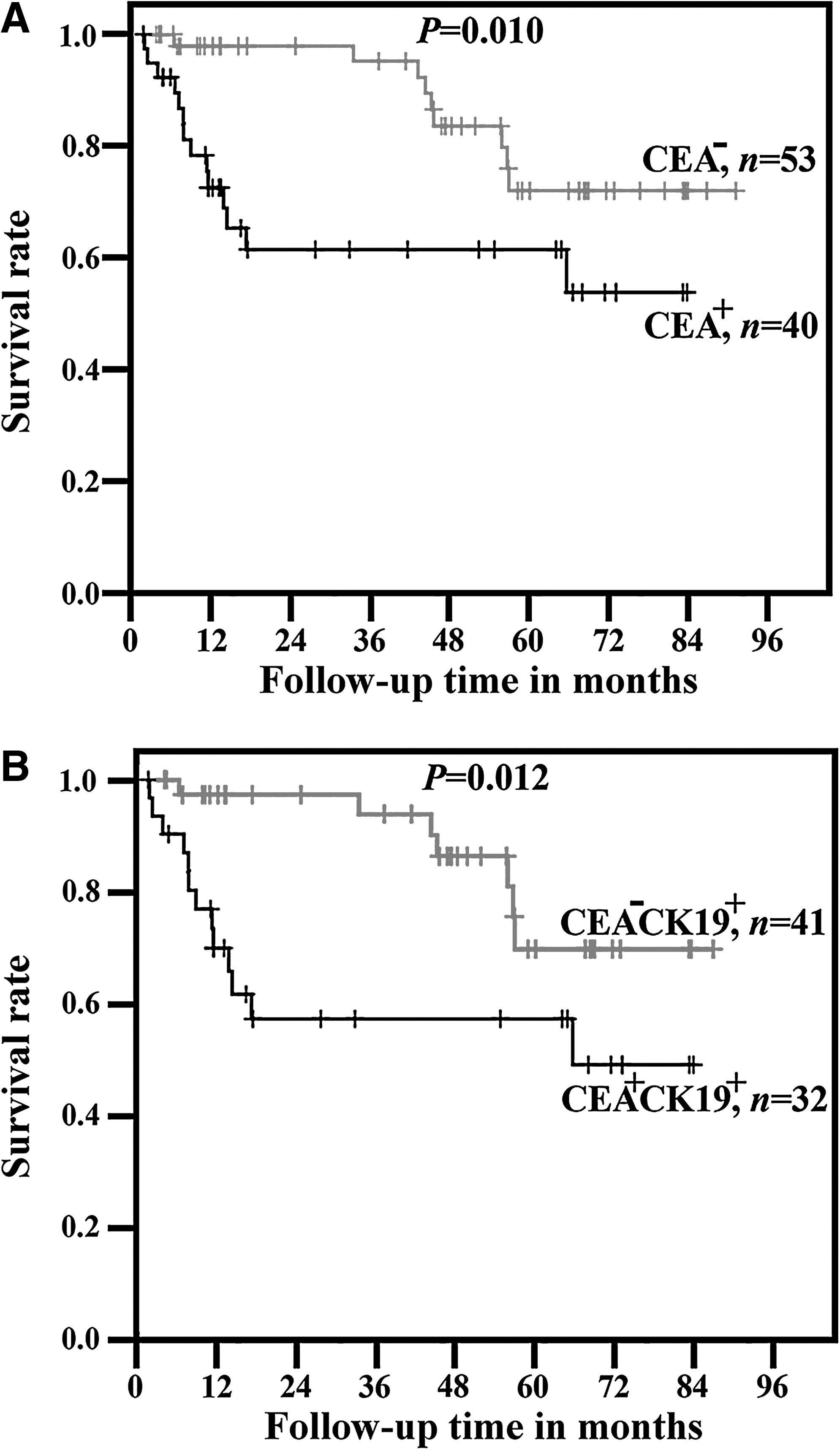
Survival analysis for elderly colorectal cancer patients with different serum levels of the tumor marker carcinoembryonic antigen (CEA). (
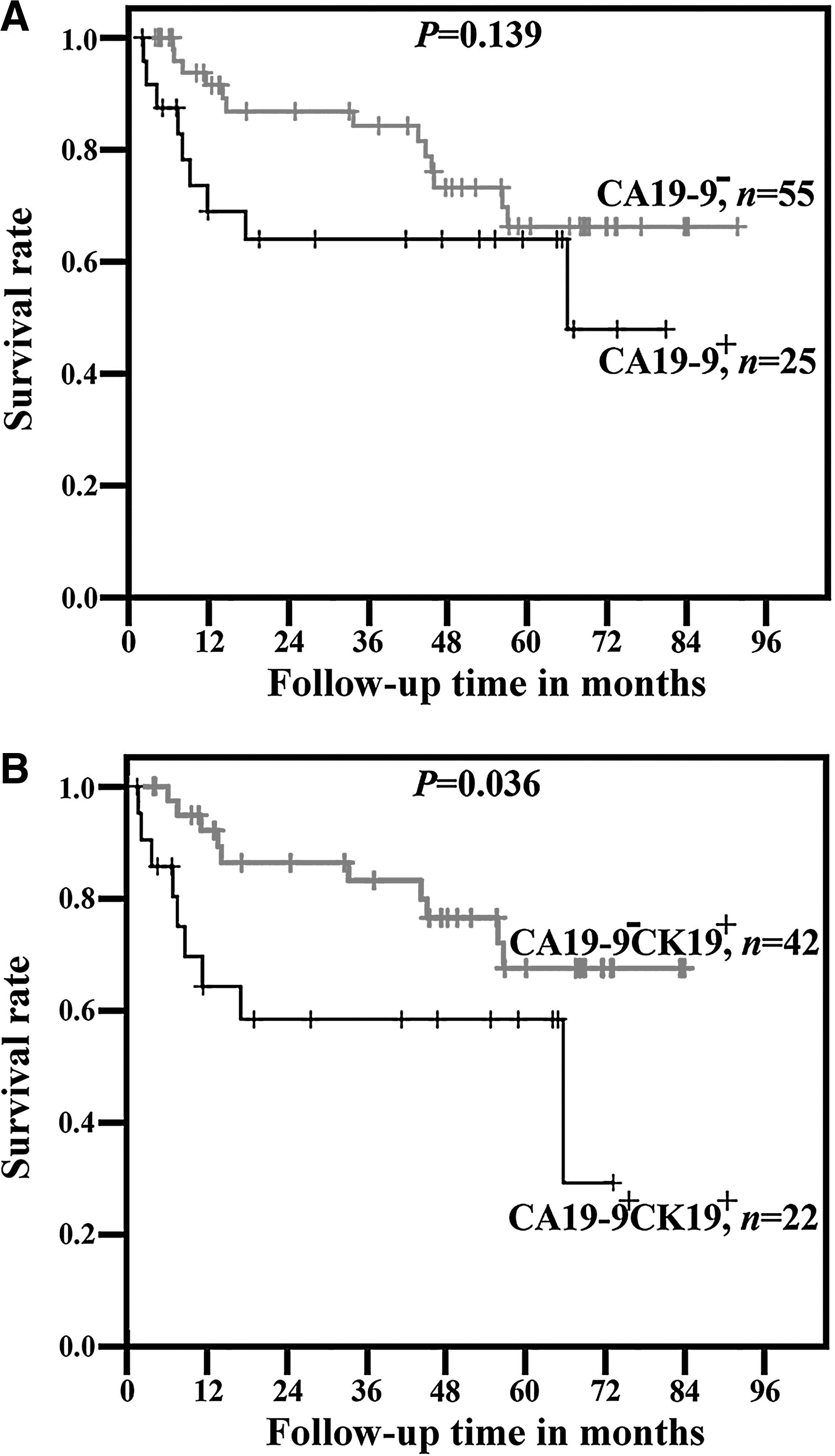
Survival analysis for elderly colorectal cancer patients with different serum levels of the tumor marker carbohydrate antigen 19-9 (CA19-9). (
Discussion
We have reported many fecal molecules with differential expression in patients with CRC (Chien et al., 2006; Huang et al., 2008) and demonstrated that CK19 expression in feces possibly correlates with CRC metastasis (Yang et al., 2005). Recently, we found that the levels of fecal CK19 mRNA represented a potential marker for colorectal malignancy in younger patients (age ≤60 years) (Chang et al., 2009).
CK19 is constitutively expressed in a majority of breast cancers (Bartek et al., 1986) and has been used extensively as a marker for detecting circulating tumor cells of many carcinomas (Fujita et al., 2006; Tao et al., 2006; Daskalaki et al., 2009). The age-related upregulation of CK19 expression from normal colon epithelial tissues was first reported by Li et al. (2007). From our previous and present studies, we have shown that patients with CRC have significantly higher expression of fecal CK19. In fact, the levels of fecal CK19 mRNA were particularly high in patients with M1 stage CRC, with statistical significance among patients less than 60 years of age (Chang et al., 2009). However, this significant difference was not seen in older patients with CRC (>60 years) (data not shown). Instead, higher fecal CK19 mRNA was associated with a 5.8-fold increased risk of CRC in older patients when 0.0002 was the cutoff value. Taken together, we deduced that the upregulation of CK19 mRNA occurs generally; however, it is stage independent in older patients. Therefore, age should be taken into account as an important issue when performing CRC screening (Yang et al., 2004; Chang et al., 2009).
Recently, similar studies have shown that cancer patients with increased CK19 expression have lower survival rates (Chen et al., 2007; Zhong et al., 2007). Indeed, changes in CK19 expression in the blood combined with other molecular markers provide a valuable tool for the clinical management of cancers (Benoy et al., 2006; Sheu et al., 2006; Wang et al., 2007). Deshpande et al. (2004) also reported that CK19 expression is a powerful predictor of survival in patients with pancreatic endocrine tumors. However, the combination of serum concentrations of CEA or CA19-9 and fecal CK19 results in a significant parameter that can be used to evaluate overall survival rates in older patients with CRC (>60 years). That is, a lower overall survival rate occurs in older patients whose detected levels of fecal CK19 mRNA and serum CEA were high, whereas patients with high levels of fecal CK19 mRNA and low serum CEA have lower overall survival rates than patients with low serum CEA alone. Other researchers have also shown that the combination of tumor markers, including CEA and CK19, increased the detection of cancer in patients and remained an independent predictor of poor prognosis (Gervasoni et al., 2008; Bielsa et al., 2009). Our data are also consistent with the results of Nozoe et al. (2006) and Sheu et al. (2006). These two groups concluded that CEA alone is possibly not an efficient prognostic or diagnostic marker, except when combined with CA19-9 for the evaluation of CRC, or with CK19 and c-met for the analysis of non-small-cell lung cancer. Moreover, we even found that older patients (n = 17) with high serum CEA and CA19-9 in addition to higher fecal CK19 mRNA had the worst 6-year overall survival rate (23.2% ± 17.7%) (data not shown).
Interestingly, we noted the 6-year overall survival rate (29.2% ± 21.4%) in older patients with high levels of fecal CK19 mRNA and serum CA19-9 to be even lower than that of patients with high fecal CK19 mRNA and serum CEA (49.1% ± 11.2%). As Yang et al. (2004) suggested, serum CA19-9 could be a significant risk factor when patients with CRC are younger than 59 years of age. In our study, we found that fecal CK19 and serum CA19-9 could jointly contribute to the poor prognosis of patients with CRC who are older than 60 years of age. Survival rates of patients with CRC are reported to be highly dependent on clinical stage (Hermanek, 1995). Here, we report that a panel of markers can be used to determine the survival of patients of a certain age. That is, experiments that address the molecular heterogeneity of CRC, such as the detection of fecal CK19 expression levels coupled with some serum markers, should contribute to the application of effective therapies for some patients (Bustin and Dorudi, 2004).
From our results and those of others, the identification of markers indicative of poor prognosis should improve the survival prediction for patients with CRC (Silva et al., 2002; Gradilone et al., 2003). In conclusion, older patients with CRC with higher levels of fecal CK19 mRNA have significantly lower overall survival rates and a poor prognosis when one of the serum markers (CEA or CA19-9) is higher than its cutoff value. This represents a new insight into the study of the molecular alterations of CRC in an age-dependent manner.
Footnotes
Acknowledgments
This work was supported by grants from the National Science Council of Taiwan (NSC-96-2320-B-281-001-MY3 to C.-J.H.), Taipei Veterans General Hospital (V97C1-145 to S.-H.Y.), and Cathay General Hospital and Taipei Medical University (97CGH-TMU-05 to C.-J.H.).
Disclosure Statement
No competing financial interests exist.