




Abstract
Introduction: We sought to understand the factors associated with recruitment activities while conducting a registry-based study of black women found to have breast cancer <age 50 to investigate mutations in the BRCA1 and BRCA2 genes. Methods: State mandated recruitment methods included TWO mailings, followed by a telephone response card for patients who did not wish to be contacted by phone. If no response was received within 3 weeks of the second mailing, the study team contacted the patient by phone. Results: Of the 209 eligible patients identified by the cancer registry, contact was established in 87, of whom 82 were eligible for study participation. The overall rate of interest in study participation was 80% (including 93% for those with passive follow-up and 68% for those with active follow-up), with the primary factor cited being the desire to understand more about the risk of cancer for family members. Conclusion: This is the first study conducted through a State Cancer Registry, in which the primary goal was to recruit participants for genetic counseling and testing for inherited breast cancer. In contrast to many prior studies, our results suggest that young black women with breast cancer are interested in participating in genetics studies.
Introduction
Studying breast cancer in young AA women is particularly important given the increased incidence of and mortality rates from early onset breast cancer compared to the Caucasian population (Aziz et al., 1999; Newman, 2005). Given the younger age of onset, a proportion of cases may be due to mutations in the BRCA genes. BRCA mutations account for ∼5%-10% of all breast cancer cases (Claus et al., 1996), and confer an 80% lifetime risk of breast cancer (Antoniou et al., 2003). A number of small prevalence surveys in black women (Gao et al., 1997, 2000a, 2000b; Newman et al., 1998; Mefford et al., 1999; Panguluri et al., 1999; Shen et al., 2000; Frank et al., 2002; Kanaan et al., 2003; Olopade et al., 2003; Pegoraro et al., 2003; Pal et al., 2004, 2008; Fackenthal et al., 2005; Haffty et al., 2006; Nanda et al., 2005; Malone et al., 2006; John et al., 2007), including two conducted by our group (Pal et al., 2004, 2008), have yielded varying results. Thus, there continues to be limited knowledge about the role of the BRCA genes in AA women, perpetuated by their low rates of participation in clinical and research BRCA genetic counseling and testing (Armstrong et al., 2005; Halbert et al., 2006).
Given the limited data about inherited breast cancer, we embarked on a registry-based study to investigate mutations in the BRCA genes in AA women found to have breast cancer at or below age 50, recruited through the state cancer registry in Florida. The primary objectives of this observational study were to assess the various aspects of recruitment, including (1) methods by which response was obtained from patients; (2) factors that influenced study participation; (3) frequency of number, time, and day of calls for initiation of study-related contact; and (4) a staged recruitment approach, whereby additional in person contact was provided by the study team for individuals who expressed interest in participation but did not return study enrollment materials by mail.
Materials and Methods
Participant recruitment
Eligible patients were self-identified AA women found to have invasive breast cancer at or below age 50 between the years 2005 and 2006 living in one of four counties in Florida (i.e., Hillsborough, Pinellas, Polk, and Broward) at the time of diagnosis and alive at time of contact. A community advisory panel, comprised of 12 local members of the AA community, was created and convened before initiating population-based recruitment. Through this academic-community partnership, recruitment methods were refined and culturally targeted study recruitment materials were developed (Vadaparampil et al., 2007; Vadaparampil and Pal, In press). Upon approval of the institutional review boards of the University of South Florida and the Florida Department of Health (DOH), registry-based recruitment was conducted between February 4, 2008, and April 30, 2009. The Florida State Cancer Registry released patient contact information, and available clinical (i.e., age at diagnosis, stage of diagnosis, and histologic subtype) and demographic (i.e., county of residence, marital status, and primary payor at diagnosis) information on all eligible participants.
The recruitment method for participants followed a protocol mandated by the Florida DOH, which included two mailings, 3 weeks apart, including a telephone response card, which gave patients the option to decline (i.e., indicating that they did not wish to be contacted by phone) or express interest (i.e., indicating that they were interested in having the study team call them to follow-up) in participation. If no response was received within 3 weeks of the second mailing, a member of the study team contacted the patient by phone to explain the study and determine interest in participation. Potential participants were called up to a total of eight times at various times in the day, with messages left at calls 4 and 6, in those who had voicemail. During the first call in which the potential participant was reached over the phone, the study coordinator explained the study, informed the potential participant that taking part in the study did not require the need for an on-site visit with the study team, determined whether the patient might be interested, and assessed reasons for their interest in participating or declining. For those who expressed interest in the study, the coordinator explained what was required for participation: (1) providing verbal and written informed consent; (2) completing a study questionnaire; (3) receiving genetic counseling over the phone to discuss inherited breast cancer with a genetic counselor; and (4) giving a blood sample which could be collected during an appointment with a home health company to be used for DNA testing.
Those who indicated interest in study participation but did not return the paperwork after a 2 month time period were offered an in-person study visit with two members of the research team (A.G. and E.R.) at a convenient public location (e.g., coffee shop) selected by the participant. During this meeting, paperwork (consent and questionnaire) was completed, a saliva sample was collected for DNA testing, and an appointment for a genetic counseling session over the phone was scheduled. Participants were provided with a $20 incentive (in the form of a gift card) after completion of the genetic counseling session and sample collection for DNA testing.
Data collection
Study personnel collected and logged all information into a study-specific Access database. Specifically, information was collected about (1) method by which response was obtained; (2) factors affecting participation; (3) details of timing of all attempted and successful patient encounters to establish initial contact; and (4) details about the staged approach to recruitment.
Collection of response methods data
The method by which the patient indicated that they were either interested in the study or declined study participation was carefully collected and logged. There were three possible options by which potential participants could respond to the study team, including (1) call to the study team following the initial mailings (i.e., passive follow-up by phone; Group 1); (2) return of the telephone response card (i.e., passive follow-up by mail; Group 2); and (3) eliciting a response when the study team actively followed-up with potential participants when there was no response from the potential participants following the initial mailing (i.e., active follow-up by phone; Group 3).
Collection of participation factors data
Interest in participating was defined as those in (1) Group 1 who actively called the study team following the initial mailings to indicate their interest in participating; (2) Group 2 who returned the telephone response card and indicated that they were interested in the study; and (3) Group 3 who indicated interest in study participation during active follow-up phone call by the study team, through asking the study team to mail the study enrollment package, containing the consent form, to their home. Reasons for interest were collected through the following methods: (1) in Group 1, reasons for interest were collected during the initial call; (2) in Group 2, reasons for interest were collected when the study team called them by phone to follow-up; and (3) in Group 3, reasons for interest were collected during the first call with the study team, after no response following mailings. Specifically, in the form of an open-ended question, the study team asked the participant what factors influenced their participation. This information was collected on a total of 48 individuals who indicated interest in study participation. The study team categorized the potential participant's response(s) into a list of seven common factors associated with participation, including (1) improve knowledge about cancer risks about self and/or family members; (2) improve knowledge about cancer through research; (3) convenience of study participation; (4) past positive research experience(s); (5) recognized someone in the study brochure; (6) recommendation from a medical professional; and (7) provision of incentives.
For those in Group 2, who declined via completion of the telephone response card, patients were asked to also select one or more reasons for declining from the following options that were included on the response card: (1) do not have time; (2) too sick; (3) never had cancer; (4) had cancer but do not feel study relevant to me; (5) not interested in study; and (6) other (participants asked to fill in response). Participants were asked to select all reasons that applied. For those in Groups 1 and 3, in whom study personnel spoke to patients over the phone, reasons for declining were collected in the form of an open-ended question. Specifically, study personnel asked them what factors influenced their disinterest in participation and fit the participant's answer(s) to a list of the following four potential reasons associated with declining participation: (1) not interested in this study; (2) not living in the United States; (3) too busy to participate; and (4) no response available.
Collection of data regarding study-related contact
Study coordinators maintained careful records after each call attempt, including details about the day of the week and time of the call as well as the disposition of each call (i.e., no contact made, voicemail left; message left with person answering the phone when patient not available, patient reached and indicated interest in study participation; patient reached and declined).
Collection of data about staged recruitment approach.
The study team recorded details about the in person encounter, including the day of the week and time of day of the encounter, length of the encounter, and preferred location requested by the potential participant. After the appointment, study personnel (A.G. and E.R.) generated summary notes to document the overall experience of the encounter, including any statements made by the participants during the encounter regarding reasons they appreciated the in person encounter.
Data analysis
Demographic and clinical characteristics of potential study participants were summarized using descriptive statistics, including means, standard deviations, and proportions. Proportions were calculated for various data elements collected during patient recruitment activities, including methods of response, participation factors, and frequency of number, time, and day of study contacts. Specifically, in all patients in whom contact was established, proportions of the method by which response obtained were generated, including stratification of those who were interested and those who declined. Frequencies of reason(s) cited for interest in participation and declining participation were calculated. Time at which first study-related contact was made in those in whom active follow-up by the study team was performed was stratified into work hours (defined as 8 am-5 pm on weekdays) and nonwork hours (defined as after 5 pm on weekdays and throughout weekend days), after which proportions of contact during work and nonwork hours was determined. Data collected for those recruited during the staged approach to recruitment (i.e., when participants were recruited through an in person encounter with study personnel) were evaluated through descriptive statistics.
Results
Of the 209 eligible patients identified by the cancer registry, contact was established in 88, of whom 82 were eligible for study participation. Of the six who were not eligible, reasons included that they were deceased (2), Latina (1), Caucasian (2), and did not speak English (1). Demographic and clinical details were similar for these 82 women compared to the other 121 women in whom contact information and study eligibility could not be confirmed, as shown in Table 1.
Mixed includes mixed infiltrating ductal with lobular or other carcinoma.
Other includes other histologic subtypes and carcinoma, not otherwise specified.
Includes single, divorced, and widowed.
Methods of response
For eligible participants in whom contact was established either by mail or by phone (n = 82), 41 were contacted through passive follow-up methods (i.e., Groups 1 and 2), including 12 who actively called the study team and 29 who returned the telephone response card from the mailing. The remaining 41 were contacted through active follow-up methods (i.e., Group 3) (see Fig. 1). Of those in whom method of response was passive follow-up, interest in study participation in Group 1 and Group 2 was 100% and 90%, respectively. For those in Group 3 in whom active follow-up was used, 68% indicated interest in study participation.
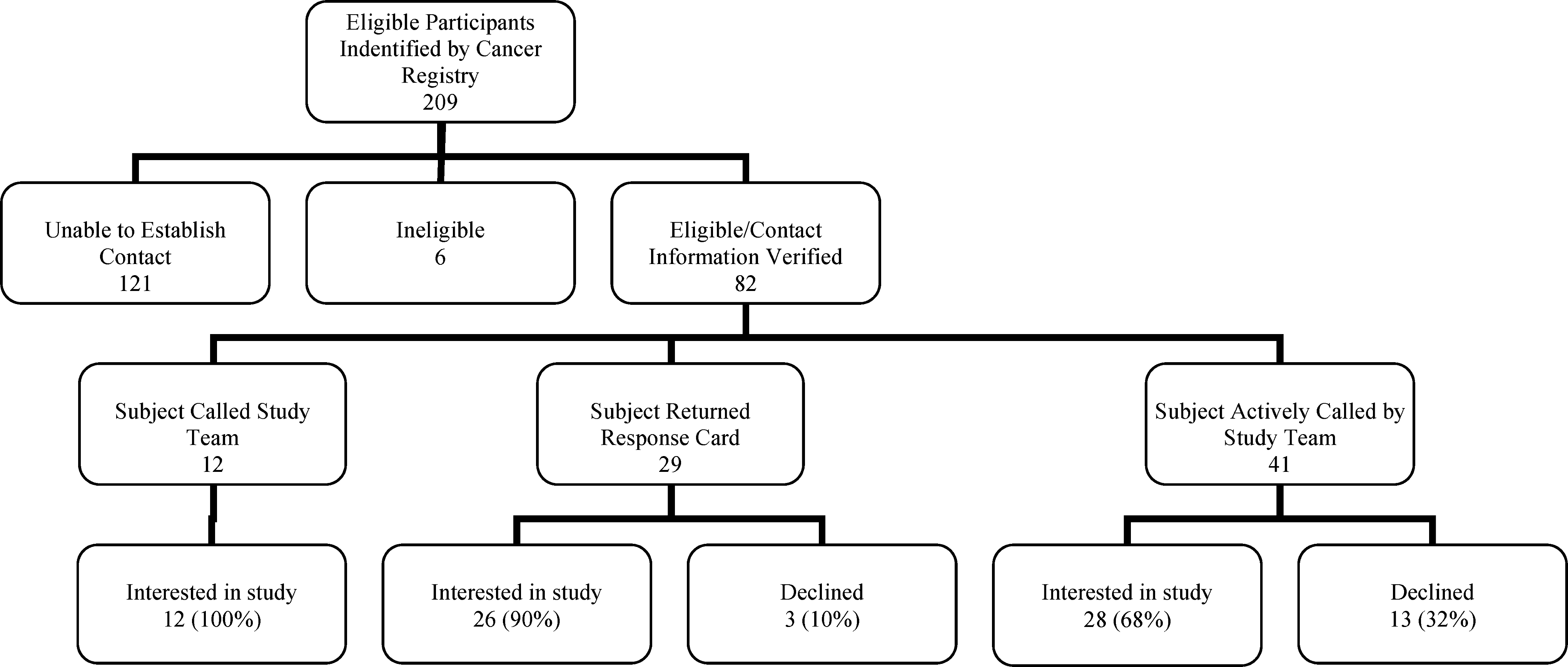
Contact of potential participants (n = 82).
Factors influencing interest in study participation
There were a total of 64 individuals on whom data regarding factors that influenced interest in study participation was collected, of whom 48 indicated interest in the study and 16 declined the study. There were an additional 18 individuals in whom this information was not collected. The most frequently cited reason for interest in participation was the desire to understand personal and family cancer risks (Fig. 2). Reasons for declining study participation included overall disinterest in the study (6), not living in the United States (1), did not have time (3), and no reason given (6).

Most frequently cited factors regarding interest in study participation (n = 48).
Success of initial study-related contact
During the process of active follow-up calls to potential participants to determine interest in study participation (n = 41), the average number of calls to reach the participant was 2.85 (±1.86). Overall, contact was made with 76% of participants by the third call (Fig. 3). Further, 63% of initial contacts were made during nonwork hours, as defined by hours other than 8 am to 5 pm Monday through Friday.

Number of calls needed to reach participants through active phone follow-up (n = 41).
Staged recruitment approach
There were a total of 11 individuals who indicated interest in study participation but did not return mailed paperwork after 2 months, who were offered an in person meeting with the study team for paperwork completion and saliva collection (for DNA extraction and genetic testing). Of these 11 in person meetings, 73% occurred during work hours. On average, the encounter lasted for 60-90 min and took place at a restaurant an average of 8 miles from the participant's home. During these encounters, participants commented that accommodation by the study team of the participant's schedule demonstrated to them: (1) the importance of their involvement in biomedical research, and (2) that the investigative team valued and was mindful of their time. Further, participants indicated that the in-person individual meeting with the two research coordinators was effective in improving their understanding of the study, made them feel an increased level of trust in medical research, and made the recruitment process more enjoyable and less tedious due to its in-person interactive nature.
Discussion
In contrast to previous studies, our findings suggest that black women with early onset breast cancer express interest in participating in studies of genetics and breast cancer. Further, our findings suggest that study participation in AA women may be enhanced through carefully considering methods to facilitate participation, keeping in mind individual preferences.
Many previous studies conducted in blacks have shown that successful recruitment methods entail community-based approaches and physician referral (Royal et al., 2000; Curry and Jackson, 2003; Halbert et al., 2005), which could not be used for our study due to the predetermined recruitment approach of the Florida Cancer Registry. Research recruitment through cancer registries generally lacks personal communication at first contact, which poses a unique challenge when using this approach to recruit research participants, especially AA who are reported as particularly challenging to recruit for research (Bennett, 1993) and underuse genetic counseling and testing services (Hughes et al., 1997; Lerman et al., 1999). Interestingly, states have their own rules for patient contact for research, with the majority allowing active follow-up after physician notification, with an opt-out approach (Beskow et al., 2006), similar to procedures used in our study. Results of previous studies to evaluate patient perspectives on research recruitment through cancer registries have indicated a preference to be directly contacted by researchers to determine interest in study participation as done in our study, rather than checking with treating physicians first (Beskow et al., 2005, 2006). Notably, our study was among the first to solely utilize the Florida State Cancer Registry for participant recruitment, since new procedures that permitted an element of active patient contact were implemented in 2004, before which only passive methods were allowed, limiting registry-based recruitment (Penedo et al., 2006). Thus, similar to findings from other published studies (Friebel et al., 2004), our study reiterates the importance of an element of active patient follow-up when recruiting for registry-based studies, as evidenced by the fact that for those interested in our study, interest was determined in 68% through active follow-up methods.
Challenges in recruiting black women for research studies from registries or other databases have been seen in a number of previous studies. Results of the Carolina Breast Cancer Study (Moorman et al., 1999; Carey et al., 2006), comprised primarily of black and white women, indicated that contact rates were lowest among young black women, despite the use of a rapid ascertainment system. Thus, it is not surprising that initial contact rates in our study of young black women with invasive breast cancer were a challenge, with contact established in <50% of patients from the original list supplied by the cancer registry, especially with our lack of a rapid ascertainment system and limited study timeframe. Similarly, in the Multiethnic Cohort Study, where the primary sampling frame was drivers' license files in Hawaii and California, supplemented by Health Care Financing Administration files to identify additional AA, response rates of black women was 25.5% compared to 47.0% for white women (Kolonel et al., 2000). It is possible that the lack of active follow-up contributed to the low response rates for AA seen in the Multiethnic Cohort. In contrast, the active telephone follow-up performed in our study was likely instrumental to achieve the better response rates. The importance of phone contact was illustrated through the population-based NICHD Women's Contraceptive and Reproductive Experiences study where black and white women with newly diagnosed breast cancer were actively contacted by phone through a rapid ascertainment system. In this study, participation rates were 72% for black women compared to 79% in white women (Marchbanks et al., 2002), similar to the overall participation rates seen in our study. However, a challenge faced in our study was obtaining accurate contact information, in part due to the amount of time from actual diagnosis to recruitment into the study (which was 3 years on average; data not shown). Nevertheless, when the study team was able to establish contact, overall interest in the study was high (i.e., 80%). As expected, those in whom initial contact was established through passive follow-up (i.e., patient responded to mailing with either a phone call or a response card) yielded higher recruitment rates than in those in whom active follow-up was needed. However, even in those who were actively called following no response to the two mailings, interest in study participation remained reasonably high, at 68%.
To date, there have been three completed population-based studies that have investigated mutations in the BRCA genes (Newman et al., 1998; Malone et al., 2006; John et al., 2007). However, in all of these recruitment efforts, BRCA testing was a secondary analysis conducted on previously collected and archived samples. Consequently, pretest genetic counseling was not reported to have been performed in these prior studies. In contrast, to our knowledge, our study is the first registry-based effort in which pretest genetic counseling and genetic testing for inherited breast cancer were both part of study participation. This was because the primary goal of our study was to investigate BRCA mutations in prospectively recruited black women. Findings from our study indicate that the majority of unselected high-risk black women may consider participating in studies of inherited breast cancer and genetic counseling and testing.
Previous studies that have examined the various aspects that influence the uptake of genetic counseling and testing for inherited breast cancer in black women have shown overall lower levels of knowledge (Hughes et al., 1997; Kinney et al., 2001), which may result in declining genetic counseling (Thompson et al., 2002). More recently, Armstrong et al. (2005) showed that racial disparities in the use of BRCA counseling exist and are not explained by differences in risk factors for being a mutation carrier, socioeconomic factors, risk perception, attitudes, or recommendations from primary care physicians. Consequently, within the AA community, genetic services are underused, with previously cited barriers, including lack of knowledge, negative attitudes regarding genetics and/or research, and concerns regarding racial discrimination (Simon and Petrucelli, 2009). In comparison, findings from our study indicated a high level of interest in participating in a study of inherited breast cancer, as the majority of individuals who we were able to reach by phone indicated interest in the study, which included genetic counseling and testing for inherited breast cancer.
Previous reports indicate that AA may be more willing to participate in prevention, diagnostic, and treatment studies and/or projects relevant to their own community (especially for those at higher risk) with tangible personal and social health benefits (Millon-Underwood et al., 1993; Linden et al., 2007; Smith et al., 2007; Gadegbeku et al., 2008). Other factors such as altruism, personal satisfaction, and learning about health have also been cited as strong motivators for research participation (Vollmer et al., 1998; Gadegbeku et al., 2008). These findings are consistent with our results that showed wanting to learn more about personal cancer risks and risks to family members was the most commonly cited reason for study participation. Other factors reported to influence research involvement in AA women include understanding the elements in the study, monetary incentives, reduction of barriers, and cultural sensitivity (Satia et al., 2005; Watson and Torgerson, 2006; Yancey et al., 2006; Linden et al., 2007; Smith et al., 2007), all of which were taken into account in our study. Not surprisingly, we experienced more success in contacting participants during nonwork hours, as previously illustrated in a survey of researchers performing clinical trials in the ICU setting (Cook et al., 2008). Additionally, over half of our participants were reached by call 3, similar to Fair et al. (2008), who reported that about 50% of women in their mammography follow-up study of minority and medically underserved women were reached by call 3. On average, it took 4.6 attempts in their study, to reach potential participants, similar to our average of 2.8 calls.
On the basis of our previous recruitment experiences (Pal et al., 2004, 2008), we recognized that enabling participation exclusively through phone, mail, and in-home contact might enhance participation. However, in a subset of participants, an in-person meeting with the study team, close to the participant's home, facilitated study participation. Previous reports have indicated that strategies tailored to the needs, experiences, and environments of individuals are likely to enhance study recruitment (Fitzgibbon et al., 1998), consistent with our finding. Along these lines, our recruitment strategy highlights the need for a staged recruitment approach, including the need to individually tailor recruitment methods in those in whom contact over the phone has not resulted in participation, despite the patient's stated interest in the study.
There were a number of strengths in the current study, including the culturally sensitive approach used to optimize participant recruitment methods and materials. Consistent with previous studies (Lenfant, 1995; Anderson et al., 2007; Smith et al., 2007), it is likely that the academic-community partnership was instrumental in the recruitment success achieved by the study team. Finally, our study is the first registry-based study focused on black women with breast cancer, in which the main objective was investigation of BRCA mutations. Thus, pretest genetic counseling was a part of study procedures, as opposed to previous population-based studies, in which testing was done on samples originally collected for other initiatives (Newman et al., 1998; Malone et al., 2006; John et al., 2007). Despite these strengths, there remain some limitations, including the relatively small sample size, as well as the large number of participants with whom contact could not be established, which could potentially contribute to a self-selection bias. However, the available data on clinical and demographic variables on all potential participants (Table 1) suggest that those in whom contact could not be established were similar to those successfully contacted. Previous reports have suggested that locating medically underserved minority women for research studies may require substantial time commitments (Bobo et al., 2006; Fair et al., 2008). Thus, our yield may have been limited, due to the relatively short timeframe and limited resources available to complete the study. Additionally, more accurate contact information may have been obtained through using social security numbers. However, this would have entailed funded effort by the cancer registry staff, which was not feasible due to our limited resources. There was also a 1 year time delay in contacting over 50% of the total sample of patients, due to refinement of recruitment methods, materials, and procedures to request data from the cancer registry. Specifically, the time lag for obtaining participant information from the cancer registry is 6-18 months from diagnosis. Thus, most data from 2005 to 2006 cases were available in early 2007; however, recruitment activities only started in early 2008 due to the afore-mentioned reasons, leading to an average lag of 3 years from date of diagnosis to initial contact by the study team. Given the prior literature to suggest that AA experience high rates of loss to follow-up (Psaty et al., 1994; Marcus et al., 1998; Dunbar-Jacob et al., 2004), changes to contact information (Haughton et al., 2005), and high residential mobility (McGraw et al., 1992), these issues likely contributed to the lack of accurate contact information. It is also possible that earlier implementation of our staged recruitment approach may have enhanced recruitment. A final limitation was that the initial mailing to patients did not state that travel to our cancer center was not needed for participation, which was identified as a deterrent by those who subsequently participated after being reached through active follow-up. This may have served as a disincentive in participants in whom active follow-up was not possible, due to unavailable phone contact information.
In summary, results from our observational study that suggest that black women with early onset breast cancer are interested in participating in studies of genetics and breast cancer, when a convenient and staged approach is utilized to facilitate participation, are encouraging. However, these findings require validation in a much larger, well-controlled, hypothesis-driven study. In our study, more black women were recruited using active follow-up methods (e.g., direct calling) than passive follow-up strategies (e.g., mailing materials to eligible patients). The availability for study personnel to contact patients during evenings and weekends appeared to greatly enhance participation. The findings from the current research have led to the refinement of culturally sensitive study methods that will be of great utility in future studies conducted in this underserved population group. Further, this effort has led to additional outreach initiatives realized through our academic-community partnership to develop educational materials to increase awareness about inherited breast cancer in the black community (Permuth-Wey et al., 2010; Vadaparampil and Pal, In press). This study has the potential to inform future research efforts to reduce health disparities faced by underserved and understudied black women with breast cancer.
Footnotes
Acknowledgments
This project was funded through Grant # POP0600964 from the Komen for the Cure Foundation (T. Pal). Breast Cancer Genetics Research Education and Advocacy Team (B-GREAT) members are Joyce Austin, Estrella Clement, Susan Friedman, Benita Hayes, Julie Kornfeld, Evora Pimento, Peggie Sherry, Dr. Donald Temple, Gloria Wood, Theresa Anderson, the late Jackie Brown, Gladys Hall. We thank Veronica Harville for administrative assistance. Cancer data for this study (analysis) was provided by the Florida DOH, Florida Cancer Data System (FCDS). Cancer data are made available to aid public health surveillance and research to advance cancer control and prevention activities to better serve the population at risk for developing cancer and improve treatment for cancer patients. The contents of this study are solely the responsibility of the authors and do not necessarily reflect the official view of the Florida DOH, Florida Cancer Data System.
Disclosure Statement
No competing financial interests exist.