




Abstract
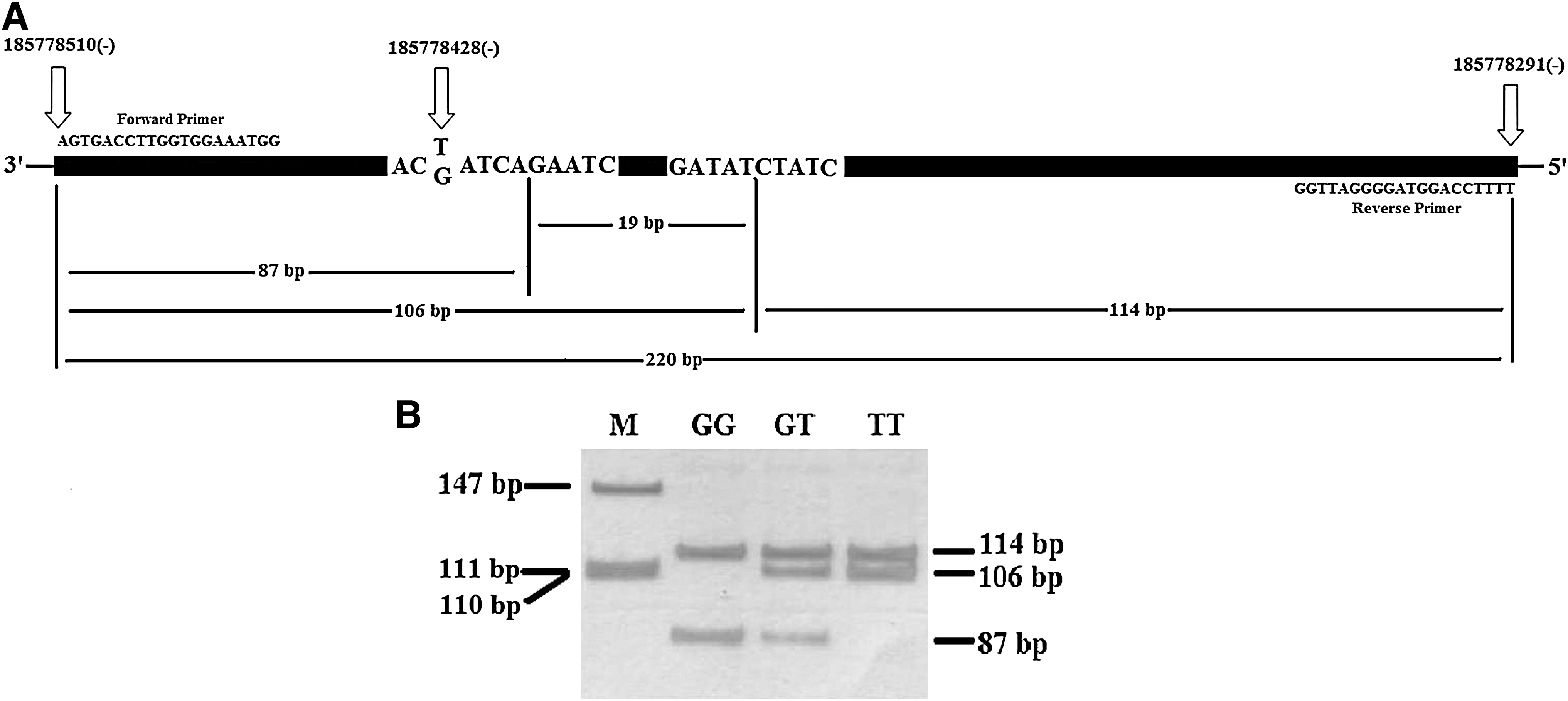
The original ZNF804A rs1344706 risk variant was identified through genome-wide association studies as a risk factor for schizophrenia. Follow-up studies involving meta-analysis have confirmed that rs1344706 is a risk factor for schizophrenia as well as bipolar disorders. We describe here a polymerase chain reaction-restriction fragment length polymorphism (PCR-RFLP) method to genotype ZNF804A rs1344706 variant in patients with schizophrenia. We generated a 220 bp fragment through PCR and subsequently cleaved it by the restriction endonuclease BsaBI, creating two fragments of 114 and 106 bp. Upon change in the nucleotide from T to G, the 106 bp fragment is further cleaved by BsaBI, thus creating two fragments of 87 and 19 bp. As a result, when the 220 bp fragment is cleaved by BsaBI restriction endonuclease, the TT genotype yields two fragments of 114 and 106 bp, and TG genotype four fragments of 114, 106, 87, and 19 bp, and the GG genotype three fragments of 114, 87, and 19 bp. Thus, this is a simple, fast, and cost-effective method to genotype the ZNF804A rs1344706 risk variant. Using this method, we were able to replicate an association between ZNF804A rs1344706 variant and schizophrenia in a Turkish population. Stratification analysis of the population according to the gender showed an association that was statistically significant among overall schizophrenia and male schizophrenia and the risk T allele and TT genotype of the ZNF804A gene.
Introduction
G
Recently, two meta-analyses provide support for the rs1344706 variant of ZNF804A as a risk factor for schizophrenia (Williams et al., 2011; Zhang et al., 2011). Another two studies have replicated the evidence of association as well as they have found the rs7597593 locus on chr2 even more profoundly associated with schizophrenia in a gender modulated manner (Riley et al., 2010; Zhang et al., 2011).
Apart from the currently available methods utilized in genotyping the ZNF804A gene, we searched for the availability of a polymerase chain reaction- restriction fragment length polymorphism (PCR-RFLP) method for genotyping, Luckily we found an enzyme that can give us an opportunity to carry out such study. The enzyme we used in our study has a number of isoschizomers available in the market. Using primers specifically designed for the determination of the T allele of the ZNF804A gene, we were able to produce an amplified band of 220 bp which we subsequently cleaved with BsaBI restriction endonuclease creating two fragments of 114 and 106 bp for TT genotype and four fragments of 114, 106, 87, and 19 bp for TG genotype and three fragments of 114, 87, and 19 bp for GG genotype.
This PCR-RFLP method we developed for genotyping of the ZNF804A gene is a fast, simple, and cost-effective PCR-RFLP method. Using this method we were able to reveal an association between the variant and schizophrenia in a Turkish population. Analysis of the data suggested that there was a significant association between the T allele and schizophrenia in the overall population of schizophrenia as well as for male schizophrenia in a gender-dependent fashion. On the contrary, the G allele was protective against schizophrenia.
Materials and Methods
Patients
A total of 105 schizophrenic patients—65 men (52.55%) and 40 women (47.45%) with mean age 36.42±10.761, and age range 20-73 years—were selected for the study, having been identified by a clinic examination at the psychiatry clinic of the University Hospital of Kocaeli, Turkey. The diagnosis of the schizophrenic patients was based on DSM-IV criteria. The control subjects—72 men (61.90%) and 65 women (38.10%) with mean age 37.48±10.185, and age range 18-72 years—were recruited into the study, from those who underwent clinical examination at the University Hospital of Kocaeli, Turkey. The institutional review board approved the study. Written informed consent was obtained from all subjects who participated in the study.
Genetic testing
The 220 bp fragment was amplified with 10 p mol each of the forward primer 5′-AGTGACCTTGGTGGAAATGG-3′ and the reverse primer 5′-TTTTCCAGGTAGGGGATTGG-3′ from 100 ng isolated human lymphocyte DNA. PCR thermal cycling conditions were a 5 min denaturation period at 94°C and 35 cycles of the following: 94°C for 1 min, 56°C for 30 s, and 72°C for 1 min, followed by a 7 min extension at 72°C at the end. The 25 μL PCR mixture contained 10 mM Tris-HCL (pH 8.8), 50 mM KCL, 0.08% Nonidet P40, 1.5 mM MgCl2, 200 μM dNTP, and 1.0 unit TaqDNA polymerase (MBI Fermentas). BsaBI enzyme digestion of the amplified 220 bp fragment was carried out in 15 μL solution containing 5 μL PCR product and 2 unit BsaBI enzyme at 65°C overnight. Digestion products were electrophoresed at 20W for 40 min on a 7% polyacylamide gel and followed by silver staining. Briefly, TT produced two fragments of 114 and 106 bp. TG produced four fragments of 114, 106, 87, and 19 bp. GG produced three fragments of 114, 87, and 19 bp.
Statistics
Statistical analyses were performed using the SPSS software package, version 13.0. Distributions of allele and genotypes were compared by the χ2 test. The significance level for statistics was set at two-tailed p<0.05. The Hardy-Weinberg equilibrium was verified for all of the tested populations. Differences between groups were examined by the χ2 test and Student's t-test whenever appropriate. The relative risk as odds ratio (OR) analysis was carried out with 2×2 cross-tabulation and a binary logistic regression model for the age and sex.
Results
The allele frequency of rs1344706 ranged from approximately 58.39 in control subjects to 67.62 in cases. Overall, the T allele of rs1344706 was significantly associated with schizophrenia (OR=2.534, p=0.037) (Table 1). Individuals with GG genotype were protected against schizophrenia. Stratification analysis revealed a strong effect of gender on the association of rs1344706 with risk of schizophrenia. The association of rs1344706 was significant in men (χ2=6.314, p=0.043). Individuals with TT genotype showed a 2.229 times increased risk for schizophrenia (χ2=4.977, p=0.026). On the contrary, the association was not significant in women (χ2=1.732, p=0.421) (Table 2). The amplified fragment of 220 bp is shown in Figure 1.
HWE, Hardy-Weinberg equilibrium; OR, odds ratio.
Discussion
In the present study, the rs 1344706 risk T allele located in the ZNF804A gene, the first variant rendering GWA with psychosis, has been shown to be associated with schizophrenia. Previously it was shown that this risk variant was associated with altered connectivity between brain regions, including the DLPFC, hippocampus, and amygdala in healthy controls. The risk allele was also shown to elevate functional connectivity (Esslinger et al., 2009), and also with cognitive impairments in episodic and working memory function in patients with schizophrenia (Walters et al., 2010). It was found that for temporally correlated networks, during different task conditions, the T allele of ZNF804A impacts systems-level connectivity with both state-independent and state-dependent components. Structural abnormalities seen in the schizophrenics caused by ZNF804A variant allele were based on a decrease in interhemispheric prefrontal functional connectivity, which was task independent. Thus, the genetic risk variant can cause different cognitive states on the functional organization of cortical Networks. Moreover, decoupling of the hippocampus is reduced in the risk allele carriers during the WM task only, indicating a dependence on state of information processing and emphasizing a possible role for WM impairments in the pathophysiology of schizophrenia (Esslinger et al., 2011).
The protein encoded by ZNF804A is a zinc finger protein with unknown function. Usually, proteins with zinc finger domains tend to have a regulatory function and behave as transcription factors, but we do not know how many genes are modulated by this protein. Recently, Riley et al. (2010) have reported that risk allele carriers showed increased gene expression levels. Although how ZNF804A variant causes schizophrenia is unclear, this variant has been associated with cognitive impairments (Walters et al., 2010; Esslinger et al., 2011). There seem to be differences in the allelic distribution of rs1344706 among ethnic groups, such as T allele frequencies in Turkey: 58, Ireland: 59, United Kingdom: 59, Germany: 61, United States: 61, Japan: 42, China: 52, Hungary: 58 (SzGene database: www.szgene.org).
The ZNF804A gene has four exons and three introns with a gene size of 341 kb located on chromosome 2q32.1 (Shi et al., 2009). The expression of T allele of rs1344706 is remarkably higher in prefrontal cortex as compared to that of the G allele (Riley et al., 2010). Rs1344706 is located on the third intron near the 3′ end of the gene, contains zinc figer DNA binding domain, and has binding sites for MYT1I and POU3F1/OCT-6 transcription factors expressed in the brain. Consequently, rs1344706 may function as a transcription factor to modulate brain-specific gene expression.
Systems biology studies have revealed that more than 160 genes are somehow involved in schizophrenia, including 24 pathways (Sun et al., 2010). In addition, there seems to be cross-talk between these pathways. The mechanism by which the cross-talk is modulated is still unclear, if and/or how the ZNF804A gene is implicated in the modulation of this network awaits future studies. However several clues have emerged through cognitive studies by which this variant is associated with functional connectivity of the dorsolateral prefrontal cortex both across hemispheres and with the hippocampus, and can increase functional connectivity of the amygdala with regulatory limbic and prefrontal areas and neuropsychological performances, such as visual memory, episodic, and working memory and attention. Consequently, these functions are impaired in patients with schizophrenia as well as bipolar disorders (Esslinger et al., 2009, 2011; Hashimoto et al., 2010; Walter et al., 2011; Walters et al., 2010; Balog et al., 2011).
A recent study has been designed to reveal an association between the ZNF804A gene and schizotypal personality traits in healthy subjects in which the individuals with the risk T allele scored higher on shizotypal personality traits and disorganization factors that those with the G allele. As a result, the ZNF804A gene may influence personality as well as neurocognitive performance (Yasuda et al., 2011).
Donohoe et al. (2011) have reported in their study, they were unable to show an association between ZNF804A genotype and brain volume in healthy controls. A recent study by Steinberg et al. (2011) has shown that copy number variants of ZNF804A gene have also been associated with psychiatric disorders in which a deletion of the whole ZNF804A gene was detected in a patient with schizophrenia, a duplication of the first exon was found in a patient with bipolar disorders, and also a deletion was identified in a patient with anxiety in addition to the confirmation of the association of a ZNF804A gene variant with schizophrenia.
In conclusion, the PCR-RFLP method that we developed for ZNF804A rs1344706 variant is an easy, fast, and cost-effective one. With this method clearly, genotyping and allele distribution of the risk variant can be easily determined in 7% polyacrylamide gel electrophoresis at 20W for 40 min. Only one band of 220 bp is amplified with specificity. With silver staining of polyacrylamide gels, the error rate is reduced to nothing. The enzyme we used in the identification is readily available with its isoschizomers in the market. BsaBI enzyme we used in our study is a remarkably stable and well-cutting enzyme at 65°C.
Footnotes
Acknowledgments
We are indebted to the subjects who participated in our study. We thank the Kocaeli University Fund for supporting this study (2008/009).
Disclosure Statement
All authors declare that they have no conflicts of interest.