




Abstract
Aims and Objectives: Industrial workers are constantly exposed to benzene, especially at the production unit. The present investigation explores any association of the outcome of various reproductive malfunctions in terms of infertility and other related factors as a result of benzene exposure. Methodology: Blood and semen samples were collected from total 160 industrial workers exposed to benzene and 200 nonoccupationally exposed control subjects. We investigated macroscopic and microscopic semen parameters in the present study population. Body fluid benzene analysis was done by Head Space chromatography. The sperm DNA integrity was determined by modified alkaline single-cell gel electrophoresis or the comet assay method. Results: No significant changes were observed in macroscopic semen parameters. A duration-dependent decrement in total sperm count and the percentage of motility was observed among the benzene-exposed industrial workers (p<0.05). A duration-dependent increment of abnormal sperm morphology was observed among the benzene-exposed industrial workers (p<0.01). A significant increase in comet tail length was observed in the exposed groups (p<0.01) in comparison to the controls. In regression analysis, the data were observed to be significant at the level of p<0.05 for Group II industrial workers (t=2.301). Conclusion: Sperm integrity is considered one of the major factors in male infertility. The sperm DNA damage is an important step from spermatogenesis to malfunctions such as infertility; therefore, the present study represents an important evaluation for correctly diagnosing the problem, precisely from the level of DNA itself.
Introduction
M
Industrial workers are constantly exposed to the specified chemicals, especially at the production unit. These solvents have been classified as reproductive toxins by International Programme on Chemical Safety-Environmental Health Criteria (IPCS-EHC). They are also potential inducers of many vital biological functions in several experimental models. Considering the nature of organic solvents as reproductive toxins, benzene was selected as a marker for solvent exposure among the occupational industrial workers. Environmental pollutants, occupational exposures, and lifestyle have been explored as possible contributors to those changes (Homan et al., 2007). Many studies have been done on occupational exposure to organic solvents and their adverse reproductive and developmental outcomes in both humans and experimental animals (Olshan and Faustman, 1993; Lindbohm and Taskinen, 2000). Many studies suggest that sperm DNA integrity may be altered by environmental exposure to some toxic chemicals (Stronati et al., 2006; Aitken and De Luiis, 2007). DNA fragmentation may be an excellent marker for exposure to potential reproductive toxicants and a diagnostic tool for male infertility (Evenson and Wixon, 2005; Ozmen et al., 2007).
The present investigation enlightens an association of the outcome of various reproductive malfunctions in terms of infertility and other related factors as a result of solvent exposure, especially benzene. The present study was performed in a bulk-drug industry situated at IDA, Patancheru, Medak District of Andhra Pradesh. Patancheru Industrial Area (PIA) was established in 1973 by A.P.I.I.C, covering 440 hectare estates in Patancheru with bulk drug and pharmaceutical industries being a major concern. PIA has been a hub for chemical and drug factories since the 1980s.
Materials and Methods
Study population
All the subjects were clinically examined by a local medical practitioner and also by a gynecologist, and the study was screened and approved by the Institutional Ethical Committee, Osmania University College for Women and Sridevi Infertility Hospital, Hyderabad, India. Demographic data of the subjects were recorded by using a standard questionnaire. All the participants were informed about the objectives of the study, and a written consent was obtained from each subject. Overall, 160 exposed industrial workers of active reproductive age 31.48±7.91 years with the mean duration of exposure period of 9.18±4.32 years were randomly selected from the bulk drug industry. They were divided into three groups depending on the duration of exposure: (1) low exposed group with 0-5 years exposure for 8 h/day (Group I=52); (2) medium exposed group with 5-10 years exposure for 8 h/day (Group II=73); and (3) high exposed group for 8 h/day exposure over a period with 10-15 years (Group III=35). Similarly, 200 unexposed groups of age- and sex-matched individuals of active reproductive age 29.54±7.61 years were randomly selected as control subjects for the study. All the participants were informed about the objectives of the study, and a written consent was obtained from each subject.
Collection of biological samples
The semen sample was collected after 3 to 4 days of sexual abstinence from each donor. The sample was obtained by masturbation, and the ejaculate was collected in a clean, wide-mouthed container made of glass or plastic, by keeping warm (20°C-40°C) to avoid reduction in sperm motility and from a batch that had been checked for toxic effects on sperm motility. One part of the semen was stored at −20°C in a metal free vial for measurement of benzene content. 1 mL of morning, fasting venous blood was collected aseptically and stored at −20°C in heparin containing vials for blood-benzene analysis.
Benzene concentration in body fluids by headspace gas chromatography
Analysis of benzene concentration in body fluids such as blood and seminal fluid was estimated by the headspace gas chromatography technique (EWF Method 002/03) proposed by Xiao et al. (2001) and Haseeb Ahmad Khan (2006) Blood: Venous blood (total 1 mL) was sampled into heparin containing vials for analysis of blood-benzene levels. From this container, 100 μL of whole blood was taken and mixed with wax prepared in N-dodecane for analysis.
Seminal fluid
After ejaculate liquefaction, the seminal fluid was separated from the spermatozoa by centrifugation at 1500 g for 10 min at 4°C. An aliquot of the seminal fluid (∼300-500 μL) was decanted into a metal-free poly propylene micro-tube and stored at −20°C until required for benzene-seminal fluid analysis. From this container, 100 μL of seminal fluid was taken and mixed with wax prepared in N-dodecane for analysis.
Gross semen analysis
Semen analysis is the only way by which a human male's fertility potential can be assessed in the laboratory. Macroscopic evaluation of the semen sample included parameters such as volume, appearance, pH, viscosity, and liquefaction. Microscopic investigation of the semen sample estimates was made of the total sperm count, sperm motility, and sperm morphology. A phase-contrast microscope was used to examine the unstained preparations of fresh semen or washed spermatozoa. A bright-field microscope was used for stained preparations. The microscopic examination for certain parameters was done by two observers. Care has been taken in screening the slides throughout the study. Two observers, one with expertise in clinical analysis, have done the screening to minimize the error, in order to ascertain the quality in reproducing the data. The samples were analyzed by adapting standard protocol proposed by WHO (1999).
Sperm DNA integrity by comet assay
The sperm DNA integrity was determined by modified alkaline single-cell gel electrophoresis or comet assay method as described (Mc Kelvy-Martin et al., 1997) and further, the protocol was modified using the silver stain technique (Ahuja and Rashmi Saran, 1999), which was easily accessible in the laboratory. After electrophoresis, the slides were processed with silver staining solution (two washes, 10 min each). Coded slides were viewed using a bright field microscope (Leica microscope). For each sample, 100 randomly selected sperm nuclei were evaluated by an image analysis system using software attached to the computer provided by a Leica microscope, and the tail length was measured. The formula is as follows:
Sperm DNA tail length (μm)=(Length of the comet sperm cell)-(Breadth of the comet sperm cell)
Statistical analysis
The data obtained from control and exposed groups were compared, and one-way ANOVA, multiple comparison, multiple regression analysis, F-test, and t-test were carried out at 5% level of significance following the computer-based statistical software SPSS version 11.5 for Windows (SPSS, Centre for Quantitative Method).
Results
The data of blood and seminal fluid benzene concentration obtained by using a headspace gas chromatographic technique are presented in Table 1. The blood-benzene concentration ranged between 0.26 and 58.36 with a mean value of 26.92±21.33 μ mol/dL. Similarly, the seminal fluid-benzene concentration ranged between 0.14 and 7.25 with a mean value of 2.47±2.53 μmol/dL in the exposed industrial workers group.
Values expressed in mean±SD.
Investigated data on macroscopic and microscopic evaluation of semen samples in the study group were subjected for statistical analysis to see their level of significance by using the student t-test (table 2). No significant deviation was observed in macroscopic semen parameters (semen volume, pH, and liquefaction) between control and exposed groups (I II and III). In microscopic parameters, there was a significant decrease in total sperm count and sperm motility among the exposed groups (I II and III) when compared with the control group (p<0.01). Similarly, there was a significant increase in abnormal sperm morphology among the exposed groups (I II and III) when compared with the control group (p<0.01).
Values of total sperm count expressed in=× 106 spermatozoa/ejaculate.
Values are in mean±SD.
p<0.05.
p<0.01.
NS, not significant.
The results on the integrity of sperm DNA analyzed by comet assay of the study group are presented in table 3. A significant increase in comet tail length was observed in the exposed groups (p<0.01) in comparison to controls. The regression data of seminal fluid-benzene and sperm comet tail length parameters of the industrial workers study group are presented in table 4. The statistical analysis of the data was observed to be significant at the level of p<0.05 for Group II industrial workers (t=2.301) shown in figure 1, while insignificant for Group I (t=0.586) and Group III (t=−0.128) industrial workers, respectively, shown in figures 2 and 3. F statistics are 1.766 with degrees of freedom (4, 30) at 5% level of significance. The duration of service of Group II industrial workers is 5-10 years. Since the Group II industrial workers are still in their reproductive age and also their duration of service is more (that is >5 years), they are constantly and regularly exposed to organic solvents such as benzene; therefore, they are a highly vulnerable group.
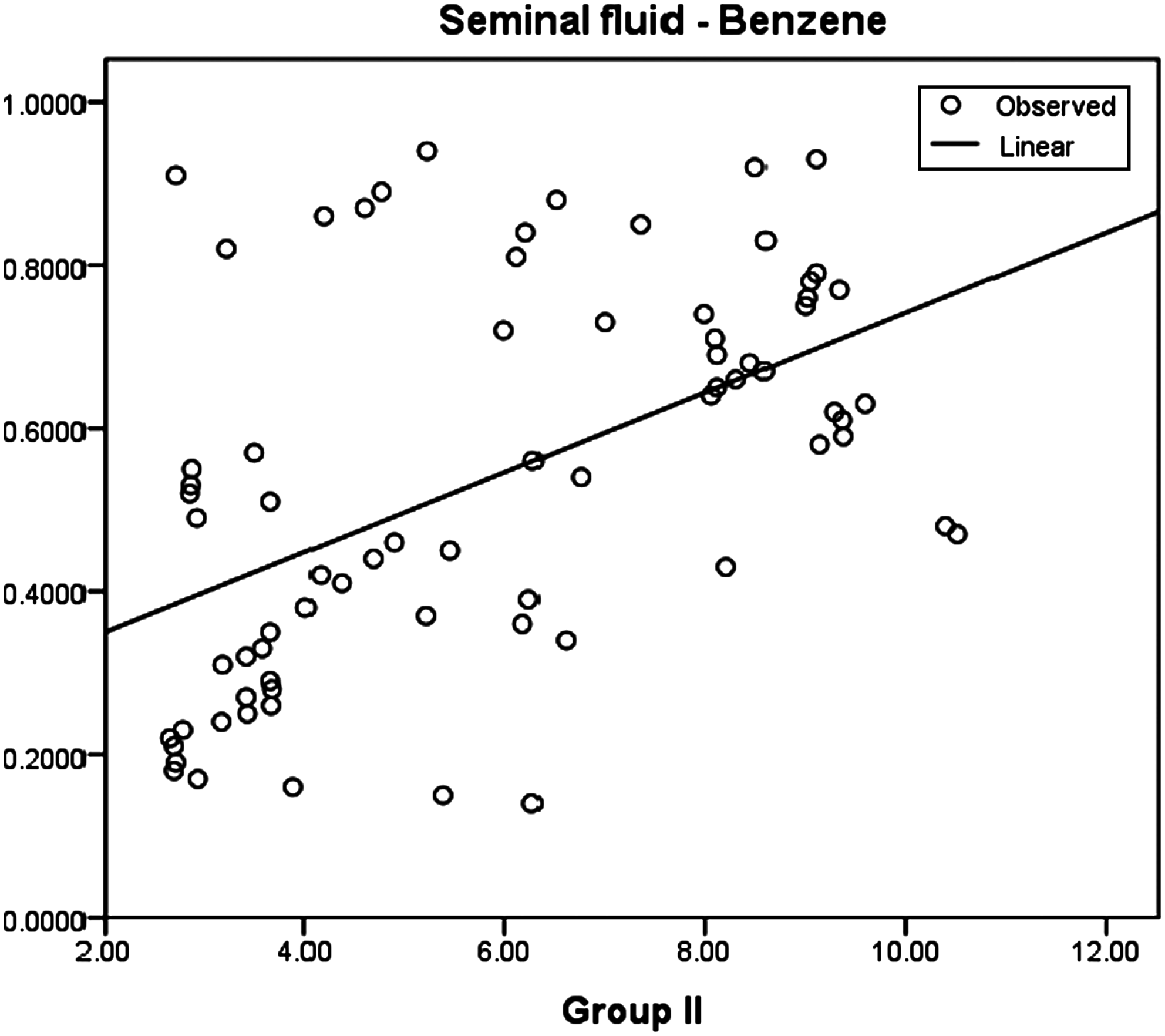
Regression plot of seminal fluid-benzene and sperm comet tail length parameters of the exposed industrial workers, Group-II (R-Square=0.261).
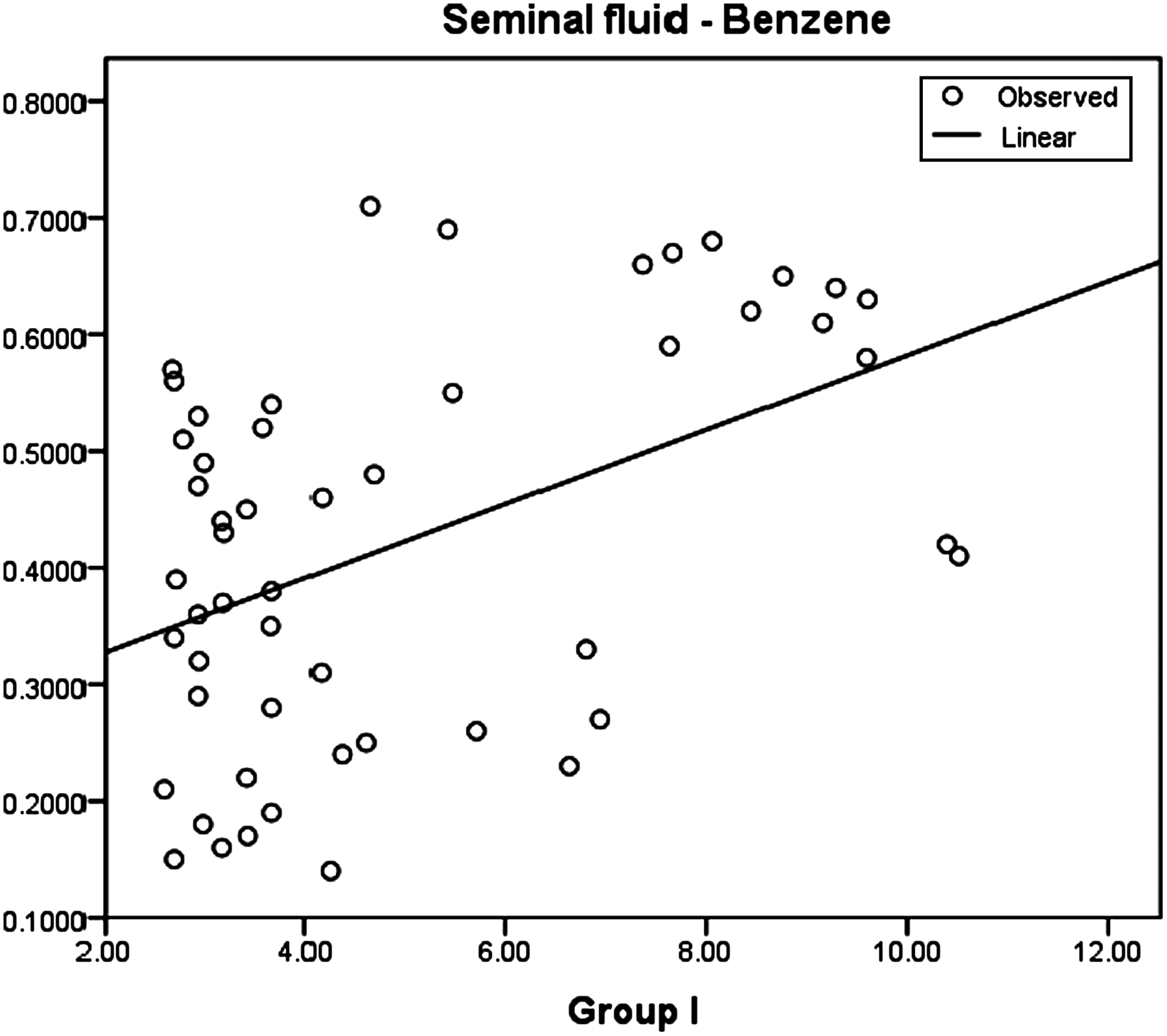
Regression plot of seminal fluid-benzene and sperm comet tail length parameters of the exposed industrial workers, Group-I (R-Square=0.213).
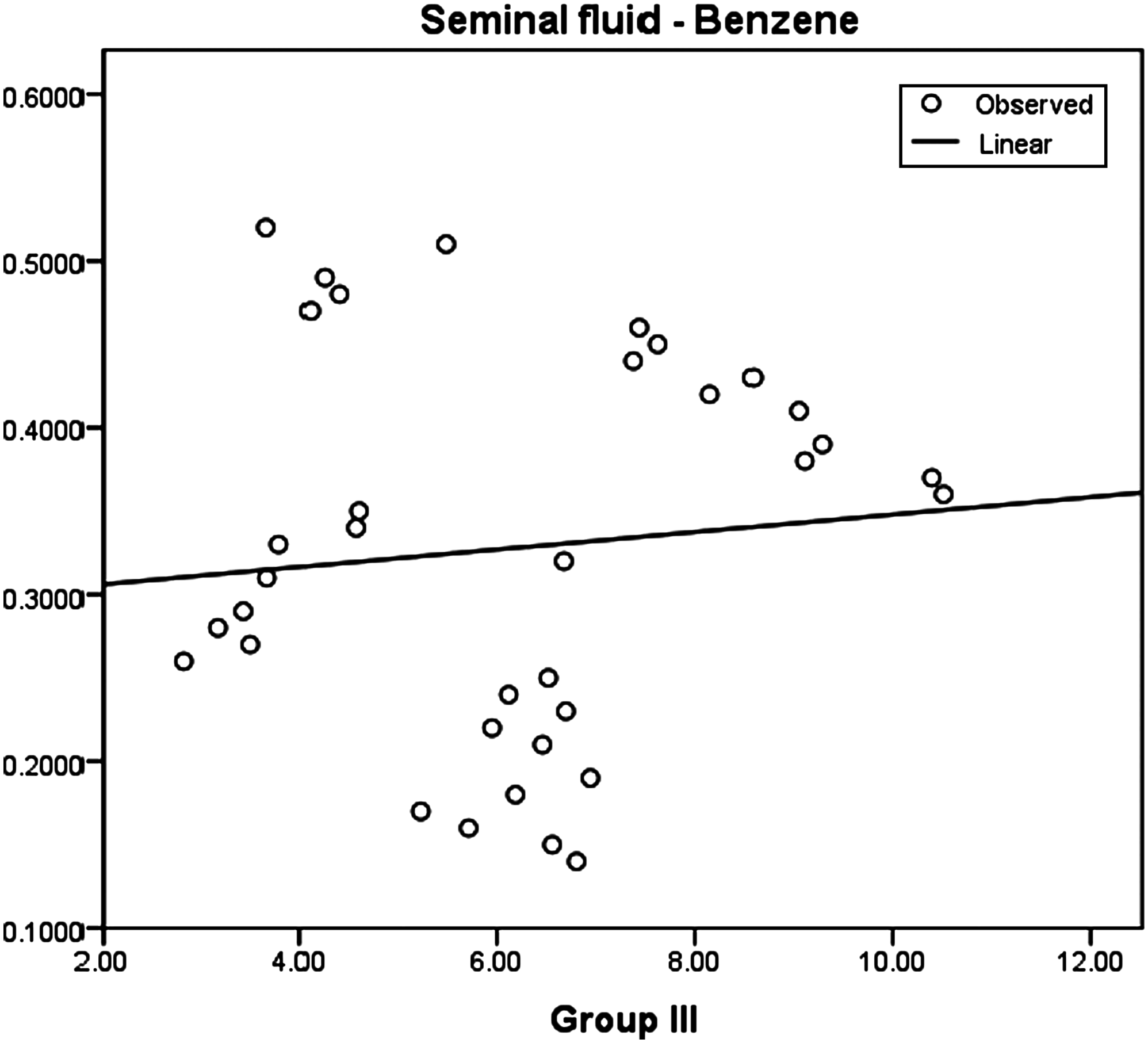
Regression plot of seminal fluid-benzene and sperm comet tail length parameters of the exposed industrial workers, Group-III (R-Square=0.009).
Values of sperm comet tail length expressed in μm.
Values are in mean±SD.
p<0.05.
p<0.05.
Discussion
In this age of growing industrialization, both environment and human health are a major concern. Occupational exposures to various risk factors are generally higher than environmental exposure (Eisler, 2003); male reproductive tract disorders have become an important public health issue, as they may cause miscarriages and abnormal outcomes in the offspring. In 20% of cases of couple infertility, the problem is predominantly male, and in up to 40% of men with sperm abnormalities, no specific etiological factor is found (Kretser, 1997). Many epidemiological studies were carried out to investigate the association between occupational exposure to solvents and the risk of male infertility. Our results support other studies which found that occupational exposure to solvents significantly increased the risk of male infertility (De Fleurian et al., 2009; Kurinczuk and Clarke, 2001). The concept of cumulative benzene exposure for the working population should be well understood before one can address levels of exposure. It is also important to remember that although many of the material safety data sheets of industrial solvents do not indicate the presence of benzene, scientific papers published in that regard clearly indicate that industrial solvents contain benzene and cannot be produced without benzene contamination. Kopstein (2006) further detailed the sources of benzene in industrial solvents. From the data, it was observed that the ambient air quality levels are above the permissible limits. The reported value for benzene in our study by the Andhra Pradesh Pollution Control Board was 6.29 μg/m3, which is crossing the NAAQS (National Ambient Air Quality Standards) permissible levels and has toxic effects on the biological organization. Sato and Nakayama (1985 and 1978) reported that the rate of absorption of organic solvents in the lungs and distribution of various tissues including endocrine glands are variable and depend on the blood-gas and fat-blood partition coefficients.
There are many ways by which solvents can affect human fertility; since organic solvents are volatile in nature, they can pass the blood-testis barrier and show adverse reproductive and/developmental effects. Therefore, organic solvents such as benzene can easily cross the lipid membrane barrier and, hence, appear in the blood and semen. Semen quality in workers exposed occupationally to hydrocarbons such as toluene, benzene, and xylene present anomalies, including alterations in viscosity, liquefaction capacity, sperm count, sperm motility, and the proportion of sperm with normal morphology compared with unexposed men (De Rosa et al., 2003). Similarly, exposure to solvents may affect human seminal quality (Jensen et al., 2006) proportionally with the range of exposure (Cherry et al., 2001).
The investigated results showed that there was no significant alteration in macroscopic semen parameters as against the controls in occupationally exposed benzene workers. There is a statistical difference in microscopic semen parameters between the control samples and the samples obtained from industrial workers. A duration-dependent decrement in total sperm count and motility was observed followed by a duration-dependent increment in abnormal sperm morphology among the benzene-exposed industrial workers as compared with the respective control group. These observations were supported by the findings of De Celis et al. (2000), while there are no significant alterations in semen volume, semen pH, and semen liquefaction time among the control group and industrial workers. Increased frequencies of abnormal sperm morphology were observed as the increase in the duration of the service or exposure in industrial workers. Our findings were in corroboration with the previous observations (Zhao et al., 2004; Song et al., 2005). The results also reveal that decreased sperm count, sperm motility, and increased abnormal sperm morphology were associated with occupational exposure to benzene in workers of the bulk drug industry Further, the results are in agreement with Wang et al. (2000), who reported that exposure to a low concentration of benzene may be correlated with the declined quality of semen in occupational workers.
Integrity of intact DNA molecules in the biological systems is essential for proper functioning; evaluation of sperm health became more important in evaluating male infertility. In the present study, we observed that mean tail length was significantly longer in benzene-exposed groups when compared with controls. Environmental or occupational exposure can also lead to abnormal reproductive outcomes by altering the integrity of genetic material, at the chromosome or DNA level, in male germ cells (Wyrobek, 1993). Many reports suggested that sperm DNA damage was related to fertilization and pregnancy (Zini et al., 2001; Henkel et al., 2004). The sperm DNA damage is an important step from spermatogenesis to malfunctions such as infertility, especially in the bulk drug industrial workers; hence, the extent of DNA damage in sperms was studied by using the comet assay technique. The comet assay is frequently used in biomonitoring to detect the genotoxic effect in the humans exposed at the work place in their environment.
Footnotes
Acknowledgments
The authors are thankful to the Institutional Ethics Committee (College for Women, Osmania University, Hyderabad) who had approved their research work. They are grateful to the industrial workers and control group who had volunteered and came forward to donate their samples, without whose cooperation the study would have been incomplete. They are also thankful to the administrative management of the industry for their support.
Disclosure Statement
No competing interests exist.