




Abstract
Aims: Association studies of ERCC1 19007T>C polymorphism and lung cancer have yielded inconsistent results, possibly because single studies often lack sufficient statistical power. Methods: We examined the association by performing a meta-analysis. Two investigators independently searched the Google Scholar, PubMed, and CNKI Databases. Summary odds ratios (ORs) and 95% confidence intervals (95% CIs) for 19007T>C polymorphism and lung cancer were calculated in a fixed-effects model and a random-effects model, when appropriate. Publication bias was evaluated using Begg's funnel plot. Results: Overall, the meta-analysis included 7 case-control studies for each polymorphism with 3840 confirmed lung cancer cases and 4712 healthy controls in total. Meta-analysis results showed a significant association between 19007T>C polymorphism and lung cancer risk (CC vs. TT: OR=0.72, 95% CI 0.53-0.99; CT vs. TT: OR=0.84, 95% CI 0.73-0.98; Dominant model: OR=0.70, 95% CI 0.52-0.95). Further stratified analyses conducted by ethnicity reveal a statistically significant association in Asians (Dominant model: OR=0.63, 95% CI 0.43-0.93), but no significant association in Europeans. Conclusions: This meta-analysis suggests that the ERCC1 19007T>C polymorphism may be associated with lung cancer risk in Asians, while larger scale association studies are necessary to further validate the association of 19007T>C polymorphism with lung cancer risk.
Introduction
L
Lung cancer patients have been found to have a lower DNA repair capacity compared with healthy individuals (Shen et al., 2003). DNA repair proteins of the nucleotide excision repair pathway (e.g., [ERCC1] protein responsible for recognition of DNA damage and removal of the damaged nucleotides in nucleotide excision repair) have been extensively studied as potential biomarkers of lung cancer. The ERCC1 gene is located on chromosome 19 and is an important member of the nucleotide excision repair gene family. The ERCC1 coding region is 1.1 kb long and comprises 10 exons. Deficits in DNA repair capacity may lead to genetic instability and carcinogenesis. Therefore, SNPs in the ERCC1 gene may be associated with increased risk of lung cancer.
A common polymorphism of the ERCC1 gene is the 19007T>C polymorphism (Asn118Asn, a C to T transition at nucleotide 33 of exon 4, codon 118, without amino acid change-Asn/Asn, rs11615). To date, the 19007T>C polymorphism has been shown to be linked to susceptibility to lung cancer in some studies, not in others. Thus, it may or may not serve as a possible risk factor for lung cancer. In the present study, we investigated whether or not the 19007T>C polymorphism is associated with lung cancer risk by performing a meta-analysis (Chen et al., 2011).
Methods
Search strategy
The data were independently gathered in duplicate by two investigators on the basis of a standard protocol (Fuyi Xie and Qi Sun). If there was discrepancy between them, it was settled by discussion until a consensus was reached. We searched for relevant publications using the terms “ERCC1,” “19007T>C,” “genetic susceptibility,” “SNP,” “lung cancer,” “polymorphism,” “variation,” or “rs11615” in Google Scholar, PubMed, and CNKI Databases, and all eligible studies published up to June 2013. The reference lists of major textbooks, reviews, and included articles were identified through manual searches to find potentially eligible studies. Studies reported by the same authors were checked for possible overlapping participant groups.
Inclusion criteria
The titles and abstracts of all citations identified by the literature search were reviewed. Selection criteria were then applied to all potentially relevant studies. The following inclusion criteria were used: (1) case-control studies that addressed lung cancer cases and healthy controls; (2) studies that evaluated the association between 19007T>C polymorphism and lung cancer risk; (3) all patients with clinically diagnosed lung cancer; (4) studies that included sufficient genotype data for extraction; and (5) healthy controls were in Hardy-Weinberg equilibrium (HWE). In addition, the following exclusion criteria were also used: (1) not case-control studies that evaluated the association between T19007T>C polymorphism and lung cancer risk; (2) animal studies; (3) studies that were based on incomplete raw data or no usable data reported; (4) duplicated publications; and (5) healthy controls were not in HWE.
Data extraction
The following data were extracted: the name of the first author, publication year, area of origin, ethnicity of the population, number of patients and controls enrolled in the study, genotype distribution in cancer cases and controls, and evidence of HWE in controls. Different ethnicities were categorized as Caucasians and Asians. For conflicting evaluations, an agreement was reached following a discussion.
Statistical analyses
We tested whether genotype frequencies of controls were in HWE using the χ2 test. The strength of the association between T19007T>C polymorphism and lung cancer risk was measured by odds ratios (ORs), whereas a sense of the precision of the estimate was given by 95% confidence intervals (95% CIs). We examined T19007T>C polymorphism using the additive (CC vs. TT; CT vs. TT), dominant (CC+CT vs. TT), and recessive models (TT+CT vs. CC), which were all calculated by the fixed-effects model or random-effects model. A Q-test was performed to evaluate between-study heterogeneities, and I2 values of 25%, 50%, and 75% were defined as low, moderate, and high estimates, respectively (3). Subgroup analysis based on race was used to explore and explain the diversity among the results of different studies. In addition, sensitivity analysis was carried out by including only large studies (sample size >500 subjects) to assess the stability of the results. Begg's funnel plot was investigated to assess publication bias (p<0.05 was considered statistically significant). In this study, we used the Stata software version 12.0 (Stata Corporation, College Station, TX) to carry out the meta-analysis.
Results
Study characteristics
The search strategy retrieved 135 potentially relevant articles from Google Scholar, PubMed, and CNKI Databases. According to the inclusion criteria, nine eligible studies were included in this meta-analysis and 121 studies were excluded. The flow chart of the study selection is summarized in Figure 1 (Zhou et al., 2005; Matullo et al., 2006; Yin et al., 2006; Zienolddiny et al., 2006; Vogel et al., 2007; Yin et al., 2008; Zhang et al., 2008; Yin et al., 2009; Deng et al., 2011). These 9 selected case-control studies included 3840 lung cancer cases and 4712 healthy controls. All studies were case-control studies that evaluated the association between T19007T>C polymorphism and lung cancer risk. The publishing year of the included studies ranged from 2005 to 2011. The HWE test was performed on the genotype distribution of the controls in all included studies, all of them proved to be in HWE (p>0.05). Table 1 provides the general characteristics of the studies. Of these studies, three reported on Caucasians and six reported on Asians.
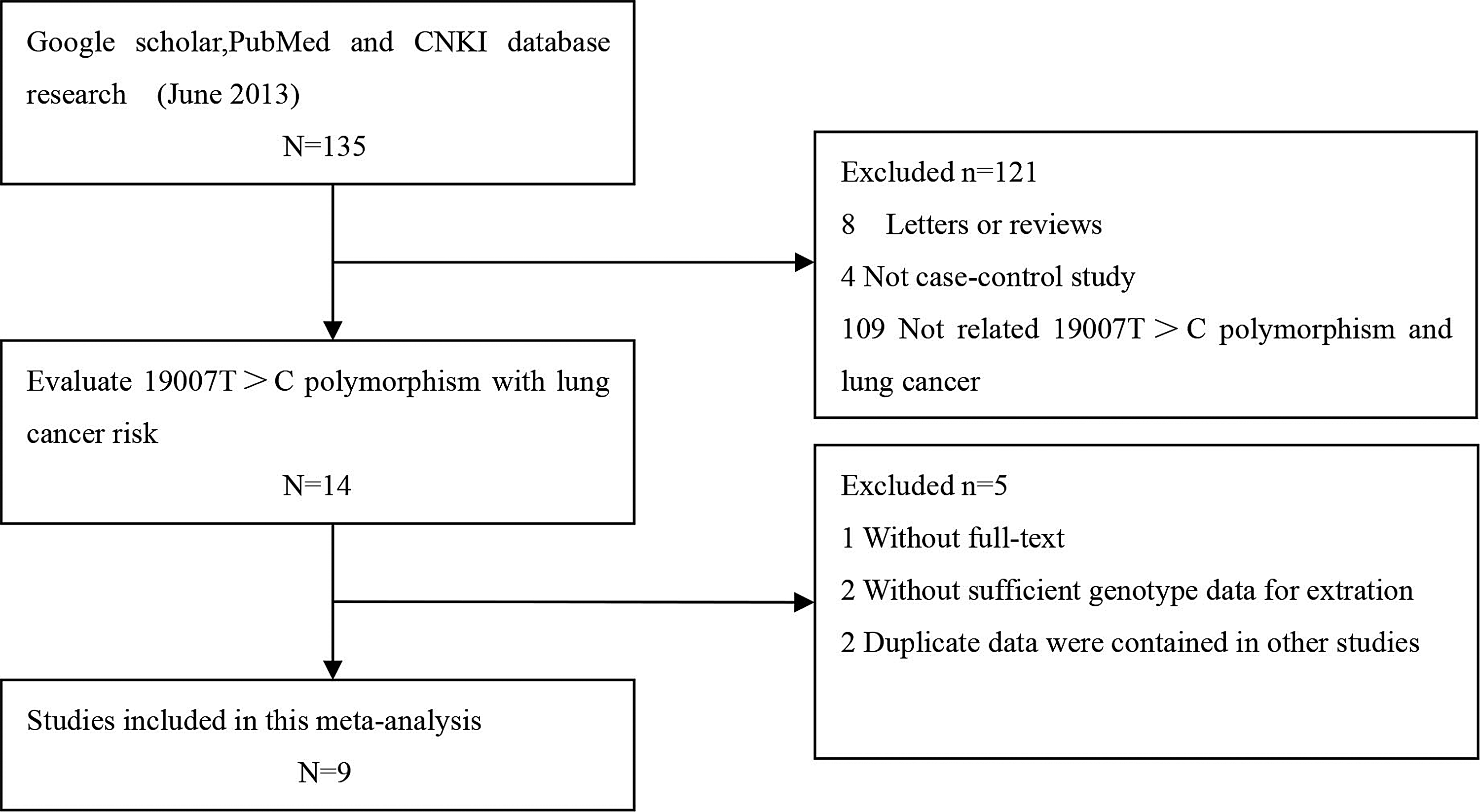
Flowchart showing study selection procedure.
HWE, Hardy-Weinberg equilibrium.
Quantitative synthesis
A summary of the meta-analysis findings of the association between ERCC1 T19007T>C polymorphism and lung cancer is provided in Table 2. Meta-analysis results showed significant associations between T19007T>C polymorphism and lung cancer risk (CC vs. TT: OR=0.72, 95% CI 0.53-0.99; CT vs. TT: OR=0.84, 95% CI 0.73-0.98; Dominant model: OR=0.70, 95% CI 0.52-0.95). On the basis of the potential overestimation of the true effect of the polymorphism on the lung cancer risk, we stratified these studies according to ethnicity. In the subgroup analysis based on ethnicity, the included studies were divided into Caucasian and Asian populations; a significantly increased risk was observed in the Asian populations (Dominant model: OR=0.63, 95% CI 0.43-0.93). Moreover, when limiting the analysis to the study sample size (>500), we detected no significant association between T19007T>C polymorphism and lung cancer (Fig. 2).
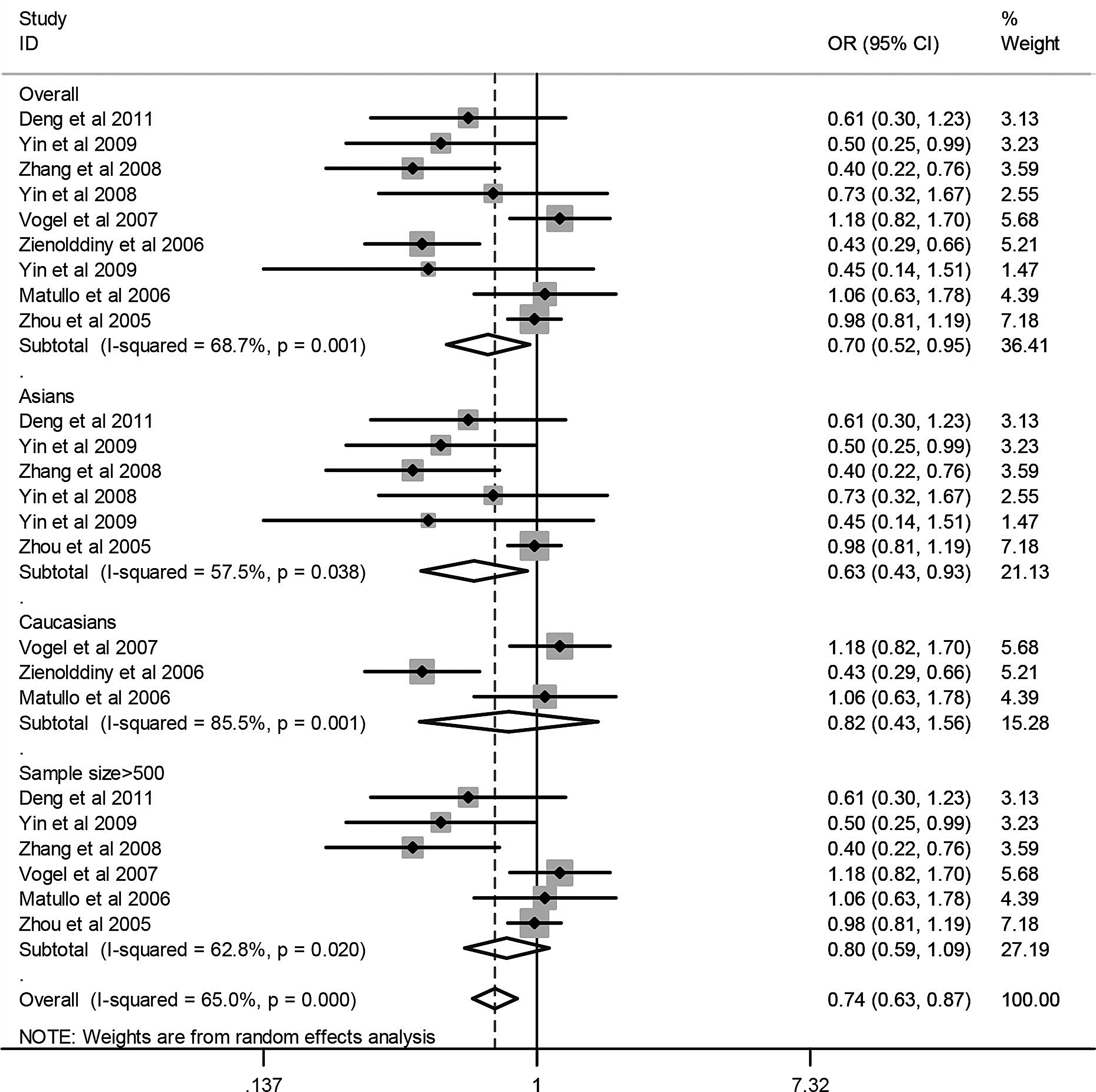
Forest plot of lung cancer risk associated with the ERCC1 19007T>C polymorphism for the dominant model. The squares and horizontal lines correspond to the study-specific odds ratios (ORs) and 95% confidence intervals (CIs).
CI, confidence interval; OR, odds ratio.
Publication bias
Publication bias in the literature was accessed by Begg's funnel plot. All graphical funnel plots of the included studies appeared to be symmetrical. The results of the Begg funnel plot suggest no evidence of publication bias in the overall and subgroup populations (all p>0.05). Information concerning the Begg's funnel plot is given in Figure 3 and Table 2.
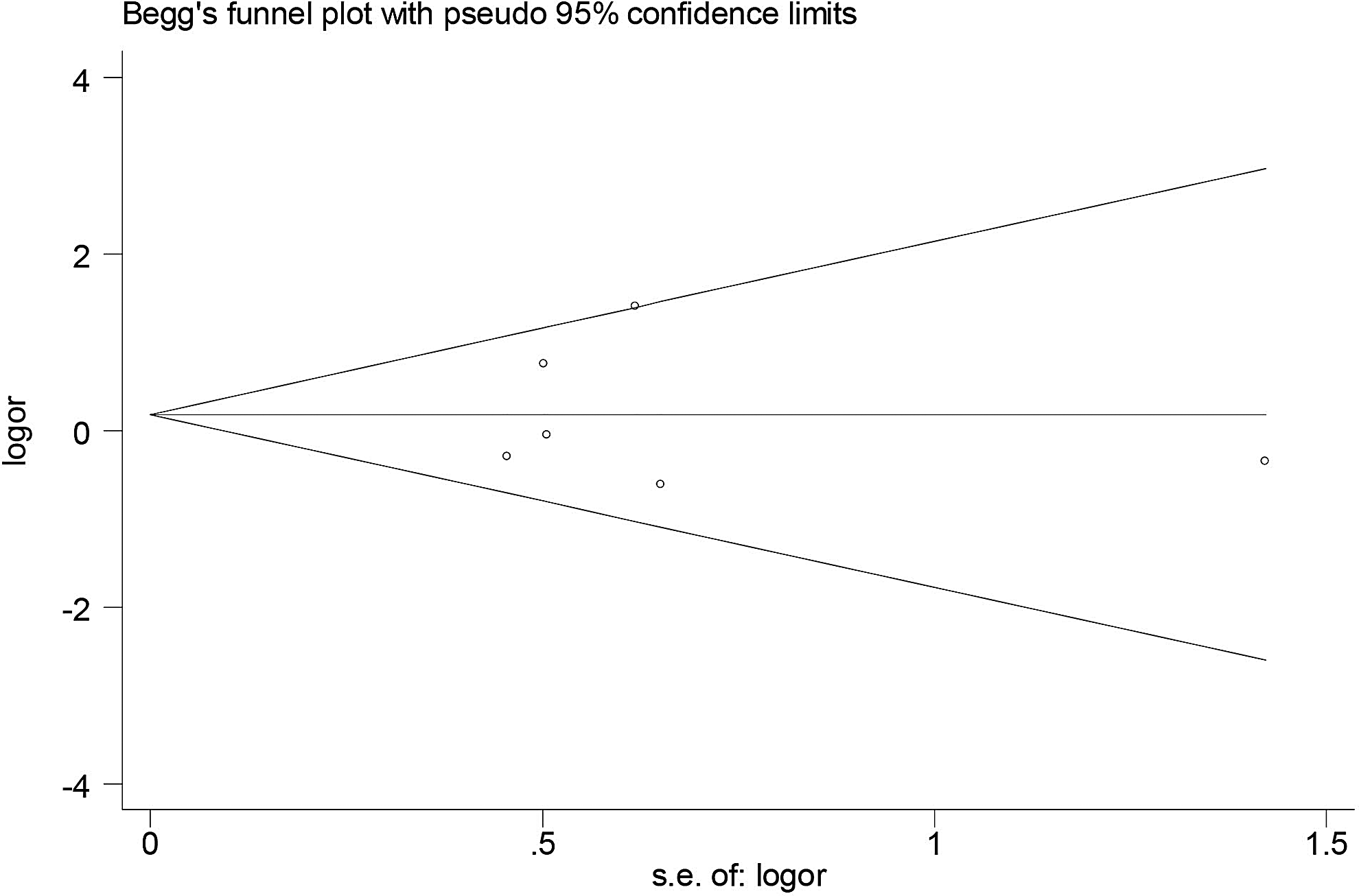
Funnel plot of ERCC1 19007T>C polymorphism and susceptibility of lung cancer for the dominant model.
Discussion
ERCC1 functions include DNA damage recognition and DNA strand incision. As is known, genetic polymorphisms altering the level of protein expressed would be anticipated to have a substantial influence on the disease activity (Tahara et al., 2009). A few epidemiological studies have investigated the association between ERCC1 polymorphisms and various cancers (Sturgis et al., 2002; Nexo et al., 2003). In addition, the ERCC1 19007T>C polymorphism was associated with basal cell carcinoma and breast cancer (Rockenbauer et al., 2002; Nexo et al., 2003). To date, although several research studies have evaluated the association between 19007T>C polymorphism and lung cancer, the specific association is still controversial. Our meta-analysis quantitatively assessed the association between 19007T>C polymorphism and susceptibility to lung cancer. Finally, 9 case-control studies were included and assessed, involving a total of 3840 lung cancer cases and 4712 healthy controls. We did not find any relevant article from the databases for healthy controls, which were not in HWE. Meta-analysis results showed significant associations between T19007T>C polymorphism and lung cancer risk (CC vs. TT: OR=0.72, 95% CI 0.53-0.99; CT vs. TT: OR=0.84, 95% CI 0.73-0.98; Dominant model: OR=0.70, 95% CI 0.52-0.95). In the subgroup analysis by ethnicity, a significant association was found between 19007T>C polymorphism and lung cancer risk in Asians (Dominant model: OR=0.63, 95% CI 0.43-0.93) and no correlation was found in Caucasians, suggesting a possible role of ethnic differences in genetic backgrounds and the environment in which they lived. Also, our meta-analysis involved several small-sample studies. There may be a selective bias for the relationship between 19007T>C polymorphism and lung cancer development, so the association should be reevaluated in studies with large sample sizes. Moreover, when limiting the analysis to the study sample size (>500), this meta-analysis detects no significant association, suggesting there may well be small-study bias in our meta-analysis. Therefore, the results should be interpreted with caution; further genetic association studies that involve very large numbers of cases and controls are needed to provide conclusive evidence on the effects of 19007T>C polymorphism on risk of lung cancer.
The mechanism of how 19007T>C polymorphism relates to lung cancer risk is still unclear. The silent 19007T>C polymorphism has been associated with differential mRNA levels and mRNA levels of ERCC1 may correlate with DNA repair capacity (Park et al., 2001). In addition, potential function of 19007T>C polymorphism might be affected through gene-gene and gene-environment interactions; the ERCC2 751C, 312A, and ERCC119007T>C alleles have been found to be in linkage disequilibrium, and the haplotype was associated with increased risk of lung adenocarcinoma among nonsmoking females (Yin et al., 2009). Furthermore, cigarette smoking may induce DNA damage; a gene-smoking interaction was found for the 19007T>C polymorphism, although the interaction was not statistically significant (Zhou et al., 2005). Except for one study that could not be included in our meta-analysis, further studies of gene-gene and gene-environment interactions should be taken into consideration for assessment of lung cancer risk.
Some limitations of this meta-analysis should be acknowledged. First, our systematic review was based on unadjusted data, as the genotype information stratified for the main confounding variables was not available in the original articles, and also, the confounding factors addressed across the different studies were variable. Second, we were not able to address all the sources of heterogeneity that existed among studies for most polymorphisms, although we could have made subgroup stratification analysis for the limited number of published studies. Finally, because of incomplete raw data or publication limitations, some relevant studies could not be included in our analysis.
In conclusion, our study indicates that the 19007T>C polymorphism was associated with risk of lung cancer in Asians. Gene-gene and gene-environment interactions should be investigated in further studies.
Footnotes
Author Disclosure Statement
No competing financial interests exist.