




Abstract
Aim: The genetic polymorphisms of the alcohol metabolizing enzymes alcohol dehydrogenase 1B (ADH1B) rs1229984 may modulate individual differences in alcohol oxidizing capability. A case-control study was conducted to evaluate the genetic effects of these functional single-nucleotide polymorphisms on the development of esophageal cancer. Methods: Here, a total of 1001 esophageal squamous cell carcinoma (ESCC) cases and 1391 controls were recruited. Genotypes were determined by DNA sequencing. Differences in the distributions of demographic characteristics, selected variables, and genotypes of ADH1B rs1229984 variants between cases and controls were evaluated using the χ2 test. Associations between ADH1B genotypes and the risk of esophageal cancer were estimated by computing the odds ratios (ORs) and their 95% confidence intervals (CIs) using logistic regression analyses for crude ORs and adjusted ORs when adjusting for age, gender, and tobacco use status. Results: There were no significant differences between ESCC patients and controls in terms of age and sex distributions, suggesting that the frequency matching was adequate. However, significantly, more smokers were presented among the ESCC cases than among controls (63.1% vs. 49.2%; p=2.14×10⁻¹¹). Smokers had an increased risk for developing ESCC (adjusted OR=2.17, 95% CI=1.78-2.64). This result clearly indicated that smoking is a risk factor for the ESCC in our study population. We found that subjects carrying the rs1229984 GG genotype had significantly increased risk of ESCC (adjusted OR, 2.81; 95% CI, 2.18-3.62; p=1.05×10⁻¹⁵) compared with the AA genotype. Conclusion: The functional polymorphisms ADH1B rs1229984 may contribute to susceptibility to esophageal cancer.
Introduction
E
Due to the biological and pathological significance of ADH1B, functional genetic variations in the ADH1B gene may contribute to the development of esophageal cancer. We evaluated the association between the ADH1B genotypes and susceptibility to esophageal cancer in a hospital-based case-control study. Genotyping analyses were conducted for the SNP with 1001 ESCC cases and 1391 controls in a Chinese population.
Materials and Methods
Patient samples
All persons have provided their informed consent before their inclusion in the study, and all human studies have been approved by the China Ethics Committee and performed in accordance with the ethical standards. The case-control cohort of this study has been described elsewhere previously. Briefly, patients were consecutively recruited between July 1999 and July 2004 at the Chinese Academy of Medical Sciences Cancer Hospital (Beijing). All patients with histopathologically confirmed ESCC were enrolled, and there was no sex and age restriction. Controls were cancer-free individuals randomly selected from a community cancer screening program for early detection of cancer based on a physical examination. Controls had no individual history of cancer and were frequency matched to patients for sex and age. At recruitment, each participant was personally interviewed to obtain detailed information on demographic characteristics, lifetime history of cigarette use, and family history of cancer. This study was approved by the Institutional Review Board of the Chinese Academy of Medical Sciences Cancer Institute. This study examined the association between rs1229984 and risk of ESCC in 1001 ESCC cases/1391 controls. The Odds ratios (OR) and 95% confidence intervals (CIs) were estimated by logistic regression.
Isolation of genomic DNA
Blood from the esophageal cancer and normal control groups was extracted within 1 week after being collected and tested without anticoagulant treatment of blood clots. Purification of genomic DNA used the following procedure: The samples were resuspended in 0.8 mL of lysis buffer (containing 10 mM Tris-HCl [pH 8.0], 0.1 M EDTA, 20 mg/mL pancreatic ribonuclease, 0.5% SDS) and incubated with proteinase K (final concentration 100 mg/mL) at 37°C for 1h and then mixed with equal volume of Tris-HCl saturated phenol (pH7.8), and centrifuged at 5000 g for 15 min. Then, the aqueous phase was harvested with an equal volume of equilibrated phenol:chloroform by centrifugation. DNA was precipitated using a 10% volume of ammonium acetate and two volumes of ethanol. DNA pellets were washed twice in 70% ethanol, air-dried at room temperature, and dissolved in the TE buffer (10 mM Tris-HCl, 1 mM EDTA, pH 8.0). The DNA concentration and purity were determined by OD260 and OD280 and their ratio. High concentration (>100 ng/μL) genomic DNA was directly used for the PCR.
Genotyping
The ADH1B rs1229984 gene was genotyped by the PCR-RFLP method. PCR primers used to amplify the rs1229984 gene were 5′-agaaacacaatttcaggaatttgggt-3′ (forward primer) and 5′-actaaccacgtggtcatctgcg-3′ (reverse primer). PCR cycling conditions were 2 min at 95°C followed by 30 cycles at 94°C for 30 s, 58°C for 30 s, 72°C for 30 s, and 72°C for 7 min. The PCR products were digested with restriction endonuclease (New England BioLabs, Inc., Beverly, MA) and then subjected to separation on a 3% agarose gel stained with ethidium bromide. After electrophoresis, the products were sequenced by ABI (Applied Biosystems) 3730XL in BGI (Beijing Genomics Institute) China. For quality control, repeated analyses were conducted for 15% of randomly selected samples.
Statistical analysis
Differences in the distributions of demographic characteristics, selected variables, and genotypes of ADH1B rs1229984 variants between cases and controls were evaluated using the χ2 test. Associations between ADH1B genotypes and the risk of esophageal cancer were estimated by computing the ORs and their 95% CIs using logistic regression analyses for crude ORs and adjusted ORs when adjusting for age, gender, and tobacco use status. The Hardy-Weinberg equilibrium (HWE) was tested by a goodness-of-fit χ2 test to compare the observed genotype frequencies to the expected among the control subjects. All statistical analyses were conducted using SAS 9.1.3 software (SAS Institute, Cary, NC).
Results
Characteristics of the study population
Among the 1001 ESCC cases and the 1391 controls with DNA samples, genotyping of ADH1B rs1229984 was successful in 996 (99.6%) cancer cases and 1384 (99.5%) controls. Characteristics of cases and controls are summarized in Table 1. Cases and controls appeared to be adequately matched in term of gender and age as suggested by the χ2 tests (p=0.69 and 0.46, respectively). The table also shows that the prevalence of smoking was higher in the esophageal cancer patients than in the control subjects (63.1% vs. 49.2%, p=2.14×10⁻¹¹) with smoking status adjusted OR of 2.17 (95% CI=1.78-2.64). The result shows that smoking is an independent risk factor for the incidence of esophageal cancer.
Two-sided χ2 test.
ESCC, esophageal squamous cell carcinoma.
Associations between ADH1B rs1229984 polymorphisms and the risk of esophageal cancer
Genotyping of the ADH1B rs1229984 SNP was successfully sequenced in all subjects. Some of the results from the regenotyped samples matched that from original ones completely (Fig. 1). The distribution of ADH1B rs1229984 SNP (Fig. 2) was not correlated with gender and age both in ESCC patients or healthy controls (data not shown). The genotype distribution in control population was in agreement with those expected under HWE. Table 2 showed the frequency of the ADH1B rs1229984 allele gene and distribution of genotype in the esophageal cancer and control groups (Table 2). In the esophageal cancer group, the proportion of allele A and G was 57.6% and 42.4%, while in the control group they accounted for 68.4% and 31.6% (p=1.69×10⁻¹⁴). The percent of ADH1B rs1229984 in the esophageal cancer group was 37.7% (AA), 39.9% (AG), and 22.4% (GG), however, 47.7% (AA), 41.5% (AG), and 10.8% (GG) (p=1.40×10⁻¹⁴), respectively, in healthy controls. Logistic regression analysis showed that subjects carrying the rs1229984 GG genotype had significantly increased risk of ESCC (adjusted OR, 2.81; 95% CI, 2.18-3.62; p=1.05×10⁻¹⁵) compared with the AA genotype.
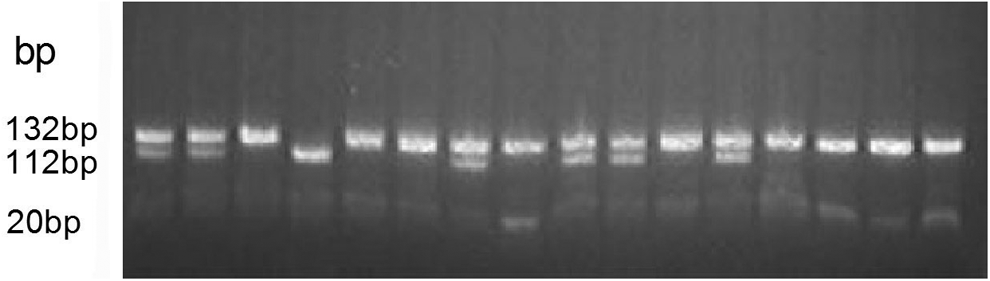
Electrophoresis of genomic DNA after restriction endonuclease digestion. Alcohol dehydrogenase 1B (ADH1B) rs1229984 A/A allele generated one fragment of ∼132 bp, G/G allele generated two bands of 112 and 20-bp, while the lanes containing both 132 and 112 fragments represent the allele A/G.
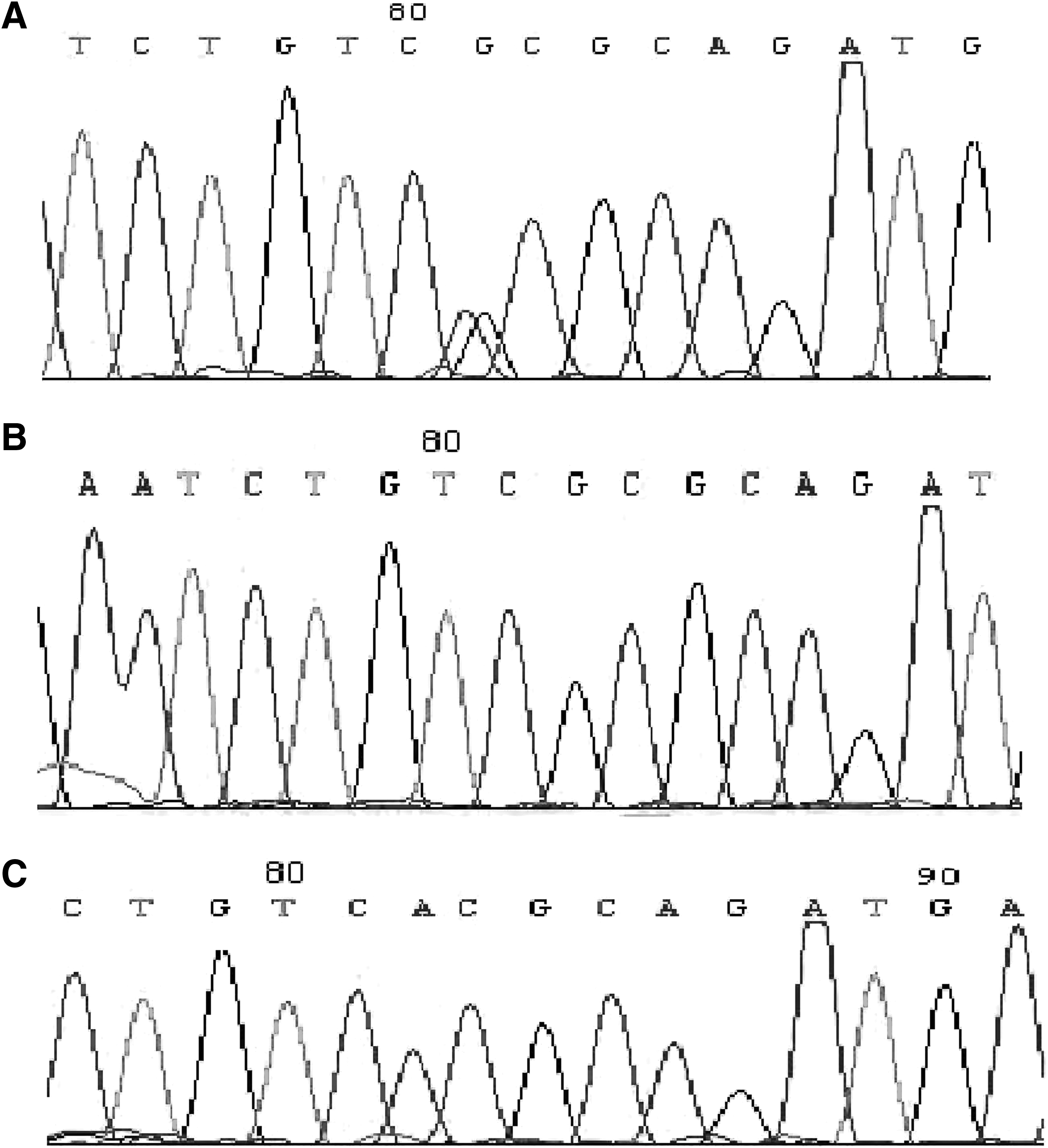
DNA sequencing of rs1229984 single-nucleotide polymorphism (SNP) in esophageal squamous cell carcinoma patients and healthy controls.
Data were calculated by logistic regression, adjusted for age, sex, smoking.
Tests for trend of odds within genotypes of AA, AG, GG were two-sided and based on likelihood ratio tests assuming a multiplicative model.
OR, odds ratio; CI, confidence interval; ADH1B, alcohol dehydrogenase 1B.
Discussion
ESCC has been reported to account for >90% of the cases and researches have shown it is associated with environmental carcinogens and complex genetic regulation and variations. Alcohol consumption and tobacco smoking have been demonstrated as the two main environmental factors for ESCC (Lee et al., 2008; Toh et al., 2010). Over 80% patients of ESCC in developed countries are considered to be related with smoking or drinking (Van Zanten et al., 2013).
How genetic variants such as ADH relate to average alcohol consumption or circulating ethanol levels deserve our attention. ADHs catalyze the oxidation of alcohols to aldehydes, which are low Km (Michaelis constant)-class enzymes (Mardh and Vallee, 1986; Kayaalti and Soylemezoglu, 2010). There are five ADH classes existing in humans (Matsushima, 1995) and functional polymorphisms of the ADH1B and ADH1C genes producing isoenzymes with different maximal activities (Vmax) and affinities for ethanol. One coding variant in ADH1B is rs1229984, which leads to the replacement of Arg48 with His48, is common in Asian populations, and the enzymes with His48 oxidize ethanol ∼70- to 80-fold faster than those with Arg48, reducing the risk for alcoholism (Bierut et al., 2012). These results are consistent with the recent analysis and showed that AG (Arg/His) or AA (His/His) phenotype exhibited a higher activity compared to GG (Arg/Arg) (Gu et al., 2012).
In the highly developed region of ESCC in the Lin district, Henan province of China, it has been reported that the incidence of ESCC has dropped considerably from 1985 to 2002, which correlated with decreased exposure of nitrosamines and mycotoxins such as alternariol (AOH) and alternariol monomethyl ether (vitamin A and C also increased significantly). ECSS is the interaction of the external and internal factors. The disruption of the balance will contribute to the tumorgenesis. Because many tumors are correlated with the lack of these nutritional elements (Le Bricon et al., 1995; McLean et al., 2008), researchers have found that ethanol can competitively inhibit the oxidation of vitamin A, the oxidation of the which is the first step of ADH (including ADH1B) in its biological metabolism, which plays an important role in the differentiation and growth of cells (Vaglenova et al., 2003).
In the present study, we investigated whether the genetic polymorphism rs1229984 A/G of ADH1B was associated with risk of ESCC in a Chinese population. We observed a significant difference in the distributions of ADH1B rs1229984 A/G allele and genotype frequencies among ESCC patients and controls. Subjects carrying the rs1229984 GG genotype were at an increased risk for developing ESCC compared with subjects carrying the AA genotype. In the present study, we found that an ADH1B GG homozygote encoding less-active forms of ADH1B could significantly enhance the risk of ESCC. This polymorphism may play its role in developing cancer by altering the smoking behavior. Numerous studies have reported that the ADH1B A allele frequency is higher in nonsmoker than in smoker subjects with the ADH1B GG genotype encoding less-active enzymes having a higher risk of ESCC. These results suggest that ADH1B rs1229984 polymorphism is susceptible to developing ESCC.
Authors' Contributions
Bo Ye and Jian Feng carried out the molecular genetic studies, participated in the sequence alignment, and drafted the manuscript. Xiufeng Pan, Yu Yang carried out the immunoassays and participated in the sequence alignment. Ming Cheng and Heng Zhao participated in the design of the study and performed the statistical analysis. Chunyu Ji Yong Cheng and Jianxin Shi conceived the study, and participated in its design and coordination and helped draft the manuscript. All authors read and approved the final manuscript.
Footnotes
Author Disclosure Statement
The authors declare that there are no conflicts of interest.