




Abstract
Background: Several published articles investigated the relationship between a polymorphism −148C>T in the β-fibrinogen gene (FGB) and risk of ischemic stroke, and did not reach the same conclusion. To shed light on these inconclusive findings, we performed a meta-analysis of studies relating the FGB genetic polymorphism (−148C>T) to the risk of ischemic stroke. Methods: We identified articles by searching PubMed, EMBASE, Chinese National Knowledge Infrastructure databases (CNKI), and Wanfang database in China and by reviewing the references of retrieved articles. We included studies that reported odds ratio (OR) with 95% confidence interval (CI) for the association between the FGB −148C>T polymorphism and stroke risk. Data from eligible studies were extracted for meta-analysis. Stroke risk associated with FGB −148C>T polymorphism was estimated by pooled ORs and 95% CIs. The software Review Manager (version 5.2) was utilized for meta-analysis. Publication bias was tested by funnel plot. Results: Eighteen independent case-control studies containing 2159 ischemic stroke patients and 3222 control subjects were included. Our results showed that −148C>T polymorphism in the FBG gene was associated with increased risk of ischemic stroke ([TT+CT] vs. CC: OR=1.40, 95% CI [1.20-1.45], p<0.0001; T vs. C: OR=1.35, 95% CI [1.18-1.56], p<0.0001, respectively] by a meta-analysis. Conclusion: The results of our meta-analysis suggested that the−148C>T polymorphism in the FGB gene is a susceptibility marker of ischemic stroke.
Introduction
I
Materials and Methods
Literature search and selection
We carried out a publication search in PubMed, EMBASE, Chinese National Knowledge Infrastructure [CNKI], and Wanfang database in China, with the following search terms: [“fibrinogen” or “β-fibrinogen” or “FGB”] and [“cerebral infarction” or“stroke” or “brain infarction” or “cerebrovascular disease”] and [“SNP” or “polymorphism” or “mutation” or “genetics”] by two independent investigators. Publication language was restricted to English and Chinese, and the subjects were limited to Chinese in our search. By means of online retrieval and literature review, references obtained using the above-mentioned databases were reviewed again to ensure that no relevant studies were missed.
Selection criteria
Inclusion criteria were as follows: (1) independently published case-control or cohort studies on the relationship between FBG gene polymorphism and stroke; (2) with comprehensive statistical indicators directly or indirectly: odds ratio (OR) or relative risk values and 95% confidence interval (CI); and (3) similar themes and methods, that is, case-control or cohort studies about the relationship of the FGB gene polymorphism and stroke. Articles were excluded if relevant data were not available or there was heterogeneity of gene polymorphism in the control population. For the heterogeneity test method, we utilized the Q-test and I2 test of the RevMan 5.2 software.
Data extraction
Two reviewers independently evaluated the research design, enrolled patients, observation results of the literature, and selected trials according to the above-mentioned inclusion criteria. Inconsistencies were resolved through discussion. We used the Cochrane Handbook 5.2 quality evaluation criteria to assess the methodological quality of included studies such as study subjects and impact factors, the source of the cases and controls, matching age and gender. To determine the quality of data by the quality of ultimately determined literature, the useless ones were excluded, such as studies that have been reported repeatedly and those with poor quality or less information and having special selection of laboratory sample; relevant data were extracted from included articles. Because there is C or T allele in the
Statistical analysis
For each study, we first examined whether the genotype distribution in controls was consistent with the Hardy-Weinberg equilibrium (HWE) by a chi-square test. Meta-analysis was performed using RevMan 5.2 software provided by the Cochrane Collaboration. We used the Q-test and I2 test to examine the heterogeneity between each study. We used OR for efficacy analysis statistics. Using the heterogeneity test, if p>0.05, we selected the fixed-effects model, and if p<0.05, we selected the random-effects model to merge the OR. p<0.05 was considered as a significant difference. Analysis of sensitivity includes the difference of point estimation and CIs of the combined effects value of different models to observe whether it changes the result; poor quality articles were excluded or reanalyzed according to the quality evaluation criteria to determine whether it changed the findings. To test the publication bias, we used the RevMan 5.2 statistical software to make the funnel plot.
Results
Literature search
As shown in Figure 1, 476 studies were preliminarily detected, which includes 414 Chinese articles and 62 English articles; 404 articles were excluded because of duplicate publication and nonclinical-based research literature. Seventy-two studies appeared to be potentially relevant for inclusion in our study. Fifty-one studies were further excluded because they did not detect the
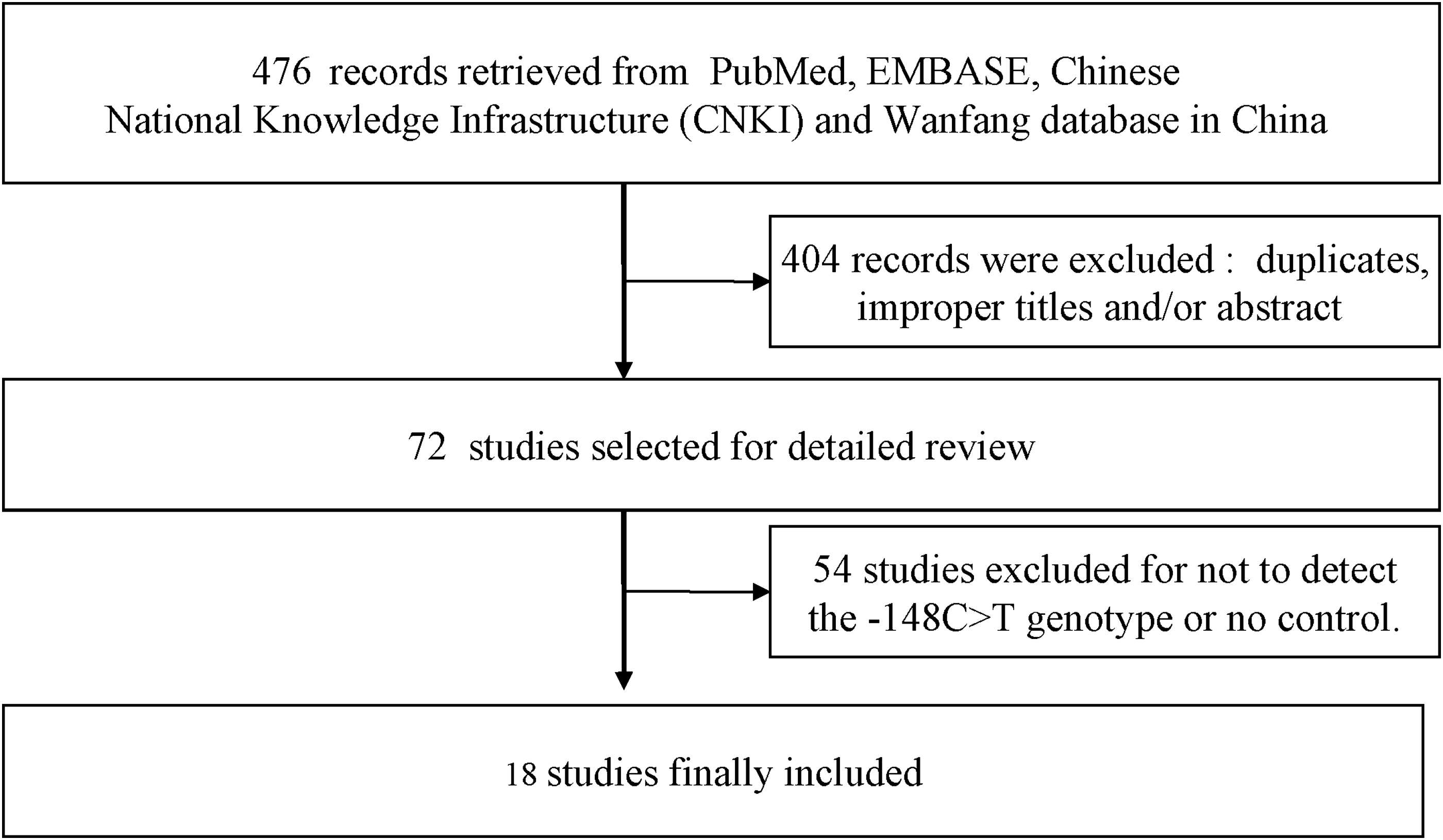
Flow diagram of study identification.
Study characteristics
The characteristics of included studies are summarized in Table 1. The 18 included studies were published between 2000 and 2010 and comprised a total of 2159 ischemic stroke cases and 3222 control subjects. All the subjects included in these studies were Chinese. A classic polymerase chain reaction assay was performed in all of these 18 studies. The genotyping method in all these studies was polymerase chain reaction-restriction fragment length polymorphism (PCR-RFLP), and the genotype distributions among the controls of all studies were in agreement with HWE.
PCR-RFLP, polymerase chain reaction-restriction fragment length polymorphism.
Meta-analysis
The association between
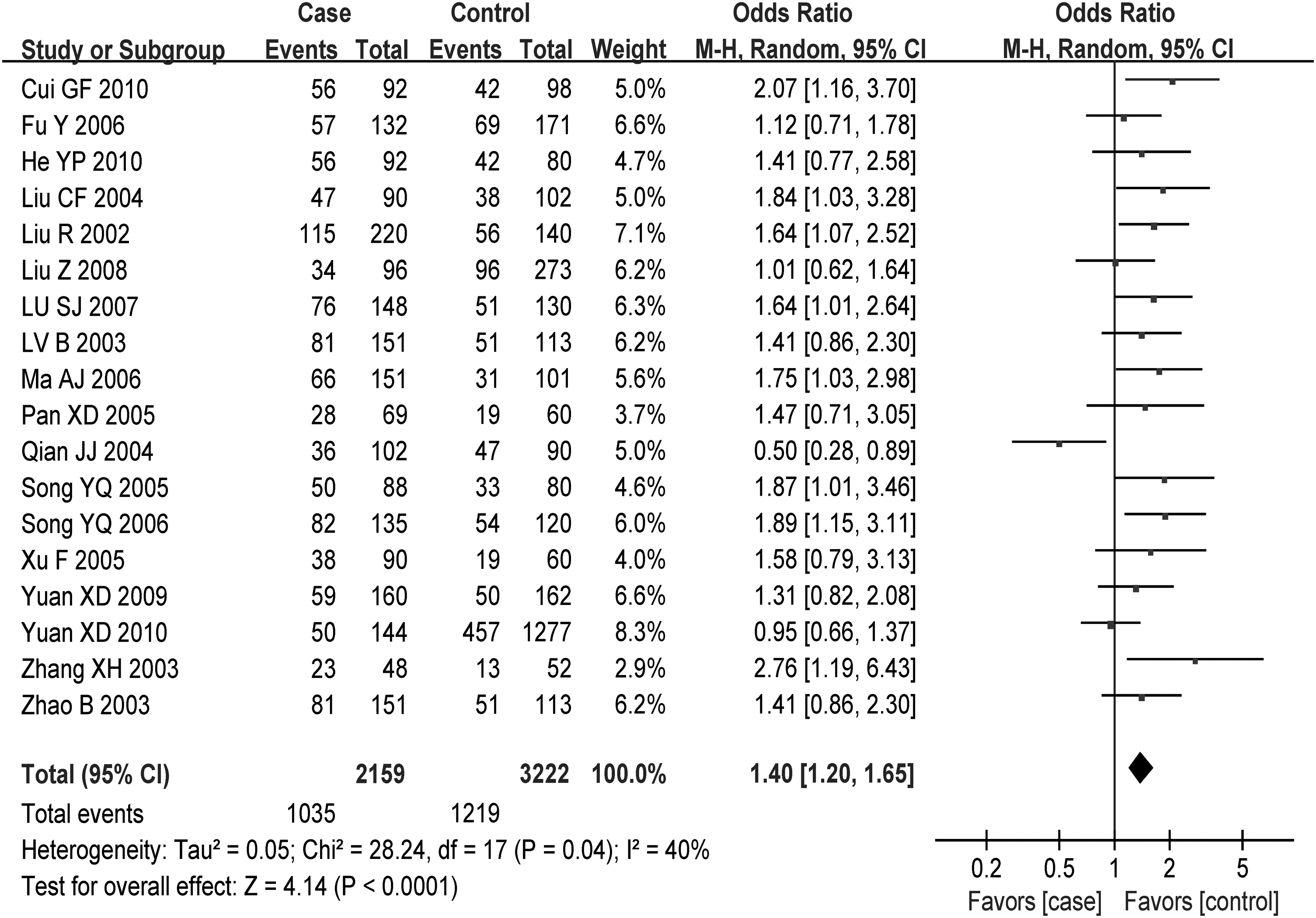
Forest plot of cerebral infarction and

Forest plot of cerebral infarction and
The heterogeneity test of the various studies revealed heterogeneous results (p=0.04, I2=40%; p=0.01, I2=48%); therefore, we used the random-effects model in the analysis. Overall, the association of FGB −148 TT/CT genotype with a higher risk of ischemic stroke was observed (OR=1.35, 95% CI [1.18-1.56]; p<0.0001) (Fig. 2). In addition, we found the −148 T allele carriers to be associated with the increased risk of ischemic stroke (OR=1.40, 95% CI [1.20-1.65]; p<0.0001) (Fig. 3).
Test of sensitivity
For the sensitivity analysis, we deleted one single study from the overall pooled analysis each time to check the influence of the removed data set to the overall ORs. The pooled ORs and 95% CIs were not significantly altered when any part of the study was omitted, which indicated that any single study had little impact on the overall ORs.
Publication bias
RevMan 5.2 software was used to analyze the publication bias; the funnel plot (Fig. 4) showed that the points are evenly distributed and symmetrical, and most of the points are within the 95% CI. Also, the shape of funnel plots showed no obvious asymmetry and the result of Egger's test did not show statistical evidence for bias either (p=0.13; p=0.16, respectively). It indicates that there is no publication bias, and the result of the study is credible.
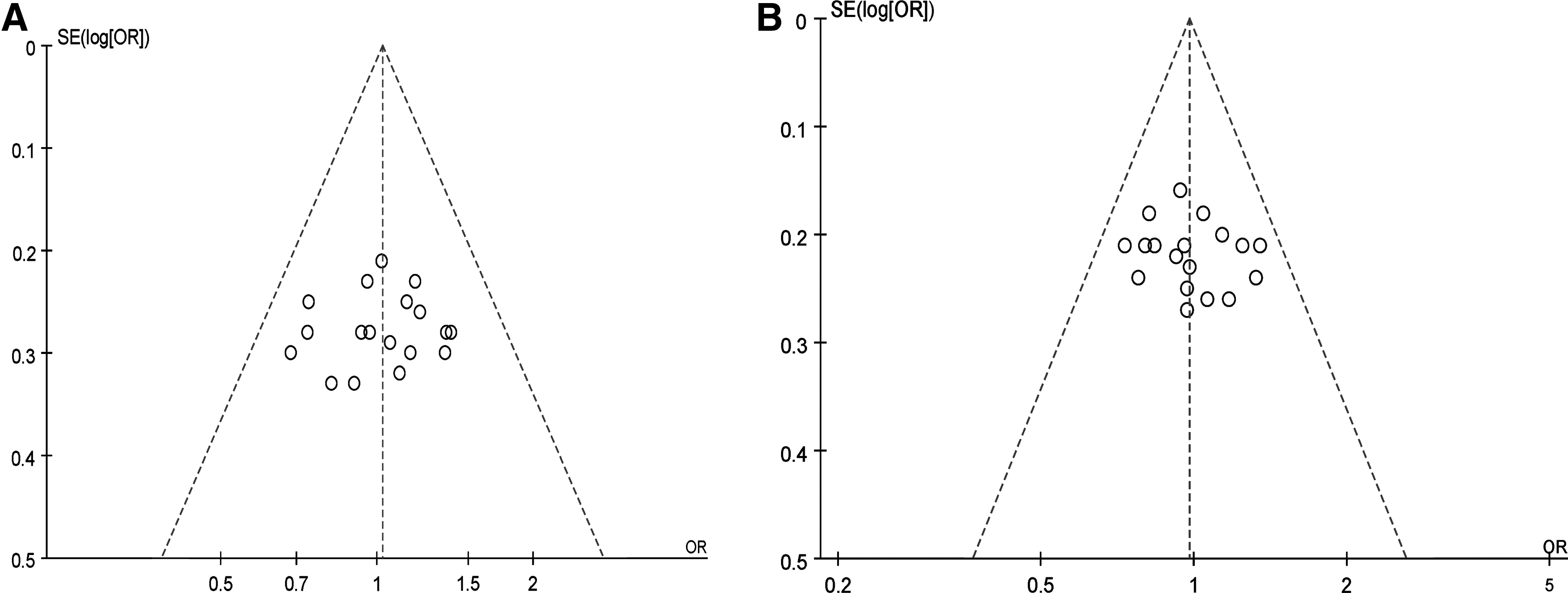
Begg's funnel plot for publication bias tests. Each point represents a separate study for the indicated association. LogOR represents natural logarithm of OR. Vertical line represents the mean effects size.
Discussion
In this meta-analysis, we found that the polymorphism
It is well known that elevated plasma fibrinogen levels can be affected by environmental and genetic factors. Polymorphisms of the FGB, especially involved in the rate-limiting steps of the formation of the β-chain, have been shown to be closely related to elevation of the plasma fibrinogen level and ischemic stroke (Liu et al., 2002; Fu et al., 2005; Gao et al., 2006; Liang et al., 2006; Ma et al., 2006; Chen et al., 2007; Xu et al., 2008; Guo et al., 2009; Yuan et al., 2009, 2010). In the present study, we combined the results of 18 studies to pool analyze the relationship between
The characteristic of meta-analysis is to combine comparable studies to increase the sample size and statistical power and draw a more compelling result. However, meta-analysis confounds factors such as publication bias, method of sampling, different genetic backgrounds of subjects, different protocols, and quality of analysis. In the present study, we did not find publication bias, all the subjects were Chinese, and the genotypes in all studies were detected with genetic DNA from blood samples using PCR-RFLP genotyping methods. All the studies checked genotypes for quality control. Genotype distribution of controls in all studies was consistent with HWE.
In addition, sensitivity analysis also showed that omission of any single study did not have significant impact on the combined ORs. This made the results of this meta-study more reliable to some extent.
However, there remained some limitations in this meta-analysis. Although the genotyping methods used in all the studies were the same, other clinical factors such as age, sex, and different chemotherapies in each study might lead to bias. Determining whether or not these factors influence the results of this meta-analysis would need further investigation.
Conclusion
Our study suggested that
Footnotes
Acknowledgment
This work was supported financially by the Project of Science & Technology of Xinxiang Medical College (2007YJAO2).
Author Disclosure Statement
No competing financial interests exist.