




Abstract
Objectives: Tumorigenesis is a multistep process that begins with the abrogation of normal controls of apoptosis and cell proliferation, and the Fas receptor-ligand system is a key regulator of apoptosis. The Fas −670 A/G single-nucleotide polymorphism (SNP) has been demonstrated to affect the expression of the Fas gene by altering the transcriptional activity in this gene's promoter. However, the association between the Fas −670 A/G polymorphism and digestive cancer risk is still controversial and ambiguous in the Asian population, so we conducted a meta-analysis to confirm and clarify the association between the Fas −670 A/G polymorphism and digestive cancer. Materials and Methods: A search of PubMed, China National Knowledge Infrastructure (CNKI), and WanFang databases was conducted and encompassed all available articles that had been published up to July 20, 2013. Overall, 15 case-control studies containing 3692 cases and 4895 controls were retrieved based on search criteria for digestive cancer susceptibility related to −670A/G SNP. Odds ratios (ORs) and 95% confidence intervals (CIs) were used to assess the strength of this association. Results: In the overall analysis, the country type and source of control subgroups, no association between the Fas −670 A/G polymorphism and digestive cancer risk was found. However, in the digestive cancer-type subgroups, a significant protective effect was detected between Fas −670 A/G polymorphism and hepatocellular carcinoma in Asians (AG vs. GG: OR=0.89, 95% CI=0.80-0.99; AA+AG vs. GG: OR=0.93, 95% CI=0.87-1.00). Conclusions: Our investigations demonstrated that the Fas −670 A/G polymorphism might decrease the hepatocellular carcinoma risk in Asian populations. Further studies based on larger sample sizes, other ethnicities, and gene-environment interactions should be conducted to further understand the role of Fas −670 A/G polymorphism in digestive cancer risk.
Introduction
A
A single-nucleotide polymorphism (SNP) at −670 of the Fas gene promoter (A to G substitution) (rs1800682) has been found with potentially altered transcriptional efficiency, which implies that this SNP may affect the occurrence and progression of apoptosis-related disorders (Kanemitsu et al., 2002). The Fas −670G allele disrupts STAT1 transcription factor binding sites and, thus, diminishes the promoter activity and decreases Fas gene expression (Huang et al., 1997; Kanemitsu et al., 2002). This indicates that the A allele may protect transformed cells against apoptosis, whereas the G allele may be a risk factor for cancer.
So far, there have been many studies that investigated the role of Fas −670A/G polymorphism and digestive cancer risk in the Asian region; however, results have been inconsistent due to different countries, case ascertainment, and small sample sizes. Thus, previous studies had the potential for false-positive findings as well as limited power to detect modest associations. To our knowledge, this is the most comprehensive meta-analysis, which has been conducted to date that examines the association between the Fas −670A/G polymorphism and digestive cancer risk in Asians.
Materials and Methods
Eligibility of relevant studies
Searches were conducted in the PubMed and Chinese language (China National Knowledge Infrastructure [CNKI] and WanFang) databases using key words containing “Fas”, “cancer” or “carcinoma” or “tumor”, and “polymorphism” or “variant”. No restrictions were placed on language or publication year and the last search was updated on July 20, 2013. A total of 174 articles were retrieved using the above terms of which, 15 articles contained the inclusion criteria.
Criteria and data extraction
Included studies had to meet the following criteria: the study assessed the correlation between digestive cancer risk and the Fas-670A/G polymorphism in an Asian population, the study was case controlled, and the study contained sufficient genotype numbers for cases and controls. On the other hand, the following exclusion criteria were used: there was no control population, there were no available genotype frequency data, and the study was a duplicate. The following items were collected: the last name of first author, year of publication, country of origin, ethnicity, digestive cancer type, the total and number of each genotype frequency in case-control groups, source of control, Hardy-Weinberg equilibrium (HWE) of controls, and genotyping methods. A subgroup analysis, stratified by cancer type, was performed. If a cancer type appeared in only one study, it was placed into the other cancer subgroup. Source of control subgroup analysis was performed on two groups and was classified as population based (PB) or hospital based (HB).
Statistical analysis
Odds ratios (ORs) with 95% confidence intervals (CIs) were used to measure the strength of the association between the Fas −670A/G polymorphism and digestive cancer risk based on genotype frequencies in cases and controls. The fixed-effects model and the random-effects model were used to calculate the pooled OR value. The statistical significance of the summary OR was determined with the Z-test. Heterogeneity assumption was evaluated among the studies with a chi-square-based Q-test. A p-value of more than 0.10 for the Q-test indicated a lack of heterogeneity among the studies. If significant heterogeneity was detected, the random-effects model was used. Otherwise, the fixed-effects model was chosen (Mantel and Haenszel, 1959; DerSimonian and Laird, 1986). We investigated the relationship between genetic variants of the Fas −670 site and digestive cancer risk by allelic contrast (A allele vs. G allele), comparison of homozygotes (AA vs. GG), comparison of heterozygotes (AG vs. GG), the dominant model (AA+AG vs. GG), and the recessive model (AA vs. AG+GG). The departure of the Fas −670A/G polymorphism from expected frequencies under HWE was assessed in controls by the χ2 test using the Pearson chi-square test; p<0.05 was considered significant. Publication bias was diagnosed using Egger's linear regression method and funnel plot. A p-value <0.05 in Egger's linear regression indicated the presence of potential publication bias (Hayashino et al., 2005). All statistical tests for this meta-analysis were performed with Stata software (version 10.0; StataCorp LP, College Station, TX).
Results
Studies characteristics
A total of 174 articles were collected from the PubMed and Chinese language (CNKI and WanFang) databases through literature search, using different combinations of key terms. Finally, 15 articles, including 3692 cases and 4895 controls, were identified (Kim et al., 2003; Sun et al., 2004; Ikehara et al., 2006; Jain et al., 2007; Jung et al., 2007; Hsu et al., 2008; Yang et al., 2008; Chen et al., 2009; Wang et al., 2009, 2010, 2013; Zhang et al., 2009; Zhou et al., 2010; Zhu et al., 2010; Hu et al., 2011) (Fig. 1). Study characteristics from published studies on the relationship between Fas −670 A/G polymorphism and digestive cancer risk are summarized in Table 1. The distribution of genotypes among controls was consistent with HWE in all studies, except one (Wang et al., 2010). In most of the studies, the cases were histologically diagnosed and the controls were free of cancer.
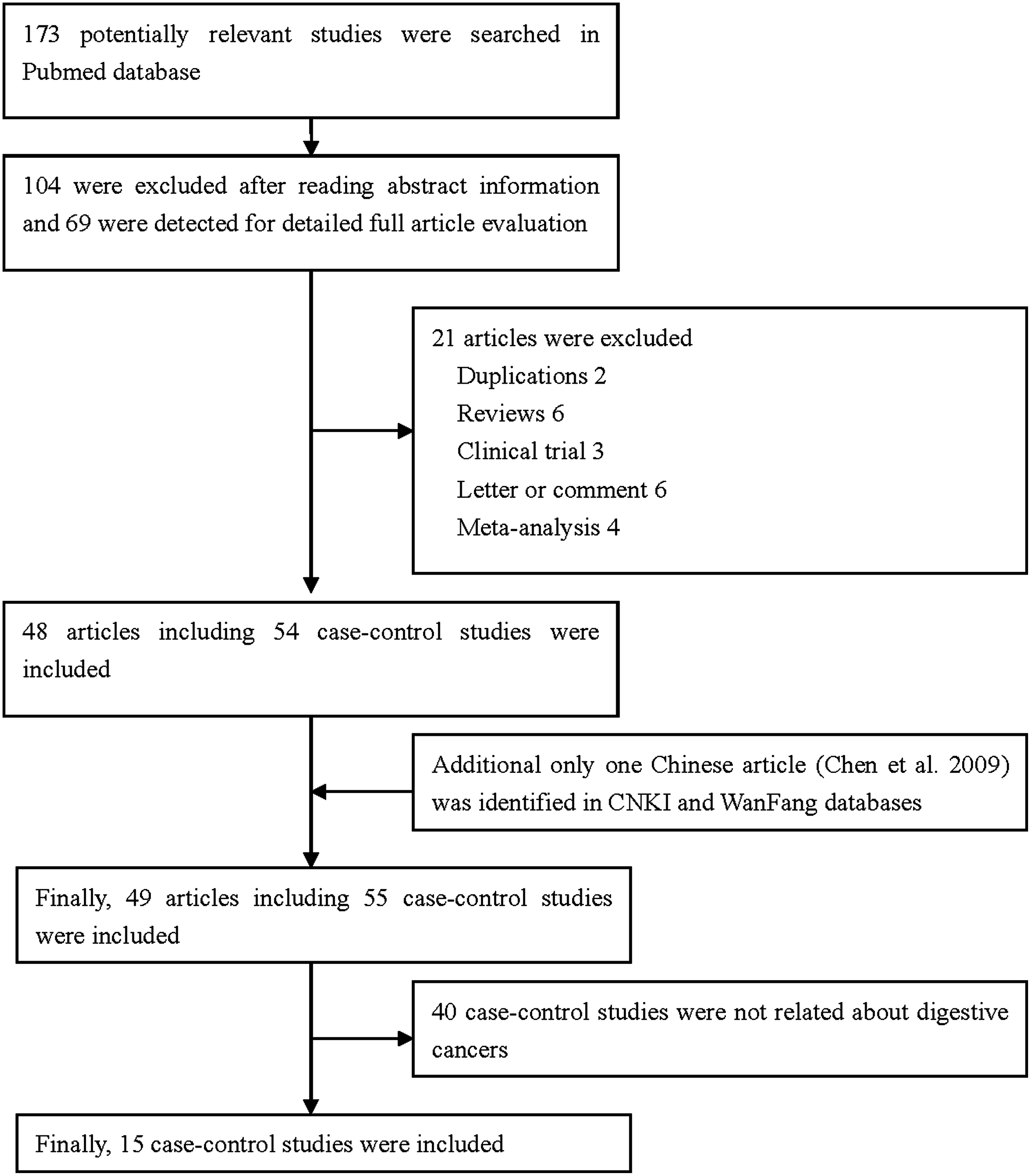
Flowchart illustrating the search strategy used to identify association studies of Fas −670 A/G polymorphisms and digestive cancer risk for the meta-analysis.
HB, hospital based; HWE, Hardy-Weinberg equilibrium; PB, population-based; PCR-RFLP, polymerase chain reaction and restriction fragment length polymorphism.
Quantitative synthesis
The results of the overall meta-analysis suggested no association between the Fas −670A/G polymorphism and digestive cancer susceptibility (allelic contrast: OR=0.97, 95% CI=0.89-1.06, pheterogeneity=0.036; heterozygote comparison: OR=0.91, 95% CI=0.76-1.09, pheterogeneity=0.034; homozygote comparison: OR=0.93, 95% CI=0.71-1.11, pheterogeneity=0.048; dominant model: OR=0.92, 95% CI=0.78-1.08, pheterogeneity=0.035; and recessive model: OR=1.00, 95% CI=0.88-1.13, pheterogeneity=0.060). Similarly, no association was found in the Chinese people and in the source of control subgroup (Table 2).
The bold in this table means significant association between FAS −670A/G polymorphism and digestive cancer risk.
p: Value of Q-test for heterogeneity test.
pa: Random-effects model was used when p-value for heterogeneity test<0.10; otherwise, fixed-effects model was used.
CIs, confidence intervals; ORs, odds ratios.
In the stratified analysis by digestive cancer type, a significant association was identified between the Fas −670A/G polymorphism and hepatocellular carcinoma (heterozygote comparison: OR=0.89, 95% CI=0.80-0.99, pheterogeneity=0.506, p=0.036, Fig. 2 and dominant model: OR=0.93, 95% CI=0.87-1.00, pheterogeneity=0.521, p=0.035, Fig. 3), but not for gastric cancer, esophageal cancer, and other cancers (Table 2).
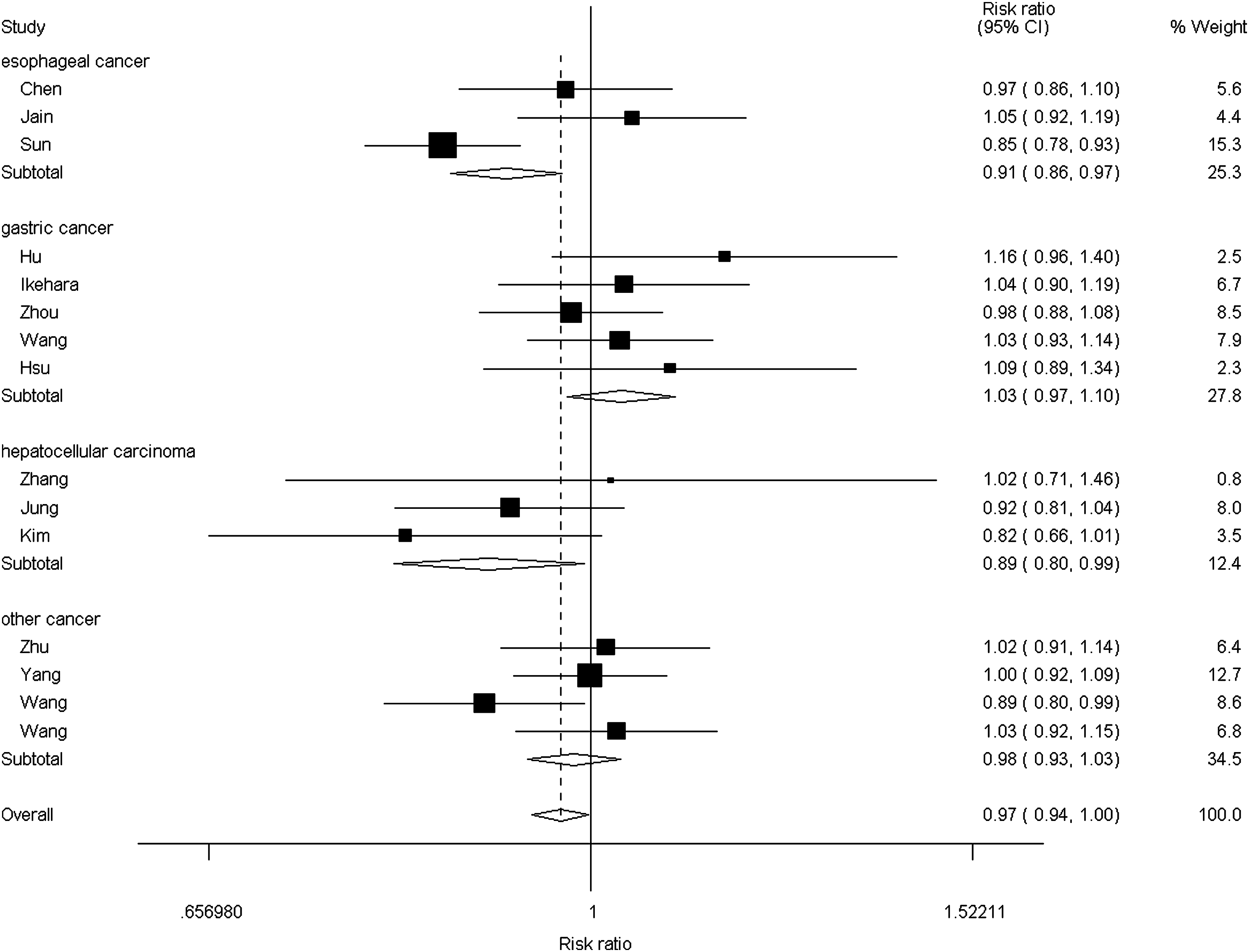
Forest plot of digestive cancer risk associated with the Fas −670 A/G polymorphism (AG vs. GG) by cancer-type subgroup. The squares and horizontal lines correspond to the study-specific ORs and 95% CIs. The area of the squares reflects the weight (inverse of the variance). The diamond represents the summary OR and 95% CI. CIs, confidence intervals; ORs, odds ratios.
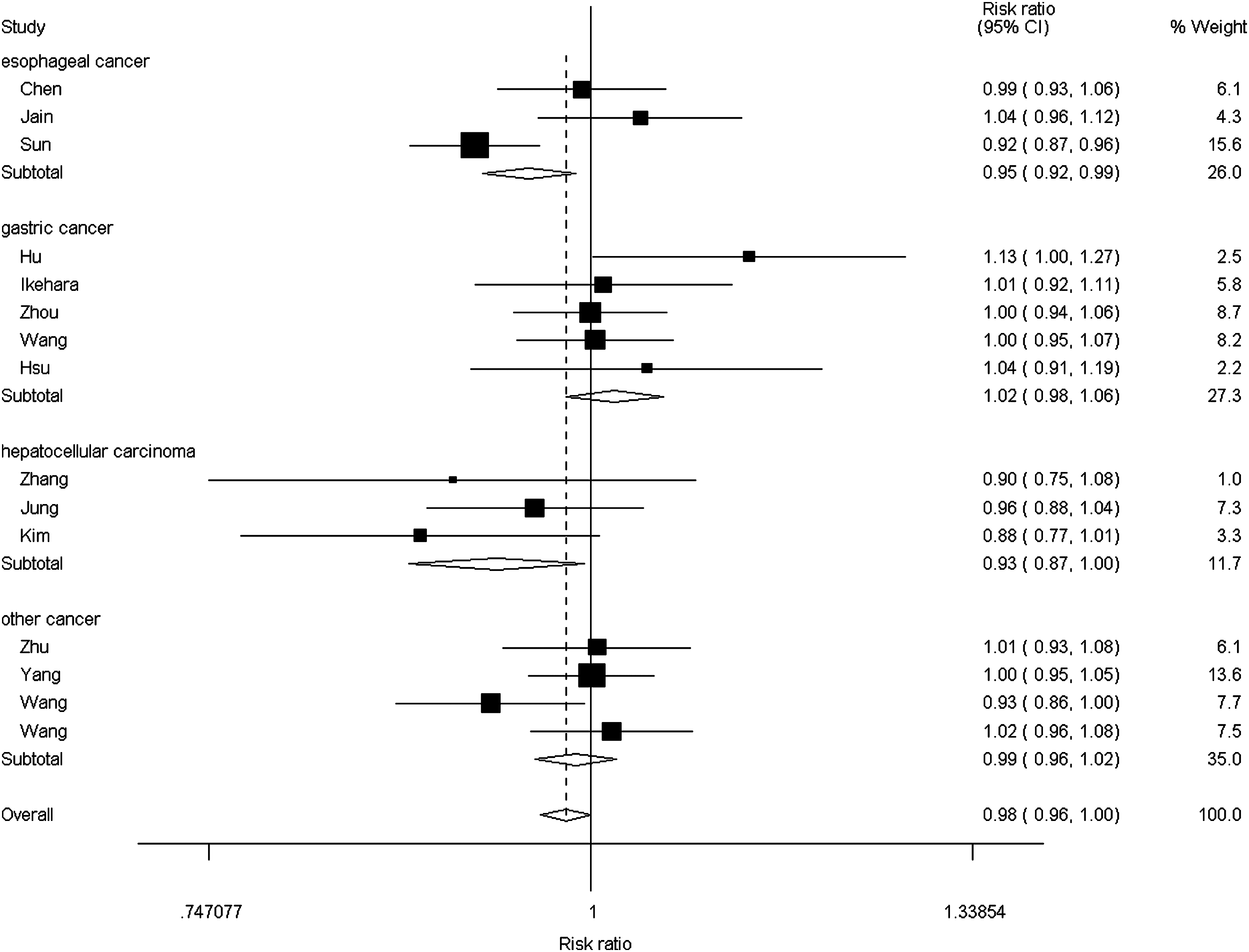
Forest plot of digestive cancer risk associated with the Fas −670 A/G polymorphism (AA+AG vs. GG) by cancer-type subgroup. The squares and horizontal lines correspond to the study-specific ORs and 95% CIs. The area of the squares reflects the weight (inverse of the variance). The diamond represents the summary OR and 95% CI.
Bias diagnosis
The Egger's test was performed to assess the publication bias of literature, and was used to provide statistical evidence of funnel plot symmetry. Ultimately, the results did not provide any evidence of publication bias.
Discussion
Antitumor T lymphocytes could be induced to undergo apoptosis after activation by tumor-associated or tumor-specific antigens, which may lead to escaping of cancer cells from antitumor immunosurveillance (Green et al., 2003). Activation-induced cell death of T lymphocytes is mainly initiated by Fas and FasL interaction (Suda et al., 1993; O'Connell et al., 1996). It has been found that there is reduced expression of FAS, but enhanced expression of FasL in many cancers (Rabinowich et al., 1998). The aberration of expression of Fas and/or FasL genes leads to cancer cells resisting the killing of anticancer T lymphocytes and malignant transformation.
Genetic susceptibility to cancers has led to growing attention to the studies of polymorphism of genes involved in carcinogenesis, which, if large and unbiased, can provide insight into the relationships between candidate genes and digestive cancer risk. However, there has been a continuing debate over the association between Fas −670A/G polymorphism and digestive cancer risk; previous studies have generally been underpowered to draw a convincing conclusion. The meta-analysis is a method that can solve the problem created by low statistical power in a single study to draw a more robust conclusion from the body of evidence.
The current report is a timely analysis that combines the findings of all previous publications that evaluated the Fas −670A/G polymorphism and digestive cancer risk in Asians. We performed a meta-analysis involving 3692 digestive cancer cases and 4895 controls. In the overall analysis, no association was found between the Fas −670A/G polymorphism and digestive cancer susceptibility in all genetic models. Similar findings were also indicated in the source of control subgroup. The main message of our meta-analysis is that there was a significant relationship between Fas −670A/G polymorphism and hepatocellular carcinoma risk, which suggests that the −670A allele in the Fas gene protects against the development of hepatocellular carcinoma and that the −670G allele confers an increased risk for the development of hepatocellular carcinoma. There must be some factors that would contribute to this discrepancy. First, Fas −670A/G polymorphism might play a different role in different digestive cancers. Second, multiple genes and environmental factors may lead to digestive cancer formation. Third, time lag bias and publication bias may also play a role in our meta-analysis.
Meta-analysis is recognized as an effective method for solving a wide variety of clinical questions by summarizing and reviewing published quantitative studies. Although meta-analysis could increase statistical power, it could not replace independent research due to differences in molecular mechanism in different types of digestive cancers. What is more, larger sample, multicenter, PB studies, which comprise gene-gene interactions and gene-environment interactions, should be carried out for the same digestive cancer; based on these, our meta-analysis would acquire much more effective statistical power. In spite of these limitations, there were two advantages in our meta-analysis. First, a substantial number of cases and controls were pooled from different studies, which significantly increased statistical power of the analysis. Second, the quality of case-control studies included in the current meta-analysis was satisfactory based on our selection criteria.
In summary, in the present meta-analysis, a significantly decreased association was found between Fas −670 A/G polymorphism and hepatocellular carcinoma risk in Asians. Therefore, further large studies, particularly, examining gene-gene and gene-environment interactions, are warranted. These future studies could lead to a better and more comprehensive understanding of the association between the Fas −670A/G polymorphism and development of digestive cancer risk.
Footnotes
Acknowledgments
The authors declare that they have no competing interests.
Author Disclosure Statement
No competing financial interests exist.