




Abstract
Objective: We conducted a meta-analysis of case-control studies to evaluate whether Cx37 C1019T (rs1764391 C>T) polymorphism may be implicated in the pathogenesis of coronary heart disease (CHD). Methods: The MEDLINE (1966-2013), the Cochrane Library Database (Issue 12, 2013), EMBASE (1980-2013), CINAHL (1982-2013), Web of Science (1945-2013), and the Chinese Biomedical Database (CBM) (1982-2013) were searched without language restrictions. Meta-analysis was performed with the use of the STATA statistical software. Odds ratios (ORs) with their 95% confidence intervals (95% CIs) were calculated. Results: Nine case-control studies with a total of 1426 CHD patients and 929 healthy controls met the inclusion criteria. Our results revealed that Cx37 C1019T polymorphism might be significantly correlated with the risk of CHD (T allele vs. C allele: OR=1.63, 95% CI=1.20-2.21, p=0.002; CT+TT vs. CC: OR=1.86, 95% CI=1.28-2.69, p=0.001; TT vs. CC+CT: OR=1.81, 95% CI=1.24-2.64, p=0.002; TT vs. CC: OR=2.50, 95% CI=1.46-4.27, p=0.001; TT vs. CT: OR=1.53, 95% CI=1.12-2.09, p=0.008; respectively). Further subgroup analysis by country indicated that Cx37 C1019T polymorphism might be closely linked to an increased risk of CHD among Chinese populations, while no positive associations were observed among non-Chinese populations (all p>0.05). Conclusion: Our findings provide empirical evidence that Cx37 C1019T polymorphism may contribute to the pathogenesis of CHD, especially among Chinese populations.
Introduction
C
Recently, epidemiologic studies have suggested that connexin 37 (Cx37), which may play a crucial role in atherosclerosis, may be closely associated with the risk of CHD (Han et al., 2008; Seifi et al., 2013). Cx37, (gap junction protein, alpha 4, also commonly known as GJA4), is a gap junction protein belonging to the Connexin family, which is normally expressed in various immune cell types, such as endothelial cells, monocytes, and macrophage foam cells, suggesting an important role of these proteins in gap junction-mediated antigen transport and intercellular communication in the immune system (Koutsoumpas et al., 2011; Juo et al., 2012). Generally, Cx37 could form gap junction channels and hemichannels, and then distinctively influence permeability for a variety of signaling molecules, and provide a means for direct cell-cell and cell-extracellular communication, which has been implicated in many important biological events intimately linked to atherogenesis (Wong et al., 2007; Seifi et al., 2013).
Since Cx37 is one of the main participants in intercell communications, it is biologically plausible that genetic polymorphisms in the Cx37 gene may change the function of this protein, which is associated with alteration of endothelial activity, and act as a potential accelerator of atherosclerosis, thereby contributing to increased susceptibility to CHD (Lanfear et al., 2007; Wong et al., 2007). The human Cx37 gene has been located at chromosome 1p35.1 and consists of two exons and one intron (Grapes et al., 2002). There is additional evidence to support that the C1019T polymorphism in the Cx37 gene may lead to one amino acid alteration, and the proline to serine shift could provide more capacity for modulating the function of gap junction proteins, which might change the function of endothelial cells, and thereby resulting in different vulnerability to atherogenesis, as well as MI (Han et al., 2008). Recently, several studies have indicated that Cx37 C1019T polymorphism might play a significant role in CHD risk (Listi et al., 2005; Feng et al., 2010), but other studies also reported contradictory results (Xie et al., 2006; Wong et al., 2007). In this regard, we performed a meta-analysis of clinical case-control studies to evaluate the associations between Cx37 C1019T polymorphism and the pathogenesis of CHD.
Materials and Methods
Literature search and selection criteria
The MEDLINE (1966-2013), the Cochrane Library Database (Issue 12, 2013), EMBASE (1980-2013), CINAHL (1982-2013), Web of Science (1945-2013), and the Chinese Biomedical Database (CBM) (1982-2013) were searched without language restrictions. We used the following keywords and MeSH terms in conjunction with a highly sensitive search strategy: [“single nucleotide polymorphism” or “polymorphism, genetic” or “genetic polymorphisms” or “mutation” or “genetic variants” or “variation” or “variant”] and [“connexin 37” or “gap junction protein alpha 4, human” or “Cx37 protein, human” or “GJA4” or “Cx37”] and [“coronary heart disease” or “CHD” or “myocardial infarction” or “MI” or “myocardium infarction” or “myocardial infarcted” or “acute myocardial infarction” or “heart infarction”]. We also conducted a manual search to find other potential articles based on references identified in the individual articles.
The following criteria were for the eligibility of included studies: (1) the study design must be a clinical case-control study that focused on the relationship between Cx37 C1019T polymorphism and the pathogenesis of CHD; (2) all patients must conform to the diagnostic criteria of CHD; (3) the genotype frequencies of healthy controls should be in Hardy-Weinberg equilibrium (HWE); and (4) the study must provide sufficient information about the genotype frequencies. If the study could not meet the inclusion criteria, it would be excluded. The most recent or the largest sample size publication was included when the authors published several studies using the same subjects.
Data extraction and methodological assessment
Data were systematically extracted by two authors from each included study by using a standardized form. The form used for data extraction documented the most relevant items, including language of publication, publication year of article, the first author's surname, geographical location, design of study, sample size, the source of the subjects, genotype frequencies, source of samples, genotyping method, and evidence of HWE.
Methodological quality was evaluated separately by two observers using the Newcastle-Ottawa scale (NOS) criteria (Stang, 2010). The NOS criteria included three aspects: (1) subject selection: 0-4; (2) comparability of subject: 0-2; and (3) clinical outcome: 0-3. The NOS scores ranged from 0 to 9 and a score ≥7 indicated a good quality.
Statistical analysis
Meta-analysis was performed with the use of the STATA statistical software (Version 12.0; Stata Corporation, College Station, TX). Odds ratios (ORs) and 95% confidence intervals (95% CIs) were calculated under five genetic models. The Z-test was used to estimate the statistical significance of pooled ORs. Heterogeneity among studies was estimated by the Cochran's Q-statistic and I2 tests (Zintzaras and Ioannidis, 2005). If the Q-test shows a p<0.05 or the I2 test exhibits >50%, which indicates significant heterogeneity, the random-effects model was conducted or else the fixed-effects model was used. We also explored reasons for heterogeneity using subgroup analyses. To evaluate the influence of single studies on the overall estimate, a sensitivity analysis was performed. Funnel plots and Egger's linear regression test were applied to investigate publication bias (Peters et al., 2006).
Results
Study selection and characteristics of included studies
Initially, the highly sensitive search strategy identified 36 articles. After screening the titles and abstracts of all retrieved articles, we excluded 13 articles; then, full texts were also reviewed and 11 articles were further excluded (Fig. 1). Finally, 9 clinical case-control studies with a total of 1426 CHD patients and 929 healthy controls met our inclusion criteria for qualitative data analysis (Yeh et al., 2001; Yamada et al., 2002; Listi et al., 2005; Xie et al., 2006; Wong et al., 2007; Han et al., 2008; Zhang et al., 2009; Feng et al., 2010; Seifi et al., 2013). Publication years of the eligible studies ranged from 2001 to 2013. Distribution of the number of topic-related literatures in the electronic database during the last decade is shown in Figure 2. Overall, six studies were carried out among Asians and three studies among Caucasians. Genotyping was performed with the use of the classical polymerase chain reaction-restriction fragment length polymorphism and TaqMan array. None of the studies deviated from the HWE (all p<0.05). We summarized the study characteristics and methodological quality, as shown in Table 1.
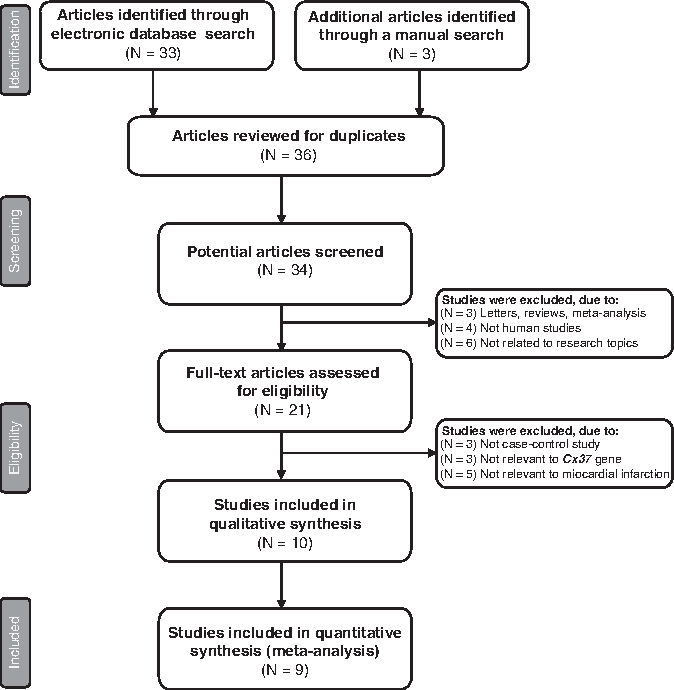
Flowchart shows study selection procedure. Nine case-control studies were included in this meta-analysis.
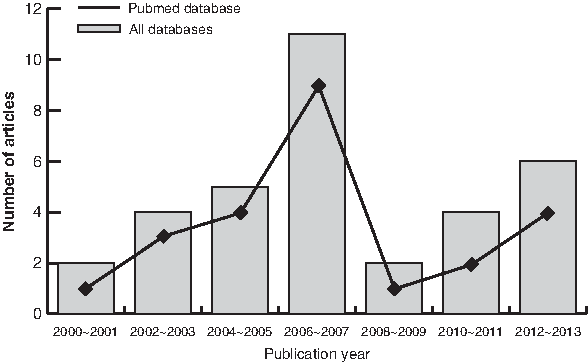
The distribution of the number of topic-related articles in the electronic database during the last decade.
AS, allele specific; F, female; HWE, Hardy-Weinberg equilibrium; M, male; NOS, Newcastle-Ottawa scale; PCR-RFLP, polymerase chain reaction-restriction fragment length polymorphism.
Quantitative data synthesis
A summary of our findings on the relationship of Cx37 C1019T polymorphism with the pathogenesis of CHD are shown in Table 2. The random-effects model was conducted due to the fact that obvious heterogeneity existed between studies. Our results revealed that the Cx37 C1019T polymorphism might be significantly correlated with the risk of CHD (T allele vs. C allele: OR=1.63, 95% CI=1.20-2.21, p=0.002; CT+TT vs. CC: OR=1.86, 95% CI=1.28-2.69, p=0.001; TT vs. CC+CT: OR=1.81, 95% CI=1.24-2.64, p=0.002; TT vs. CC: OR=2.50, 95% CI=1.46-4.27, p=0.001; TT vs. CT: OR=1.53, 95% CI=1.12-2.09, p=0.008; respectively) (Fig. 3).
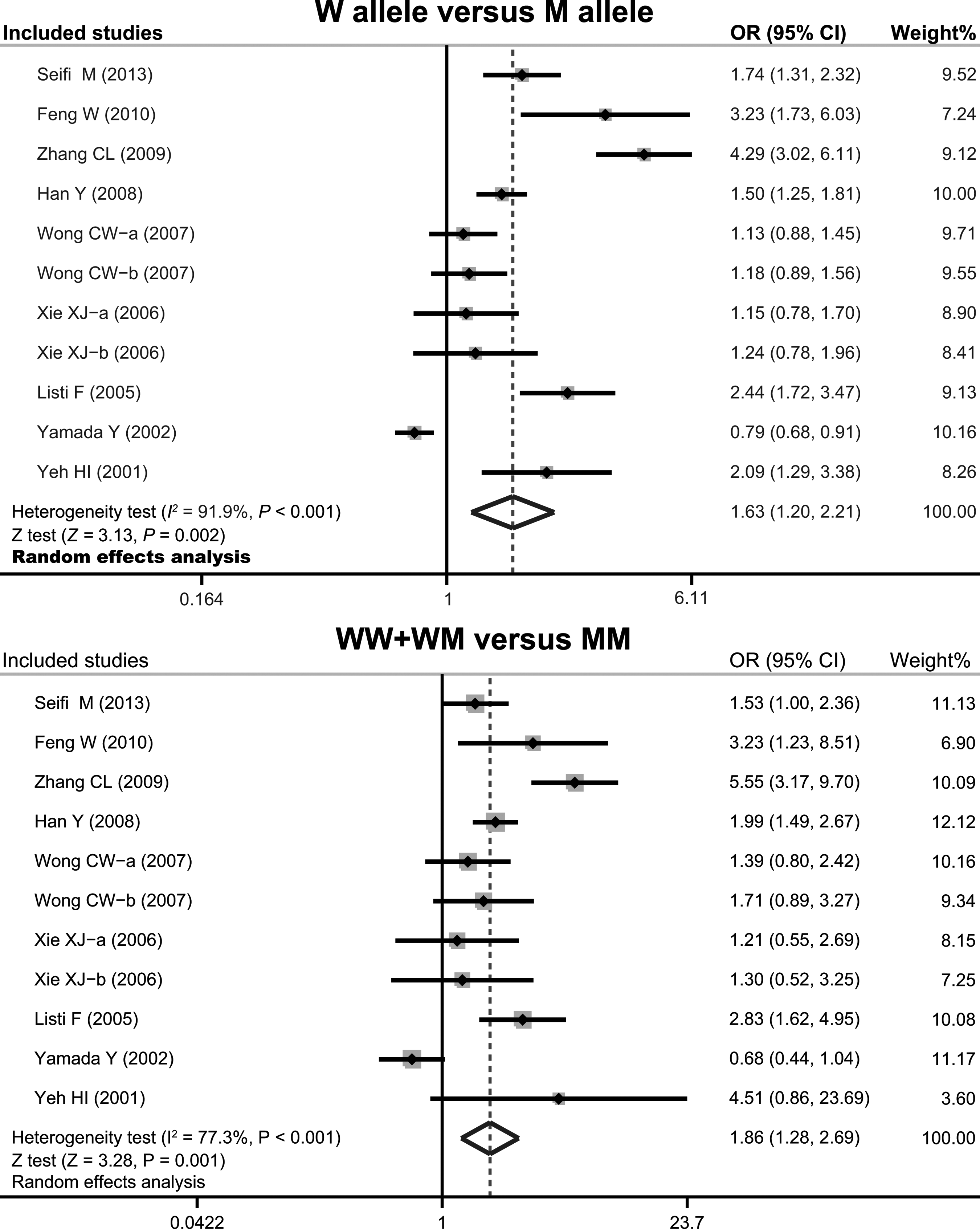
Subgroup analysis by single nucleotide polymorphism of the relationships between Cx37 C1019T polymorphism and the risk of coronary heart disease (CHD) under the allele and dominant models.
CHD, coronary heart disease; 95% CI, 95% confidence interval; MI, myocardial infarction; OR, odds ratio.
To further investigate the impact of Cx37 C1019T polymorphism in the pathogenesis of CHD, we carried out subgroup analysis by country, type of disease, and gender. The findings of subgroup analysis based on country indicated that Cx37 C1019T polymorphism might be closely linked to an increased risk of CHD among Chinese populations, while no positive association was observed among non-Chinese populations (all p>0.05) (Fig. 4). Furthermore, we found significant relationships of Cx37 C1019T polymorphism with increased risk of both CHD and MI (all p<0.05). Results of subgroup analysis by gender suggested that Cx37 C1019T polymorphism might be implicated in the pathogenesis of CHD in both male and female populations (all p<0.05). Sensitivity analysis confirmed that no single study could influence the pooled ORs (Fig. 5). Funnel plots indicated that there was no evidence for obvious asymmetry existing (Fig. 6). Strong statistical evidence for publication bias was observed in the Egger's test (all p>0.05).

Subgroup analysis by country, disease, and gender of the relationships between Cx37 C1019T polymorphism and the risk of CHD under the allele and dominant models.

Sensitivity analysis of the summary of odds ratio coefficients on the relationships between Cx37 C1019T polymorphism and the risk of CHD under the allele and dominant models.
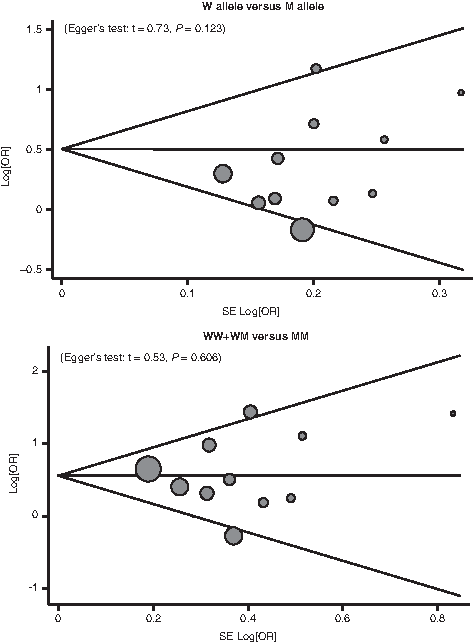
Funnel plot for publication bias evaluation on the relationships between Cx37 C1019T polymorphism and the risk of CHD under the allele and dominant models.
Discussion
In the present meta-analysis, we evaluated whether a common polymorphism (C1019T, rs1764391 C>T) in the Cx37 gene might be correlated with the pathogenesis of CHD. Our findings demonstrated that the frequency of Cx37 C1019T polymorphism was significantly higher in patients with CHD compared with healthy controls, indicating that this polymorphism may be a risk factor for the development and progression in CHD. Although Cx37 has been reported to play a vital role in atherosclerosis by promoting growth, regeneration after injury, and aging of the endothelial cells, the regulatory mechanism by which genetic variants in the Cx37 gene increase the risk of CHD is still poorly elucidated. We hypothesized that a C to T shift at codon 1019 in the Cx37 gene may result in a shift from proline to serine at amino acid 319, which is located at the carboxy terminal in the cytoplasmic side of the gap junction channel formed by the Cx37 protein (Han et al., 2008). This amino acid alteration may induce more capacity for regulating the function of gap junctions that was responsible for modifying endothelial cell function, through modulating trafficking, assembly, channel gating, and turnover of gap junction proteins, and consequently result in different vulnerability to atherosclerotic disease, including CHD (Lampe et al., 2000). Another possible explanation is that Cx37 1019 C/T polymorphism may cause its overexpression and activated function, and contribute to thickening of the carotid intima in CHD (Listi et al., 2005). Our results are in line with a previous study, which have displayed an independent association of C1019T polymorphism in the Cx37 gene with an increased risk of CHD (Wong et al., 2007).
Our results also illustrated a positive association between Cx37 C1019T polymorphism and CHD development among Chinese populations, but not among non-Chinese populations, indicating that country differences may be a causative determinant for the effect of Cx37 C1019T polymorphism on an individual's susceptibility to CHD. Although the precise mechanism of country differences is still not fully understood, a potential reason might be that there existed differences in alleles and genotypes among different countries due to environmental conditions and natural selection. In addition, our results also showed that Cx37 C1019T polymorphism may be closely related to the risk of CHD in both males and females, implicating that gender is not a source of heterogeneity. Furthermore, subgroup analysis by type of disease suggested that Cx37 C1019T polymorphism contributes to the pathogenesis of both CHD and MI. It is widely accepted that Cx37 could be implicated in the modification in endothelial activity, which probably affects atherogenesis (Morel et al., 2009), while hyperlipidemia is connected with alterations to the junctions between neighboring endothelial cells, including gap junctions (Brisset et al., 2009). Consequently, these channels providing cell communication could infer the potential role of Cx37 in the development of atherosclerosis (Morel et al., 2009). It has been demonstrated that Cx37 C1019T polymorphism, replacing a cytosine by thymine, may cause a rather nonconservative amino acid change in the regulatory carboxy-terminus of human Cx37 protein, namely, a proline to serine substitution (Incalcaterra et al., 2010; Seifi et al., 2013). Moreover, the lack of Cx37 expression usually resulted in the occurrence of vascular functional defects or morphological changes (Johnstone et al., 2009). Therefore, it was plausible to postulate that Cx37 C1019T polymorphism may be related to susceptibility to CHD. Guo et al. (2013), for example, indicated that although it was not clear which allele was more closely associated, the C1019T single nucleotide polymorphism in human Cx37 was suggested to be correlated with CHD development in various populations. In summary, our findings are consistent with previous studies that C1019T polymorphism in the Cx37 gene may increase individuals' susceptibility to CHD, implying that this polymorphism may be a reliable and valuable biomarker in prediction of CHD risk.
The current meta-analysis also had a number of limitations that should be pointed out. First, our results were short of sufficient statistical power to evaluate the correlations of Cx37 C1019T polymorphism with the pathogenesis of CHD due to the small number of studies. Since some of the studies were small and even had standard deviations, our meta-analysis might contain fairly wide CIs, which restrain our confidence in drawing conclusions. Besides, the small number of studies may constrain the general applicability of our findings, and consequently, the cognitive function of our meta-analysis should be regarded as preliminary. Second, meta-analysis is a retrospective study that may lead to subject selection bias, and thereby have an effect on the reliability of our results. Third, our meta-analysis failed to obtain original data from the included studies, which may limit further evaluation of the potential role of Cx37 C1019T polymorphism in the development and progression of CHD. Although our study has several limitations, this is the first meta-analysis focusing on the relationship between Cx37 C1019T polymorphism and CHD risk. Furthermore, we performed a highly sensitive literature search strategy for electronic databases. A manual search of the reference lists from the relevant articles was also conducted to find other potential articles. The selection process of eligible articles was based on strict inclusion and exclusion criteria. Importantly, rigorous statistical analysis provided a basis for pooling of information from individual studies.
In conclusion, the present meta-analysis confirms that Cx37 C1019T polymorphism may contribute to the pathogenesis of CHD, especially among Chinese populations. Thus, this polymorphism may be a reliable and valuable biomarker for CHD. However, due to the limitations acknowledged above, larger sample-size researches with more qualified data are in need to provide a more representative statistical analysis precisely.
Footnotes
Acknowledgment
The authors would like to acknowledge the reviewers for their helpful comments on this article.
Author Disclosure Statement
The authors have declared that no competing interests exist.