




Abstract
Objective: This study sought to use a meta-analysis approach to comprehensively evaluate correlations between the human leukocyte antigen-DR beta 1 (HLA-DRB1)*03 allele and chronic hepatitis B (CHB) in the Han Chinese population. Methods: The China Biomedical Literature database (CBMdisc), the Chongqing VIP database (VIP), and the PubMed database were searched. Using the inclusion and exclusion criteria of this study, all relevant case-control studies retrieved in these searches that satisfied the conditions of this investigation were collected. Review Manager (RevMan) 5.2 software was used to conduct a meta-analysis on the results of these studies. Results: There were 9 publications that satisfied the inclusion criteria. These publications included a total of 970 cases in the CHB group and 1185 cases in the normal control group. Egger's test revealed no significant publication bias. A comprehensive analysis indicated that the pooled odds ratio (OR) value was 1.94 with a 95% confidence interval (CI) of 1.23-3.06 (Z=2.84, p=0.004); these findings suggested that in the Han Chinese population, the HLA-DRB1*03 allele is a susceptibility allele related to the occurrence of CHB. Conclusion: There is a statistically significant correlation between the HLA-DRB1*03 allele and the occurrence of CHB in the Han Chinese population, and the HLA-DRB1*03 allele may be a susceptibility allele for this disease.
Introduction
H
Materials and Methods
Search strategy
The Chinese Biomedical Literature Database (CBMdisc), the Chongqing VIP database (VIP), and the PubMed database were searched. The search keywords included chronic hepatitis B (CHB), HBV, human leukocyte antigen (HLA), DRB1, and gene polymorphism. This search found 79 publications. The time frame for the search was 2000-2013, with a final search date of December 31, 2013. Based on the inclusion and exclusion criteria of this study, a total of 9 publications (Liu et al., 2000; Jiang et al., 2003; Kong and Wang, 2004; Zhang et al., 2004, 2006; Zhu et al., 2005; Yang et al., 2005; Zhou et al., 2005; Fu et al., 2006) were selected for inclusion in the meta-analysis.
Inclusion criteria
The included investigations were required to be research studies that provided raw data; addressed how polymorphism in the HLA-DRB1 gene correlated with CHB; utilized a case-control study design in which a CHB group and a normal control group were established; examined HLA-DRB1*03 allele frequencies as an observed indicator; and clearly described study data. Exclusion criteria were as follows: studies were excluded if no control group was established; if specific HLA-DRB1*03 allele frequency data were not clearly described; if they were duplicated reports regarding the same data (in which case only one report was selected for inclusion); or if they examined how polymorphism in the HLA-DRB1 gene correlated with HBV infection, cirrhosis, liver cancer, the clearance of self-limiting HBV infections, therapeutic response, or vaccine response.
Data collection and analysis
Publications were selected by two reviewers in accordance with the aforementioned inclusion and exclusion criteria. Disagreements were resolved by reaching consensus through discussion. The collection of data recorded in the included publications was independently performed by the two reviewers; the accuracy of these data was then verified.
A general description of the included studies
The 9 studies included in the meta-analysis of the current investigation utilized a case-control study design. The subjects of these studies were from the Han Chinese population, and the CHB diagnostic criteria were obtained from the September 2000 publication “Viral hepatitis prevention and treatment programs,” which was jointly revised in Xi'an by the Chinese Society of Infectious Diseases and Parasitology and the Chinese Society of Hepatology of the Chinese Medical Association (2000). In the included studies, HLA-DRB1 gene polymorphisms were detected using the polymerase chain reaction-sequence-specific primers (PCR-SSP) approach, although not all of the reagents and primers involved in this process were obtained from the same sources.
Statistical analysis
Review Manager (RevMan) 5.2 (Cochrane Collaboration, Oxford, United Kingdom) software was used to organize relevant information, perform heterogeneity testing, draw a funnel plot, and conduct a comprehensive meta-analysis.
Results
Basic information from the included research literature
As shown in Table 1, we described the characteristics of the included studies.
CHB, chronic hepatitis B; PCR-SSP, polymerase chain reaction-sequence-specific primers.
Heterogeneity analysis and model selection
The χ2 test was used to examine heterogeneity among the included studies (α=0.05). If the results of this analysis revealed no statistically significant heterogeneity among the studies, a fixed-effects model would be adopted, and the Mantel-Haenszel method or the Peto method would be used for analysis. If the testing revealed statistically significant heterogeneity among studies, a random-effects model would be applied, and the DerSimonian-Laird method would be used for analysis. The results of heterogeneity testing indicated that χ2=17.41 (p=0.04); therefore, a random-effects model was used for the analysis.
Meta-analysis results regarding the correlation between the HLA-DRB1*03 allele and CHB
The results of a meta-analysis examining how the HLA-DRB1*03 allele is correlated with CHB are presented in Figure 1. The HLA-DRB1*03 allele was detected in 128 cases of the 970 cases in the CHB group; thus, the frequency of this allele in the CHB group was 13.20%. The HLA-DRB1*03 allele was detected in 99 cases of the 1185 cases in the normal control group; thus, the frequency of this allele in the control group was 8.35%. The difference between the two groups was statistically significant, with a pooled odds ratio (OR) of 1.94 and a 95% confidence interval (CI) of 1.23-3.06 (Z=2.84, p=0.004).

Forest plot of human leukocyte antigen-DR beta 1 (HLA-DRB1)*03 and chronic hepatitis B (CHB), the horizontal lines correspond to the study-specific odds ratio (OR) and 95% confidence interval (CI), respectively. The area of the squares reflects the study-specific weight. The diamond represents the pooled results of OR and 95%CI.
The assessment of publication bias
Publication bias is an important factor that affects the authenticity of the results of meta-analysis. For various reasons, literature published in journals may differ from unpublished studies. The existence of this type of bias cannot be completely resolved by a meta-analysis itself. In this investigation, a funnel plot was drawn using the Funnel plot command in the RevMan software (Fig. 2). This figure indicates that the included studies exhibited no publication bias.
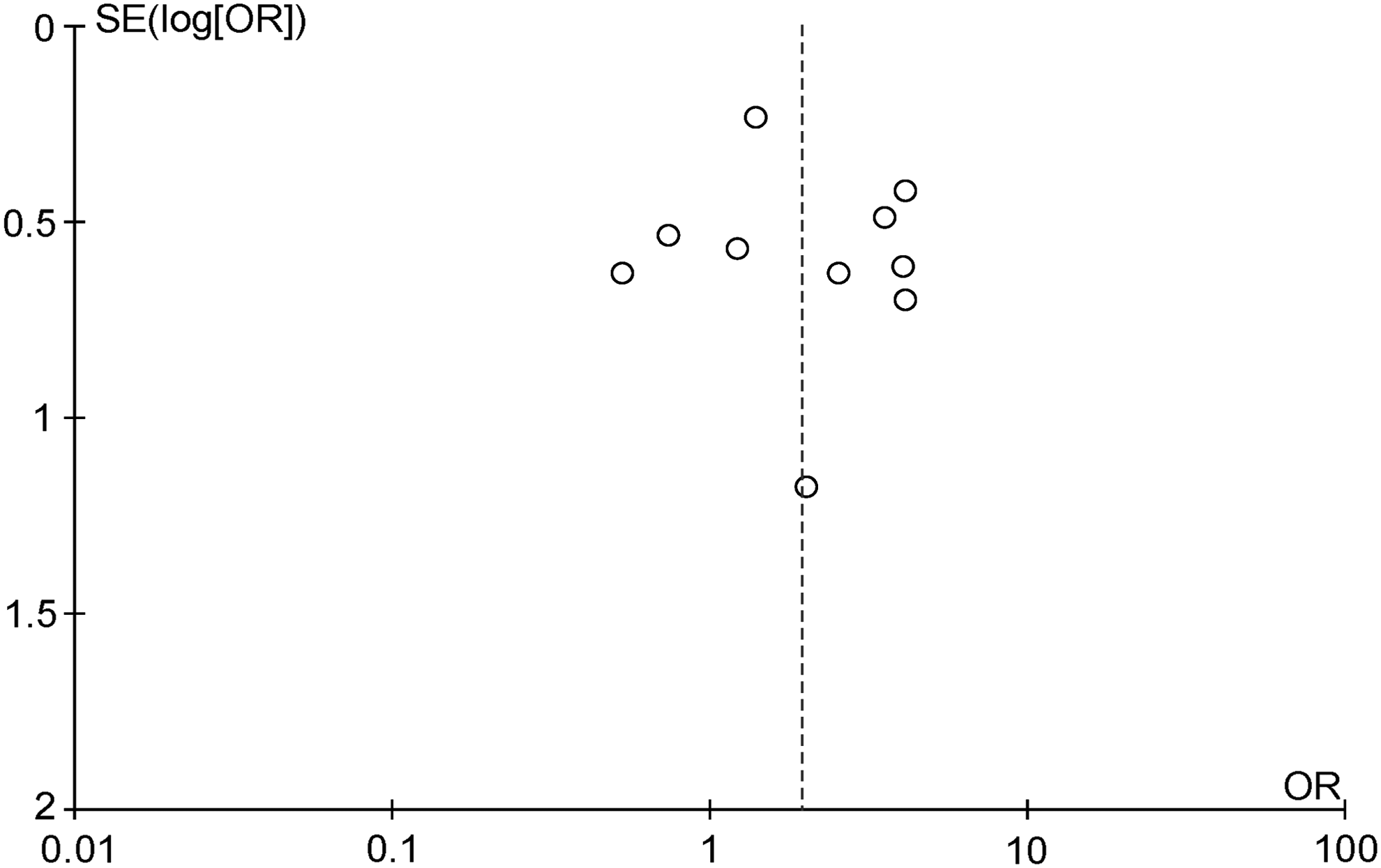
Begg's funnel plot for publication bias tests. Each point represents a separate study for the indicated association. LogOR represents natural logarithm of OR. Vertical line represents the mean effects size.
Discussion
The HLA gene complex is located in a 3.6 Mb region of the short arm of human chromosome 6 (6p21.31). Highly polymorphic HLA alleles are the most important genetic factors in the human body. Individual differences in the HLA-related genetic background impact the ability of T cells to recognize antigens and the intensity of host immune responses. HLA polymorphisms are closely correlated with genetic susceptibility or resistance to a variety of diseases (Ghodke et al., 2005). The HLA complex can be divided into three regions: the I (1.8 Mb), II (1.l Mb), and III (0.7 Mb) gene regions. The HLA-II gene region is ∼1000 kb in length and is located close to the centromere of chromosome 6. Many genes in this region are correlated with cellular immune responses. The gene loci in this region, which include three subregions known as HLA-DR, HLA-DQ, and HLA-DP, have highly similar structures. In recent years, Chinese and non-Chinese scholars have conducted a relatively large number of studies examining the correlations between HLA-II gene polymorphisms and the outcome of HBV infections.
Previously, various Chinese and non-Chinese researchers have examined the HLA-DRB1*03 allele. In particular, Michael et al. (1997) found that the frequency of the HLA-DRB1*03 allele was significantly higher (risk ratio [RR]=4.5) among 86 patients with autoimmune hepatitis than among other individuals. Akcanl et al. (2002) found that HLA-DRB1*03 allele frequency was significantly higher in a CHB group than in a self-limiting hepatitis clearance group. Godkin et al. (2005) proposed that the HLA-DRB1*03 allele is associated with a poor immune response to the hepatitis B vaccine. In a study conducted in the Hebei Province, the Chinese scholars Bao et al. (2005) found that a genetic predisposition to autoimmune hepatitis may be correlated with the HLA-DRB1*0301 allele. These scholars proposed that impaired immunoregulatory function facilitates cross reactions with foreign antigens (such as HBV, among others) that have similar structures to liver autoantigens, resulting in the occurrence of autoimmune hepatitis; in addition, these scholars suggested that polymorphisms in the HLA gene complex are closely related to the body's immunoregulatory functions. In a study conducted in Chongqing, Jiang et al. (2005) found that there was significantly less secretion of tumor necrosis factor (TNF) by HLA-DRB1*0301-positive lymphoblastoid cell lines than by cell lines negative for this allele; these findings suggested that HLA-II genes may impact immune regulation by affecting TNF and that these effects could be correlated with chronic HBV infection or the clearance of HBV.
The meta-analysis of the nine included studies of Chinese subjects indicated that the pooled OR was 1.94. Thus, this comprehensive analysis indicated that there was a statistically significant correlation between the HLA-DRB1*03 allele and CHB. Among the 9 included studies, 7 studies indicated that the HLA-DRB1*03 allele was more frequent in the CHB group than in the control group. These findings are consistent with the results of this comprehensive meta-analysis. Meta-analysis is a tool to summarize and comprehensively analyze the results of multiple, similar, and independent studies. Meta-analysis thereby achieves the objectives of increasing sample size and enhancing the effectiveness of examinations of various phenomena. In particular, if the results from multiple studies are not entirely consistent or are not statistically significant, then relative to any existing individual study, a meta-analysis of multiple prior studies can provide not only a statistical analysis that more closely approaches the actual situation under investigation but also more objective and credible evidence for future research. In this study, a meta-analysis has produced the conclusion that the HLA-DRB1*03 allele is a susceptibility allele for the occurrence of CHB among HBV-infected patients from the Han Chinese population.
Author Disclosure Statement
No competing financial interests exist.