




Abstract
Background and Aims: SLC26A4 gene mutations are the second currently identifiable genetic cause of autosomal recessive nonsyndromic hearing loss after GJB2 mutations. Because of the extensive size of the SLC26A4 gene and the variety of mutations, indirect diagnosis using linkage analysis has been suggested. Therefore, in this investigation three potential short tandem repeat (STR) markers related to this region including D7S2420, D7S496, and D7S2459 were selected for further analysis. Methods: The characteristics and haplotype frequency of the markers were examined for the first time in five ethnic groups of the Iranian population including Fars, Azari, Turkmen, Gilaki, and Arab using the polymerase chain reaction followed by fluorescent capillary electrophoresis. Results were analyzed by GeneMarker HID Human STR Identity, GenePop, Microsatellite tools, PowerMarker 3.25, and Arlequin 3.5 software. Results: Analysis of the allelic frequency revealed the presence of 11, 10, and 8 alleles for D7S2420, D7S496, and D7S2459 markers, respectively, in the Iranian population. The detailed analysis of each ethnic group was reported. Calculated polymorphism information content values were above 0.7 in the Iranian population. Pairwise linkage disequilibrium (LD) revealed a significant LD in pairing markers of D7S2420-D7S496 and in D7S496-D7S2459. Estimation of the haplotype frequency showed the presence of 20, 13, 15, 15, and 20 informative haplotypes in Fars, Azari, Turkmen, Gilaki, and Arabian ethnics, respectively. Conclusion: Together, the investigated markers could be suggested as powerful tools for linkage analysis of SLC26A4 gene mutations in the Iranian population.
Background
N
Investigation of the SLC26A4 gene region revealed the presence of different polymorphic markers including short tandem repeats (STRs). Among reported STRs in the SLC26A4 gene region, D7S2420 (Probe accession No. Pr012582364), D7S496 (Probe accession No. Pr012475069), and D7S2459 (Probe accession No. Pr012618656) were suggested to have a high degree of heterozygosity and allelic number, which makes the markers ideal for indirect diagnosis (Gyapay et al., 1994). However, to date the reported data on these STRs were restricted and no specific investigation has been performed in the Iranian population.
In view of the population-dependent nature of the polymorphic markers, the prerequisites of using STRs in linkage analysis are determination of allele and haplotype frequencies, genetic linkage, and linkage disequilibrium (LD) status of the markers under study (Inturri et al., 2011). Application of informative markers in linkage analysis approaches could increase the accuracy of carrier detection and prenatal diagnosis (Hildebrand et al., 1992). In addition, the investigation of markers as informative haplotypes could improve the power of linkage analysis for transmission study of the affected alleles in pedigrees instead of using markers separately (Fazeli and Vallian, 2009). In this study, three STR markers of the SLC26A4 gene region, D7S2420, D7S496, and D7S2459, were investigated for the first time in the Iranian population.
Materials and Methods
Sampling, DNA extraction, and genotyping
Blood samples were collected from 165 unrelated healthy individuals in the Iranian population. Total equal number of Fars subjects from Isfahan, Azari from Tabriz, Turkmen from Gorgan, Gilaki from Rasht, and finally Arabs from Ahvaz were used in this study. In this study, written informed consent was obtained from all involved participants or guardians. Genomic DNA was extracted by standard phenol-chloroform method. DNA concentration and purity were qualified by Nano Drop 1000 spectrophotometer (Thermo Scientific, Inc., Wilmington, DE).
DNA samples were genotyped for D7S2420, D7S496, and D7S2459 at SLC26A4 gene region using fluorescent polymerase chain reaction (PCR) with previously described primers in the Probe Database (www.ncbi.nlm.nih.gov/probe/). Standard cycling was performed in a thermo cycler (ASTEC PC-818; ASTEC, Fukuka, Japan) with the following condition: initial denaturation at 96°C for 2 min followed by 35 cycles of 94°C for 30 s, 56°C for 30 s, 72°C for 30 s, and finally 72°C for 7 min. For fragment analysis, 5′ end of reverse primers were labeled with different fluorescent dyes (D7S2420, ROX; D7S496, HEX; and D7S2459, 6-Fam). Genotypes of STR markers were determined by fluorescent capillary electrophoresis with 16-capillary ABI 3130 Genetic Analyzer (Applied Biosystems, Carlsbad, CA). About 1.2 μL PCR products, 9 μL Hi-Di™ formamide (Applied Biosystems), and 0.3 μL Genescan™-500 LIZ™ size standards (Applied Biosystems) were diluted and loaded into capillaries with POP-4™ (Applied Biosystems) separation matrix. Finally, alleles were assigned by GeneMarker® HID Human STR Identity software.
Statistical analysis
GenePop Website (Raymond and Rousset, 1995) was used to perform the following statistical analysis, including allele frequency, observed and expected heterozygosity, and the exact and chi-square test for Hardy-Weinberg equilibrium (HWE). Polymorphism information content (PIC) was estimated by using the Microsatellite Toolkit (Park, 2001). LD between markers was calculated with PowerMarker 3.25 software (Liu and Muse, 2005), and frequency estimation was performed by Arlequin 3.5 software (Excoffier et al., 2005).
Results
The allele frequency of genetic markers including D7S2420, D7S496, and D7S2459 in SLC26A4 gene region was estimated in a group of healthy individuals in five ethnic groups of the Iranian population as listed in Table 1. Genotyping analysis of D7S2420 revealed the presence of 11 alleles in the Iranian population (Fig. 1). The genotyping data for different ethnic groups were shown Table 1. As illustrated in Figure 1, PCR products of alleles ranging from 272 to 290 bp correspond to alleles with 18-27 CA core repeats. Moreover, D7S496 marker in the Iranian population showed 10 alleles with size of 121-143 bp, representing 12-23 CA core repeats (Fig. 1). Finally, genotyping analysis of D7S2459 marker indicated the presence of eight alleles in the studied population. For this marker, the alleles ranged from 140 to 154 bp correspond to 16-23 CA core repeat alleles (Fig. 1).
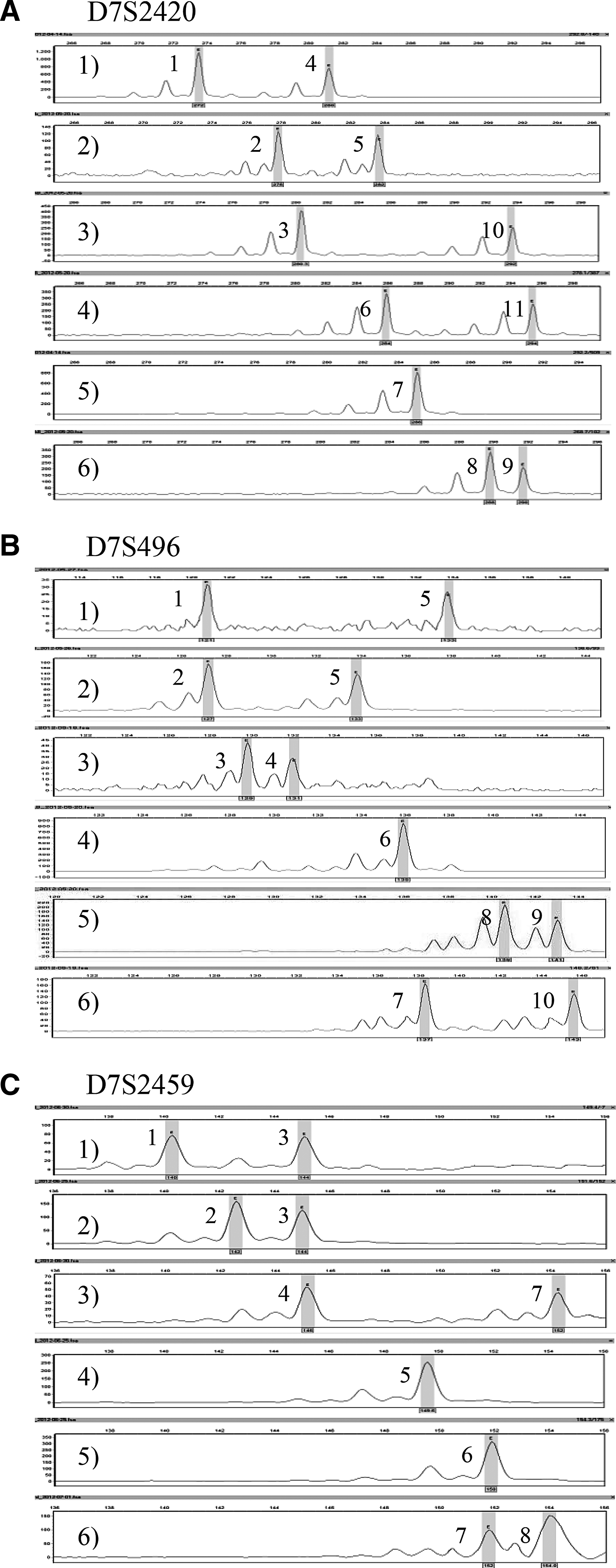
Genotyping of
The observed and expected frequencies of heterozygosity, HWE p-values, and PIC values for the analyzed markers were calculated. As shown in Table 2, the observed heterozygosity of the three markers differed in five ethnic groups. The degree of heterozygosity for D7S2420, D7S496, and D7S2459 was 82.4%, 74.5%, and 70.3%, respectively. The calculated HWE p-values for all the examined markers were above 0.05, except for Fars ethnic of D7S2459 marker which was not considered in HWE assumption-based analysis. The informativeness of the markers was examined by analysis of PIC value. The PIC values for D7S2420 and D7S2459 were above 0.7 in all the Iranian ethnic groups, indicating that the markers could be considered as highly informative. However, D7S496 was found highly informative (above 0.7) only in Fars, Azari, and Turkmen, but only moderately informative in Gilaki and Arabian ethnic groups (Table 2).
HWE, Hardy-Weinberg equilibrium; PIC, polymorphism information content.
LD analysis for three linked markers was performed between two adjacent pairs. As shown in Table 3, based on different genetic structures, p-value of exact test and chi-square p-value were different in different ethnic groups. However, the Iranian population (five ethnic groups) showed significant LD p-value of exact test<0.000001 for D7S2420-D7S496 markers pair. Moreover, the relative value for D7S496-D7S2459 pair was 0.0014.
Bold values are significant values.
Ultimately, haplotype frequency was calculated in three groups. The informative haplotypes (frequency above 5%) were represented in Table 4. Although the analysis revealed different informative haplotypes in different ethnics, 10 informative haplotypes concurrently existed in 5 ethnic groups of the Iranian population.
Discussion
Mutations in GJB2 and SLC26A4 genes have been reported as the most common causes of ARNSHL worldwide (Smith and Robin, 2002). Unlike GJB2, SLC26A4 is a large gene with a variety of known ARNSHL pathogenic mutations without any prevailing frequency (Tabatabaiefar et al., 2011). Moreover, SLC26A4 mutations of ARNSHL differ among populations around the world (Tabatabaiefar et al., 2012). Consequently, it is preferable to use linkage analysis to facilitate molecular diagnosis of SLC26A4-based ARNSHL. Linkage analysis requires informative polymorphic markers and haplotypes that are specific and allocated within populations (Terwilliger, 1995). In this, three STR markers within SLC26A4 gene region were chosen (D7S2420, D7S496 extragenic, and D7S2459 intragenic) and their characteristics were precisely analyzed within five ethnic groups of the Iranian population.
Investigation of the D7S2420 marker revealed the existence of at least eight alleles in each ethnic group (Table 1). Among the alleles, the allele number 8 was the most frequent (above 22%) in four ethnicities (Fars, Azari, Turkmen, and Arabian), whereas the allele 6 showed highest frequency (25.73%) in the Gilaki. This allele showed the same frequency as allele 8 in the Arabian group. Therefore, allele 8 could be considered as the most frequent allele in the Iranian population (24.24%). Based on the reports from the Genethon Center (www.genethon.fr/) and the Mammalian Genotyping Service (http://research.marshfieldclinic.org/genetics/home/), the polymorphic range for D7S2420 marker was 272-292 bp, which equals to alleles 1-10 in this study (Table 1). Interestingly, the allele with 294 bp (allele 11) is a new allele for the D7S2420, which was identified in Turkmen in the Iranian population. HWE analysis demonstrated no deviation at D7S2420 loci in any of the ethnics, and the p-values were above the expected threshold (p>0.05). The PIC of all ethnics was between 0.788 and 0.832, which could identify this marker as a highly informative polymorphism in the SLC26A4 gene region in the Iranian population.
D7S496 polymorphic marker was reported with allele size ranging 129-141 bp in UniSTS Probe Data Bank (www.ncbi.nlm.nih.gov/probe/). However, three additional alleles (alleles 1, 2, and 10, correspond to 121, 127, and 143 bp) were found in the present investigation that have not been reported previously. Allele 1 and 2 and 10 were identified in Azari, Arabian, and the two ethnics of Turkmen and Gilaki, respectively. However, allele 7 with frequencies between 36.36% and 51.51% was the most frequent allele identified in the five ethnic groups of the Iranian population. HWE distribution analysis revealed no deviation among any of the ethnic groups, which verifies further analysis on this marker. In general, the PIC values demonstrated high informativeness of D7S496 marker for linkage analysis in the Iranian population, especially, in detailed prospect for Fars, Azari, and Turkmen individuals. Moreover, D7S496 marker could be considered as a moderate informative marker for the Gilaki and Arabian ethnics based on their values (0.659, 0.661).
Data analysis of the D7S2459 marker clarified the presence of the 154 bp allele among the Azari (allele 8) in addition to previously reported alleles in UniSTS Probe Data Bank. Unlike the D7S2420 and D7S496 markers, the most frequent allele for D7S2459 (allele 5) differed in different ethnic groups. Allele 3 in Fars, 6 in Azari, 5 in Gilaki, Turkmen, and Arabian were the most frequent among the alleles identified. Together, allele 5 with 30.61% frequency was the most prevalent in the Iranian population. HWE p-values for four ethnics except Fars (five ethnics) were above 0.05. The Fars ethnic group showed deviation from HWE (p=0.0003), which could be explained by possible laboratory/genotyping errors or population stratification. Therefore, in view of the deviation from HWE, further analysis of the Fars ethnic is necessarily prevented (for instance, PIC test and pairwise LD test). Furthermore, based on the results form PIC tests, the D7S2459 marker (PIC values >0.7) could be introduced as a highly informative polymorphism among the studied ethnic groups of the Iranian population.
A pairwise LD test on the adjacent pair of the studied markers was performed. The data indicated that D7S2420-D7S496 had noteworthy values (p<0.00001) demonstrating significant LD in the studied population and among Fars and Arabian individuals in a detailed deliberation. On the other hand, LD analysis corroborated existence of LD for the D7S496-D7S2459 pair (p=0.0014) in the Iranian population. Moreover, LD test analysis of each ethnic group showed the highest LD for the Gilaki (p-value=0.004, chi-square p-value<0.00001) among the four studied ethnic groups.
Our data on the analysis of haplotype frequency indicated the presence of 20, 13, 15, 15, and 20 informative haplotypes in Fars, Azari, Turkmen, Gilaki, and Arabian ethnic groups, respectively (Table 4). However, of the informative markers, 10 markers could be considered as informative in the Iranian population, which could be suggested for application in molecular screening of the disease causing SLC26A4-related mutations.
Conclusion
This study for the first time provided information on D7S2420, D7S496, and D7S2459 polymorphic markers located in the SLC26A4 gene region in the Iranian population. The estimated informative haplotypes would therefore greatly assist optimization of molecular tests for SLC26A4 in ARNSHL mutation detection in linkage based strategies in the Iranian population.
Footnotes
Acknowledgment
This work was supported by Cellular and Molecular Research Center, Shahrekord University of Medical Sciences, Iran (grant number 1045).
Author Disclosure Statement
No competing financial interests exist.