




Abstract
Objectives: Genotyping of single-nucleotide polymorphisms (SNPs) has been applied in various genetic contexts. Tetra-primer amplification refractory mutation system (ARMS) polymerase chain reaction (PCR) is reported as a prominent assay for SNP genotyping. However, there were published data that may question the reliability of this method on some occasions, in addition to a laborious and time-consuming procedure of the optimization step. In the current study, a new SNP genotyping method named modified tetra-primer ARMS (MTPA) PCR was developed based on tetra-primer ARMS PCR. Design and Methods: The modified method has two improvements in its instruction, including equalization of outer primer and inner primer strength by additional mismatch in outer primers, and consideration of equal annealing temperature of specific fragments more than melting temperature of primers. Advantageously, a new computer software was provided for designing primers based on novel concepts. Results: The usual tetra-primer ARMS PCR has a laborious process for optimization. In nonoptimal PCR programs, identification of the accurate genotype was found to be very difficult. However, in MTPA PCR, equalization of the amplicons and primer strength leads to increasing specificity and convenience of genotyping, which was validated by sequencing. Conclusions: In the MTPA PCR technique, a new mismatch at −2 positions of outer primers and equal annealing temperature improve the genotyping procedure. Together, the introduced method could be suggested as a powerful tool for genotyping single-nucleotide mutations and polymorphisms.
Introduction
N
Many techniques for genotyping had been designed based on polymerization such as allele-specific primers and tetra-primer amplification refractory mutation system (ARMS) polymerase chain reaction (PCR) (Ugozzoli and Wallace, 1991; Ye et al., 2001). Ye et al. (2001) introduced tetra-primer ARMS PCR as a simple, effective, and economical SNP genotyping method, which uses four primers in one PCR, followed by gel electrophoresis. This method was derived from a tetra-primer PCR method and the ARMS (Newton et al., 1989; Ye et al., 1992). In this method, two smaller and allele-specific fragments are amplified by inner and outer primers. In addition, outer primers amplify a common fragment that is larger than the former products and contains the selected SNP, in addition to two smaller fragments. Moreover, inner primers have mismatches at 3′ ends and the −2 position (third position from the 3′ end). In detail, mismatch at the 3′ end causes allele specificity, and mismatch at −2 positions was designed for enhancing the specificity of allele-based polymerization (Fig. 1). As a result, DNA polymerase would be able to commence polymerization, if the 3′ terminus of inner primer was complimentary to the template. Whether the allele-specific fragment is amplified or not, the sample is genotyped (Kwok, 2001). Designed mismatch at the −2 position follows rules that are represented in Table 1 (Little, 1997). To facilitate these instructions, the accessible web program (http://primer1.soton.ac.uk/primer1.html) is available. However, the tetra-primer ARMS PCR has not only a difficult procedure for optimization but also fails to distinguish the target allele in SNP genotyping on some occasions (Ye et al., 2001; Medrano and de Oliveira, 2014).

Schematic representation of the tetra-primer amplification refractory mutation system (ARMS) polymerase chain reaction (PCR) technique and modified tetra-primer ARMS (MTPA) PCR. Four primers were involved in one reaction: the two outer primers amplify a common fragment that contains a single-nucleotide polymorphism (SNP; white box) and two specific fragments. The inner primers amplify the two allelic specific fragments, which have additional mismatch at −2 positions. The MTPA PCR method has two facilities compared to casual tetra-primer ARMS PCR. First, additional mismatch at −2 position of outer primers is improvised to equalize the strength of primers. Second feature is considering same annealing temperature for allelic fragments more than same melting temperature for primers. X, Tm, and TA represent additional mismatch at −2 position, melting temperature, and annealing temperature of primers, respectively.
A “strong” mismatch (G/A or C/T mismatches) at the 3′ end of allele-specific primers would be completed with a “weak” second mismatch (C/A or G/T) at −2 position and vice versa, whereas a “medium” mismatch (A/A, C/C, G/G, or T/T) at the 3′ end would be completed with a “medium” second mismatch.
IUPAC, International Union of Pure and Applied Chemistry.
In the current study, the tetra-primer ARMS PCR technique was modified and introduced as a new method to facilitate the evaluation of SNPs, which may not be accurately identified by the traditional technique. The introduced technique was named MTPA PCR (modified tetra-primer ARMS PCR). Data were compared with original tetra-primer ARMS PCR based on sequencing. The new MTPA PCR primer designer is introduced elsewhere (http://sci.ui.ac.ir/∼rahgozar). This program performs the new rules automatically and is prepared for free download.
Our goal was improvement of the original tetra-primer ARMS PCR to become more specialized and easier in optimization steps and then comparison of the MTPA PCR and original tetra-primer ARMS PCR based on sequencing.
Materials and Methods
C934A in the ABCC4 gene (rs2274407) was chosen randomly for this study. One hundred fifty DNA samples were collected for performing tetra-primer ARMS PCR and MTPA PCR. PCR products were analyzed by agarose gel (2%) electrophoresis.
Tetra-primer ARMS PCR
Four primers were designed by Primer1 software (Table 2). The calculated melting temperature was 59°C for all primers. The common fragment length was 324 bp and specific fragment lengths were 135 and 236 bp for G and T alleles, respectively. The final volume of the PCR was 25 μL. The concentration of reagents is represented in Table 2. Standard cycling was performed in a thermocycler as the following conditions: initial denaturation at 94°C for 5 min followed by 30 cycles of 94°C for 30 s, 55°C for 30 s, 72°C for 40 s, and finally, 72°C for 10 min. Five microliters of PCR products was mixed with 2 μL loading dye and loaded into a vertical agarose gel (2%) for further analysis.
Tm, melting temperature; the mismatches of the primers were emphasized in underline.
ARMS, amplification refractory mutation system; PCR, polymerase chain reaction.
Modified tetra-primer ARMS PCR
Inner primers were designed just like the tetra-primer ARMS method, but we considered two new rules for the outer primer design. Initially, the mismatches at −2 positions of outer primers were contrived, as shown in Table 1. Second, the equal annealing temperature was calculated for the specific fragments by the formulas of Rychlik et al. (1990). Primers and their annealing temperatures are represented in Table 3. The common fragment length was 306 bp, and allelic fragments were 119 bp for the G allele and 230 bp for the T allele. The equal annealing temperature for the specific fragments was 53.5. The final volume of PCR was 25 μL, and concentration of materials was 1.2× for PCR buffer, 4 mM for MgCl2, 0.4 mM for dNTP, 0.4 μL for outer primers, 0.2 μL for inner primers, and 0.6 U/μL for Taq DNA polymerase. The thermocycler program was as follows: initial denaturation at 94°C for 5 min followed by 30 cycles of 94°C for 30 s, 53.5°C for 30 s, 72°C for 40 s, and finally, 72°C for 10 min. Five microliters of PCR products was mixed with 2 μL loading dye and loaded into a vertical agarose gel (2%) for analyzing.
TA, annealing temperature; the mismatches of the primers were emphasized in underline.
MTPA, modified tetra-primer ARMS.
MTPA PCR primer designer computer software
A new software of MTPA PCR primer designer was introduced elsewhere (http://sci.ui.ac.ir/∼rahgozar) and is available for free download. Microsoft Visual Basic 6.0 was accomplished as the implementation language. The modus operandi of the primer designer program is shown in Figure 2. The nearest-neighbor (N-N) model and the formulas given by Rychlik et al. (1990) were used for primer melting temperature, product melting temperature, and annealing temperature calculations (Breslauer et al., 1986).

Flowchart of the MTPA PCR primer designer program.
Results
Tetra-primer ARMS PCR
Tetra-primer ARMS PCR products of 12 samples are shown in Figure 3. In tetra-primer ARMS PCR, a high concentration of MgCl2 (2-3.5 mM) and inner primers was required. However, distinguished genotypes by this method did not match with the sequencing results, and identification of accurate genotypes was found very difficult in many cases. Therefore, this method does not seem to be reliable on the basis of two specific alleles present in all samples. When MgCl2 and inner primer concentrations were decreased, specific bands disappeared in homozygote samples. In addition, PCR touchdown protocol failed to improve the results (data are not shown).
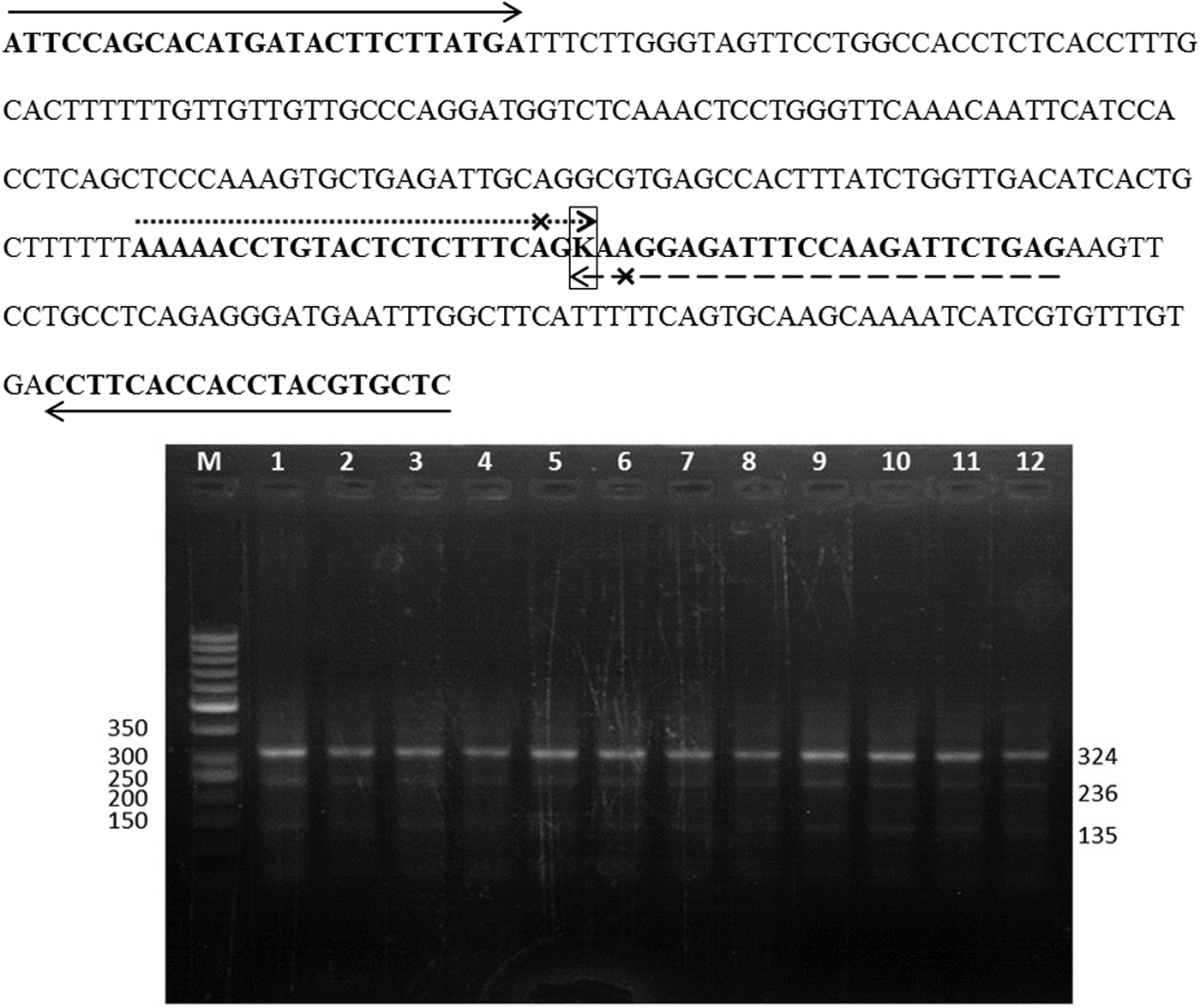
Presentation of tetra-primer ARMS PCR primers and results. The outer nonspecific primers, inner allele specific primers, mismatches and the position of SNP were emphasized in simple arrow, dotted arrow, cross, and box, respectively.
Modified tetra-primer ARMS PCR
Optimization of this assay is substantially easier than normal tetra-primer ARMS PCR. One sample of each identified genotype by this technique (GG, GT, and TT) was selected randomly and amplified for sequencing. Results of sequencing confirmed MTPA PCR data (Fig. 4). The outer primers were used twice as frequently as the inner primers. The rationale for selecting this ratio was the amount of primers spent in PCR. In such a reaction, outer primers are expended for both common and allelic fragments, whereas inner primers are less consumed and involved only in allelic fragments. Moderate outer primers (because of mismatch) and equal calculated annealing temperature for allelic bands facilitated the optimization steps of PCR.

Presentation of MTPA results and validation by DNA sequencing. It should be noticed that DNA sequencing is performed by outer reverse primer. The outer nonspecific primers, inner allele specific primers, mismatches and the position of SNP were emphasized in simple arrow, dotted arrow, cross, and box, respectively.
MTPA PCR primer designer computer software
In a preliminary step, designing primers, whole critical aspects should be considered. Therefore, the computer software of a MTPA PCR primer designer was introduced to facilitate this task. To take advantage of software, the DNA sequence of interest should be inputted and the intended SNP should be specified as IUPAC codes. Moreover, features, including product size, allelic product size ratio, annealing temperature, melting temperature of primers, primer length, concentration of primers, concentration of cations, and the acceptable difference between primer pairs, can be defined by users. The program would compute possible primers, which have acceptable difference of melting temperature the same as possible annealing temperature of allelic amplicons. The software is outlined in Figure 2 and accessible through Internet.
Discussion
Traditional tetra-primer ARMS PCR has a laborious process for optimization and the results do not seem stringent enough. Tetra-primer ARMS PCR is too sensitive to variations of annealing temperatures and MgCl2 concentrations (Medrano and de Oliveira, 2014). Ye et al. (2001) reported a SNP in the angiotensinogen gene that was failed in genotyping. The concluded problem is probably the unbalanced efficiency that appears between the outer and inner primers. Due to the designed mismatch, outer primers were more efficient than inner primers in the PCR. Consequently, 2-10 times more inner primers were used than outer primers, which may lead to decreasing specificity of genotyping. In the MTPA PCR technique, a new mismatch at −2 position of outer primers was designed to decrease the efficiency of the aforementioned primers. Moreover, to improve the strength of PCR, annealing temperatures of allelic fragments were calculated equally. Equal annealing temperature may facilitate the process of PCR. Differences between the MTPA PCR, tetra-primer ARMS-PCR, tetra-primer PCR and ARMS method are summarized in Table 4.
In addition, some researches demonstrated that tetra-primer ARMS PCR may not be practical for studying SNPs in the CG-rich regions (Chiapparino et al., 2004; Medrano and de Oliveira, 2014). In the present study, possible beneficial usage of the novel method in such cases was demonstrated due to improvements compared with the tetra-primer ARMS PCR. As an advantage, short primers (22-28), which could not be used previously in tetra-primer ARMS PCR, now could be accomplished in the new method. Shorter primers have lower melting temperatures and fewer secondary structures that could be useful for PCR.
Both modifications were applied in a novel program, named MTPA PCR primer designer. Introduced software was provided by a nearest-neighbor (N-N) model, primer melting temperature, product melting temperature, and annealing temperature calculation formulas (Breslauer et al., 1986; Chiapparino et al., 2004). Nevertheless, calculating the complementarities of primers was not considered in the software.
In summary, the new SNP genotyping technique reported in this study contains additional advantages compared to the normal tetra-primer ARMS PCR, including balanced strength between outer and inner primers and equal annealing temperature, which make MTPA PCR more efficient than tetra-primer ARMS PCR in a setup process and validity of results. Moreover, using strategies, such as hot start, touchdown PCR, or reagents, like dimethyl sulfoxide (DMSO), are optional and could be beneficial for ameliorating yield and specificity of the reaction. Comprehensive understanding of positive and negative impacts of this assay requires further investigation.
Footnotes
Author Disclosure Statement
No competing financial interests exist.