




Abstract
MiRNAs and NFKB1 are well-known immune response and inflammation regulators. MiRNA gene polymorphisms may affect miRNA biogenesis and function and, may thus, lead to changes in the expression of hundreds of genes such as NFKB1. The aim of this study was to investigate the association of Behcet's disease (BD) with NFKB1 rs28362491, pre-miRNA-146a rs2910164, and pre-miRNA-499 rs3746444 polymorphisms, as well as the analysis of their single and combined effects on its susceptibility in a Turkish population. These polymorphisms were analyzed by using the polymerase chain reaction-restriction fragment length polymorphism method in 100 BD patients and 145 healthy control subjects. The results were analyzed statistically using Pearson chi-square (χ2) test and Fisher's exact test (two sided). According to genotype analysis, the frequencies of ins/ins genotype and ins allele of rs28362491 were considerably higher in BD patients. Also, miRNA-499 rs3746444 homozygous (TT) genotypes exibited a significantly higher risk in patients with BD (odds ratios [OR]=3.0, 95% confidence intervals [95% CI]=1.284-7.007, p=0.017). Moreover, the frequency of T allele of rs3746444 was a risk factor for BD (OR=1.562, 95% CI=1.087-2.24, p=0.015). In addition, significant differences were found between the groups concerning miRNA-146a rs2910164 polymorphism. Homozygous CC genotype and C allele of rs2910164 polymorphism were found to be protective factors against BD. The results of the combined genotype analysis showed no notable differences between the multiple comparisons of rs28362491-rs2910164 and of rs28362491-rs3746444 in patients and control groups. Our data demonstrate that homozygous CC genotype and C allele of rs2910164 polymorphism are protective factors against BD, but rs3746444 and rs28362491 polymorphisms in miRNA-499 and in NFKB1 promoter are involved in the genetic susceptibility of BD. In addition, TT and ins/ins genotypes may influence certain proinflammatory cytokines and, may thus, play a role in the pathogenesis of BD.
Introduction
B
The nuclear factor of kappa B (NFKB), one of the most famous transcription factors, has a key role in regulating the immune response to infection, differentiation, immunity, cell survival, and proliferation (Singh et al., 1986). Therefore, NFKB plays a vital role in inflammatory diseases and the development of autoimmunity. One of the most prominent polymorphisms identified within the promoter of NFKB1 gene is −94 ins/del ATTG rs28362491, which is able to regulate the expression and activity of NFKB1 gene. This polymorphism was investigated in many inflammatory diseases, such as Hashimoto thyroiditis, rheumatoid arthritis (RA), Graves's disease, and BD (Kanigur-Sultuybek et al., 2014).
As we are at a very early stage in understanding BD's molecular mechanism, new candidate markers, such as microRNAs (miRNAs), are changing the way we think about the mechanism of the disease on a post-transcriptional level. MiRNAs, ∼20-22 nucleotides long, are small RNA fragments and can downregulate the gene expression by modifying their translational efficiency and stability (Bartel, 2004). To date, hundreds of miRNAs participating in cellular processes such as proliferation, differentiation, and survival have been identified (Ambros, 2004). Recent studies revealed their prominent regulatory role in the pathogenesis of immune and inflammatory pathologies in human diseases (Ma et al., 2011).
MiRNAs have diverse roles in the fate of immune cells (miR-181a and miR-223) (Chen et al., 2004), innate immunity regulating the Toll-like receptor (TLR) signaling (miR-146) (Taganov et al., 2006), adaptive immunity (miR-155, miR-181a) (Rodriguez et al., 2007; Chen et al., 2004), chronic inflammatory diseases (miR-203, miR-146) (Taganov et al., 2006; Sonkoly et al., 2007), myosin gene regulation (miR-499) (Van Rooij et al., 2009), and antiviral defense (miR-196) (Pedersen et al., 2007).
MiR-146a, located on chromosome 5q33.3, is the most widely known miRNA and has a key role in immune response and inflammation (Rusca and Monticelli, 2011). Previous studies confirmed that several single-nucleotide polymorphisms (SNPs) of miR-146a have functional importance and can modify the expression level of mature miRNA-146a (Jazdzewski et al., 2008; Luo et al., 2011). The SNP 2910164 (G/C) in miR-146a leads to a decrease in the total amount of mature miRNA, which then affects the transcription of target genes and pathogenesis of the disease (Pedersen et al., 2007). Several immune- and inflammatory-related diseases are associated with rs2910164 polymorphisms, such as ulcerative colitis (Okubo et al., 2011), Alzheimer's disease (Cui et al., 2014), Behçet's disease (Zhou et al., 2012), and type 2 diabetes (Ciccacci et al., 2014).
As the TLR4 signaling is activated, miR-146a is induced, resulting in the downregulation of IL-1 receptor-associated kinase 1 (IRAK1) and TNF receptor-associated factor 6 (TRAF6) (Taganov et al., 2006). Some studies associate miR-146a with NFKB, a famous transcription factor, in this negatively regulated pathway (Pacifico et al., 2010). MiR-146a, an NFKB target gene, plays an essential role by increasing the inflammatory response in inflammatory diseases. Naturally, this has influenced many researchers to look into the convergence of miRNAs and their target genes with NFKB signaling cascades that are crucial to autoimmune processes and tumor development.
MiR-499, encoded within the intron of myosin heavy chain 7B, is a cardiac-abundant miRNA that plays a vital role in the myosin gene regulation (Bell et al., 2010) and is strongly associated with heart diseases by regulating cellular differentiation and proliferation (Wilson et al., 2010). The miR-499 rs3746444 polymorphism involves an A>G nucleotide substitution, which leads to a change from AU pair to GU mismatch in the stem structure miR-499 precursor (Xiang et al., 2012). The protein synthesized with this mismatch then participates in the pathogenesis of some autoimmune diseases.
This case-control study was designed to determine whether these three SNPs (NFKB rs28362491, miR-146a rs2910164, miR-499 rs3746444 polymorphisms), alone or combined, are associated with BD in a Turkish population.
Materials and Methods
Study population
A group of 100 BD patients at the Department of Skin and Veneral diseases of Bezmialem University and a control group of 145 healthy individuals were recruited. Study subjects were healthy people in the range of 33.4±5.2 years and patients with BD in the range of 34.8±3.4 years. All subjects reclaimed to be free of any history of autoimmune diseases. Men and women subjects were equally chosen. There was no gender bias in the analysis. Patients were diagnosed with BD based on the international classification criteria. According to the criteria, oral ulceration must be present, along with either a positive pathergy test result or two of the following: typical skin lesions, typical eye lesions, and genital ulceration (International Study Group, 1990). Alcohol usage, smoking, pregnancy, prescription drugs, or having an autoimmune disease, which probably affects the results of the current study, were the exclusion criteria for attendance to the study. All patients and controls were inhabitants of Istanbul and related to the Turkish origin. The study protocol was approved by the Institutional Ethics Committee of Acibadem University.
Blood samples and DNA isolation
Three milliliters of peripheral blood from each subject were collected in EDTA tubes. Genomic DNA was isolated from each blood sample using the Roche DNA purification kit (Roche Diagnostics GmbH, Mannheim, Germany). The concentration and purity of DNA were measured by a NanoDrop™ spectrophotometer and detected by the 260/280 nm optical density (OD) ratio. DNA samples with a 260/280 OD ratio of 1.8±0.2 were accepted.
Genotyping
All NFKB1-94 ins/del ATTG rs28362491, miR-146a rs2910164, and miR-499 rs3746444 polymorphisms were investigated with the polymerase chain reaction-restriction fragment length polymorphism (PCR-RFLP) method. For PCR, forward primer TGG GCA CAA GTC GTT TAT G and reverse primer CTG GAG CCG GTA GGG AAG for rs28362491; forward primer ATG GGT TGT GTC AGT GTC AGA GCT and reverse primer TGC CTT CTG TCT CCA GTC TTC CAA for rs2910164; and forward primer CAA AGT CTT CAC TTC CCT GCC A and reverse primer GAT GTT TAA CTC CTC TCC ACG TGA TC for rs3746444 were preferred.
PCR protocols were as follows: 95°C for 1 min as initial denaturation, followed by 35 cycles at 95°C for 30 s for denaturation, 60°C for 30 s for annealing primers, 72°C for a 1-min extension, and a final extension at 72°C for 5 min for rs28362491; for rs2910164 and rs3746444: 5 min at 94°C followed by 35 cycles of 1 min at 94°C, 1 min at 58°C for rs2910164, 1 min at 67°C for rs3746444, and 2 min at 72°C, with a final step at 72°C for 20 min to allow a whole extension of all PCR fragments.
The PCR product was digested with one unit of restriction enzyme PfIMI (10 U/μL; Fermentas, Vilnius, Lithuania) to distinguish between two different alleles of rs28362491, the 281 bp (deletion allele) or 285 bp (insertion allele). The PCR product-enzyme mix was incubated overnight at 37°C and afterward run on electrophoresis for 30 min at 120 V using a 2% agarose gel. The deletion genotype did not contain the PflMI (Van91I) restriction site and the PCR product of 281 bp remained undigested. However, the insertion variants were seperated into two fragments of 240 and 45 bp by the PflMI (Van91I) restriction enzyme. Heterozygotes showed all three bands (Fig. 1).

The enzyme digestion pattern of rs28362491. M is a 50-bp size marker, lanes 1, 5, and 6 are heterozygous ins/del ATTG, lanes 2, 3, and 4 are homozygous ins/ins ATTG, and lane 7 is del/del ATTG homozygous.
Another restriction enzyme, SacI (NEB, 20,000 U/mL) was used for miRNA-146a rs2910164 gene polymorphism, and the PCR product-enzyme mix was then incubated at 37°C for 1 h. The wild-type homozygous alleles (C/C) yielded 25- and 122-bp products, the heterozygous alleles (C/G) yielded 25-, 122-, and 147-bp products, and the mutated type homozygous alleles (G/G) yielded a 147-bp product (Fig. 2).
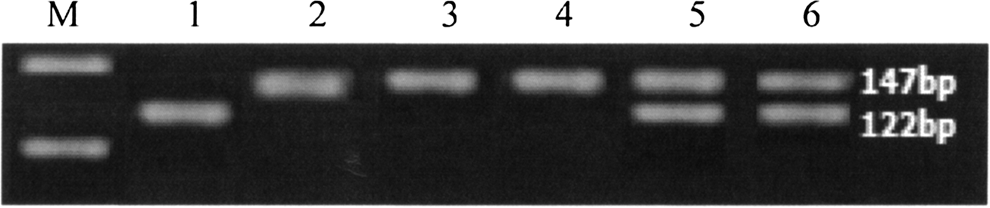
The enzyme digestion pattern of rs2910164. M is a 50-bp size marker, lane 1 is wild-type homozygous alleles (C/C) of mi RNA146, lanes 2-4 are mutant-type homozygous alleles (G/G) of microRNA (miRNA)-146, and lanes 5 and 6 are heterozygous alleles (C/G) of miRNA-146 (rs2910164).
As for miRNA-499 rs3746444, another restriction enzyme, BclI (NEB, 10,000 U/mL) was used for digestion. After a 1-h incubation at 50°C, the genotypes were seen as follows: the wild type (T/T) yielded 26- and 120-bp products, the heterozygous alleles (C/T) yielded 26-, 120-, and 146-bp products, and the mutated-type homozygous alleles (CC genotype) yielded a 146-bp product (Fig. 3).
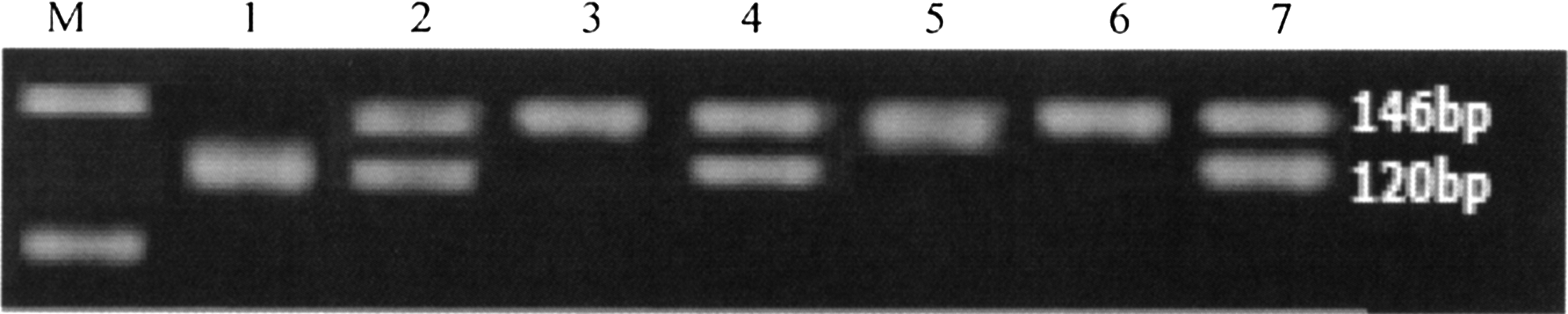
The enzyme digestion pattern of rs3746444. M is a 50-bp size marker, lane 1 is wild-type homozygous alleles (T/T) of mi RNA 499, lanes 2, 4, and 7 are heterozygous alleles (C/T) of miRNA-499, and lanes 3 and 6 are mutated-type homozygous alleles (C/C) of miRNA-499 (rs3746444).
Data processing and analysis
Statistical analysis was performed using the Statistical Package for Social Sciences statistical software release 18 (SPSS Windows version 18; SPSS, Inc., Chicago, IL). The Hardy-Weinberg equilibrium was determined for compatibility between patient and control groups using chi-square (χ2) tests. The relationship between parameters was evaluated using Spearman correlation analysis. The comparison of frequencies and ratios between groups was evaluated using χ2 and Fisher's exact tests. The quantitative data with normal distribution between groups were evaluated using Student's t-test, while the Mann-Whitney U test was used for the rest. The associations between rs 28362491, rs2910164, and rs3746444 genotypes and BD were analyzed by calculating the odds ratios (OR) and their 95% confidence intervals (95% CI) using the χ2-test, accepting the homozygous common genotypes as the reference category for each polymorphism. Since this study was conducted with a small-sized sample and there were a number of multiple comparisons, the results could have arisen from a type I error. The confidence in results will generally be weaker if it is concluded as part of a multiple comparison analysis, rather than a single-comparison analysis.
Results
Distribution of polymorphisms in miR-499 and miR-146a genes in BD
The distribution of the genotype and allele frequencies of all polymorphisms studied is shown in Table 1. One hundred BD patients and 145 control subjects were successfully genotyped for the rs28362491, rs2910164, and rs3746444.
Statistically significant results are marked in bold.
95% CI, 95% confidence intervals; OR, odds ratios.
The frequency of the ins/ins genotype of rs28362491 was considerably higher in patients (p=0.0305, OR=1.839, 95% CI=1.056-3.200). According to our results, having the ins/ins genotype of rs28362491 has a 1.839-times risk factor in patients with BD.
By comparing the allele frequencies, we found that, having the ins allele increased the risk for BD by 1.6 times (p=0.0084, OR=1.663, 95% CI=1.138-2.430). The recessive model (ins/ins vs. ins/del+del/del) (p=0.01, OR=1.987, 95% CI=1.174-3.361) when compared to the dominant model (ins/ins+ins/del vs. del/del) (p=0.4029, OR=1.491, 95% CI=0.6902-3.220) is also found to lead to an increased risk.
In the single-genotyping study of miR-146a polymorphism, the overall frequencies of CC, CG, and GG allele combinations were 1%, 33%, and 66% in the group of patients and 6%, 55%, and 39% in the control group. The frequency of CC genotype of rs2910164 was significantly higher in controls (p=0.0087, OR=0.0960, 95% CI=0.0118-0.7810). When the allele frequencies were compared, it was found that the frequency of C allele is still higher in the control group (p=0.0001, OR=0.4221, 95% CI=0.2721-0.6546). The above results suggest that the CC genotype and C allele of miR-146a rs2910164 have a protective role in BD. According to our results, the dominant model (CC+CG vs. GG) (p=0.0001, OR=0.3337, 95% CI=0.1961-0.5677) is also found to have a protective effect on BD patients with respect to the recessive model.
In the single-genotyping study of mir-499 polymorphism, the overall frequencies of TT, CT, and CC allele combinations were 21%, 65%, and 14% in the group of patients and 15%, 55%, and 30% in the control group. The frequency of TT genotype of rs3746444 was significantly higher in patients (p=0.0179, OR=3.000, 95% CI=1.284-7.007). When the allele frequencies were compared, we found that having the T allele increased the risk for BD (p=0.0157, OR=1.562, 95% CI=1.087-2.245). In addition, the dominant model (TT+CT vs. CC) is correlated with an increased risk compared to the recessive model (p=0.0050, OR=2.676, 95% CI=1.374-5.213). All the results are shown in Table 1.
Apart from that, there were no significant differences between the multiple comparisons of rs28362491 and miRNA-146a, rs2910164 and rs28362491, and miRNA-499 rs3746444 in the patient and control groups (Tables 2 and 3).
del/del CC combined genotypes were excluded in the table as none observed in the subjects or the size was enough for the statistical analyses.
del/del CC combined genotypes were excluded in the table as none observed in the subjects or the size was enough for the statistical analyses.
Combined genotype analysis of the polymorphisms in NFKB1 rs28362491 and miR-146 rs2910164 genes in BD
During combined genotype analysis, no associations were found between BD and NFKB1 rs28362491 and miR-146 rs2910164 polymorphisms. All results are shown in Table 2.
Combined genotype analysis of the polymorphisms in NFKB1 rs28362491 and miR-499 rs3746444
Table 3 summarizes the association of combined genotypes between NFKB1 rs28362491 and miR-499 rs3746444. Both polymorphisms, rs28362491 and rs3746444, had no considerable differences among the combined genotypes of BD patients and controls. None of the combinations was found to be a significant risk or protective factor for BD.
Discussion
Although the ethiology of BD is not yet known, genetic predisposition and immune dysregulation are thought to be critical factors in the pathogenesis of this disease (Dilek et al., 2009). In this study, we investigated whether the single or combined effects of NFKB1-94 ATTG rs28362491, miR-146a rs2910164, miR-499 rs3746444 are related to the susceptibility to BD in the Turkish population, or not. It is known that NFKB1 regulates the cytokine production. The variations of NFKB1 gene may result in an altered NFKB expression, which in turn results in an altered transcription of inflammatory cytokines and may explain the overexpression of these cytokines as well as the increased serum concentrations in BD (Yalcin et al., 2008; Zhang et al., 2013).
One of the most famous polymorphisms identified within the promoter of NFKB1 gene is −94 ins/del ATTG rs28362491, which is able to regulate the expression of NFKB1. Many researchers have pointed out that NFKB1-94ins/del ATTG rs28362491 variations within NFKB1 could potentially influence the inflammatory cytokines and thus the process of inflammation (Karban et al., 2004). According to our previously published research, the functional ins/ins genotype and ins allele of NFKB1 rs28362491 are associated with an enhanced risk of BD in the Turkish population. This study is the follow-up of our previous research.
In addition, miRNAs participate in the pathogenesis of many autoimmune inflammatory diseases; however, the results remain conflicting. MiRNAs are involved in the regulation of a variety of biological processes such as inflammation (Taganov et al., 2006; Keating et al., 2007). They could perform degradation or translational repression of the target mRNA by binding to the 3′UTR, 5′UTR, or even the coding sequences of the target mRNAs, as seen with the inhibition of NFKB1. The bond between miRNA and its target may be reinforced or weakened by an SNP variation within the miRNA sequence. Therefore, a minor variation in miRNA genes alters a wide spectrum of biological processes by affecting the processing and/or the target selection of mRNAs.
MiRNAs, by their overexpression or downregulation, seem to be involved in the pathogenesis of many inflammatory and autoimmune diseases such as sepsis (Yiming et al., 2014), gastric cancer (Xu et al., 2010), oral cancer (Chu et al., 2012), prostate cancer (Wei et al., 2013) RA (Ceribelli et al., 2011), Crohn's Disease, and ulcerative colitis (Gazouli et al., 2013).
One of the most important miRNAs, miR-499, regulates the expression of many cytokines, including IL-23a, IL-2R, IL-6, IL-2, and IL-18R (Hashemi et al., 2013). An important polymorphism with a change of A to G was identified (rs3746444) in the miR-499. This polymorphism is located in the stem region of miR-499 and may damage the secondary structure stability and, in turn, disturb the miRNA maturation process and binding affinities to its target genes (Hu et al., 2009). It is reasonable that rs3746444 is correlated with risk of a variety of diseases such as different types of cancers (Xiang et al., 2012), RA (Hashemi et al., 2013), coronary artery disease (Zhou et al., 2012), and ischemic stroke (Luo et al., 2011). In contrast to the findings of Hashemi et al. (2013), Yang et al. (2012) did not detect a significant association between miR-499 rs3746444 polymorphism and RA.
Our data show that the miR-499 rs3746444 polymorphism is associated with an increased risk of BD in the TT genotype and the dominant model (having at least one T allele). The prevalence of rs3746444 TT (21%) variants in BD patients was found to be significantly higher than that in healthy individuals (15%); and the T allele of rs3746444 was found to be more frequent in patients with BD than that in the controls (54% and 42% respectively).
Considering previous studies, having the CC genotype, interestingly, is a risk factor for having, for example, oral squamous cell carcinoma (Chu et al., 2012). This explains the diverse roles of miRNAs in different targets. Our results are similar to the result of Lechun et al. (2014) of an overall association of autoimmune diseases with the homozygote TT genotype. Hence, when rs3746444 and rs28362491 polymorphisms were evaluated together, no significant differences were found between the BD patients and control groups.
We also investigated the association between another common miRNA polymorphism, miR-146a rs2910164, with BD. It has an important role in inflammation and immune response (Rusca and Monticelli, 2011). Recently, this SNP in miR-146a was reported to be able to influence the expression level of mature miR-146a and, thus, affect an individual's susceptibility to various diseases (Jazdzewski et al., 2008, 2009; Xu et al., 2008, 2010; Luo et al., 2011; Zhou et al., 2012).
Many studies have shown that the rs2910164 polymorphism involves a G>C nucleotide replacement, which causes a change from a GU pair to a CU in the stem structure of the miR-146a precursor. This change affects the specificity of mature miRNA in binding to its target genes such as IRAK2, FADD, DTAT-1, and NFKB1 (Iwai and Naraba, 2005). Taking these into consideration, we carried out single and combined genotype analysis between rs28362491, rs2910164, and BD in a population-based case-control study. We found that having the CC genotype of miR-146a rs2910164 has a protective role in BD contradicting with Crohn's disease, as shown in a previous study (Gazouli et al., 2013). In addition to the homozygosity of C allele's protective role, the dominant model (CC+CG vs. GG) also shows that having at least one C allele has a protective effect in BD. Confoundly, in some studies, the CG genotype (Chen et al., 2013) and combined CG+GG (Zhang et al., 2014) genotypes are shown to be risk factors for autoimmune diseases in Asians and for psoriasis, respectively. When we evaluated rs28362491 and rs2910164 polymorphisms together, we did not find any significant differences between BD patients and the control groups. A growing number of studies have revealed that rs2910164 polymorphisms in miR-146a affect the pathogenesis of several human diseases such as RA and cardiovascular autonomic neuropathy (CAN) in type II diabetes. The rs29101164 SNP in miR-146a showed a protective effect to early CAN, which is a common type 2 diabetes complication (Cinzia et al., 2014). Shao et al. (2014) demonstrated a notable association between rs2910164 of the pre-miR-146a gene and the susceptibility to severe sepsis of a patient in a Chinese population.
In conclusion, this study demonstrates that polymorphisms within NFKB1 rs28362491 and miR-499 rs3746444 seem to be involved in the susceptibility to BD, and these polymorphisms may be valuable markers to predict the risk for the development of BD. This study was the first to show the association between miR-499 (rs3746444) polymorphism and BD. On the other hand, rs2910164 SNP in miR-146a showed a protective effect in BD. However, a study with a sample of a larger size, picked out from different ethnic origins, should be carried out to futher verify this association.
Footnotes
Author Disclosure Statement
No competing financial interests exist.