




Abstract
Aim: In gliomas, mutations in the core promoter region of the telomerase reverse transcriptase (TERT) gene have been associated with specific subtypes and are inversely correlated with IDH1 mutation status, predicting poor prognosis. Thus, TERT promoter mutation status might be a candidate for development as a prognostic biomarker. However, current IDH1 mutation detection methods using conventional polymerase chain reaction (PCR), followed by Sanger sequencing, have low sensitivity and are time-consuming. To improve test efficacy, we developed a more efficient detection protocol based on an amplification refractory mutation system-PCR (ARMS-PCR), which is based on the principle that DNA extension only happens when the 3′-terminal nucleotide of a primer matches its target sequence. Materials and Methods: We generated plasmids containing TERT promoter sequences and optimized this new protocol for the identification of the two most common TERT promoter mutations, C250T and C228T. Results: The enhanced sensitivity and efficiency of this protocol were validated using 124 human glioma samples. Conclusion: We have described an ARMS-PCR methodology with improved sensitivities that could replace current commonly used methods for the detection of TERT promoter mutations in gliomas.
Introduction
G
TERT promoter mutations are found in multiple types of tumors usually originating from tissues with relatively low rates of self-renewal (Horn et al., 2013; Huang et al., 2013; Killela et al., 2013; Liu et al., 2013; Nault et al., 2013; Vinagre et al., 2013). In gliomas, TERT promoter mutations are associated with specific subtypes, including primary glioblastomas and oligodendrogliomas, and inversely correlated with IDH1 mutation status, suggesting a poor prognosis (Killela et al., 2013; Xie et al., 2014). TERT promoter mutations are usually detected through conventional reverse transcription-polymerase chain reaction (RT-PCR), followed by Sanger sequencing (Horn et al., 2013; Nonoguchi et al., 2013; Xie et al., 2014; Hosen et al., 2015), which is time-consuming with low sensitivity (15-30%). In this study, we employed the amplification refractory mutation system-PCR (ARMS-PCR) technology, which is based on the principle that extension in a PCR only happens when the 3′-terminal nucleotide of a primer matches its target sequence (Ye et al., 2001), to develop a new methodology for the identification of the two most common TERT promoter mutations, C250T and C228T (Killela et al., 2013; Nonoguchi et al., 2013; Mosrati et al., 2015). We optimized this new method using plasmids containing mutant TERT promoter sequences, and then validated using 124 glioma samples that were formalin fixed and paraffin embedded (FFPE). Thus, we here describe an alternative method for the detection of TERT promoter mutations in gliomas with enhanced sensitivity, yet reduced time and labor.
Materials and Methods
Samples and DNA extraction
A total of 124 tumor samples that were FFPE, including astrocytomas (n = 43), oligodendrogliomas (n = 51), and oligoastrocytomas (n = 30), were collected from the First Affiliated Hospital of Zhengzhou University. DNA was extracted from the most tumor-rich area of each sample block using a QIAamp DNA FFPE Tissue Kit (Cat. No. 56404; Qiagen) according to the manufacturer's instructions.
Plasmid construction
DNA fragments harboring the human TERT promoter C250T or C228T mutant sequences were synthesized (Invitrogen). These fragments were cloned into pUC18; the mutations confirmed by sequencing and used as positive controls.
Sensitivity assay study
Mutant plasmid DNA at a concentration of 5 copies/μL was serially diluted and added into various concentrations of genomic DNA to generate a sensitivity panel consisting of 50%, 20%, 10%, 1%, and 0.5% of mutants in a wild-type background. Each sample was prepared in triplicate for ARMS-PCR or sequencing for the detection of mutations.
ARMS-PCR and sequencing
ARMS TaqMan PCR was performed in a 50 μL final mixture containing 5-10 ng of sample, 1× PCR buffer (10 mM Tris-HCl, pH 9.0, 50 mM KCl, 0.1% Triton X-100), 1 mM MgCl2, 200 μM of dNTPs, 0.2 pmol of forward primer, 0.25 pmol of reverse primer, 0.1 pmol of each internal primer, 0.1 pmol of each probe, 0.5 pmol of nest primer (also known as an adapter primer, which is designed to amplify the mutant allele before the nested PCR), and 0.9 U of Hotstar Taq DNA polymerase (Takara). PCR was carried out in three stages: incubation at 95°C for 5 min to activate the DNA polymerase; enrichment of the mutant allele with 16 cycles at 95°C for 20 s, 65°C for 20 s, and 72°C for 20 s; and ARMS TaqMan PCR with 35 cycles at 95°C for 20 s and 65°C for 60 s (fluorescence collection). All reactions were carried out in single sealed tubes and detected using a fluorometric PCR instrument (Stepone Plus). Bidirectional Sanger sequencing was performed following the manufacturer's instructions using the primers indicated in Table 1.
Cutoff value determination
A TaqMan PCR assay of exon 4 of the tert gene was used for an internal control. Each assay with 5-50 ng of genomic DNA per reaction was performed to assess the specificity and to determine the cutoff value of ARMS TaqMan PCR. Cycle threshold (Ct) values were recorded and corresponding ΔCt values (Ct (mutant allele assay) − Ct (gene control assay)) were calculated. The assays were carried out six times and each DNA concentration was repeated in triplicate in each assay. The cutoff ΔCt value was determined to be 3 Ct below the lowest ΔCt value in all reactions for each assay.
Results
To establish the specificity of the method, we performed ARMS TaqMan PCR for the target genes and TaqMan PCR for the internal control genes using 5-50 ng of human genomic DNA. Copy proportions of mutant to wild-type DNA were varied from 0.5% to 10%. We calculated the cutoff values to be 9.1 for C228T and 8.5 for C250T (Table 2).
ARMS, amplification refractory mutation system.
To assess the sensitivity of the assay, we made serial dilutions of plasmid containing either the C250T or C228T mutation spiked into wild-type genomic DNA. The PCR results showed that the assay was able to detect as few as 5 copies of the C250T or C228T allele when this mutant consisted of only 0.5% of the total against a background of wild-type genomic DNA (Table 2).
We prepared a mixture of plasmid harboring either C250T or C228T mutations with genomic DNA to compare the sensitivity of sequencing versus the ARMS TaqMan PCR assay. Direct sequencing was unable to identify either mutation at <20% of the total mixture, reflecting the low sensitivity of detection of automated dideoxy sequencing. The ARMS assay, by contrast, was more sensitive, detecting a mutation present at only 1% of the DNA mixture (Fig. 1).
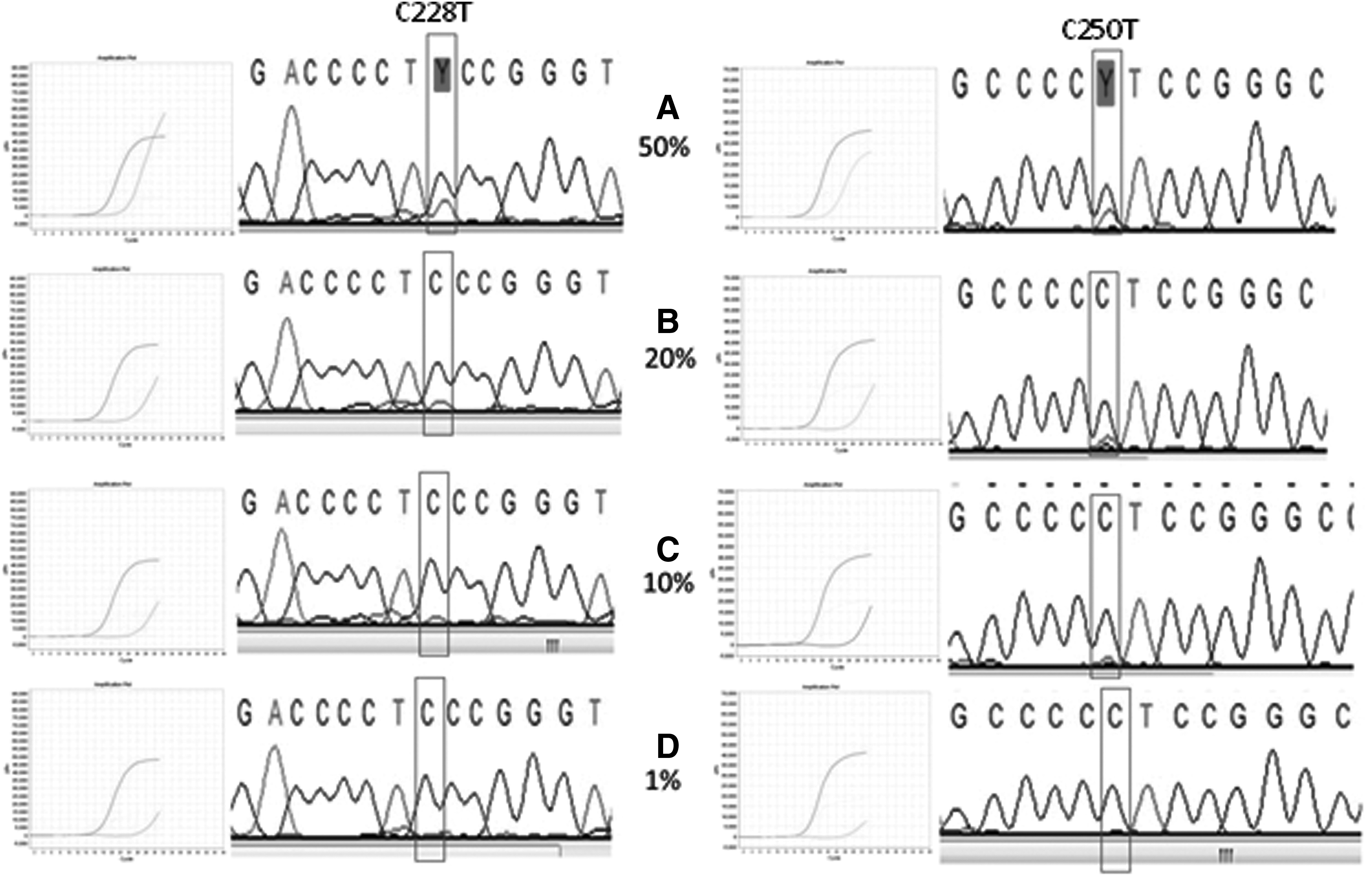
Sensitivities of the amplification refractory mutation system (ARMS) assays in comparison with sequencing. Plasmids harboring mutations, C228T and C250T, were used to compare the ARMS assays with sequencing. The percentage of mutants in human genomic DNA is
We then analyzed human tumors for the C250T and C228T TERT promoter mutations using ARMS-PCR. We investigated a total of 124 clinical tissue samples as indicated in the Materials and Methods section. ARMS-PCR revealed that 3 of 30 (10%) astrocytoma III and 35 of 81 (43.2%) oligodendrogliomas contained C250T or C228T mutations. Interestingly, we found none of the six astrocytoma II samples or seven astrocytoma IV samples to be positive for either mutation.
Discussion
In somatic cells, telomerase inactivation and length shortening are not only essential barriers to tumor growth but also contribute to loss of cells due to aging (Aubert and Lansdorp, 2008). A characteristic hallmark of cancer cells is immortalization, which is likely mediated by telomerase reactivation or through the alternative mechanism of telomere lengthening (Vinagre et al., 2014). Mutations in the TERT promoter region are associated with a failure to silence telomerase activity, resulting in an insufficient barrier to cell proliferation as observed in cancer cells (Chiba et al., 2015). Consistently, these mutations are associated with poor prognosis in patients with various types of cancers (Horn et al., 2013; Huang et al., 2013; Killela et al., 2013; Liu et al., 2013; Nault et al., 2013; Vinagre et al., 2013). In gliomas, TERT promoter mutations are associated with worse overall survival and are more frequently detected in specific subtypes, including primary glioblastomas (Nonoguchi et al., 2013) and oligodendrogliomas (Killela et al., 2013). Thus, detecting TERT promoter mutations has clinical relevance and can provide guidance for disease diagnosis and treatment.
TERT promoter mutations were usually detected using Sanger sequencing of conventional RT-PCR products. This method is time-consuming and has limited sensitivity, which may result in an underestimation of the prevalence of TERT promoter mutations when tumor samples contain a low percentage of mutant cells. This problem is likely more prominent in gliomas with high heterogeneity in cellular composition and lower availability due to the amount of tissue that can be collected for screening. To overcome these potential problems, we adapted the ARMS-PCR methodology, which has been used successfully to improve sensitivity, accuracy, and efficiency over Sanger DNA sequencing of RT-PCR products for the detection of other genetic mutations, including IDH1/2 mutations in gliomas (Catteau et al., 2014), KRAS and BRAF mutations in colorectal cancers (Lang et al., 2011), and EGFR mutations in nonsmall cell lung carcinomas (Angulo et al., 2012). Using plasmids encoding mutant TERT promoter sequences in wild-type background DNA, we demonstrated that our ARMS-PCR-based method is much more sensitive (1% vs. 20%) than conventional RT-PCR/Sanger sequencing. Through the new method, we have successfully detected TERT promoter mutations in glioma FFPE samples with a result comparable with a previously published study (Vinagre et al., 2013). This result validated the advantage of this new method over the traditional Sanger sequencing of RT-PCR products.
In summary, we have developed an ARMS-based molecular screening method for detecting TERT promoter mutations in glioma FFPE samples. We have demonstrated that this method is much more sensitive than the conventional Sanger sequencing of RT-PCR products. Using this newly developed technique, we have successfully characterized the TERT promoter mutation status in a variety of human tumors, which is more frequently detected in oligodendrogliomas, but rarely in astrocytomas. This technology improvement will facilitate the molecular diagnosis of gliomas and likely improve prognostic prediction and treatment selection.
Footnotes
Acknowledgment
This study was funded by National Natural Science Foundation of China (81272371).
Author Disclosure Statement
No competing financial interests exist.