




Abstract
Objective:
The SLC44A4 gene was recently reported to be associated with ulcerative colitis (UC) susceptibility in the Indian and Japanese populations. The aim of our study was to investigate the association of common variants within the SLC44A4 gene and the susceptibility to UC among the Han Chinese.
Methods:
We examined 16 tag single nucleotide polymorphisms (SNPs) within the SLC44A4 gene in a Han Chinese population that consisted of 311 UC patients and 675 healthy controls; both SNP and haplotypic association analyses were performed.
Results:
We found that rs2736428 was significantly associated with UC risk (allelic p = 0.0004), and the CT and TT genotypes of rs2736428 had a higher distribution compared with the CC genotypes (genotypic p = 0.001), suggesting that the T allele was a risk allele (odds ratio = 1.45, 95% confidence interval = 1.18-1.78). Moreover, one haplotype block that included rs2736428 was found to be strongly associated with UC risk as well (global p < 0.001).
Conclusion:
Our results provide further supportive evidence for an important role of the SLC44A4 gene in the pathogenesis of UC.
Introduction
U
Currently, some epidemiological studies have demonstrated that UC is a complex and multifactorial disorder that involves interactions among genetic, immunologic, bacterial, environmental, and psychological factors (Xavier and Podolsky, 2007; Cho, 2008; Molodecky and Kaplan, 2010). Growing evidence has corroborated the notion that genetic factors play an important role in the etiology of UC (Papadakis and Targan, 1999; Ooi et al., 2010; Khor et al., 2011); thus, the underlying genetic susceptibility factors that are involved in the pathogenesis of UC have been an extensive research focus.
With the fast development of high-throughput genetic research techniques and statistical methodologies, which enable us to investigate the genetic susceptibility of complex diseases (Guan et al., 2013, 2014, 2016d), genetic association analysis has provided a promising approach to elucidate the genetic susceptibility of complex diseases in an unprecedentedly unbiased way (Wang et al., 2010; Guan et al., 2016b, 2016c). Thus far, genetic association studies, including genome-wide association studies (GWASs), have identified approximately 160 loci associated with UC susceptibility and development (Jostins et al., 2012). However, those identified risk alleles have mostly low-to-modest effects (odds ratio [OR] <1.5) and explain <15% of the overall variance in UC risk (Anderson et al., 2011; Jostins et al., 2012) due to the uncertain etiology of the disease and the scarce biological interpretations.
Recently, a novel GWAS single nucleotide polymorphism (SNP) (rs2736428) within the SLC44A4 gene has been reported to be associated with an increased UC risk in Indian and Japanese individuals (Gupta et al., 2016). The SLC44A4 gene, located at 6p21.33, encodes human thiamine pyrophosphate transporter (TPPT), which is highly expressed in the colon and is responsible for the absorption of the microbiota-generated thiamine pyrophosphate (TPP) in the large intestine (Nabokina et al., 2016). Therefore, elucidating the role of genetic variations in SLC44A4 gene might provide implications for predictive medicine and a further understanding of UC biology.
Recent GWASs of UC in Korean and Japanese populations have suggested that genetic associations for UC tend to overlap among different ethnic groups (Yamazaki et al., 2013; Yang et al., 2013b, 2014); thus, replication studies of these significant common variations are necessary and important in different ethnic populations. We performed a case-control study to investigate the association of the SLC44A4 gene with UC risk in Han Chinese individuals. We included 311 UC patients and 675 healthy controls to provide insightful information on the role of the SLC44A4 gene in UC susceptibility in the Han Chinese population.
Materials and Methods
Subjects
This hospital-based case-control study contained 311 UC patients (173 males and 138 females) and 675 age- and gender-matched healthy controls (378 males and 297 females). All the patients were diagnosed based on Montreal classification (Satsangi et al., 2006) in the Second Affiliated Hospital of Xi'an Jiaotong University, Shaanxi People's Hospital, and Xi'an Central Hospital. The extent of UC was classified as entire large bowel (extensive colitis) and local large bowel (limited to a proportion of the colorectum) on endoscopy examination. Extraintestinal manifestations of UC patients, including abnormal manifestations on joint, skin, and eyes, were reviewed by medical records and interviews with the patients. Related clinical characteristics and demographic data of enrolled subjects are summarized in Table 1.
NA, non-available; SD, standard deviation; UC, ulcerative colitis.
Individuals with other concomitant autoimmune diseases, including Crohn's disease, were excluded from the study. All subjects self-reported as having an unrelated Chinese Han ancestry. Written informed consent to take blood samples from the subjects was obtained. The study protocol conformed to the ethical guidelines of the 1975 Declaration of Helsinki and was approved by the Ethics Committee of the Xi'an Jiaotong University.
SNP selection and genotyping
As an initial screening of common SNPs in the Han Chinese population, we first searched for all SNPs with minor allele frequencies (MAF) ≥0.01 of the SLC44A4 gene in the 1000 genomes CHB dataset. Then, MAF ≥0.01 with pair-wise tagging and r2 ≥ 0.6 were used as the threshold criteria of tag SNP selections. Finally, 16 tag SNPs covering the region of the SLC44A4 gene were included in the study (Supplementary Table S1; Supplementary Data are available online at www.liebertpub.com/gtmb).
Genomic DNA was isolated from peripheral blood mononuclear cell with the Tiangen DNA Extraction Kit (Tiangen Biotech Co., Ltd., Beijing, China) according to the manufacturer's protocol. SNP genotyping was performed at the Sequenom MassARRAY platform with the iPLEX GOLD chemistry (Sequenom, San Diego, CA) based on the manufacturer's protocols (Gabriel et al., 2009), and the results were processed using Sequenom Typer 4.0 software, and genotype data were generated from the samples (Guan et al., 2016a). The samples were blinded for quality control during genotyping processes, and 5% of random samples were repeated with a concordance of 100%.
Statistical analysis
The Hardy-Weinberg equilibrium (HWE) of each SNP in both groups was calculated using Haploview v4.2. SNP-based association analyses were performed with PLINK v1.9, and a logistic model (Guan et al., 2012a) was implemented for each SNP to examine the association with UC risk. The reasonable use of the Bonferroni correction could avoid multiple comparison problems, and the statistical strength of the association between SLC44A4 and UC risk was measured with ORs and 95% confidence intervals (CIs) from the logistic model with adjustments for age and gender (Guan et al., 2012b). The linkage disequilibrium (LD) of 16 selected tag SNPs was determined by Haploview v4.2, and haplotypic association analyses were further carried out for all haplotypes with GENECOUNTING v2.2. All tests were two tailed, and p-values <0.05 were considered statistically significant.
Results
Population characteristics
The subjects consisted of 311 UC patients and 675 healthy controls with a mean age of 41.34 and 41.62, respectively, who were successfully genotyped. The allelic and genotypic distributions of all selected tag SNPs were consistent with the HWE (Table 2 and Supplementary Table S2). The male to female ratios in the cases and controls were 1.25 (173/138) and 1.27 (378/297), respectively, and there was no significant difference in gender distribution between the cases and controls (p = 0.913, Pearson χ2 = 0.012). As shown in Table 1, 72.67% of UC patients (226/311) had local large bowel involvement, and 27.33% (85/311) of UC patients had entire colorectal involvement.
Corrected p-values are underlined after Bonferroni correction (p × 16). Risk allele and significant p-values are in italic bold. OR referred to the risk allele OR in cases and controls.
Means p-values after adjustments for gender and age.
CI, confidence interval; HWE, Hardy-Weinberg equilibrium; OR, odds ratio; SNP, single nucleotide polymorphism.
Association analysis
The results of SNP association analyses are presented in Table 2 and Supplementary Table S2. As shown in Table 2, we observed that rs2736428 was significantly associated with UC risk. Compared to the controls, the frequency of the allele T at rs2736428 was significantly higher in UC patients than in controls (34.57% vs. 26.74%). Under the logistic regression model that was adjusted for age and gender, subjects with a T allele had an increased risk of UC (allelic p = 0.000387, OR = 1.45, 95% CI = 1.18-1.78). The genotypic association analyses indicated a similar significant pattern. The genotype distributions of T/T and C/T at rs2736428 were both higher in UC patients than in healthy controls, and the difference was also significant (p = 0.001204). The significance of the SNP rs2736428 remained after Bonferroni correction. In contrast, we did not find any association between the other 15 tag SNPs and UC risk (Table 2 and Supplementary Table S2).
Haplotype analysis
First, we measured the LD structure of the tag SNPs and identified two LD blocks within the genotype dataset. LD patterns are shown in Figure 1. As shown in Figure 1, we observed a two-SNP LD block (rs117369289-rs2736428) that included the associated SNP rs2736428. Haplotypic association analyses were subsequently carried out to evaluate whether any specific haplotype would confer a higher UC risk or protection from UC. Haplotypic analyses revealed four distinct haplotypes, and there was a significant difference in the distributions of haplotype frequencies between cases and controls (global p = 0.003) (Table 3). The most common haplotype (GC) was observed to be a protective haplotype with a frequency of 64.22% in UC patients and 72.62% in controls (p = 0.0002). The haplotype (GT) was significantly associated with UC risk; the frequency increased almost 1.5-fold in the case group (p = 0.0001).
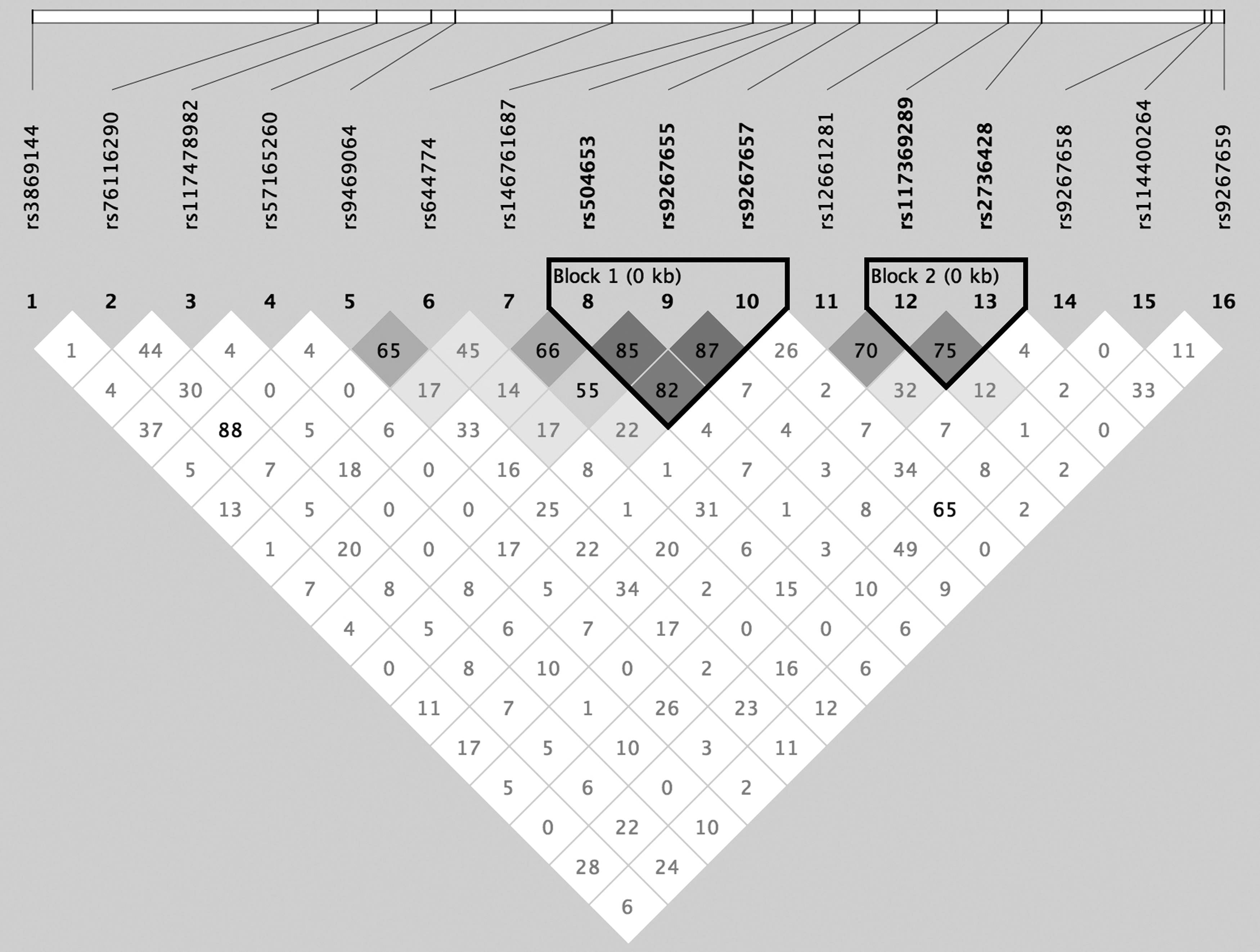
Linkage disequilibrium patterns of the region around the SLC44A4 gene in Han Chinese population. The two identified linkage disequilibrium blocks are indicated as shaded matrices and outlined.
Haplotypes in italics were the significant ones in the study, and significant p-values are in italic bold.
Based on 10,000 permutations.
Based on comparison of frequency distribution of all haplotypes for the combination of SNPs.
Discussion
UC is a complex disease that is characterized by multiple factors, and the incidence of UC has been increasing all over the world. Although accumulating evidence has suggested that genetic factors play an important role in the pathogenesis of UC, the genetic background of UC remains unclear and it remains a major challenge to elucidate the biological mechanism of the genetic etiology of UC. Searching for the causal genes of UC risk has become one of the most intensive research focuses in recent years. Most recently, the SLC44A4 gene has been reported to be a significant risk factor for UC in Indian and Japanese individuals (Gupta et al., 2016). In the current case-control study, we investigated the potential association between 16 tag SNPs in the SLC44A4 gene and UC in the Han Chinese population. To the best of our knowledge, this was the first genetic association study of the SLC44A4 gene with UC risk in Han Chinese individuals.
To evaluate the effect of common variants in the SLC44A4 gene on UC risk in different populations, we compared our study with a previous study (Gupta et al., 2016). In our study, the rs2736428 SNP was significantly associated with UC risk, and the CC genotype indicated a lower risk of UC compared with the CT and TT genotypes. The OR and 95% CI also suggested a risk effect of the T allele at rs2736428 on UC susceptibility. These results were basically similar to the results of Gupta et al. (2016), who reported that the T allele at the UC-associated SNP rs2736428 was a risk allele in Indians, but a protective allele in Japanese. Although overall similarities in general association patterns have demonstrated the relationship between the SLC44A4 gene and UC risk, the possible reasons for the discrepancy might be in the different ethnicity and genetic background.
The MAF of rs2736428 in the UC cases in our study population were similar with that in Indian and Dutch populations (0.35 vs. 0.39 and 0.33), but they were lower than in the Japanese population (0.42) (Gupta et al., 2016). Moreover, when comparing MAF of the SNP rs2736428 in the NCBI dbSNP, we also found significant difference between Han Chinese and Japanese, indicating the existence of the heterogeneity of ethnic groups. It is not enough to draw a conclusion from the analysis of some SNPs (Yang et al., 2013a; Chen et al., 2015; Guan et al., 2015; Zhang et al., 2015; Jia et al., 2016). Our haplotype analyses further supported that the rs2736428 was significantly associated with UC susceptibility, indicating that the T allele of rs2736428 was involved in increased UC risk.
A considerable amount of vitamin B1 is synthesized in the form of TPP by microbiota of the large intestine (Nabokina et al., 2015). The human TPPT, which is encoded by the SLC44A4 gene, is responsible for the absorption of the microbiota-generated TPP in the large intestine (Nabokina et al., 2016). The TPPT is highly expressed in the colon, but not in other regions of the intestinal tract. Given that the microbiota-generated TPP could contribute to host thiamine homeostasis, especially to the cellular nutrition of colonocytes (Nabokina et al., 2014), the SLC44A4 gene has been speculated to have an important effect on thiamine nutrition, especially in the colon. Our results were confirmed by both SNP and haplotype-based analyses that highlighted the importance of this gene in UC biology, but they should be considered preliminary because of the unknown underlying molecular mechanism. These results should be replicated in other ethnic populations with larger sample sizes.
In summary, our independent case-control study indicates that the SLC44A4 gene contributes to UC risk in Han Chinese individuals. Moreover, as an intriguing new insight into the pathogenesis of UC, we have also confirmed previous reports that suggested that the gene may play an important role in the etiology of UC. However, several limitations in our study should be considered, such as the lack of extensive coverage of the gene and the relatively small sample size. Thus, further functional studies are needed to validate our findings and clarify the effect of SLC44A4 on UC susceptibility.
Footnotes
Acknowledgments
The authors thank all the colleagues for their assistance in accessing collections and their advice and comments during the preparation of this article.
Author Disclosure Statement
No competing financial interests exist.
References
Supplementary Material
Please find the following supplemental material available below.
For Open Access articles published under a Creative Commons License, all supplemental material carries the same license as the article it is associated with.
For non-Open Access articles published, all supplemental material carries a non-exclusive license, and permission requests for re-use of supplemental material or any part of supplemental material shall be sent directly to the copyright owner as specified in the copyright notice associated with the article.
