




Abstract
Aims:
microRNAs (miRNA) play a key role in the pathogenesis of breast cancer (BC) as regulators of tumor-associated genes, and understanding their polymorphisms is critical to the control of breast carcinogenesis. Thus, the present study explored the association between five common functional polymorphisms in miRNAs (i.e., miRNA-196a2C>T, rs11614913; miRNA-146aG>C, rs2910164; miRNA-423C>A, rs6505162; miRNA-608G>C, rs4919510; miRNA-27aC>T, rs895819) and the risk of BC.
Materials and Methods:
Meta-analyses were performed on 31 studies, including 14,677 BC patients and 16,143 cancer-free controls. Fourteen studies with 6147 cases and 5820 controls were analyzed for rs2910164, seventeen studies with 7021 cases and 8186 controls were analyzed for rs11614913, seven studies with 1891 (3390) cases and 2239 (5485) controls were analyzed for rs6505162 and rs4919510, respectively, and nine studies with 4499 cases and 5434 controls were analyzed for rs895819. Odds ratios (ORs) and 95% confidence intervals (CIs) were adopted to estimate BC risk. Subgroup analyses were performed for ethnicity. Because there was one study with mixed ethnicities, 16 studies were used in the analysis of Caucasian groups, and 16 studies were used for the Asian group.
Result:
Meta-analysis showed that rs895819 correlated with reduced BC risk in three genotypic models: allele (Caucasian: OR = 0.89, 95% CI = 0.82-0.97, p = 0.008; Total: OR = 0.93, 95% CI = 0.87-0.99, p = 0.03), recessive (Caucasian: OR = 0.85, 95% CI = 0.77-0.94, p = 0.002; Total: OR = 0.92, 95% CI = 0.85-0.99, p = 0.04), and dominant (Total: OR = 0.87, 95% CI = 0.77-0.99, p = 0.04). Of note, a significant publication bias for rs895819 was observed in the dominant model. Unexpectedly, the other four polymorphisms were not associated with BC risk in any of the models.
Conclusions:
The present study indicates that only the rs895819 polymorphism was associated with BC risk.
Introduction
B
miRNAs are short (19-23 nt), noncoding RNA molecules that control gene expression by repressing or activating transcription (Dahiya et al., 2015). In the region of miRNA sequence, single nucleotide polymorphisms (SNPs) can alter the maturation of pre-miRNA or target selection, to affecting downstream processes (Iwai and Naraba, 2005), which contribute to many physiological and pathological processes involved in tumorigenesis (Gaur et al., 2007), proliferation (Song et al., 2014), and immune function (Srivastava et al., 2017). Increasing evidence suggests that dysregulation of miRNAs is responsible for the initiation and progression of many cancers (Mullany et al., 2015; Pipan et al., 2015), including BC.
Five miRNA SNPs (i.e., miRNA-196a2C>T, rs11614913; miRNA-146aG>C, rs2910164; miRNA-423C>A, rs6505162; miRNA-608G>C, rs4919510; miRNA-27aC>T, rs895819) have been explored previously regarding the development of BC (Meshkat et al., 2016; Morales et al., 2016), but the results were conflicting and inconclusive. For example, studies about rs11614913 can be different in two meta-analysis (Dai et al., 2016; Upadhyaya et al., 2016; Zhao et al., 2016; Mu et al., 2017). There are some representative results that can be found in the part of discussion.
To better understand the causes of these inconsistencies, we performed an updated meta-analysis of all available articles published in English and Chinese, focusing on the association between the five common functional SNPs mentioned above and BC risk. By exploring molecular targets for therapeutic interventions, the results of the present study contribute further to the current understanding of populations susceptible to BC.
Materials and Methods
Literature search
English and Chinese Studies published from the earliest available through October 2017 were searched on PubMed, Embase, Web of Science, and CBKI with the following search terms: “miRNA 146a/miRNA 608/miRNA 196a2/miRNA 423/miRNA 27a” and/or “rs2910164/rs4919510/rs11614913/rs6505162/rs895819” and “BC/breast carcinoma/BC” and “polymorphism/genotype/SNP”.
Inclusion criteria
All articles were independently reviewed by two investigators. Studies were included in the current meta-analysis if they were a case-controlled or original study of human samples; focused on the associations between “miRNA 146a/miRNA 608/miRNA 196a2/miRNA 423/miRNA 27a” and/or “rs2910164/rs4919510/rs11614913/rs6505162/rs895819” and “breast cancer/breast carcinoma/BC”; included allele and genotype distribution data. In the event of duplicate publications from the same patient population, only the report with the largest sample size or with sufficiently useful data was included.
Data extraction and quality assessment
All articles were carefully and independently reviewed by two researchers to guarantee validity of the analysis. Researchers discussed every inconsistent data which were discovered in the process of verification for solving the problem. The information collected from all included studies was as follows: first author, year of publication, sample size of cases and controls, country of origination, ethnicity, sources of controls, genotype method, and genotype frequencies of each cohort (cases and controls). All data collected were divided into two ethnic background groups: Caucasian and Asian. Both case and control groups were appropriately controlled.
Statistical analyses
First, Hardy-Weinberg equilibrium was calculated by chi-square test for genotype distribution. Second, odds ratios (ORs) with 95% confidence intervals (CIs) were used to observe the association between rs2910164/rs4919510/rs11614913/rs6505162/rs895819 and BC risk. Three genotypic models were utilized for meta-analyses: allele (1 vs. 2), dominant (12 + 22 vs. 11), and recessive (22 vs. 11 + 12). Moreover, heterogeneity between studies was acquired via the I2-value and Cochran's Q-test. The fixed-effects model was applied when I2 < 50% and I > 0.10 in the Q-test; otherwise, the random-effects model was chosen. Third, a possible variational trend of the continuous renewal results with new studies added was identified through cumulative meta-analyses. Finally, publication bias was assessed with Begg's funnel plot and Egger's regression asymmetry test. All statistical analyses were carried out with review manager version 5.1 and STATA version 14.0 (Stata Corp., College Station, TX). A p < 0.05 was considered statistically significant.
Results
General characteristics
Based on the inclusion criteria, 31 relevant studies were identified, which included 14,677 BC patients and 16,146 controls (Fig. 1). Among them, 16 studies were on Caucasian populations and 16 were on Asian. A study from Brazil was not included in the subgroup study because of its mixed ethnic groups. Table 1 lists all of the included studies. These 31 studies were classified according to the country and ethnicity. Notably, several studies were performed by the same author but included several parts; therefore, they were treated as different studies.
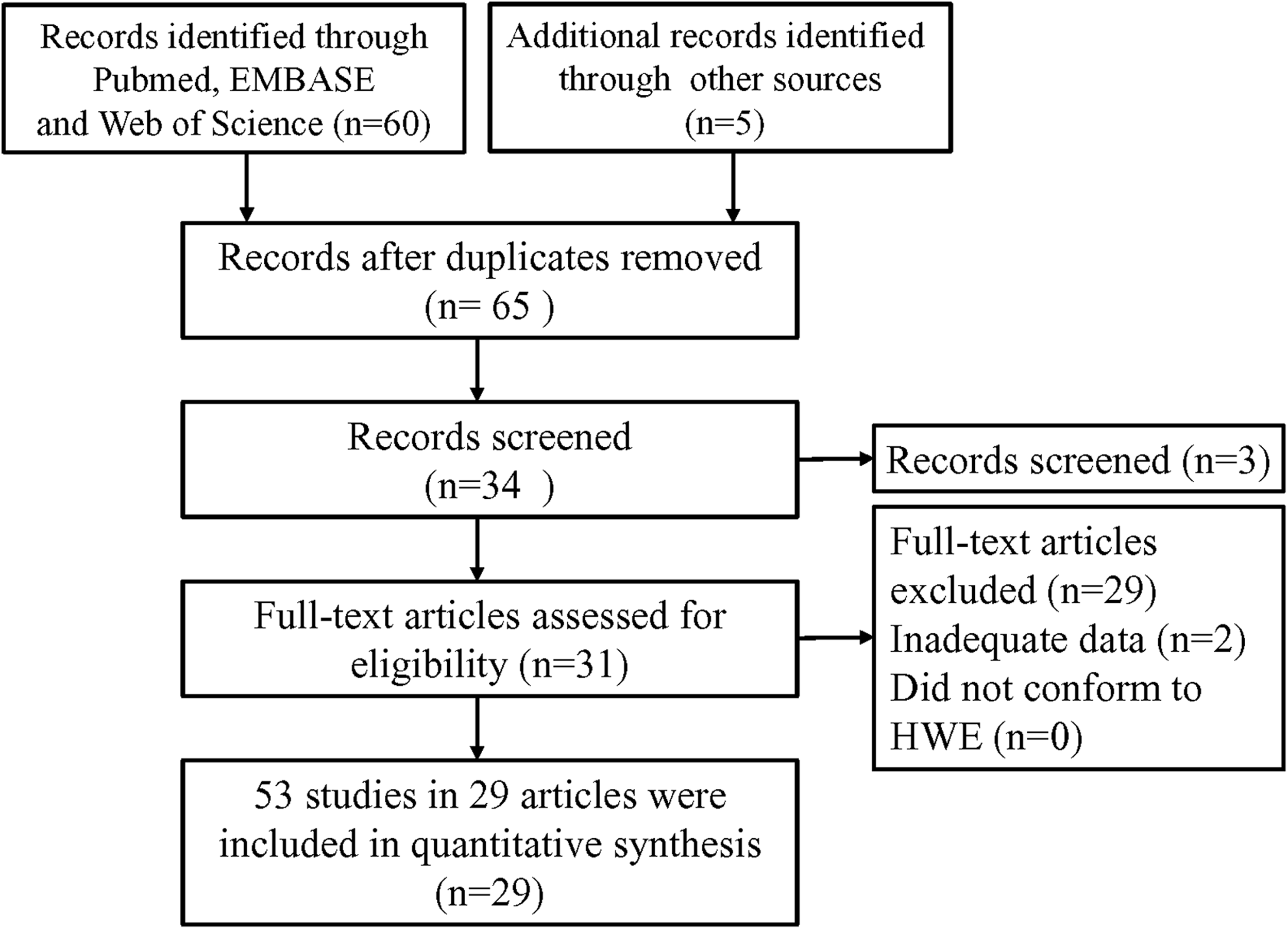
Flow diagram of study identification.
HRM, high resolution melt; PCR-RFLP, polymerase chain reaction-restriction fragment length polymorphism; SNP, single nucleotide polymorphism.
Meta-analysis results
Nine studies, consisting of 4499 cases and 5434 controls, were included in the study of rs895819 of miRNA-27a. The results demonstrated that a decreased BC risk was related to rs895819 in all three of the genotypic models. The allele model showed a possible decreased risk of BC development (OR = 0.93, 95% CI = 0.87-0.99, p = 0.03; Fig. 2). Subgroup analysis showed this was the case for the Caucasian ethnic group (OR = 0.89, 95% CI = 0.82-0.97, p = 0.008) but not the Asian. The dominant model also revealed a decreased risk of BC (OR = 0.87, 95% CI = 0.77-0.99, p = 0.04) but not in subgroup analysis of ethnicity (Asian: OR = 0.84, 95% CI = 0.68-1.04, p = 0.10; Caucasian: OR = 0.9, 95% CI = 0.76-1.06, p = 0.20; Fig. 3). A decreased risk of BC was also illustrated in the recessive model (OR = 0.92, 95% CI = 0.85-0.99, p = 0.04; Fig. 4). At the same time, the result of subgroup analysis of Caucasians in this model demonstrated consistent consequence that is low susceptibility (OR = 0.85, 95% CI = 0.77-0.94, p = 0.002); however, there was no effect in Asian subgroup.
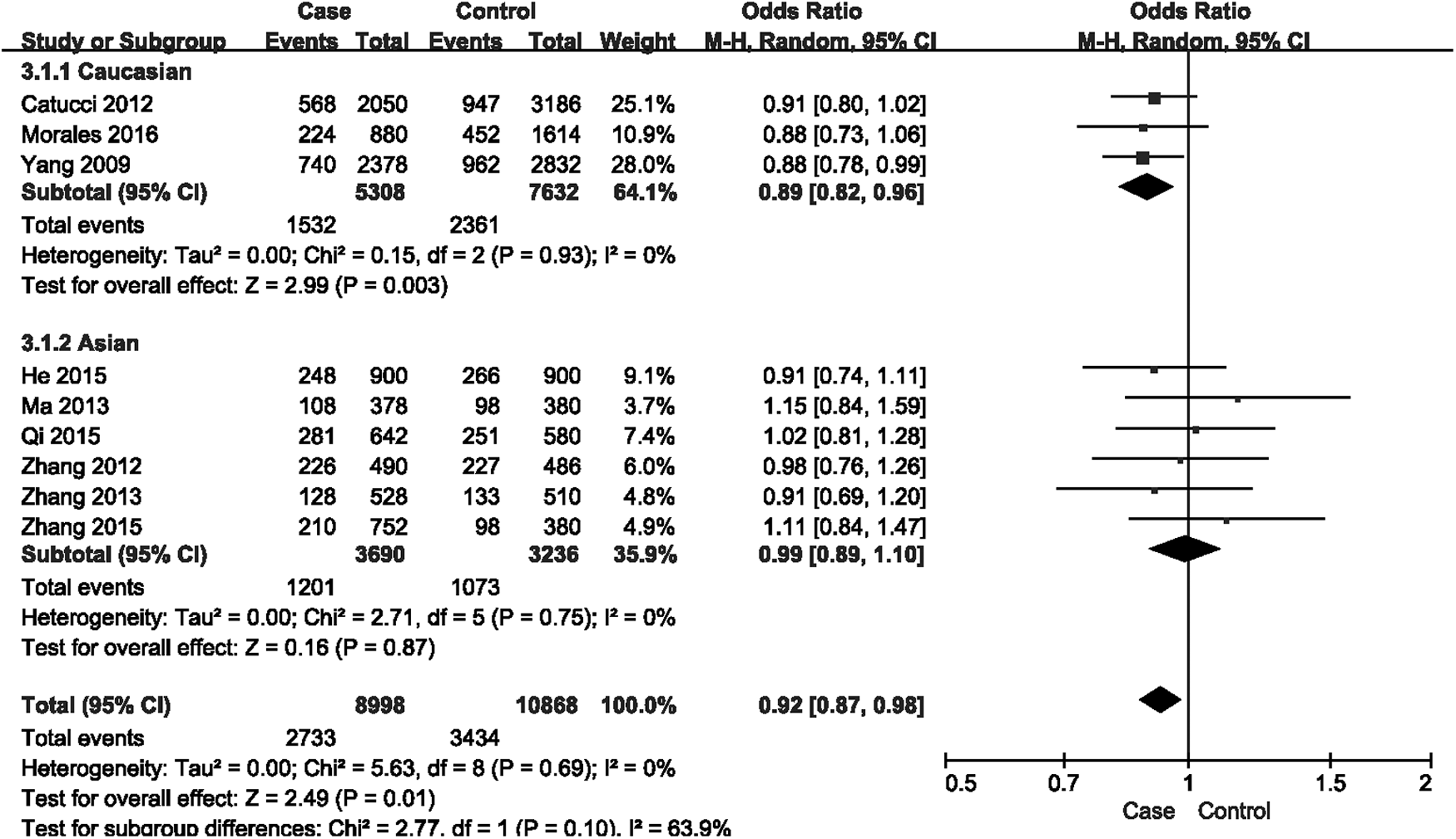
Forest plots of allele model meta-analysis of the association between rs895819 and BC risk. Squares and horizontal lines correspond with the OR and 95% CI of a specific study, respectively, and the area of squares reflects study weight. Diamonds represent the pooled OR and related 95% CI. BC, breast cancer; CI, confidence interval; OR, odds ratio.

Forest plots of recessive model meta-analysis of the association between rs895819 and BC risk. Squares and horizontal lines correspond with the OR and 95% CI of a specific study, respectively, and the area of squares reflects study weight. Diamonds represent the pooled OR and associated 95% CI.

Forest plots of dominant model meta-analysis of the association between rs895819 and BC risk. Squares and horizontal lines correspond with the OR and 95% CI of a specific study, respectively, and the area of squares reflects study weight. Diamonds represent the pooled OR and related 95%CI.
For rs2910164 and rs11614913 of miRNA-146a, meta-analysis consisted of 14 (6147 cases and 5820 controls) and 17 (7021 cases and 8186 controls) studies, respectively. The results showed that there was no significant relationship between these SNPs and BC risk in any of the genotypic models, unlike several meta-studies (Dai et al., 2015). The selected study characteristics are listed in Table 1.
Meta-analysis of rs6505162 and rs4919510 consisted of seven different studies (rs6505162: 1891 and 2239 controls; rs4919510: 3390 cases 2239 and 5485 controls). No significant relationship with BC was found in any of the genotypic models for either SNP. However, rs4919510 showed a trend related to decreased risk of BC in the Asian subgroup for allele and dominant models (allele: OR = 0.94, 95% CI = 0.88-1.01, p = 0.08; dominant: OR = 0.89, 95% CI = 0.79-1.00, p = 0.06; Fig. 5).

Forest plots of dominant model meta-analysis of the association between rs4919510 and BC risk. Squares and horizontal lines correspond with the OR and 95% CI of a specific study, respectively, and the area of squares reflects study weight. Diamonds represent the pooled OR and associated 95% CI.
Sensitivity analysis
To evaluate the effect of individual studies on overall OR estimates, we performed one-way sensitivity analyses. After sequentially excluding each eligible study, the corresponding ORs were not substantially changed, suggesting that the results of this meta-analysis are statistically stable.
Heterogeneity analysis
Q- and I2-tests were used to assess heterogeneity among the included studies. When an obvious difference in study heterogeneity (Q-test p < 0.1 or I2 > 75%) was observed in the overall pooled or subgroup analyses, the random-effects model was applied because it generated wider CIs. Otherwise, the fixed-effects model was used to analyze related data.
Publication bias
To examine publication bias in the present meta-analysis, a Begg's funnel plot and Egger's test were utilized. For rs11614913, rs2910164, rs6505162, and rs4919510, no publication bias was found in allele, dominant, or recessive genotype models (Table 2), and the shape of the funnel plots appeared to be relatively symmetrical (data not shown). Similarly, we did not find a publication bias for rs895819 in the recessive model. However, there was evidence of a significant publication bias in the dominant model (Begg's and Egger's p < 0.05; Table 2), which might be due to the limited number of studies included in our meta-analysis. Therefore, further analysis, including more related studies, is necessary.
CI, confidence interval; FE, fixed effects; OR, odds ratio; RE, random effects.
Discussion
In the present meta-analysis, associations of miRNA-146a rs2910164 G>C, miRNA-196a2 rs11614913 T>C, miRNA-499 rs3746444 A>G, miRNA-27a rs895819 C>T, and miRNA-149 rs71428439 A>G polymorphisms with BC risk were comprehensively investigated based on 31 case-control studies consisting of 14,677 cases and 16,143 controls. Overall, the results of the present study demonstrated that only the C allele of rs895819 was significantly associated with a decreased BC risk. To our knowledge, this is the largest and most recent meta-analysis to investigate the association of these five common functional SNPs with BC risk.
Our finding is partially consistent with the results of two previously published meta-analyses, in which the C allele of rs895819 was significantly associated with decreased risk of BC in the overall population (Nikkari et al., 1989; Mu et al., 2017). By contrast, our study included nine additional eligible studies and analyzed ethnic subgroups. Interestingly, our subgroup analysis showed a significantly decreased risk of BC in Caucasians with rs895819 in allele and recessive genotype models, while the Asian population showed no significant association in any of these models.
In their in vivo experiment, Xu et al. (2017) detected significantly lower expression of mature miRNA-27a containing pCMV-miRNA-27a-rs895819-C allele than that of the wild-T allele, suggesting that rs895819 may partially affect mature miRNA-27a expression. At present, it is still unclear whether mature miRNA-27a acts as an oncogene or tumor suppressor during carcinogenesis. Some reports indicate that miRNA-27a regulates several targets as an oncomiRNA (Fletcher et al., 2012; Zhou et al., 2012), while others have reported controversial results regarding miRNA-27a function (Nie et al., 2015). For example, miRNA-27a has been reported to act as a tumor suppressor by suppressing oncogene mitogen-activated protein kinase kinase4 in vivo (Wan et al., 2016) and decreasing p53 protein levels (Maqbool et al., 2016). In addition, miRNA-27a has been reported to function as a tumor suppressor in renal cell carcinoma by targeting epidermal growth factor receptor (Li et al., 2016). The authors presumed that rs895819 C downregulates expression of miRNA-27a, contributing to the decrease in cancer risk through upregulation of tumor suppressors (Yang et al., 2010). This idea is supported by the current comprehensive and updated meta-analysis that shows that rs895819 C is significantly associated with a decreased risk for BC. Furthermore, the significant association between this SNP and reduced BC risk in Caucasians, but not Asians, suggests possible ethnic differences in genetic background.
rs21910164 and rs11614913 have been studied by several meta-studies of BC. In the current meta-analysis, no correlation was detected between these SNPs and BC susceptibility in the overall population or the ethnic subgroups examined. However, previous studies have shown different results on the association between rs11614913 and BC risk. In particular, rs11614913 was reported to be a protective factor against BC in a previous meta-analysis (Dai et al., 2016). On the contrary, rs11614913 was found to be associated with a decreased risk of BC in other studies (Upadhyaya et al., 2016; Zhao et al., 2016; Mu et al., 2017). Interestingly, our results differed from these, even though we analyzed the same published studies. A closer look at the data revealed that several cited data sets (Zhang et al., 2012) in the most recent meta-analysis were not exactly the same as the original ones, which we made as a reference and verified in our research. For example, Dai et al. found that the rs2910164 was significantly associated with BC risk in Caucasians using a homozygote comparison and dominant models.
In addition, we did not find a significant association between rs6505162 or rs4919510 and BC risk after meta-analysis of seven studies. Instead, the presence of rs4919510 was found to correlate with a reduced risk of BC in Asian subgroup in the present study. Further studies are necessary to investigate these SNPs and processes using larger sample sizes.
The present meta-analysis has some limitations. First, although many eligible studies were included overall, stratification of data by ethnicity resulted in a relatively small number of studies being assessed per subgroup, reducing the statistical power. Second, further evaluation of potential interactions and associations was not conducted due to lack of original study data. Thus, we did not stratify the data by age, menopausal status, expression of triple antigen (ER/PR or Her2), environmental exposure, and so on. Third, the results were based on individual unadjusted ORs; however, other suspected factors should be used to adjust ORs to improve the accuracy of the evaluation. Finally, only three studies based on rs895819 in Caucasians (2654 cases and 3816 controls) were included herein, which is insufficient for making reliable assessments and subgroup analysis of anything other than ethnicity, for rs895819 was not feasible due to the relatively limited number of studies on this SNP.
In conclusion, the current results suggest that rs895819 on the C allele is likely associated with a decreased risk of BC mainly in Caucasians. The results of our analysis of the remaining four common functional miRNA SNPs did not indicate any significant association with BC risk. Future studies, including a larger sample size and providing a more complete analysis without bias, are warranted for further evaluation of BC risk.
Footnotes
Acknowledgments
This study was supported by grants from the Overseas Education Project of the Ministry of Education of Heilongjiang Province, China (1253HQ005) to J.W.
Author Disclosure Statement
No competing financial interests exist.