




Abstract
Objective:
To investigate the association between the CYP4F2 gene rs1558139 and rs2108622 polymorphisms and hypertension.
Materials and Methods:
In this meta-analysis, we searched databases for case-control studies published before May 2018 examining the associations between two polymorphic sites of the CYP4F2 gene (rs1558139 and rs2108622) and hypertension. The fixed or random effects model chosen was selected according to the heterogeneity of the studies to calculate the pooled odds ratios (OR) and corresponding 95% confidence intervals (95% CI).
Results:
Six articles in total were analyzed in this study; three investigated the rs1558139 polymorphism and six investigated the rs2108622 polymorphism. The pooled OR and 95% CI using the dominant model for rs1558139, and both the homozygous model and the recessive model of rs2108622 were statistically significant giving values of 0.83 (0.71-0.96), 0.83 (0.71-0.98), and 1.24 (1.07-1.44), respectively. The pooled OR and 95% CI of the rs1558139 polymorphism in the subgroup analysis based on gender were 1.25 (1.08-1.45) and 0.98 (0.85-1.13), whereas the results for the rs2108622 polymorphism were 1.03 (0.86-1.24) and 0.91 (0.72-1.14).
Conclusion:
Our meta-analysis demonstrates that the rs1558139 and rs2108622 single nucleotide polymorphisms of the CYP4F2 gene are associated with hypertension, with a particularly strong link between the rs1558139 polymorphism in males.
Introduction
Hypertension and related cardiovascular diseases are major factors when it comes to health, which often result in a stroke or heart attack. The interplay of genetics and environmental factors determines the onset and progression of hypertension. Only a few genetic loci, however, have been identified that are associated with hypertension by whole-genome studies. The CYP4F2 gene, which is a member of the CYP450 subfamily, is an important enzyme in the metabolism of arachidonic acid and the production of 20-HETE (20-hydroxyeicosatetraenoic acids) (Kim et al., 2018). There are up to 70% of 20-HETE found in human kidney microsomes comes from CYP4F2-catalyzed metabolism of arachidonic acid (Lasker et al., 2000). CYP4F2 gene contains several common single nucleotide polymorphisms (SNPs), such as rs3093100, rs3093105, rs3093166, rs1558139, and rs2108622. rs1558139 are located in the intron, whereas rs2108622 is located in the exon and known as a nonsynonymous substitution (Fu et al., 2009; Yu et al., 2014). Studies suggest that the rs1558139 and rs2108622 polymorphisms can lead to an increased or decreased activity of the CYP4F2 gene, which determines the level of in vivo production of 20-HETE. 20-HETE inhibits Ca2+ activated K+ channels. This results in significant vasoconstriction by promoting the depolarization of vascular smooth muscle cells. In renal and cerebral capillaries, 20-HETE plays a role in myogenic vasoregulation, influencing local vascular tension (Ni and Wang, 2010; Wang et al., 2018). 20-HETE is, therefore, most likely involved in the pathogenesis of hypertension.
Population-based studies show that urinary 20-HETE concentration levels in individuals with AA and GA genotypes at the rs2108622 locus were 2.06 and 1.13 ng/mL, respectively. This is much higher than that of individuals with the GG genotype, and is statistically significant (Hu et al., 2011). Epidemiological surveys, however, show different conclusions about the association between these polymorphisms and hypertension. It has been shown that the rs1558139 and rs2108622 polymorphisms are not associated with hypertension in all subjects (Wang, 2012). Studies undertaken on the Chinese Han population indicate that the G allele of rs2108622 is closely related to hypertension in male subjects (Zhang et al., 2010). Allele A of this polymorphic site has also been shown to be associated with hypertension (Fava et al., 2008). A meta-analysis of the rs2108622 polymorphisms and hypertension, rs1558139, rs2108622 polymorphisms, and cardiovascular diseases were previously reported. However, no meta-analysis for rs1558139, rs2108622 polymorphisms, and hypertension has been reported (Luo et al., 2015; Zhang et al., 2018). We, therefore, conducted a meta-analysis by collecting published studies on the association between the rs1558139 and rs2108622 polymorphisms of the CYP4F2 gene and hypertension.
Materials and Methods
Study subjects
We collected all published case-control articles on the association between two SNPs of the CYP4F2 gene (rs1558139 and rs2108622) and hypertension. The case group included patients who were diagnosed according to WHO/International Society of Hypertension Guidelines for the Management of Hypertension, who have systolic blood pressure or diastolic blood pressure ≥140/90 mm Hg, or who had been on antihypertensive treatment (Whitworth and Chalmers, 2004). The control group comprised healthy individuals with normal blood pressure, who have no blood relation to the study subjects. The ages of the two groups were similar. Through the use of genotyping methods, the alleles of the polymorphic sites rs1558139 and rs2108622 in both the case and controls were determined to calculate their genotype frequencies.
Sources of materials
We conducted a systematic search in Medline, PubMed, and the Chinese National Knowledge Infrastructure (CNKI) databases covering all articles published before May 2018. “Hypertension,” “CYP4F2,” “polymorphism,” “variation,” and corresponding Chinese terms were entered as both medical subject heading terms and keywords. A manual search and a review of the references were performed to identify additional articles. We also searched theses, and included qualified articles.
Inclusion and exclusion criteria
Articles were included in this study if they met the following criteria: (a) reasonably designed case-control studies, (b) selected the one with highest quality data among repeatedly published studies, and (c) conformed to the Hardy-Weinberg equilibrium.
An article was excluded if it was (a) a study on animals, (b) a survey without healthy controls, (c) a review, or (d) provided incomplete data or content.
Statistical methods
Two researchers worked independently to analyze the qualified articles and extract data. Disagreements were resolved by referring to the articles and discussing the issues. A homozygote model, a recessive model, and a dominant model were used to analyze the eligible data on the association of the CYP4F2 SNPs and hypertension. Heterogeneity across studies was determined by Stata version 12.0. The fixed effect model or the random effect model was used to calculate the pooled odds ratios (OR) and corresponding 95% confidence intervals (95% CI), Statistical significance was considered at p < 0.05.
Results
Characteristics of included studies
Figure 1 describes the steps of the study selection in detail. Nineteen articles were found by searching databases. There were 13 that were excluded: 2 animal studies, 2 reviews, 4 repeatedly published articles, 2 with incomplete data or content, and 3 articles that included case people with antihypertensive medication or metabolic syndrome. Six articles qualified for this study, five published articles and one theses. Among them, three articles covered the rs1558139 polymorphism of the CTP4F2 gene, two of which were from China and one from Japan. These three articles provided 1524 cases and 1490 controls. Six of the articles were studies of the rs2108622 polymorphism, two from China and one each from Japan, Australia, Sweden, and India; which provided 5815 cases and 4222 controls in total. The characteristics of each study are summarized in Table 1.
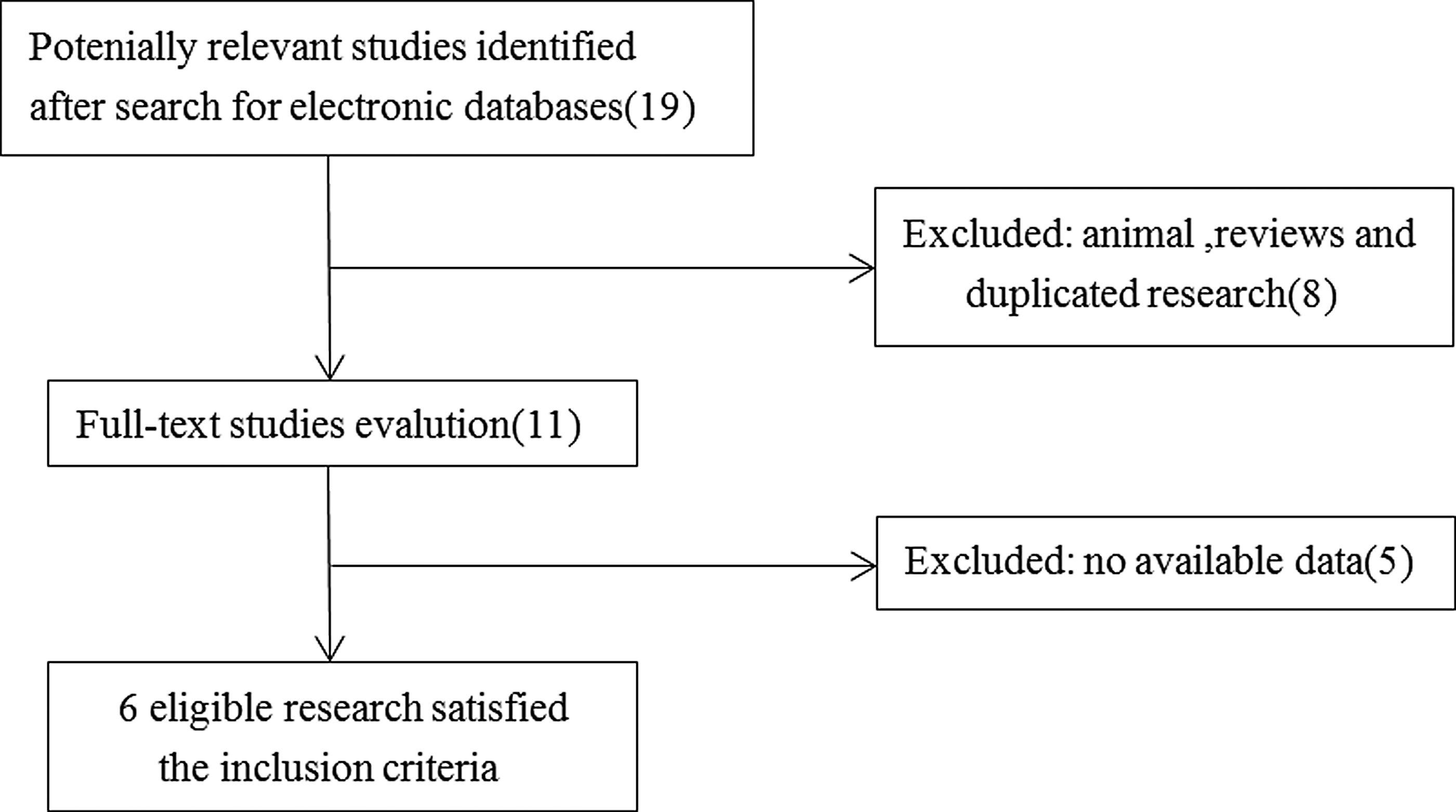
Flowchart of selection of studies.
Characteristics of Included Studies and the Distribution of CYP4F2 Polymorphisms
Results of meta-analysis
Heterogeneity among the studies was determined for all models and each p-value was >0.05, indicating no significant heterogeneity among the articles chosen for the meta-analysis. The fixed effect model was, therefore, used for analysis (Table 2). The pooled OR and 95% CI of the homozygote, recessive, and dominant models for rs1558139 were 1.14 (0.92-1.41), 0.98 (0.80-1.19), and 0.83 (0.71-0.96), respectively. The pooled OR of the dominant model was statistically significant (Table 2). The pooled OR and 95% CI of the homozygote, recessive and dominant models of rs2108622 were 0.83 (0.71-0.98), 1.24 (1.07-1.44), and 1.03 (0.94-1.12), respectively. The pooled OR of both the homozygote and the recessive models achieved statistical significance (Table 2).
Results of the Meta-Analysis on the Association of CYP4F2 Gene Polymorphisms and Hypertension
CI, confidence intervals; OR, odds ratios.
Analysis of publication bias
Begg's funnel plot and Egger's test were used to analyze the publication bias of the eligible studies. The p-values of the homozygote, recessive, and dominant models of both loci were all >0.1, indicating no significant publication bias (Table 3).
Results of Publication Bias by Begg's Funnel Plot and Egger's Test
Subgroup analyses
Subgroup analyses on the rs1558139 and rs2108622 polymorphisms were performed based on gender. The results showed that no heterogeneity was identified in the eligible studies investigating the rs1558139 polymorphism. Calculated by the fixed effect model, the pooled OR and 95% CI of males and females were 1.25 (1.08-1.45) and 0.98 (0.85-1.13), respectively, which were statistically significant (p < 0.05). Among the eligible studies on the rs2108622 polymorphism, heterogeneity was identified and the random effect model was adopted. The pooled OR and 95% CI for males and females were 1.03 (0.86-1.24) and 0.91 (0.72-1.14), respectively, which exhibited significant differences (p < 0.05) (Fig. 2).
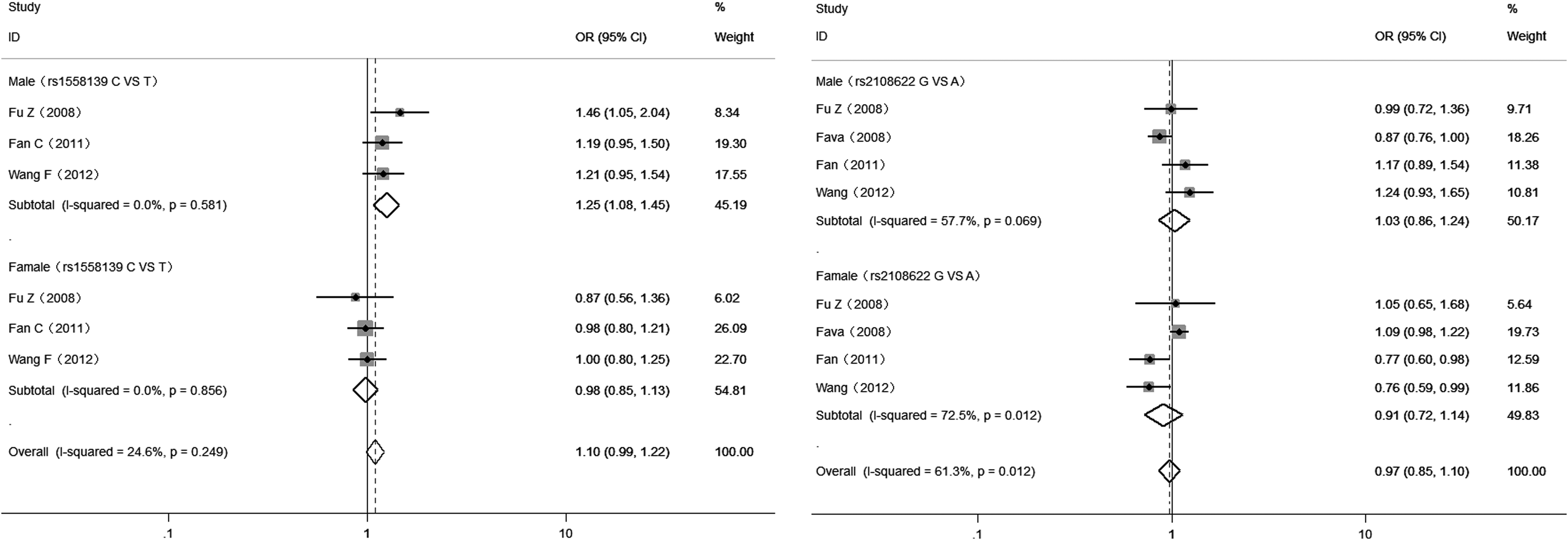
Forest plots of subgroup analysis on gender association of the CYP4F2 polymorphisms and hypertension.
Discussion
Arachidonic acid is one of the most abundant lipids in the human body. It can be metabolized by a number of substances through three different pathways: the cyclooxygenase pathway, the lipoxygenase pathway, and the CYP450 pathway. The resultant metabolites play critical roles in various physiological and pathological processes. 20-HETE, produced by the CYP450 pathway, can play a dual role in blood pressure regulation depending on the tissue. Specifically, in renal vessels, 20-HETE acts as a vasoconstrictive agent and raises blood pressure. In renal tubules it inhibits Na+ reabsorption, leading to a blood pressure decrease. As shown in population-based studies, 20-HETE has an apparent correlation with hypertension; there is, however, disagreement among different studies (Liu et al., 2009; Zordoky and El-Kadi, 2010).
The CYP4F2 gene, known as a major member of the CYP450 subfamily, encodes ω-hydroxylase, which participates in metabolizing arachidonic acid to 20-HETE. In humans, this gene is located on chromosome 19p13.12, and consists of 13 exons and 12 introns. Studies show that SNPs at many loci of the CYP4F2 gene, such as rs3093105, rs3093135, rs3093200, rs1558139, and rs2108622, can cause an increase or decrease in ω-hydroxylase activity. This results in altered levels of 20-HETE production (Stec et al., 2007). Among these polymorphic sites, rs1558139 and rs2108622 are the most studied; conclusions of the physiological effects of these SNPs, however, remain inconsistent. For example, it was found in a Japanese that rs1558139 is associated with hypertension, but not rs2108622 (Fu et al., 2008). Other studies, however, suggest that neither of these SNPs are correlated with primary hypertension (Wang, 2012).
Our study shows that the pooled OR and 95% CI [0.83 (0.71-0.96)] of the rs1558139 dominant model (CT+TT/CC) are significantly different (p = 0.02). This demonstrates that the T allele of this polymorphic site plays a protective role in the pathogenesis of hypertension. As is found by subgroup analysis based on gender, the C allele in males is related with hypertension [1.25 (1.08-1.45)], but not in females [0.98 (0.85-1.13)]. The pooled OR and 95% CI of the rs2108622 homozygous model and recessive model are [0.83 (0.71-0.98)] and [1.24 (1.07-1.44)], both of which are statistically significant. The recessive model indicates that the prevalence of hypertension in individuals with a homozygous genotype (AA) is 1.24 times greater than that of individuals with a homozygous or recessive genotype (GG or GA). Subgroup analyses based on gender shows that the correlation between the A allele of the rs2108622 locus and hypertension is not influenced by gender. However, hypertension has a polygenic and multifactorial inheritance pattern so that many etiologic factors may affect its molecular pathogenesis.
The evidence to date indicates that the high levels 20-HETE in plasma and urinary are related to multiple human diseases and conditions such as hypertension, obesity and metabolic syndrome, myocardial infarction, stroke, and chronic kidney diseases. Nevertheless, studies of polymorphic associations also suggest an important role for 20-HETE in essential hypertension (Rocic and Schwartzman, 2018). In this article, we only had analyzed the association between the CYP4F2 gene rs1558139 and rs2108622 polymorphisms and hypertension, when the patients in included literatures have systolic blood pressure or diastolic blood pressure ≥140/90 mm Hg. It is well know that pharmacological agents affect 20-HETE levels and the CYP4A and 4F genes, such as angiotensin-converting enzyme inhibitors and angiotensin II receptor blockers. There were only two articles of rs1558139 polymorphism and one article of rs2108622 polymorphisms indicated the cases with antihypertensive medication. The data were too little to analyze effectively. To ensure the preciseness and accuracy of the analytical data, we had excluded these three articles and expect to analyze them again when there is a large amount of data.
Of course, our study has its limitations. There are many studies on the association of the rs2108622 polymorphism and hypertension, which show that it is gender related. For instance, a study of Swedish men shows that blood pressure of A allele carriers is higher than that of G allele carriers (Fava et al., 2012). Our gender-based subgroup analysis, however, suggested that this locus is not significantly correlated to hypertension. Thus, the correlation of this locus and hypertension needs a subgroup analysis based on ethnicity as well as multiregional and multiethnic studies. This will help to confirm the exact association between the rs1558139 and rs2108622 polymorphisms and hypertension.
Footnotes
Acknowledgments
This study was supported by Henan Province key science and technology research projects (172102310001), the National Natural Science Foundation of China (81871856), and Henan Province Foundation for University Key Teacher (16A330001).
Authors' Contributions
H.G. and B.L. designed the study and performed the analyses. Y.W. and L.W. analyzed the data. L.W. wrote the article. All of the coauthors approved the final version of the article.
Author Disclosure Statement
No competing financial interests exist.