




Abstract
Objective:
Our study was designed to determine if the TRPM1 gene is associated with any of three mental disorders. The project included a cross disorder meta-analysis and association analysis including 141701 cases and 175248 controls.
Materials and Methods:
We genotyped eight tag single nucleotide polymorphisms (SNPs) in 1248 unrelated schizophrenia (
Result:
Although two haplotypes of the TRPM1 gene, rs1035706-rs10162727 and rs10162727-rs3784599, were identified in the control group, as well as all three disease groups, none of the eight tag SNP associations remained significant after correction for multiple tests. In this cross-disorder meta-analysis of the three diseases, none of the tag SNPs were confirmed to be common among the diseases. In addition, in the meta-analysis conducted for the rs10162727 locus in
Conclusion:
In the Han Chinese population, no significant evidence was found linking variants of the TRPM1 gene with any of the mental disorders examined.
Introduction
Schizophrenia (SCZ), major depressive disorder (MDD), and bipolar disorder (BPD) are known as complex polygenic psychiatric disorders. SCZ disables brain functions and could produce serious related negative effects on a patient's movement and cognitive function—that is, in their daily life, as well as their social responsibilities. The traits of SCZ are divided into three categories: positive symptoms (hallucinations, delusions); negative symptoms (social withdrawal, reduced affective expression); and cognitive impairments (Karam et al., 2010). MDD is attributed to mental disease, which causes mental and long-term depression as an observational clinical symptom. BPD is characterized by alternating mania and depression.
The lifetime prevalence of these three diseases in Han Chinese population was estimated at 0.66% (SCZ, 1994, mainland, China), 1.5% (BPD, 2011, Shenzhen, China) (Merikangas et al., 2011), and 3.3% (MDD, 2013, mainland China) (Gu et al., 2013). Although the pathogenic mechanisms of the three psychiatric disorders are still unclear, genetic factors definitely contribute to the pathophysiology of them. In essence, we established a cross-disease meta-analysis for finding the common genetic factors of the three diseases.
Neurotransmission makes an essential impact on neural circuit formation in the central nervous system (CNS). Neurotransmission has been recently clarified as a key modulator of CNS development; however, the roles of individual genes are not yet fully understood. There are types of protein that work as intermicellar transmission, including the transient receptor potential (TRP) superfamily. Currently, the TRP superfamily of ion channels contain more than 30 cationic channels, which are mostly permeable for Ca2+, but some are also for Mg2+ (Clapham, 2003). What is more, many TRP-related proteins were expressed in the nervous system (Montell et al., 2002).
The TRP box is located in the C-terminus domain of the TRPM family and no Ankyrin repeats in the N-terminus (Hantute-Ghesquier et al., 2018). According to the latest data obtained, the TRP domain was divided into two segments (Winkler et al., 2017). TRPM1 was found to be a member of the TRPM subfamily, and its sequence is similar to other members of the TRP family in the cation channels (Montell, 2005). The previous study indicates that TRPM1 works as a cation permeable protein, and as expressed in ON bipolar cells, it mediates neurotransmission between photoreceptors and ON bipolar cells (Koike et al., 2010).
Essentially, a visual signal is received by photoreceptors in the mammalian retina, and then the information is segregated into ON and OFF pathways (Kozuka et al., 2017). In current studies, Flash electroretinography (fERG) has been used to identify anomalies in the retinal cell function of patients with
SCZ is a common mental illness with a large genetic component (Freedman et al., 2001; Owen et al., 2004). Significant or suggestive evidence linked to SCZ has implicated 18 chromosomal regions (Baron, 2001; Harrison and Owen, 2003). Twelve of these linked chromosomal regions have been replicated—including one or more polymorphisms such as SCZ-associated polymorphisms—and contain biologically believable candidate genes showing altered expression in the disorder (Harrison and Weinberger, 2005). In addition, the 15q13-q14 locus is one of these regions, and its replication results are from the National Institute of Mental Health's (NIMH)
Notably, the results of a study by Stephens also indicated that TRPM1 gene, along with KLF13 and RYR3, was associated with
However, we found two pooling databases that show opposite consequences. In essence, pooling database (drawn from 2010 to 2011) concludes with data from four meta-analyses or genome-wide association studies (GWASs) pertaining to European ancestry, and then pooling database 2010-2013 concludes with data from five meta-analyses or GWASs in European ancestry as well (Cross-Disorder Group of the Psychiatric Genomics Consortium, 2013; Neale et al., 2010; Psychiatric GWAS Consortium Bipolar Disorder Working Group, 2011; Ripke et al., 2013; Schizophrenia Psychiatric Genome-Wide Association Study (GWAS) Consortium, 2011). Pooling database 2010-2011 indicates p-value = 0.402 and Odds ratio = 0.884 (rs10162727) while database 2010-2013 indicates p-value = 0.334 and Odds ratio = 1.295 (rs10162727), which means that there is an insignificant association with
These conflicting results motivate us to further verify in psychiatric disorders in Han Chinese population. In this study, we performed a cross-disorder association analysis of the TRPM1 gene in unrelated Han Chinese SCZ, MDD, and BPD patients—as well as normal controls—to verify previous findings and possibly discover new potential associations.
Materials and Methods
Subjects
Due to the inheritance factor of mental illness, age of onset in relation to psychiatrics, and also gender, we recruited 4896 unrelated Chinese subjects for our study. Among said subjects, 1248 were unrelated
Detailed Information of the Sample Set
MDD, major depressive disorder; BPD, bipolar disorder; SD, standard deviation.
All of the cases were interviewed by two independent psychiatrists who, subsequently, made a formal diagnosis that confirmed each subject's classification, which was in accordance with the Diagnostic and Statistical Manual of Mental Disorders Fourth Edition (DSM-IV). In the control groups, all subjects were not only randomly selected from the general population but also in a manner that ensured that all subjects were without family histories of psychiatric disorders. All participants knew the purpose and potential hazard of the study, and they signed written informed consent forms before their participation.
Single nucleotide polymorphism selection
According to results by Haploview 4.2 software, eight tag SNPs (rs12901022, rs1035706, rs10162727, rs3784599, rs10400821, rs4779503, rs12441329, rs12910440) that emerged were picked across the whole gene, which was accomplished using genotype data—of Han Chinese in Beijing, China (CHB)—from the International HapMap Project (Barrett et al., 2005) and rs10162727, which was defined as having single nucleotide polymorphism (SNP) susceptibility. Linkage disequilibrium r2 threshold was set as 0.5 with a minor allele frequency that was greater than 0.05 (De Bakker et al., 2005, 2006). Next, a total of eight SNPs were selected for our study, and the locations are indicated in Figure 1.

Locations of the tag SNPs within the TRPM1 gene and all of that distributed across the whole gene. SNP, single nucleotide polymorphism.
Genotyping
The genomic DNA was extracted from peripheral blood by QuickGene DNA Whole Blood Kit (Fujifilm, Tokyo, Japan) and according to the manufacturer's agreement. Genotyping was performed using iPLEX chemistry on a matrix-assisted laser desorption/ionization time-of-flight mass spectrometer (MALDI-TOF-MS, named as the MassARRAY system, which is manufactured by Sequenom, San Diego, CA). Polymerase chain reaction (PCR) and extended primers were designed using the online primer design tool Sequenom. Mass spectrum was obtained using Compact Mass Spectrometer and analyzed with MassARRAY Typer 4.0 Software.
Statistical analyses
It was a basic component to ensure that Allele and genotype frequency calculation, pair-wise linkage disequilibrium analysis, Hardy-Weinberg (H-W) equilibrium analysis, and haplotype were all carried out on the SHEsisPlus online software platform in single site association study (Shen et al., 2016). H-W equilibrium was received through chi-square test for each group of fitness. Chi-square test independence was used to examine allele and genotype distribution between cases and controls. For haplotype analysis, in all cases and control groups, adjacent tag SNPs with pair-wise linkage disequilibrium D values larger than 0.90 were defined in the same haplotype block.
All statistical analyses were two-tailed tests, and if the p-values were below 0.05, Bonferroni correction (p-value multiplied by the number of testing SNPs) should be set to test the statistical significance of results. Case-control genetic power was calculated on the Genetic Power Calculator (Purcell et al., 2003).
Meta-analysis
We used the keywords “TRPM1,” “Schizophrenia,” “Major Depressive Disorder,” and “Bipolar Disorder” to build a hunting zone in several databases—including PubMed, EMBASE, and Web of Science—to retrieve all pertinent studies or GWAS involving TRPM1 gene variants. In essence, we found a pooling database from Psychiatric Genomics Consortium (PGC) about
The meta-analysis procedures were conducted using Review Manager 5.3 software. Heterogeneity was assessed by the chi square and quantified by I2 statistics, which ensured that the group of studies was suitable for meta-analysis. An odds ratio (OR) with a 95% confidence interval (CI) indicates the magnitude of the effect. The Z test was used as a means of estimating the p-value of OR. All p-values were reported as two-tailed tests, which would, ultimately, be regarded as significant statistic while determining whether or not the p-value was less than 0.05.
Results
Single site analysis
According to export results from SHEsisPlus, all eight SNPs passed H-W equilibrium tests in control groups. The average call rate of all sites in three disease groups and controls was 0.981. Detailed information pertaining to these sites is supplemented in Table 2.
Detailed Information of the Testing Single Nucleotide Polymorphisms in the TRPM1 Gene
H-W P, H-W equilibrium p-value; SCZ, schizophrenia; SNP, single nucleotide polymorphism.
For SCZ, rs10400821 indicated genotypic or allelic association before Bonferroni correction (rs10400821: Pallele = 0.564, OR [95% CI] = 1.178 [0.934-1.485]; Pgenotype = 0.022, adjusted Pgenotype = 0.182). For BPD, rs4779503 was significant before multiple-test corrections (rs4779503: Pallele = 0.256, OR [95% CI] = 1.167 [0.893-1.526]; Pgenotype = 0.023, adjusted Pgenotype = 0.187). For MDD, rs12901022 showed marginal significances in both allelic and genotypic analyses (rs12901022: Pallele = 0.069, OR [95% CI] = 1.162 [0.987-1.366]; Pgenotype = 0.067). However, none of these associations remained after multiple tests and corrections. The results are listed in Table 3.
Single Site Association Results of the Eight Locus in Schizophrenia, Major Depressive Disorder, Bipolar Disorder Cases, and Normal Controls
Pairwise linkage disequilibrium analysis
The pairwise linkage disequilibrium D values among the eight SNPs were calculated in control, as well as all three disease groups (Fig. 2). Relying upon the haplotype analysis criteria illustrated in the former section, the two blocks of TRPM1 and rs1035706-rs10162727 were identified in a control group, as well as all three disease groups. As such, rs10162727-rs3784599 was identified in a control group and, also, the BPD and SCZ groups.

Linkage disequilibrium among the eight SNPs in CTRL, SCZ, MDD, and BPD groups. The pairwise D'values are presented in the matrices. Dark gray implicates relatively strong linkage disequilibrium, and vice versa. CTRL, control; MDD, major depressive disorder; BPD, bipolar disorder; SCZ, schizophrenia.
Cross-disorder meta-analysis
In this cross-disorder meta-analysis, we recruited pooling database 2010-2011, pooling database 2010-2013, and five GWAS as collecting databases to build a meta-analysis (Bipolar Disorder and Schizophrenia Working Group of the Psychiatric Genomics Consortium, 2018; Cross-Disorder Group of the Psychiatric Genomics Consortium, 2013; Neale et al., 2010; Ripke et al., 2013; Ruderfer et al., 2014; Stahl et al., 2018; Schizophrenia Psychiatric Genome-Wide Association Study (GWAS) Consortium, 2011; Schizophrenia Working Group of the Psychiatric Genomics Consortium, 2014; Wray et al., 2018). We separately analyzed these SNPs for understanding common genetic mechanism. After analyzing, the result shows rs12910440 (p-value = 0.49, Odds ratio = 0.97 [95% CI = 0.89-1.06]), rs10162727 (p-value = 0.41, Odds ratio = 0.89 [95% CI = 0.68-1.17]), rs10400821 (p-value = 0.26, Odds ratio = 0.81 [95% CI = 0.56-1.16]), rs12901022 (p-value = 0.49, Odds ratio = 0.76 [95% CI = 0.35-1.65]), rs4779503 (p-value = 0.44, Odds ratio = 0.80 [95% CI = 0.45-1.42]), rs3784599 (p-value = 0.34, Odds ratio = 0.77 [95% CI = 0.44-1.32]), rs12441329 (p-value = 0.51, Odds ratio = 0.98 [95% CI = 0.91-1.05]), and rs1035706 (p-value = 0.68, Odds ratio = 0.99 [95% CI = 0.95-1.03]) (Supplementary Figs. S1, S2, S3, S4, S5, S6, S7, S8).
Meta-analysis for rs10162727 in SCZ
We recruited pooling database 2010-2011 and pooling database 2010-2013 from PGC and, also, a GWAS about SCZ in which experimented SNPs overlapped with ours in the meta-analysis (Cross-Disorder Group of the Psychiatric Genomics Consortium, 2013; Neale et al., 2010; Ripke et al., 2013; Ruderfer et al., 2014; Schizophrenia Psychiatric Genome-Wide Association Study (GWAS) Consortium, 2011). After further consideration of studies performed in Han Chinese population, it was determined that rs10162727 was suitable for the meta-analysis. Merging all data, we suggest that there is no significant association between rs10162727 and SCZ (p-value = 0.84, Odds ratio = 1.02 [95% CI = 0.87-1.19]). The result of meta-analysis supports our results in this study of the Han Chinese population (Fig. 3).
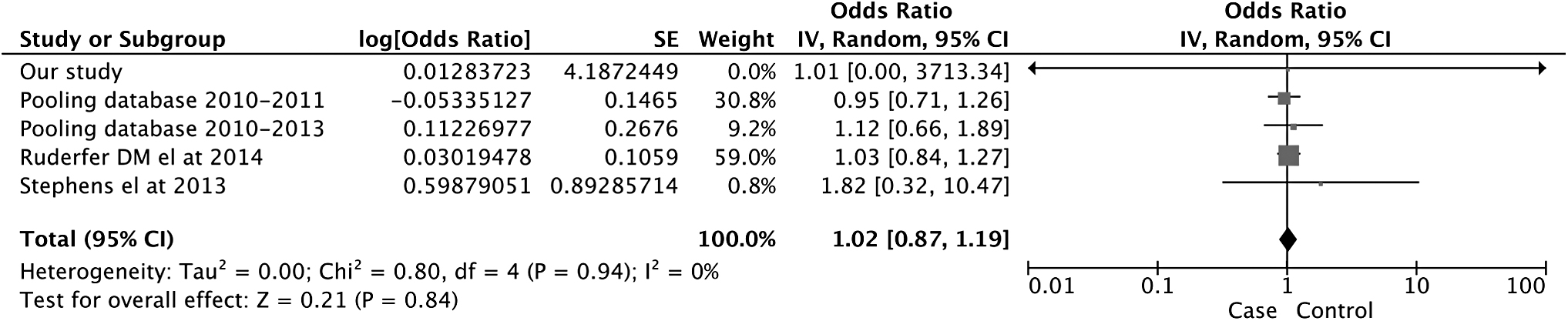
Forest plot of the association between rs10162727 and schizophrenia in a random effects model. The point represents the OR, and horizontal lines indicate 95% CI for each study. The diamond illustrates that summary OR and 95% CI by random effect calculations.
Discussion
Currently, the pathogenesis of these three psychiatrics is still unclear. Family-based association studies also show comorbidity among BPD and MDD (Smoller and Finn, 2003), as well as SCZ and BPD (Valles et al., 2000). These three diseases have general characteristic symptoms, shared genetic etiology, and increased numbers of variants and gene regions, such as: rs1344706 in the ZNF804A gene (Williams et al., 2011); rs1006737 in the CACNA1C gene also confers risk of recurrent MDD and SCZ (Green et al., 2010); and intron 42 of the MYO18B gene and intron 1 of the NPAS3 gene (Huang et al., 2010). Meanwhile, a previous cross-disorder GWAS revealed that common genetic factors can be shared among SCZ, MDD, and BPD (Ruderfer et al., 2014).
However, it is possible that similar genetic overlap relating to TRPM1 happens in major psychiatric illnesses of the Han Chinese population, especially in SCZ, MDD, and BPD. It is notable that SCZ, MDD, and BPD share many clinical symptoms and sign change. Due to the complicated pathogenesis of mental diseases, one of the obstacles in psychiatric exploration that is too difficult to dynamically analyze is the state of human brain.
Several retina dysfunctions have been observed in psychiatric patients through the fERG, and it is suggested that retinal activity may reflect uncommon neurochemistry in brain disorders (Lavoie et al., 2014). Forsingdal built a 15q13.3 homozygous knockout mouse model effect using seven genes—FAN1, MTMR10, TRPM1, miR-211, KLF13, OTUD7A, and CHRNA7—and the study suggests that the cognitive disabilities of Df (h15q13)−/− mice were related to
Previously, it was reported that TRPM1 showed a significant association with SCZ in African Americans (105 cases and 45 controls) (Stephens et al., 2012), but we also found opposite results in some GWASs that considered multiple races (Ruderfer et al., 2014) (Bipolar Disorder and Schizophrenia Working Group of the Psychiatric Genomics Consortium, 2018; Schizophrenia Psychiatric Genome-Wide Association Study (GWAS) Consortium, 2011; Schizophrenia Working Group of the Psychiatric Genomics Consortium, 2014; Stahl et al., 2018; Wray et al., 2018). Because of the conflicting conclusions between these different studies, we searched an imputed dataset of a Zhiqiang et al. (2017) study that was published in 2017 to find out whether or not TRPM1 was associated with these three diseases. However, the results suggest insignificant association between SCZ and TRPM1, and these tag SNPs were not found in the imputed database.
It is well known that the three diseases have similar clinical signs. What is more, recent genetic and epidemiological studies have demonstrated substantial overlap between these three disorders (Cross-Disorder Group of the Psychiatric Genomics C, 2013). Meta-analysis can improve the efficiency of research and further discover the relationship between the three diseases. Only then can we combine patients with SCZ or BPD or MDD for cross-disorder genetic research analysis. In this cross-disorder meta-analysis of the diseases, all tag SNPs fail to confirm that there are cross-disorder common genetic factors. In addition, in meta-analysis for rs10162727 in
All of the SNPs failed to prove statistically significant associations with
Footnotes
Author Disclosure Statement
No competing financial interests exist.
Funding Information
This work was supported by the National Key R&D Program of China (2017YFC0908105), National Key R&D Program of China (2019YFA0905400), Shanghai Municipal Science and Technology Major Project (2017SHZDZX01), the Natural Science Foundation of China (U1804284, 81421061, 81701321, 31571012, 81501154), the Program of Shanghai Subject Chief Scientist (15XD1502200), the National Program for Support of Top-Notch Young Professionals, Shanghai Key Laboratory of Psychotic Disorders (13dz2260500), the National Program for Support of Top-Notch Young Professionals to Y.S., Shanghai Hospital Development Center (SHDC12016115), Shanghai Municipal Commission of Science and Technology (17JC1402900, 17490712200, 18DZ2260200) and Shanghai Municipal Health Commission (ZK2015B01, 201540114), and Scientific Research and Development Fund of Shanghai Jiao Tong University (19X150010012).

References
Supplementary Material
Please find the following supplemental material available below.
For Open Access articles published under a Creative Commons License, all supplemental material carries the same license as the article it is associated with.
For non-Open Access articles published, all supplemental material carries a non-exclusive license, and permission requests for re-use of supplemental material or any part of supplemental material shall be sent directly to the copyright owner as specified in the copyright notice associated with the article.
