




Abstract
Background:
Genetic variants of the SLC39A8 gene are associated with several cardiovascular disease risk factors, including body mass index, systolic blood pressure (SBP), diastolic blood pressure (DBP), N-terminal pro-B-type natriuretic peptide (NT-proBNP) and high-density lipoprotein cholesterol (HDL-C) levels. The present study aimed to investigate the association between the SLC39A8 SNPs rs13107325 and rs74650330 and CAD in the Han population in Jiangsu (China).
Methods:
Genotyping of these SNPs was performed in 258 patients with CAD and 170 healthy controls using the base-quenched probe technique. The association between the alleles of the rs74650330 locus and blood lipid and glucose profiles was investigated. Receiver operating characteristic (ROC) curve analysis was used to quantify the optimal thresholds for lipid and FBG levels and the risk factors for CAD were estimated by logistic regression analysis.
Results:
The rs13107325 polymorphism was not found in the 428 Chinese individuals enrolled in the current study. For rs74650330, individuals harboring the C allele had significantly higher HDL levels than those without this allele in the control group (p = 0.039), while the opposite was true for low-density lipoprotein cholesterol (LDL-C) levels (p = 0.046). Further analysis indicated that when LDL-C levels were lower than 2.365 mmol/L, subjects with C/del and del/del had a 7.293-fold increased risk of CAD compared with that of controls without the mutation (odds ratio: 7.293; 95% confidence interval: 0.953-55.79).
Conclusions:
The susceptibility of SLC39A8 polymorphisms to CAD were studied and revealed a possible role for the deletion variant of rs74650330 in increasing the risk of CAD among the Chinese Han population.
Introduction
Globally, coronary artery disease (CAD) is a common cardiovascular disease that is the main cause of morbidity and mortality, particularly in developing countries (Zhao et al., 2014). According to European Society of Cardiology guidelines (Roffi et al., 2016; Ibanez et al., 2018; Knuuti et al., 2020), both obstructive and nonobstructive CAD are pathological processes characterized by the accumulation of atherosclerotic plaques in the epicardial arteries, and CAD is categorized as either acute coronary syndromes (grouped as chest pain with or without persistent ST segment elevation) or chronic coronary syndromes. CAD is a complex disease affected by a combination of environmental and genetic factors. A familial predisposition for CAD has been identified, with the heritability of CAD estimated to be 40-60% (Nikpay et al., 2017). Genome-wide association studies have revealed various genetic polymorphisms that contribute to disease susceptibility (van der Harst and Verweij, 2018).
SLC39A8 (solute carrier family 39 member 8) is a member of the ZIP family of transporters located in the plasma membrane, which play a role in the transport of divalent metal ions such as zinc, manganese, cadmium, and iron (Wang et al., 2012). Several epidemiological studies have suggested that exposure to metals, including cadmium and lead, is associated with the development of high blood pressure and other cardiovascular diseases (Staessen et al., 2000; Tellez-Plaza et al., 2008). Furthermore, previous studies have revealed that genetic mutations in the SLC39A8 gene have an impact on human health (Wahlberg et al., 2018; McCoy et al., 2019). The single nucleotide polymorphism (SNP), rs13107325, located in exon 8 of the SLC39A8 gene results in an amino acid change from alanine to threonine at position 391 (NC_000004.11:g.103188709C>T). Rs13107325 is one of the most pleiotropic variants in the human genome and is associated with several cardiovascular disease-associated risk factors, such as body mass index, systolic blood pressure, diastolic blood pressure, N-terminal pro-B-type natriuretic peptide (NT-proBNP), high-density lipoprotein cholesterol (HDL-C), and manganese levels (Speliotes et al., 2010; Willer et al., 2013; Johansson et al., 2016; Zhang et al., 2016; Choi et al., 2018; Costas, 2018). Rs74650330 is an intronic SNP in the SLC39A8 gene, which results in a deletion of the C allele, and is in close proximity to rs13107325. To date, the association between SLC39A8 polymorphisms and CAD in the Chinese Han population has not been explored. The current study therefore investigated the association between SLC39A8 SNPs and CAD in the Han population in Jiangsu (China) using molecular biology techniques.
Materials and Methods
Ethical compliance
The Ethics Committee of the Third Affiliated Hospital of Soochow University (the First People's Hospital of Changzhou) and all the included participants gave informed consent. A total of 258 patients (191 males and 67 females with a mean age of 62.5 ± 10.1 years) with significant obstructive CAD (at least one stenosis ≥50% by coronary angiography) were clinically designated as CAD. A total of 170 healthy examinees (133 males and 37 females) with a mean age of 61.4 ± 9.3 years for preventive check-ups, matched for sex and age with CAD patients, were enrolled as the control group. The control subjects had no prior history of CAD. For all participants, the exclusion criteria included cerebrovascular disease, severe hepatic and renal dysfunction, infections, malignant tumors, and autoimmune diseases. The participants were recruited from the Medical Examination Center and Department of Cardiology of the Third Affiliated Hospital of Soochow University (Changzhou, China).
Collection of clinical data
A total of 2 mL of cubital venous blood was drawn from all the subjects after 12 h of fasting. The fasting blood glucose (FBG), total cholesterol (TC), triglyceride (TG), HDL-C, and low-density lipoprotein cholesterol (LDL-C) levels were subsequently measured using an automatic biochemical analyzer.
Preparation of DNA from peripheral blood samples
Blood (2 mL) was drawn from the cubital vein and stored in a microtainer tube containing EDTA-K2 anticoagulant. Using the TIANamp Blood DNA Kit (TIANGEN Biotech, Co., Ltd., Beijing, China) to extract genomic DNA, DNA was dissolved in Tris-EDTA (TE) buffer and stored at −20°C.
Vector construction
A vector representing the SLC39A8 rs13107325 T homozygote genotype was constructed and used as an amplification template for validating the base-quenched probe technique. A 460 bp fragment of the SLC39A8 gene was synthesized and cloned into the PUC57 vector by Sangon Biotech (Shanghai, China). The plasmid was subsequently extracted and used as a template for amplification.
Genotype identification of the SLC39A8 SNPs rs13107325 and rs74650330
SNPs were identified using the base-quenched probe technique (Luo et al., 2009). Primers and probes were designed according to the SLC39A8 sequence in NCBI (NC_000004.12) on the Primer 5.0 platform (Table 1) and then synthesized by Sangon Biotech (Shanghai, China). Polymerase chain reaction (PCR) was carried out in a 25 μL reaction system containing 2 μL of DNA template, 2.5 μL of 10 × buffer, 2.5 μL of magnesium chloride (25 mM), 0.5 μL of 4 × dNTPs, 0.25 μL of TaqDNA polymerase (5 U/μL), 0.1 μL of each primer (100 μM), and 0.3 μL of the probe (10 μM). Thermal cycling was performed on a LightCycler (version 480II; Roche). The conditions were as follows: 2 min of denaturation at 95°C, followed by 40 cycles at 95°C for 10 s and 60°C for 90 s. An analytical melting procedure involved incubation at 95°C for 30 s and 30°C for 4 min, which was increased to 80°C (temperature transition rate: 0.1°C/s) with continuous acquisition of fluorescence data. Forty-eight samples from the CAD group (n = 24) and the control group (n = 24) were randomly selected, and a 460 bp fragment from the PCR amplification product was sequenced on an automatic sequencer to verify the accuracy of the base-quenched probe technique (model 3730; Applied Biosystems, Shanghai, China).
Sequences of the Primers and Probes Used to Identify rs13107325 and rs74650330
The underlined nucleotides represent polymorphisms.
SNP, single nucleotide polymorphism.
Coronary angiography and Gensini score
All CAD patients underwent coronary angiography according to the Judkins method (Rondan et al., 2005). Two experienced cardiologists examined the angiographic findings, and the Gensini integral and number of coronary lesion branches were used to evaluate the degree of coronary stenosis (Gensini, 1983).
Statistical analyses
Data analyses were performed using GraphPad Prism software (version 5.0). The Kolmogorov-Smirnov normality test was applied to assess the distribution of the data, and skewed data are shown as the median and interquartile range. The Mann-Whitney U test was used to compare differences in the general characteristics between the two groups. The deviation in the allele and genotype frequencies from the expected numbers was analyzed using Hardy-Weinberg equilibrium. Data expressed as frequencies and percentages were analyzed using the chi-square (χ2) test or Fisher's exact test, which was also used to compare the allele frequencies and genotype distributions between controls and CAD patients. The association between the genotypes and risk of CAD was assessed by calculating values for odds ratios (ORs) and 95% confidence intervals (95% CIs). Receiver operating characteristic (ROC) curve analysis was used to quantify the optimal thresholds for lipid and FBG levels. ROC and logistic regression analyses were performed by SPSS 25. p < 0.05 was considered statistically significant.
Results
Comparison of clinical characteristics between CAD patients and controls
The comparison of general characteristics, serum lipid levels, and FBG levels between CAD patients and controls is summarized in Table 2. There were no significant differences in the age and sex distributions between the two groups (all p > 0.05). The levels of TG and FBG in the CAD group were significantly higher than those in the control group (all p < 0.0001), whereas the levels of TC, HDL-C, and LDL-C were significantly lower than those in the control group (p < 0.0001).
Clinical Characteristics of 428 Participants with Coronary Artery Disease Patients and the Control Group
Data are presented as median (interquartile range). ***p < 0.0001 versus the control group.
CAD, coronary artery disease; FBG, fasting blood glucose; HDL-C, high-density lipoprotein cholesterol; LDL-C, low-density lipoprotein cholesterol; TG, triglyceride
Melting curve analyses
As shown in Supplementary Figure S1, PCR products of rs13107325 (C/C) and rs74650330 (C/C) melted at ∼50°C and 55°C, respectively. For homozygous mutant types of the two SNPs, PCR products melted at ∼37°C and 48°C. The two inverted peaks at both temperatures for each SNP represent heterozygotes.
Accuracy analysis
A total of 48 DNA samples from the CAD and control groups were amplified, and these amplicons were sent to Sangon Company for further validation by sequencing (Supplementary Fig. S2). DNA sequencing results were completely consistent with the aforementioned base-quenched probe method by Kappa test (k = 1; p = 0.001).
Genotype and allele frequency distribution of the SLC39A8 SNPs rs13107325 and rs74650330
The mutation of rs13107325 was not observed in the Chinese Han population from Jiangsu Province. The genotype distribution of rs74650330 in the CAD and control groups conformed to Hardy-Weinberg equilibrium (p = 0.632 and p = 0.223, respectively), indicating that the study population was representative of the general population. The genotype and allele frequencies of the rs74650330 SNP are summarized in Table 3. There was no significant difference in CAD patients and controls in the genotype and allele frequencies of rs13107235 (all p > 0.05). Furthermore, four models of inheritance (dominant, recessive, codominant, and overdominant) were proposed for rs74650330 to explore the potential inheritance patterns. However, no significant association of rs74650330 and CAD was observed (all p > 0.05) in Table 4.
The Allele Frequencies and Genotype Distributions of the rs74650330 Single Nucleotide Polymorphism in the Coronary Artery Disease and Control Groups
CI, confidence interval; OR, odds ratio.
Genetic Model Analysis of the Association of rs74650330 Single Nucleotide Polymorphism and Coronary Artery Disease Susceptibility
Association between clinical characteristics and the rs74650330 SNP in CAD patients and controls
Table 5 shows the relationship between the levels of lipids and FBG and the rs74650330 polymorphism in the CAD and control groups. There were no statistically significant differences in age, lipid levels, or FBG levels between different genotypes in the CAD group. However, compared with C/C homozygotes, carriers of the mutant allele had significantly lower HDL-C levels in the control group (p = 0.039), whereas the LDL-C levels were higher in those with the mutant allele (p = 0.046). Compared with the controls, CAD patients with the C/C genotype had higher TG levels and lower HDL-C and LDL-C levels. The levels of TC and LDL-C in CAD patients with C allele deletions were lower than those in controls. Determining an optimal threshold of lipid and FBG levels based on the ROC curve (Fig. 1), the case-control cohort populations were divided into two groups (Table 6). The results of a chi-square test showed that when the LDL-C level was lower than 2.365 mmol/L, subjects with C/del had a 7.293-fold increased risk of CAD (OR: 7.293; 95% CI: 0.953-55.79) compared with that of controls without the mutation (Table 6). Logistic regression analysis indicated that the genotype in the rs74650330 SNP was not significantly associated with CAD (OR = 1.075, 95% CI: 0.564-2.047; p = 0.827). However, sex and TG, TC, and HDL-C levels were considered risk factors for CAD (Table 7).
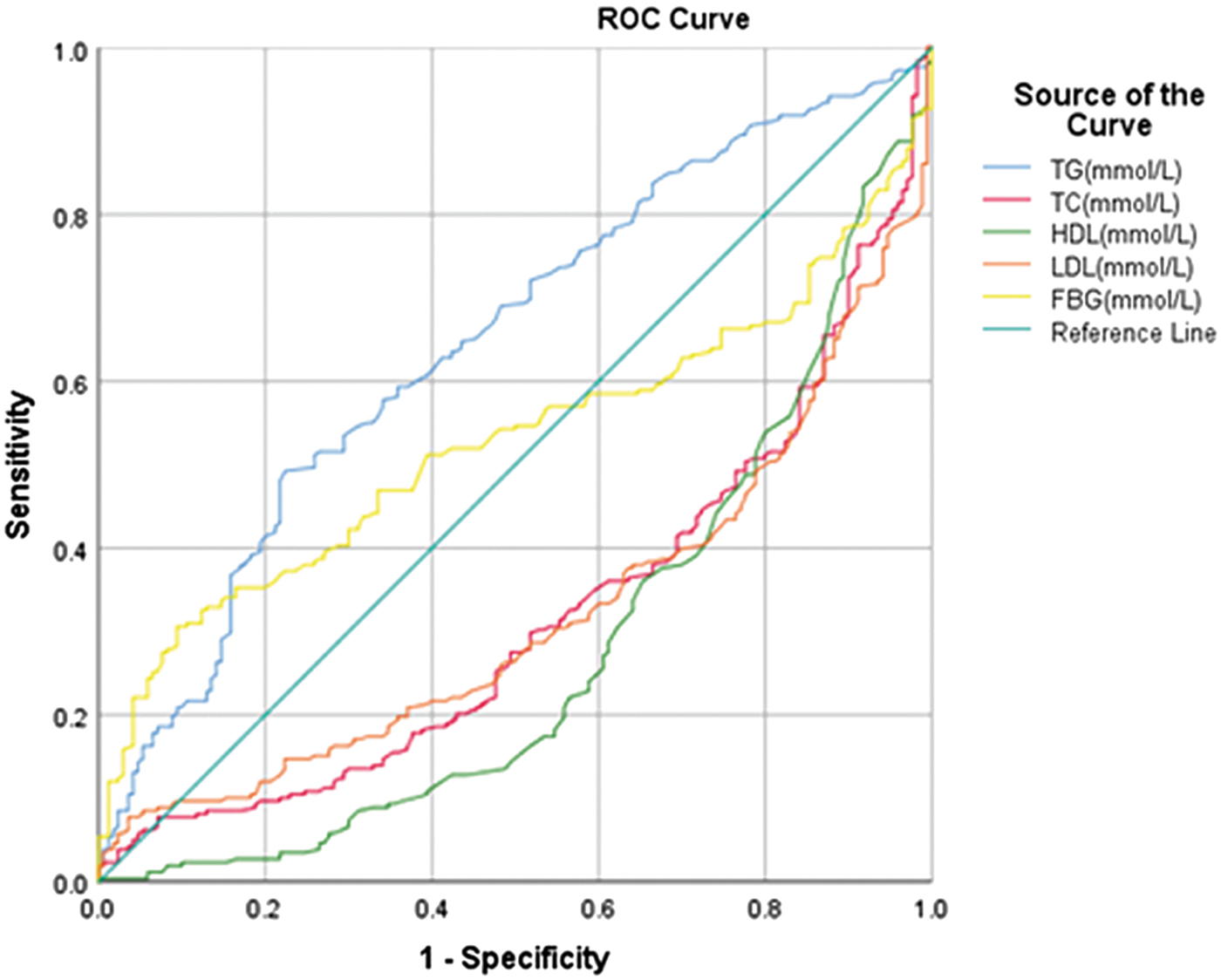
ROC curve of the predictive value of TG, TC, HDL-C, LDL-C, and FBG to CAD. The maximum value of the Youden index was used as the cutoff value, which makes the result more objective and reliable. CAD, coronary artery disease; FBG, fasting blood glucose; HDL-C, high-density lipoprotein cholesterol; LDL-C, low-density lipoprotein cholesterol; ROC, receiver operating characteristic; TC, total cholesterol; TG, triglyceride. Color images are available online.
Rs74650330 Single Nucleotide Polymorphism Genotype and Clinical Characteristics of Patients with Coronary Artery Disease and Controls
Bold values indicate statistically significant differences between the two groups.
Data are presented as median (interquartile range).
Comparison in C/C genotype between control group and CAD.
Comparison in C/del and del/del genotype between control group and CAD.
Risk of Coronary Artery Disease in Subjects with Elevated Serum Lipids and Fasting Blood Glucose Assessed by rs74650330 Allele C Status in a Case-Control Study
N, number of coronary heart disease or controls classified by genotype and baseline characteristics. *p < 0.05.
Logistic Regression Analysis Estimating the Risk Factors for Coronary Artery Disease
p < 0.05, ***p ≤ 0.001.
Discussion
The present study investigated the genetic polymorphisms of rs74650330 in patients with CAD and controls. The results obtained in the current study suggested that the rs74650330 SNPs exhibited no significantly different genotype or allele frequencies between patients with CAD and controls.
From the literature (Johansson et al., 2016), we knew that rs13107325 of the SLC39A8 gene was associated with NT-proBNP levels in patients with acute coronary syndrome. We, therefore, wanted to investigate whether this SNP was associated with CAD in the Chinese population. Our data showed that the rs13107325 polymorphism was not present in the Han Chinese participants enrolled in the current study. However, there were several reports in the literature about a missense mutation in the SLC39A8 gene (rs13107325) that was associated with schizophrenia, Crohn's disease, and severe idiopathic scoliosis in European populations (Li et al., 2016; Haller et al., 2018; Luo et al., 2019). Exploratory analyses suggested that the rs13107325 SNP is monomorphic in individuals of Asian and African descent, while it is prevalent in patients of European descent, which is related to the selective pressure of colder climate in Europe, leading to an increase in the frequency of the T allele so that humans can adapt to the environment (Li et al., 2016).
In the analysis of PCR product sequencing results, a single base deletion SNP (subsequently confirmed as rs74650330 in NCBI's SNP database) was observed at 261 bp for rs13107325. rs74650330 is an intron mutation, and further investigation is required to elucidate its effects. From the Regulome DB (https://www.regulomedb.org/regulome-search/) and HaploReg (https://pubs.broadinstitute.org/mammals/haploreg/haploreg.php) databases, we could not obtain annotation information for the rs74650330 SNP. Most of the risk SNPs detected by GWAS are located in the noncoding regions of the genome, indicating that these SNPs play their functional roles mainly by regulating gene expression (Gong et al., 2018). Introns may regulate gene expression through splicing and “exon shuffling” during evolution. If a mutation occurs in splice junctions, the splicing process is usually disrupted, as the splicing machinery is unable to recognize the sequence. Furthermore, Pagani and Baralle (2004) revealed that mutations in the middle of intron sequences may result in changes to splicing patterns. Sometimes, lethality is attributed to intron mutations rather than missense mutations (Mentrup et al., 2017).
To explore the potential effect on CAD, we further compared clinical features in the case and control groups according to the rs74650330 genotype. The data showed that statistically significant differences in the serum HDL-C and LDL-C levels were present between the C/C and C/del genotypes in the control group (p < 0.05). The mutant allele carriers had lower HDL-C (1.167-fold decrease) and higher LDL-C levels (1.126-fold increase) than the C/C homozygotes, which suggested that the C/C genotype could be a protective genotype in healthy people. However, no statistically significant differences in the lipid profiles of C allele and mutation allele carriers in the CAD group were observed (p > 0.05). Comparing the lipid levels between the two groups, for the C/C genotype, CAD patients had higher TG levels and lower HDL-C and LDL-C levels, and for the C/del and del/del genotypes, CAD patients had lower TC and LDL-C levels.
CAD has a complex pathogenesis that may be caused by risk factors other than cholesterol levels, including smoking, hypertension, glucose intolerance, dyslipidemia, and obesity (Al-Rubeaan et al., 2016). This meaningful result was not observed in the CAD population, which may be related to the possibility of CAD patients taking statin lipid-lowering drugs. Statins are comprehensive lipid-regulating drugs that not only strongly reduce TC and LDL-C levels but also lower TG levels to some extent. The effect of the drugs may mask the protective effect of the C/C genotype. In addition, according to our results, we speculate that SLC39A8 with the C mutation could regulate the expression of genes that promote the development of atherosclerosis and CAD or inhibit the expression of cardiovascular-protective genes. These negative effects might outweigh the blood fat-lowering benefits of statins, which may explain why the C deletion of rs74650330 increases the risk of CAD in patients with low LDL-C levels. However, how it regulates the expression of genes associated with CAD needs further study.
Interestingly, our results indicated when the LDL-C level was lower than 2.365 mmol/L, subjects with C/del had a 7.293-fold increased risk of CAD (OR: 7.293; 95% CI: 0.953-55.79) compared with that of controls without the mutation. A series of studies have shown that low LDL-C levels are associated with poor outcomes in patients with acute coronary syndromes, a phenomenon known as the “cholesterol paradox” (Al-Mallah et al., 2009; Wang et al., 2009, 2021; Cho et al., 2010; Reddy et al., 2015; Nakahashi et al., 2018). Therefore, we speculated that low levels of LDL-C, either congenitally or caused by lipid-lowering drugs might be related to the incidence and mortality of cardiovascular diseases. Thus, SLC39A8 gene (rs74650330) C allele deletion increases the risk of CAD in individuals with low LDL-C levels, which should not be ignored in clinical practice.
In this study, we introduced a method for detecting the SNPs (rs13107325 and rs74650330) of SLC39A8 in one tube by base-quenched probe technique, and the potential relationship between rs74650330 and lipid levels in CAD patients from Han population in Jiangsu (China) had been further revealed. However, the present study had a number of limitations. Patients enrolled in this study had their blood lipid levels measured before angiography. However, the previous medication information was not available, including the type, dosage, and duration of lipid-lowering drugs. We believe that these are the interference factors that affect the results, and it is also difficult for most patients to provide accurate information at the time of consultation. We had a limited sample size to detect SNPs, and weak effects can be observed when considering multiple corrections. In addition, our sample was limited to the Han population. The control group may contain some volunteers whose coronary arteries have stenosis but no symptoms. Further research is warranted on patients with large sample sizes and other ethnic groups as well as patients enrolled from multiple sources to confirm our findings. We hoped that this polymorphic locus could be a predictor of CAD risk, especially in a normolipidemic population.
Footnotes
Authors' Contributions
G.H.L. conceived and designed the study and made critical revision of the article. J.Z. interpreted the results, finished the data analysis and wrote the draft article. Y.Y., L.L.P., and T.H.Y. participated in the laboratory tests and data collection, and helped interpret the results. All authors read and approved the final article.
Acknowledgments
The authors thank the personnel from the Department of Cardiology for their help. Thanks to Xu Bin of the Department of Tumor Biological Treatment for his help in their statistical analysis. They would also like to acknowledge all the patients who participate in the present study.
Ethics Approval
The present study was approved by the Ethics Committee of The Third Affiliated Hospital of Soochow University (Jiangsu, China) and performed in accordance with the institution's guidelines.
Author Disclosure Statement
No competing financial interests exist.
Funding Information
The current study was supported by the Changzhou High-Level Medical Talents Training Project (grant no. 2016ZCLJ002).

References
Supplementary Material
Please find the following supplemental material available below.
For Open Access articles published under a Creative Commons License, all supplemental material carries the same license as the article it is associated with.
For non-Open Access articles published, all supplemental material carries a non-exclusive license, and permission requests for re-use of supplemental material or any part of supplemental material shall be sent directly to the copyright owner as specified in the copyright notice associated with the article.
