




Abstract
Objective:
Previous studies have reported on the association between the rs4680 polymorphism in the Catechol-O-methyltransferase (COMT) gene and opioid use disorder (OUD) with inconsistent outcomes. The goal of this study was to examine the correlation of the rs4680 polymorphism and OUD using a meta-analysis approach.
Methods:
Six electronic databases, including PubMed, Web of Science, Cochrane Library, EMBASE, Wanfang and CNKI, were searched thoroughly for relevant studies on the association of the rs4680 polymorphism and OUD up to September, 2021. Summary odds ratios (ORs) with 95% confidence intervals (CIs) were utilized to test the association. Statistical analyses was performed using RevMan 5.3 software.
Results:
Eleven studies with 13 independent cohorts encompassing 2538 cases and 2519 controls were included in this study. In the overall analysis, the rs4680 polymorphism was not associated with OUD susceptibility. Subgroup analyses suggested that rs4680 was significantly correlated with OUD in Asian populations: VV vs. MM, OR = 1.46, 95% CI 1.05-2.02, p = 0.02; VM vs. MM, OR = 1.44, 95% CI 1.04-2.00, p = 0.03; VV+VM vs. MM, OR = 1.45, 95% CI 1.07-1.99, p = 0.02. However, the pooled data did not suggest any significant association in the Caucasian population.
Conclusion:
This meta-analysis supports a significant association between the rs4680 polymorphism and predisposition to OUD in Asians, carriers of VV and VM genotypes appear to have an increased susceptibility to OUD. However, the association does not exist in Caucasians.
Background
Opioid use disorder (OUD), including opioid abuse, misuse, dependence, and addiction, is characterized by persistent use of opioids despite the adverse consequences (Blanco and Volkow, 2019). OUD is associated with a series of physical, mental, and legal issues, and with increased mortality giving rise to significant impairment or distress. It has been reported that nearly 26.8 million individuals are living with OUD around the world, with >100,000 opioid-related deaths annually (Strang et al., 2020). OUD has become an epidemic in the new century, and the public burden of OUD is immeasurable.
Across the past years, knowledge on the mechanisms of the occurrence and development of OUD has greatly improved. OUD is well recognized as a biopsychosocial disorder with significant hereditary susceptibility. Studies of genetic epidemiology in twins suggest a considerable degree of genetic contribution to OUD. Tsuang et al. (2001) reported that genetic factors contributed 44% of the variance in opioid abuse. Thus, understanding the genetic factors affecting OUD may assist investigators in taking preventive measures and identifying novel therapeutic targets. A great many genes, including μ-opioid receptor (OPRM1), prodynorphin, brain-derived neurotrophic factor (BDNF), and catechol-O-methyltransferase (COMT) genes, have been reported to be associated with OUD (Reed et al., 2014).
COMT is a crucial metabolic enzyme that mediates the metabolism of dopamine. The reward pathway consisting of dopamine circuits is of great importance to OUD (Volkow et al., 2019). The COMT gene is mapped to chromosome 3p25. rs4680 (Val158Met or G472A) is the most common polymorphism in the COMT gene generating an amino acid substitution, leading to a reduction in the activity of the COMT enzyme (Mukherjee et al., 2010). Compelling evidence indicates that the rs4680 polymorphism plays a critical role in numerous substance use disorders, such as cocaine dependence (Lohoff et al., 2008), nicotine dependence, and alcohol abuse (Klimkiewicz et al., 2017).
In 2000, Horowitz et al. (2000) initially carried out a case-control study of the correlation between rs4680 polymorphism and vulnerability to OUD in an Israeli population, and observed that carriers of val allele and val/val genotype were more susceptible to OUD risk. However, the outcomes of subsequent studies were inconsistent. Therefore, this meta-analysis was performed to further elucidate the association of rs4680 polymorphism and OUD risk.
Materials and Methods
Literature search
A systematic retrieval of EMBASE, Cochrane Library, PubMed, Web of Science, China National Knowledge Infrastructure (CNKI), and Wanfang databases until September 2021, was undertaken for original articles without any language restriction. The following search string was used: (heroin dependence OR heroin addiction OR heroin abuse OR heroin misuse OR heroin use disorder OR opioid dependence OR opioid abuse OR opioid addiction OR opioid use disorder) AND (COMT OR Catechol-O-methyltransferase OR catechol methyltransferase) AND (mutant OR SNP OR mutation OR polymorphism OR variant). Screen of references in the retrieved articles was also carried out to obtain potentially relevant articles.
Inclusion and exclusion criteria
Studies satisfied the following criteria were included: (1) case-control or cohort studies on the topic of rs4680 polymorphism and OUD; (2) sufficient information were available to calculate the strength of the effect size; (3) for duplicate data, the study with the largest sample size was selected. Correspondingly, review articles, case reports, conference abstracts, and animal experiments were excluded.
Quality assessment
The Newcastle-Ottawa Scale (NOS) was employed to assess the study quality. This scale consists of three aspects, including selection, comparability, and exposure, with a total of nine points (Wells et al., 2018). Studies with a score of six or more points were considered to be in excellent quality. Two reviewers (X.H. and C.W.) independently evaluated each article's quality. Conflicts were resolved by a third reviewer (Z.Y.).
Data extraction
Data of first author, publication year, country, ethnicity, gender of participants, sample size, and allele/genotype distribution, were independently collected by two reviewers (X.H. and C.W.). Conflicts were settled by a third reviewer (Z.Y.).
Statistical analysis
Deviations from the Hardy-Weinberg equilibrium (HWE) in control participants were evaluated by using chi-square test. Heterogeneity across studies was assessed by Q and I2 tests. I2 <50% was generally considered to be an acceptable level of variability, and a fixed-effects model was adopted. Otherwise, a random-effects model was used. The combined odds ratio (OR) and 95% confidence interval (95% CI) were used to appraise the strength of the effect size. Genetic models investigated were allele model (V vs. M), codominant models (VM vs. MM and VV vs. MM), dominant model (VV+VM vs. MM), and recessive model (VV vs. VM+MM). Subgroup analysis was carried by ethnicity.
Sensitivity analysis and publication bias
Sensitivity analysis was employed to investigate the stability of the results by gradually excluding each study. Potential publication bias was evaluated graphically with funnel plots.
Results
Literature search
Systematic searches of six databases identified 279 potentially relevant items. No additional records were obtained through other sources. A first screen rejected 100 duplicated records. After reading the titles and abstracts, 154 irrelevant studies were removed. Another 14 studies were excluded after reading the full texts and applying inclusion and exclusion criteria. Finally, 11 studies (Horowitz et al., 2000; Zhu et al., 2001; Cao et al., 2003; Oosterhuis et al., 2008; Demetrovics et al., 2010; Voisey et al., 2011; Wang et al., 2011; Yang et al., 2012; Vereczkei et al., 2013; Sonia et al., 2021) were included for data combination. The detailed process of literature search and study selection is displayed in Figure 1.

Flowchart of literature search and screen.
Main characteristics
The characteristics of the included studies are shown in Table 1. A total of 11 studies with 13 independent cohorts encompassing 2538 cases and 2519 controls were eligible to this meta-analysis. Six cohorts (Horowitz et al., 2000; Zhu et al., 2001; Cao et al., 2003; Wang et al., 2011; Yang et al., 2012; Sonia et al., 2021) were performed in Asians (Chinese, Bangladeshi, and Israeli), six (Oosterhuis et al., 2008; Demetrovics et al., 2010; Voisey et al., 2011; Vereczkei et al., 2013; Christoffersen et al., 2016) in Caucasians (Danish, Hungarian, and Australian), and one (Oosterhuis et al., 2008) in African Americans.
Characteristics of Included Studies
V, Val allele; M, Met allele; HWE, Hardy-Weinberg equilibrium; NOS, Newcastle-Ottawa Scale; OUD, opioid use disorder.
Of these studies, eight (Horowitz et al., 2000; Oosterhuis et al., 2008; Demetrovics et al., 2010; Voisey et al., 2011; Yang et al., 2012; Vereczkei et al., 2013; Christoffersen et al., 2016; Sonia et al., 2021) were published in English and three (Zhu et al., 2001; Cao et al., 2003; Wang et al., 2011) were in Chinese. The sample size showed great variation ranging from 78 to 992. Of note, the study by Oosterhuis et al. (2008) included three independent cohorts. Based on the NOS, all included studies received at least six points, suggesting they were in favorable quality.
Meta-analysis and subgroup analysis
For the overall populations, significant heterogeneity was observed under allele model (I2 = 51%, p = 0.02) and recessive model (I2 = 53%, p = 0.02), where the random-effects model was employed. Sensitivity analysis indicated that the heterogeneity was mainly from Zhu et al.'s study (Zhu et al., 2001). The combined outcome did not support any correlation between rs4680 polymorphism and OUD vulnerability under allele model (V vs. M, OR = 1.04, 95% CI 0.91-1.19, p = 0.59, Fig. 2), codominant models (VV vs. MM, OR = 1.11, 95% CI 0.91-1.35, p = 0.29, Fig. 3; VM vs. MM, OR = 1.10, 95% CI 0.92-1.31, p = 0.29, Fig. 4), dominant model (VV+VM vs. MM, OR = 1.09, 95% CI 0.92-1.29, p = 0.30, Fig. 5), or recessive model (VV vs. VM+MM, OR = 0.98, 95% CI 0.79-1.20, p = 0.83, Fig. 6).
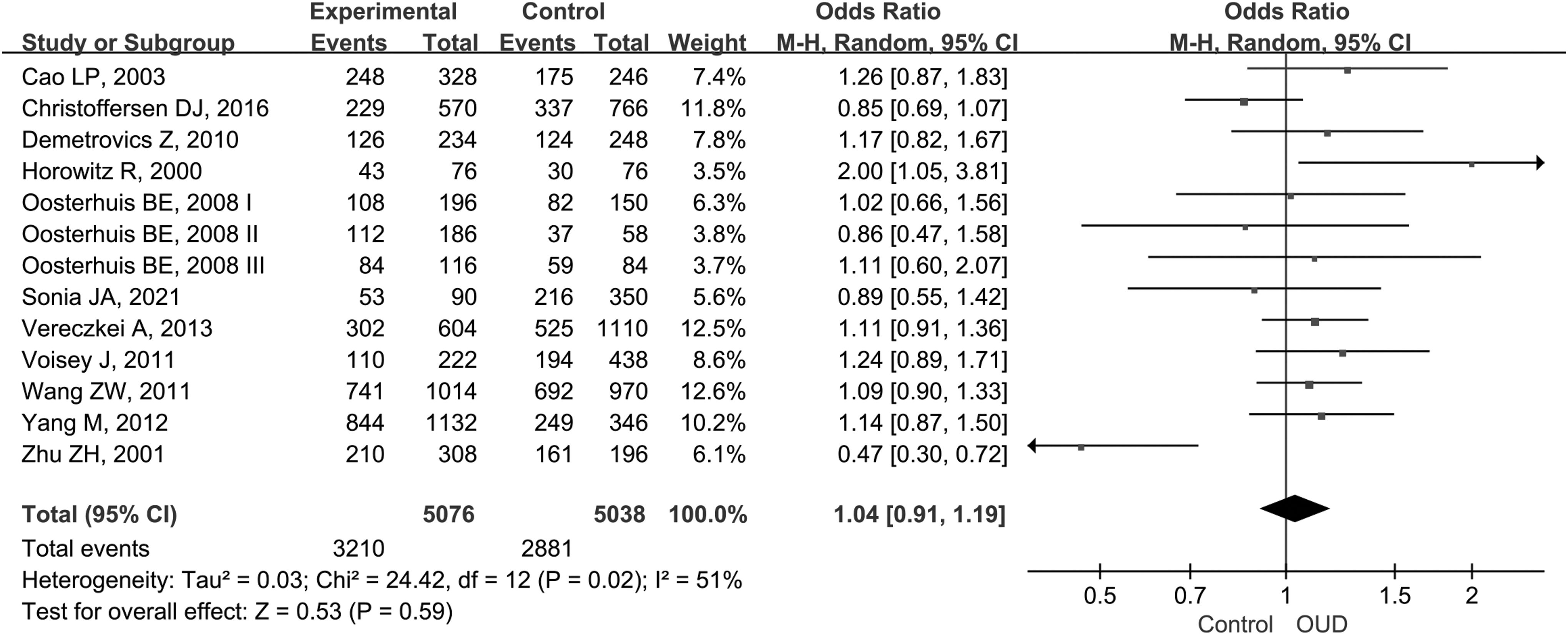
Forest plot of rs4680 polymorphism and opioid use disorder under allele model (V vs. M). OUD, opioid use disorder.
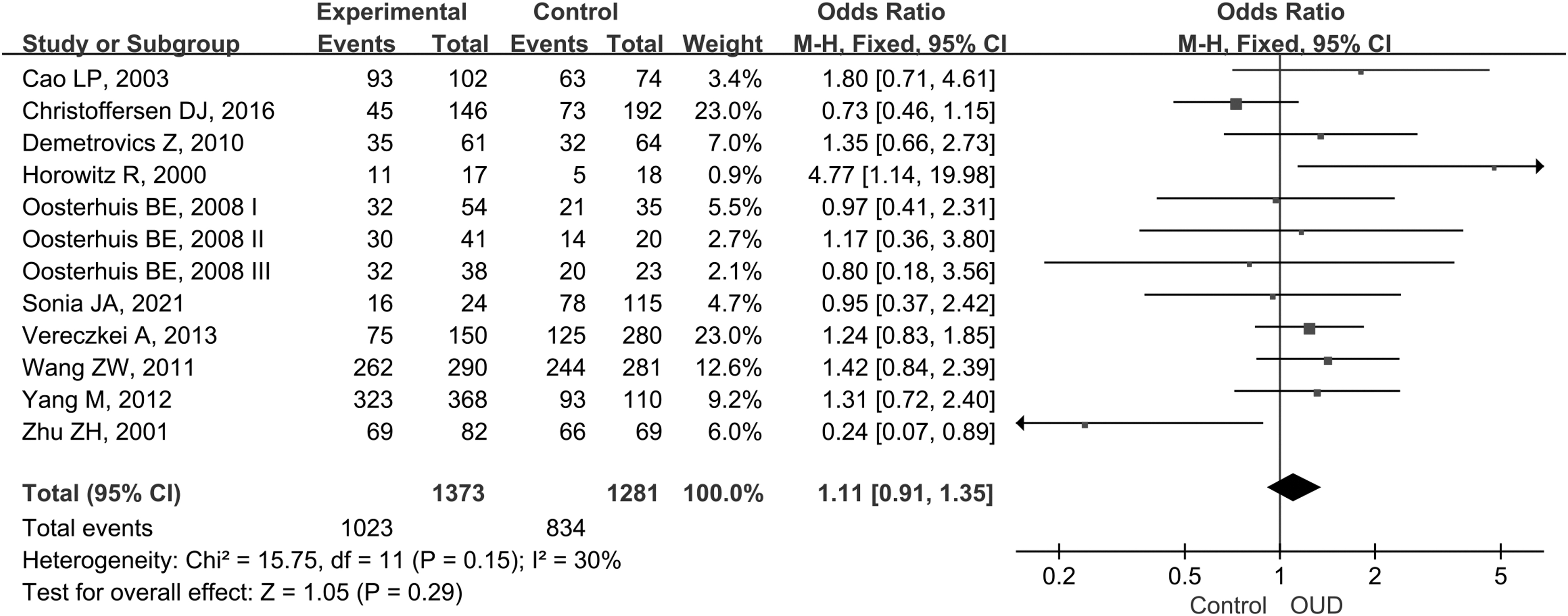
Forest plot of rs4680 polymorphism and OUD under codominant models (VV vs. MM).

Forest plot of rs4680 polymorphism and OUD under codominant models (VM vs. MM).
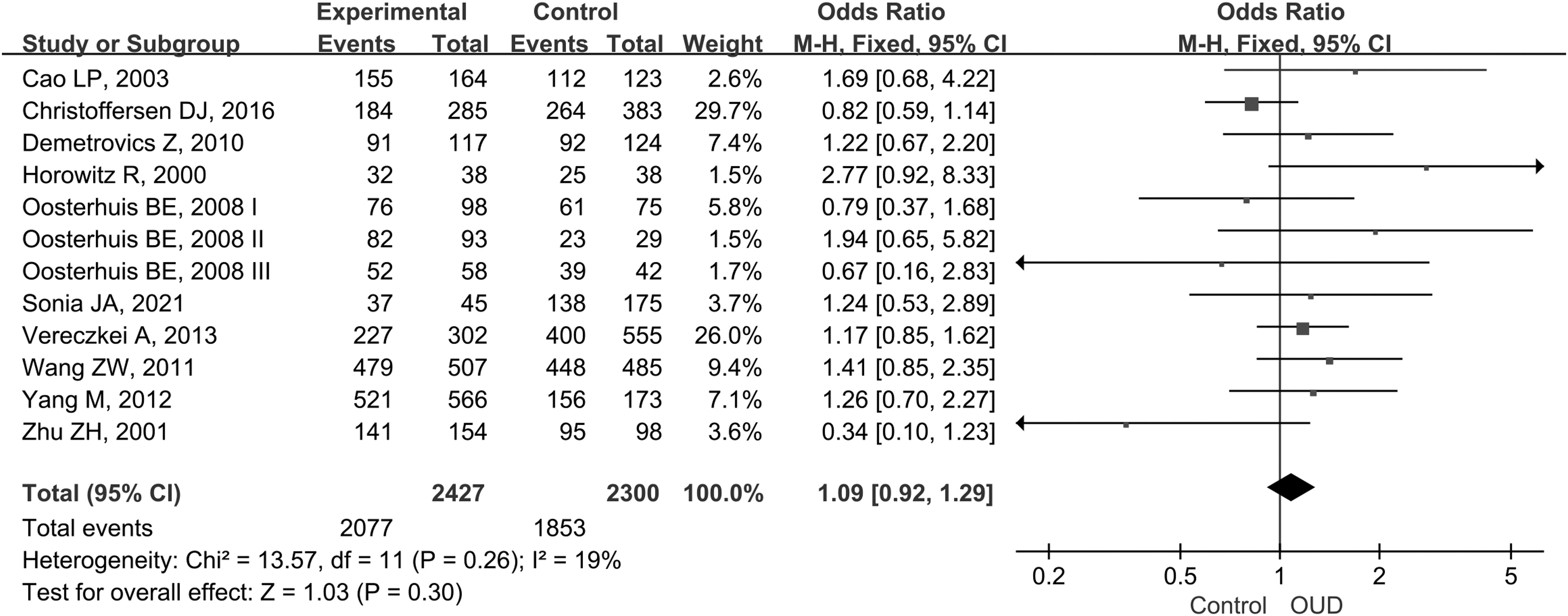
Forest plot of rs4680 polymorphism and OUD under dominant model (VV+VM vs. MM).
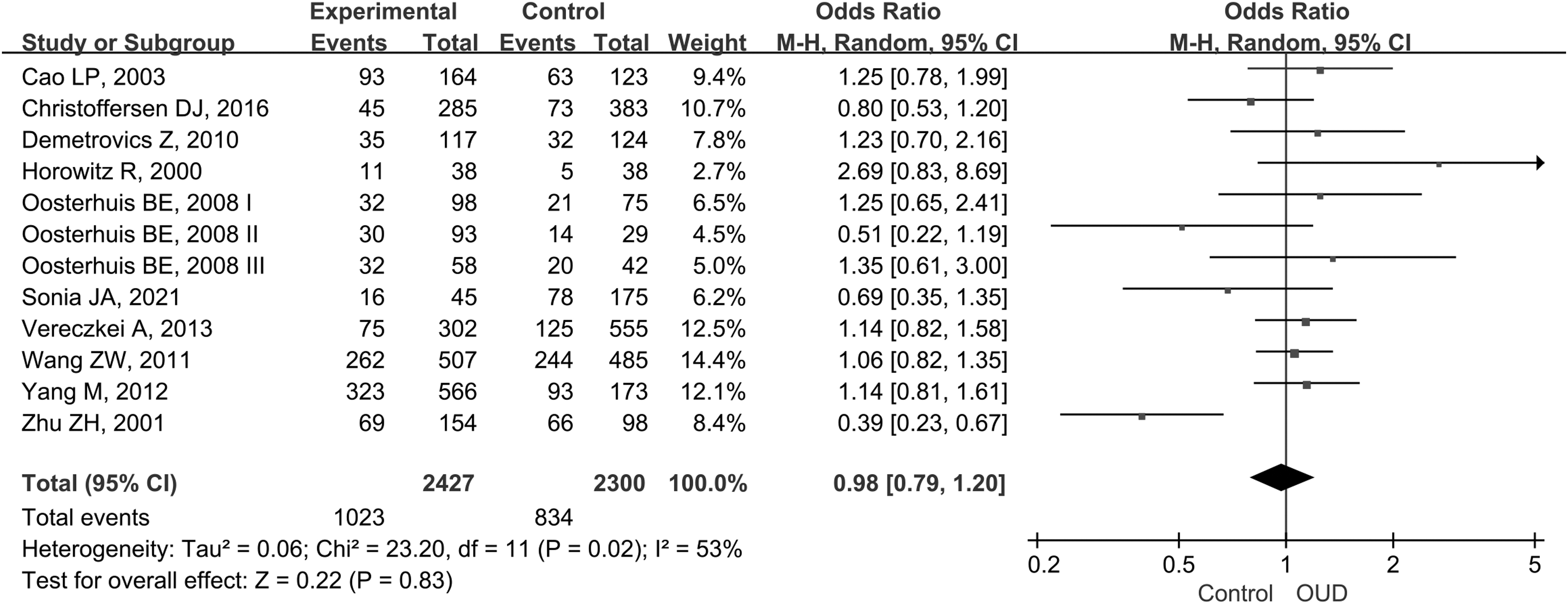
Forest plot of rs4680 polymorphism and OUD under recessive model (VV vs. VM+MM).
In the Asian subgroup, considerable heterogeneity was detected under allele model. Sensitivity analysis indicated that the heterogeneity was caused by Zhu et al.'s study (Zhu et al., 2001), which could significantly change the outcomes. Hence, Zhu et al.'s study was excluded from the final analysis. The recalculated outcomes of the rest studies suggested that rs4680 polymorphism was significantly correlated with OUD under codominant model (VV vs. MM, OR = 1.46, 95% CI 1.05-2.02, p = 0.02; VM vs. MM, OR = 1.44, 95% CI 1.04-2.00, p = 0.03) and dominant model (VV+VM vs. MM, OR = 1.45, 95% CI 1.07-1.99, p = 0.02).
For the Caucasian subgroup, little between-study heterogeneity was found, and the fixed-effects model was used. The pooled data indicated that rs4680 polymorphism was not associated with OUD under any genetic model.
Sensitivity analysis and publication bias
Excluding the studies (Voisey et al., 2011; Sonia et al., 2021) that did not obey to HWE had no significant influence on the pooled OR and 95% CI. Therefore, they were kept in the final data combination. In the overall and Caucasian populations, sensitivity analysis suggested the outcome was robust. In the Asian population, Zhu et al.'s study (Zhu et al., 2001) caused the instability of the result. After their study was excluded, the recalculated outcome became robust and stable. Funnel plots appeared to be symmetrical, suggesting there was no significant publication bias (Fig. 7).
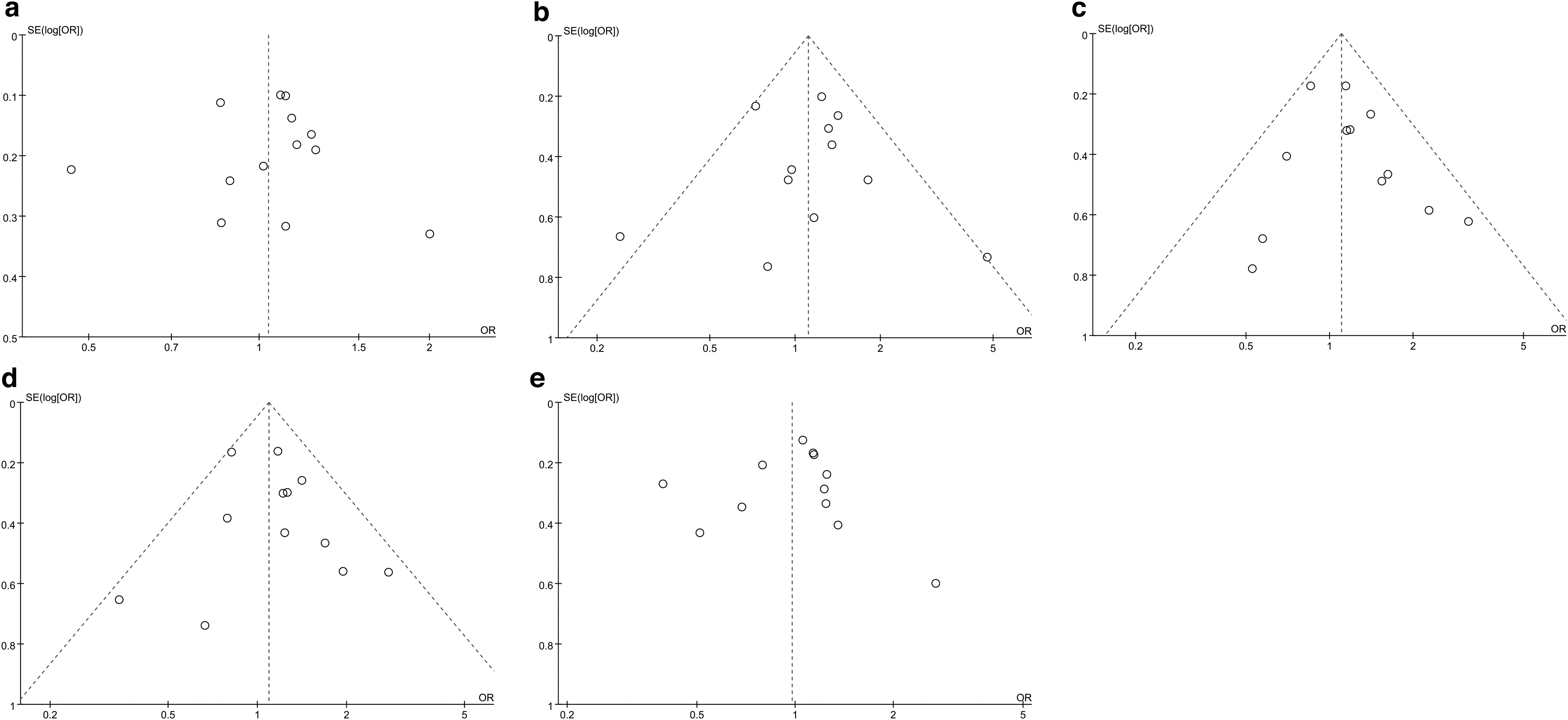
Funnel plots of rs4680 polymorphism and OUD.
Discussion
Studies investigating the effect of genetics on OUD might allow investigators to find novel genetic factors involved in the pathogenesis of this disorder. COMT gene is one of the most substantially studied candidate genes for OUD. Multiple studies among diverse populations have been carried out on rs4680 polymorphism and OUD susceptibility, some studies suggested a significant association, whereas others indicated a null association. The inconsistency might be attributable to different diagnostic criteria, genotyping errors, population stratification, and ethnic heterogeneity (Nakaoka and Inoue, 2009). In such circumstance, meta-analysis is a useful and powerful approach to combine results from individual studies. The current meta-analysis, by pooling together the available estimates from Asian, Caucasian, and African populations, indicated that rs4680 was significantly associated with OUD in Asians, but not Caucasians.
The COMT gene encodes for soluble and membrane-bound isoforms of the enzyme, which is widely expressed in the brain and plays a crucial role in dopamine flux in the prefrontal cortex, a brain region critical to cognitive function (Chen et al., 2004). COMT catalyzes the transfer of a methyl group to a hydroxyl group on a catechol nucleus of major neurotransmitters such as epinephrine, dopamine, and norepinephrine (Chen et al., 2004). COMT has significant control over dopaminergic nerve transmission, particularly in brain regions with lower dopamine transporter density. The reward pathway consisting of dopamine circuits is the basis of substance addiction.
COMT gene harbors dozens of polymorphisms, such as rs4680, rs2097603, rs737865, and rs6267, which are reported to modify the enzyme activity (Lee et al., 2005). Located in the coding region of COMT gene, rs4680 is a nonsynonymous variation owing to a guanine-to-adenine transition at codon 158. This substitution transforms the encoded amino acid from valine (Val) to methionine (Met), thus reducing the COMT enzyme activity (Lachman et al., 1996).
Chen et al. (2004) observed that COMT activity was 40% higher in humans with the COMT-Val than those with COMT-Met, which might lead to lower synaptic dopamine levels and relatively deleterious prefrontal function. The Met carriers were reported to be more sensitive to stress and exhibit higher anxiety and reactivity to lower levels of stress (Dauvilliers et al., 2015). Hooten et al. (2019) found that carriers of Met/Met genotype were more likely to use opioids compared with carriers of Val/Met genotype among adults with chronic pain. Khalil et al. (2017) observed carriers of Met/Met genotype consumed more opioids in patients with orthopedic trauma. Su et al. (2015) reported that heroin-dependent patients with the Met/Met genotype were more likely to relapse because it had an influence on impulsive personalities. Collectively, these studies suggested that rs4680 polymorphism might contribute to OUD susceptibility.
Heterogeneity should not be ignored when elucidating the results of this study. In the overall analysis, moderate between-study heterogeneity was detected under allele model (I2 = 51%, p = 0.02) and recessive model (I2 = 53%, p = 0.02). Sensitivity analysis identified the heterogeneity was mainly from Zhu et al.'s study. Regarding their study had no significant influence on the overall effect size, it was kept in the final data combination. For the Asian population, significant heterogeneity existed under the allele model (I2 = 74%, p = 0.002), homozygous model (I2 = 62%, p = 0.03), and recessive model (I2 = 71%, p = 0.004), which was caused by Zhu et al.'s study. Sensitivity analysis indicated their study could reverse the outcomes. Therefore, Zhu et al.'s study was excluded from the subgroup analysis of Asian population, and the effect size became stable and robust.
Drawbacks in this study still should be pointed out. First, similar to other complex disease, multiple variants may cooperate with others rather than function individually. However, only one polymorphic site was evaluated in this study. The potential interactions of locus and locus were not analyzed due to insufficient data, which might distort the accuracy of the outcomes. Second, crude OR and 95% CI were calculated because confounding factors such as gender, age, living habit, socioeconomic status, medication-consumption were unavailable in the majority of eligible studies.
Third, the effect size of the variant was small, and the combined statistical power was still relatively weak. Fourth, multiple genetic models were tested on the same cohort, which might increase false positive error rates. In this study, after correction for multiple testing was applied, the association in Asian population tended to be not significant. Fifth, only 11 studies from 6 databanks were retrieved, which might lead to publication bias. Finally, most of the included studies were conducted in Caucasians and Asians, and only one study was carried out in African ancestry. Therefore, the outcome for the African population was limited.
Conclusion
Taken together, this meta-analysis supports a significant association of rs4680 polymorphism and predisposition to OUD in Asians, carriers of VV genotype and VM genotype appear to have an increased susceptibility to OUD. However, the association in Caucasians is not observed. Owing to limitations in this study, well-designed studies are encouraged to validate the findings.
Footnotes
Authors' Contributions
Z.Y. and Y.T. conceived and designed this study. X.H. and C.W. were responsible for collection of data and performing the statistical analysis and article preparation. L.Z., L.R., and T.J. were responsible for checking the data. All authors were responsible for drafting the article, read and approved the final version.
Author Disclosure Statement
No competing financial interests exist.
Funding Information
No funding was received for this article.