




Abstract
Background:
Previous studies have reported conflicting results regarding the potential association between the risk of Parkinson's disease (PD) and the single nucleotide polymorphism, rs11558538 (Thr105Ile), in the histamine N-methyltransferase (HNMT) gene. We performed a systematic review and meta-analysis to improve our understanding of the association between them.
Methods:
We systematically searched several online databases to identify relevant studies regarding the association between rs11558538 and PD. We extracted data on the frequencies of genotypes (Thr/Thr, Thr/Ile, and Ile/Ile) and alleles (Thr and Ile) at the rs11558538 locus in patients with PD and healthy controls. Associations between genotype and PD risk were assessed in terms of odds ratios (OR) and 95% confidence intervals (CI).
Results:
The final meta-analysis included six case-control studies and data from the International Parkinson's Disease Genomics Consortium (IPDGC) data base on the association between HNMT rs11558538 and PD, involving 22,855 patients and 65,367 controls. Among the studies, substantial heterogeneity was observed (I2 = 84.42 for genotype and I2 = 73.39 for allele). Both the Ile (log OR: −0.31; 95% CI: −0.5 to −0.12; p < 0.001) and Thr/Ile+Ile genotypes (log OR: −0.32; 95% CI: −0.55 to −0.08; p < 0.001) were associated with a decreased risk of sporadic PD across all study populations. Subgroup analysis showed the protective effect of Thr/Ile+Ile genotypes in non-Chinese cohorts (log OR: −0.66; 95% CI: −0.67 to −0.04; p < 0.001) but not in Chinese cohorts (log OR: −0.26; 95% CI: −0.63 to 0.11; p = 0.13).
Conclusion:
Our findings suggest that the HNMT rs11558538T polymorphism may protect against PD, particularly in patients from the United States and Europe.
Introduction
Parkinson's disease (PD)
PD has been associated with an increase in the density of histaminergic fibers in the brain (Anichtchik et al, 2000), and the inhibition of histamine synthesis in a rat model of PD protected against neuronal loss (Langlais et al, 1994). Despite these findings, the overall pathophysiology of PD is poorly understood (Bernardino, 2022; Zafar and Yaddanapudi, 2021). This hinders our ability to predict or treat the disorder and identifying the genetic risk factors may help in this regard.
Many genetic risk factors have been identified for sporadic PD, including SNCA and LRRK2 (Bernardino, 2022). Variants of the COMT and MAO-B genes, which are associated with dopamine metabolism, may play a role in the development of PD, potentially increasing the risk of levodopa-induced dyskinesia (Yin et al, 2021).
Similarly, variations in the genes associated with histamine metabolism, such as the gene encoding histamine N-methyltransferase (HNMT), have been associated with neurological disorders. One study indicated that the nucleotide variant C314T in exon 4 (rs11558538) of the HNMT gene, which changes Thr105 to Ile, can decrease enzyme activity by 30-50% in heterozygotes and by 60% in homozygotes (Horton et al, 2001). Although previous studies have addressed the association between the rs11558538 variant and diseases, such as essential tremor (Ledesma et al, 2008) and restless leg syndrome (Jiménez-Jiménez et al, 2017), and PD (Agundez et al, 2008; Palada et al, 2012; Yang et al, 2015), the findings were inconsistent (Agundez et al, 2008; Chen et al, 2018; Dai et al, 2021; Keeling et al, 2010).
A meta-analysis published in 2016 also indicated that HNMT rs11558538 minor allele confers a decreased risk of developing PD (Jiménez-Jiménez et al, 2016). However, two recent studies showed contrasting results (Chen et al, 2018; Dai et al, 2021). Thus, in this study, we conducted an updated meta-analysis to elucidate the association between rs11558538 and PD.
Methods
Search strategy
We systematically examined the Web of Science, EMBASE, PubMed, Chinese National Knowledge Infrastructure database, and Wanfang database to identify studies regarding HNMT rs11558538 genotype and risk of PD published before July 2021. The following search strings were used in combination with the term “Parkinson's disease”: “histamine,” “histamine N-methyltransferase,” “HNMT,” and “HNMT gene.” No language restrictions were applied, and genetic data were obtained from the International Parkinson's Disease Genomics Consortium (IPDGC) (https://pdgenetics. shinyapps.io/VariantBrowser/).
Eligibility criteria
We included case-control studies comparing healthy controls with sporadic PD patients who were diagnosed based on the Movement Disorder Society Clinical Diagnostic Criteria (Postuma et al, 2015) or the UK Parkinson's Disease Society Brain Bank Diagnostic Criteria (Hughes et al, 1992). We included studies that assessed the association between the rs11558538 variant and the risk of developing PD, as well as those that reported the genotypes and minor allele frequency (MAF) distributions of the rs11558538 variant in PD patients and controls. Only the largest cohort was included in studies with overlapping cohorts. We excluded studies that failed to report complete information on the MAF distribution of rs11558538.
Data extraction
Two investigators (D.M.B. and Y.X.L.) independently reviewed the literature and extracted relevant data, including the first author's surname, year of publication, country of origin, sample size, average age of PD patients and controls, as well as their genotypic distribution and allele frequencies. All inconsistencies were clarified through discussion with the corresponding authors.
Quality assessment of studies
Two authors (D.M.B. and Y.X.L.) independently assessed the quality of studies by using the Newcastle-Ottawa quality assessment scale. If there were discrepancies between the two authors, a third author (B.Y.Y.) was consulted. A study with scores ≥6 was considered as high quality (Stang, 2010).
Statistical analysis
Meta-analysis was performed using Stata 16.0 (StataCorp., TX), and the threshold of statistical significance was defined as p = 0.05. Based on the collected data, we evaluated the association between the risk of developing PD and the presence of specific alleles (Thr, Ile) or genotypes (Thr/Thr,Thr/Ile,Ile/Ile) at rs11558538. The strength of these associations was expressed in terms of odds ratios (ORs) and the associated 95% confidence intervals (CIs).
Heterogeneity among studies was assessed using the Q test and I2 statistics. I2 values between 25% and 50% indicated low heterogeneity, values between 50% and 75% indicated moderate heterogeneity, and values ≥75% indicated substantial heterogeneity. I2 values <25% indicated no heterogeneity (Higgins, 2003). If the data were homogeneous or showed low or moderate heterogeneity, we performed a meta-analysis using a fixed-effects model. When substantial heterogeneity was observed, a random effects model was used. Publication bias was assessed using funnel plots and Egger's and Begg's tests.
Results
Literature screening and assessment
A total of 262 records were identified after examining the databases and removing duplicates (Fig. 1). After eliminating 250 records based on titles and abstracts, the full texts of 14 records were reviewed. We excluded two review articles and four studies that did not examine the relationship between rs11558538 polymorphism and the risk of PD. After a detailed assessment based on eligibility criteria, the final meta-analysis included six articles involving seven unique cohorts and data from IPDGC comprising 22,855 patients with sporadic PD and 65,367 healthy controls (Table 1).

Flowchart depicting study selection.
Frequencies of HNMT rs11558538 Genotypes in Parkinson's Disease Patients and Healthy Controls Included in the Meta-analysis
Values are n or n (%). Age is reported as “mean ± SD” or “median, interquartile range.”
This article contains data from two nonoverlapping cohorts.
HNMT, histamine N-methyltransferase; IPDGC, International Parkinson's Disease Genomics Consortium; PD, Parkinson's disease.
These cohorts originated from China (Chen et al, 2018; Dai et al, 2021; Yang et al, 2015), the United States (Keeling et al, 2010; Palada et al, 2012), Europe (Palada et al, 2012), Canada (Keeling et al, 2010), Spain (Agundez et al, 2008), and IPDGC (Table 1). Quality assessment of all the studies indicated high quality (Table 2).
Quality Assessment of Case-Control Studies Included in the Meta-analysis
Association between rs11558538 genotype and risk of sporadic PD: all patients
We pooled data from the final set of six case-control studies and IPDGC to examine the potential association between rs11558538 and PD risk (Table 1). We observed substantial heterogeneity among the studies with respect to frequencies of the Thr/Ile+Ile/Ile genotype (I2 = 84.42%, p < 0.001) and moderate heterogeneity in the Ile allele (I2 = 73.39%, p < 0.001). Moreover, the L'Abbé plot showed heterogeneity among studies (Supplementary Figs. S1 and S2). Therefore, we conducted a meta-analysis on the data using a random effects model.
The pooled log OR for risk of PD in the presence of the Thr/Ile or Ile/Ile genotypes was −0.32 (95% CI: −0.50 to −0.14, p ≤ 0.001) relative to the Thr/Thr genotype (Fig. 2), indicating that the presence of Thr/Ile or Ile/Ile genotypes may confer a potentially protective effect on PD. The funnel plot was visually asymmetrical, indicating potential significant publication bias (Fig. 3). However, Egger's (p = 0.05) and Begg's tests (p = 0.54) showed that there was no significant publication bias.
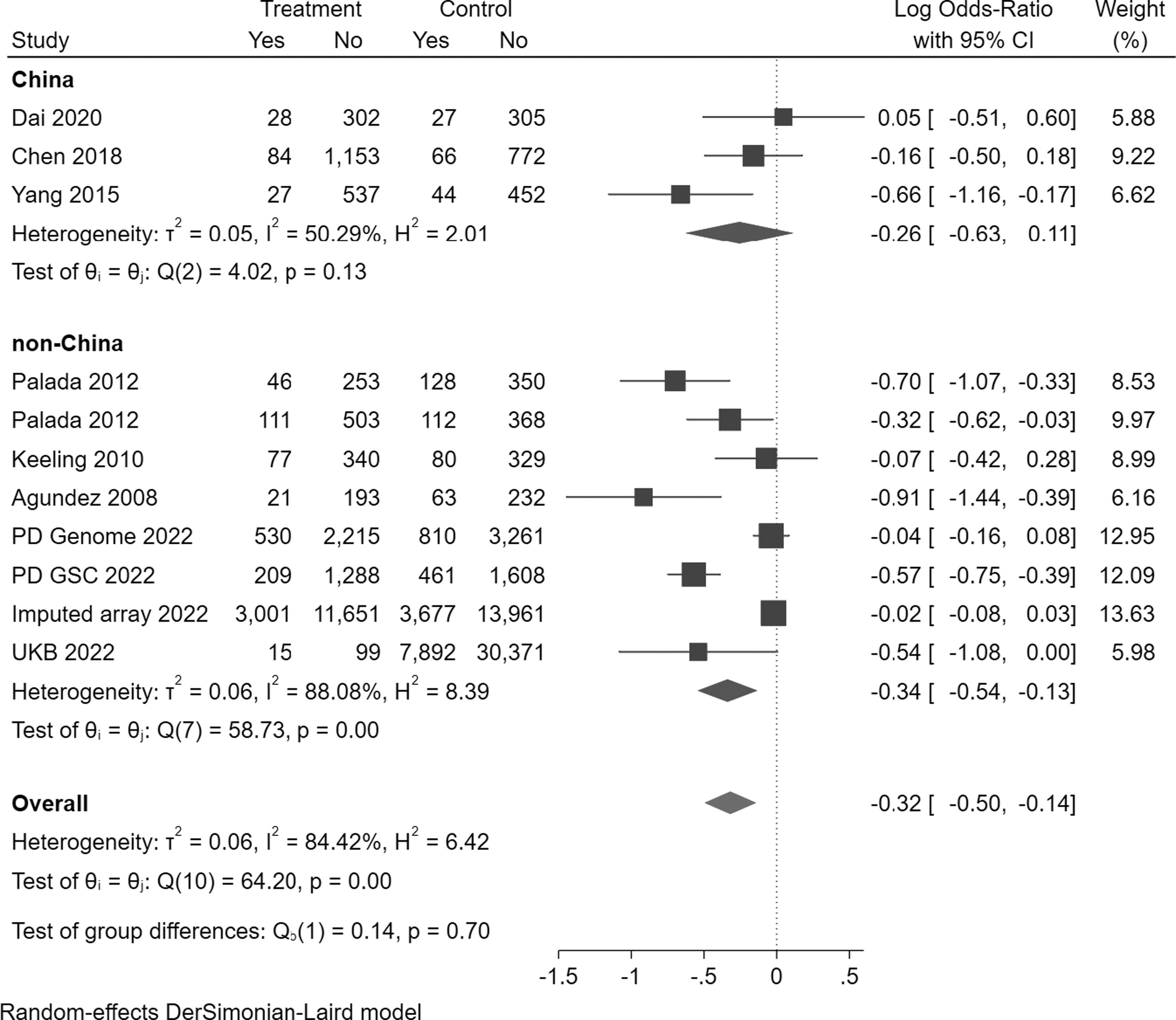
Forest plot of the potential association between rs11558538 genotypes (Thr/Ile+Ile/Ile vs. Thr/Thr) and risk of developing PD. PD, Parkinson's disease.
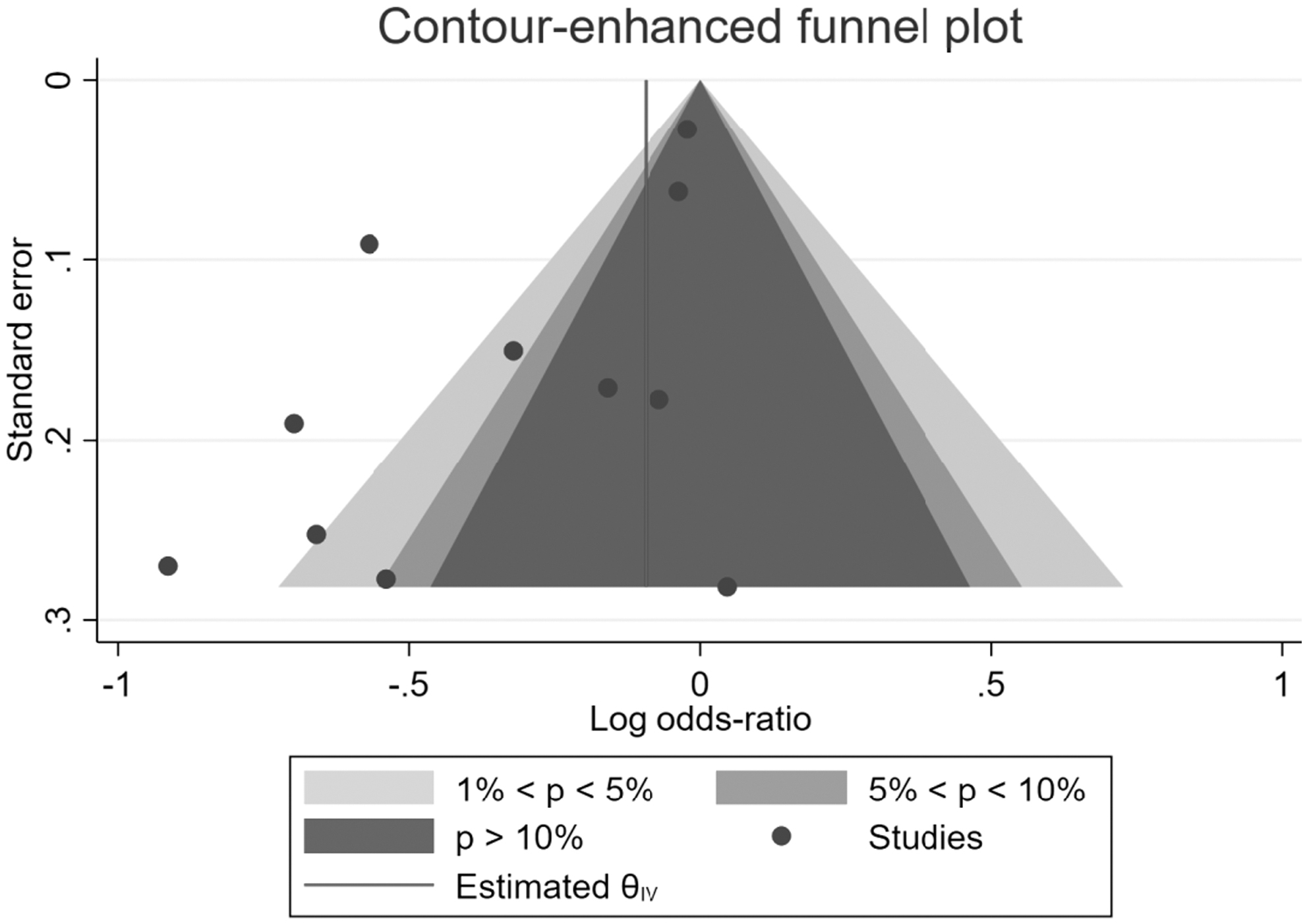
Funnel plot of study precision with respect to data on rs11558538 genotypes (based on log OR). OR, odds ratio.
Similar results were observed for the Ile allele alone (Fig. 4), suggesting that the Ile allele was sufficient to observe a significant protective effect (log OR: −0.23; 95% CI: −0.35 to −0.10; p < 0.001). The funnel plot was visually asymmetrical, indicating potential significant publication bias (Fig. 5), whereas Egger's (p = 0.26) and Begg's tests (p = 0.06) show no significant publication bias.
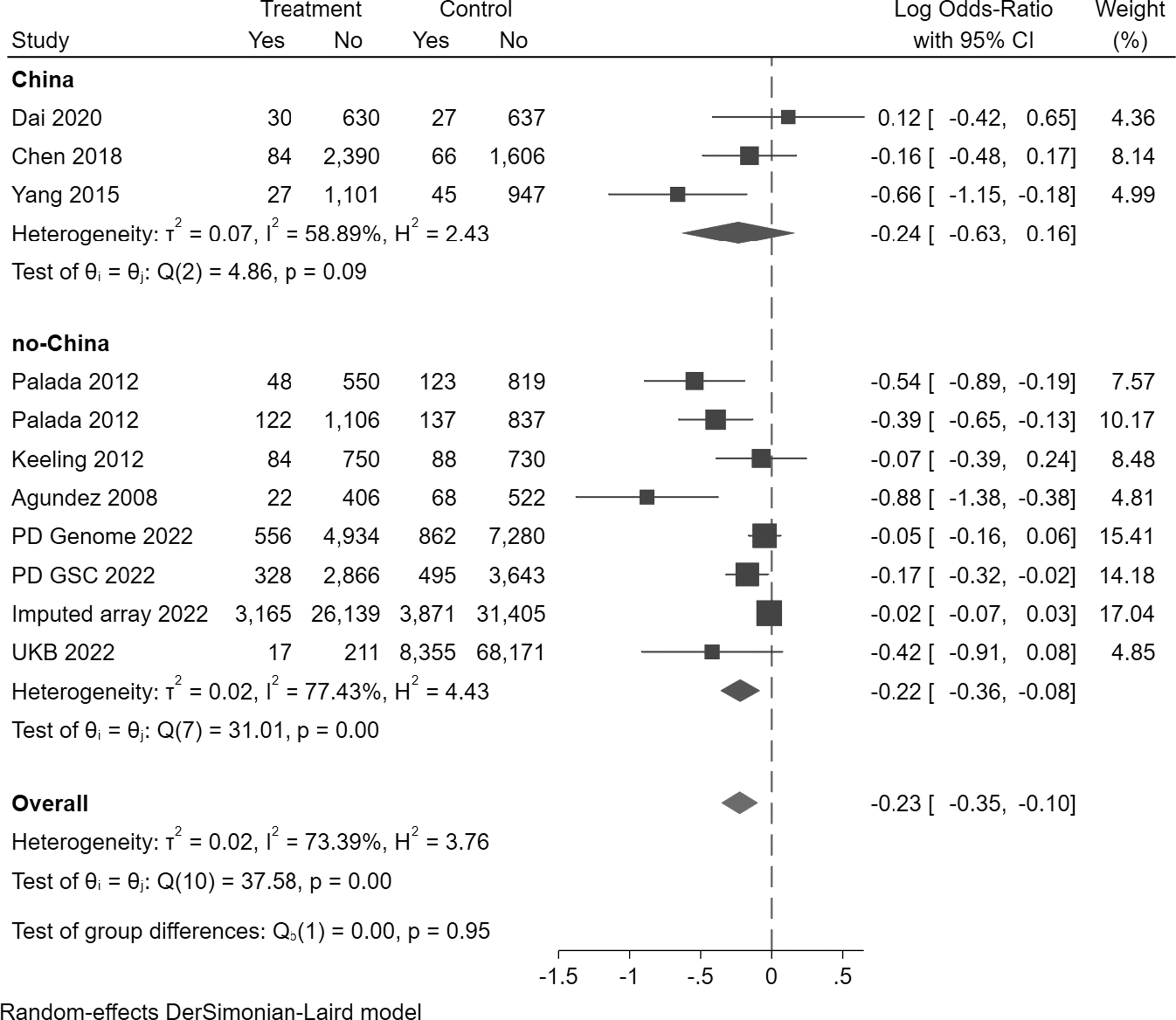
Forest plot of the potential association between rs11558538 alleles (Ile vs. Thr) and risk of developing PD.

Funnel plot of study precision with respect to data on alleles of the rs11558538 variant (based on the log OR).
Association between rs11558538 genotype and risk of sporadic PD: geographic subgroups
In cohorts from the United States and Europe, the Thr/Ile and Ile/Ile genotypes of rs11558538 decreased the risk of sporadic PD (log OR: −0.34; 95% CI: −0.54 to −0.13; p < 0.001). However, they did not affect the risk of PD in the Chinese cohort (log OR: −0.26; 95% CI: −0.63 to 0.11; p = 0.13) (Fig. 2). Similar results were obtained for the Ile allele (Fig. 4).
Data availability
The data sets supporting the conclusion of this study are included in this article.
Discussion
Genome-wide association and candidate gene studies have reported several genetic variants that affect the risk of developing PD (Alonso-Navarro et al, 2014; Nalls et al, 2019). A detailed understanding of the mechanism of PD requires an in-depth analysis of these genetic risk factors (Ross and Farrer, 2005; Wider and Wszolek, 2008). In this meta-analysis, we collected data from six case-control studies to examine the association between HNMT rs11558538 genotypes and the risk of developing PD.
Our findings indicate that across all studies, the occurrence of the Thr/Ile or Ile/Ile genotypes at rs11558538 was associated with a decreased risk of PD. Our subgroup analysis by geographical location suggests that this protective effect may hold in European and U.S. populations but not in Chinese populations.
HNMT plays an important role in histamine metabolism in the central nervous system by degrading it. Another enzyme that degrades histamine, diamine oxidase, or amiloride-binding protein 1 plays a marginal role in the central nervous system (Yoshikawa et al, 2019). Patients with PD show higher HNMT expression in the substantia nigra pars compacta and putamen than controls (Shan et al, 2012). The pThr105Ile variant of HNMT leads to strongly reduced enzyme activity (Horton et al, 2001), and the resulting persistence or accumulation of histamine may influence PD pathogenesis. Structural studies suggest that residue 105 lies in the turn between an α-helix and a β-strand on the protein surface away from the HNMT active site.
The presence of Ile at this position may destabilize protein conformation and lead to clearance by proteasomes (Pang et al, 2001). Our results indicate that the Ile allele may decrease the risk of PD, whereas we cannot eliminate heterogeneity among all the studies that may decrease the power of our results. The results differed in the Chinese, European, and U.S. populations, which may be due to ethnic differences; the MAF in healthy controls in the Chinese population was 3.95-4.5%, whereas in the European and U.S. populations, the MAF was 10.76-14.34% (Table 2).
Our study has several limitations. First, although we collected data from seven unique cohorts, our sample size was relatively small, which limits the reliability of our subgroup analysis. Second, the pThr105Ile (rs11558538) variant has not been reported to be associated with PD in a previous large genome-wide association study. Third, moderate to substantial heterogeneity cannot be neglected in this study, and heterogeneity remained even after we applied subgroup analysis. The main cause of the moderate heterogeneity (I2 = 50.29%) among studies from China may be the small sample size, and only three studies were involved.
Although among the non-Chinese population the main cause of substantial heterogeneity may be ethnicity (patients from various countries), the MAF of rs11558538 was volatile even among Western countries (among the normal controls, the MAF was 14.34% in European countries and 10.76% in the United States and Canada). Besides, different genotyping/sequencing methods used among the studies may also be a potential factor for the substantial heterogeneity.
Despite these limitations, our study suggests that the pThr105Ile variant (rs11558538) in HNMT may be associated with a reduced risk of PD, particularly in European and American populations. However, due to the substantial heterogeneity present in the study, future studies involving larger samples from multiple ethnicities and analysis of HNMT expression and function are needed to clarify the role of rs11558538 in PD.
Footnotes
Ethical Statements
Ethics approval and consent to participate are not applicable in this article.
Authors' Contributions
Y.L. and D.B. designed the study and wrote the protocol. K.L. and C.Z. conducted the literature search, and L.C., W.W., and B.Y. checked the literature. Y.L. and B.Y. performed the analyses. The first draft of the article was written by Y.X.L and revised by B.Y.
Author Disclosure Statement
The authors declare that they have no competing interests.
Funding Information
This research was supported by Applied Basic Research Program of Sichuan Province of China (2020YJ0484).

References
Supplementary Material
Please find the following supplemental material available below.
For Open Access articles published under a Creative Commons License, all supplemental material carries the same license as the article it is associated with.
For non-Open Access articles published, all supplemental material carries a non-exclusive license, and permission requests for re-use of supplemental material or any part of supplemental material shall be sent directly to the copyright owner as specified in the copyright notice associated with the article.
