




Abstract
Background:
Association studies of variations in the 5-hydroxytryptamine (5-HT, serotonin) transporter gene-linked polymorphic region (5-HTTLPR) and functional dyspepsia (FD) have yielded contradictory results. Hence, we performed a meta-analysis to clarify inconsistencies between the 5-HTTLPR polymorphism with FD and it subtypes.
Methods:
We performed a literature search in PubMed, Embase, Web of Science, Cochrane Library, and CNKI, including articles published until March 2022. We calculated and pooled odds ratios (ORs) with their 95% confidence intervals (CIs) in Stata 15.0. Data extraction was performed in accordance with the Preferred Reporting Items for Systematic Reviews and Meta-Analyses (PRISMA) guidelines and Cochrane Handbook for Systematic Reviews of Interventions.
Results:
The meta-analysis included six studies, comprising 488 cases and 1513 healthy controls. We did not observe a significant association between the 5-HTTLPR polymorphism and FD in the overall population. In subgroup analyses, the 5-HTTLPR polymorphism was significantly associated with FD-subtype epigastric pain syndrome (EPS) (SS vs. LL+LS, OR = 0.620, 95% CI: 0.414-0.930; SS vs. LS, OR = 0.640, 95% CI: 0.417-0.980; S vs. L, OR = 0.655, 95% CI: 0.471-0.911). However, no association was observed with the other subtype, postprandial distress syndrome (PDS).
Conclusion:
While the 5-HTTLPR polymorphism had no relationship with FD overall, splitting the disease into its subtypes revealed a clear association with EPS.
Introduction
Functional dyspepsia (FD) is a chronic disease that seriously impairs quality of life by inducing high health-care expenses and negatively affects the ability to work (Brook et al, 2010). The Roman IV diagnostic criteria (Stanghellini et al, 2016) describes FD as involving recurrent or chronic abdominal symptoms without anatomical or biochemical abnormalities. The disease can be divided into two subtypes based on symptoms: postprandial distress syndrome (PDS) and epigastric pain syndrome (EPS). FD, one of the most common gastrointestinal (GI) disorders, has an estimated prevalence of 10-40% in western countries and 5-30% in Asia (Enck et al, 2017; Ford et al, 2020).
Numerous pathophysiological factors have been implicated in FD etiology, including visceral hypersensitivity, impaired proximal gastric accommodation, delayed or early gastric emptying, dysfunction of the autonomic nervous system, psychiatric problems, Helicobacter pylori infection, impaired duodenal mucosal integrity and low-grade inflammation, as well as alterations of the immune system or intestinal microbiota (Du et al, 2019; Ford et al, 2020; Stanghellini et al, 2016; Vanheel et al, 2014). However, the exact cause remains unclear. Hence, genetic approaches are now being included in etiological research studies on FD.
A study examining patient family aggregation reported genetic components that could be associated with GI disorders (Locke et al, 2000). Genetic variants of several genes reportedly contribute to FD development, such as the SLC6A4 5-hydroxytryptamine transporter gene-linked polymorphic region (5-HTTLPR), G-protein β3 (GNB3), transient receptor potential ion channel of vanilloid type 1 (TRPV1), and cholecystokinin receptor 1 (CCK-1R) (Du et al, 2019; Kourikou et al, 2015; Singh et al, 2016; Triantafyllou et al, 2017).
5-HTTLPR polymorphisms are most widely evaluated in relationship to FD. Serotonin transporter protein (SERT) is associated with the serotonin (5-hydroxytryptamine [5-HT]) pathway, which is important to brain-gut communication and functional regulation (Ford et al, 2020; Keating and Spencer, 2019; Kim and Camilleri, 2000; Wei et al, 2021). The SLC6A4 gene encodes SERT or 5-hydroxytryptamine transporter protein (5-HTT), located on chromosome 17q11. The SERT is primarily responsible for 5-HT reuptake by mucosal epithelial cells and enteric neurons (Torres et al, 2003). The 5-HTTLPR polymorphism is a variable number tandem repeat variant on SLC6A4 with a long 572 base-pair transcript or a short 528 base-pair transcript that influences the activity of SERT (Heils et al, 1996). There is a 44-bp insertion/deletion in the 5′-flanking promoter region, which creates a long and a short allele (L and S allele).
The S allele of 5-HTTLPR has been associated with lower transcriptional efficiency than the L allele. It leads to a decrease in synaptic uptake of 5-HT and therefore an increase in synaptic 5-HT (Heils et al, 1996; Lesch et al, 1996; Yeo et al, 2004). 5-HTTLPR polymorphisms have been extensively studied in psychiatry and linked to depression and other disorders (Lesch et al, 1996; Ren et al, 2020). A study from Japan (Toyoshima et al, 2011) showed that the L carrier was significantly associated with PDS, and other studies from China (Han et al, 2010) and Korea (Hwang et al, 2014) similarly demonstrated a possible association between the 5-HTTLPR polymorphism and FD.
However, no significant association was found between 5-HTTLPR and FD in two Caucasian studies (Camilleri et al, 2006; van Lelyveld et al, 2008). The inconsistency in results can be attributed to the small sample size in individual investigations, geographic region, and ethnic diversity. Moreover, individual studies may have lower power to determine overall effects. Therefore, we performed a meta-analysis to clarify whether the 5-HTTLPR polymorphism is associated with the development of FD and its subtypes.
Materials and Methods
Literature search strategy
PubMed (Medline), Ovid-Embase, Web of Science, and CNKI were searched using the following keywords: “functional dyspepsia,” or “FD,” “serotonin,” “5-Hydroxytryptamine,” or “5-HT,” and “polymorphism,” “variant,” or “mutation,” with no limits on publication status. Both Chinese and English publications were included. The last search date was March 15, 2022. Articles were organized with Endnote version X9 (Thomson Reuters, New York, NY).
Study selection and data extraction
The inclusion criteria for search results were as follows: (1) studies examining the association between the 5-HTTLPR polymorphism and FD, (2) case-control design, and (3) sufficient data on genotype frequency. The exclusion criteria were as follows: (1) overlapping literature, (2) unextractable data, (3) no control, and (4) abstracts or reviews. Two investigators screened potentially relevant studies and extracted data, including the first author's name, publication year, ethnicity, sample size, and available genotype information from the 5-HTTLPR polymorphism. Titles and abstracts were first reviewed. If appropriateness could not be determined, the full article was read. Disagreements among investigators were discussed with a third investigator, and agreement was reached by consensus. A Preferred Reporting Items for Systematic Reviews and Meta-Analyses (PRISMA) flow diagram describing our study selection process is shown in Figure 1.
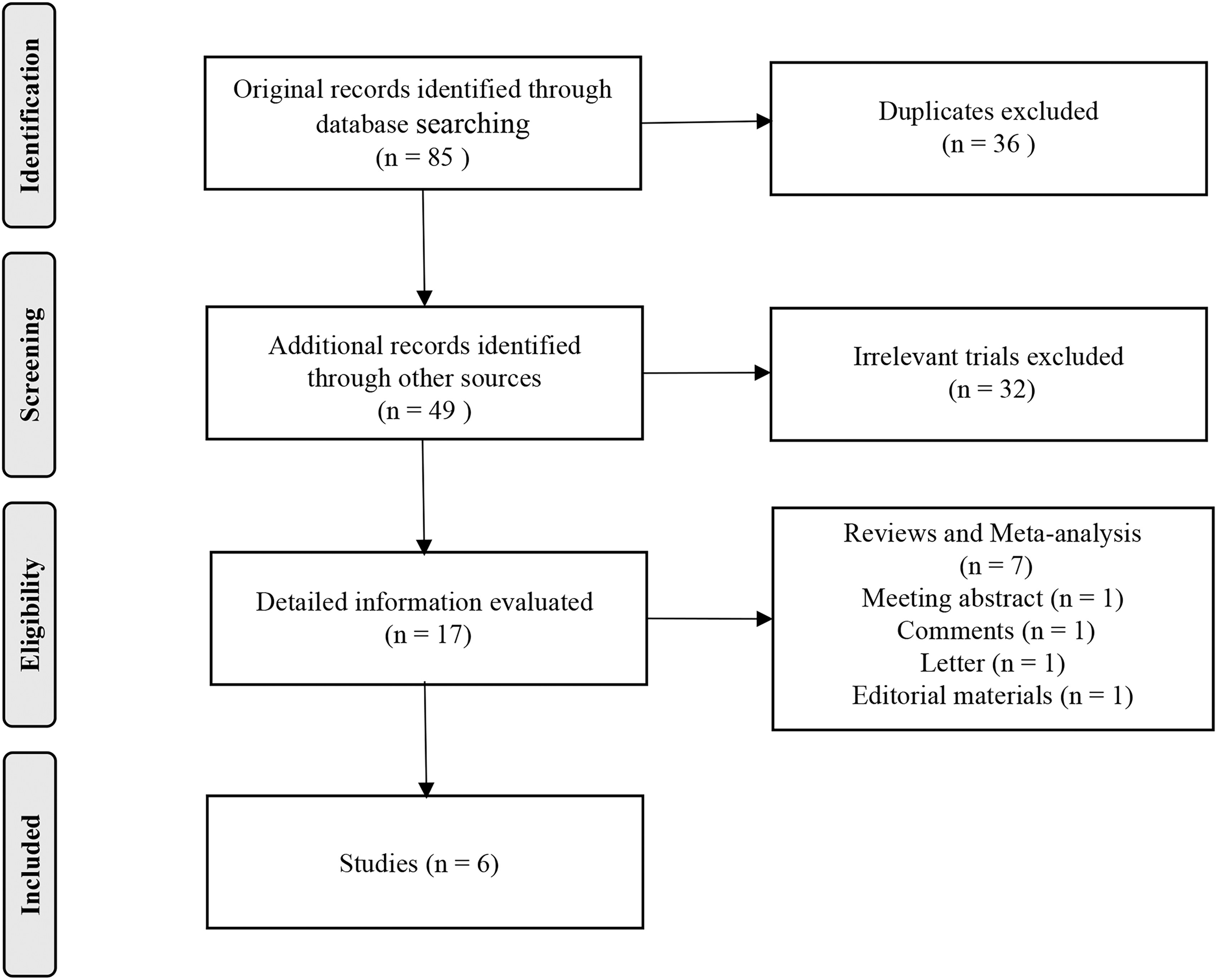
Flow showing the identification, inclusion, and exclusion of published articles analyzed in this study.
Statistical analysis
The presence of selection bias in control participants was evaluated by calculating the Hardy-Weinberg equilibrium (HWE) and assessed with chi-square tests; p < 0.05 indicated disequilibrium. Given the lack of unequivocal data for 5-HTTLPR genotype pooling, we tested both recessive and dominant hypotheses. The association between FD and the 5-HTTLPR polymorphism was evaluated with the following genotype pairs: (1) an allelic analysis (S vs. L); (2) a genotypic analysis (SS vs. LS, SS vs. LL); and (3) another genotypic analysis evaluating dominant or recessive effects of allele S (SS vs. [LL+LS], and [SS+LS] vs. LL).
In particular, we did not perform genotype analysis for LL versus LS because the focus was on the relationship between SS and EPS subtype. Odds ratios (ORs) with 95% confidence intervals (CIs) were calculated in Stata version 15.0 (StataCorp, College Station, TX) to assess the relationship between the 5-HTTLPR polymorphism and FD. Statistical heterogeneity was assessed with the I2 statistic based on the Q-test. Results were subjected to a fixed-effects model when pheterogeneity (ph) ≥ 0.10 and I2 < 50%; otherwise, a random-effects model was applied. When studies demonstrated significant heterogeneity, subgroup analyses were performed according to the following criteria: subtypes of FD (PDS vs. EPS) and ethnicity (Caucasian vs. East Asian). Egger's test was applied to assess publication bias. Statistical significance was set at p < 0.05.
Results
Search results
Using the predetermined keywords, our literature search in multiple major databases yielded 85 articles (Fig. 1). The final meta-analysis included six unique studies (Camilleri et al, 2006; Han et al, 2010; Hwang et al, 2014; Park and Uhm, 2012; Toyoshima et al, 2011; Vanheel et al, 2014), ranked by publication year (for study characteristics, see Table 1).
The Characteristics and Genotype Distributions of Included Studies
EPS, epigastric pain syndrome; FD, functional dyspepsia; HWE, Hardy-Weinberg equilibrium; PDS, postprandial distress syndrome.
Overall analysis
We did not find significant associations between the 5-HTTLPR polymorphism and FD in the overall population among the five hereditary models: SS+LS versus LL (OR = 0.899, 95% CI = 0.645-1.251); SS versus LL+LS (OR = 1.021, 95% CI = 0.697-1.495); SS versus LL (OR = 1.011, 95% CI = 0.678-1.504); SS versus LS (OR = 1.083, 95% CI = 0.797-1.684); and S versus L (OR = 0.957, 95% CI = 0.805-1.139). Detailed results, models used in each comparison, and ph values are shown in Table 2.
Association of the 5-Hydroxytryptamine Transporter Gene-Linked Polymorphic Region Polymorphism on Functional Dyspepsia Susceptibility
Bold values denote statistical significance.
N: number of studies included; ph: p value for heterogeneity test; pE: p value for the Egger's text; F: fixed-effect model; R: random-effect model.
5-HTTLPR, 5-hydroxytryptamine transporter gene-linked polymorphic region; CI, confidence interval; NA, not applied; OR, odds ratio.
Subgroup analysis
Neither the Caucasian nor East Asian populations exhibited any associations between the 5-HTTLPR polymorphism and FD; all controls conformed to HWE (Table 2).
Meta-analysis of FD subtypes
We pooled three studies—all with East Asian populations—to assess associations between the 5-HTTLPR polymorphism and FD subtypes (i.e., EPS and PDS). Studies conducted on a Caucasian population did not evaluate FD subtypes. In three hereditary models, the SS genotype and S allele were protective factors against EPS development: SS versus LL+LS, OR = 0.620, 95% CI = 0.414-0.930; SS versus LS, OR = 0.640, 95% CI = 0.417-0.980; and S versus L, OR = 0.655, 95% CI = 0.471-0.911 (Fig. 2). However, the 5-HTTLPR polymorphism and EPS were not associated in the other two hereditary models (Table 2). None of the hereditary models exhibited significant associations between this polymorphism and PDS (Table 2).
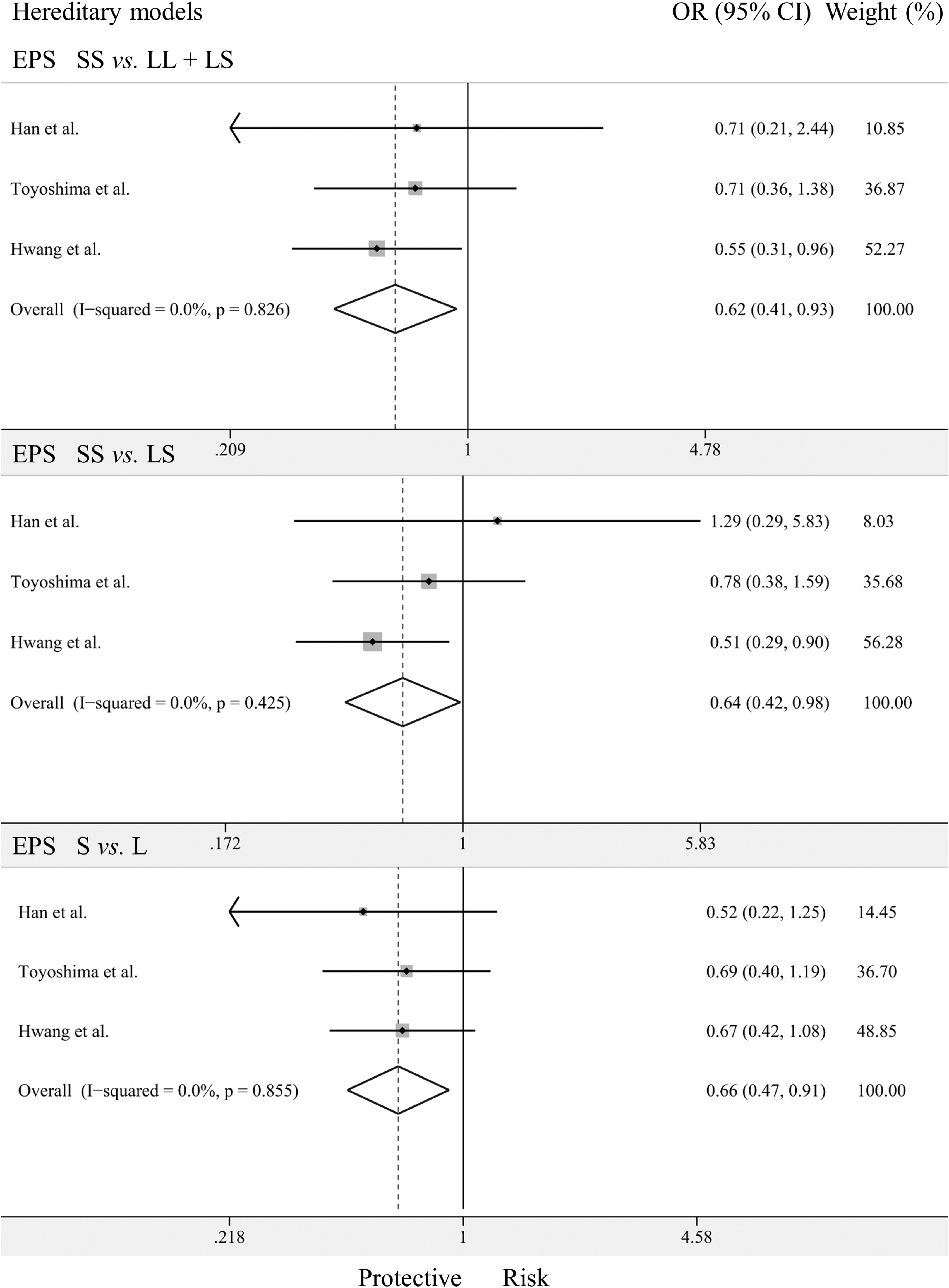
Forest plots of the 5-HTTLPR polymorphism and EPS in SS versus LL+LS, SS versus LS, and S versus L models. 5-HTTLPR, 5-hydroxytryptamine transporter gene-linked polymorphic region; CI, confidence interval; EPS, epigastric pain syndrome; OR, odds ratio.
Publication bias
The Begg's funnel plot was symmetric in the overall FD analysis (Fig. 3), the Egger's publication bias plot (Supplementary Fig. S1 in Supplementary Materials) and Egger's test revealed no publication bias (p > 0.05; Table 2).
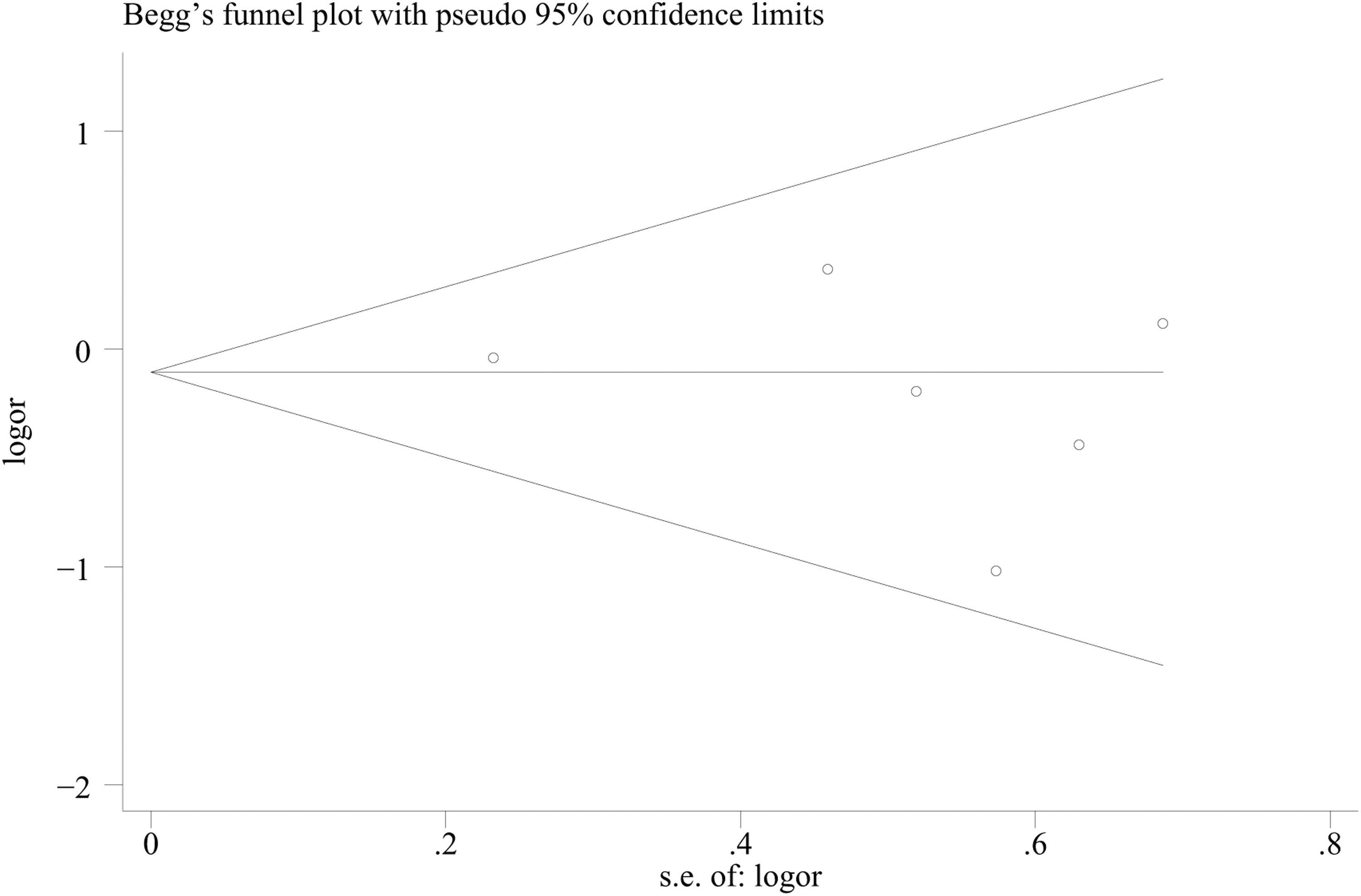
Begg's Funnel plot of publication bias of the included studies.
Discussion
Susceptibility to FD is determined by environmental, psychosocial, and genetic factors. In the past several years, increasing interest in genetic susceptibility to FD has driven studies on gene polymorphisms. Attention has been paid to the deletion/insertion 5-HTTLPR polymorphism of SLC6A4. The mutation results in an S and L allele and affects 5-HT transport efficiency. Many studies have analyzed the association between 5-HTTLPR gene polymorphisms and the risk of FD, but the results are inconsistent. While some studies identified no relationship between the 5-HTTLPR polymorphism and FD (Camilleri et al, 2006; van Lelyveld et al, 2008), others reported evidence of such a relationship (Hwang et al, 2014).
Several factors could cause discrepancies among the results of these studies, such as different allelic frequencies across Caucasian and Asian populations or a limited number of cases. To improve statistical power and provide more comprehensive and reliable conclusions, we conducted the present meta-analysis, with conclusions derived from 6 studies with 488 patients and 1513 healthy controls of 5-HTTLPR polymorphisms and FD risk, combining metadata from multiple studies has the advantage of reducing random errors. A previous meta-analysis found no association between the 5-HTTLPR polymorphism and FD, but did not analyze FD subtypes (Liu et al, 2018). To our knowledge, this is the most comprehensive meta-analysis on the correlation between 5-HTTLPR polymorphisms and FD to date. Our study provides new perspectives regarding the pathogenesis and treatment of FD with a possible risk predictor or a marker for treatment response.
Overall analysis of the pooled results indicated that the 5-HTTLPR polymorphism was not significantly associated with FD. However, when we conducted a subgroup analysis of the 5-HTTLPR polymorphism and FD subtypes, we found that the S allele and SS genotype may be protective factors against EPS in the Asian population. Our results are consistent with those of a previous study (Hwang et al, 2014) showing that patients with EPS had a significantly lower S genotype frequency than control individuals. In addition, genotype S and EPS subtypes were negatively correlated in patients with H. pylori infection.
While few studies are available on the 5-HTTLPR polymorphism in FD, both FD and irritable bowel syndrome (IBS) are digestive system diseases with overlapping pathogenesis. A meta-analysis found no significant relationship between the 5-HTTLPR polymorphism and IBS incidence but observed that Asian and American subgroups carrying the S allele carried a reduced risk of IBS (Areeshi et al, 2013). However, another meta-analysis indicated that the 5-HTTLPR polymorphism is associated with an increased risk of IBS (especially IBS-C) in the Chinese population (Jia et al, 2019). Moreover, altered plasma 5-HT signaling is associated with the IBS subtype (Atkinson et al, 2006). Approximately, 95% of 5-HT is expressed in the GI tract. Changes in 5-HT levels in the GI tract can affect visceral sensitivity and gut motility (Bertrand and Bertrand, 2010; Keating and Spencer, 2019; Wei et al, 2021).
Uptake of 5-HT by SERT attenuates the neurotransmitter's effects in the GI tract. The L allele increases SERT uptake of 5-HT, decreases synaptic 5-HT, and slows GI motility. In contrast, the S allele of 5-HTTLPR decreases SERT expression and SERT activity, lowering 5-HT reuptake (Lesch et al, 1996; Osher et al, 2000). Increased serum 5-HT levels are observed in patients with EPS (Harasiuk et al, 2007). It is theoretically expected that the S allele leads to increased intestinal motility and pain perception. However, some studies on IBS have found controversial results (Camilleri and Katzka, 2012; Sikander et al, 2009). This implies that GI symptoms cannot be explained simply by 5-HT expression levels. Regarding FD, the present study showed that the SS genotype and S allele were protective factors for EPS.
These data led us to hypothesize that prolonged high 5-HT concentration desensitizes receptors and alleviates symptoms (especially epigastric burning and pain) in patients with FD subtypes. The difference between EPS and PDS is that PDS symptoms of bothersome fullness and early satiation manifest after meal ingestion, while EPS symptoms of epigastric burning and pain are not necessarily associated with eating (Sayuk and Gyawali, 2020). In addition, a study showed that abnormal central visceral pain processing may be one of the main pathogenic mechanisms of EPS (Chen et al, 2018).
Research studies on 5-HT agonists have shown that 5-HT agonists in the neuronal gap downregulate 5-HT receptors, and that internalization of 5-HT3 receptors in enteric neurons was induced by long-term inhibition of 5-HT reuptake transporters (Freeman et al, 2006; Sikander et al, 2009). Chronic changes in mucosal 5-HT may alter GI secretory and motor functions via continuous desensitization of receptors on the neuronal membrane, the subsequent changes are not related to eating but are associated with fixed epigastric pain or burning sensation, which are EPS symptoms. Compared with the L allele and LL genotype carriers, the S allele and SS genotype carriers are more likely to be protected against EPS. The results of our meta-analysis supported this hypothesis.
Our meta-analysis also identified the effects of 5-HTTLPR on EPS in East Asians only. We observed that 5-HT acted as a protective factor for FD subtype EPS in the Asian population, but not in the Caucasian population. We suspect that this outcome may be related to different distributions of S and L alleles between the two populations. The Caucasian population has a higher frequency of the L allele than of the S allele (Saito et al, 2012), whereas the S allele is dominant in the Asian population (Park et al, 2006). Thus, in the Caucasian population, the S allele has little effect on downregulating SERT expression, and its influence on EPS pathogenesis cannot be observed.
In addition, diet and environmental factors are expected to have distinct impacts across different countries, likely altering disease susceptibility regionally. To the best of our knowledge, this is the first meta-analysis to assess specific associations between the 5-HTTLPR polymorphism and FD subtypes.
The significant association between 5-HTTLPR polymorphisms and EPS may provide guidance for drug use with FD patients. Pharmacogenetic studies suggest that these genetic variants may predict antidepressant response to tricyclic antidepressants (TCAs) and selective serotonin reuptake inhibitors (SSRIs; Porcelli et al, 2012). 5-HTTLPR is an excellent candidate for genetic investigation, since SERT is the primary target for SSRIs and one of the main targets for antidepressant drugs. Moreover, a study has shown that the 5-HTTLPR L/L genotype may predict a better response to alosetron (a 5-HT3 receptor antagonist) with lower colonic transit times, which may be because the long polymorphism leads to a lower synaptic concentration of 5-HT (Camilleri et al, 2002).
5-HTTLPR polymorphism studies may benefit patients with disorders of gut-brain interaction (DGBI). FD, a brain-gut axis-related disease, has a close relationship with the central nervous system. Psychological comorbidity plays an important role in the development of FD, particularly owing to the close gut and brain bidirectional communication between the central and the enteric nervous system (Enck et al, 2017; Ford et al, 2020). Treatment options for FD include acid-suppressing drugs, central neuromodulators, including TCAs, SSRIs, serotonin norepinephrine reuptake inhibitors, antipsychotics, or prokinetics. The latter include drugs acting on dopamine receptors, acetylcholinesterase inhibitors, or 5-HT receptor agonists, such as buspirone (Ford et al, 2021). Central neuromodulators also have peripheral effects on GI motility that stem from their agonism or antagonism of receptors with an affinity for various neurotransmitters, including 5-HT, dopamine D2, histamine, and acetylcholine receptors, which is the rationale for their use in DGBI.
This study has several limitations. First, selection bias may exist. The analysis only involved articles published in English and Chinese. Hence, we may have missed relevant articles published in other languages and indexed in other databases. Second, we have not adjusted for potential confounding factors such as age and sex because such data were limited in the original publications. To exclude these biases, prospective randomized controlled studies should be performed. Third, FD pathogenesis is multifactorial, and a single genetic variant is probably insufficient to predict risk. Therefore, further research studies on different environmental backgrounds are required to validate the association observed in our study.
Nevertheless, our results will benefit future investigations on potential gene-gene and gene-environment interactions between 5-HTTLPR polymorphisms and FD susceptibility. Fourth, the statistical methods which are used to assess publication bias have inherent limitations (Egger et al, 1997). Fifth, as the included studies were cohort and case-control studies, recall bias and loss-to-follow-up bias may have occurred. Furthermore, multiple testing may affect the results. Therefore, we cannot exclude an effect of type I error.
Conclusions
In conclusion, our meta-analysis suggests that the 5-HTTLPR polymorphism is not associated with FD overall, however, it is associated with the EPS subtype, with SS genotype and S alleles acting as protective factors against EPS development. The genetic polymorphism of SLC6A4 5-HTTLPR could be a pathophysiological factor of the FD subtype. To identify the genetic factors that influence susceptibility to FD, future large-scale studies and different polymorphisms are needed for the precise elucidation of the pathophysiology of FD.
Footnotes
Acknowledgments
The authors thank all the participants whose data were included in this study.
Authors' Contributions
Z.W. conceived of and designed the experiments. L.W. contributed to the analysis tools, methodology, funding acquisition, and supervision. P.D., Q.W., and X.S. performed experiments. L.L., Y.G., Y.S., and T.S. interpreted the findings and provided critical revisions of the article. Z.W. analyzed the data and wrote the article. All authors have read and approved the final version of the article.
Ethical Standards
None of the authors performed any experiments with human participants or animals for this study. All cited articles reported compliance with the relevant ethical standards. No ethical approval was needed.
Author Disclosure Statement
No competing financial interests exist.
Funding Information
This study was supported by grants from the National Natural Science Foundation of China (81700467), the Foundation of Science and Technology Department of Sichuan Province (2022YFS0340), and the Chengdu Science and Technology Bureau (2021-YF05-00585-SN).

References
Supplementary Material
Please find the following supplemental material available below.
For Open Access articles published under a Creative Commons License, all supplemental material carries the same license as the article it is associated with.
For non-Open Access articles published, all supplemental material carries a non-exclusive license, and permission requests for re-use of supplemental material or any part of supplemental material shall be sent directly to the copyright owner as specified in the copyright notice associated with the article.
