




Abstract
Aim:
The matrix metalloproteinases (MMPs) inhibit tissue inhibitors of metalloproteinases (TIMPs), playing a notable role in various biological processes, and mutations in TIMP2 genes impact a variety of urinary cancers. In this study, we analyze and evaluate the potential involvement of the TIMP2 418 G/C and MMP gene polymorphism in the etiology of urinary cancer.
Methodology:
For suitable case-control studies, a literature search was undertaken from various database sources such as PubMed, EMBASE, and Google Scholar. Incorporated into the analysis were case-control or cohort studies that documented the correlation between TIMP2 418 G/C and urological cancers. MetaGenyo served as the tool for conducting the meta-analysis, employing a fixed-effects model. The collective odds ratios, along with their corresponding 95% confidence intervals, were calculated and presented to assess the robustness of the observed associations.
Results:
A total of seven studies involving controls and cases out of recorded 1265 controls and 1154 cases were analyzed to ascertain the significant association of the TIMP2 gene with urologic cancer. No statistically significant correlation was observed between allelic, recessive, dominant, and overdominant models for the genetic variant under investigation. A 95% confidence interval (CI) and odds ratio (OR) were computed for each model, considering p-values <0.05. The OR and 95% CI for the allelic model were 0.99 and 0.77-1.27, respectively, whereas the respective values were 1.00 and 0.76-1.32 for the recessive model. In the dominant contrast model, OR and 95% CI were 1.09 and 0.62-1.90, while the same were 0.93 and 0.77-1.12 for the overdominant model. A funnel plot was used to reanalyze and detect the results as statically satisfactory.
Conclusions:
As a result of the data obtained, the TIMP2 gene polymorphism does not correlate statistically with cancer risk. The significance of this finding can only be confirmed using a large population, extensive epidemiological research, a comprehensive survey, and a better understanding of the molecular pathways associated.
Introduction
Cancer remains a pivotal and pervasive global issue that causes major mortality. The uncontrollable growth of diseased cells proliferates and multiplies to form tumors, which might occur in every part of the body (Hassanpour and Dehghani, 2017). The International Agency for Research on Cancer (IARC) has a division called the Cancer Surveillance Unit, and one of its primary roles is to provide and update the latest estimates of the worldwide cancer burden regularly. According to the cancer statistics 2023, the anticipated landscape of 2023 trends the diagnosis of ∼1,958,310 novel cancer cases worldwide (Siegel et al., 2023). To reflect the scientific knowledge GLOBOCON 2020, there were ∼19.3 million instances of newly diagnosed cancer cases, with an estimated demise of 10.0 million attributed to cancer, revising the cancer cases and mortality rates that were previously reported (Sung et al., 2021; Veerabathiran et al., 2023; Yasam et al., 2023).
Worldwide, breast cancer (47.8%) has suppressed prostate cancer (30.7%), followed by colorectal cancer (19.5%), cervical cancer (13.3%), urinary bladder cancer (5.6%), and renal cancer (4.6%). As far as mortality related, lung cancer (18%) remains top, followed by breast cancer (13.6%) and colorectal cancer (9%). This trio encompasses renal cell carcinoma, bladder cancer, and prostate cancer, which has a major trend in prevailing urinary malignancies. In aggregate, the 10 most prevalent types of cancer constitute in excess of 60% of cancer diagnoses and 70% of cancer-related fatalities (Deo et al., 2022; Siegel et al., 2023; Singh et al., 2023) (Fig. 1).

Incidence and mortality rates of various types of cancer.
The incidence rate of prostate cancer is intricately intertwined with multifarious variables such as demographic transitions and ethnically divergent cohorts; in 2023, around 288,300 new cases are estimated. Bladder cancer, holding the 8th position in terms of prevalence, contributes to the 13th rank in the spectrum of mortality indices (Ferlay et al., 2015). Significantly, 50% of instances characterized by non-muscle invasive bladder cancer are poised for recurrence within a 5-year postoperative window, thereby substantially impinging on the quality of life and imposing formidable financial exigencies. In the realm of renal cell carcinoma, constituting 2-3% of adult cases, the incidence assumes a gender dimorphism, wherein males exhibit an incidence rate 1.5-2.0 times higher relative to their female counterparts (Bhatt and Finelli, 2014).
First, as before, individual nations served as the foundation for these estimates, which were calculated using age, sex, and types of cancers. The tumor cells undergo many changes in their chromosomes, such as deletion and duplication of chromosomes. Cancer is associated with changes in tumor suppressor, DNA repair, and proto-oncogenes. These DNA repair genes are involved in developing the additional mutations and lead to changes in the chromosomal periphery, such as deletion and mutations in the chromosomes, leading to the cause of cancer (Lahtz and Pfeifer, 2011). Therefore, it is expected that identifying the host-specific candidate genes for cancer susceptibility will significantly aid to understand the new strategies for controlling and treating these deadly diseases.
Matrix metalloproteinases (MMPs) belong to a family of endopeptidases that require zinc for their catalytic activity. They play a key role in coordinated proteolytic breakdown and remodeling of molecules that comprise the extracellular matrix and basement membrane. Tissue inhibitor of matrix metalloproteinase (TIMP) is present on the long arm of chromosome 17 at 25.3 position (17q25.3) (Wu et al., 2021). TIMPs are highly specific endogenous inhibitors of metalloproteinase that play a vibrant role in controlling the activity of MMPs. These are not only necessary for a variety of physiological activities but also for tumor penetration and progression. The members of the TIMP family were divided into four subgroups: TIMP1, TIMP2, TIMP3, and TIMP4, which have considerable homology and structural identity in common with one another.
TIMPs and MMPs have a key role in healthy tissues by balancing extracellular matrix homeostasis through inhibitory function, and the physiological equilibrium between TIMPs and MMPs plays a major role in regular cell functioning (Chowdhury et al., 2017). For instance, TIMP2 can specifically connect with membrane type 1 MMP (MT1), which helps activate the cellular surface, which in turn makes it easier for pro-MMP2 (Stetler-Stevenson, 1999).
In addition to this, it has been discovered that TIMP2 stimulates cell proliferation, while preventing polyamine from stimulating angiogenesis at the same time (Gao et al., 2019; Hayakawa et al., 1994). Due to the complexity of TIMP2's actions, there is a possibility that it plays several roles in the development, proliferation, and penetration of cancer (Chernov et al., 2009). In general, TIMP2 protein activity occurs in nucleotides with position number 418, representing a G and C transition site noted as 418 G/C (rs8179090) (Srivastava et al., 2013).
Previously, many epidemiological and molecular studies were carried out to explore the possible link between urinary cancer and TIMP2 418G/C gene polymorphisms, which were closely linked with a variety of tumors (Zhang et al., 2015). Although the results were contradictory, it is still necessary to summarize the results by incorporating all eligible studies. This investigation is designed to assess the correlation between the TIMP2 418 G/C gene polymorphism and urinary cancer risk. To achieve this objective, a meta-analysis was performed to identify relevant associations reported in recent studies.
Methodology
Literature search
We performed database searches in various public and scientific domains: Google Scholar, PubMed, EMBASE, and Science Direct, using the following keywords: Gene polymorphism, TIMP, inhibitor of metalloproteinase, urinary cancer, prostate cancer, renal cancer, cervical cancer, TIMP2, TIMP-2, carcinoma, and cancer, to identify all the articles that surveyed interrelation among the TIMP2 418G/C gene (polymorphism OR mutation) AND increased risk of cancer development. All the eligible articles were examined and evaluated by studying titles and abstracts. In addition to this, the references of articles that were obtained were also examined.
Selection criteria
Selection of articles was made by following criteria, to be considered for inclusion in the meta-analysis used: (1) Evaluation by considering intercorrelation of TIMP2 G/C and associated cancer risk; (2) control-case studies; (3) having eligible genotypic and phenotypic details of the control-case study; (4) article published in the English language; and (5) both cases and controls with the same ethnicity. Rejection criteria were as follows: (1) Only case studies lacking control information; (2) overlapping data in the studies; and (3) studies on animals. The inclusion and exclusion of studies were appended in the form of a flow chart, as Figure 2 (PRISMA).
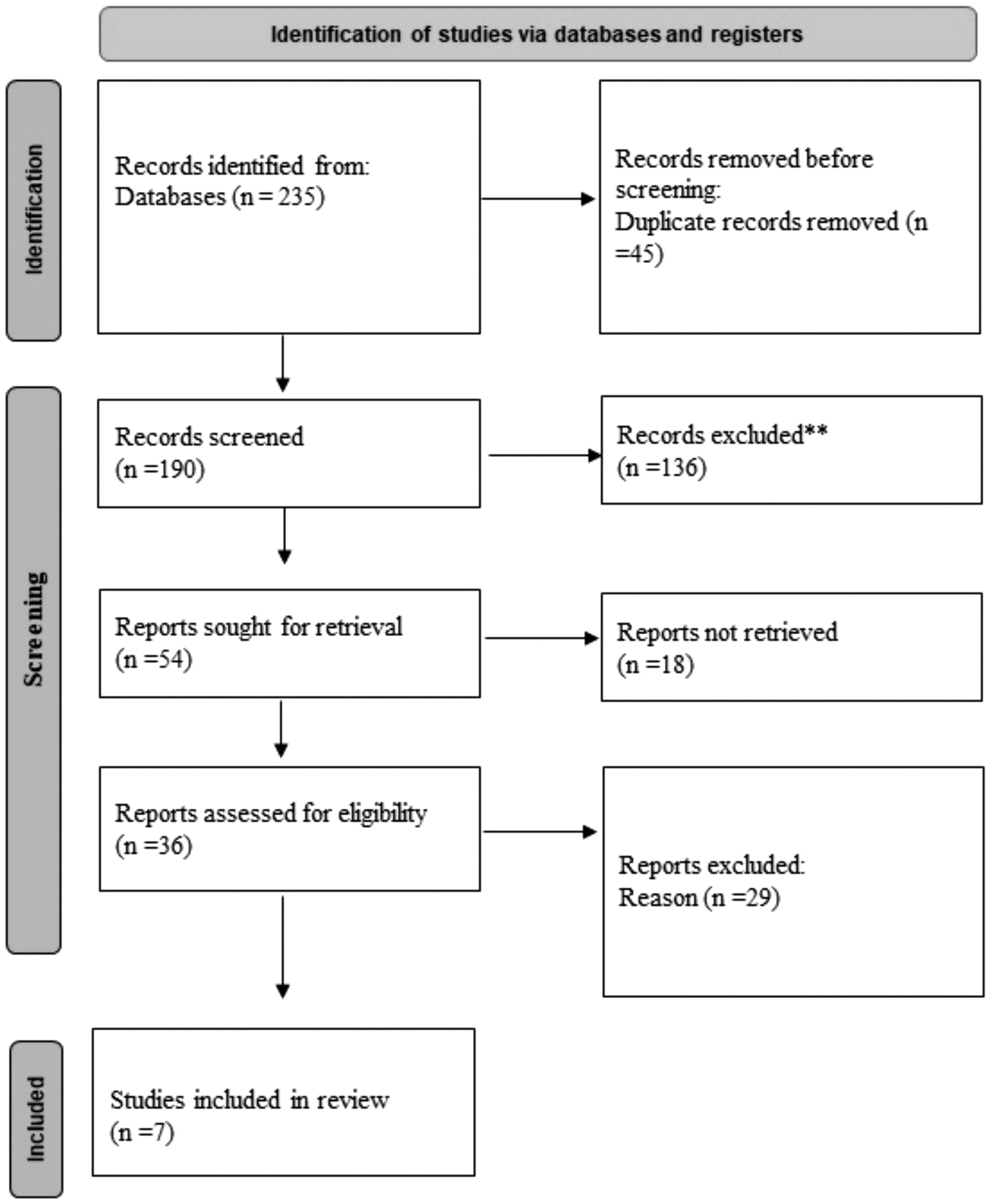
Flow chart representing the study selection procedure.
Data extraction
Data analysis and extraction were conducted from the retrieved publication extracted by the authors. This investigation incorporates a comprehensive analysis of various studies, each of which provides the following data: The primary author, year of publication, geographical origin, number of control and case studies recorded, ethnicity, cancer type, and the genotyping approach employed. The conflict and disagreement from the selected articles were excluded from the study.
Statistical analysis
MetaGenyo combines the effect sizes from the included studies, assigning weights based on the amount of information found in each study. Association values are determined by employing two distinct statistical models, namely the Fixed-Effects Model (FEM) and the Random-Effects Model (REM). In the FEM, the analysis assumes that all studies share a common true effect size and that any observed difference is due to random error. On the other hand, the REM considers the presence of variability among true effect sizes, acknowledging that the true effects may differ across studies due to both systematic and random factors.
The choice between these models depends on the level of heterogeneity detected in the data, which is assessed using indicators such as the I2 test. The FEM is typically favored when heterogeneity is low, while the REM is employed in the presence of substantial heterogeneity. By appropriately accounting the inherent variability among included studies, this methodological approach enhances the precision and reliability of the meta-analysis.
We determined a statistically significant value of p, which is less than 0.05, to determine whether the study was significant by employing the following genetic variations: Overdominant, recessive, dominant regression, and allele comparisons. As a result, the consistency of findings across all trials was evaluated using a metric called the inconsistency index (I2), which may range from zero to a hundred. The I2 values of studies play a major role in indicating the homogeneity (0% significance), and heterogeneity indicates that it is responsible for most of their variation. By using the Q statistical analysis, the Chi-Square test was performed to understand the degree of heterogeneity present among the selected studies. By using Z test analysis, the ORs considered from the shared results of the studies were significant at p < 0.05 (Thakkinstian et al., 2005).
We conducted a sensitivity analysis to find the studies that likely contributed to the bias by first deleting the studies that were likely responsible for introducing it into the total estimations. This was done consecutively. To decide the estimation of the publication bias and funnel plots, the Egger linear regression test (type of linear regression) was done (Murugesan et al., 2020). For example, we compared each study's ORs to their respective standard error of log (SE) plots. A t-test can be used to identify publication bias if the plot is not symmetrical. The heterogenicity assumption was compared between the eligible studies done using the Egger test, Q-test, and inconsistency index statistics, and the obtained studies were considered significant when p < 0.05.
Results
By following exclusion and inclusion criteria, the total number of studies finalized and included was 7, of which 4 were performed on Asians (Park et al., 2011; Srivastava et al., 2013; Srivastava et al., 2012; Yi et al., 2009), whereas three studies were performed on Caucasians (Akad Dincer et al., 2023; Çaykara et al., 2020; Pençe et al., 2017). The incidence and mortality rates of selected studies were mentioned (Table 1). To provide statistical evidence for the funnel plot, two commonly used methods were employed: Egger's test and Begg's funnel plot. In this study, an analysis was conducted on selected publications to observe the heterogeneity present in genetic models. The allelic (G vs. C), recessive (GG vs. GC), dominant (GG+GC vs. CC), and overdominant (GC vs. GG+CC) models were all examined.
Incidence and Mortality of Selected Cancer Studies
Quantitative data analysis
In this analysis, a total of 7 studies were scrutinized to find out the interrelation between the associated risk of urinary cancer in the TIMP2 418 G/C gene polymorphism and its association. We pooled all data together with 1154 cases, with 1265 controls recorded. The study results indicate that the genetic variant under investigation has not shown any statistical significance when associated with the dominant, recessive, overdominant, and allelic models.
The study computed the odds ratio (OR), and associated 95% confidence intervals (CI) were premeditated for every single model, and the p-values were found to be less than 0.05. Specifically, the OR and 95% CI for the allelic model were 0.99 and 0.77-1.27, respectively. For the recessive model, the OR and 95% CI were 1.00 and 0.76-1.32, respectively. The OR and 95% CI for the dominant contrast model were 1.09 and 0.62-1.90, respectively. Finally, the OR and 95% CI for the overdominant model were 0.93 and 0.77-1.12, respectively. Based on the obtained results, the TIMP2 gene shows no association in all contrast models (p < 0.05) (Figs. 3-6).
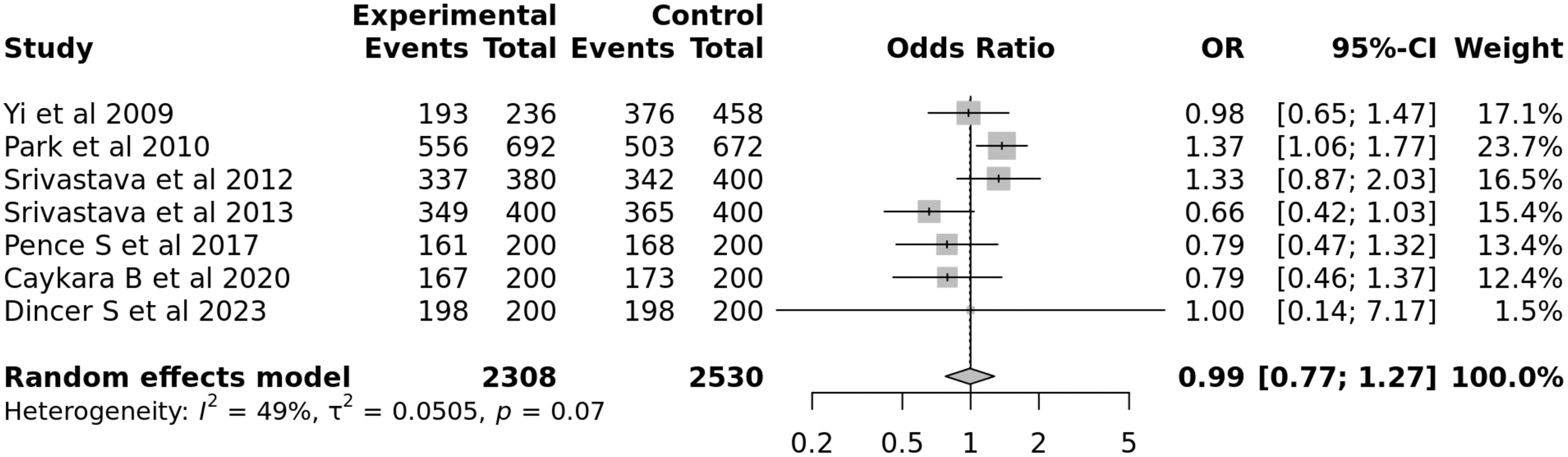
Forest plot representation of allelic model of TIMP2 gene polymorphism with urinary cancer. TIMP, tissue inhibitors of metalloproteinase.
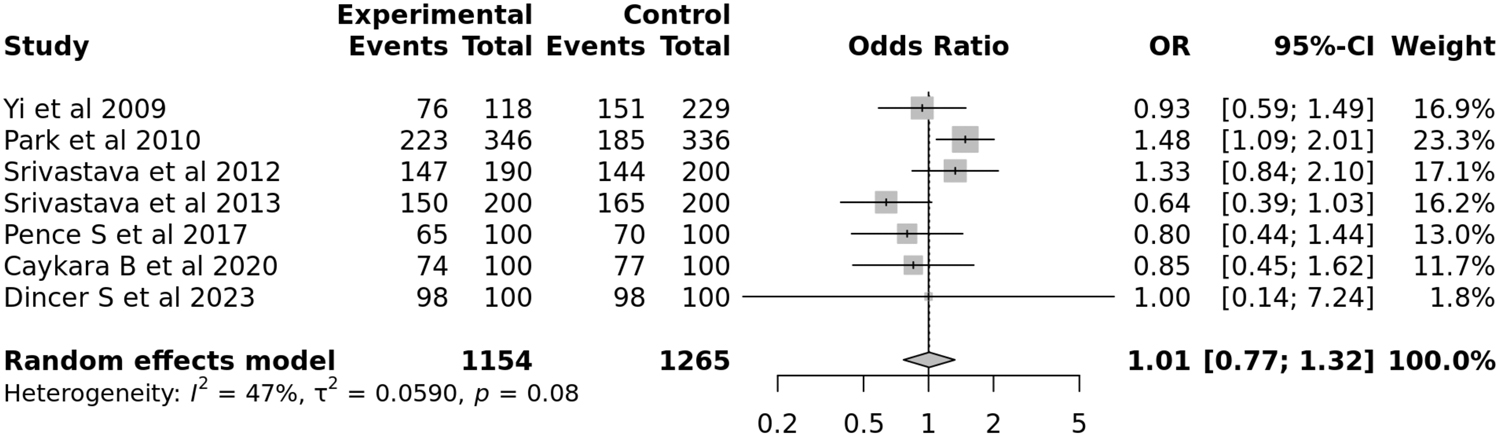
Forest plot representation of recessive model of TIMP2 gene polymorphism with urinary cancer.

Forest plot representation of dominant mode of TIMP2 gene polymorphism with urinary cancer.
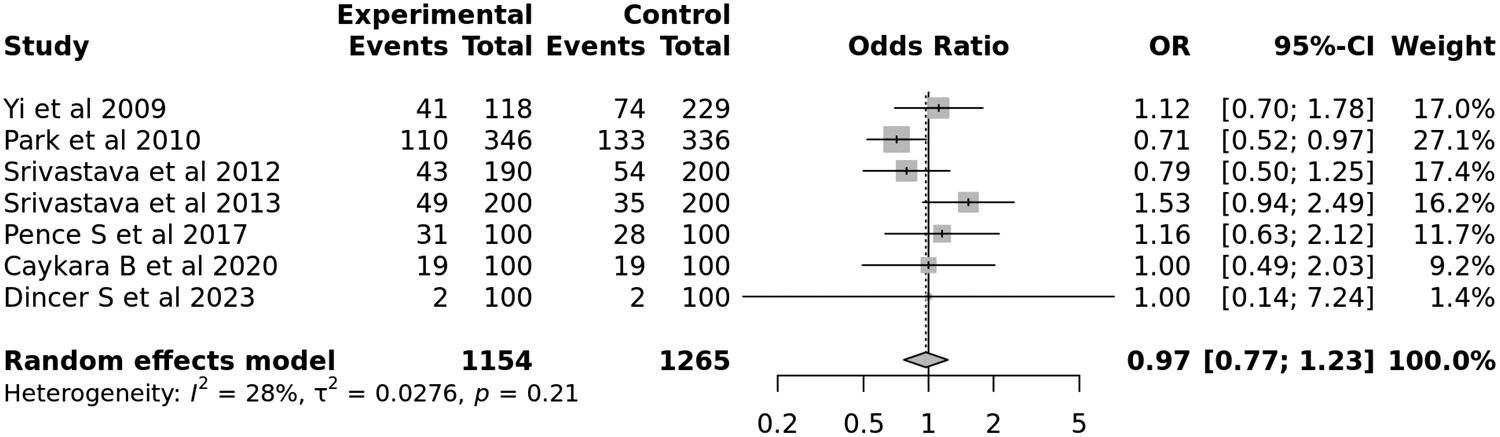
Forest plot representation of overdominant model of TIMP2 gene polymorphism with urinary cancer.
Based on the ethnicity subgroup results, Caucasians and Asians are at low-risk association of cancer in allelic, recessive, and dominant and overdominant states. Extensive findings are available for both random and fixed models from subgroup analyses (Table 2), and HWE (Table 3) are presented herewith. Striking heterogeneity was observed due to the few types of research that do not conform to HWE. As a result, an analysis of the inclusion criteria of the study was carried out to ascertain any potential influence on the outcomes, and a sensitivity analysis was performed. Taking this into consideration, none of the studies had a significant impact on the overall outcome of the study (Fig. 7). All the obtained data were assessed using publication bias and funnel plots, Eggers tests were performed on the data, and statically stable and credible results were obtained from this meta-analysis (Fig. 8).

Sensitivity analyses the representation of TIMP2 gene polymorphism with urinary cancer.
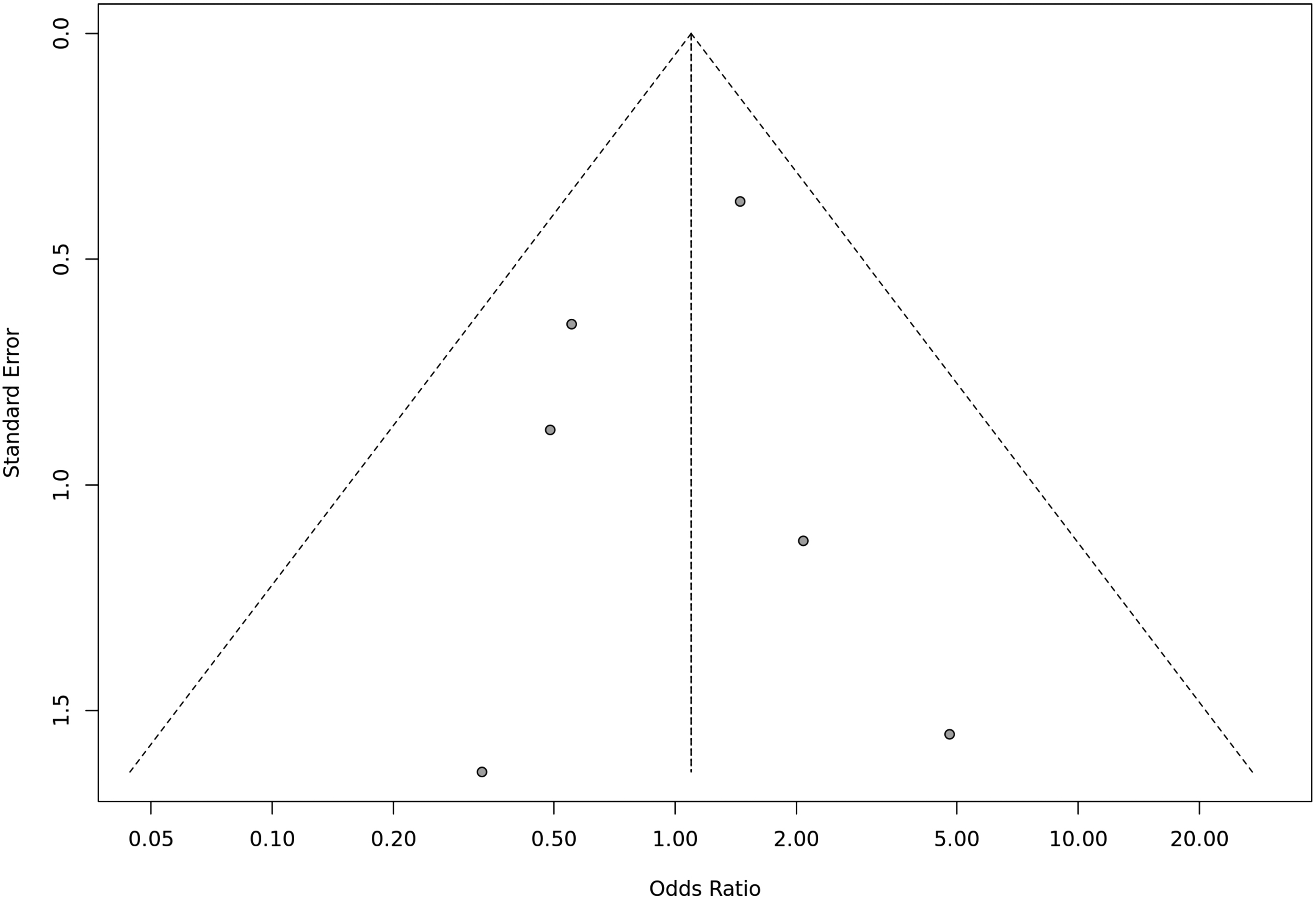
Publication bias representation of dominant model of TIMP2 gene polymorphism with urinary cancer.
Summary Estimates for Odds Ratios and 95% Confidence Interval in Different Ethnicity
The Distribution of the Tissue Inhibitors of Metalloproteinase Allele and Genotype Among Cancer Cases and Controls HWE Score
Discussion
A major obstacle to cancer treatment and assessment is the fact that cancer recurs even after surgery and chemotherapy and does not reduce the probability of a cancer diagnosis. The etiology and progression of cancer are significantly influenced by genetic factors, including several low-penetration genes. Thus, genetic marker-based risk assessment is likely to be useful for predicting cancer risk and detecting cancer in its early stages.
MMPs are a family of zinc-dependent proteolytic endopeptidases that possess 23 members, which downregulate the proteins depending on the calcium present in the extracellular matrix (Cabral-Pacheco et al., 2020; Kapoor et al., 2016). TIMPs, a protein made up of 184-194 amino acids that have no identical protease inhibitory profile, have a vital role in influencing the extracellular matrix in various factors such as cell adhesion, cytokines, chemokines, growth factors, and cell phenotype (Arpino et al., 2015; Murphy, 2011).
Several studies reported the association of TIMP2 and its associated role with MMPs in inhibiting the growth of factor-mediated endothelial cell proliferation (Li et al., 2021; Peeney et al., 2022). Apoptosis and angiogenesis are suppressed by TIMP2, indicating that it is a cancer-related protein. Several investigations have been carried out in recent years regarding the etiology of TIMP2 gene variants, yet the findings remain inconsistent. As a small sample study was taken, statistical power may not be sufficient to find a marginal significant risk factor in the study. To enhance comprehension of the association between the TIMP2 418G/C gene polymorphism and urinary cancer risk association, more precise investigation, we conducted this meta-analysis.
To the best of our knowledge, this study investigated the potential correlation between the TIMP2 418G/C gene polymorphism and its susceptibility to urinary cancer. A meta-analysis was performed to evaluate the correlation between allelic, overdominant, dominant, and recessive models. The genetic variations in this TIMP2 gene cause breast cancer or gallbladder cancer and are also responsible for many other cancers. The TIMP2 plays a vital role in the growth of BeWo choriocarcinoma cells and has a major role in the plasma of metabolic syndrome patients (Ji et al., 2013). It is significant to emphasize that genetic mutations are distinct from simple monogenic diseases. Moreover, the etiology of cancer and other lethal diseases possesses complex phenotypes, and this kind of lethal disease cannot be predicted by genetic variations alone. The interpretation of meta-analysis outcomes necessitates a careful evaluation of heterogeneity. By using a random-effects model, it is possible to minimize heterogeneity.
The inherited factors may account for observed inconsistencies in the HWER law of molecular observational studies, resulting in inaccurate conclusions. Thus, meta-analysis relies on HWE test results. The findings of this investigation of TIMP2 418G/C gene polymorphism were consistent with HWE. Omitting individual studies was used to check the sensitivity assay, which exposed the heterogeneity of studies. The findings demonstrated that no single study significantly impacted the overall conclusion. A few advantages can be found in our current meta-analysis. Qualitative and quantitative analyses such as funnel plots and Egger linear regression did not demonstrate clear evidence of publication bias. We can, therefore, conclude that our findings are supported statistically. Second, a strict data extraction and analysis procedure was performed to draw satisfactory and reliable conclusions from the study.
Conclusions
These meta-analyses were conducted with the aim of identifying the connection between the TIMP2 gene polymorphism and urinary cancer risk and its correlation with cancer susceptibility by valuable statistical data from significant and nonsignificant studies. The overall meta-analysis results confirm that the TIMP2 418 G/C gene morphotype was not linked with the risk of urinary cancer. The possible association should also be further investigated with ingenious research on a massive scale that reflects both gene and environmental interactions into consideration to confirm these findings.
Footnotes
Acknowledgment
Authors acknowledge CARE for infrastructural and financial support.
Ethical Approvals
This study does not involve experiments on animals or human subjects.
Authors' Contribution
Data curation, formal analysis, and the original draft were prepared by P.G. and K.G. A.T., K.H., and P.P. were involved in additional data collection, data validation, and software administration. A.G. was involved in conceptualization, project administration, supervision, and final draft preparation. All the listed authors verified the final version of the article.
Author Disclosure Statement
No competing financial interests exist.
Funding Information
No funding was received for this article.