




Abstract
Abstract
Introduction
C
Numerous techniques have been reported for the creation of a neovagina. Among the invasive methods, the most common operation for creating a new vagina follows the basic principle of creation of space between the bladder and the rectum. In the management of vaginal aplasia, creation of a new vagina with aesthetic shape, acceptable size, with physiologically functioning epithelium, and low morbidity associated with the procedure is the ideal target for all reconstructive surgeons. 2 Abbe-Wharton-McIndoe operation is a commonly performed vaginoplasty procedure with various modifications. A simple modification was advised by Wharton to place a condom to cover the mold in the neovagina to allow the vaginal granulation tissues to epithelize quickly. 3 However, this method fell out of favor because of the complaints of prolonged bloody vaginal discharge from the granulation tissues.
After Wharton's modification, various materials/tissues have been used for neovagina lining with variable success. Interceed (oxidized regenerated cellulose, absorbable adhesion barrier; Ethicon, Inc., Somerville, NJ) has also been used for creation of neovagina with good success.4–6 Herein, we report successful creation of a neovagina in six patients with vaginal aplasia (MRKH syndrome) using a modified McIndoe's procedure with oxidized regenerated cellulose placed on mold made of disposable syringe to solve the shortcomings associated with the original procedure.
Case
Patients with the age range 23–26 were evaluated for primary amenorrhea. All patients were planned for marriage within 6–9 months. All patients underwent comprehensive clinical procedure involving physical examination, ultrasound of the pelvis, hormonal profile, intravenous pyelography, magnetic resonance imaging, and chromosomal analysis. The patients had normal female karyotype and normal secondary sexual characteristics with normal bilateral ovaries, absent uterus, and an absence of vagina. The patients had normal ovarian function evaluated by hormone levels and secondary sexual characteristics. After evaluation, patients were planned for vaginal reconstruction. We prefer to operate for neovagina reconstruction 6–9 months before marriage. After obtaining the consent regarding the surgical approach and complications associated with the procedures, it was decided to carry out the modified McIndoe's method using a mold made of disposable syringe and oxidized regenerated cellulose (Interceed) for vaginal reconstruction.
Operative technique
The patient was placed in the dorsal lithotomy position after giving her general anesthesia. An incision was made in the vestibular part of the vagina. The space between the rectum and the urethra and bladder was created up to reaching the Douglas pouch with blunt dissection with fingers. The mold was constructed using a 20-cc disposable plastic syringe (Fig. 1). The mold was wrapped with the Interceed and was inserted into the newly created vaginal space (Fig. 2). The labia minora was sutured together over the mold. Patients were put on antibiotics and analgesics for 5 days. A Foley catheter was maintained for 1 week to avoid postoperative urine retention and contamination of the external genitalia by urine.

Mold made with disposable plastic 20-cc syringe.
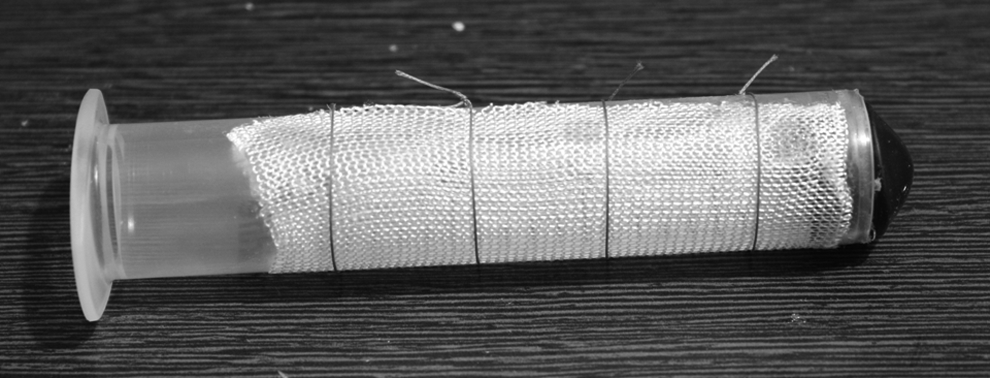
Mold with Interceed.
The external genitalia with mold in situ was irrigated daily with sterile saline solution. The intravaginal mold was removed after 7 days of surgery under anesthesia. During the initial week, Interceed acted as graft, which was subsequently absorbed by the body and later on was replaced by squamous epithelium. Squamous epithelization of the neovagina was confirmed by Schiller's test without performing traumatic punch biopsy at the time of mold change (i.e., seventh postoperative day) (Fig. 3).

Early epithelization on seventh postoperative day.
Freshly made mold (without Interceed) was secured in the neovagina and a tight undergarment was given to the patient. Subsequently, patients were taught how to use the mold. Patients were encouraged to practice the daily removal and insertion of the mold. Since our syringe mold was made of plastic, it was very light and easy for patients to process according to the size of neovagina. Patients were discharged after they started using the mold by themselves. Patients were advised to use the mold regularly. Patients were advised to keep the mold in the neovagina at all times, except while passing urine and defecation. Patients were also advised to maintain postures (e.g., cycling), in which pressure is maintained on the mold for at least 6 hours a day. Metronidazole cream was applied to the mold before insertion.
Follow-up examinations were performed monthly for 6 months and once in 2 months for 1 year consecutively. On each visit, patients were asked to demonstrate the use of mold. The extent of the mold insertion was checked by visualizing the markings on the mold. In cases where the patient was not able to keep the mold completely in the neovagina (as obvious by the visible marking on the mold), the patient was instructed to keep pressure, maintain postures on mold for longer duration, and the patient was followed more frequently. On the first visit (after 1 month of surgery), tissue biopsy was taken to confirm squamous epithelization. At each visit, the vaginal depth and the degree of epithelization were observed to assess the functional length of the neovagina. When the patients had regular sexual intercourse (6–9 months) after surgery, the mold was removed; otherwise, the mold was advised to be kept in the neovagina. The mean length of the neovagina 1 week after surgery was 8 cm (range 7–9) with two fingers in width in all patients. Within 2–3 months after surgery, the neovagina was noted to be completely epithelialized in all patients when assessed by Schiller's test only (tissue biopsy not taken) (Figs. 4 and 5).
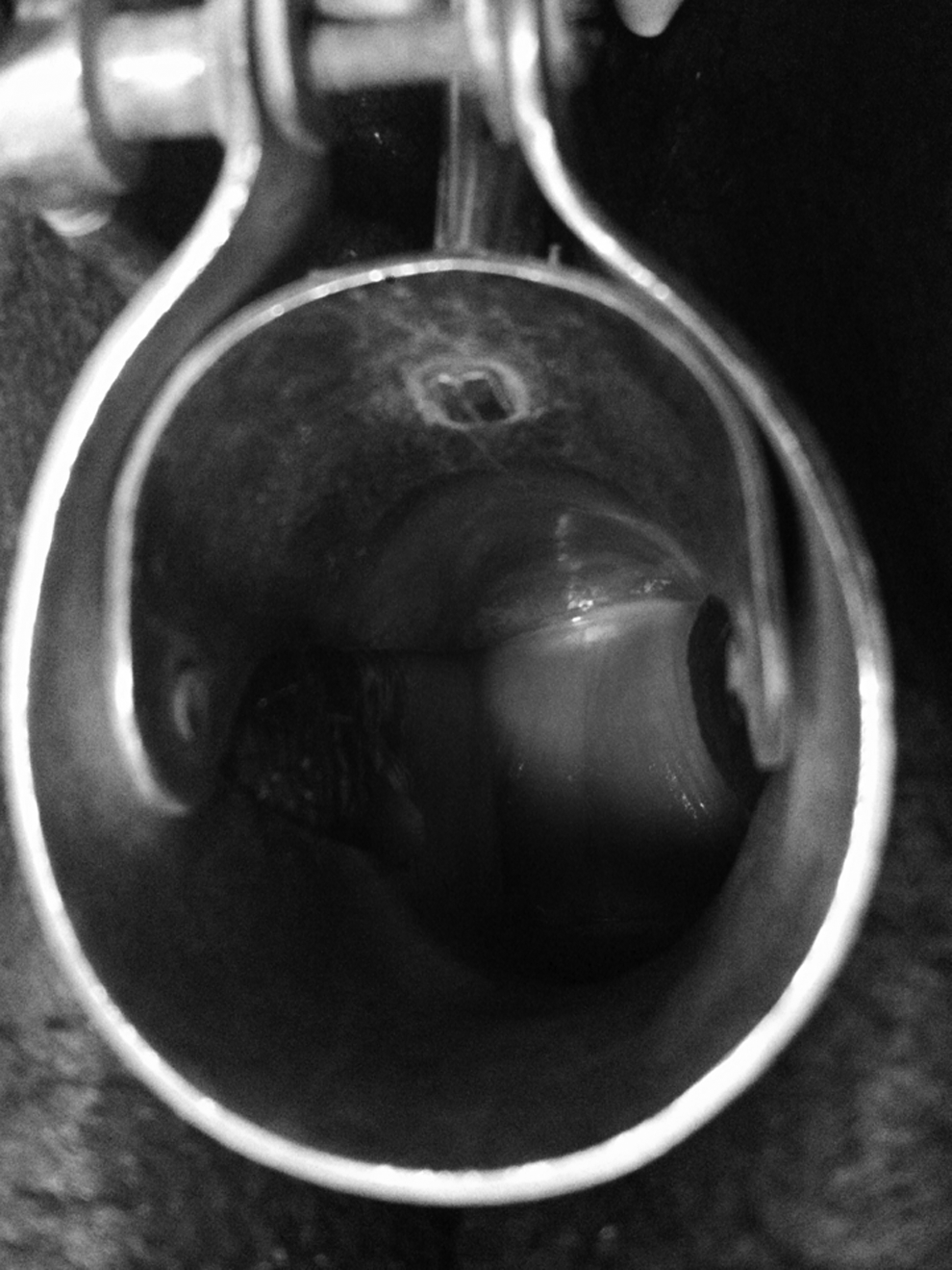
Epithelization after 3 months of reconstruction (vault).
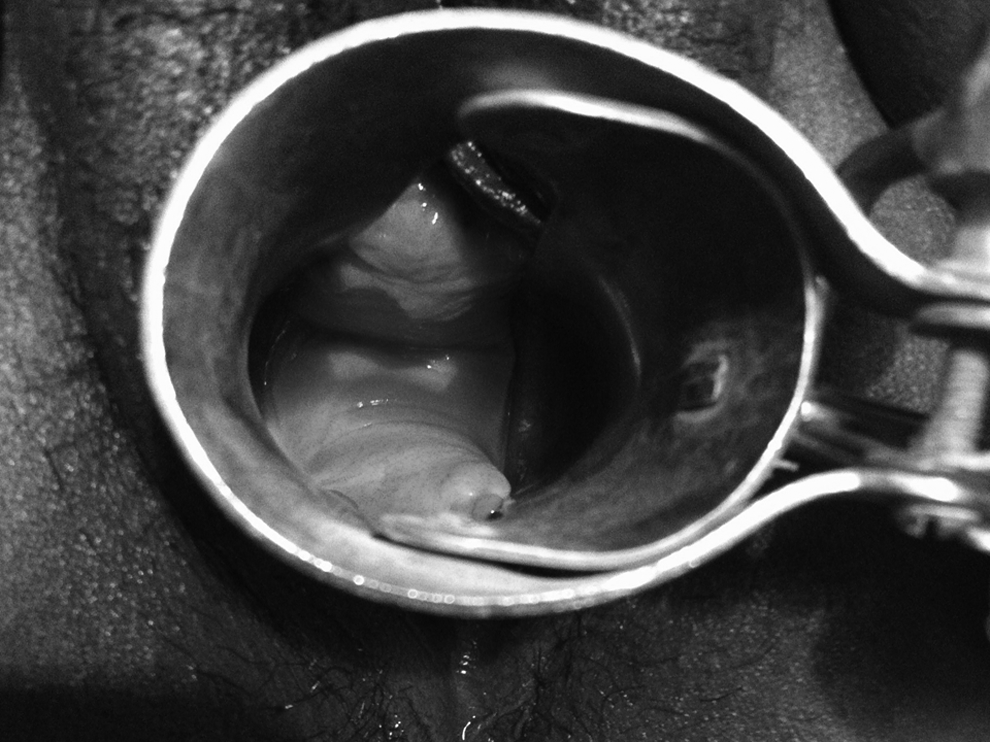
Epithelization after 3 months of reconstruction (anterior and posterior wall).
All patients successfully engaged in sexual intercourse after surgery with no feelings of discomfort or any use of lubricant. There were no problems reported about the compliance in the use of syringe mold. All patients maintained same dimensions of well-formed neovagina (8 cm in average length and two fingers in width) at 6 months and 2 years of follow-up after surgery.
Discussion
Till date, there is no universally agreed ideal approach to vaginoplasty for vaginal aplasia. A lot of the published work on vaginoplasty demonstrates the feasibility of a particular procedure, highlights its possible advantages, and expresses the skills of the surgeons. The question now is not whether the procedure is feasible, but whether the approach is superior and beneficial to a particular patient, cost-effective for the community at large and, more importantly, easily performed by the general gynecologist without sophisticated instrumentation.
For creation of neovagina, various nonsurgical techniques and surgical techniques have been described. Surgical procedures, such as Vecchietti's procedure, McIndoe's procedure, William's procedure, Laparoscopic procedures, and their modifications have been described.7–11 Different techniques of vaginoplasty have various advantages and disadvantages. Intestinal vaginoplasty entails laparotomy and intestinal resection.12–17 This procedure poses a considerable risk to the patients with a frequent incidence of foul-smelling vaginal discharge. Vecchietti's laparoscopic procedure is complicated, associated with discomfort, and requires a specially designed traction device. 18 Some procedures require harvesting flaps with technical difficulties and lengthy operations.19–22
Till date, the most common surgical approach for vaginoplasty is the McIndoe's procedure and its modifications. The basic operative approach involves creation of a plane of dissection between the urinary tract and rectum. 9 With traditional description of the procedure, a harvested split-thickness skin graft is placed around a mold (made from various materials) and then inserted into the created retrovesical space. The mold is left in situ for 7–10 days initially, after which regular dilation or sexual intercourse is required to maintain vaginal patency. Proponents of this approach cite the advantages of no abdominal incision and least morbidity. 23
A major disadvantage of the McIndoe technique is the formation of visible scars at the origin of the skin graft site, which is usually unacceptable to young women. Vaginal dryness is a common problem. In addition, failure to comply with the follow-up dilator treatment can result in vaginal stenosis, which is the most devastating consequence. It has been emphasized that the material of mold, tissue used for lining of neovagina, and timing of vaginoplasty affect the successful outcome of McIndoe vaginoplasty. From the time of invention of McIndoe vaginoplasty, appropriateness of vaginal mold has been emphasized for achieving successful results. 24
Various materials such as a solid plastic mold, a perforated pyrex glass mold, hollow vulcanite wood, a detachable porous plastic tube, a condom packed with iodoform gauze, a silicon-coated acrylic vaginal stent, inflatable vaginal stents, Surgi-Stuf (Ethox, Buffalo, NY), and Orfit “S” material (Wijnegem, Belgium) have been used as vaginal molds. 25 Rigid or semirigid molds are associated with complications, such as graft loss, pressure-related bladder or rectum perforations, fibrosis, contracture formation, and most importantly, patient discomfort. 26 Soft molds have less association with the complications associated with rigid molds. Soft molds also have shortcomings such as instability, complexity of assembly, and lack of commercial availability. We propound the use of plastic syringe mold because of few inherent advantages.
• This mold can be easily made at any hospital/clinic due to common availability of plastic syringes with rubber piston.
• This mold is cheaper than the commercially available molds.
• Marking on the mold gives a subjective assessment of adequate placement of mold in the neovagina. Subjectively, with the help of markings, it is easy to make out the length of mold that stays out of the neovagina, which indirectly indicates the possibility of improper usage of mold or earliest development of stenosis.
• In addition, we hypothesized that this mold retains compression at the proximal end due to the open end of the mold, which is shallow. Compressibility of the mold gives comfort to the patient because it does not give a pressure effect on the urethra or rectum. Stenosis in the neovagina mainly starts at the distal end. The main reason for stenosis in this part is collapsing walls of neovagina which, in turn, results from inability to maintain dilatation of this segment due to reluctance of the patient to keep the full length of mold inside the vagina.
A variety of tissues have been used to create a functional vaginal substitute, including split-thickness skin grafts, myocutaneous flaps, buccal mucosa grafts, full-thickness skin grafts, peritoneum, atelocollagen, silicon gel sheet, amnion, and autologous in vitro cultured vaginal tissue.25,27–30 Vaginoplasty using amnion grafts, skin, or mucosal tissues is reported to have a relatively poor sexual function. 31 Oxidized regenerated cellulose (Interceed, absorbable adhesion barrier; Ethicon, Inc.) is an absorbable adhesion barrier, which is frequently being used for prevention of adhesions after abdominal or laparoscopic surgeries. Interceed has also been used as the material to line the neovagina after vaginoplasty.
In 1996, Jackson and Rosenblatt 4 used Interceed for vaginoplasty in four patients. All patients in this series were satisfied with the results of the surgery, and epithelization of the neovagina was completed by 3–6 months. Subsequently, Motoyama et al. 5 (10 cases) and Inagaki et al. 6 (2 cases) reported the use of Interceed absorbable adhesion barrier for vaginoplasty. This method was easy and less invasive, compared with the McIndoe's method. This series also showed good results after the procedure and satisfactory epithelization after 1–4 months. The neovagina created with use of Interceed was the same with the normal adult vagina, histologically and physiologically.
We also experienced the same duration of epithelization in our patients. All the patients were satisfied with the results in our series. In our experiences, the neovagina was found to be covered by an epithelium-like layer with neovascularization 7 days after surgery. Within 2–3 months after surgery, the epithelization of the neovagina became complete in almost all patients.
We follow the policy of operative intervention when the patient is physically and psychologically mature enough to wear the vaginal mold for at least 6 months and when she is going to get married (engage in regular sexual intercourse). This approach is influenced by locoregional, cultural, and sexual practices. This adopted policy is governed by the following observations:
• Availing treatment for the genital tract diseases and abnormalities and handling genital area are considered taboo subjects in the community, which is one of the reasons for poor compliance for follow-up visits. • During adolescent age, girls do not understand the importance of keeping the vaginal mold in place, even if it is inconvenient or uncomfortable. • The likelihood of stenosis is increased if the mold is removed prematurely or regular sexual activity does not occur.
32
Conclusively, it is suggested from the observation that the timing of the operative intervention should be decided on attainment of physical and psychological maturity, so that on further follow-up, the exercise of mold use can be conducted in a serious manner to prevent chances of stenosis and reoperation.
We were following amnion graft methodology for such patients and we found 25% chances of stenosis and requiring second surgery. This appears to be the first report to demonstrate the creation of a neovagina that uses oxidized regenerated cellulose (Interceed) and disposable syringe mold. In our cases, the operating time ranged from 20 to 40 minutes and intraoperative hemorrhage volume did from 10 to 30 mL. However, the length of hospitalization for our patients remained 10–15 days because our procedure required close physical and mental care in the practice of the removal and insertion of our hand-made mold by patients.
In the treatment of vaginal defect, a multidisciplinary team comprising well-experienced gynecologists, nurses, and psychological counselors is required to be responsible to manage the patients. The best therapeutic procedure and good postoperative management would bring them long-term satisfaction.
The current technique was simple; there were no major complications encountered during this operation and follow-up period. All married patients reported satisfactory sexual relationship after the operation. The syringe mold used in the present study was easy to prepare to the required size, cheap, light in weight, and spongy enough to prevent extreme pressure on the surrounding viscera.
Conclusion
An easily available disposable 20-cc plastic syringe can be converted to a plastic mold in an ordinary setting in the hospital or clinic. This plastic mold can be used comfortably as a vaginal stent for neovagina creation due to its lightweight and pliable properties. Interceed covers benefits in terms of good epithelization of neovagina and no risk of stenosis, compared to other covering materials. Hence, this combination, disposable plastic syringe mold covered with Interceed, can be used for neovagina creation with good efficacy.
Footnotes
Acknowledgments
The authors would like to thank all the patients who participated in the trial, the midwives in the clinic and the operation theatre, and the nurses in the postoperative care unit, whose involvement made this study possible. This study did not receive any funding from any source.
Disclosure Statement
The authors have no conflicts of interest to declare. This study was approved by the departmental screening committee. Patients gave informed consent for participating in the study. The patients were assured that anonymity will be preserved. This study report does not violate the policies and/or procedures established by the journal.