




Abstract
Objective:
To evaluate 2-year outcome of subjects who underwent the single incision midurethral sling procedure by the Dynamic Intraoperative Standing Sling Technique (DISST).
Design:
A chart review was conducted on subjects who underwent the DISST from August 2013 through November 2016 and were considered intraoperative success.
Materials and Methods:
Subjects were contacted postoperatively to complete the medical, epidemiological, and social aspects of aging (MESA) questionnaire and satisfaction questions per routine follow-up. Primary outcome of cure was subjective success based on question, “From the point of view of stress urinary incontinence, that is leaking if you cough, sneeze, laugh, or do other strenuous activities, are you satisfied with the outcome of surgery?” answered affirmatively. Changes from baseline in MESA scores were determined. Complications were also recorded.
Results:
A total of 139 subjects underwent successful DISST and were at least 24 months postsurgery. The MiniArc (AMS, Minnetonka, MN) sling was used in 122 (87.8%) subjects whereas the Solyx (Boston Scientific, Marlborough, MA) sling was used in 17 subjects (12.2%). A total of 110 (79%) subjects were reached at 24 months. Success of the procedure was 94% with 6% failures and 1.4% retreatment. De novo urgency was noted in 5.5% subjects with none receiving retreatment. In total 47.5% of subjects noticed improvement in preoperative urgency. Voiding dysfunction necessitating sling release was noted in 1.4% subjects, and 88.5% of those with intrinsic sphincter deficiency were cured.
Conclusion:
Subjective outcomes after successful intraoperative DISST are excellent even after 2 years, and success is similar to our 1-year study.
Objective
Stress urinary incontinence (SUI), or the involuntary leakage of urine with exertion, affects 37.5% of women between 30 and 50 years of age 1 and has a deleterious effect on a woman's sense of well-being. 2 Tension-free vaginal tape (TVT) and transobturator sling procedures, collectively called standard midurethral slings (SMUSs), have stood the test of time, 3 and studies have shown them to be effective. 4 The complications of the SMUSs prompted the innovation of the single incision midurethral sling (SIMUS) with the goal of achieving similar success while mitigating complications. 5
Although some studies show no significant differences in outcomes between SIMUSs and traditional long slings,6,7 an updated systematic review of SIMUS randomized clinical trials demonstrates an insignificant trend toward repeat incontinence surgery with SIMUSs. 8 Also, the complication rate of SIMUS was not better than SMUS. Based on this, the FDA's revised statement of January 2016 states that SIMUSs need further evaluation, and that traditional slings are not under such scrutiny. 9 Several factors have been cited for the poor results of SIMUSs, mainly the anchoring mechanism and the learning curve. 10
The senior author has been performing SIMUS procedures under local anesthesia for many years with excellent outcomes.11–14 With the goal of improving outcomes and reproducibility, he developed the Dynamic Intraoperative Standing Sling Technique (DISST™). Our technique and 1-year prospective analysis of the DISST has been previously published. 13
The aim of this study was to assess the success rate 24 months after the DISST. “DISST success” was defined as a negative intraoperative standing cough test at bladder fullness.
Design
A chart review was conducted on subjects who underwent the DISST 13 from August 2013 through November 2016 and were considered intraoperative success.
Materials and Methods
Cure was defined as a “Yes” response to the question: “From the point of view of stress urinary incontinence, that is leaking if you cough, sneeze, laugh, or do other strenuous activities, are you satisfied with the outcome of surgery?” A “No” response indicated failure. Secondary aims were to assess complications and to review the changes from baseline in the medical, epidemiological, and social aspects of aging (MESA) questionnaire scores.
The DISST was performed entirely under local anesthesia so that the patients were able to stand up on a height-adjustable table supported by a harness bar. The platform allowed the surgeon to see the urethra at eye level without risk of contamination (Fig. 1). Before standing, one sling arm was affixed into the obturator internus muscle, and the opposite arm was also placed, but the inserter was left attached to the self-fixation tip in case further adjustment was required. A cough stress test was performed at bladder fullness (determined by preoperative urodynamic assessment). If the patient leaked in the standing position, sling adjustments were made, and she was once again tested until there was no leakage noted. The inserter was removed under direct observation to ensure the sling did not loosen. The surgeon carefully cradled the inserter while the patient stood up, and there was never a concern about the inserter coming loose or getting displaced. Relative heights of the OR table and the platform were adjusted so that the patient had to merely lean forward and was standing.
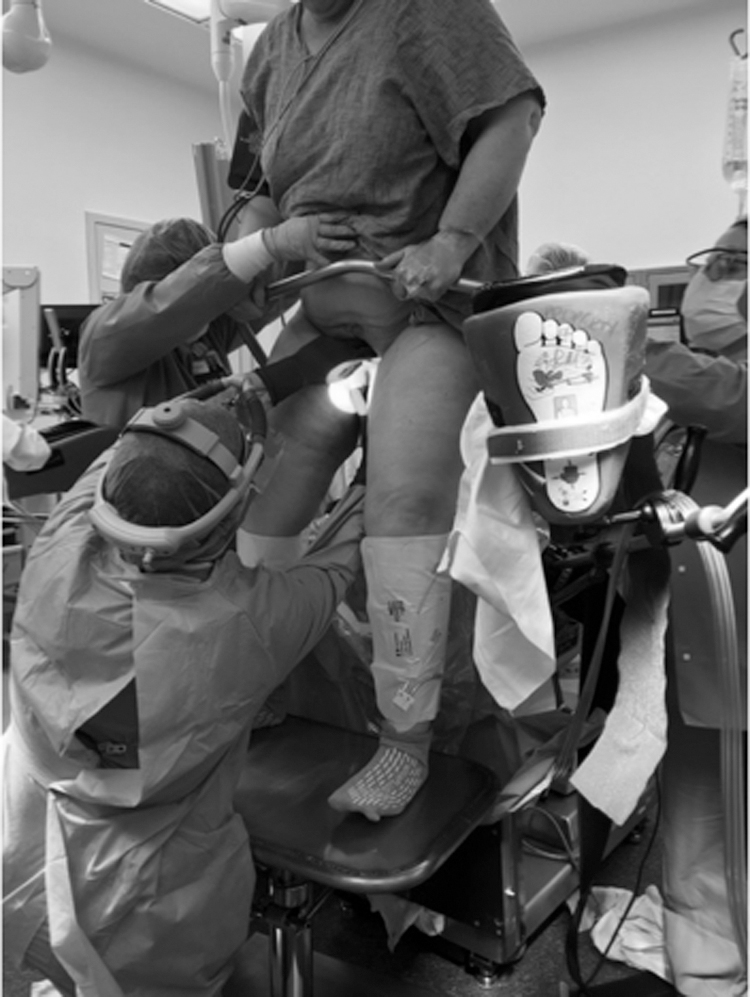
Cough test performed in standing position with special height-adjustable platform and movable harness bar that the patient can hold onto in front of her when standing fully erect. The patient is asked to stand and cough three times to confirm no leakage.
The Beaumont Health Institutional Review Board approved this study. Data retrieved from the medical record included age, body mass index (BMI), menopausal status, obstetric history, prior hysterectomy, urodynamic observations, baseline responses to the MESA questionnaire, months elapsed from surgery, follow-up responses to the MESA questionnaire, and patient satisfaction responses. The MESA is a 15-item validated questionnaire 15 that asks about situations that cause SUI and urge urinary incontinence with a choice of answers: never, rarely, sometimes, or often. The maximum composite score is 45 (a maximum stress subscore being 27 and a maximum urgency subscore being 18). The higher the score, the worse is the urinary incontinence. SUI surgery was offered to subjects with SUI or stress-dominant mixed urinary incontinence on MESA assessment and who failed conservative management.
After the initial visit that was done 1–2 weeks after the procedure, subjects were followed up by a telephone call at 6 months, 12 months, and annually thereafter from their index surgeries. MESA questionnaires were completed along with two satisfaction questions: (1) “From the point of view of stress urinary incontinence, that is leaking if you cough, sneeze, laugh, or do other strenuous activities, are you satisfied with the outcome of surgery?” answered Yes or No, and (2) “On a scale of 0–10, if 0 is really bad and you are leaking like you were before surgery and 10 is no leak at all, how would you rate your urinary symptoms today?” This telephone interview was conducted by an independent assessor trained to ask the MESA questions verbatim, without any interpretation, explanation, or modifications.
Continuous variables are expressed as mean ± standard deviation or median with interquartile range, and categorical variables are expressed as percentages. Changes from baseline and postoperative MESA stress subscore, urge subscore, and total composite scores were compared using a paired t-test. An independent samples t-test was used to compare improvement in SUI symptoms based on preoperative SUI severity and by patient satisfaction. We also calculated Cronbach's α coefficients to provide an assessment of the MESA's internal consistency. A p < 0.05 was considered statistically significant.
Results
From the time period August 2013 and November 2016, 139 subjects underwent a successful DISST and were at least 24 months postsurgery. The MiniArc sling was used in 122 (87.8%) subjects, whereas the Solyx sling was used in 17 (12.2%) subjects. Of these 139 subjects, 110 subjects (79%) were reached for subjective assessments at a median follow-up of 24 months (interquartile range 23–29 months). Regarding demographic characteristics, there were no statistically significant differences between those missing follow-up data and those with follow-up data.
One hundred eight (78%) patients responded to question 1 and 110 (79%) responded to question 2. One hundred one out of 108 (93.5%) subjects indicated “Yes,” that they were cured while 7 (6.5%) answered “No” and were considered failures.
With regard to question 2, the satisfaction score was 8.7 ± 2.0 out of 10, with 10 indicating “no leakage at all.” The satisfaction score of those who answered “Yes” to satisfaction question 1 was 9.0 ± 1.0. The average score for those considered as failures was 3.9 ± 3.6. There were no statistically significant differences in demographic characteristics between those with and without completed questions.
Table 1 gives baseline demographic information. Subjects were on average 51 years of age (30–77 years). In total 48.9% of subjects were premenopausal, and 51.1% were postmenopausal. The average BMI was 30.7 ± 5.8 kg/m2. Based on results of the urodynamic study, 86.3% had SUI and 10.8% had SUI-dominant mixed urinary incontinence. The mean maximum urethral closure pressure (MUCP) was 64.1 ± 19.0 cm of H2O with one subject having an MUCP <20 cm of H2O. Abdominal leak point pressures were determined at 200 mL as the lowest intravesical pressure observed at the time of leakage with gradual increases in abdominal pressure by valsalva maneuver. The mean abdominal leak point pressure was 71.4 ± 21.4 cm of H2O. Thirty-one (22.3%) subjects had abdominal leak point pressures ≤60 cm of H2O, indicative of intrinsic sphincter deficiency (ISD). Of these 31 subjects with ISD, 26 (84%) had complete subjective data. Of the 26 subjects, 23 (88.5%) answered “Yes” to satisfaction question 1 whereas 3 of 26 (11.5%) answered “No.”
Baseline Characteristics of the Study Group (N = 139)
By urodynamic testing.
Unable to complete urodynamic testing (e.g., vagal reaction).
BMI, body mass index; SD, standard deviation; SUI, stress urinary incontinence.
One hundred seven (77%) subjects had complete preoperative and postoperative MESA stress subscores and composite scores for comparative analysis, and 109 (78%) had complete preoperative and postoperative MESA urge subscores. Table 2 summarizes these results. There were statistically significant improvements in MESA stress subscores, urge subscores, and composite scores from baseline to 24 months follow-up. There was an 83.9% improvement in the MESA stress subscore from baseline, and the MESA urge subscore improved by 47.4%, whereas the total MESA score improved by 75.8%. At baseline, Cronbach's α was 0.87, and at 24 months follow-up, the α was 0.91, thus indicating that the MESA questions were trustworthy in our subjects (i.e., a reliable scale).
Preoperative to Postoperative Comparison of Medical, Epidemiological, and Social Aspects of Aging Scores in all Patients
CI, confidence interval; MESA, medical, epidemiological, and social aspects of aging.
Subjects were further analyzed based on their preoperative MESA stress subscore severity (Table 3). Fourteen subjects had preoperative SUI subscores between 1 and 13 (lower baseline SUI severity) whereas 93 subjects had scores between 14 and 27 (higher baseline SUI severity). Those subjects with higher baseline SUI severity had a significantly greater improvement in their SUI symptoms on postoperative assessment.
Improvement in Stress Urinary Incontinence Based on Preoperative Symptom Severity
Mean preoperative MESA SUI subscore minus mean postoperative MESA SUI subscore; p < 0.001.
Regarding patient satisfaction related to changes from pre- to postoperative MESA scores (Table 4), those satisfied with the procedure experienced a greater decrease in postoperative MESA scores. There were no statistically significant differences in preoperative MESA subscores between satisfied and dissatisfied subjects, however, on account of a small sample size of those who were dissatisfied, true differences may not be appreciated in this study.
Preoperative to Postoperative Comparison of Medical, Epidemiological, and Social Aspects of Aging Scores by Satisfaction Outcome (N = 108)
There were no injuries to the bladder or urethra encountered at the time of intraoperative cystoscopy. There were no cases of lateral vaginal wall perforations. All subjects were discharged home on the day of surgery. Only one subject (0.7%) required clean intermittent catheterization upon discharge for immediate postoperative voiding dysfunction, but she was voiding without difficulty by her 1-week follow-up appointment. Although postoperative pain was not specifically assessed in this study, no subject required prescription analgesia upon discharge. The average blood loss during the procedure was 26.7 ± 19.1 mL.
There were two retreatments (1.4%) in this study. One subject was treated with plication of her existing MiniArc SIMUS, whereas the other (who previously received MiniArc) was treated with a Solyx SIMUS by DISST, and both subjects are doing well and are 9 and 8 months from the second intervention, respectively. Two subjects (1.4%) had their slings released due to delayed voiding dysfunction.
De novo urgency was noted in 6 out of 109 subjects (5.5%) at 24-month follow-up. Of these six subjects, three had a postoperative MESA urge subscore of only 1/18, and three had a subscore of only 2/18. None of these six subjects required treatment.
Conclusion
The aim of this study was to assess the outcomes 24 months after a successful DISST. Our subjective cure was 94% with only 1.4% subjects needing retreatment for persistent SUI.
There have been several reasons cited for poor success with the SIMUS compared with SMUS. 16 One of the main concerns is the actual fixation of the sling to the obturator internus muscle. It was demonstrated by Hubka et al. by anatomic studies on cavaders that only 53.6% of cases of TVT-Secur SIMUS were correctly positioned in the obturator internus muscle. 17 This is not a concern with the long slings, as the sling has to pass through the entire obturator complex and the adductor muscles to exit the groin. Proper anchoring of the SIMUS is critical because if the sling is not anchored to the internus and is loose in the paravaginal/paraurethral space, then it is likely to fail. Our technique of placing the index finger in the vagina to guide the sling into the obturator internus muscle at the junction of the body and superior ramus of the pubis is a critical step to ensure that the sling is placed at a correct angle and also that it penetrates the obturator internus muscle. This also helps maneuver the sling away from vascular structures, namely the obturator vessels 18 or the corona mortis. 19
The other factor stated for the poor success is the learning curve. 10 The fact that this procedure does not have the luxury of tensioning from the outside by pulling on the sling arms mandates that it be tensioned appropriately before the release of the trocars from the mesh anchors. Compared with SMUS, the SIMUS should typically be placed more snug against the urethra. If anything, the SIMUS will loosen during the withdrawal of the delivery device (trocar). Moreover, the intrinsic tensioning noted during the removal of the plastic sheaths of the SMUS does not happen with the SIMUS procedure. Therefore, with SIMUS, what you see is what you get. We feel that the DISST helps to correct for any inherent variability in pelvic anatomy, intrinsic tone of the urethra, and BMI, factors that may influence SIMUS success. The DISST removes the tensioning variability out of the equation as this can be immediately assessed at placement by way of the standing cough test at fullness. Persistent leakage in the standing position would allow the sling to be immediately tightened and adjusted appropriately until there is complete continence.
The success noted at 24 months (94%) is similar to what we observed at the 12-month period (97.4%). 13 This indicates that the success is maintained at least up to the 2-year mark. This is similar to the findings of Neuman et al. who noted the cure rate of TVT-Secur at 90.9% for the TVT-Secur group at 3-year follow-up. 20 Lee et al. also noted consistent patient satisfaction of 83.4%, 84.8%, and 83.3% at 1, 2, and 3 years, respectively, after the TVT-Secur SIMUS. 21 Tommaselli et al. at a 5-year follow-up showed subjective outcomes of the TVT-Secur similar to the TVT-Obturator. 22
A patient's subjective outcome and perceived improvement in quality of life are important determinants in treatment outcomes. 23 After our initial study 13 that showed stable examinations up to 12 months postoperatively, we decided that it was unnecessary to bring patients in for a follow-up examination unless the patient (or her partner) had symptoms or concerns noted at the telephone interviews.
The DISST may be applied to any SIMUS as we found similar positive results for MiniArc and Solyx slings.
In this study, there were 31 (22%) subjects who had ISD based on abdominal leak point pressures ≤60 cm of H2O. Paick et al. 24 compared the cure rate in patients with low Valsalva leak point pressure (VLPP) (<60 cm H2O) and higher VLPP (≥60 cm H2O) after the TVT procedure. They found that the overall cure rate was significantly lower in patients with low VLPP (32%) versus 93% in patients with higher VLPP. 25 However, in our study, 88.5% of subjects with ISD answered satisfaction question 1 as “Yes” with a mean satisfaction score of 9.0 ± 2.4 out of 10. The mean percentage improvement in MESA stress subscore was 81% for the ISD group compared with 83% for the entire study population. These findings are similar to those of Abdelwahab et al. 26 who found that the SIMUS TVT-Secur had no failures in patients with low VLPP (<60 cm of H2O). This indicates that the SIMUS DISST could effectively be performed in patients with urethral hypermobility with ISD, and the midurethral placement is not a risk factor. In this study, one subject who had an MUCP of <20 cm of H2O also was subjectively cured with a satisfaction score of 8 out of 10.
Certain other factors that predict patient satisfaction after a urinary incontinence procedure include pain, voiding function, and de novo urgency.27,28 No subjects required or were given prescription analgesics in the immediate or delayed postoperative periods. This is consistent with multiple reports of patients having less postoperative pain with SIMUS compared with first- and second-generation slings especially in the immediate postoperative period.8,16 In our study, only 2 (1.4%) subjects had voiding dysfunction in the postoperative period necessitating sling release. This is similar to the meta-analysis by Schimpf et al. 29 wherein the long-term urinary retention rate necessitating release of the SIMUS sling was 1.9% (1.2%–2.9%). De novo urgency was noted in 5.5% subjects in this study with no subjects requiring any treatment. In eight trials on the mini-sling, the incidence of de novo urgency incontinence was noted to be 10%. This was worse than the TVT procedure but similar to the TVT-O procedures. 16
Also, in our study, the MESA urge subscore improved by 47.4%. This is similar to the study by Levi et al. who noticed that 40% of the 93 subjects who underwent MiniArc SIMUS procedure had complete resolution of the urgency. 30 Han et al. in their study also noted a 68.8% cure rate for urgency and a 64.5% cure rate for urgency incontinence after the TVT-Secur SIMUS procedure. 31 The low incidence of voiding dysfunction and de novo urgency in this study indicate that the sling is not placed under any undue tension to achieve a DISST intraoperative success.
There were no further complications or concerns revealed by the patients at the 24-month telephone interview.
We acknowledge that this study has certain limitations. First, the retrospective design of the study may inherently introduce bias. Second, only 79% of subjects who were 24 months out could be reached, although there were no demographic or surgical differences between those lost to follow-up and those who were contacted. Finally, this was a telephone interview with possible bias even though it was conducted by an independent assessor who was very aware of not “putting words in the patient's mouth” and to ask questions verbatim. Other long-term studies on SIMUS have also used similar methodology.21,22
Our study has several strengths. We used validated questionnaires for this study to help compare pre- and postsurgery data. Our study population was made up of a fairly even distribution of age, menopausal status, and BMIs. The DISST was used with MiniArc and Solyx SIMUS with satisfactory outcomes at 2 years.
The DISST can be safely and effectively applied to any SIMUS provided the surgeon masters the technique of performing the procedure under local anesthesia and is able to make the patient stand up during the procedure. The DISST provides an immediate intraoperative feedback of continence at the time of surgery. Our 2-year short-term subjective outcome is promising with success rates maintained from the 1-year period. We look forward to following these patients over the midterm and long term.
Footnotes
Acknowledgments
The authors thank Dr. Ke Song and Dr. Robert Podolsky for their statistical assistance and Mrs. Rachel Ritter and Ms. Hannah Wright who helped with the database.
Author Disclosure Statement
S.K. is a consultant for Boston Scientific, Coloplast, and Medtronic. S.K. is also an expert witness for Johnson & Johnson in the multidistrict litigation. J.P.C. has no conflicts of interest. The authors have no financial conflicts of interest pertaining to this study.
Funding Information
No funding was received for this article.