




Abstract
Background:
Opportunistic bilateral salpingectomy is one of the primary strategies available for preventing epithelial ovarian cancer.
Case:
An 81-year-old woman underwent a vaginal pelvic organ prolapse and anti-incontinence procedure. An opportunistic bilateral salpingectomy was performed. Pathology testing revealed an occult fallopian tube adenocarcinoma.
Results:
The patient underwent surgical staging by gynecologic oncology, which revealed no further malignancy.
Conclusions:
In the setting of an occult tubal carcinoma identified at the time of opportunistic salpingectomy, adjuvant treatment with an interval staging procedure or chemotherapy will be needed—regardless of whether or not the ovaries were concurrently removed—and can be associated with an excellent patient outcome when early stage disease is identified. (J GYNECOL SURG 36:158)
Introduction
Ovarian cancer is associated with high mortality rates, primarily because successful early detection and screening techniques have not yet emerged. As such, women diagnosed with ovarian cancer often present at an advanced stage and have poor life expectancy. Opportunistic bilateral salpingectomy (OBS), also known as prophylactic salpingectomy, affords surgeons the opportunity to lower future ovarian cancer rates in average-risk women. While there is a great deal of data on occult tubal carcinomas identified during a risk-reducing salpingectomy for women with histories of hereditary breast and ovarian cancer syndromes, there are few data on occult fallopian-tube carcinoma identified during OBS.
Case
An 81-year-old Caucasian woman presented for pelvic organ prolapse (POP) and stress urinary incontinence (SUI) evaluation at a tertiary-care urogynecology practice. She reported having a symptomatic vaginal bulge and had a pessary that had failed to help. Her medical history was notable for coronary-artery disease that was managed with chronic anticoagulation. She had no history of prior cancer or gynecologic surgery. Her family history was notable for a daughter with ductal carcinoma in situ; however, she denied a history of uterine, ovarian, or colon cancer. On examination, she was found to have stage 3 uterovaginal prolapse (POP quantification points Ba +4, C + 3 and Bp +3). A bimanual examination was notable for a small, mobile uterus and no adnexal tenderness or mass. A urodynamic study revealed SUI and a stable detrusor. She was scheduled for a total vaginal hysterectomy with bilateral salpingectomy, uterosacral ligament colpopexy, anterior and posterior colporrhaphy, a midurethral sling, and cystoscopy. Oophorectomy was planned if any abnormalities were noted on inspection or palpation. Informed consent was obtained.
In the operating room, the planned procedures were performed. After the vaginal hysterectomy, the fallopian tubes and ovaries were visually and digitally inspected, and found to be grossly unremarkable. A vaginal salpingectomy was performed using the current authors' standard technique of clamping across and transecting the mesosalpinx sharply, and ligating the pedicle with an 0-polyglactin suture. As agreed with the patient, both ovaries were left in situ, as they were grossly normal in appearance and on palpation. The native tissue prolapse repair and anti-incontinence procedures were performed without complications.
Results
Surgical pathology revealed an 3 × 2mm invasive adenocarcinoma involving the fimbriated end of the fallopian tube. The histopathologic features were those of an endometrioid adenocarcinoma of tubal origin, providing that secondary involvement from an ovarian primary source was excluded (Fig 1). Immunohistochemical stains for PAX-8, p16, and ER were positive, supporting a diagnosis of an endometrioid carcinoma. Stains for PG3 (wild type) and GATA 3 were negative, and did not support a diagnosis of a serous or mesonephric carcinoma. The patient was notified and referred to gynecologic oncology.
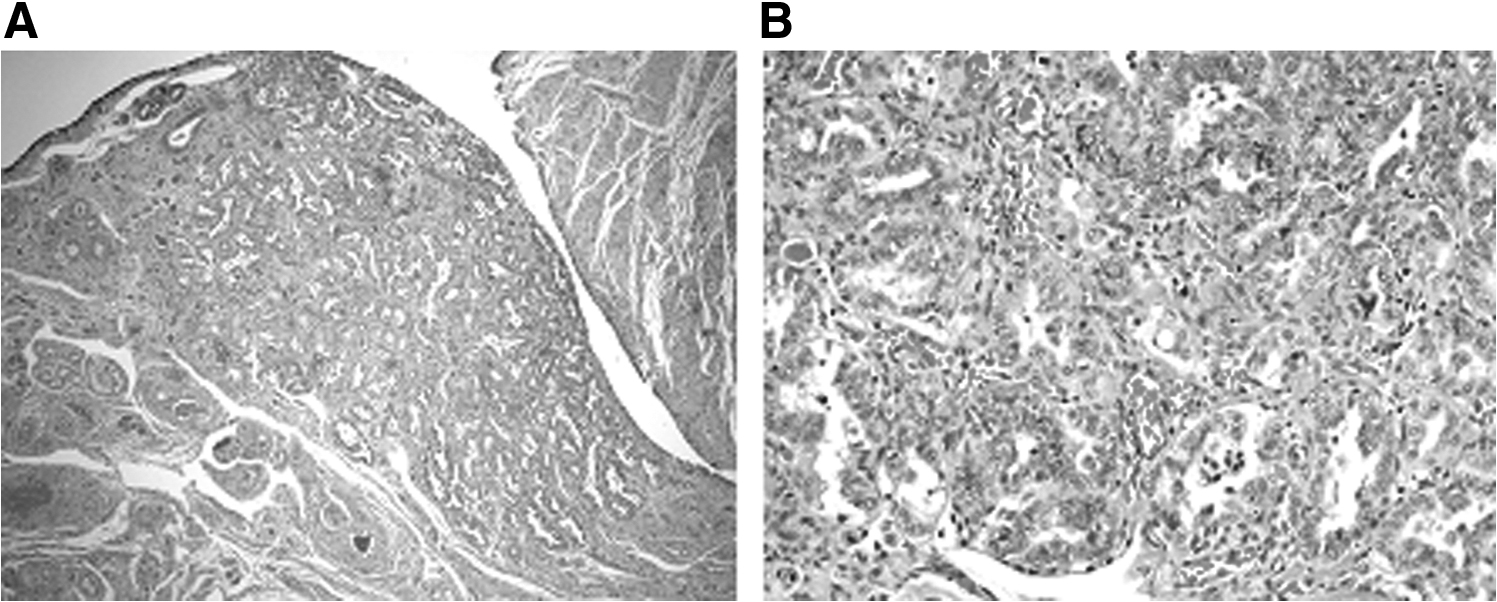
Hematoxylin and eosin stain.
During her gynecologic oncology consultation, she was offered surgical staging versus chemotherapy only. This patient chose surgical staging; a diagnostic laparoscopy, bilateral oophorectomy, bilateral pelvic and para-aortic lymphadenectomy, and omental biopsy were scheduled. Her cancer antigen–125 level was 14, and computed tomography scans of her chest, abdomen, and pelvis were negative for metastatic disease.
She underwent surgery 7 weeks after her initial surgery and, again, the ovaries were without gross disease. No peritoneal studding or other malignant features were noted. The final pathology revealed benign bilateral ovaries with suture granulomas. Omental biopsy, 5 pelvic lymph nodes, and 5 para-aortic lymph nodes were negative for malignancy.
Discussion
Over the past 10 years, there has been growing interest in OBS at the time of hysterectomy or sterilization. OBS is widely supported by International Federation of Gynecology and Obstetrics societies, although explicit recommendations are restricted, given the lack of proven disease prevention. The American College of Obstetricians and Gynecologists also recommends that surgeons discuss salpingectomy benefits with average-risk women undergoing hysterectomy for benign indications. These recommendations significantly increased OBS performance at the time of hysterectomy, with rates highest during laparoscopic and lowest during vaginal approaches.
Much OBS interest is because ovarian cancer is the most fatal gynecologic malignancy in the United States. Despite significant efforts, screening and treatment strategies have only led to modest survival improvements. Insights into disease pathogenesis indicate that lesions might first arise from the fallopian tubes in up to 80% of high-grade serous cancer, with these lesions termed serous tubal intraepithelial carcinoma (STIC). 1 In addition, STIC lesions have been found in up to 3% of women with BRCA mutations who were undergoing prophylactic bilateral sapingo-oophorectomy (BSO). 1 With fallopian-tube removal, and thus a STIC lesion site of origin, a patient could theoretically preempt the development of a lethal disease.
In the context of this case, the patient's diagnosis was an endometrioid carcinoma of the fallopian tube. This differs from STIC lesions, which generally might not require further intervention, when diagnosed during an OBS. This also differs from serous carcinomas, which account for the majority of primary fallopian-tube malignancies and are associated with poor prognoses. Endometrioid carcinomas of the fallopian tube are typically low-stage, unilateral, and associated with a more favorable prognosis. 1
Given that the primary fallopian-tube cancer rate is low, accounting for 1%–2% of all gynecologic cancers annually in the United. States, studying disease prevention via OBS is challenging. A Michigan Surgical Quality Collaborative study identified an occult malignancy incidence of 1.08%; however this study grouped ovarian, peritoneal, and fallopian-tube cancers. 2 The National Surgical Quality Improvement Program did not report any occult fallopian-tube malignancies, only citing an occult ovarian malignancy incidence of 0.19%. 3 Determining a causative disease decline from performing OBS will thereby prove difficult, requiring a well-designed randomized controlled trial with a large cohort of average-risk patients with prolonged follow-ups.
Yet, available data support OBS for ovarian-cancer risk-reduction. In 1 population-based study, BSO at the time of hysterectomy essentially eliminated ovarian cancer-development risk. That said, this precludes the protective benefit that live birth and breastfeeding have in lowering ovarian-cancer risk. In a case-controlled study by Chen et al., patients diagnosed with epithelial ovarian cancer or primary peritoneal cancer who had previously undergone benign gynecologic procedures were compared to case-matched controls. 4 The incidence of cancer was significantly decreased in patients who underwent salpingectomy, compared to those whose fallopian tubes remained in situ (p < 0.05) 4
Various studies have demonstrated feasibility, safety, and financial benefit of performing an OBS during a vaginal surgery. In 2 prospective studies of women undergoing vaginal hysterectomy, primarily for POP, a vaginal salpingectomy was performed successfully in 73.9% and 81% of cases, respectively5,6 Risk factors for failure included older age, menopausal status, and elevated body mass index, as well as prior adnexal surgery and uterine fibroids.6,7 Mean operating time was increased by 11
In deciding whether or not to perform a concurrent opportunistic oophorectomy, one must consider an individual's risk for ovarian cancer, and weigh both the potential surgical complications and impact on loss of ovarian function. In a low-risk individual, surgical complications, as well as an increased total mortality related to coronary heart disease, stroke, osteoporosis, and colorectal cancer with BSO may preclude opportunistic oophorectomy as a recommendation. 9 However, the positive impact of ovarian conservation versus opportunistic oophorectomy did not differ statistically after age 64, 9 suggesting that opportunistic BSO, if surgically feasible, should be considered in this age group. 9 As with the current case, for patients diagnosed with occult fallopian-tube cancer and who are surgical candidates, regardless of whether or not concurrent oophorectomy was performed, the next management step would include complete staging, with bilateral pelvic and para-aortic lymph node dissection as well as omental biopsy, per National Comprehensive Cancer Network Guidelines. If concurrent oophorectomy at the time of OBS in postmenopausal women were not or could not be performed vaginally, the need for lymph-node sampling would remain and oophorectomy could then be performed concurrently.
Conclusions
While still being developed, data supporting OBS impact on cancer prevention thus far are promising. Case reports are important, as data on OBS value continue to be collected. This is the first case in the literature reporting an occult fallopian-tube cancer found during OBS at the time of a vaginal hysterectomy for POP. The patient subsequently underwent staging completion without evidence of disease spread. As such, the current authors support performance of OBS at the time of vaginally approached benign gynecologic procedures in patients who have completed childbearing, with concurrent opportunistic BSO consideration, if feasible and desired by the patients, in women 65 years and older. The current case also demonstrated an excellent outcome for a patient after an interval staging procedure for occult tubal carcinoma, which would have been indicated regardless of whether or not the ovaries had been removed concurrently.
Footnotes
Author Disclosure Statement:
No financial conflicts of interest exist.
Funding Information
No funding was received for this article.