




Abstract
Abstract
Milledge, James S. The Silver Hut Expedition, 1960–1961. High Alt. Med. Biol. 11:93–101, 2010.— The 1960–1961 Himalayan Scientific and Mountaineering Expedition, commonly known as the Silver Hut Expedition, was a unique project to study the physiology of acclimatization in human lowlander subjects at extreme altitude over a prolonged period and also to make an attempt on Makalu, an 8470-m peak. The leader was Sir Edmund Hillary, and Dr. Griffith Pugh was the scientific leader. Studies were conducted at a Base Camp in the Everest region of Nepal at 4500 m and at the Silver Hut at 5800 m on the Mingbo Glacier. Simpler physiology was continued on Makalu, in camps at 6300 and 7400 m. The expedition left Kathmandu at the end of the monsoon in 1960 and spent the autumn setting up the Base Camp and the Silver Hut. Some members also spent time making a study of the evidence for the existence of the Yeti. The winter was spent on physiological studies at Base Camp and in the Silver Hut, and the nearby peak of Ama Dablam was climbed. In the spring the expedition moved over to Makalu and made an unsuccessful attempt to climb it without supplementary oxygen. The 9-month expedition ended at the start of the 1961 monsoon. An ambitious program of studies was successfully completed. It was a very happy and, scientifically, a successful expedition. Many of the findings were not repeated for many years, and none has been refuted. On the mountaineering side, we were unsuccessful on Makalu owing to a combination of weather and illness, but the ascent of Ama Dablam was considerable compensation.
Introduction
It is common practice to land parties of scientists on the Antarctic ice one summer, leave them to “winter over,” and pick them up the following summer. A similar sort of timetable was planned for the Himalayas, that is, going out from Kathmandu after the monsoon and returning just before the next monsoon 9 months later. The autumn would be spent setting up a Base Camp and a high altitude station. In the winter, a group of scientists would work at extreme altitude in the station, carrying out a program of physiological research on themselves. In the spring, more members, mainly climbers, would join the scientists and together they would mount a standard 8000-m peak attempt on Mt. Makalu (8470 m), the fifth highest mountain in the world. It had been climbed only once by a French expedition in 1954 using oxygen. Hillary planned to attempt it without oxygen, and Pugh hoped to continue some simpler physiological research at higher altitudes on this mountain. This was the ambitious plan, and over the next 3 years Hillary and Pugh worked to make this dream a reality.
The Expedition
The official title was The 1960–61 Himalayan Scientific and Mountaineering Expedition (Hillary and Doig, 1962); about halfway through the 9 months of the trip the Sherpas began to call it the “Silver Hut Expedition,” and we followed suit. The Silver Hut itself was the high altitude station erected at 5800 m on the upper Mingbo Glacier in the Everest Region of Nepal (Fig. 1). It was specially designed and built for us in the United Kingdom from boxed-up sections of marine plywood containing 8 cm of foam plastic insulation. No section was more than a porter's load. It was 6.7 m long and 3 m wide, painted silver, and cylindrical in shape; it looking a bit like a London underground train carriage. There was a snow porch, triple-glazed plastic windows, and accommodations for sleeping, eating, and laboratory space. The Hut had a specially designed stove for heating and melting snow in a tea urn on its hot plate. It provided us with a very comfortable, warm home for the winter.

Silver Hut (5,800 m) with Ama Dablam in the background. The ascent route is roughly up the left-hand skyline ridge.
The team chosen by Pugh and Hillary consisted of scientists, mostly physiologists, climbers, and various specialists. They came in roughly equal numbers from New Zealand, the United States, and the United Kingdom, plus three from India (see Appendix for list of members). Some members came for just the autumn, some for the autumn and returned for the spring, others came for the winter and spring periods, and some for the whole 9 months.
Hillary was successful in obtaining generous funding from Marshall Field Enterprises of Chicago, who were publishers of World Book Encyclopedia. He suggested that the climbers might spend time in the first phase of the expedition, getting acclimatized, by trying to find evidence for the existence of the Yeti. At this time, opinion was divided as to the truth behind widespread belief in this creature. This enterprise may well have influenced our sponsor to back us.
Autumn
Most of the members flew out to Kathmandu, but I, with my wife and Lila, Barry Bishop's wife, traveled out by ship, taking 45 crates of scientific gear, including the prefabricated Silver Hut. From Bombay we took this baggage to Patna by train. There we met with New Zealand members, who had traveled overland from Calcutta with the food and mountaineering equipment from New Zealand. From Patna, we and the baggage went by air using a chartered Dakota, which shuttled back and forth between Patna and Kathmandu.
In Kathmandu we met many of the other members and, after sorting out the gear, the Yeti hunting party set off on September 13, trekking from the edge of the Kathmandu Valley for their hunting grounds in the Ralwaling Valley. A day later a smaller party, led by Norman Hardie, of which I was a member, set off with the bulk of the supplies (300 porter loads), taking the usual route to the Everest Region. Pugh traveled out later followed by Mike Ward and John West in December.
Being postmonsoon, the bridge over the Dhud Khosi at Jubing had been washed away, so from Junbaisi we had to take a high-level route over a 4550-m pass. We were very conscious that this was the place where in 1952 the Swiss Everest Expedition lost two porters in bad weather. We also had bad weather, but after waiting 2 days for it to clear, we decided we had to go on. There was mist and snow on the pass, but fortunately all our party got over safely.
After 18 days from Kathmandu, we reached Namche Bazaar and 4 days later made our temporary base at Tangboche. From the monastery at Tangboche, Everest and Lhotse are seen up the Dudh Koshi Valley, but nearer and dominating the view to the right is the spectacular peak of Ama Dablam (6814 m), which was to be our constant companion for the next 6 months. Ama means mother in many Indian languages. Dablam is the charm box or phylactery worn by Sherpa women on their chests. The mountain, as seen from the south, has two ridges curving inward like a mother's arms and what looks like a large block of ice on her chest, actually a great hanging glacier.
We then started to explore up the Mingbo Valley, which runs round the south and then east of Ama Dablam. Our task was to find sites for a base camp, for the Green Hut, a transit camp, and for the Silver Hut at the head of the valley. The little alpine yak pasture of Mingbo was the obvious site for a Base Camp at 4500 m, and a site for the Green Hut was found at about 5200 m in the moraine below the snout of the Mingbo Glacier. Wally Romanes, a New Zealand climber and builder, built the Green Hut from local timber, with canvas wall and roof.
The Yeti hunting party came out of the Ralwaling through the difficult Tessi Lapcha pass and joined us at the beginning of November. We, or rather the Sherpas, had been moving all our scientific stores and the Silver Hut parts up the Mingbo Valley, and on November 8 we all went up to the upper Mingbo Glacier and erected the shell of the hut in 1 day (Fig. 1). After that, many of the climbers and other specialists departed and started their trek back to Kathmandu. A few of us spent about 10 days fitting out the interior of the Hut and getting the power supply (windmill generator and marine batteries) installed.
Over the next 4 weeks Pugh, with Romanes's help, established a lab at Base Camp. We continued to get apparatus together in the Silver Hut, but we also found time to do some climbing. With Sherpa Ang Tsering, I made the first ascent of a small peak overlooking the Silver Hut. It was next to Ama Dablam and a bit lower at 6340 m, so I called it Puma (daughter) Dablam. We also took time off for the Mani Ram Dhu festival at Tangboche at the beginning of December.
Winter
We started our physiological program in the lab at Base Camp with some hemoglobin measurements on 10 Sherpas on December 6, and then started exercise tests, ventilation, heart rates, and V
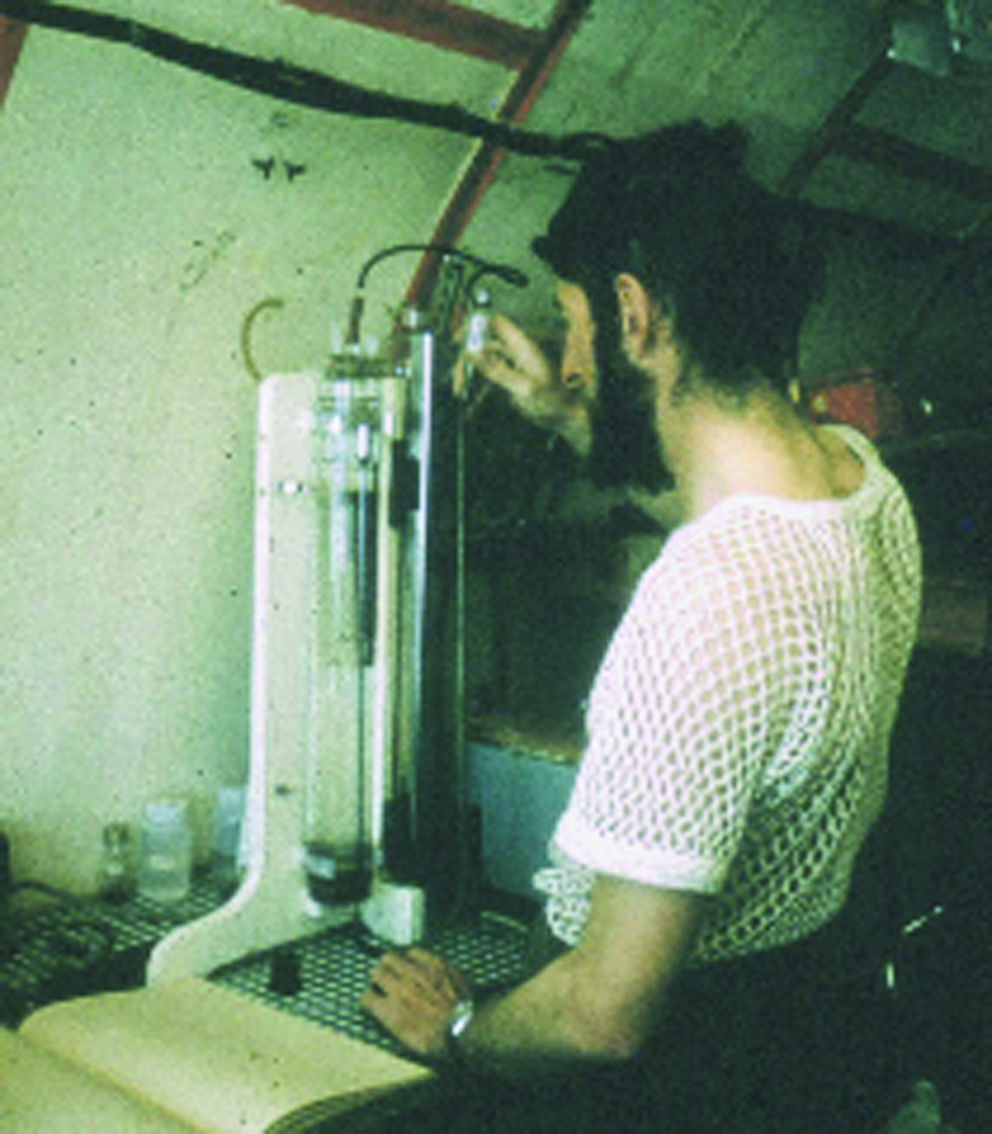
The Lloyd-Haldane apparatus, inside the Silver Hut, Milledge analyzing gas sample for CO2 and O2.
For Christmas, all the wintering party were able to assemble in the Silver Hut, though the more recent arrivals only came up from the Green Hut for the day and went back for the night. By the middle of January, Ward and West had finished their part in the physiology at Mingbo and were sufficiently acclimatized to stay at the Silver Hut, so they joined Gill and me there. Barry Bishop, our geologist and photographer, and Romanes were also in residence at times. In early February, Pugh and Lahiri came up to the Silver Hut and started their work there. They both had difficulty with acclimatizing and had to return to Mingbo at intervals. However, they persisted in returning and gradually were able to tolerate the altitude.
With Pugh and Lahiri being more in residence by mid-February, the Silver Hut was becoming rather crowded. Ward had finished his projects, and Gill and Romanes were free of responsibilities. Thus, when they suggested that the three of them plus Barry Bishop might make an attempt to climb Ama Dablam, Pugh was prepared to approve the project. As a bonus, it would solve the overcrowding in the Hut. We all felt that the chances of success were small. However, over the next 3 weeks they worked their way slowly along the knife-edge ridge, over rock towers, to the snow and ice section. We were able to follow their progress by watching them through the telescope and by radio contacts. On March 13, all four reached the summit. It was a climb of great technical difficulty and well ahead of its time (Ward, 1961). It was not repeated for 20 yr, though it has now become very popular, with 20 to 30 expeditions each year. They descended safely, clearing the mountain of all their climbing gear, which would be needed for the attempt on Makalu. Unfortunately, lower down, where Sherpas could help, one of the Sherpas, Gumi Dorgi, had an accident. A rock slab he was standing on broke and came down on his leg, breaking his tibia. He was brought down by the climbers to their base camp and then by Sherpas to Mingbo. From there he was flown back to Kathmandu and recovered in time to join the expedition again.
Spring
A few days after the ascent of Ama Dablam, Hillary and a number of fresh climbers arrived together with some of the wives of members, including my wife Betty. They had trekked out by the usual route, the bridge at Jubing having been rebuilt. It was wonderful to meet them and celebrate. Betty was able to come up to the Silver Hut and see our winter home and workplace. However, our pleasure at meeting was soon replaced by anxiety, because the climb of Ama Dablam had apparently caused consternation in government circles in Kathmandu. We had thought that we had permission to climb peaks within the Khumbu region. We had already climbed peaks such as Island Peak and Puma Dablam with no objections, and we had assumed that Ama Dablam fell into the same category. However, the authorities took a different view. Hillary had to fly back to Kathmandu and spend almost 2 weeks visiting various offices to apologize. Eventually, the matter was settled with a fine. But for a time it looked as if we might have to abandon the expedition altogether. As it was, the wives had to leave early.
The climbers and Sherpas now started to make a route over the col behind the Silver Hut and across the vast Hongu basin, where we had a transit camp. The route then went over two more high passes and into the Barun Valley opposite Makalu.
The scientists returned to the Silver Hut and after 3 weeks, having finished our physiological program there, West and I were ready to go over to Makalu. Hillary now returned from Kathmandu and other members, plus Sherpas, all made our way over this wonderful high- level route. John and I used skis on the downhill parts of this traverse and had the luxury of having Sherpas carry them on the uphill sections!
Before joining the main party on Makalu, West and I with Gill and Ward had a 5-day break at lower altitude down the Barun Valley, since we had all lost weight after our winter in the Silver Hut. We were in some respects very fit and well acclimatized, but in other respects we probably had deteriorated. We felt jaded and lacking in energy and drive.
After our break, we rapidly went up to our advance Base Camp (III) on Makalu at 6300 m and began the physiology there. Meanwhile the climbers were pushing the route up to the Makalu Col (7400 m). We concluded our physiology on May 8, and West and I went down to Camp II (5800 m), where many of the party were staying prior to ascending for the summit bids. Before leaving Camp III, we were called to see a sick Sherpa, Aila, and I diagnosed HAPE. This was just 8 months after Houston's landmark paper on HAPE (1960). We took him down with us, stopping frequently on the glacier while he coughed up frothy sputum, later becoming blood tinged. When we were off the ice, I went ahead and brought back oxygen, and with it he was able to get back to the camp without stopping.
That evening Hillary suddenly found himself unable to speak properly and was paralyzed on his left side. Ward and I diagnosed a cerebrovascular accident and gave him oxygen overnight. He recovered considerably by the next morning, but we decided he had to go down. So I went with him and the now partly recovered Aila to Base Camp, and Ward took over leadership of the expedition. Later Hillary and I returned by a much longer low-level route to the Khumbu, while the others attempted to climb the mountain. West and Ward carried out some physiology on the Makalu Col, including electrocardiograms on themselves and some climbers, and exercise tests including V
The first attempt on the summit was beaten back by bad weather. On the second, Peter Mulgrew was suddenly stricken with what was probably a pulmonary embolus. The rest of the expedition turned into an incredible rescue team for this unfortunate climber. All the climbers played their part in this and West, having gone down to Advanced Base Camp, went back up to Makalu Col and, being fresher than others there, was the galvanizing force in getting the whole team moving down with the victim. Mulgrew very nearly died and did sustain severe frostbite of his hands and feet, later requiring below-knee amputation of both legs (Mulgrew, 1964).
After getting back to the Khumbu, Hillary and the returning climbers built the school for which Hillary had collected money in the winter. It was sited at the village of Kumjung and was the start of a development program in Solu Khumbu, which continues to this day under the Himalayan Trust. It has made an enormous contribution to the Sherpa community. Hillary asked me to go up to the Silver Hut with a group of Sherpas, dismantle it, and bring it down. Tensing Norgay later came and transported it back to the Himalayan Mountaineering Institute in Darjeeling, where he was the chief instructor. Lahiri and I saw it again in Darjeeling the following year when we attended the International Symposium on Problems of High Altitude. Later it was taken up to a training camp in Sikkim at an altitude of 4500 m, where it serves as a first-aid post and sick berth. In 2000, to celebrate the 40th anniversary, four of us survivors of the expedition trekked up to see it. It was still in use, though in need of some maintenance. But considering it was only designed to last 1 yr, we thought it had done very well.
Physiological Program
The program was mainly put together by Griffith Pugh and therefore reflected his interests (Pugh, 1961; Pugh, 1962a). These interests were influenced by his experiences. Before World War II, he had been a cross-country skier and a member of the British Olympic team in that discipline. During the war he was posted to the Military Ski School at The Ceders, in Lebanon, where he studied the load carrying and performance of British (ski) mountain troops. More recently, he had experience of high altitude on the Cho Oyu Expedition of 1952 and the 1953 Everest expedition. It was not surprising therefore that high on his list of projects for the Silver Hut Expedition was the study of the effect of altitude on exercise in acclimatized subjects. But he was also interested in the effect of altitude hypoxia on all the steps in the oxygen transport system of the body, from atmosphere, through the lungs, to the arterial blood, and then to the tissues. In this he was following Barcroft (1934), and in Pugh's paper summarizing the scientific program of the expedition (Pugh, 1964a), he has a graph of the oxygen transport system at sea level and at the altitude of the Silver Hut, where the barometric pressure (380 mmHg) was just half that at sea level. The effect of acclimatization (and exercise) on the gradient of the fall of P
Exercise: Effect of altitude on exercise ventilation, heart rate, Vo 2max
The exercise project took up more time and effort than any other. Using a specially made cycle ergometer, which could be dismantled and carried as a porter load, we performed steady- state, staged exercise at increasing workload up to maximum work. Timed collections of expired gas were made into Douglas bags and then measured and analyzed for O2 and CO2 using the Lloyd–Haldane apparatus, and V
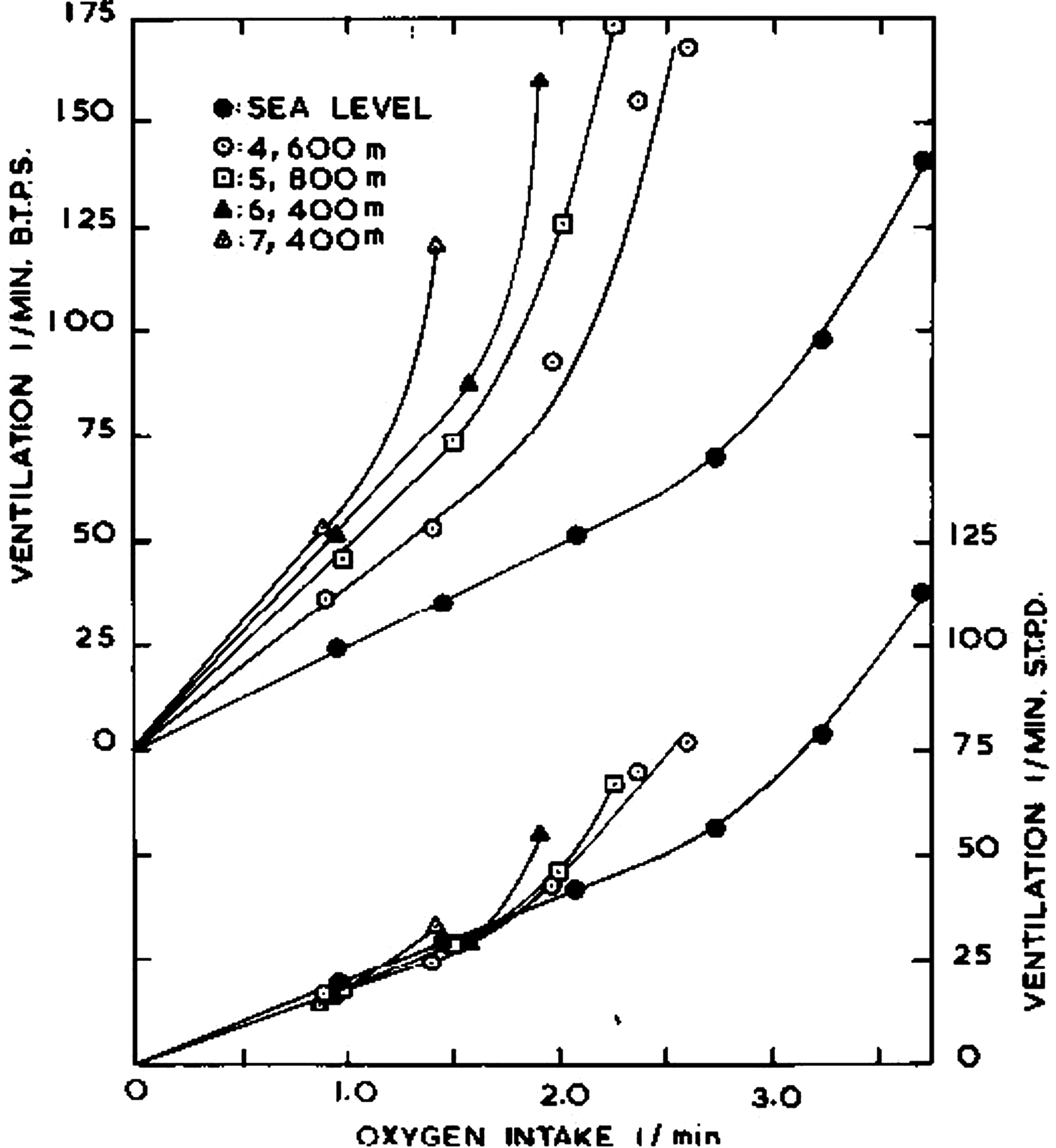
Exercise study. Relation of ventilation (BTPS and STPD) to O2 intake with increasing exercise at altitudes from sea level to 7,400 m. The reduction in VO2max can be seen by inspecting the highest point on each altitude line. (From Pugh et al. 1964d).
Cardiac output on exercise at altitude
We used a modification of the Grollman acetylene method at the Silver Hut, which can be used on exercise, but is very difficult to carry out correctly by both subject and operator (Fig. 4). We showed that for exercise the same absolute work rate resulted in the same cardiac output as at sea level. Maximum work rate was less and so was the cardiac output at this maximum work rate (mean 16.8 L/min at altitude compared to 23.7 L/min at sea level) (Pugh, 1964d).
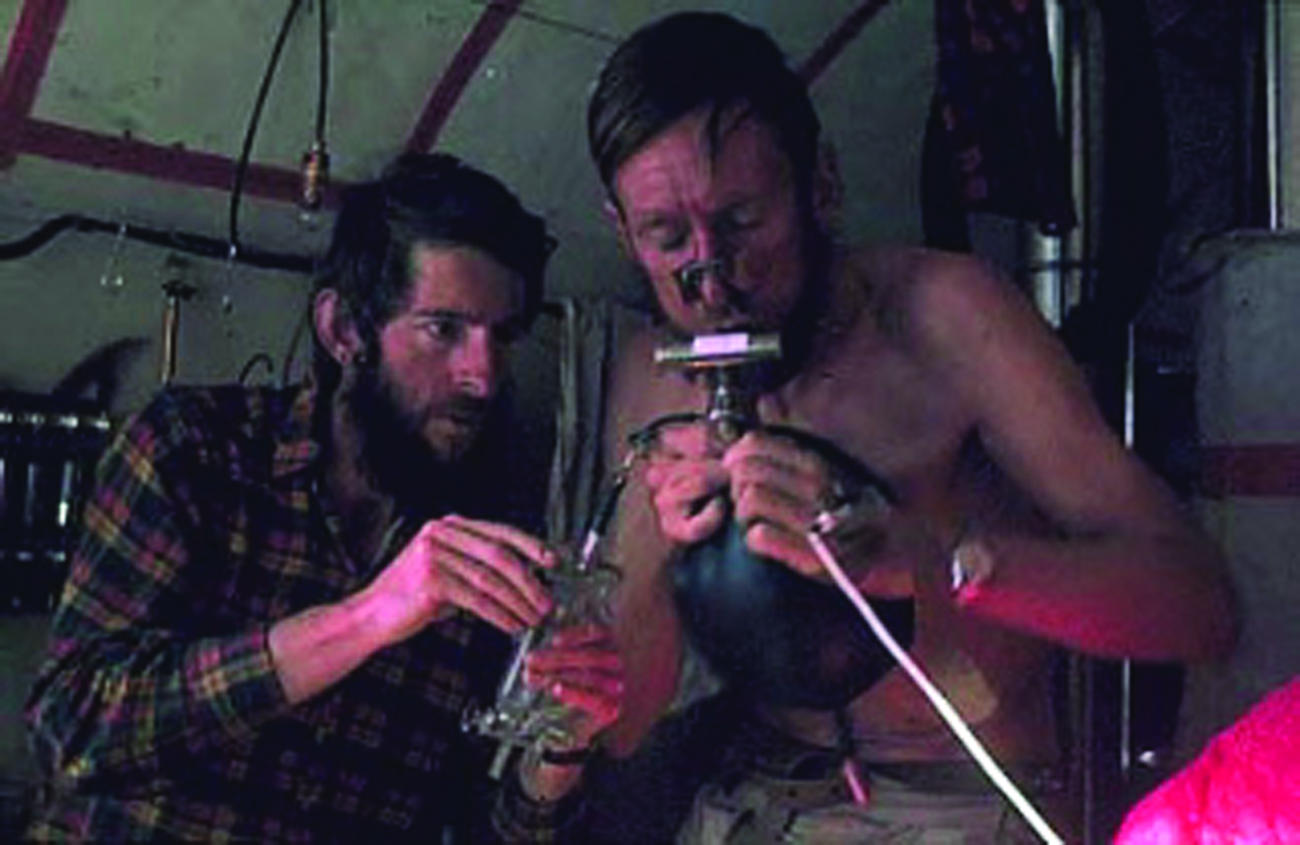
Cardiac output measurement, acetylene method, inside the Silver Hut. West as subject, Milledge as operator.
Changes in the chemical control of breathing with acclimatization
This project followed from previous work in the physiology department at Oxford by Lloyd, Jukes, and Cunningham (1958) on the ventilatory response to carbon dioxide and hypoxia. It was carried out with their supervision and in collaboration with their doctorate candidate Charles Michel. Control experiments were done in the lab at Oxford, and there we worked out ways of doing the study without large quantities of N2, CO2, and O2. All altitude experiments were done in the Silver Hut. The subject breathed various gas mixtures with increasing levels of CO2, and we measured his ventilation and took samples of alveolar gas at each stage. We did this at three or four levels of hypoxia. From the analysis of the alveolar gas samples, we constructed a “fan” of CO2 ventilatory response lines. From this plot, we derived parameters for CO2 and hypoxic ventilatory response.
We had 4 main subjects, each undergoing experiments early in our stay in the Silver Hut and after about 3 months, as well as control studies at Oxford. From recent work by Ralph Kellogg and colleagues, (1963) we knew that the CO2 response shifted to the left with acclimatization. We confirmed this and showed that this was complete by the time of our first experiments and did not shift farther with continued residence at altitude. The main parameter for the hypoxic ventilatory response showed an increase in three out of our four subjects, and in the case of the fourth subject, who showed a slight decrease, his control experiments gave rather scattered and high values. So we concluded that there was certainly no decrease and probably an increase in hypoxic sensitivity with acclimatization (Michel and Milledge, 1963). Studies carried out 30 yr later showed this to be the case (Masuda et al., 1992; Sato et al., 1992).
Altitude acclimatization and alveolar gas composition
Alveolar gas samples were taken in the Silver Hut as part of the control of breathing study, but the results reported by Gill and colleagues (1962) were confined to extreme altitude on Makalu. They were taken by the Haldane–Priestly method of end-tidal sampling into pre-evacuated glass ampuls and analyzed in London after the expedition. Samples were taken at Camp III (6400 m), on Makalu Col (7440 m), and at camp VI (7830 m). At this highest altitude the mean results were P
Effect of altitude acclimatization on gas exchange (lung diffusion) and exercise on arterial oxygen saturation
It had been suggested that perhaps the acclimatization process included an increase in the diffusing capacity of the lung. West already had an interest in gas exchange in the lung and was responsible for this project. We took an infrared carbon monoxide analyzer up to the Silver Hut, and he measured our diffusing capacities for CO (steady-state method). He was puzzled at first by the fact that our expired CO concentration was higher than the inspired mix he had made up for us! We then realized that the use of primus stoves in the hut for cooking was giving us CO poisoning. We banished the cooking to a tent outside and all was well. He found that the only change in DLCO was a small increase with acclimatization, which could be accounted for by the increase in hemoglobin concentration. We also had an early ear oximeter. Using this instrument, West showed that the arterial oxygen saturation fell with heavy exercise, from 67% at rest to 56% at 900 kg/m/min exercise (maximum for most of us). He correctly surmised that this was due to diffusion limitation (West, 1962). Further work, especially on the American Medical Research Expedition to Everest 20 yr later, confirmed these early results and established that diffusion limitation was an important factor limiting exercise performance at altitude.
Blood and plasma volume, red cell mass, and hemoglobin concentration at altitude
Using the carbon monoxide method, Pugh made serial measurements of blood volume and hemoglobin concentration throughout the expedition. From these he calculated changes in plasma volume and red cell mass. The results showed an early reduction in plasma volume giving a rapid early rise in hemoglobin, followed by a slow further rise owing to the slow increase in red cell mass throughout the rest of the expedition (Pugh, 1964b).
Electrocardiogram at altitudes up to 7440 m
Twelve-lead ECGs were recorded from 6 principal subjects in London and at the Green Hut (5300 m), the Silver Hut (5800 m) soon after arrival, about halfway through our stay there, just before leaving for Makalu, and then on Makalu at Camp III (6300 m) and on Makalu Col (7440 m) (Milledge, 1961). From work on the 1959 Ama Dablam Expedition published just before we set off (Jackson and Davis, 1960), we knew that there was a right shift of the QRS vector (right axis deviation), and we were able to confirm this and show that it developed within a few days of arrival at a given altitude. There was no further shift with continued residence at that altitude, but a further shift if the subjects went higher (Fig. 5). Accompanying this shift was an inversion of the T wave in the right-sided chest leads, V1–V3. However, the QRS-T wave vector difference (ÂQRS - T angle) did not increase significantly, and the performance of the subjects confirmed that this T wave inversion did not signify anything sinister. We observed the effect of breathing supplementary oxygen on the ECG. In general, it had no effect on axis deviation except in the case of the first ECG in one subject on day 2 at the Silver Hut. On air, his QRS vector was +97°, whereas it had been +83° in London. After breathing added oxygen, it reverted to +82°. We assumed the explanation for this right axis deviation to be the increase in pulmonary artery pressure owing to altitude hypoxia. The failure to shift back on breathing oxygen, in all but this one case, is presumably because remodeling of the pulmonary artery has taken place and requires at least some days of normoxia to be reversed.

ECG changes at altitude. Change in the frontal plane projection of the mean QRS vector with altitude. 5 lowland subjects (initials) at increasing altitude and three Sherpas (S) at 19,000ft. (From Milledge 1961).
Renal function at altitude
Ward carried out some simple renal function studies in the Silver Hut and found that after 24-h dehydration the kidney concentrates urine normally and eliminates a water load as well as it does at sea level. The kidney also responds to ingestion of bicarbonate or ammonium chloride (metabolic alkalosis or acidosis) by producing appropriate changes in urinary pH. This is perhaps not surprising since the kidneys are subjected to hypoxia at sea level during exercise when blood flow is shifted from kidneys to exercising muscles (Pugh, 1962a).
Basal metabolism and nutrition
Gill measured our basal metabolic rate (BMR) in the Silver Hut before getting up in the morning and found it to be increased by 10% mean over sea-level values. This finding has since been confirmed by others and is a factor, together with the loss of appetite, in causing weight loss at altitude (Gill and Pugh, 1964). We were very conscious of this weight loss and did our best to keep up our calorie intake with high-calorie foods and drink. In spite of an ample and varied supply of food and drink at the Silver Hut, we all lost weight at the rate of 0.5 to 1.4 kg/week. Descent to Base Camp (4500 m) for a few days was enough, in our acclimatized state, for us to put on some weight. Thus it seems that a maximum altitude of somewhere between 5000 to 5500 m is the limit for most lowland subjects to live permanently (Pugh, 1962a).
Psychomotor function at altitude
Gill was responsible for this study, done in collaboration with the MRC Applied Psychology Unit, Cambridge. Psychomotor function was studied in the Silver Hut by a card- sorting test using an early electronic apparatus, which timed the delay in making each decision. Accuracy was scored by inspecting the sorted cards. This test showed impairment in sorting with respect to decision time, but not in accuracy. This confirmed the impression that accurate work can be done at altitude after acclimatization, but needs more time and concentration (Gill et al., 1964).
Conclusion
The Silver Hut Expedition was a very happy and, scientifically, successful one. Many of the findings were not repeated for many years, and none have been refuted. On the mountaineering side, we were unsuccessful on Makalu owing to a combination of weather and illness, but the ascent of Ama Dablam was considerable compensation. For many of us, the experience of being members of this unique expedition turned out to be career changing in a most positive way.
Footnotes
Appendix
| Name | Role | Time in the field | Remarks | Nationality |
|---|---|---|---|---|
| Sir Edmund Hillary | Leader | Autumn, spring | Had Stroke on Makalu | New Zealand |
| Dr Griffith Pugh | Scientific leader | Late autumn, winter, spring | Remained in Khumbu | British |
| Barnu Bannerjee ? | Assistant to Desmond Doig | Autumn, spring | Remained in Khumbu | Indian |
| Pat. Barcham | Climber | Autumn | 2nd ascent Puma Dablam | New Zealand |
| Barry Bishop | Geologist and Photographer | Autumn, winter, spring | Remained in Khumbu 1st ascent Ama D | USA |
| Desmond Doig | Reporter, the Statesman, Calcutta | Autumn, Spring | Remained in Khumbu | British, resident in India |
| Michael Gill * | Med. Student climber | Autumn, winter spring | On 1st Makalu summit attempt, 1st ascent Ama D | New Zealand |
| Norman Hardie * | Climber | Autumn | Ldr. Working party to Khumbu | New Zealand |
| John Harrison | Climber | Spring | Rescue of Mulgrew | New Zealand |
| Sukhamay Lahiri | Physiologist | Winter, spring | Remained in Khumbu | Indian |
| George Lowe * | Climber | Autumn | New Zealand | |
| Jim Milledge * | PhysiologistClub climber | Autumn, winter spring | Ret. with Ed from Makalu | British |
| Capt. S.B. Matwani? | Army Doctor | Autumn, winter | Remained in Khumbu | Indian |
| Peter Mulgrew | Climber Radio Officer NZRN | Autumn, spring | Near death on Makalu | New Zealand |
| Tom Nevison * | NASA scientist | Autumn, spring | On 2nd Makalu summit attempt | USA |
| Leigh Ortenburger | Climber | Spring | Rescue of Mulgrew | USA |
| Marlin Perkins | Animal expert | Autumn | Yeti hunter | USA |
| Walter Romanes | Climber, handyman | Autumn winter spring | On 1st Makalu summit attempt, 1st ascent Ama D | New Zealand |
| Larry Swan | Biologist | Autumn | USA | |
| Michael Ward | Surgeon, M.O. physiologist Climber | Winter, spring | 1st ascent of Ama Dablam | British |
| John West * | Physiologist | Winter spring | Rescue of Mulgrew | Australian |
An * after the name indicates that the member is known to be still alive (Jan. 2010). A ? indicates uncertainty. The second column is the role played by the member on the Expedition. Of course, members had other roles and occupations outside of the expedition. In the Remarks column, “stayed in Khumbu” means they did not go over to Makalu in the spring. The nationality is that at the time of the Expedition.