
Letter
 Available accessLetterFirst published 2026
Letter: The Experience of Health Care Providers Working At High Altitude
Jeremy WindsorORCID


Select search scope: search across all journals or within the current journal


1-20 of 27 articles
Available accessLetterFirst published 2026 Available accessLetterFirst published 2026
 Available accessResearch articleFirst published 2026
Chen, Biao, Shuai Li, Kun He, Dunzhu Basang, Yuzhen Suolang, Fang Li, Jiangcun Silang, Hongyuan Yi, Langjie Jinmei, La Dan, Deqing Ciren, Haifeng Xu, and Dong Wu. Mitigating Intraoperative Fatigue in Surgeons at High Altitude: A Stepped-Wedge Cluster Randomized Trial.
Both genetically adapted Tibetan surgeons and less-acclimatized Han surgeons deployed through the Aid-Tibet medical aid program face significant challenges from hypobaric hypoxia in the Qinghai-Xizang Plateau. Hypoxia is known to impair cognitive functions and induce fatigue, threatening surgical performance and patient safety. Traditionally, surgeons in Tibet consume Coca-Cola to combat fatigue, a potentially harmful practice lacking in scientific basis. Supplemental oxygen, recommended for better cerebral oxygen delivery, is underutilized. This study compares supplemental oxygen versus Coca-Cola in mitigating intraoperative fatigue among surgeons in Tibet, considering the influence of long-term high-altitude adaptations.
We conducted a stepped-wedge cluster randomized controlled trial at the People’s Hospital of Xizang Autonomous Region in Lhasa (3,650 m altitude). Twenty-two surgeons (11 Han, 11 Tibetan) performed 24 surgeries each, receiving either 100 ml of Coca-Cola every 30 minutes or continuous 2 l/min supplemental oxygen via nasal cannula. Cognitive fatigue was assessed using the d2 Test of Attention, and physical fatigue was measured using a dynamometer, before and after surgeries. The primary outcome was change in concentration performance (ΔCP). The secondary outcome was the change in maximum voluntary contraction force (ΔMVC). Data were analyzed using a linear generalized estimating equations model.
All 22 surgeons completed 528 surgeries. Generally, supplemental oxygen significantly reduced cognitive fatigue compared to Coca-Cola (ΔCP: 6.08, 95% confidence interval [CI]: 1.37–10.80,
Supplemental oxygen outperforms Coca-Cola in reducing cognitive fatigue during high-altitude surgery, especially for less-acclimatized Han surgeons, supporting its adoption to enhance surgeons’ performance and well-being.
Available accessResearch articleFirst published 2026Du, Tianjing, Haoqing Shi, Linlin Liu, and Zeyu Yang. The mediating role of cognitive function in the relationship between acute high-altitude stress and casualty care capability following rapid ascent.
The impact of high-altitude rescue missions on medical personnel’s cognitive function and casualty care capabilities remains unclear.
This multicenter, randomized, sham-controlled clinical trial established high-altitude intervention (HAI), high-altitude (HA), and sea level (SL) groups (
In the HA group, cognitive ability mediated strong negative indirect effects at 24 hours, alongside a positive direct effect of stress. At 48 hours, the negative indirect effect remained dominant, whereas the direct effect of stress was not significant. At 72 hours, the indirect effect weakened but remained significant, whereas the direct effect of stress became significantly negative. By 96 hours, the indirect effect disappeared, with the total effect explained by stress. In the HAI group, the total and indirect effects were significant at 24 and 48 hours, whereas the direct effects were not. At 72 and 96 hours, no effects were statistically significant.
During the initial phase of RAHA, cognitive ability serves as a mediating factor through which stress impairs casualty care capabilities. Over time, the mediating effect of cognition gradually diminishes, while the direct negative impact of the stress response continues to strengthen. The integrated cognitive-stress training can effectively preserve cognitive function and mitigate the stress response, thereby enhancing medical personnel’s casualty care capabilities.
 Open accessResearch articleFirst published 2026, Marco Antonio Salazar-Zegarra, Franklin Miranda-Solis , [...]
Villamonte-Calanche, Wilfredo, Marco Antonio Salazar-Zegarra, Franklin Miranda-Solis, and María Jerí-Palomino. Correlation of uterine blood flow in the first trimester of pregnancy and birth weight at term in high altitude.
To determine the correlation between total uterine artery flow (UtAQ) at the end of the first trimester of pregnancy and birth weight (BW) at term at 3,400 m altitude.
Prospective study, conducted at 3,400 m altitude in 210 women who underwent routine ultrasound evaluation. The inclusion criteria were singleton pregnancy between 11 and 14 weeks + 1 day, crown-rump length between 45 and 84 mm, born and raised at high altitude (native), and without pathology. The outcome was BW, expressed as a Z score. Variables such as UtAQ, uterine artery (UtA) diameters, age, body mass index, and mean arterial pressure, among others, were evaluated.
After applying the inclusion criteria, 203 pregnant women were evaluated, out of a total of 210 women. The average diameter of UtA was 0.27 cm, and the total bilateral UtA blood flow was 305.8 ml/min. A significant correlation was found between BW and UtAQ (rho = 0.15,
In low-risk singleton pregnancies among native women living at high altitude, a correlation was observed between UtAQ and term BW, with the highest association found between BW and the diameter and UtAQ of the left UtA.
Available accessResearch articleFirst published 2026Chen, Yanli, Suying Zhu, Doudou Hao, Zhiyou Shi, Yang Zhong, Suyuan Wang, and Yunhong Wu. Time-Dependent Effects of Chronic Hypoxic Exposure on Microarchitecture of Different Skeletal Sites in Mice.
Available accessResearch articleFirst published 2026This study examined the effects of chronic high-altitude hypoxic exposure on attention networks in indigenous primary school students, integrating cardiovascular indices to explore underlying physiological mechanisms.
Three real-world altitude groups were established: low (2,200 m), mid (3,200 m), and high (4,200 m). Cardiovascular function was assessed via systolic blood pressure, diastolic blood pressure, and heart rate. Attentional performance was evaluated using the Attention Network Test (ANT), which provides measures of alerting, orienting, and executive control efficiency.
Cardiovascular indices followed a nonlinear pattern across altitudes, with systolic blood pressure, diastolic blood pressure, and heart rate being significantly higher at mid-altitude compared to both low and high altitudes. In contrast, attention performance exhibited an opposite trend: alerting and executive control efficiency were relatively reduced at mid-altitude but were comparable between the low- and high-altitude groups. Orienting efficiency did not differ significantly across the three altitude groups.
The findings reveal a dissociation between physiological regulation and cognitive performance under chronic hypoxia. To explain these results, we propose a U-shaped model of cardiovascular adaptation, where mid-altitude represents an incomplete compensatory state, while prolonged exposure at higher altitudes leads to stabilized cardiovascular function and preserved attentional performance. This integrative framework underscores the crucial role of physiological adaptation in shaping cognitive outcomes in high-altitude environments.
Open accessResearch articleFirst published 2026 , [...]Pena, Eduardo, Samia El Alam, Juliane Hannemann, and Rainer Böger. Compliance and genetic variability are determinants of the success of
Asymmetric dimethylarginine (ADMA) is a risk biomarker of high-altitude pulmonary hypertension (HAPH). ADMA is inactivated by dimethylarginine dimethylaminohydrolase (DDAH)1 and 2. Single nucleotide polymorphisms in these genes contribute to genetic predisposition for HAPH. Supplementation with
Twenty male volunteers were randomly assigned to receive 6 months of A/C or placebo; PAP was assessed by echocardiography.
Our data show that A/C supplementation may offer an opportunity to alleviate the altitude-induced increase in PAP; however, long-term compliance and genetic factors may affect outcome.
Available accessResearch articleFirst published 2026, C. Alejandro Luzardo, Daniel F. Namen , [...]Ramírez, Esteban, C Alejandro Luzardo, Daniel F Namen, Juan D Rivera, Lina Pérez, Daniela Mora, Nicolás Moncada, Santiago Lopez, and Jaime Guiza. Heart rate variability in adults from low- and high-altitude origins residing in a high-altitude city: A cross-sectional comparison.
Heart rate variability (HRV) is used to assess autonomic regulation, reflecting autonomic nervous system activity through heartbeat interval analysis. HRV can be evaluated using time-domain, frequency-domain, and nonlinear methods. Although acute high-altitude exposure has been studied, the effects of chronic exposure remain less well understood.
This study compared HRV in adults from altitudes ≥2,500 m (group 1) and <1,500 m (group 2), with both groups residing in Bogotá, Colombia (2,600 m) for more than 6 months. HRV was assessed using time domain, frequency domain, and nonlinear metrics.
Participants from low-altitude regions (group 2) exhibited higher resting heart rates (
Adults raised at low altitudes showed lower HRV when living in Bogotá compared with those raised at high altitudes, suggesting an association with long-term autonomic differences potentially related to early-life altitude exposure, rather than a direct causal effect of chronic hypoxia during childhood. These findings may have physiological and clinical implications, particularly in countries with diverse geography. Further prospective, longitudinal research is needed to confirm these associations and clarify their cardiovascular relevance and the potential contribution of genetic and environmental factors.
Available accessBrief reportFirst published 2026, Molly Enenbach, Javier Seufferheld , [...]Brillhart, Aaron, Molly Enenbach, Javier Seufferheld, Bernabé Abramor, Peter Callas, Rodrigo Duplessis, Ian Guertin, Theodore A Hartridge, Roxana Pronce, Ana Saravia, and Scott E. McIntosh. Medical screening of climbers who later develop high-altitude pulmonary edema on Aconcagua.
On Aconcagua (6,961 m), high-altitude pulmonary edema (HAPE) is the most frequent reason for medical evacuation. This study aimed to compare medical screening data of climbers who developed HAPE with those who did not and to identify trends to aid in illness prevention and climber safety.
De-identified medical screening data of Aconcagua climbers from 2024 to 25 were retrospectively reviewed, comparing climbers who developed HAPE with those who did not.
Fifty-three of 2,336 climbers developed HAPE (2.3%). Asymptomatic climbers screened at 4,300 m who later developed HAPE had lower mean oxygen saturation than controls (80% vs. 85%,
On Aconcagua, certain vital sign parameters, including oxygen saturation below 80% and tachycardia during asymptomatic screening at 4,300 m, could raise concern for later developing HAPE. Future research could clarify any association between HAPE, certain climber groups such as guided clients, ascent rate, and medication use. Gradual ascent should continue to be emphasized to facilitate acclimatization and prevent life-threatening altitude illness such as HAPE.
Available accessLetterFirst published 2026 Available accessLetterFirst published 2026
 Available accessResearch articleFirst published 2026
Pan, Cuiping, Qunyuan Wang, Minglei Zhang, Ruizhe Li, Yining Liu, and Zongbin Li. Role of Mitochondrial tRNALeu 12320 A>G Mutation on Heart Rate Variability and Blood Pressure at Low Altitude and in a High-Altitude Hypoxic Environment.
Mutations—gene mutations—can exert dual, environment-dependent effects on cardiovascular disease.
We analyzed clinical data and mitochondrial DNA from 84 young Han Chinese men ascending from low-altitude to high-altitude regions (>4,000 m).
Nine subjects harbored the mitochondrial tRNA A12320G mutation. Notably, none of these 9 mutation carriers developed acute mountain sickness (AMS), whereas 34 (40.5%) of the 84 volunteers in the cohort were diagnosed with AMS, indicating a significant protective association (
The A12320G mutation acts as a cardiovascular risk factor (reduced HRV, increased blood pressure) at low altitude, whereas at high altitude it was associated with a reduced incidence of AMS, possibly through metabolic adaptive mechanisms, reflecting the environmentally dependent dual roles of this gene effect.
Available accessResearch articleFirst published 2026, Luobu Gesang, Yangzong Suona , [...]Zhuoga Danzeng, Luobu Gesang, Yangzong Suona, Yuansheng Wang, Yangjin Baima, Bai Ci, Ju Huang, Zhuoma Ciren, Rui Zhang, Binyun Liu, and Quzong Zhaxi. Establishing Early Intervention Thresholds for High-Altitude Polycythemia: Evidence from a Cross-Sectional Study of Tibetan Residents.
High-altitude polycythemia (HAPC), defined by elevated hemoglobin levels, is a key feature of chronic mountain sickness, yet the “intermediate zone” preceding overt HAPC remains poorly understood. This cross-sectional study aimed to define evidence-based thresholds for early intervention in high-altitude populations.
A total of 2,819 indigenous Tibetan residents (≥18 years) living at altitudes ≥ 4,500 m were classified into three groups based on hemoglobin levels: normal (males: 130–175 g/l; females: 115–150 g/l), intermediate (males: 175–210 g/l; females: 150–190 g/l), and HAPC (males: ≥210 g/l; females: ≥190 g/l). We assessed clinical phenotypes, organ function, and metabolic parameters through questionnaires, physical exams, biochemical analyses, and echocardiography. Logistic regression identified health risks for each group.
Revealed that participants in the intermediate and HAPC groups exhibited significant abnormalities compared with the normal group: increased waist circumference (
These findings suggest that individuals in the intermediate zone exhibit early signs of organ dysfunction, indicating a “pre-HAPC state.” We advocate for a risk-stratified approach to early intervention in high-altitude illness.
Available accessResearch articleFirst published 2026Buja, Alessandra, Sandro Cinquetti, Marco Coller, Angela Padoin, Chiara Trevisiol, Ilaria Pantaleo, Claudio Palmeri, Vincenzo Marcotrigiano, Erica Bino, Silvia Flesia, and Simone Mocellin. Health promotion for sun protection: a community approach in a mountain setting.
Alpine regions exhibit high incidence rates of cutaneous melanoma due to increased ultraviolet radiation at higher altitudes. In 2022, the “Montagna SÌ, Melanoma NO” (Mountain YES, Melanoma NO) public health campaign began promoting sun-protective behaviors in these areas. This study aims to evaluate an intervention’s effectiveness 3 years after its launch and assess improvements in sun safety practices.
A before-and-after comparative study was conducted by surveying a random sample of 229 Belluno residents in the Veneto Region, Italy, in 2022, and 115 of those same individuals in 2025 using a standardized questionnaire. Data on sociodemographics, phenotypic characteristics, sun exposure habits, sunscreen use, protective clothing/eyewear usage, and campaign awareness were collected.
In 2025, 43% of respondents (95% CI: 33.44%–52.17%) reported being aware of the health promotion efforts. A significant increase in sunscreen application during outdoor activities lasting more than 1 hour and during skiing was detected. Nevertheless, other protective measures, such as the use of caps and sunglasses, did not demonstrate any significant improvement.
The campaign was effective. It reached its target population and improved sun-protective behaviors, confirming the value of community-engaged, tailored health promotion strategies. Further initiatives are necessary to address the remaining gaps in melanoma prevention adherence.
Available accessReview articleFirst published 2026Wei, Shuna, Xiaoju Liu. High-altitude environment and chronic obstructive pulmonary disease: epidemiology, pathological mechanisms and clinical management.
Chronic obstructive pulmonary disease (COPD) is a significant global health concern. Environmental factors such as low oxygen and temperature, along with poor living habits in high-altitude areas, contribute to regional variations in the occurrence and progression of COPD. There is currently a lack of systematic reviews on the relationship between high-altitude environments and COPD, which hinders effective prevention and treatment.
This narrative review comprehensively sorts out and analyzes the research on COPD in high-altitude areas from three aspects: epidemiological characteristics, pathophysiological mechanisms, and clinical management.
Epidemiologically, COPD mortality increases with altitude; however, prevalence rates remain debated. Pathophysiologically, factors include hypoxia-inducible factor regulation, hemodynamic changes, air pollution particles promoting inflammation and oxidative stress, as well as gene mutations like PPARA and SERPINA1. Clinically managing COPD in high-altitude regions requires individualized approaches that consider environmental conditions.
High-altitude environments exacerbate COPD through hypoxic stress, pollutant exposure, and genetic variations. Future efforts should focus on developing a risk prediction model for COPD that incorporates altitude parameters to enhance targeted prevention and treatment strategies in these areas.
Available accessBrief reportFirst published 2026, Jenny Schlichtiger, Sara Jamali , [...]Kolokas, Iraklis, Jenny Schlichtiger, Sara Jamali, Lina Kronschnabel, Paul Adam, Jeremias Götschke, Pontus Mertsch, Christian Goelz, Solveig Vieluf, and Stefan Brunner. Exercise-induced autonomic and cardio-respiratory stress at high altitude in leisure athletes.
Exercise at high altitude imposes additional cardiovascular and autonomic demands on leisure athletes. We investigated how acute exposure to high altitude alters cardiovascular, respiratory, and autonomic regulation during rest, exercise start, and peak exercise.
Briefly, 12 nonacclimatized participants (five female) performed standardized exercise tests at low and high altitude, while heart rate (HR), respiratory rate (RR), heart rate variability (HRV_RMSSD), respiratory rate variability (RRV_RMSSD), and respiratory sinus arrhythmia (RSA) were measured using wearable electrocardiogram (ECG) recordings and computer-based signal analysis.
Maximal power output during the maximal incremental cycling test was lower at high altitude (235.5 ± 65.5 W) compared to low altitude (276.4 ± 77.5 W). HR and RR increased with exercise intensity and showed a nonsignificant increase at high altitude. RMSSD decreased during exercise (−116.67 ± 79.29 ms,
These patterns indicate that acute high-altitude exercise shifts autonomic balance, imposing heightened cardiac strain while the respiratory system maintains adaptive ventilatory flexibility, highlighting their differential roles in supporting oxygen delivery and systemic homeostasis under hypoxic stress.
Available accessCase reportFirst published 2026Hill, Adam D. Slow symptom resolution of acute altitude illness upon rapid descent.
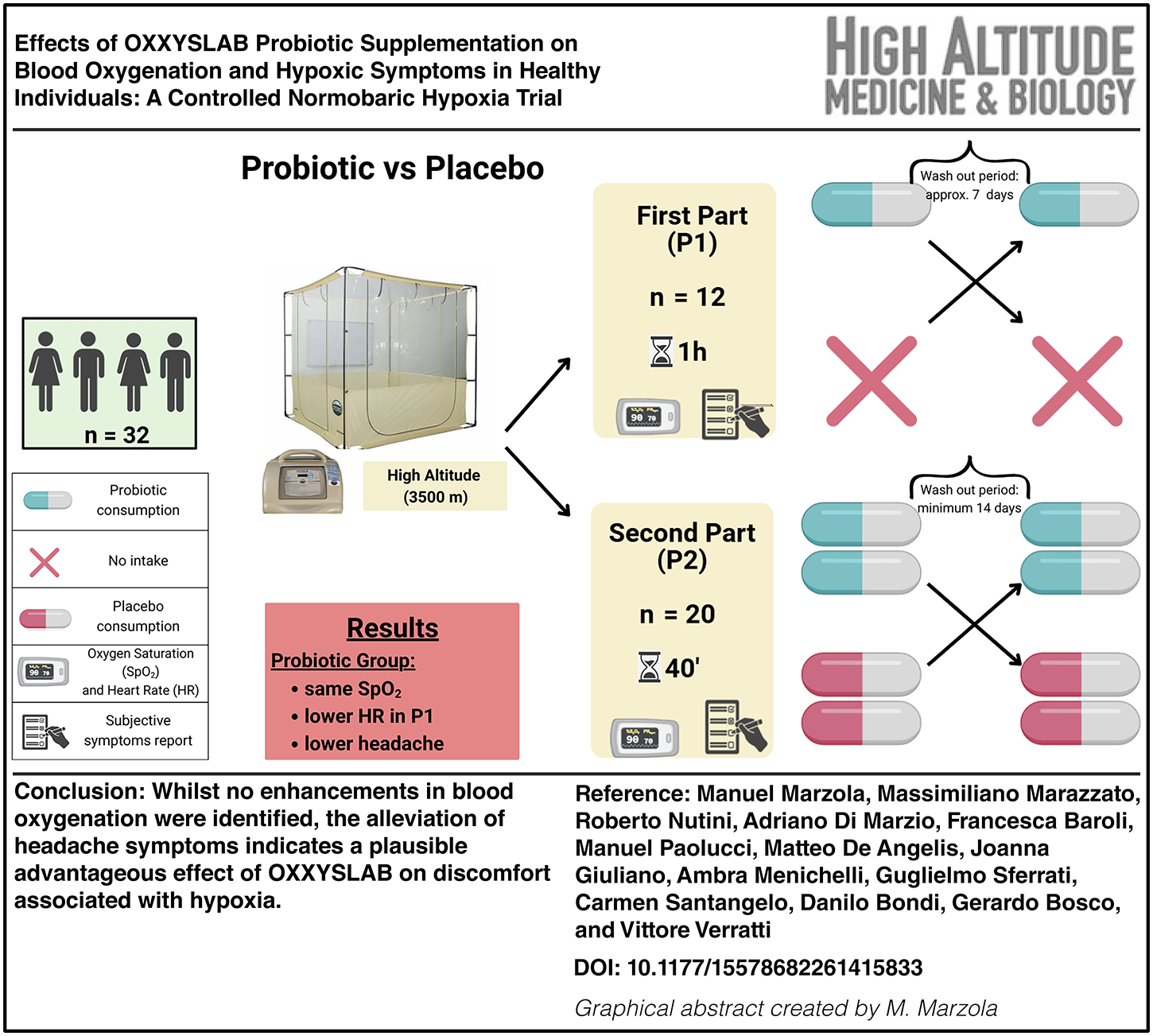
Available accessResearch articleFirst published 2026Marzola, Manuel, Massimiliano Marazzato, Roberto Nutini, Adriano Di Marzio, Francesca Baroli, Manuel Paolucci, Matteo De Angelis, Joanna Giuliano, Ambra Menichelli, Guglielmo Sferrati, Carmen Santangelo, Danilo Bondi, Gerardo Bosco, and Vittore Verratti. Effects of OXXYSLAB probiotic supplementation on blood oxygenation and hypoxic symptoms in healthy individuals: A controlled normobaric hypoxia trial.
OXXYSLAB, a high-dose, multi-strain probiotic, has shown promise in pathological hypoxemia but remains untested under acute normobaric hypoxia (NH) in healthy volunteers. We evaluated whether OXXYSLAB alters peripheral oxygen saturation (SpO2) and alleviates hypoxia-related symptoms in healthy adults exposed to NH.
In two randomized, double-blind, crossover phases, young adults were exposed to ∼13.5% inspired O2 for 1 hour (Phase 1:
NH induced the expected SpO2 decrease (Phase 1: 90.0 ± 2.1%; Phase 2: 86.7 ± 2.9%), with no significant effect of probiotic supplementation on SpO2. In Phase 1, a trend toward lower heart rate (Δ = –3.2 bpm) under OXXYSLAB approached significance (
While OXXYSLAB did not enhance systemic oxygenation during acute NH, it significantly attenuated headache, a common symptom of hypoxia. Further research should assess its efficacy under prolonged or clinical hypoxemic conditions.
Available accessLetterFirst published 2026, Kenton Cool, Graham Parrott , [...]