




Abstract
Abstract
Borm, Nicholas, Jon D. Van Roo, Carlos Pesce, D. Mark Courtney, Sanjeev Malik, and Matthew P. Lazio. Prior altitude experience of climbers attempting to summit Aconcagua. High Alt. Med. Biol. 12:387–391.—Aconcagua (6962 m) is one of the seven summits and the highest mountain outside of Asia. Climbers of varying experience are drawn to its nontechnical route. Our objective was to detail the prior altitude experience of climbers attempting to summit Aconcagua. We asked all climbers on the normal route of Aconcagua to complete questionnaires with demographics and prior high altitude experience while acclimatizing at Plaza de Mulas base camp during 9 nonconsecutive days in January 2009. 127 volunteers from 22 countries were enrolled. Mean age was 39.8 years and 88.2% were male. Median altitude at place of residence was 200 m (IQR: 30, 700). Median previous maximum altitude reached was 5895 m (IQR: 5365, 6150). 7.1% of climbers had never been above 4000 m. Median previous maximum sleeping altitude was 4800 m (IQR: 4300, 5486). 12.6% of climbers had never slept above 4000 m. Climbers who performed acclimatization treks spent a mean of 3.6 (2.5, 4.7) days at>3000 m in the previous 2 months. However, 50.4% of climbers performed no acclimatization treks. Although the majority of mountaineers who attempt Aconcagua have prior high altitude experience, a substantial minority has never been above 4000 m.
Introduction
One of the seven summits, Aconcagua [6962 m (22,841 ft)] is the highest mountain in South America and the highest peak in the world outside of Asia. More than 6000 climbers attempt Aconcagua annually (data courtesy Aconcagua Provincial Park authorities). Most climbers utilize the Ruta Normal and acclimate at Plaza de Mulas base camp at 4365 m (14,321 ft) for a few days prior to ascending to the high camps. Although past studies have reported mean previous maximum altitude reached among Aconcagua mountaineers at 5926 m (Pesce et al., 2005) and 5309–5695 m (Lazio et al., 2010), detailed knowledge of prior altitude exposure for climbers on Aconcagua is limited, particularly for inexperienced climbers. Because Aconcagua is advertised as requiring no technical mountaineering experience, we hypothesized that a large proportion of climbers would lack prior high altitude exposure. The goal of this study was to detail the prior high altitude experience of climbers attempting to summit Aconcagua, both in their lifetime and in the time period just prior to their attempt (acclimatization). Our first specific objective was to quantify the number of climbers who had never previously reached an altitude of 4000 m or greater. Our second specific objective was to quantify the number of climbers who had never previously slept at an altitude of 4000 m or greater. Our third specific objective was to quantify the number of climbers who had not performed acclimatization treks in the 2 months prior to attempting Aconcagua.
Materials and Methods
Data were prospectively collected during January 2009 in Aconcagua Provincial Park, Mendoza, Argentina at Plaza de Mulas base camp (4365 m) on the Normal Route. This was a prospective consecutive sample of all adult climbers greater than 17 years old who spoke English, Spanish, French, or German, and checked in with park rangers. For volunteers meeting the above criteria and willing to participate, there were no exclusion criteria. Two investigators (JDV, MPL) obtained signed written informed consent and collected demographics and prior mountaineering experience from volunteers. The Institutional Review Board of Northwestern University (IRB #2863-001) and the Mendoza Provincial Department of Natural Resources (Resolución #836) granted approval of human subjects research. For the purpose of this study, acclimatization treks were defined as reaching an altitude greater than 3000 m in the 2 months prior to the attempt on Aconcagua. Data were analyzed using Stata® 9.2 for Macintosh (Stata Corporation, College Station, TX). For data in which normality was ensured, means with 95% confidence intervals (CIs) are presented. For data in which normality was not ensured, medians, interquartile ranges (IQRs), skewness, and kurtosis are presented. For our subset analysis of maximum altitude reached by continent of origin, North Americans and Europeans were grouped together and compared to South Americans. Because there were<5 climbers each from Asia, Australia, and Africa, climbers from these continents were excluded.
Results
During the study period in January 2009, 543 mountaineers entered the park attempting to summit Aconcagua (data courtesy Aconcagua Provincial Park authorities). One hundred twenty-seven volunteers from 22 different countries agreed to participate in the study. Volunteer characteristics are summarized in Table 1. Mean age was 39.8 (95% CI: 37.8, 41.9) and 88.2% were male. The majority of volunteers were from Europe (41.4%), South America (35.0%), and North America (16.3%). Data regarding climbers' prior altitude experience are summarized in Table 2. The median altitude of residence was 200 m. The median previous maximum altitude reached was 5895 m. Importantly, 7.1% had never been to an altitude of 4000 m. Figure 1 depicts the distribution of maximum previous altitude reached. The most common previous maximum altitude reached was between 5800–5900 m. Five (3.9%) climbers had a previous successful summit attempt on Aconcagua. Only five (3.9%) participants had ever been at altitudes greater than 7000 m. Figures 2a (skewness –1.49, kurtosis 5.88) and 2b (skewness –0.06, kurtosis 3.65) depict the previous maximum altitude reached for European and North American climbers versus South American climbers, respectively. Figure 3 depicts the distribution of maximum previous sleeping altitude. Median maximum previous sleeping altitude of those surveyed was 4800 m. 12.6% of climbers had never slept at an altitude of 4000 m or greater. 50.4% of climbers had not performed acclimatization treks in the previous 2 months. Climbers who had performed acclimatization treks spent a mean of 3.6 days above 3000 m in the 2 months prior to their attempts on Aconcagua.
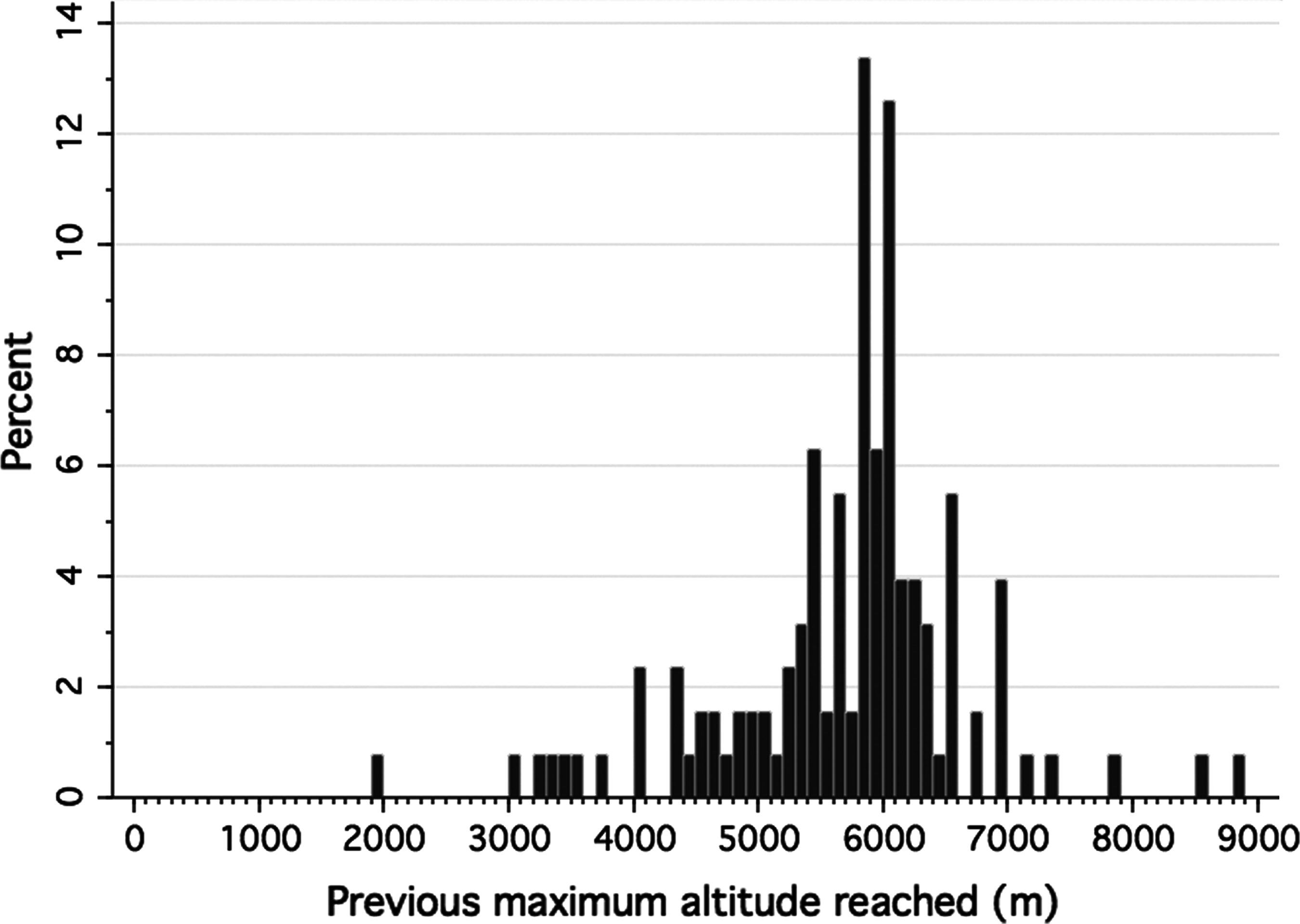
Previous maximum altitude reached (m) among all climbers attempting to summit Aconcagua. The most common range of altitude was 5800–5900 m.

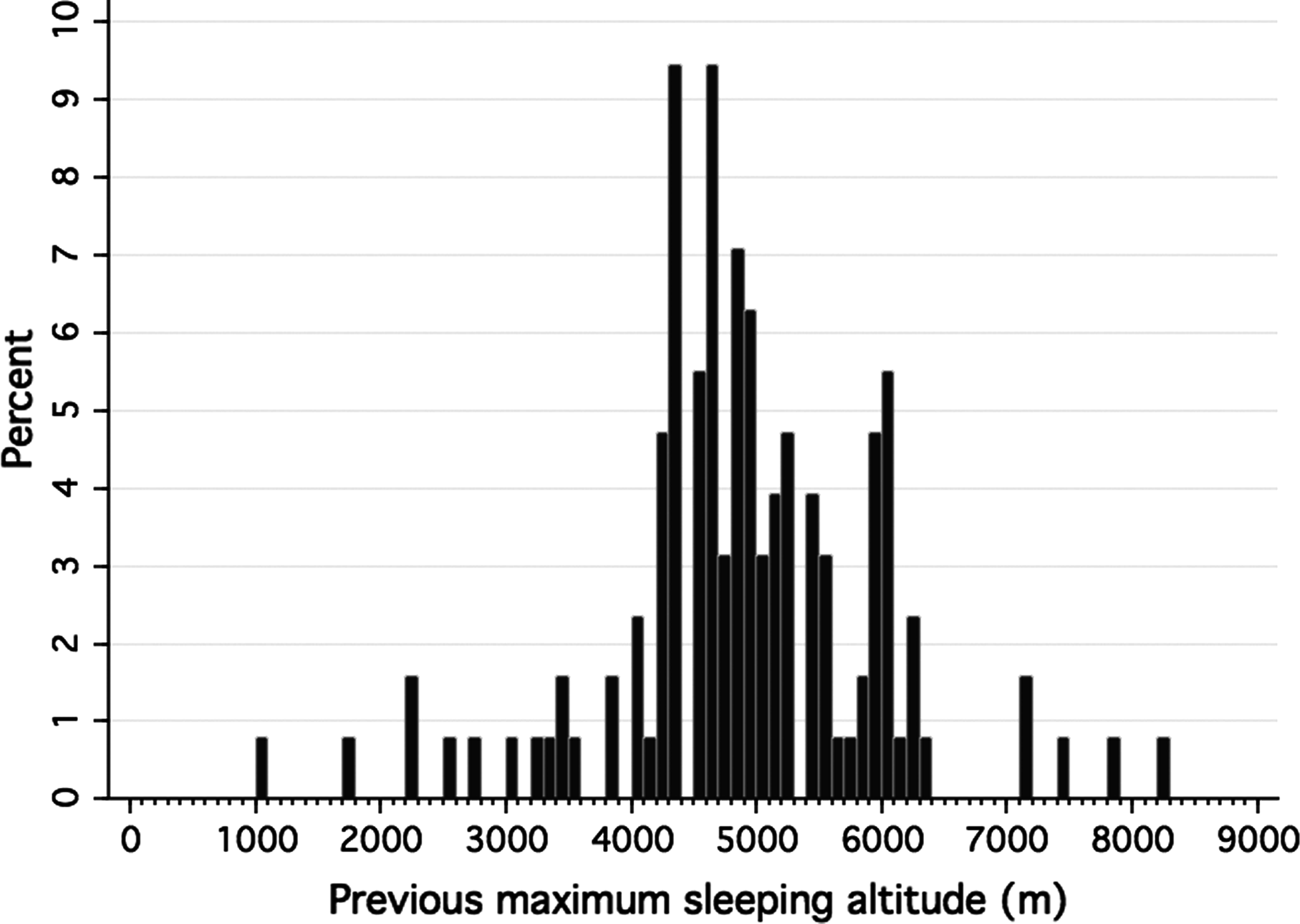
Previous maximum sleeping altitude reached (m) among all climbers prior to attempting to summit Aconcagua.
Discussion
This study is the first detailed analysis of previous high altitude experience among climbers attempting to summit Aconcagua. Many of these mountaineers have not ever previously been to altitudes within 1000 m of the summit, ever slept at altitudes within 1000 m of the highest camps, nor performed acclimatization treks in the months preceeding their summit attempt. Expedition companies advertise an Aconcagua summit attempt as a nontechnical climb of one of the seven summits requiring little experience, and our data suggest there are indeed a substantial number of inexperienced mountaineers attempting this dangerous 6962 m peak.
Of climbers with prior high altitude exposure, the most common previous maximum altitude reached was 5800–5900 m, by 13.4% of participants. Stratifying our data by the climber's continent of origin provides some insight into where they may have gained their past exposure to altitude. Climbers from Europe and North America do not live in close proximity to many peaks over 5000 m on which to gain experience prior to attempting Aconcagua. Figure 2a shows a leptokurtic distribution with a peak frequency near 5900 m. One could speculate that this blip in our histogram may correspond to Kilimanjaro [5895 m (19,341 ft)]. The highest freestanding mountain in the world, Kilimanjaro sees more than 30,000 people attempt its summit annually (Davies et al., 2009; Karinen et al., 2008). Aconcagua and Kilimanjaro are unique among the seven summits in that they are both generally advertised as being suitable for beginning mountaineers possessing only a minimum of technical climbing experince or skill. Foreign mountaineers traveling to Argentina with the goal of climbing the seven summits may use Kilimanjaro as a stepping stone prior to attempting Aconcagua. A similar progression has been suggested by Wiseman regarding Aconcagua and Everest (Wiseman et al, 2006). Climbers attempting Aconcagua have significantly more high altitude experience than those attempting Kilimanjaro, where many have never been above 3000 m nor done aaclimatization treks prior to their summit attempts (Karinen et al, 2008; Kalson et al., 2009; Jackson et al., 2010). Aconcagua, however, is not only over 1000 m higher than Kilimanjaro but experiences much more severe weather and more limited (nonmandatory) portering services. In contrast to their counterparts from the northern hemisphere, many South American climbers live in close proximity to the more than one hundred 6000 m peaks and well over eight hundred 5000 m peaks that exist in South America (Biggar, 2005). In Argentina, for example, the Cordón del Plata range lies between the city of Mendoza and Aconcagua and contains many peaks in the 4000–6000 m range. The histogram of previous maximum altitude reached among South American climbers attempting Aconcagua (Fig. 2b) exhibits much less kurtosis and more closely approaches normality than Figure 2a. Considered in light of this geographical proximity, the data depicted in Figure 2b support the observation that South American climbers likely obtain prior altitude experience on peaks in their own nations prior to attempting Aconcagua.
Inexperienced climbers typically use the Ruta Normal on the Northwest side of Aconcagua and may encounter situations in which they need help. Some support systems are already in place or have been recently added. Medical personnel are currently stationed at Confluencia (3415 m) and Plaza de Mulas base camp (4365 m) to perform screening exams. Limited weather forecasts are intermittently available at Plaza de Mulas via the park service and/or private guiding companies. An emergency VHF radio frequency (142.800 MHz) is monitored by park rangers and search and rescue personnel. In 2010, comprehensive emergency rescue caches were donated by “El Fede” Campanini Foundation (2011) and placed at Nido de Condores (5350 m), Refugio Independencia (6370 m), and la Canaleta (6660 m). In 2011, Refugio Elena was established at 6000 m in the event a climber would need to emergently bivouac due to inclement weather or high-altitude illness. As a last resort, helicopter evacuation has existed for many years and is provided as part of the entrance fee to the park. However, because visibility often limits flights to Nido de Condores, and a climber's rapidly deteriorating condition may preclude an ambulatory descent to Plaza de Mulas, this should not be relied upon. The local high altitude medicine infrastructure has also been growing recently. Centro de Investigación en Medicina de Altura (CIMA) de Aconcagua (2011) is an international research consortium established in 2010 to gather scientific data that may be used to improve safety. Asociación Andina de Medicina para la Altura (AAMPA; 2011) was established in 2010 and has been instrumental in organizing wilderness medicine lectures for physicians in Mendoza who volunteer on the mountain. However, further opportunity for improvement remains. First, preventative services, such as mandatory pre-registration, publication of the mountaineering booklet in languages other than Spanish and English, ranger-led group orientation and education sessions, and certification of guide services are in place at Denali and are worth investigating on Aconcagua (Denali Mountaineering Staff and Medical Advisors, 2005). Second, protecting the cleanliness of water supplies remains a priority. A single waste alleviation and gelling (WAG) bag is included in the permit fee for a multi-week trek. Mandatory use of multiple WAG bags or “Clean Mountain Cans” such as those used on Denali would better protect the water supply and may decrease gastrointestinal illness among climbers (Denali Mountaineering Staff and Medical Advisors, 2005). Third, consistent public posting of the best available 5-day forecasts at the ranger station at Nido de Condores may potentially limit ill-fated summit attempts from the high camps. Fourth, standardization of search and rescue protocols and simulated search and rescue scenarios are needed to prepare rangers, medics, and physicians adequately. Fifth, adoption of an event alert system, similar to that used by marathons, may facilitate mass communication to climbers, especially in inclement weather or during a search and rescue operation (Chiampas and Jaworski, 2009; McCarthy et al., 2011). Finally, most morbidity and mortality on the mountain occurs at the higher camps. Establishing medical personnel at Nido de Condores may lessen this burden and is a priority of AAMPA (2011).
Conclusion
Information regarding previous high altitude experience of climbers attempting the seven summits is sparse, particularly with regard to Aconcagua. In this cohort of 127 mountaineers, 7.1% had never been above 4000 m in their lifetimes and 12.6% had never slept at an altitude of greater than 4000 m previously. North American and European climbers may use Kilimanjaro to gain high altitude experience prior to attempting Aconcagua, but South American climbers likely do not. Identification of the relative inexperience of a substantial subset of climbers on Aconcagua may be a useful first step to park rangers and physicians. Here we have outlined practical future steps to enhance systems in place on the mountain that will better protect these inexperienced climbers.
Footnotes
Acknowledgments
The authors wish to thank Heber Orona, Roel Quique Apolinario Villafán, and the staff of Aconcagua Trek for their expedition support; the base camp physicians and park rangers of Aconcagua Provincial Park for their time, equipment, and cooperation; Marisa Chumil and Silvia Palmerin for their Spanish translations; François Blumenfeld and Eliana Vagalau for their French translations; Kristina Ogilvie and Misha Kovacevic for their German translations; and James Harris of Orbital Technologies Corporation for constructing the drop-boxes.
Author Disclosure Statement
The authors have no conflicts of interest or financial ties to disclose.